


 DaaS
DaaS
What Are Agentic Workflows (And Why Businesses and Agencies Are Leaning In)
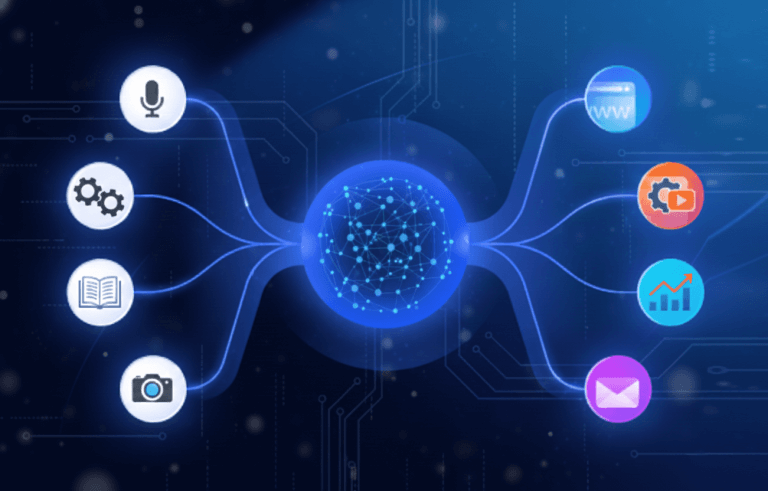
Businesses don’t just need chatbots. They need agents.
There’s a difference. Chatbots are reactive. They respond to questions in the moment.
Agents are proactive. They execute tasks, monitor changes, and make decisions over time. More importantly, they can be role-defined, context-aware, and autonomous.
Here’s the shift:
| Chatbot | AI Agent | |
| Function | Answers questions | Executes tasks and makes decisions |
| Context | Short-term memory | Maintains long-term goals and state |
| Action | Generates summaries | Pulls data, triggers workflows, and collaborates with other agents |
| Autonomy | User-driven | Self-directed, can schedule, alert, and act without prompting |
| Example | “Show me competitor traffic.” | “Monitor competitors and alert me when traffic spikes above baseline.” |
What are agentic workflows?
Lets take this a step further.
Agenting workflows or networks are systems of connected AI agents that work together toward a shared goal. Each agent has a defined role: one collects data, another interprets it, and another creates a report.
The real power begins here. In fact, recent data shows that 23% of organisations are already scaling agent-like systems, and another 39 % are testing them.
Imagine a workflow where a:
- Search Trends Agent pulls external demand shifts.
- Competitive Intelligence Agent tracks site traffic and engagement from Similarweb.
- Social Listening Agent adds sentiment data from third-party sources.
- Report Writer Agent compiles the results into an executive summary.
But in practice, getting those sources to work together has always been the hard part. Every platform structures data differently, and every API has its limits.
Stitching them into a single, coherent workflow requires time, custom code, and ongoing maintenance.
Many businesses are facing this challenge because it aligns with their existing work processes. They build processes. They manage multiple brands. They deal with high volumes of repeatable analysis. Agentic workflows are a way to scale that, without scaling headcount.
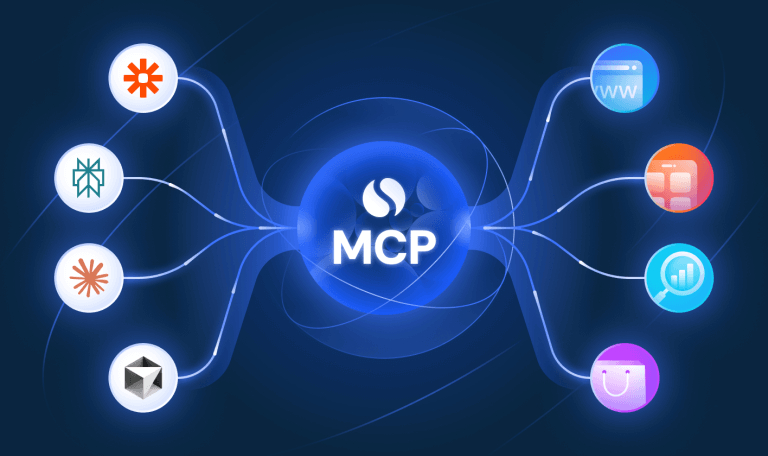
And the Similarweb MCP (Model Context Protocol) server is what connects the dots.
Why Similarweb is a design partner, not just a data source
There’s a fundamental shift brought about by the growing complexity of integrating multiple data sources into coherent agentic workflows and systems. Teams need help designing how those sources interact, complement each other, and produce consistent outcomes.
This is where MCP becomes more than an integration and more of a collaboration layer.
It’s why businesses are now focused less on the question, “What metrics can you provide?” and more on, “What should our agents do with this data?”
Designing workflows and delivering data
MCP is built for this shift. It allows agencies to embed Similarweb insights into the logic of their AI workflows. The focus is on both building tools that report data and creating systems that drive action.
That changes the conversation entirely. Agencies are designing agents that continuously monitor shifts, run analyses, and generate outputs without requiring human intervention.
Similarweb becomes part of the workflow, not a separate step.
If you’re building an agentic workflow. Then you’re looking for input on where digital behavior matters most, what signals to track, and how to define meaningful outcomes.
These are design-level decisions, and Similarweb can help shape them from the inside out.
Governance isn’t optional anymore
As agentic systems scale across teams and clients, consistency becomes a strategic requirement. So you want systems you can trust, where logic and data aren’t dependent on the quality of someone’s prompt.
MCP gives them that control. It enables teams to:
- Pre-instruct agents on how to analyze or interpret data
- Define which data sources are used, and when
- Apply permissions or guardrails to ensure compliant outputs
This is how agencies ensure their agentic systems remain reliable, scalable, and safe.
Orchestrating workflows of intelligence
If there’s one early misstep we’ve spotted businesses making with our tech, it’s building a single “Similarweb agent” that answers traffic questions. Sure, it may work, it may be useful, but it barely scratches the surface of what you can do.
The real opportunity is orchestration.
We’ve seen a trend to deploy workflows of agents, each with a defined role: one monitors competitors, another tracks keyword trends, and another generates weekly summaries. These agents collaborate and exchange insights while operating autonomously.
In this model, Similarweb connects the system, linking agents, data, and outcomes through its MCP server.
What agentic workflows look like in the real world
The shift from dashboards to intelligent workflows is happening now, across teams deploying Similarweb MCP in real-world environments.
From manual effort to autonomous systems
One company, for example, had spent six months manually building a composite scorecard to benchmark brand performance. The project was delayed, resource-intensive, and difficult to scale.
Once they adopted Similarweb’s MCP with Claude, that same process was automated in a single day. The agent pulled the right metrics, applied custom weightings, and generated an executive-ready summary, instantly.
Another used MCP to build a monthly performance dashboard that tracks SERP performance, Gen AI traffic, and keyword trends.
In some cases, teams even use Similarweb’s data for AI training, feeding Similarweb insights into foundation models to improve how agents understand market trends or digital behavior.
This used to take hours each month across multiple platforms. Now, one conversational prompt triggers a full report, custom-branded, insight-rich, and delivered in minutes.
Faster answers, broader adoption, easy access to data
Then there’s the company that embedded Similarweb into its internal chatbot. Now, any team member can access insights via natural language without leaving their existing tools.
The result? Faster answers, broader adoption, and more intelligent client conversations.
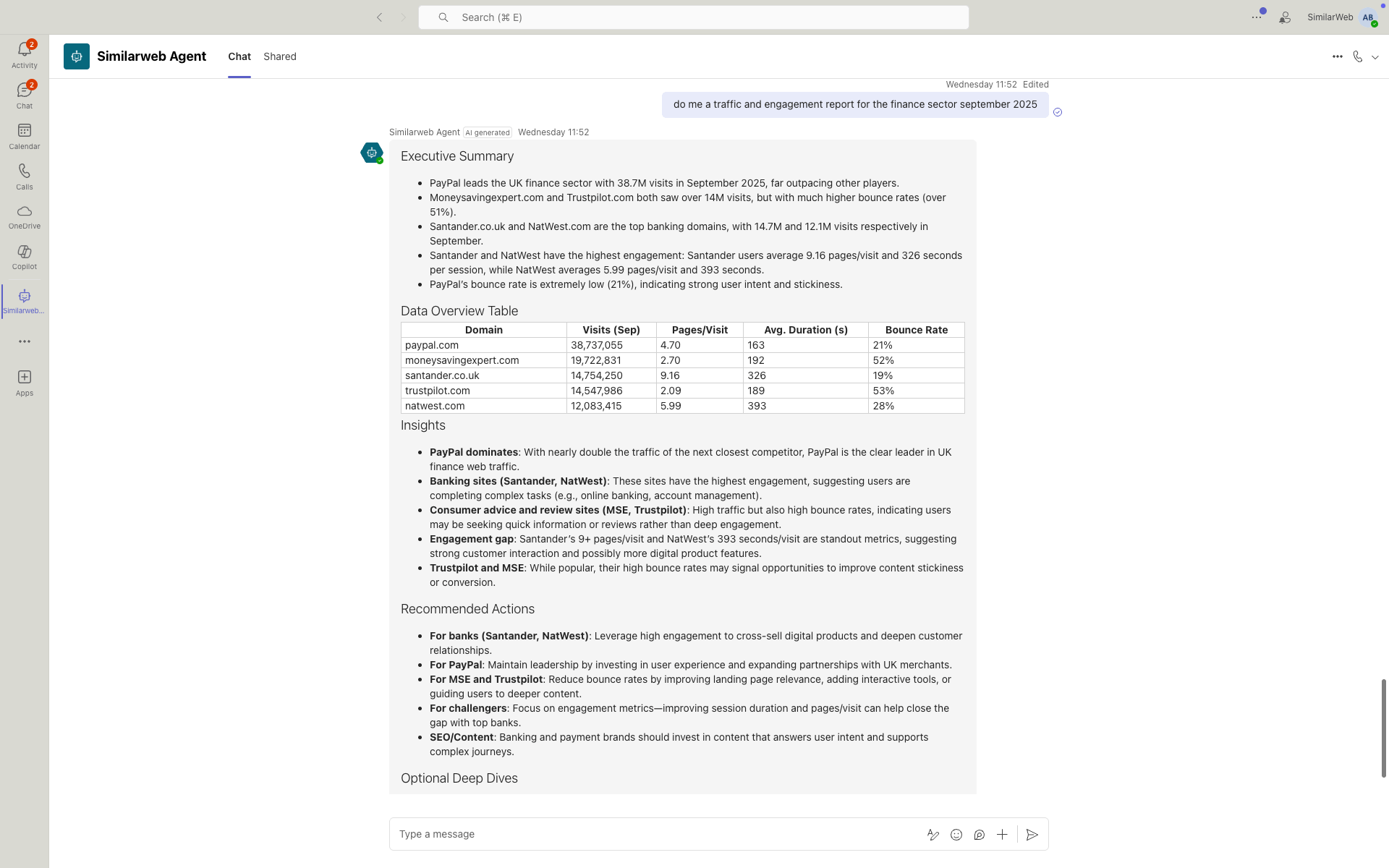
What unites these examples is structure, as well as speed and automation. Each one shows how MCP allows Similarweb data to play a defined role within a broader agentic network.
These systems are quickly becoming AI teammates – agents that don’t just deliver data but actively collaborate with human teams to drive insights and action, supporting everything from reporting to strategic insight to action triggers.
This is the future of agentic intelligence: not just surfacing information, but orchestrating it across roles, clients, and systems.
FAQs
How are agentic workflows different from AI automation tools?
Traditional automation tools follow fixed rules and workflows. Agentic workflows, by contrast, use AI agents that can reason, make contextual decisions, and adapt based on changing inputs. They combine automation with intelligence, making them useful for complex, evolving tasks like market monitoring or insight generation.
What types of business workflows benefit most from agentic workflows?
Agentic workflows are especially effective in workflows that involve repetitive analysis, multi-source data integration, or ongoing monitoring, such as competitive intelligence, market research, brand tracking, or campaign reporting. They reduce manual effort while improving consistency and response time.
How does Similarweb’s MCP fit into an agentic network?
MCP acts as a coordination layer that connects Similarweb’s data with AI systems. It helps agents access metrics, interpret them in context, and trigger actions without manual setup. This allows organizations to move from using Similarweb as a reporting tool to embedding it directly into their operational logic.
Can agentic workflows use multiple data providers?
Yes. A robust agentic network can integrate insights from different sources, such as Similarweb data, CRM systems, and social listening platforms, to create a unified understanding of performance and behavior. MCP supports this by standardizing how agents access and use those data streams.
What role does governance play in agentic workflows?
Governance ensures that AI agents use data responsibly and consistently. It defines which sources are trusted, how data should be interpreted, and what actions agents are allowed to take. MCP gives organizations a way to set these rules clearly, improving both compliance and output quality.

Related Posts

Bring Digital Intelligence Into Your Daily Workflows with the Similarweb Google Sheets Integration

Maximize your growth potential
Harness the power of data with Similarweb’s APIs to drive smarter business decisions