
Where the Olympics News Drove the Most News Traffic
by David F. Carr4 Min.
Aug 14, 2024
 Insights
The streaming industry has experienced exponential growth in recent years, with an influx of companies vying for consumers’ attention in an increasingly crowded market. As new players emerge and challenge Netflix’s dominance, the competition has become fierce, with the focus shifting to critical battlegrounds such as pricing strategy, affordability, and innovative exclusive content offerings that can attract and retain viewers.
In a macroeconomic environment where companies are prioritizing profitability and budget-strapped consumers are coping with less discretionary dollars, companies like Netflix are looking to combat both with changes like their new ad-supported tier and password-sharing limitations.
In this report, we analyze the digital market share of the industry’s top streaming platforms, including Netflix, Hulu, Disney+, YouTube TV, Peacock TV, Paramount+, and HBO Max.
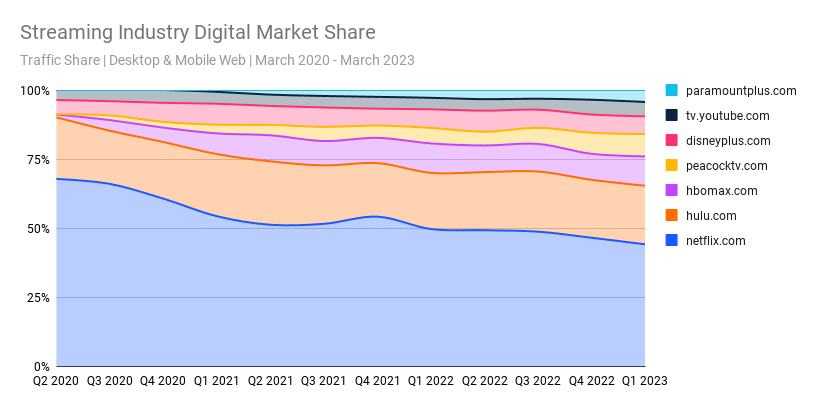
Netflix’s decline in US market share has continued in 2023, dropping to 44.21% in Q1, down 6% YoY. While it is still the largest player in the market, it’s a clear indication that the streaming landscape is becoming increasingly competitive. It will be interesting to see if Netflix can reverse this trend with changes to its business model via its lower-priced ad-tier and password-sharing limitations, or if it will continue to lose ground to other streaming services.
Meanwhile, HBOMax and PeacockTV both continue to grow in March 2023, with market shares of 10.31% and 8.08%, respectively. It seems that these relatively newer entrants to the market are successfully gaining traction and attracting subscribers.
Note that these figures only represent website traffic and may not fully reflect the overall market share of these streaming services, as many users access these platforms through their respective apps on various devices. Nonetheless, this data provides insight into popularity and growth trends.
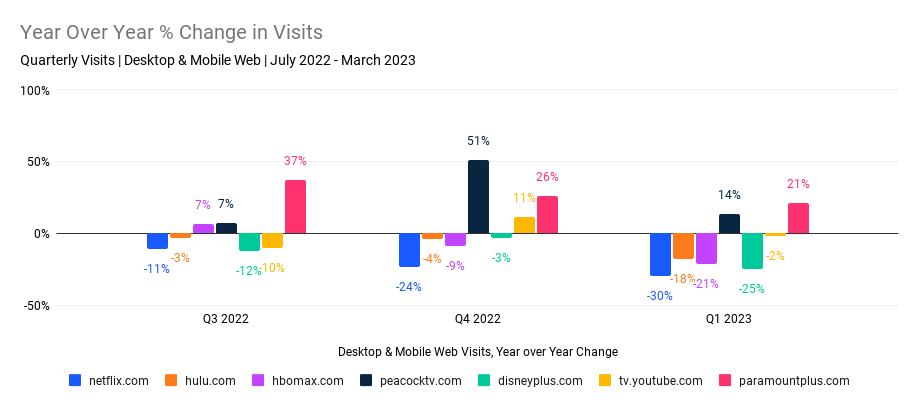
Netflix, Hulu, and Disney+ all experienced a decline in quarterly visits from Q1 2022 to Q1 2023, with Netflix seeing the largest decline at -29.8%. In contrast, Peacock TV and Paramount Plus saw growth in quarterly visits during the same period, with Paramount Plus having the highest growth rate at 21.46%. HBO Max and TV YouTube saw a mix of growth and decline over the same period.
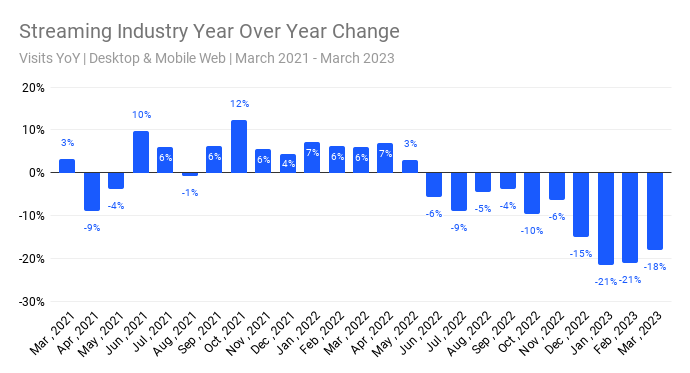
The industry trend (based on the top 10 streaming platforms in our analysis) shows a decline in the streaming industry from June 2022 to March 2023, with year-over-year percentage changes consistently in the negative. The data indicates that the decline has accelerated in the past few months, with the percentage change dropping sharply from -9.68% in October 2022 to -21.13% in February 2023, and -18.06% in March 2023.
The overarching trend shows that Netflix continues to lose market share, while the other major streaming services, including Hulu, Disney+, and TV YouTube, have remained relatively stable. Meanwhile, HBO Max, Peacock TV, and Paramount Plus have seen growth in market share over the past few quarters and have proven to be the next big companies to look out for. Most importantly, stay tuned as we look to follow the HBO Max and Discovery+ merger coming up this spring.
Publicly traded or owned companies mentioned in this report include Netflix (NFLX:NASDAQ), HBO Max (NASDAQ:WBD), Paramount Global (NASDAQ:PARA), Disney+ (NASDAQ:DSNY), Peacock TV (CMCSA:NASDAQ), Youtube TV (GOOGL:NASDAQ)
The Similarweb Insights & Communications team is available to pull additional or updated data on request for the news media (journalists are invited to write to press@similarweb.com). When citing our data, please reference Similarweb as the source and link back to the most relevant blog post or similarweb.com/blog/insights/.
Contact: For more information, please write to press@similarweb.com.
Report By: Sneha Pandey, Insights Manager
Disclaimer: All names, brands, trademarks, and registered trademarks are the property of their respective owners. The data, reports, and other materials provided or made available by Similarweb consist of or include estimated metrics and digital insights generated by Similarweb using its proprietary algorithms, based on information collected by Similarweb from multiple sources using its advanced data methodologies. Similarweb shall not be responsible for the accuracy of such data, reports, and materials and shall have no liability for any decision by any third party based in whole or in part on such data, reports, and materials.

by Sneha Pandey
Insights Manager
Sneha, a Purdue graduate, delivers data-driven insights on Retail, eCommerce, Politics, CPG, and B2B Software, helping Fortune 50 companies succeed.
Give it a try or talk to our insights team — don’t worry, it’s free!