


 Insights
Stepping Into the Conversation: Insights From Our 2025 GenAI Landscape Report

The numbers tell the story so far in 2025: web visits to generative AI platforms and app downloads have jumped 76% and +319% respectively.
People have officially gone beyond experimenting with AI.
Now, they’re using it on a daily basis in their everyday lives. Web sessions are longer, prompts are becoming richer, and the prompt intent itself is deeper.
In fact, you could say that Gen AI has changed the machinery of online discovery. Once, people used to search. Instead of a few words tossed into a search bar, people are sharing full thoughts, tasks, and goals. And they are working out how to do this better as time goes on.
All of this was revealed in our report, 2025 Generative AI Landscape: From Platforms to Pathways. Here we’ll give you some immediate takeaways of how people are using Gen AI.
Going from questions to conversations
Let’s take this thought further.
The average Google search is just three or four words long. A ChatGPT prompt? Around 60.
That says everything. Whereas search is about typing in the right words. Now it’s about getting the right context.
In the old days, people would drop keywords into a box and hope for relevance. If that didn’t get it right? Then they would put in new keywords.
Now, they’re writing full thoughts, adding details, preferences, and even tone. “Write a polite email asking for a refund.” “Explain this in a way a 10-year-old would understand.” AI can interpret as well as receive, and this alone is changing user behavior.
“AI sessions are more conversational and personalized than traditional search. ChatGPT prompts average 60 words, which are far longer than Google’s 3.4, reflecting how users add context and preferences for tailored responses.”
2025 Generative AI Landscape: From Platforms to Pathways
In other words, each session moves in a non-linear way as people explore new angles. As opposed to travelling in a straight line.
The more users adjust their prompts, the better the system gets at mirroring their intent. On one level, it’s dialogue. But on another, Gen AI is teaching people to think differently about how they request information.
So what are people asking Gen AI?
To recap, once people get comfortable talking to AI, their requests and conversations tend to evolve.
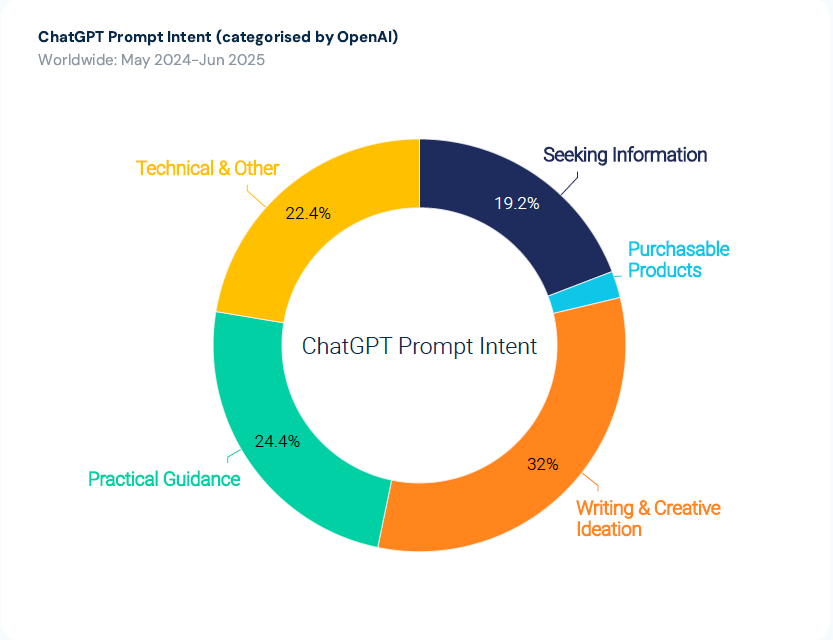
Source: OpenAI
At first, it’s curiosity: “What’s the capital of Latvia?” or “Summarize this text for me.” But quickly, the questions grow broader and bolder.
The Gen AI Landscape Report shows how prompts now span every type of human intent. People are turning to AI for ideas, guidance, writing code, solving math, and planning workouts.
People turn to AI for:
- Ideas – brainstorming blog titles, ad copy, or video scripts.
- Guidance – writing code, solving math, or planning workouts.
- Practical help – rewriting emails, comparing tools, or crafting resumes.
- Information – fact-checking or explaining complex topics simply.
Each use case shows how users are moving from searching for answers to shaping them.
ChatGPT often leads these creative and exploratory sessions, while Google’s AI mode serves as a quick helper, synthesizing facts quickly. Many people still use both ChatGPT and Google. One for depth. One for direction.
And then there are transactional prompts, like product comparisons or purchase decisions. These are rising but still rare. That’s the next frontier. It’s when intent meets action, and AI becomes the bridge.
A good example of this is Buy it in ChatGPT. Its Instant Checkout feature supports single-item purchases. It utilizes the Agentic Commerce Protocol, built on Stripe. Plus, the tech is open source, so any store can build an integration.
Trust and citations: the new path to visibility
When people talk to AI, they see an answer rather than a list of links. But those answers still have to come from somewhere.
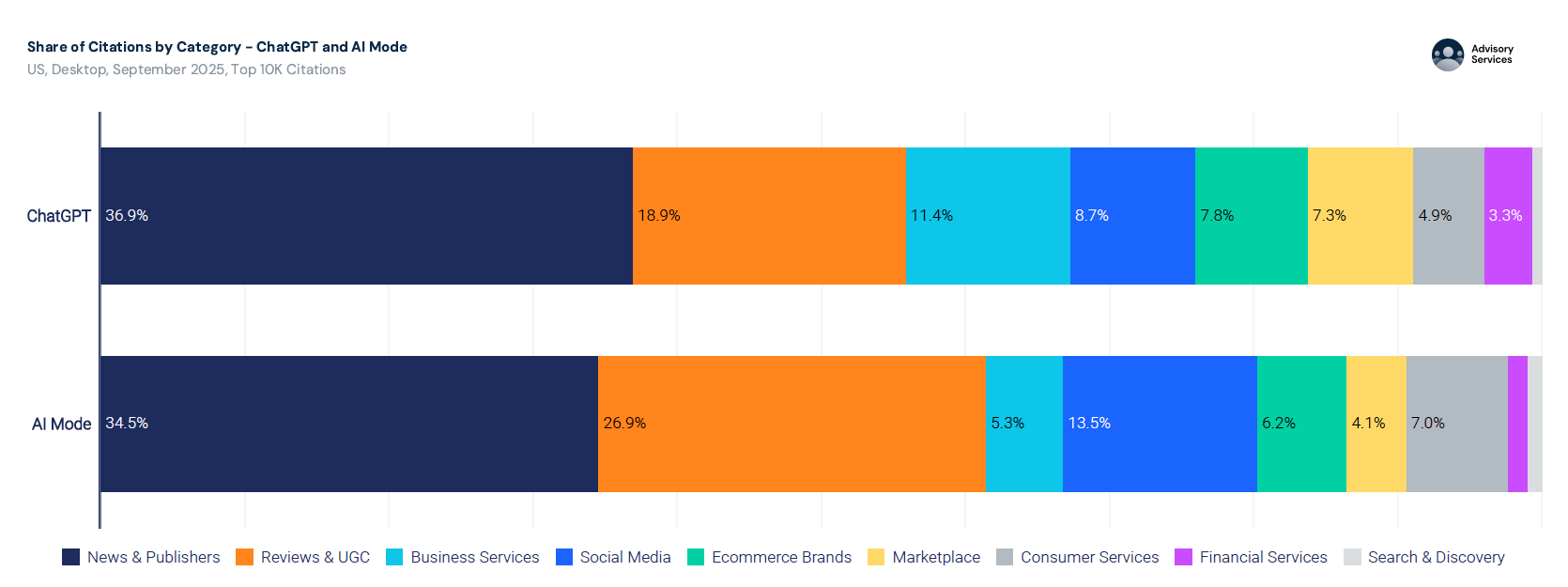
Generative AI tools like ChatGPT and Google’s AI Mode now act as curators. They pull from news sites, trusted publishers, and community spaces like Reddit. All to craft a single, cohesive response.
Authority looks different in these sessions. It’s about owning the information and being included in the sources that AI trusts. And that shift matters.
People may not click, but they still rely on those references to judge credibility. AI has become a kind of editor in that way. Or in another way, it’s the nightclub doorman who decides what voices get quoted and what ones are left out in the cold.
For brands mentioned in AI, that means one thing: visibility isn’t measured in page rank like it once was. An AI citation analysis will measure these quick mentions, which shape what AI says next.
This takes us to the next point…
It’s less about clicking and more about knowing
If the old web was about clicks, the new web is about confidence.
In traditional search, every result is an open door. Here are ten blue links. Users would look at them and decide which one to use.
Inside AI platforms, the answer arrives fully formed. No click required.
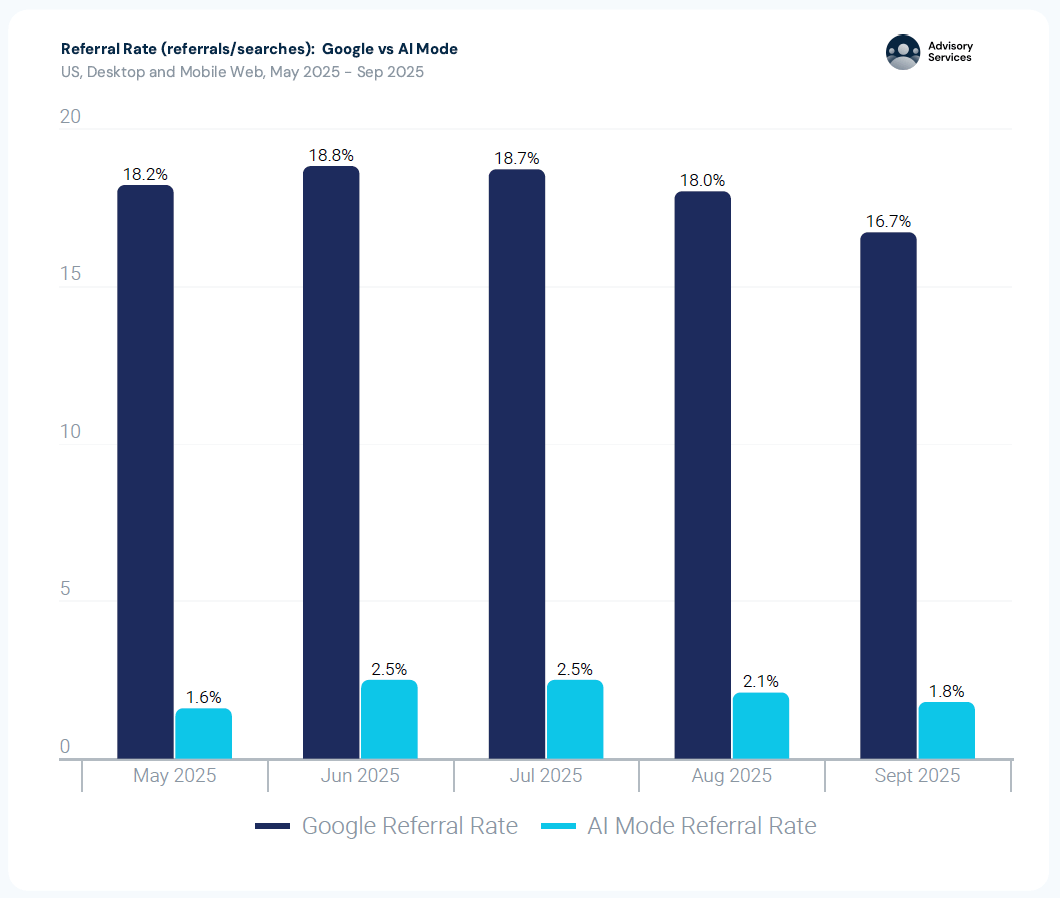
That’s why referral rates from AI are low. Google still sends nearly one in five searches out to other sites. AI Mode sends far fewer.
But here’s the thing:
The visitors who do click through from AI tend to stay longer, explore deeper, and convert more often. So it’s quality over quantity. People are clicking to take action. They arrive ready, informed, and confident because the AI has already filtered the noise.
What does this mean for brands?
The good news? It’s a richer stream of visits. Because each referral carries intent, and that intent is gold.
The lesson is simple, but it’s big: we should view Gen AI as a new way for people to decide, not just another traffic source. Every chat, every citation, every embedded answer influences how they think about a brand before they even visit a site.
What does Gen AI success look like?
It won’t come from chasing clicks and metrics like page impressions.
It will come from earning presence, being cited, trusted, and included in the responses that AI is putting out. The brands that do well will speak clearly, structure their content well, and give AI something meaningful to say about them.
In this new world, visibility means showing up inside the answer, not just showing up in the results and hoping for a click. In our view, Similarweb Gen AI Intelligence is the best way to measure and analyse this. But don’t take our word for it, try it for yourself.

Related Posts


Wondering what Similarweb can do for your business?
Give it a try or talk to our insights team — don’t worry, it’s free!