TikTok Sets a Record and the RedNote Craze Subsides
by David F. Carr3 Min.
Jan 23, 2025
 Insights
Social networks have been proving a less reliable traffic source for news publications in recent years, but Bluesky may prove to be the exception that is winning the love of the news media. Bluesky’s web traffic and app engagement ballooned immediately after the election in the US, making it a suddenly much more significant player – albeit still much smaller than X by every measure.
Just last week, the New York Times added Bluesky to the social sharing widget that appears at the top of its articles, placing the Bluesky butterfly just after Facebook and above X. Meta’s Threads, the other microblogging rival to X, doesn’t appear on the list of social sharing targets at all.

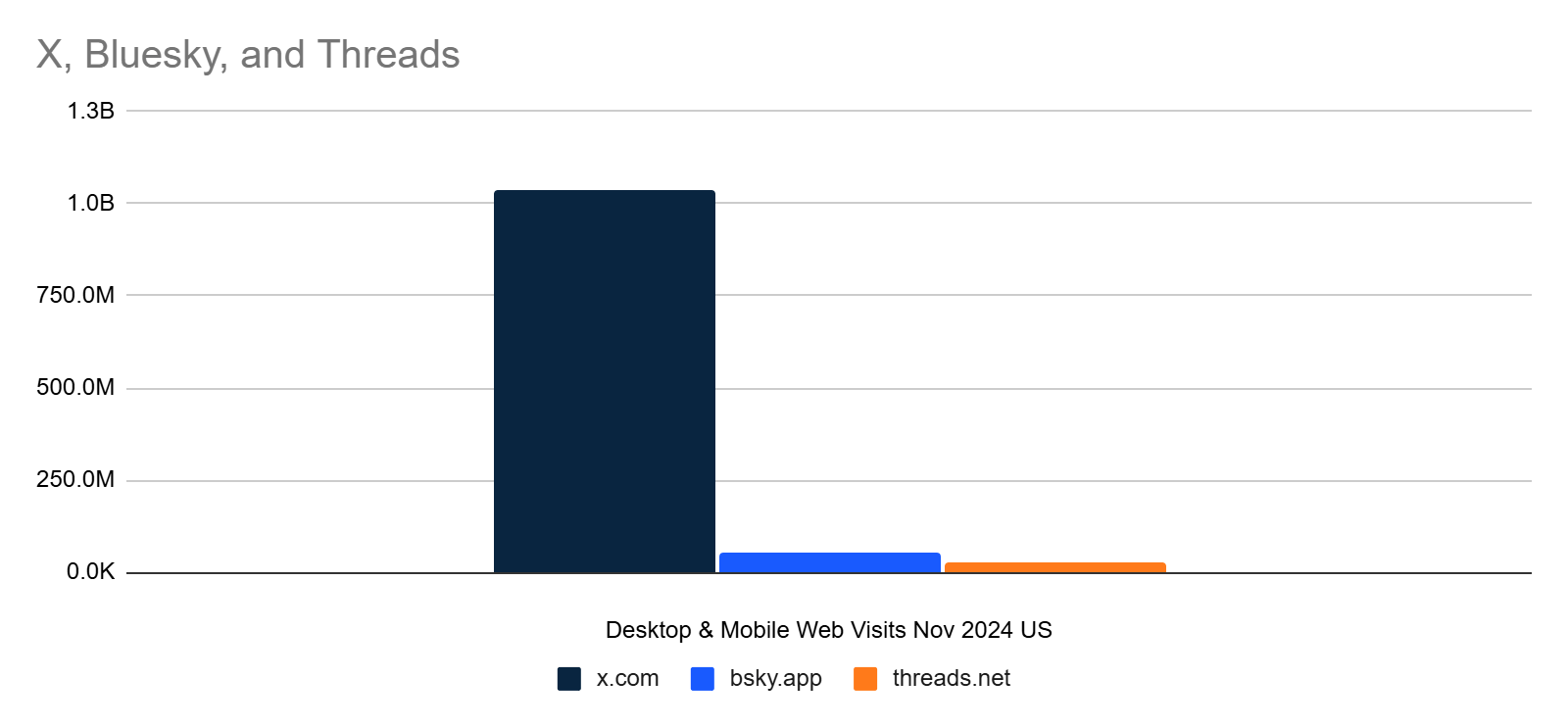
Why give so much attention to a small but growing upstart? Maybe because Bluesky punches above its weight in the volume of traffic it is sending to news sites. For example, x.com commands roughly 33 times more total web traffic than bsky.app, but sent less than double the traffic to nytimes.com in November, according to Similarweb estimates. Threads, which is much smaller than X, but bigger than Bluesky by most measures, is an even weaker news traffic driver.
In different ways, both X and Threads are designed to capture traffic for themselves rather than encourage users to click through to the source of an article, while Bluesky is emphasizing that it wants to work with publishers.
The post-election surge of interest seemed to reflect pent-up demand for an alternative to X from people who didn’t consider Threads a good option. Since then, Meta has introduced a number of changes that look like competitive responses to Bluesky (for example, with its own equivalent to Bluesky Starter Packs of recommended accounts).
Bluesky celebrated the love it has been getting from the news media with a late November blog post, The Engagement Is Better on Bluesky, saying “we welcome publishers, we don’t demote links,” and featuring quotes from digital leaders at The Boston Globe, The Guardian, and The New York Times, each of whom reported seeing surprising large volumes of referrals from Bluesky, even at this early stage of its development.
Here is what the comparison with Threads looks like, according to Similarweb estimates.
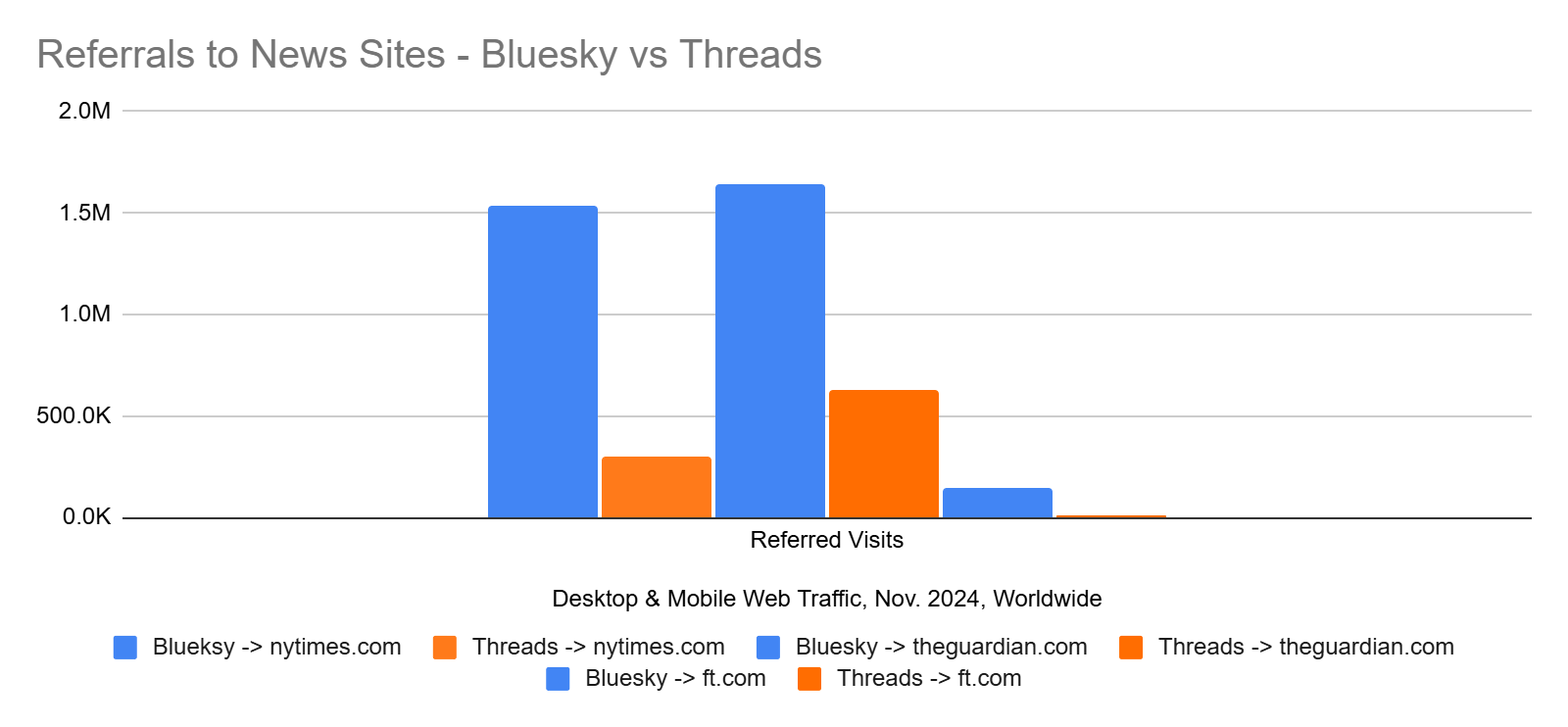
For the Boston Globe, which is not included in the chart, Bluesky generated 53.4K referral visits, compared with 7.9K from Threads.
If we measure Bluesky by its month-over-month growth in the US in November, it looks like a juggernaut. By web traffic, Bluesky’s growth (+189%) might even be coming at the expense of X (-3.6%). On a worldwide basis, traffic to Bluesky was up 75%, while traffic to X was down 2.3%. That traffic to X would be down is surprising, given that its highest traffic days of the year came around the time of the election.
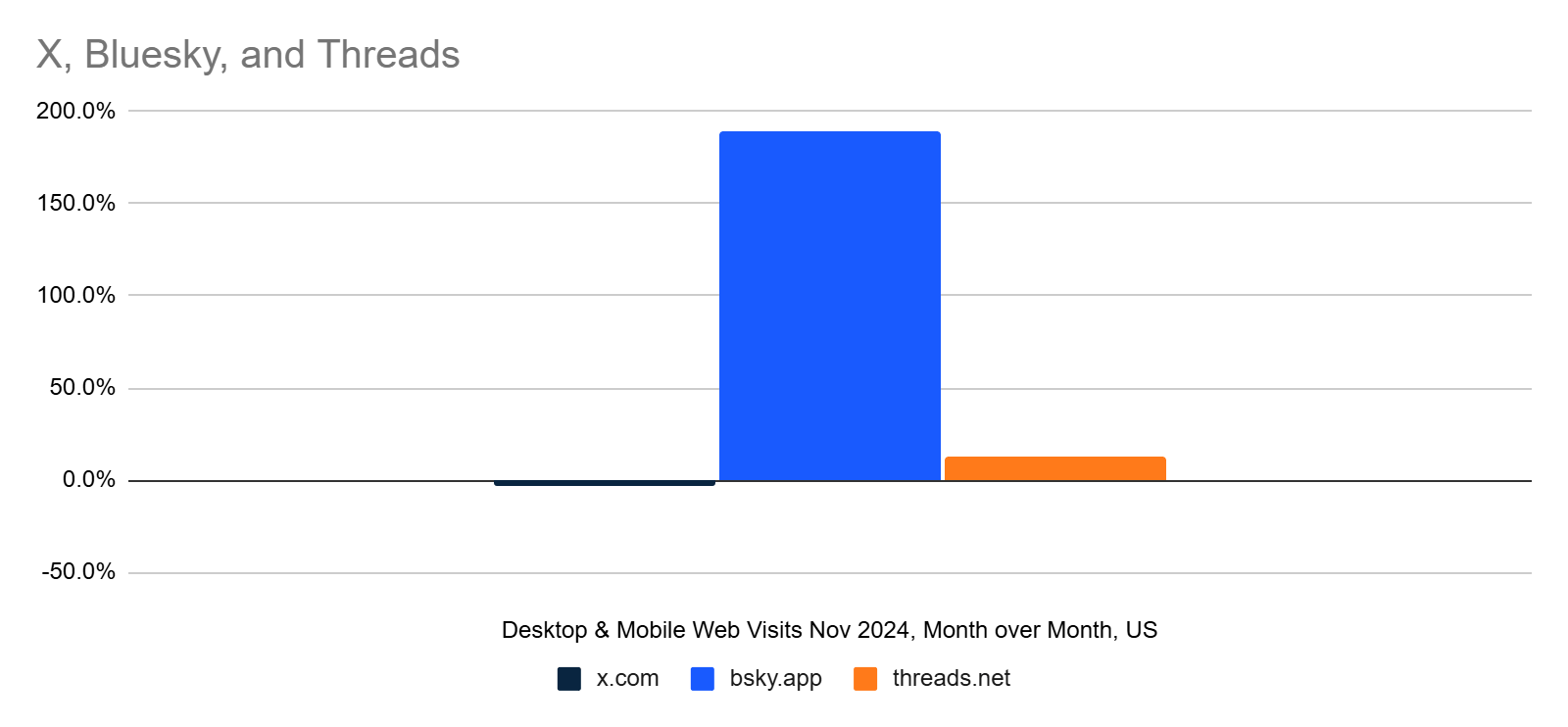
By monthly active users of its iOS and Android apps, Bluesky is up 295.4%, compared with a 2.4% gain for X.
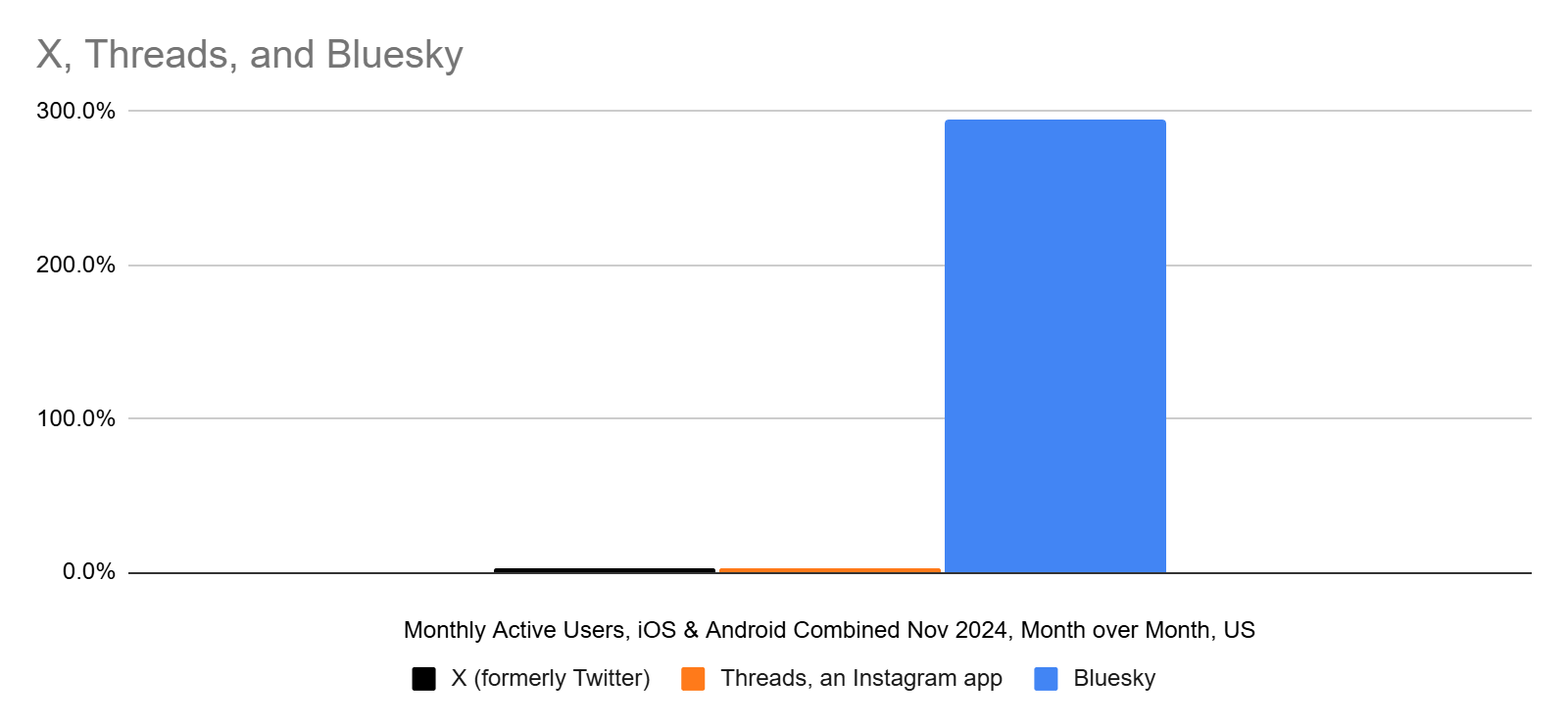
However, Bluesky’s gains are on a much smaller base – reflecting the app’s emergence from obscurity. In the US, bsky.app is ahead of threads.net in web traffic – but still far behind x.com.
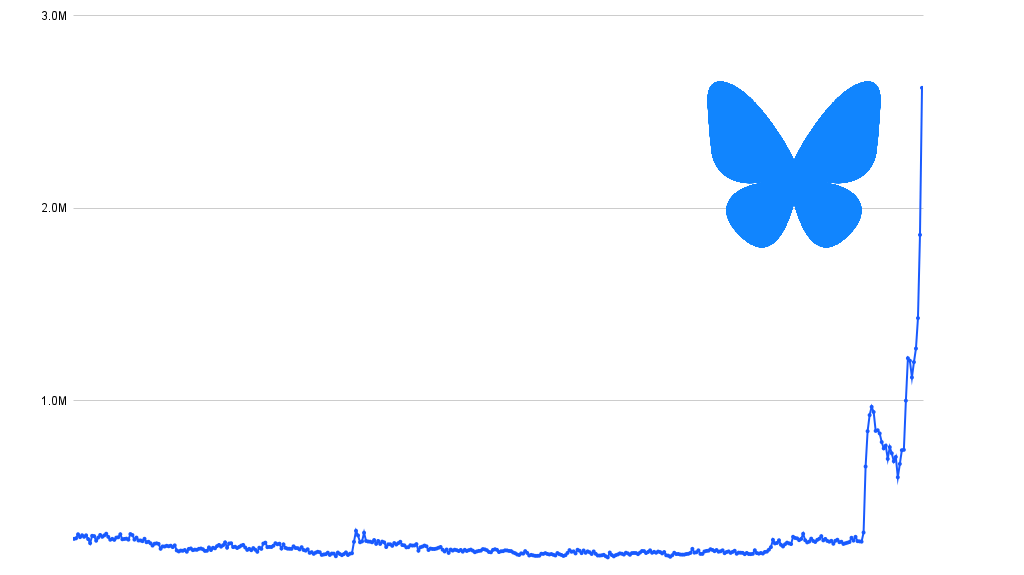
In worldwide traffic, and by app users, Bluesky trails Threads. Still, Bluesky has been closing the gap, as you can see from this chart of daily app usage in the US.
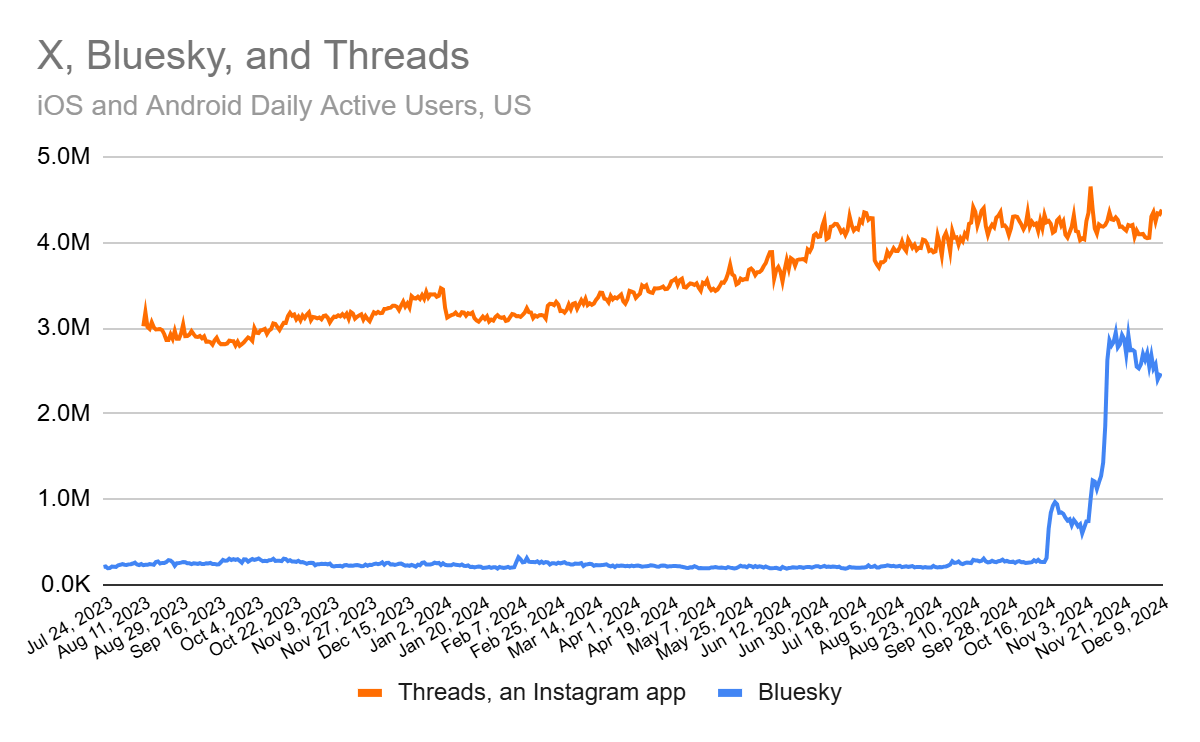
For a few weeks in November, Bluesky looked like it was on a straight ride up to the top of the web traffic rankings. But since mid-November, web traffic and app engagement have both seemed to plateau, suggesting that the next increment of growth may come harder.
On the other hand, if the love story between Bluesky and the media continues, that could fuel further growth in 2025.
The Similarweb Press Office can pull additional or updated data on request for the news media (write to press@similarweb.com). When citing our data, please reference Similarweb as the source and link back to the most relevant blog post or similarweb.com/blog/insights/.
Disclaimer: All names, brands, trademarks, and registered trademarks are the property of their respective owners. The data, reports, and other materials provided or made available by Similarweb consist of or include estimated metrics and digital insights generated by Similarweb using its proprietary algorithms, based on information collected by Similarweb from multiple sources using its advanced data methodologies. Similarweb shall not be responsible for the accuracy of such data, reports, and materials and shall have no liability for any decision made or action taken by any third party based in whole or in part on such data, reports, and materials.

David covers social media, digital advertising, and generative AI. With a background in web trends since the 1990s, he’s also the author of "Social Collaboration for Dummies".
Give it a try or talk to our insights team — don’t worry, it’s free!