





Top Ecommerce Companies in the USA: The 100 Brands Winning the Traffic Race in 2026
by Inbar Eytan6 Min.
Aug 30, 2026
What does media buying mean to you? The answer to that sounds completely different from someone in a marketing agency to a digital marketer in a SaaS company. An affiliate marketer will give you yet another dissonant explanation.
There’s a lot of confusion and unbounded misleading content on the web. People like to write about media buying. It’s popular, and it’s good for generating traffic. So you must be careful who you trust and place every bit of info in the right context.
At Similarweb, we are experts in digital marketing because we have the tool that analyzes it. And we’ve done our homework, speaking directly with media buyers in different industries.
So if you’re confused about what media buying means, you’ve come to the right place. You’ll understand the difference between media planning and media buying, learn how programmatic media buying works, what role it plays in affiliate marketing, and how performance marketing is related. Let’s get started.
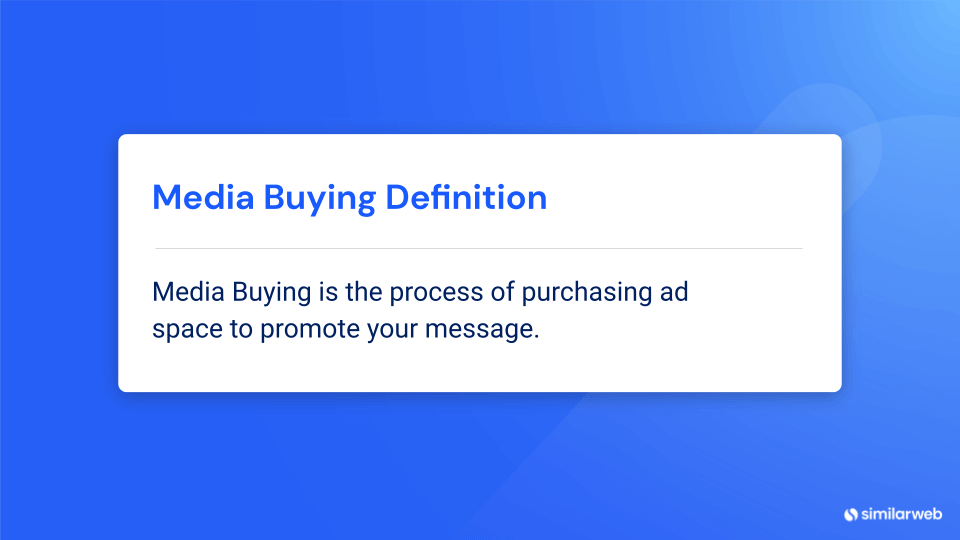
The Cambridge dictionary puts it plain and simple: Media buying is the job of arranging to pay to put advertisements on television, radio, or the internet, or in a newspaper, magazine, etc. Forbes simplifies it even more: Media buying is the process of purchasing ad space to promote your message.
Then why is it so difficult to understand? Here’s the thing: with digital advertising, the landscape is constantly changing, and so are the processes. Moreover, in recent years the concept of affiliate media buying has evolved into an independent sub-type of affiliate marketing. And that is yet another ball game.
So let’s break that down and see what it means.
Traditionally, media buying is part of the media planning process and refers to the actual negotiation. Advertising agencies work according to this concept.
The media planner creates a media plan based on the client’s brief and budget. Together with the client, they finalize all campaign details, including which media to advertise on, for how long, and how much to spend on what.
The media buyer enters the picture only after the planner receives relevant proposals from publishers. They must be excellent negotiators and experts in advertising media cost schemes and calculations.
Technically, media buying refers to the negotiation of the actual deal and doesn’t involve any decision-making or strategizing.
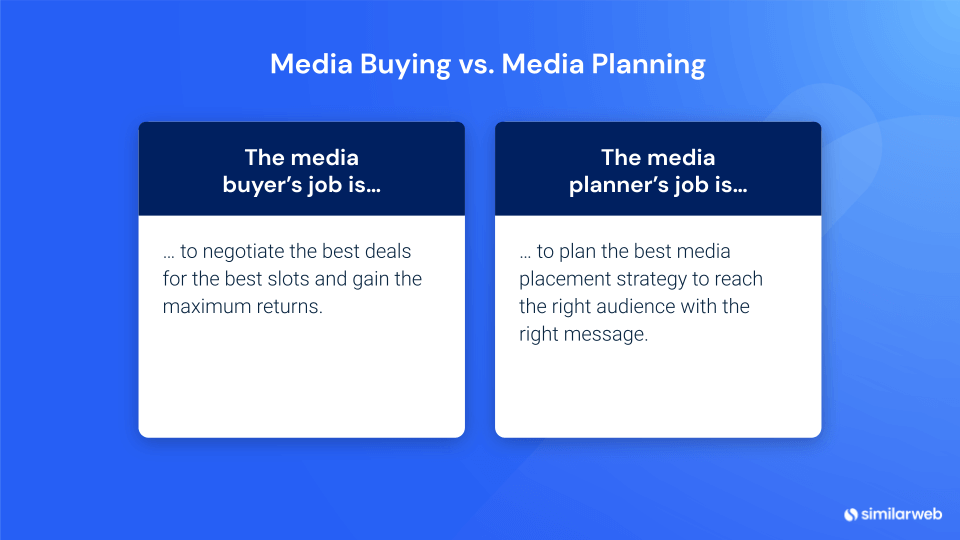
The media buyer’s job is to negotiate the best deals for the best slots and gain the maximum returns.
The media planner’s job is to plan the best media placement strategy to reach the right audience with the right message.
In digital media buying, you purchase digital advertising space or impressions. There are two ways of doing this: direct and programmatic.
The ad seller and the advertising space provider are in direct contact. In other words, the company that wants to run an advertising campaign (or their agent) purchases directly from a website that offers ad space. This could be any site that seeks to generate income from its traffic, such as news sites, blogs, and informational sites.
The advertiser pays the publisher based on the number of impressions an ad receives. Almost all digital media is calculated in CPM, which stands for Cost Per 1000 Impressions. The advertiser pays an agreed amount for every 1000 impressions. If the ad does not get impressions, they don’t pay. The more exposure the ad receives, the higher the cost.
Here’s another term often connected to direct media buying: performance marketing. However, media buying isn’t performance marketing per se, which is usually based on clicks, CPC (cost per click), and sometimes PPC (pay per click).
In direct media buying the parties can sometimes agree on a flat fee. This could be in the form of sponsorship or a homepage takeover, ensuring the ad is shown continuously to all visitors.
Agencies may negotiate special agency fees if they can commit to an agreed volume of work. They can negotiate rates for all their clients with individual media companies based on the quantum. This saves time and resources for all involved parties.
The programmatic model automizes the media buying and ad placement process.
Besides the advertiser and the publisher, there are three additional parties involved.
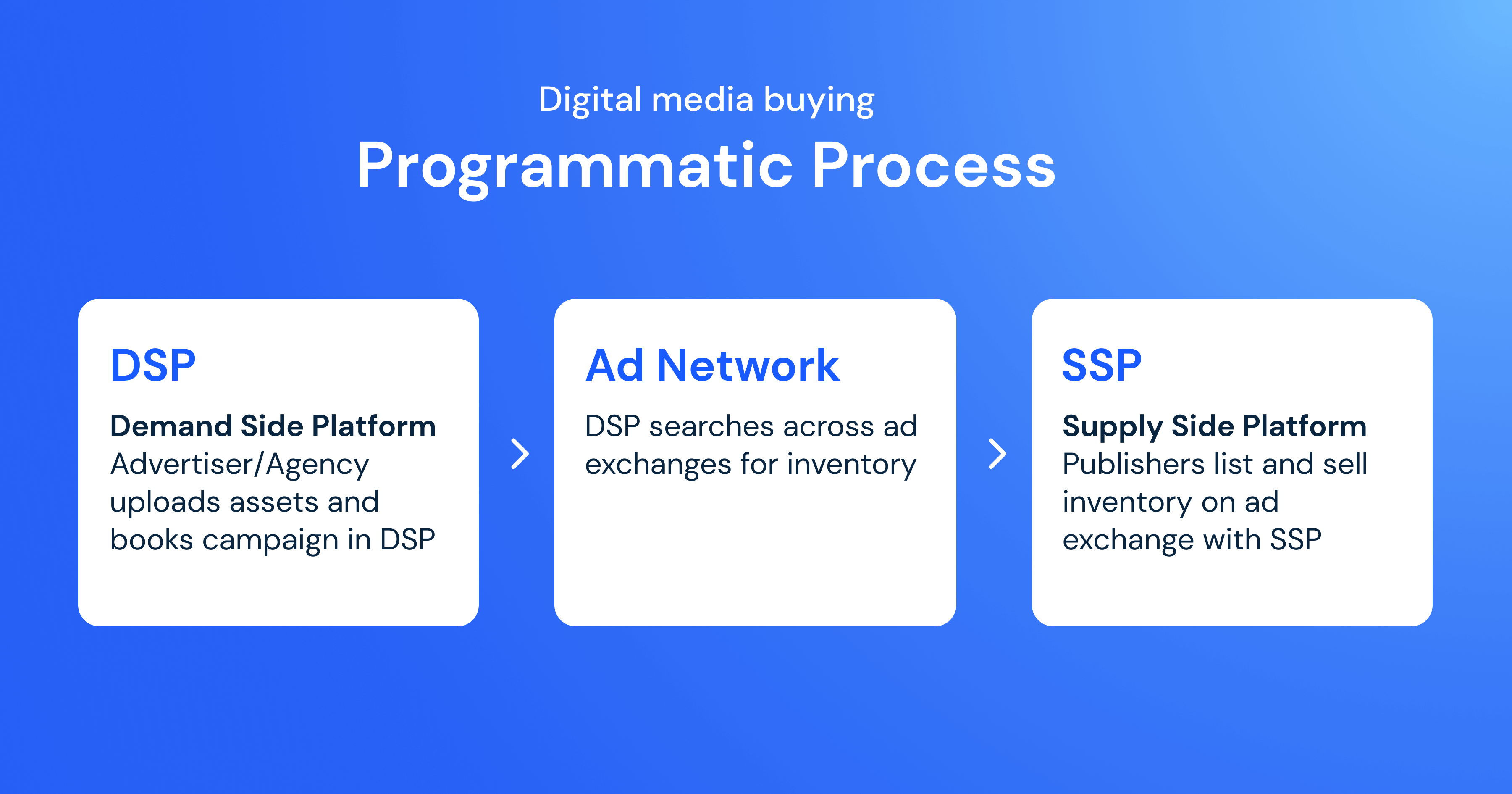
Let’s imagine, you want to run an advertising campaign. You create a campaign plan, calculate a budget, and set KPIs. When your campaign is ready, you upload the assets to the DSP and book a campaign. You specify where and when you’d like your ad to be published and who you’d like to reach. And, of course, you indicate how much you’re willing to pay.
On the other side of the equation is the SSP, where sites and networks offering advertising space place their inventory. The advertising space is also called inventory, and it gets listed on the ad exchange through the SSP.
Connecting the two is the ad network or ad exchange. Here’s where the matchmaking happens. The DSP searches the ad exchange for suitable inventory for your ad. When that’s located, your ad competes against other ads, and the highest bid with the highest relevance wins the ad space.
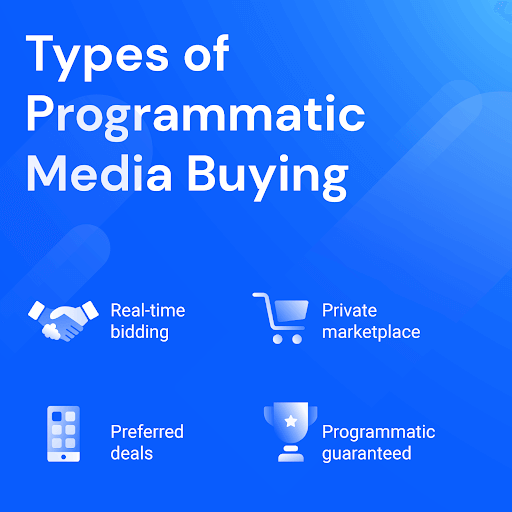
Sometimes the term RTB, which stands for Real-Time-Bidding is used instead of programmatic advertising. However, they are not the same. RTB refers to automated bidding within the media buying process and is part of programmatic advertising.
Now you know the players and the overall flow. Time to dig deeper so you’ll get a glimpse at what a media buyer deals with. In programmatic media buying there are four main bidding types:
Automation doesn’t make the human media buyer obsolete. To succeed in negotiating the best deals that bring the highest ROI or ROAS (return on ad spend), media buyers have much to learn.
A programmatic media buyer needs to know how to use the various types of digital media, from social media to display ads, from PPC to video ads. In most companies, a media buyer’s responsibility will focus on one of the media types. However, each network has its unique rules and methodologies.
Often the programmatic media buyer’s objective is to reach the lowest cost through optimization. At the end of the day, performance is deemed effective if they achieve the lowest cost per click (CPC).
Whether a media buyer works in an agency or client direct, the only way to keep getting the best deals is through monitoring and analyzing website performance data.
Media planners and buyers alike need to evaluate networks and publishers’ activities for their preferences. Media analytics tools monitor ad performance, incoming traffic, and conversions for your campaigns.
With Similarweb Digital Marketing Intelligence, media buyers can also dig into the data of publishers and their competitors.
Here are a few ways media buyers use the Similarweb platform.
1. Similarweb’s Find Publishers tool helps analyze the top-performing publishers used by competitors.
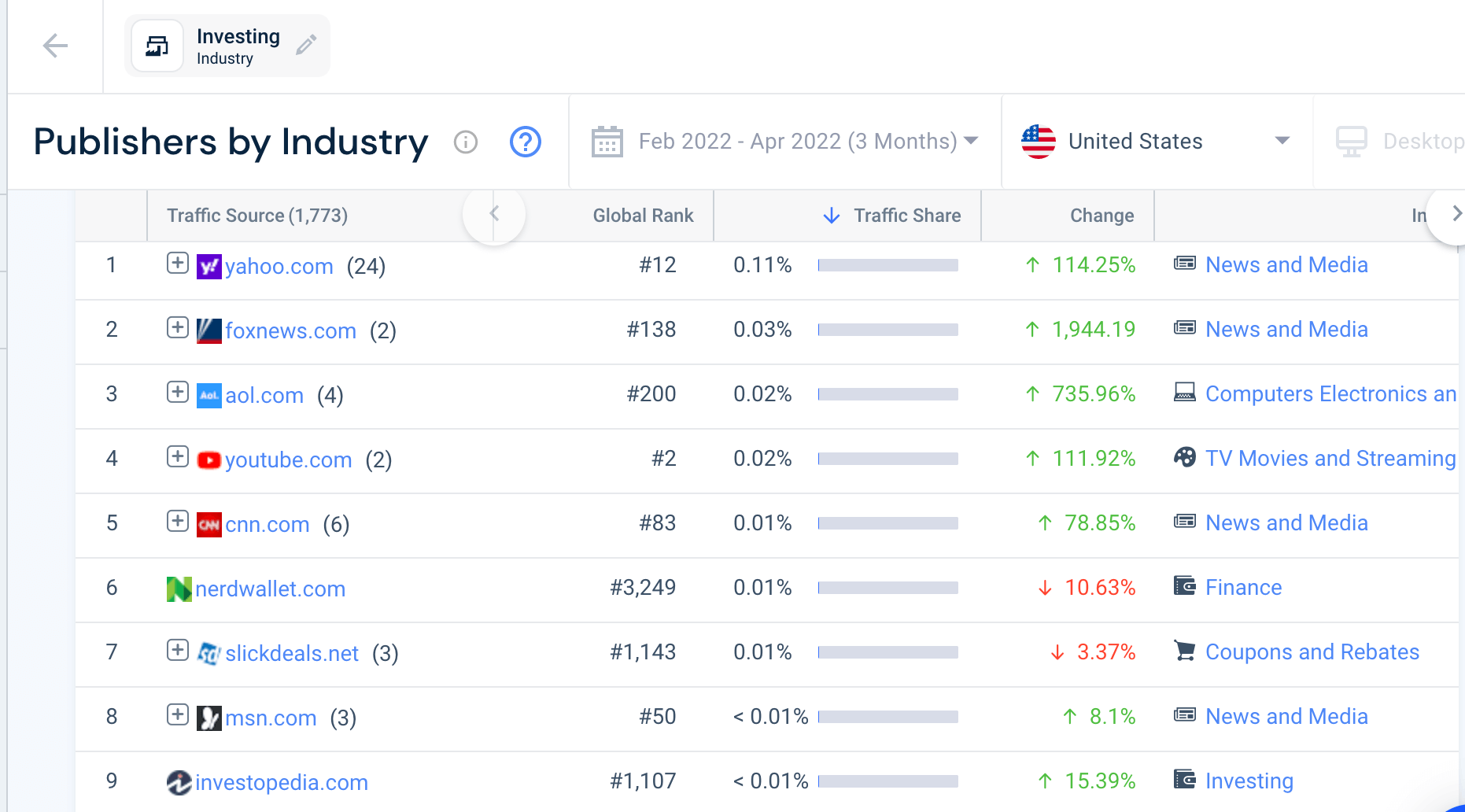
The list shows the current top publishers in the financial industry, subcategory investing, region USA
You can search by industry or by competition. With our Analyze Publisher tool, media buyers (or planners) see which advertisers and ad networks work with each publisher, how much outgoing traffic they generate, and where they’re driving that traffic to. They can also see how many ads are placed on that publisher’s site and other valuable insights.
2. With Similarweb Outgoing Traffic insights, media buyers can compare multiple publishers’ traffic metrics and understand which ones send traffic to their competitors (and which ones perform best).
This can be a huge benefit when bargaining. The media buyer can use the insights to plan and lead the negotiations. If a potential advertising partner is underperforming and the media buyer knows they need the business, this can help press the right pressure points.
3. Similarweb Digital Marketing Intelligence platform enables professionals to analyze audiences and the competitive landscape.
4. Marketers also use Similarweb’s Search Ads Spy tool for inspiration.
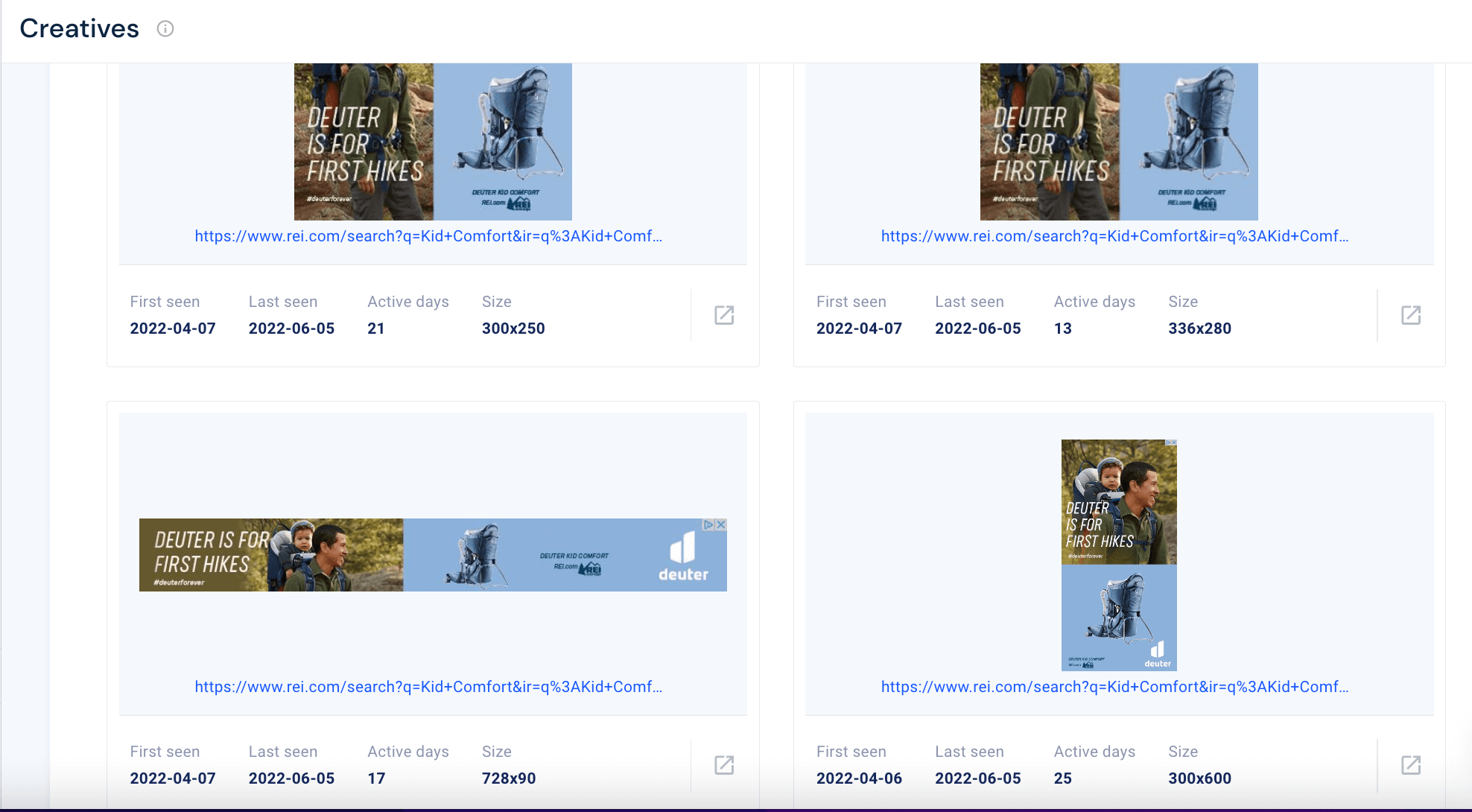
View competitors’ ad creatives and discover when, for how long, and where they ran.
5. Digital marketers discover and analyze the competition’s landing pages with Similarweb’s Landing Page Analyzer tool displaying a ton of examples of what your competitors use.
6. Media planners and buyers use the Search Ads tool to show competitors’ display ads and the Find Ad Networks tool to identify the network’s competitors use to advertise, such as GDN, Taboola, Amazon, and many more.
Explore our insights blog for more guidance and information on digital marketing and get actionable tips for your own work. When you’re ready to face competitor’s data access Similarweb for free.
What is media buying?
Media buying is the process of purchasing advertising space.
What are the types of media buying?
There are two types of digital media buying: direct media buying and programmatic media buying.
What is direct media buying?
Direct media buying refers to when the ad seller and the advertising space provider are in direct contact with each other.
What is programmatic media buying?
The programmatic media buying model automizes the process. Along with the advertiser and the publisher, there are three additional parties involved. These three parties are the demand-side platform (DSP), the ad network, and the supply-side platform (SSP).
This post was co-authored by Amelia Leib, who was Condé Nast’s Media Strategy Director for nine years and started her career as a media buyer at LVMH. Now she is the Media Industry Lead at Similarweb.

by Ruth Trucks
Senior Marketing Writer
Ruth, with 15 years in marketing, transforms complex data into engaging content. She enjoys gardening, motorcycle tours, and family time.
Top Ecommerce Companies in the USA: The 100 Brands Winning the Traffic Race in 2026

3 of the Sharpest Minds Weigh in on the State of Gen AI in 2026

Give it a try or talk to our marketing team — don’t worry, it’s free!
