


 Marketing Intelligence
Why Your Brand Isn’t Showing Up in AI Answers (And How to Fix It)
Your brand ranks #1 on Google for “best pest control services.” Your SEO is solid. Traffic is steady. Then your marketing director tests ChatGPT with the same query, and your brand doesn’t appear. Not even in the top four recommendations.
You’re not imagining it. And you’re not alone.
LinkedIn recently reported traffic drops of up to 60% on certain topics despite stable Google rankings. The cause? A fundamental shift in how people discover brands. AI platforms have become the new gatekeepers of brand visibility, and they play by completely different rules than traditional search engines.
The question isn’t whether AI search matters. It’s whether you can diagnose why your brand is invisible and fix it before your competitors cement their dominance.
In this article, I’ll share the four most common reasons brands disappear from AI answers based on Terminix analysis, how to diagnose which one is blocking you, and exactly how to fix it using Similarweb AI Search Intelligence tools. No theory, just actionable steps you can take this week.
The 4 Reasons Your Brand Isn’t Showing Up in AI
Reason #1: Your competitors own the topics that matter
The Problem
AI doesn’t rank websites the same way Google does. Instead, AI platforms synthesize answers by referencing the brands that dominate specific topics. If your competitors have established themselves as the go-to names for your category’s most important prompts, AI will mention them and skip you entirely.
This isn’t about being better. It’s about being associated. When AI sees “pest control” mentioned hundreds of times alongside “Terminix” or “Orkin” across authoritative sources, those brands become the default answer. Your brand, no matter how excellent, simply doesn’t exist in AI’s knowledge graph for those topics.
Think of it this way: AI is building its own mental map of your industry. The brands that appear most frequently across the most trusted sources get the biggest spots on that map. If you’re not on it, you’re invisible.
The Solution
I started by opening Similarweb AI Brand Visibility tool in Similarweb and navigating to the Competitors section. I reviewed the Brand’s visibility chart and filtered by specific topics.
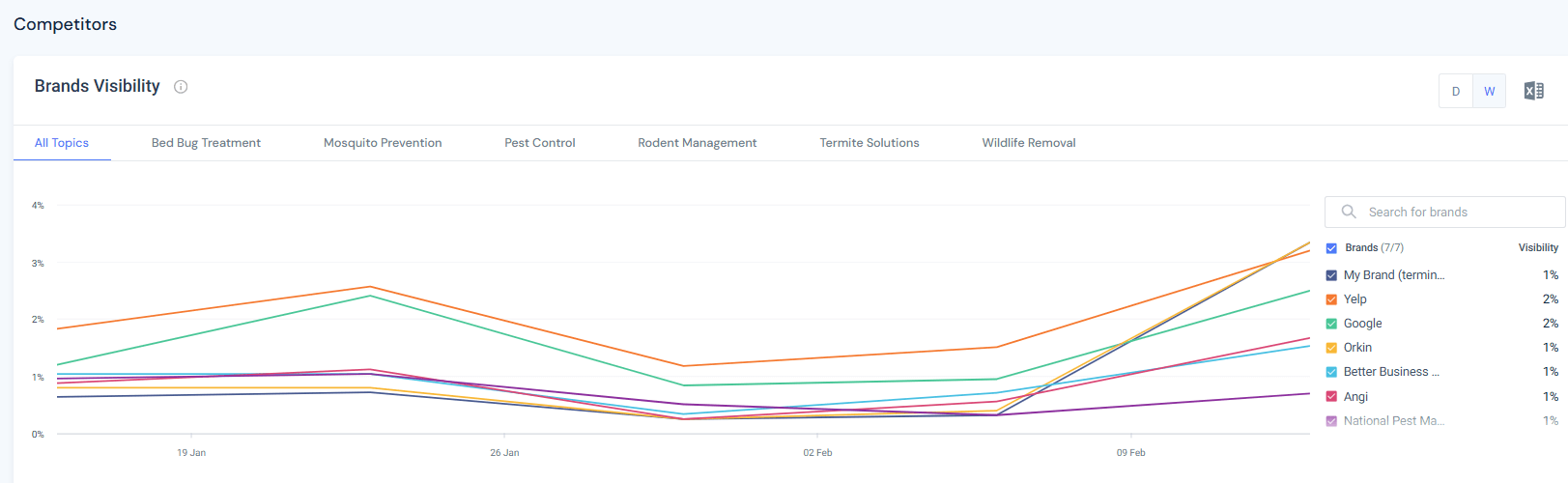
I focused on dominating one topic at a time instead of trying to compete everywhere. I chose the Bed Bug Treatment topic, where I could see the competitive landscape clearly. Yelp led with 3% visibility, followed by Orkin and Google at 2% each, while Terminix brand sat at just 1% visibility, tied with several competitors but significantly behind Yelp.
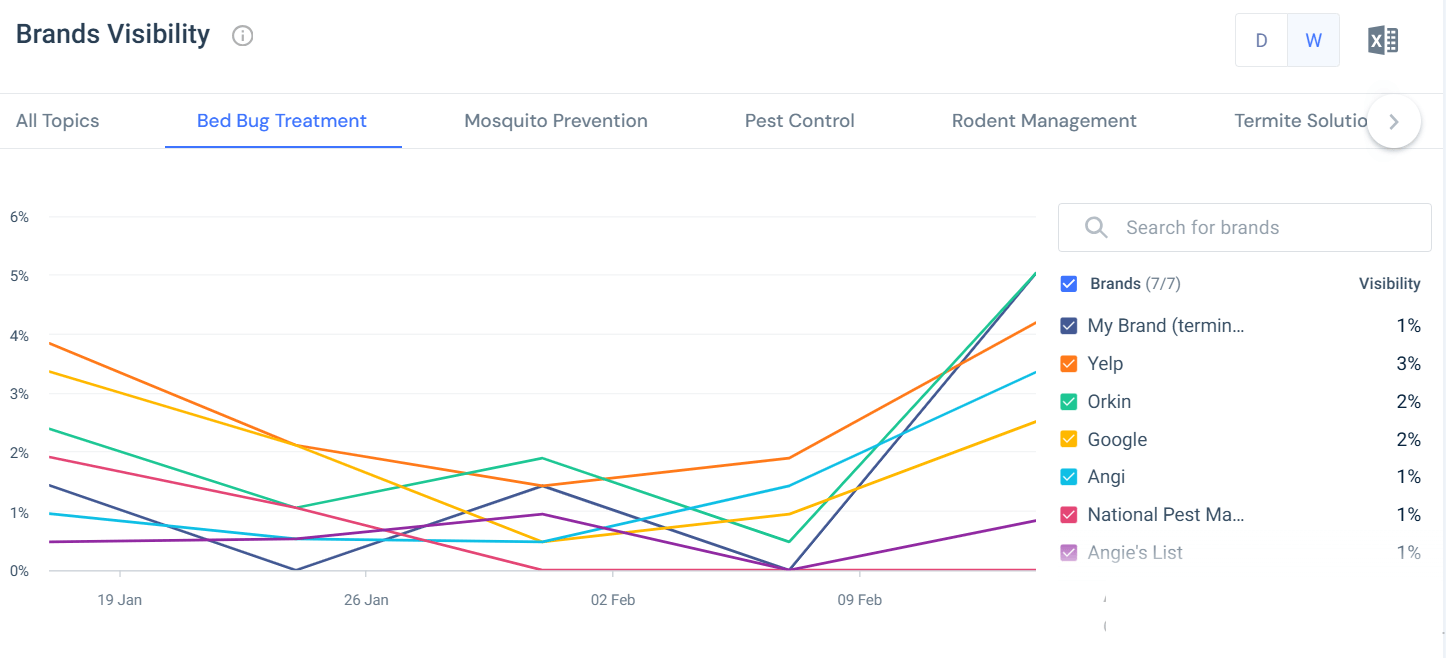
This was actually a perfect opportunity. The topic showed relatively distributed visibility with no single dominant player crushing everyone else. The gap between first place at 3% and Terminix’s position at 1% was just 2 percentage points, which felt achievable.
I picked Bed Bug Treatment specifically because it had high commercial intent for the Terminix business. The visibility was distributed enough that I could realistically break into the top three, and Terminix already had 1% visibility, meaning they existed in AI’s knowledge graph but barely.
I checked all prompts for Bed Bug Treatment and filtered them by not mentioned status. Looking at the Terminix Prompt Tracking report, I could see exactly where they were invisible. The data was eye-opening.
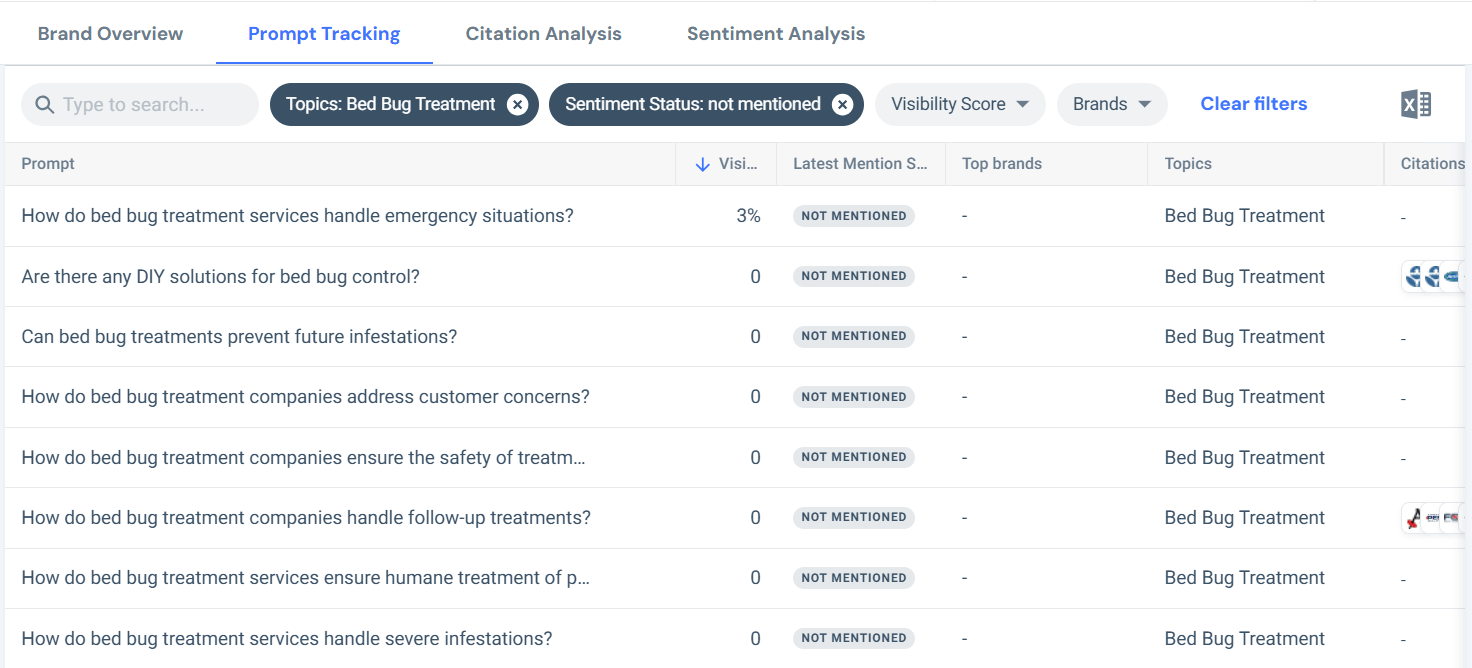
What stood out were the service quality and trust prompts. Service quality questions like “How do companies handle emergency situations?” and “How do they address customer concerns?” represented trust and reliability intent.
Follow-up and prevention questions like “Can treatments prevent future infestations?” and “How do companies handle follow-up treatments?” showed customers wanted ongoing support information.
Safety and humane treatment questions like “How do companies ensure safety?” and “ensure humane treatment?” revealed concerns about treatment methods.
DIY and alternative solutions like “Are there any DIY solutions?” showed people exploring all their options before hiring.
This explained everything. Terminix wasn’t showing up for the questions that actually drive hiring decisions. These weren’t just informational queries. These were the questions people ask right before they choose a provider or decide whether to call a professional at all.
I realized Yelp and Angi dominated because they had review content and comparison articles that naturally addressed these trust, safety, and service quality questions through customer testimonials and detailed company profiles.
The Action Plan
- Build one definitive page that will answer all these prompt variations. Structure it with H2 headings that will mirror the actual prompts I will find: “How We Handle Bed Bug Emergencies (24/7 Response)”, “Our Follow-Up Treatment Process”, “Safety Standards and EPA-Approved Treatments”, “Addressing Your Concerns: Our Customer Service Approach”, and “When to Call a Professional vs. DIY Solutions.”
- Include comparison tables because AI will love tables. Create one comparing treatment methods with columns for Method, Effectiveness Rate, Safety Level, and Timeline. Add another table showing “What to Expect: Treatment Schedule” with rows for Initial Treatment, Follow-Up Visit 1, Follow-Up Visit 2, and Final Inspection, each with specific timeframes and what will happen at each stage.
- Add a comprehensive FAQ section that will directly answer every not mentioned prompt I will find. Use natural language instead of keyword-stuffed content, writing like you will be answering a worried customer’s questions.
Reason #2: AI Can’t Find Quality Sources About You
The Problem
I started thinking of AI as a researcher preparing a report. It doesn’t just visit your company website and take your word for it. Instead, it looks for consensus across multiple trusted sources like news sites, review platforms, industry publications, government resources, and community forums.
If news publishers and consumer review sites all mention your competitors but never mention you, AI concludes you’re not relevant to that topic. It’s not bias. It’s how AI systems are designed to avoid hallucinations and ensure factual accuracy.
The brutal truth I discovered is your competitors don’t need better content. They just need better citations.
The Solution
I got three critical insights that completely changed Terminix’s strategy.
First, I discovered AI has clear favorites via Similarweb AI Citation Analysis tool. Government sites like EPA.gov weren’t just appearing in citations, they were dominating them. EPA.gov held a 2.29% influence score, and CDC.gov followed closely at 2.15%.
This wasn’t random. AI treats government educational resources as the gold standard for factual accuracy in health and safety topics.
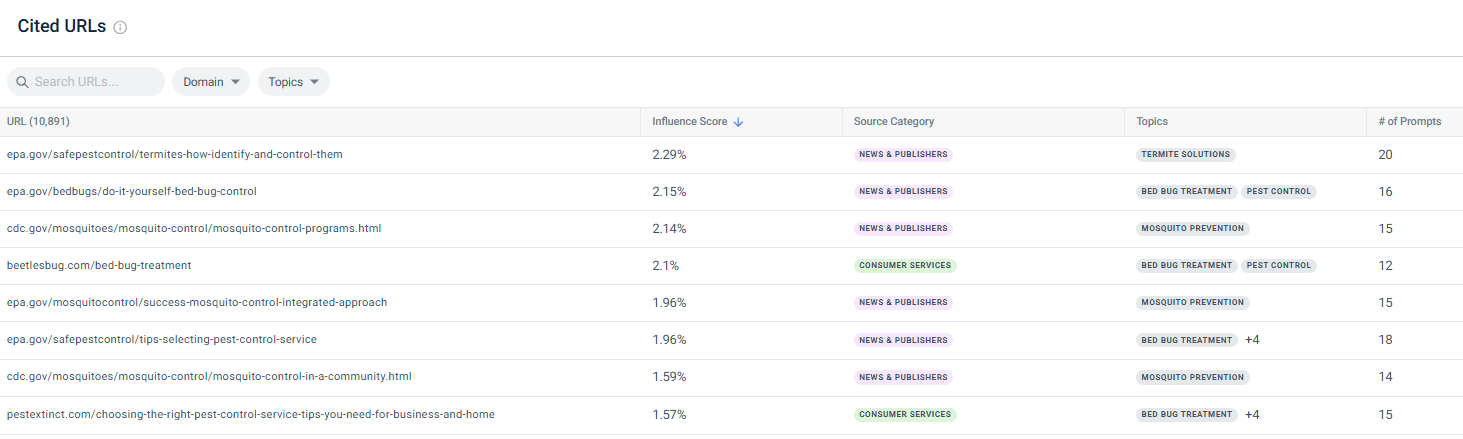
Second, I learned that source types create a hierarchy. AI doesn’t weigh all citations equally. News & Publishers carried the most authority, followed by Consumer Services like review sites, then Brand Sites, and finally Community Forums.
This explained why Terminix competitor with mediocre content but strong media coverage was getting cited more than me with superior content but zero press mentions.
Third, I realized influence compounds through repetition. The most powerful sources weren’t just cited once, they appeared across dozens of prompts. EPA.gov’s 2.29% influence score meant it shaped AI’s understanding of pest control across 20 different questions. One authoritative source appearing repeatedly holds more weight than ten different low-authority sources appearing once.
The pattern was unmistakable: AI trusts government educational resources above everything else in categories involving health, safety, or environmental concerns. If you’re in pest control and your brand never appears alongside EPA or CDC content, you’re missing the foundational layer of credibility AI requires before it will cite you.
The fix isn’t creating more content on Terminix site. It is earning mentions on the sites AI already considers authoritative, or at minimum, creating content that these authoritative sites would reference.
The Action Plan
- Launch a targeted outreach campaign. For government sites, reach out to community resource coordinators offering to provide accurate local service information for their directories. For consumer education sites, pitch comprehensive guides and offer to be quoted as an expert source.
- For the few review and comparison opportunities that did exist, Email 20 happy customers asking if they’d share their experience on sites that AI actually cited. Don’t waste time on platforms that looked important but weren’t showing up in AI citations.
- Create citation-worthy assets specifically designed for the sources AI trusted: educational guides formatted like government fact sheets, data-driven content about treatment effectiveness that educational sites could reference, comparison tables showing treatment methods and safety standards, and comprehensive how-to guides that consumer education sites would link to.
- Monitor the “Top Domains” weekly in Citation Analysis, watching specifically for movement in the News & Publishers and Consumer Services categories. The goal is to appear in three to five new authoritative sources per month, prioritizing government-affiliated resources first, then educational consumer sites, and finally traditional review platforms.
Reason #3: You’re Optimizing for the Wrong Prompts
The Problem
Traditional SEO taught me to optimize for keywords, short phrases people type into search boxes. I learned that AI search works fundamentally differently. Users don’t type “pest control Chicago.” They ask full questions like “How do I find a mosquito prevention service near me?”
These natural language prompts reveal intent, not just topics. And if your content doesn’t directly address the specific questions AI is answering, you won’t get cited even if you rank #1 on Google for related keywords.
Here’s what I found makes this tricky: AI responds to thousands of prompt variations you’ve never thought to optimize for. You might have great content about “bed bug treatment,” but AI is answering prompts like “How do I find a bed bug treatment service near me?”, “How do I know if a bed bug treatment service is reputable?”, and “What questions should I ask before booking bed bug treatment?”
Each prompt has a different intent. Answer the wrong question, and AI cites your competitor who answered the right one.
The Solution
Similarweb’s AI Prompt Analysis tool reveals the actual questions AI is answering in your category and whether your brand appears in those answers.
I discovered a brutal pattern in the data: Terminix was invisible on the prompts that mattered most. “How do I find a termite control service near me?” had 34% overall visibility, but Terminix’s mention status showed neutral, meaning they were being listed without any recommendation.
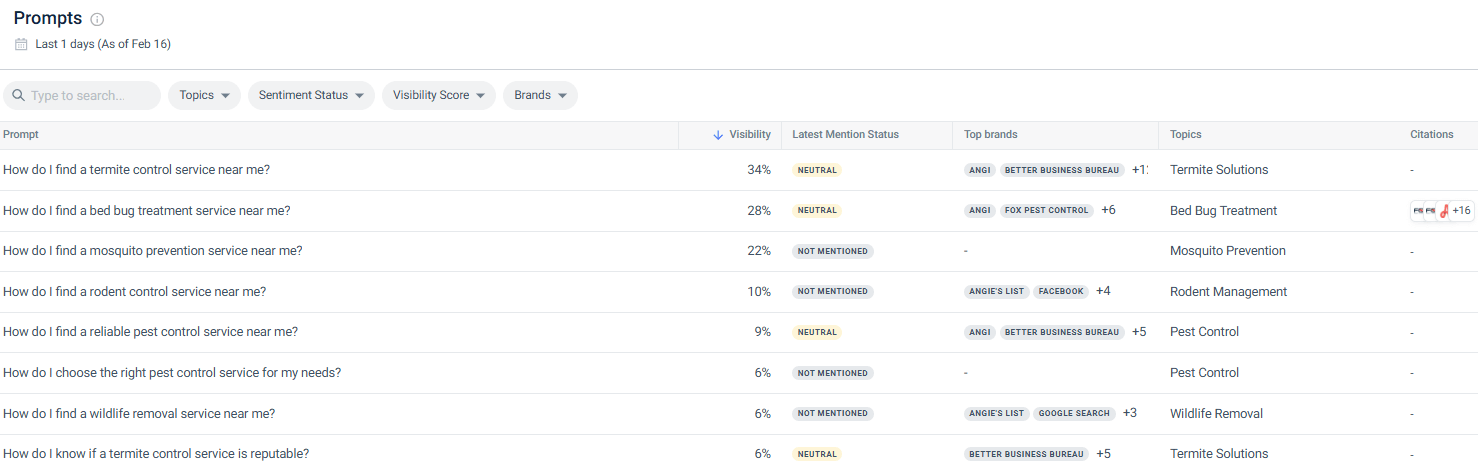
I continued to dive in and found that the prompt “How do I find a mosquito prevention service near me?” showed 22% visibility, and the status was not mentioned. Terminix didn’t exist in this answer at all. Zero presence while competitors were being cited.
I filtered the prompts by not mentioned status and by neutral status to see the prompts gap I need to focus on. By sorting prompts by visibility percentage, I could prioritize which gaps to fix first.
High-visibility prompts with neutral status (like termite at 34%) meant Terminix was in competitive markets but losing positioning. Medium-visibility prompts with not mentioned status (like mosquito at 22%) meant clear content gaps on important topics.
The Action Plan
- Build a prompt library tracking. Create columns for the prompt, mention status (Not Mentioned or Neutral), visibility percentage, which competitors were mentioned, and the content gap.
- For prompts where you’re not mentioned, like mosquito prevention at 22% visibility, create comprehensive mosquito prevention guides, local mosquito species profiles, and treatment comparison content.
- For prompts where you’re neutral like termite control at 34% visibility, identify what made ANGI and Better Business Bureau get featured more prominently, for example they had trust signals (reviews, certifications, verifiable business information) that you might lack.
- The sentiment progression you need to achieve: Not Mentioned → Neutral → Positive. Each require different tactics. Getting from Not Mentioned to Neutral meant creating cite-able content. Getting from Neutral to Positive meant building authority signals, earning better reviews, and providing more distinctive value propositions that AI could highlight.
- Check your mention status weekly across all prompts, tracking movements from not mentioned to neutral as small wins, and from neutral to hopefully something better as the real victories.
Reason #4: Your Brand Sentiment in AI is Negative or Neutral
The Problem
Being mentioned by AI isn’t enough. How you’re mentioned determines whether users choose you or skip you entirely. AI might cite your brand in three ways.
- Positive framing sounds like “Brand X is highly rated for fast service and transparent pricing.”
- Neutral framing sounds like “Other options include Brand X, which offers pest control services.”
- Negative framing sounds like “Customers report that Brand X has inconsistent service quality.”
Here’s why I found this matters more than you think: users see AI’s framing before they ever visit your website. If AI presents you neutrally while praising competitors, you lose the click. If AI mentions you negatively, you’ve actively damaged your brand reputation.
Even more concerning, I discovered neutral mentions often feel like wins. You think “Hey, we’re mentioned!” but they’re actually missed opportunities. A neutral mention means AI knows you exist but has no reason to recommend you over competitors. You’re the background noise while competitors get the spotlight.
What drives sentiment? I found it’s customer reviews on G2, Yelp, Trustpilot, and Reddit. News coverage and press mentions. Comparison articles on third-party sites. Forum discussions and community feedback. How you’re positioned in industry roundups.
AI synthesizes all of these signals to determine not just whether to mention you but how to frame you.
The Solution
Similarweb’s AI Sentiment Analysis tool shows exactly how AI portrays your brand across all mentions and how that compares to competitors.
I saw an overall sentiment breakdown with Terminix mentions classified into three categories. In my pest control example, the brand received 13% positive mentions (6 out of 48), 85% neutral mentions (41 out of 48), and 2% negative mentions (1 out of 48).
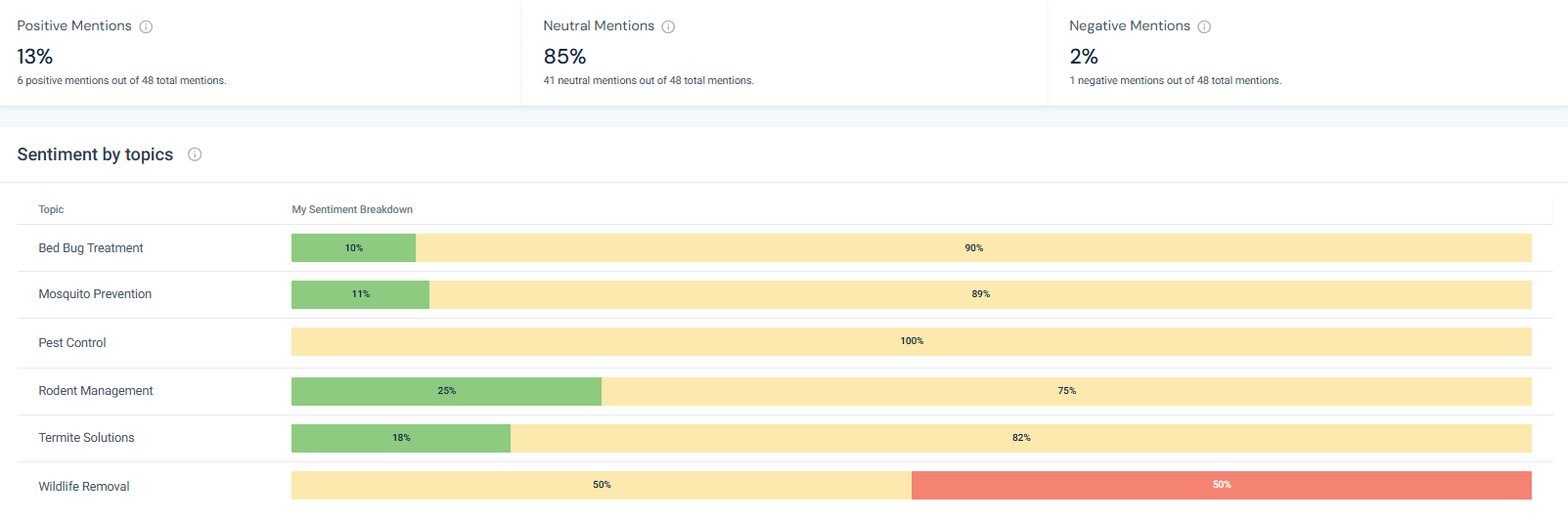
Two topics stood out as severe problems: Pest Control showed 100% neutral sentiment with zero positive mentions, and Wildlife Removal showed a 50/50 split between neutral and negative sentiment, a reputation crisis.
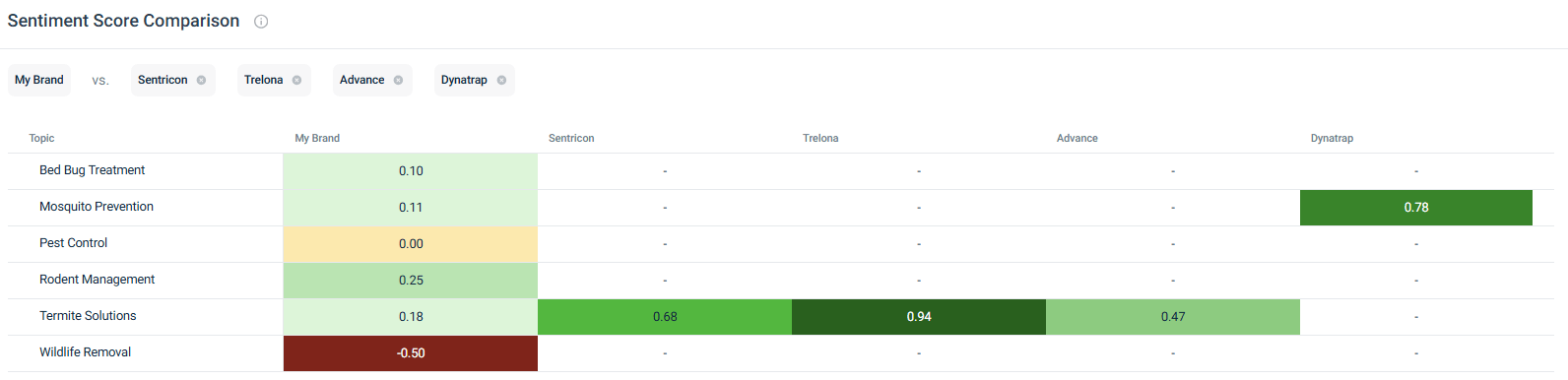
The Sentiment Score Comparison table quantified how far behind competitors Terminix fell. Their scores ranged from 0.10 to 0.25 across most topics, except for Wildlife Removal, which was -0.50 (strongly negative).
When I clicked into Wildlife Removal to investigate the negative sentiment, Similarweb showed me the exact prompt driving it: “How do I find a wildlife removal service near me?”. The Citations section showed 21 sources AI pulled from to answer this question.
This citation data revealed why Wildlife Removal had negative sentiment. AI was pulling from 21 different sources, and Terminix clearly wasn’t positioned well in any of them. The sources were dominated by directory sites, specialized wildlife removal companies, and regional providers.
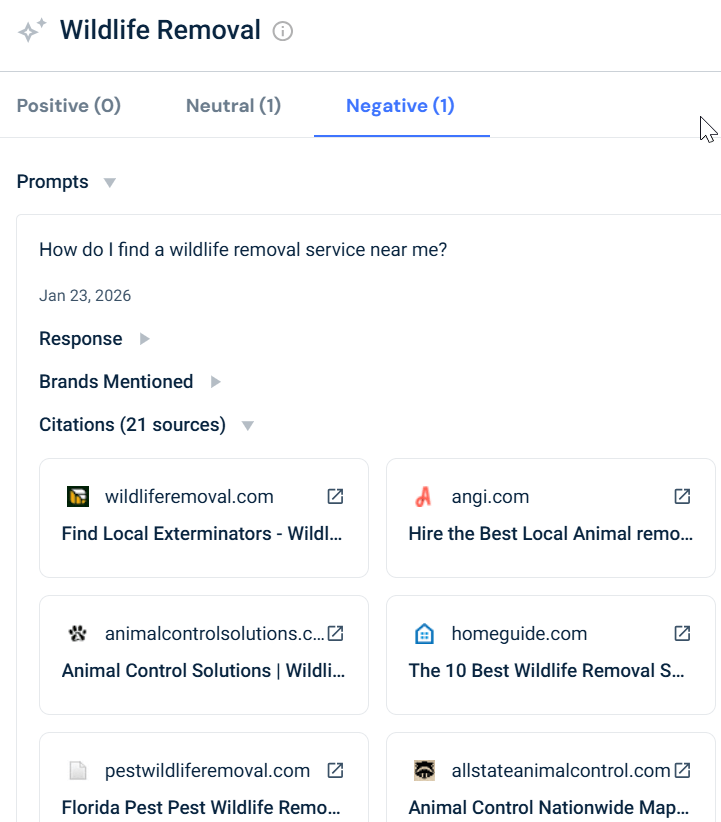
The pattern became clear: AI was citing wildlife removal specialists and directories, not general pest control companies. Terminix was being mentioned in a context where specialized competitors had stronger positioning, leading to negative comparative sentiment. They were being framed as a generalist in a specialist’s market.
This explained the -0.50 sentiment score. It wasn’t necessarily about bad reviews, it was about being cited in sources where specialized wildlife removal companies were presented as better options. The negative sentiment came from unfavorable positioning against niche competitors who owned this specific category.
When I clicked into Pest Control to understand why it had 100% neutral sentiment, the data told a different story than Wildlife Removal.
Wildlife Removal had negative sentiment because Terminix was being compared unfavorably to specialists. Pest Control had neutral sentiment because Terminix was being mentioned without any distinguishing characteristics at all.
These were high-value, decision-oriented prompts: “How do I choose the right service?” and “How do I find a reliable service?” These questions represent users actively trying to make a hiring decision. Yet AI was citing Terminix generically, acknowledging they exist but giving zero reasons to choose them over anyone else.
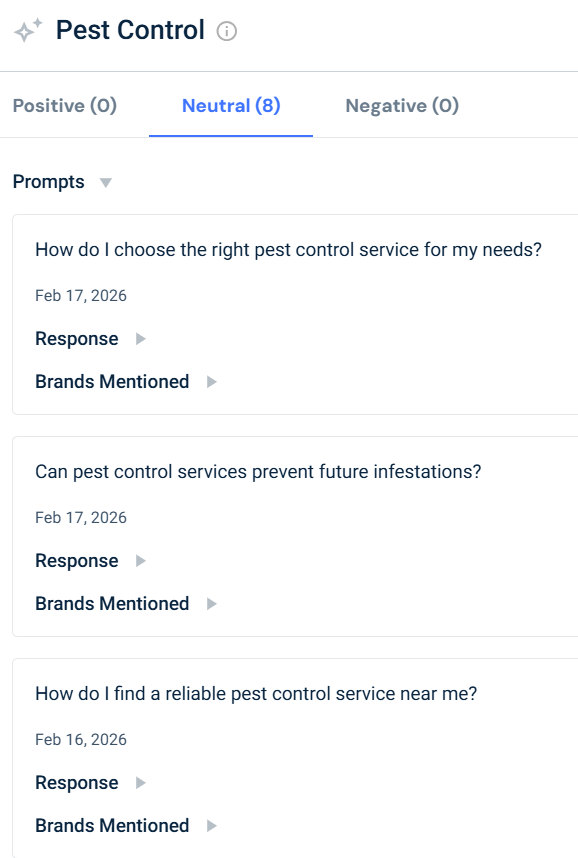
The diagnosis was clear: Pest Control suffered from lack of differentiation (neutral with nothing to distinguish them), while Wildlife Removal suffered from unfavorable positioning (negative because specialists outshone them).
Both problems require giving AI specific, cite-able reasons to recommend Terminix, either through distinctive positioning for Pest Control or specialist credentials for Wildlife Removal.
The Action Plan
- Pick One Thing You’re Known For: for Pest Control’s neutral problem, choose one specific thing AI can talk about, for example: “We respond to emergencies in 2 hours or less”. For Wildlife Removal’s negative problem, decide if you want to become wildlife specialists (get certifications, hire a dedicated team) or just stop competing in that category to avoid bad comparisons.
- Put This Message Everywhere: update your website headers with your main message. Add structured data so AI can find and use it. Update your Google Business, Yelp, and Better Business Bureau profiles with the same message. Write content explaining why your specific strength matters when someone’s choosing a pest control company.
- Get Customers to Back Up Your Claims: ask 15-20 happy customers to leave reviews that mention your specific strength. For Wildlife Removal, if you’re going the specialist route, get listed on the 21 websites AI uses as sources.
- Compare Yourself to Competitors: look at how your scores (currently 0.10-0.25 across topics) stack up against competitors (0.68-0.94). Track if you’re closing the gap.
Final Thoughts
If your brand isn’t showing up in AI answers, it’s not because AI is broken. It’s because AI is working exactly as designed.
That means brand visibility in AI comes down to four controllable levers:
- Topic Ownership: Are you strongly associated with the prompts that drive buying decisions?
- Citation Authority: Do trusted sources mention you?
- Prompt Alignment: Are you answering the exact questions AI is responding to?
- Sentiment Framing: When AI mentions you, does it recommend you?
The brands that win in AI search aren’t necessarily the biggest. They’re the most consistently cited, clearly positioned, and structurally optimized.
And here’s the most important takeaway: AI visibility isn’t a content problem, it’s an intelligence problem. When you systematically close prompt gaps, strengthen your citation footprint, and improve sentiment framing using Similarweb AI Brand Visibility tools, you find smart insights, and something shifts.
You stop guessing what AI might say about your brand and start knowing.
You stop reacting to competitor mentions and start identifying the exact levers that change recommendation share.
You move from publishing more general content to influencing the answers that drive decisions.
FAQs
What is AI Brand Visibility and how is it different from traditional SEO visibility?
AI Brand Visibility measures how often and how positively your brand appears inside AI-generated answers. Traditional SEO tracks rankings and traffic, while AI visibility tracks recommendation presence and brand mentions within synthesized responses.
Why do smaller brands sometimes appear in AI answers instead of larger ones?
AI prioritizes strong topic association and trusted citations, not company size. A smaller brand consistently cited across authoritative sources for a specific topic can outperform a larger but less focused competitor.
How does AI decide whether to recommend a brand or just mention it?
AI evaluates sentiment, third-party validation, and differentiation signals. If your brand has clear strengths supported by reviews and credible sources, AI is more likely to recommend it rather than list it neutrally.
How important are third-party citations for AI visibility?
They are critical. AI systems rely on trusted sources like news sites, government resources, and review platforms to validate brands. Without consistent external citations, visibility remains limited.
Can publishing more content on my website improve AI visibility?
Not by itself. Content must align with real AI prompts and be supported by authoritative citations. Volume alone does not increase AI recommendations.
How often should brands monitor AI visibility?
Brands should review AI visibility at least monthly to track mention status, sentiment shifts, and competitor positioning, especially in competitive industries.
Does negative AI sentiment always come from bad reviews?
No. Negative sentiment can also result from weak positioning, unfavorable comparisons, or competing against niche specialists with stronger authority in a specific category.
What’s the fastest way to improve AI visibility?
Start with one high-visibility prompt where you are not mentioned or neutral, create a structured, citation-ready answer, and strengthen third-party validation around that topic.

Related Posts


The Inevitable Convergence: Why AI is Rewriting the Economics of Advertising
![GEO Framework For Growth Leaders [+Free Template]](https://www.similarweb.com/blog/wp-content/uploads/2026/02/attachment-growth-leader-geo-decision-framework-768x429.png)

Wondering what Similarweb can do for your business?
Give it a try or talk to our insights team — don’t worry, it’s free!