


 Marketing Intelligence
ChatGPT Ecommerce: How to Get Your Products Recommended in ChatGPT
Shoppers are changing how they buy. Instead of digging through multiple sites, people increasingly ask ChatGPT for help: what to buy, what matters, and how products compare. OpenAI’s recent Shopping Research feature now compiles product details, reviews, and trade‑offs into digestible guides. Instant Checkout, which currently supports select Etsy sellers in the US, adds a direct purchase layer with more merchants expected to follow.
These new features from OpenAI affect more than the dedicated shopping experience. The same signals influence how ChatGPT responds in everyday conversations. Even when users are not explicitly shopping, ChatGPT often recommends products while answering questions like “What’s a good laptop for design school?” or “How do I choose a stroller for travel?”
So what does all of this mean for retailers?
1. ChatGPT is now a research engine, not just a chatbot
In our recent webinar, “From Search to Shop: How ChatGPT and Rufus Are Rewriting Ecommerce“, we saw that most of the shopping prompts Similarweb analyzed weren’t “buy now” questions. They’re upper-funnel:
- 38% interest
- 24% consideration
- 11% evaluation/deals
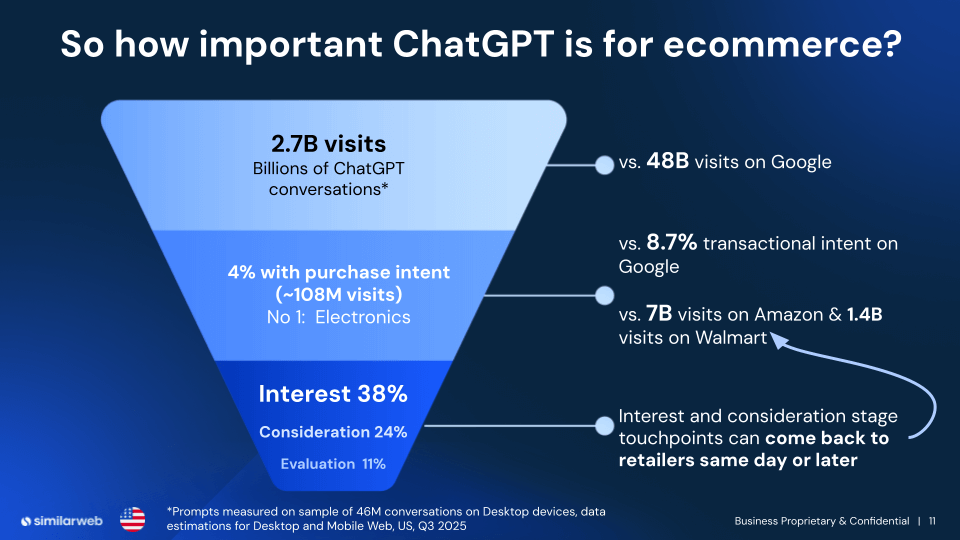
Translation: ChatGPT is shaping the consideration set, long before a shopper clicks a link or visits a retailer.
2. Direct clicks severely undercount ChatGPT’s influence
Our data shows that journeys that start in ChatGPT and end in a purchase later (through Google, retailer search, marketplaces, and other channels) happen about 5× more often than journeys with a direct ChatGPT to retailer click.
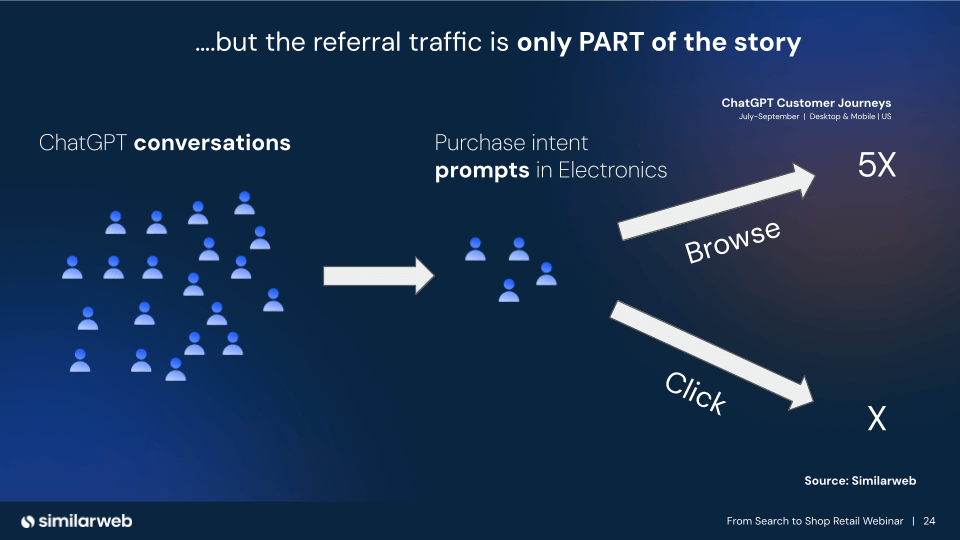
So if you’re only looking at referrals from ChatGPT, you’re missing most of the story.
3. ChatGPT influences research long before a shopper clicks anything becomes a measurable part of the journey
Even when shoppers don’t click directly from ChatGPT, the guidance they receive shapes what they search for later, which retailers they visit, and which products they compare. It plays a quiet but important role in the early stages of decision‑making.
The three signals ChatGPT uses to recommend products
ChatGPT builds its shopping research answers from three inputs. You need all three aligned.
1. Merchant feeds/Agentic commerce protocol (ACP)
Instant Checkout and Shopping Research rely on structured product feeds:
- ID
- Title
- Description
- Price
- Availability
- Images
- Attributes
- Performance signals (reviews, return rate, popularity)
- Rich media (video, 3D models)
Feeds are increasingly important because they supply structured product information directly to ChatGPT, but OpenAI has not published a full ranking formula. Treat feed quality as one of several signals that help ChatGPT understand your products.
2. Your product pages (PDPs & categories)
ChatGPT cross-checks your feed data against your website to confirm:
- Are the specs accurate?
- Do the images match?
- Do the details line up?
- Can it understand who the product is for and why it’s good?
If ChatGPT can’t understand the content of your page, it is less likely to recommend your product.
3. Your brand footprint (Reviews, citations, expert lists)
ChatGPT uses:
- Reviews from your site
- Marketplace reviews
- Editorial roundups (“best laptops under $1,000”)
- Forums and trusted sources
These three signals need to reinforce each other.
If they don’t, ChatGPT will probably recommend someone else’s product.
Step 1: Make Your Product Data Technically Discoverable
Allow ChatGPT’s crawlers
Make sure ChatGPT can actually read your product pages. Some brands unintentionally block AI crawlers through their robots.txt settings, so it’s worth confirming that your product pages are publicly visible and easy to browse. If ChatGPT can’t access the page, it is far less likely to recommend the product.
Implement product schema (aligned with your feeds)
Include the essentials in clear, structured data: your product name, main image, price, availability, brand, ratings and reviews, and core attributes such as materials or size. Presenting this information consistently helps ChatGPT interpret your product correctly and connect it with user needs.
Prepare for ACP (even if you’re not using Instant Checkout yet)
Clean your product data now:
- Write descriptive titles
- Fill out all attributes
- Make your descriptions complete and factual
- Keep availability and pricing updated frequently
Here’s OpenAI’s sneak peek at Instant Checkout:
Step 2: Optimize product titles and descriptions for ChatGPT
Your biggest lever is your product page copy.
ChatGPT focuses on meaning, not keyword matching.
This step has some overlap with traditional ecommerce SEO and Amazon SEO. In both cases, you’re optimizing product page content so it aligns with what people search for. The difference with ChatGPT is that users tend to describe their needs with far more detail. Instead of short keywords like “men’s pants” or “moisturizing cream,” ChatGPT queries sound more like full sentences and scenarios. That means your optimization needs to go deeper: your titles and descriptions must reflect real situations, constraints, and goals, not just keywords.
Here’s what that means.
Optimize for intent, not SKUs
People rarely phrase their needs the way traditional product pages are written. Instead of technical names or internal labels, they describe everyday situations and constraints.
Your product pages should clearly communicate:
- Audience (who it’s for)
- Use case (what it solves)
- Constraints (budget, size, fit, environment)
- Benefits (what makes it a good choice)
These are the details that help ChatGPT understand when a product may fit a user’s described needs.
How to write ChatGPT-ready titles
Most ecommerce product titles were written for search engines, not for how people actually ask for products.
Think of titles less like labels and more like clear identifiers. They don’t need to sound like ads, but they should quickly signal:
- What it is
- Who it’s for
- The key detail that matters most for the shopper’s decision
Examples:
Too vague:
- “Hiking Pants”
- “Moisturizing Cream”
- “Bluetooth Speaker”
More helpful:
- “Men’s Lightweight Hiking Pants for Warm Weather”
- “Moisturizer for Sensitive, Oily Skin (Fragrance-Free)”
- “Portable Bluetooth Speaker with Long Battery Life”
These are still clean, readable titles-but now they match the way people describe what they need when they talk to ChatGPT.
Simple rule: If someone said this out loud while asking a friend for a product recommendation, does it sound natural?
How to write ChatGPT-ready descriptions
ChatGPT breaks down your content into chunks it can paraphrase or cite.
Make that process easy.
Use a simple structure:
1. What it is + who it’s for + why it’s good
Keep this to 2–3 sentences.
2. Bullet points tied to real scenarios
Not: “Water-resistant nylon blend”
Instead: “Stays dry in light rain; ideal for travel or morning runs”
3. Mini FAQ
Pull these from real customer questions:
- Is it true to size?
- Will this fit overhead bins?
- Does it work for flat feet?
- Is this suitable for curly hair?
This mirrors the way shoppers talk to ChatGPT.
Step 3: Structure attributes around real prompts
ChatGPT needs clear, specific attributes-especially for high-consideration categories like electronics and tools.
Turn prompts into attributes
Ask ChatGPT: “What do people consider when choosing a [product]?”
Take those attributes and:
- Add them to your PDP
- Include them in your structured data
- Add them to your product feed when relevant
The goal is simple: reduce the gap between how shoppers describe their needs and how your product data presents your solution.
Use synonyms and everyday language
People rarely search using technical terms alone. They talk about their real lives:
- “I walk a lot for work”
- “My apartment is tiny”
- “My skin gets oily in the afternoon”
Your content should reflect this. Encourage reviews that describe real scenarios. Use plain language in your bullets and FAQs. ChatGPT understands this naturally because it mirrors how real people talk.
Keep formatting predictable
ChatGPT does best when information is easy to parse. Use consistent sections such as:
- Best for
- Key specs
- Who it’s for
- Fit and sizing
- What to know before you buy
This structure helps ChatGPT interpret your page correctly and summarize it in a way that makes sense to shoppers.
Step 4: Strengthen reviews and trust signals
Reviews play a major role in how ChatGPT understands products. They act as training data, giving AI real-world context about how a product works and who it works best for.
Encourage customers to share:
- Their specific use case
- The environment in which they used the product
- Problems the product solved
- Comparisons with other products
These details map directly to the kinds of prompts people give ChatGPT.
Make your policies easy to find as well. ChatGPT often references return policies, warranties, and shipping timelines when recommending products. If this information is buried, AI may overlook it.
Step 5: Build conversational content
One of the simplest ways to improve your visibility in ChatGPT is to understand how people actually ask questions.
Use ChatGPT to research your category:
- “What questions do people ask before buying a [product]?”
- “What matters most when choosing a [category]?”
Use those insights to tighten your:
- PDP FAQs
- Buying guides
- Category pages
- Comparison pages
The same strategy applies to retailer sites. AI agents like Amazon’s Rufus perform best when content is clear, conversational, and grounded in real use cases.
Step 6: Measure GenAI visibility and AI traffic with Similarweb
Most brands don’t know where they appear in GenAI responses or whether they appear at all. Similarweb’s AI Search Intelligence gives you two complementary views: how often your brand appears in AI answers, and how much AI‑driven traffic reaches your site.
AI Brand Visibility tracker
AI Brand Visibility shows where your brand appears inside ChatGPT and other AI chatbots. It highlights the topics where you’re mentioned, whether the sentiment is positive or negative, and whether AI tools cite you as a source. It also lets you examine the actual prompts behind those mentions through prompt analysis, which reveals the questions users are asking and how ChatGPT answers them.
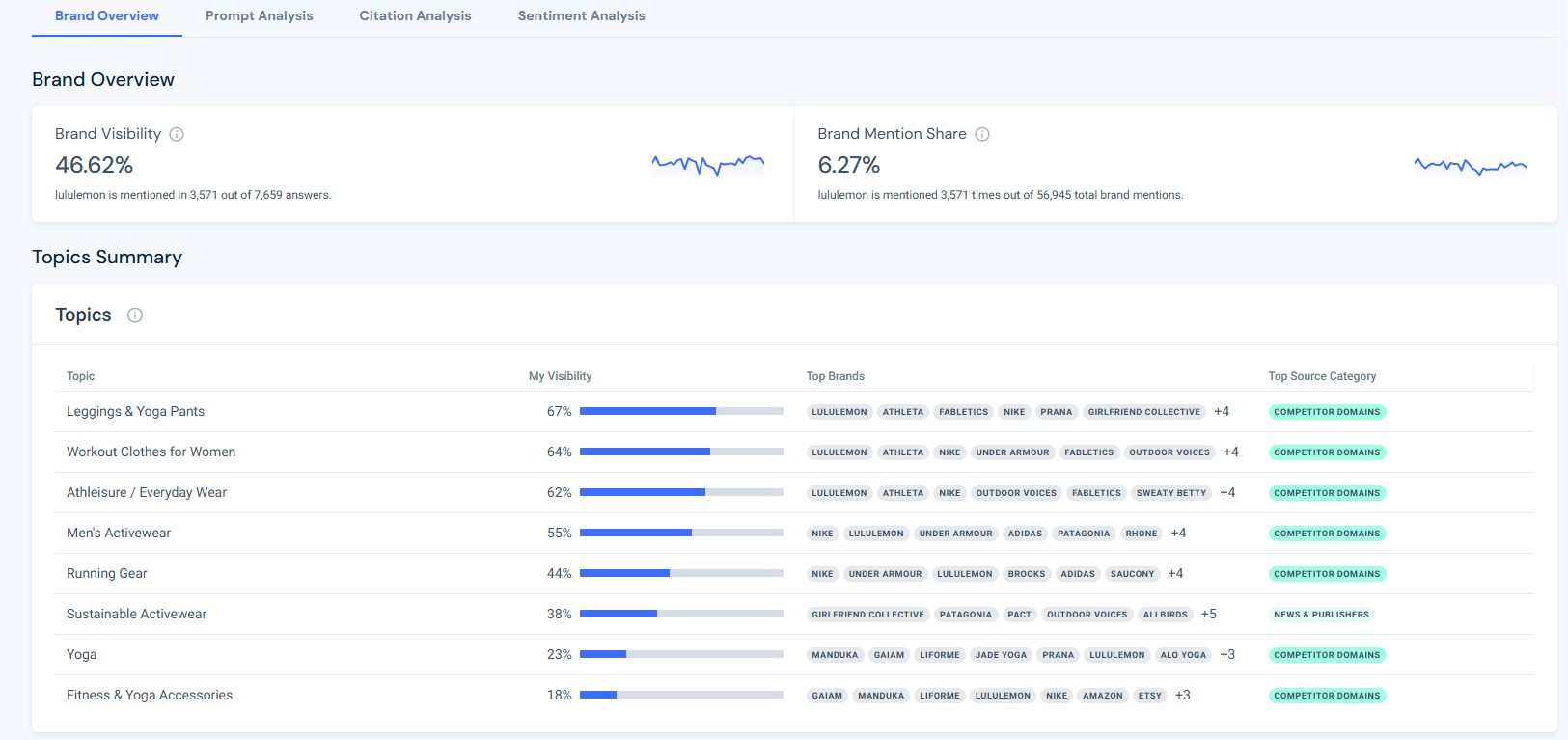
I had a look at lululemon as an example, the Brand Overview module shows a visibility score of 46.62% across tracked answers and a brand mention share of 6.27% compared to all competitors.
Topic-level visibility shows lululemon strongly represented in “Leggings & Yoga Pants,” “Workout Clothes for Women,” and “Athleisure / Everyday Wear,” while categories like “Yoga” and “Fitness & Yoga Accessories” show lower visibility. These granular topic scores can reveal both strengths and immediate gaps to prioritize.
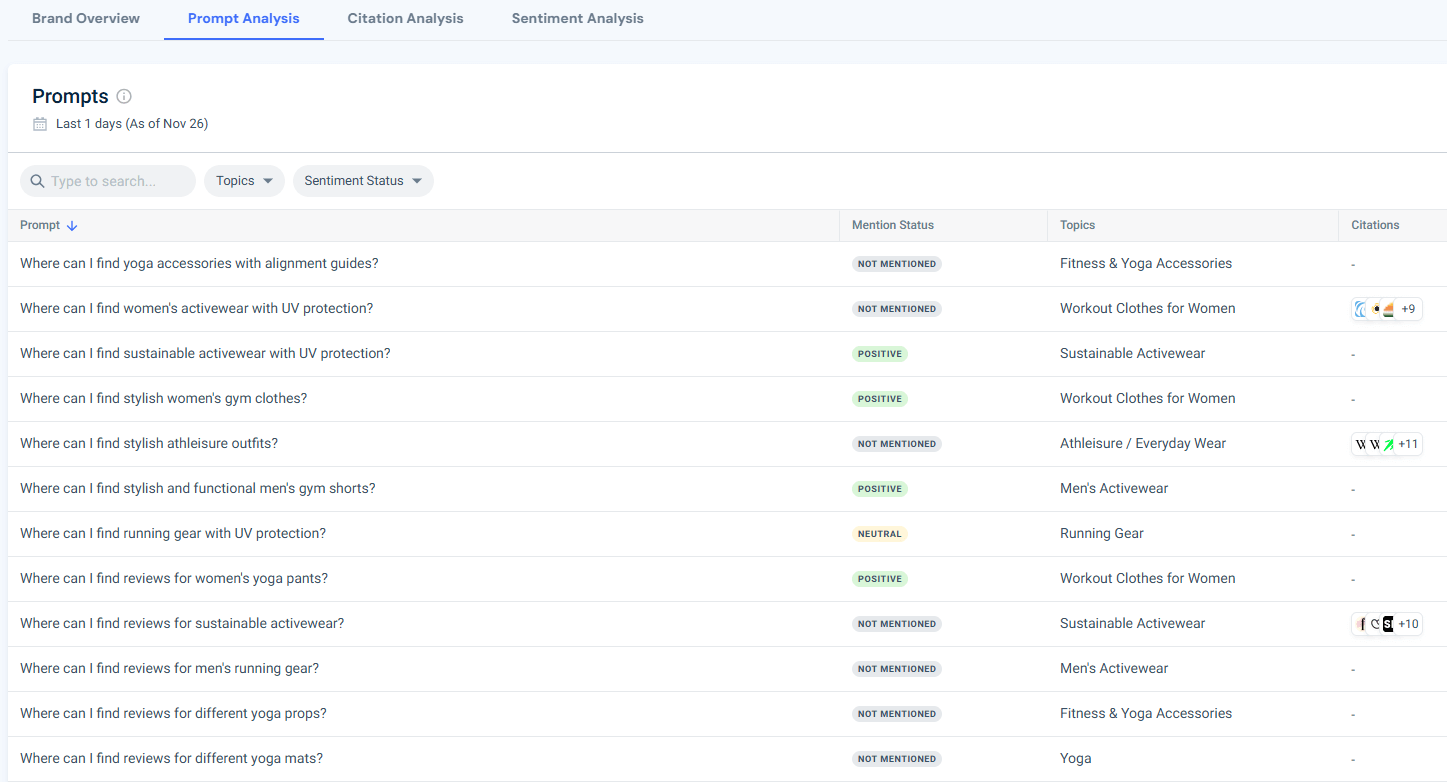
The AI prompt analysis tool makes these gaps clearer. For lululemon, prompts such as “Where can I find stylish women’s gym clothes?” or “Where can I find sustainable activewear with UV protection?” resulted in positive visibility, but many similar prompts showed “Not Mentioned”. This tells a brand exactly where content is missing or insufficient, and what questions ChatGPT is already answering using competitor products or sources.
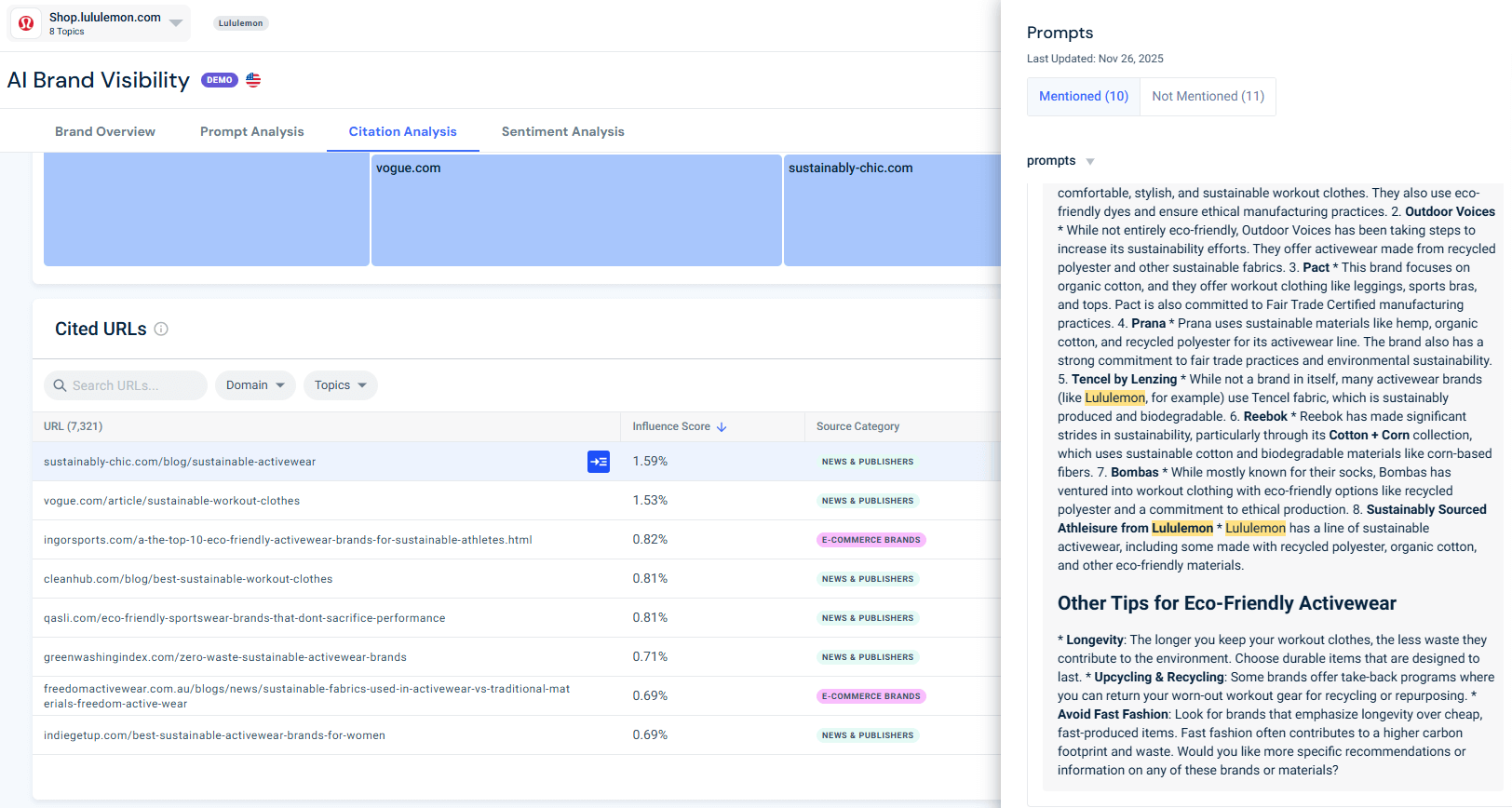
The AI citation analysis tool goes a level deeper by showing the domains and URLs shaping AI answers. For lululemon, large portions of ChatGPT’s citations came from sources like Reddit, WhoWhatWear, REI, Nike, Vogue, and sustainability-focused blogs.
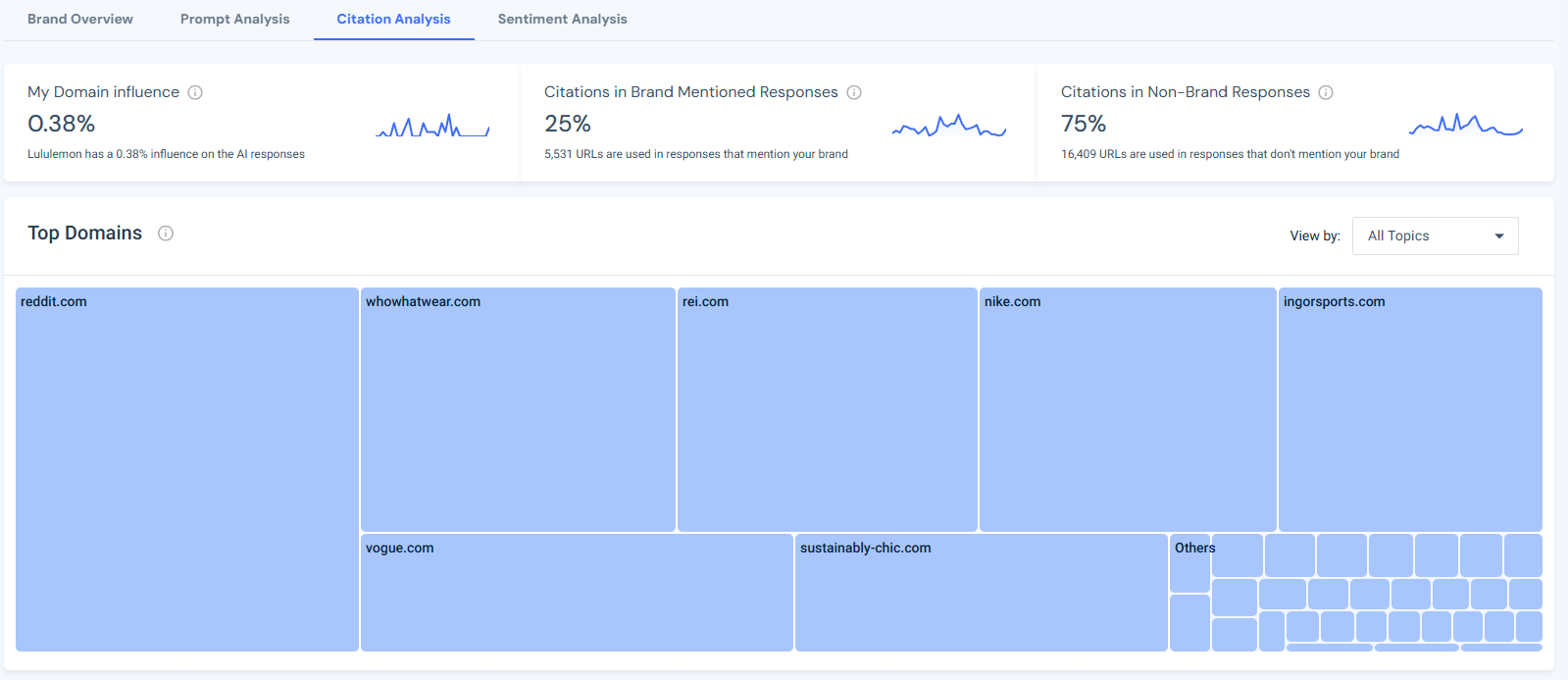
This matters because these are the sources ChatGPT trusts when forming its responses. By understanding which URLs influence answers across topics, brands can design strategies to strengthen their presence, either by creating more authoritative content or by collaborating with trusted sources.
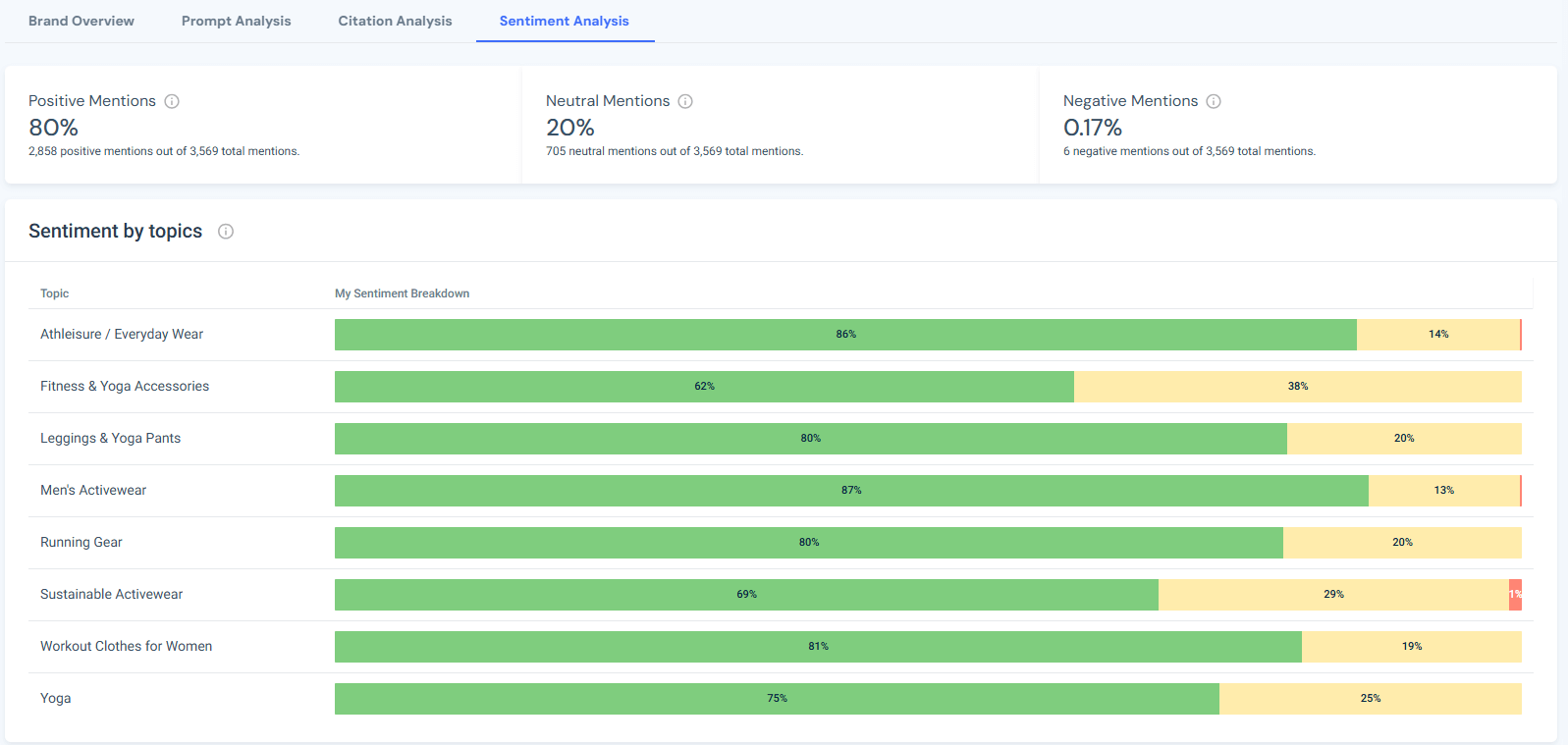
Finally, Sentiment Analysis rounds out the picture for me by showing how the brand is perceived across topics. Lululemon’s sentiment was overwhelmingly positive in categories like Athleisure, Men’s Activewear, and Running Gear, but more mixed in Sustainable Activewear. These nuances help brands prioritize where to invest in messaging, product education, or review management.
Together, these insights allow you to strengthen your content strategy, cover missing prompts, identify PR or partnership opportunities through top citations, and understand exactly what GenAI relies on to form opinions about your category.
AI traffic
AI Traffic Intelligence completes the picture by showing how much traffic reaches your site from ChatGPT, Perplexity, Copilot, Claude, DeepSeek, and others. It lets you track how AI traffic changes over time, which pages attract the most AI‑originated visits, and which prompts drove those visits. You can also benchmark your AI traffic against competitors to spot strengths, weaknesses, and opportunities.
For ecommerce teams optimizing for ChatGPT, this matters because it shows exactly which products and pages resonate with AI assistants today. When you know which pages AI tools already send shoppers to, you can refine those pages further, replicate their strengths across other products, and identify content gaps where high‑intent prompts are driving traffic to competitors instead. This turns AI‑driven discovery from a black box into a measurable channel you can systematically improve.
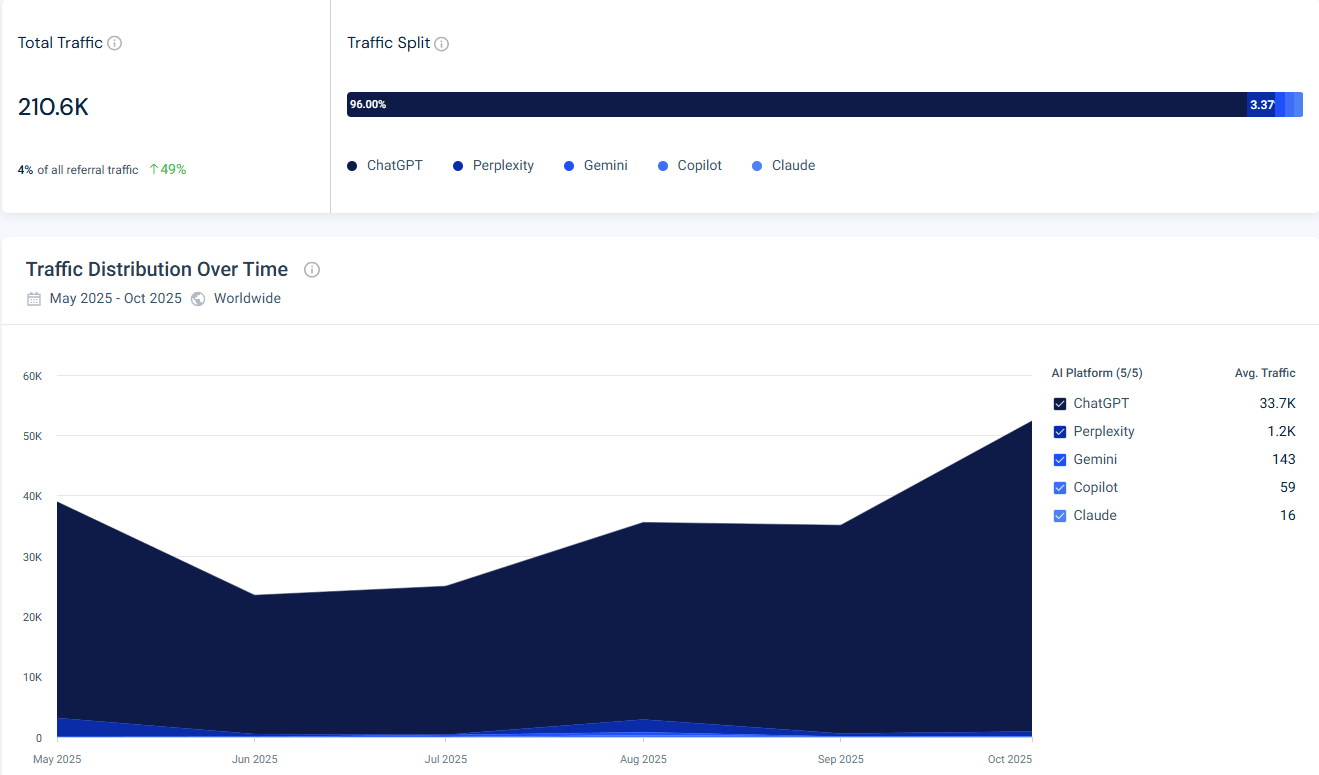
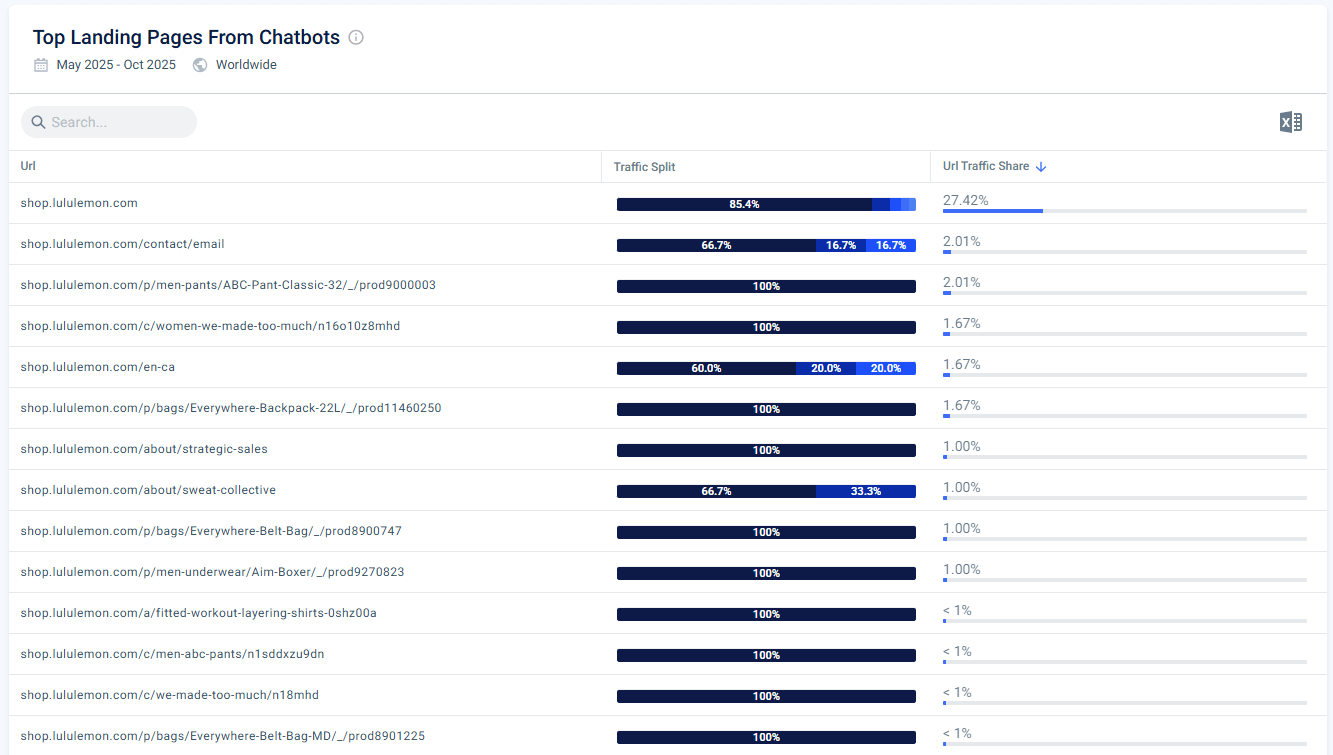
In practice, AI Traffic Intelligence reveals these patterns very clearly. For example, when looking at shop.lululemon.com over six months, ChatGPT made up the vast majority of AI‑originated visits, and traffic climbed steadily month to month.
We can see that ChatGPT is often linked directly to specific products. Let’s look at one of the top-performing products, the ABC Classic‑Fit 5‑Pocket Pant.
The prompts driving this traffic were highly specific, including questions about comfort, office‑appropriate pants, hidden zippered pockets, wrinkle‑resistant fabric, and everyday wear.
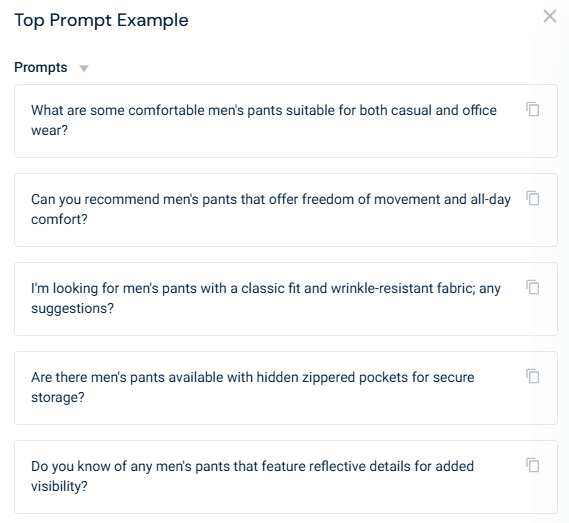
These examples show how closely AI assistants match user intent with product content.
A look at the ABC Classic‑Fit Pant page itself reinforces why it performs so well in AI-driven journeys.
The page combines clear photography, lifestyle imagery, and scannable detail sections that mirror the exact prompts users ask ChatGPT.
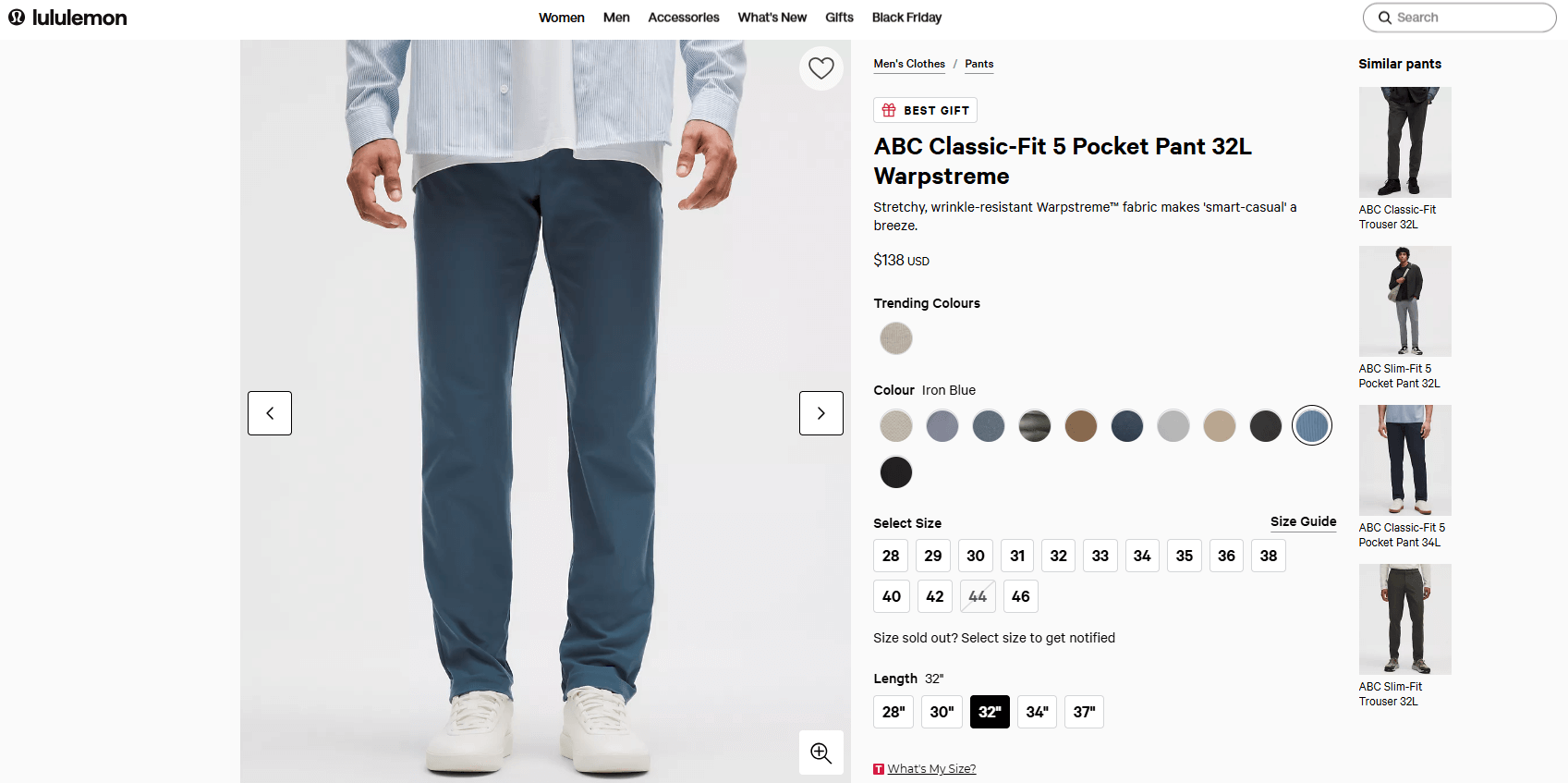
The visuals show the pants in motion, in both casual and office‑friendly contexts, which aligns with prompts about comfort and versatility.
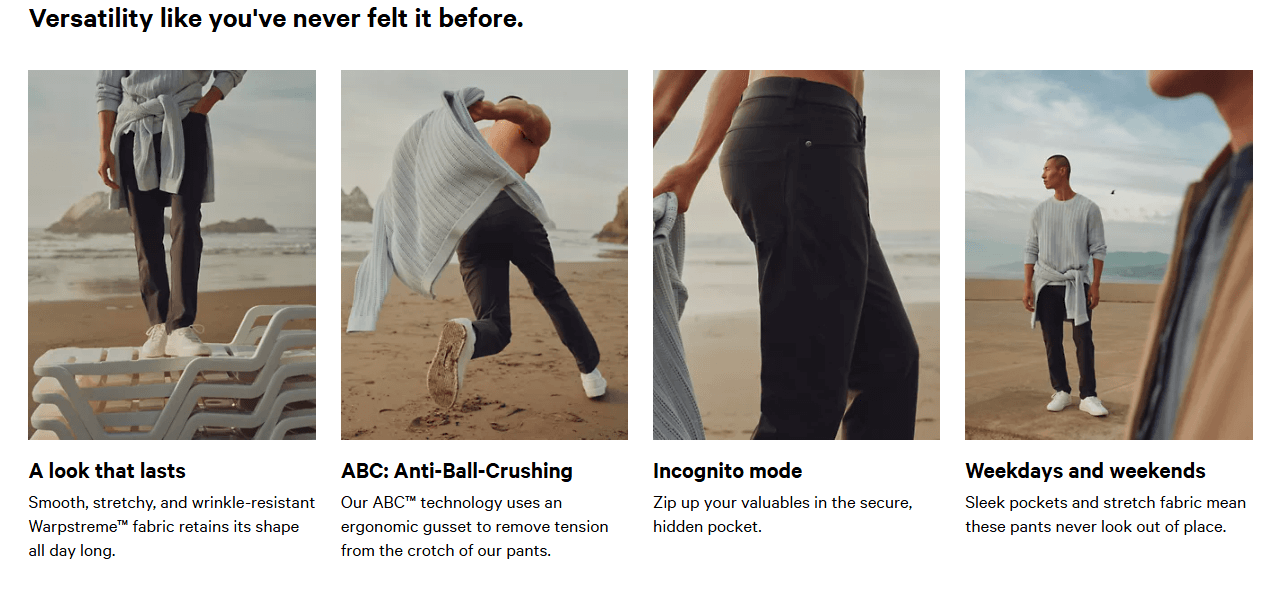
The feature sections are highlighting stretch, wrinkle resistance, hidden zippered pockets, and everyday performance, which map directly to high‑intent queries surfaced in Prompt Analysis.
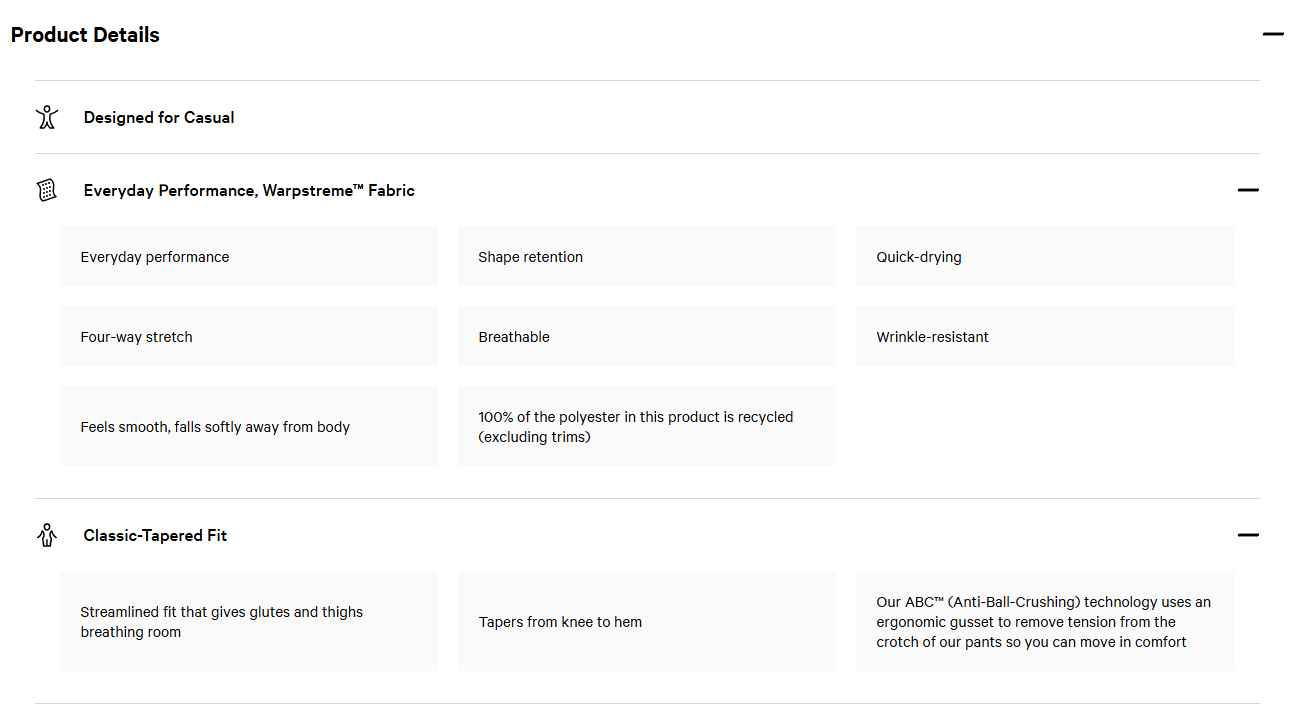
This blend of clear attributes, scenario‑based language, and descriptive visuals makes the product easy for ChatGPT to interpret and recommend. When a product page includes clear attributes, scenarios, and benefits that correspond to real prompts, AI tools have a much easier time recommending the product and sending shoppers directly to the page.
Together, these capabilities give you a measurable view of how GenAI influences your visibility, your audience, and your performance.
Step 7: Build a continuous optimization loop
ChatGPT’s recommendations evolve as products, reviews, and content change. Your strategy should evolve with them.
Each month:
- Test your core prompts in ChatGPT.
- Review which products and brands appear.
- Check your AI brand visibility campaigns.
- Review your AI traffic data.
- Update titles, bullets, and FAQs.
- Refresh your category or comparison content.
- Track changes and repeat.
Start with one category, learn what works, then scale.
Win in both ChatGPT Shopping and everyday conversations
ChatGPT now plays a meaningful role in how people learn about products, compare options, and make decisions. Some of these moments happen inside the shopping research. Many more happen in everyday conversations where users ask broad questions, and ChatGPT includes product recommendations in its answers.
Brands that want to show up in both contexts should focus on:
- Clear explanations of what a product is and who it’s for
- Complete, consistent product data across all channels
- Use-case-driven content that mirrors how shoppers describe their needs
- Strong, specific customer reviews
- Continuous measurement of AI visibility and AI-driven traffic
Similarweb’s GenAI Brand Visibility and AI Traffic Intelligence make this possible. You can see where you appear, what prompts drive mentions, which pages attract AI traffic, and how your performance stacks up against competitors.
Strengthen one category. Measure the impact. Expand.
Whether a shopper is deep in a comparison guide or just casually asking a question, your products should have a chance to be part of the conversation.
FAQs
Does ChatGPT recommend products even outside Shopping Research?
Yes. ChatGPT frequently suggests products during regular conversations when users ask for advice, comparisons, or help evaluating options. These suggestions may not appear as formal “Shopping Research” guides, but the same underlying signals – clear product data, structured content, and strong reviews – influence whether your brand is referenced.
Can smaller brands show up in ChatGPT recommendations?
Yes. ChatGPT does not rank brands based on their size. If a smaller brand has clear product information, strong use‑case content, and trustworthy reviews, it can appear alongside larger competitors. Visibility is tied to clarity and relevance, not company size.
Do I need Instant Checkout to appear in ChatGPT Shopping?
No. Instant Checkout controls how a purchase can be completed inside ChatGPT, not whether a product is recommended. Product relevance, data quality, and review signals matter far more for visibility.
Does ChatGPT use my product feed directly?
ChatGPT’s Shopping Research and Instant Checkout experiences rely partly on structured product data, including feeds submitted through the Agentic Commerce Protocol (ACP). However, OpenAI has not published a full description of how that data is prioritized or combined with website information and third‑party sources. The safest approach is to keep product data consistent across your feed, schema, and PDPs.
How often should I review my GenAI visibility?
A monthly review is a practical cadence for most brands. Product availability, reviews, competitor activity, and ChatGPT behavior all shift quickly. Regular monitoring through Similarweb’s GenAI Brand Visibility and AI Traffic Intelligence helps you adapt to those changes.

Related Posts



Why AI Engines Cite UGC Over Brand Content And How To Leverage It For AEO

AI Mentions vs. AI Citations: What’s the Difference and Why It Matters for GEO


Wondering what Similarweb can do for your business?
Give it a try or talk to our insights team — don’t worry, it’s free!