


 Marketing Intelligence
GEO for B2B: How To Get Your B2B Brand Mentioned In AI Responses

A B2B buyer at a mid-size SaaS company needs to find a cybersecurity vendor. Contract value: $180,000. Sales cycle: nine months. The first thing they do is open ChatGPT and ask: “What are the leading enterprise endpoint security solutions for a 500-person SaaS company?”
The AI returns a synthesized answer. It names four vendors. It explains each one’s positioning, strengths, and a relevant use case. The buyer never opens a browser tab.
Three weeks later, the company issues an RFP. It goes to the four vendors ChatGPT named.
You were not one of them.
This is how the B2B pipeline is changing. According to the 6sense 2025 Buyer Experience Report, which surveyed over 4,000 B2B buyers, 95% of winning vendors were already on the buyer’s initial shortlist. The shortlist is forming earlier than ever, and increasingly, buyers use AI to evaluate and validate the vendors on that list. The brands that don’t appear in those AI answers risk being deprioritized before the first call.
For B2B companies, GEO is a traffic channel as well as pipeline infrastructure. Early movers are more likely to dominate AI comparisons over time.
This guide covers what makes B2B GEO different from B2C, how AI is changing the B2B purchase journey, and how to implement a three-phase GEO strategy. It also covers measurement: the specific KPIs that connect AI visibility to the pipeline, and how to track them using Similarweb’s AI Search Intelligence.
Why GEO hits differently in B2B
GEO for B2B needs a different approach than B2C. In B2B, buying decisions involve multiple stakeholders, take longer, and carry real professional risk if someone makes the wrong choice. Now that AI tools can summarize weeks of vendor research into one answer, B2B brands need to be included in those answers before any sales conversation even begins. If your brand doesn’t show up, you’re not just losing traffic, you’re being left out of the deal entirely.
B2B buying isn’t a quick transaction. A typical enterprise purchase includes six to ten stakeholders on the buyer’s side. Each of them may use AI tools during their research. A software engineer, a procurement manager, and a CISO will all ask different questions. They need different levels of detail. The answers they get from AI can either move your brand into consideration or remove it completely.
B2C GEO is mostly about how often your product gets recommended. For example, if someone asks for the best protein powder, the result is usually a simple product suggestion. B2B is different. It’s less about quick recommendations and more about credibility in complex comparisons. The key question is whether your brand appears when someone asks, “What’s the difference between these enterprise solutions?” or “What should a fintech company look for in a vendor risk management platform?”
Here is how GEO for B2B compares to both B2C GEO and traditional SEO:
| Dimension | Traditional SEO | B2C GEO | B2B GEO |
| Primary goal | Rank for clicks in Google | Appear in product recommendations | Be cited in complex vendor comparisons and category analyses |
| Success metric | Organic traffic, keyword rankings | Recommendation frequency, mention rate | Citation rate across multi-stakeholder query types, pipeline attribution |
| Content unit | Page optimized for keyword | Product listing or review-optimized content | Atomic expert content: structured, data-dense, independently citable |
| Key citation signal | Backlinks and E-E-A-T | Review volume and product authority | Earned media, analyst citations, original research, structured thought leadership |
| Measurement tool | Google Search Console, rank trackers | AI chatbot mention tracking | Similarweb AI Search Intelligence (brand visibility across ChatGPT, Perplexity, Gemini, Google AI Mode) |
| Failure mode | Algorithm update | Negative review in LLM training data | Sub-query coverage gaps: being present for definition queries but absent for comparison queries |
Only 11% of B2B marketing executives say that the majority (75%+) of their content is currently ready for AI discovery. That is the competitive gap. The B2B brands that close it now will be the ones on the Day One shortlist when the RFP goes out.
How B2B buyers use AI in the purchase journey
Like many of us, B2B buyers now use AI assistants at every stage of their work, including the purchase journey, from initial category research through vendor shortlisting to late-stage validation. According to Forrester’s Buyers’ Journey Survey, 89% of B2B buyers engage with generative AI during their buying process. This makes AI visibility relevant not just at top-of-funnel awareness but throughout the entire evaluation cycle, including the stages where most traditional content marketing does not reach.
The B2B purchase journey has three AI touchpoints where GEO determines visibility.
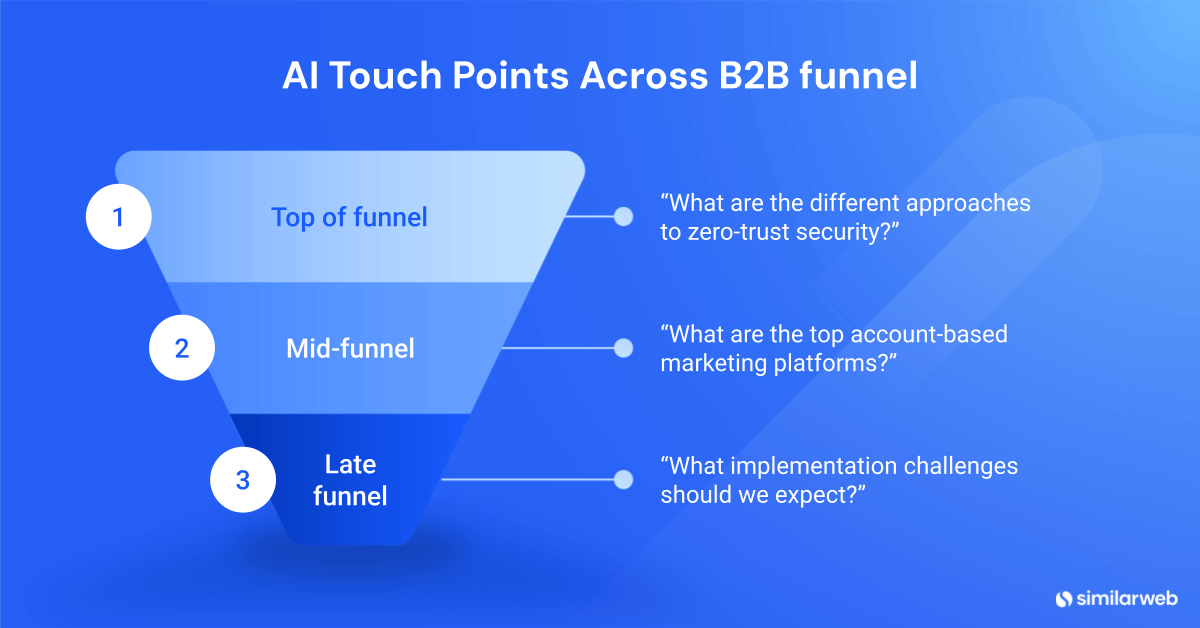
Top of funnel: defining the problem
Similarweb’s 2026 Generative AI Brand Visibility Index report shows AI tools are most used in the discovery stage (35%), significantly ahead of traditional search engines at the same stage (13.6%).

At this stage, buyers are using AI to understand the space. They ask questions like, “What are the different approaches to zero-trust security?” or “How do enterprises manage vendor risk?”
These aren’t product questions. They’re education questions. The brands that show up here aren’t selling, they’re explaining. AI tends to pull content that clearly defines terms, uses credible data, and breaks ideas into easy-to-understand sections.
If your brand appears at this stage, you influence how the buyer understands the category. That understanding often guides the rest of their decision-making process.
Mid-funnel: shortlisting and comparisons
This is the most important moment for B2B GEO.
Buyers now ask comparison questions like, “What are the top account-based marketing platforms?” or “How does Solution A compare to Solution B for a mid-market company?”
The 6sense research shows that most winning vendors are already on the buyer’s initial shortlist before the first sales call. That shortlist is built mostly from brand familiarity and prior exposure.
AI answers play a big role here. They influence how vendors are compared and ranked. If your brand doesn’t appear in AI-generated comparisons, you’re losing influence during the evaluation phase that happens before sales ever get involved.
Late funnel: validation and risk reduction
In the final stage, buyers use AI for reassurance. They ask questions like, “Is this vendor a good fit for a regulated industry?” or “What implementation challenges should we expect?”
At this point, AI responses are often influenced by third-party sources, analyst reports, reviews, and industry publications.
That’s why external credibility matters so much in B2B GEO.
Why this matters now
6sense reports that the average B2B buying cycle shrank from 11.3 months to 10.1 months in just one year. Research is moving faster, and decisions are happening earlier.
When your brand appears in AI answers during the early research phase, you enter the buyer’s evaluation set at the very beginning of the decision process. Early visibility establishes consideration, reinforces credibility, and puts your company on the shortlist before your sales team begins direct outreach.
The Audit-Build-Signal framework: three phases of B2B GEO implementation
B2B companies can implement GEO best practices in three phases. Phase 1 audits current AI visibility across the buyer query space. Phase 2 restructures owned content so AI systems can easily retrieve and cite it. Phase 3 builds the off-page signal trail that trains LLMs to associate the brand with high-intent buyer prompts. Each phase has concrete deliverables, and the full cycle can be completed in 90 days.
Phase 1: Audit and Quantify Your AI Visibility
The audit phase answers a single question:
When buyers in your category ask AI the questions you should own, does your brand appear, and how are you represented when it does?
Start by setting up a campaign in Similarweb’s AI Brand Visibility tool.
Instead of manually running 40 to 60 prompts across ChatGPT and other AI chatbots, define the strategic topics that matter to your brand, products, use cases, industry themes, and customer pain points. These topics power the system’s prompt tracking and visibility measurement.
The platform will suggest topics for you based on our analysis of your brand, and you can also add custom topics:

Once your campaign is live, you can:
- Discover your visibility score across tracked topics
- Benchmark against top competitors
- See which brands dominate each topic
- Identify the most visible domains influencing AI answers

This establishes your starting point.
Use Prompt Analysis to Reveal Coverage Gaps
Navigate to Prompt Analysis within your campaign.
Here, you can:
- View all tracked prompts related to your topics
- See whether your brand is mentioned in each answer
- Identify competitors that appear (in order of mentions)
- Review the full chatbot response
- Analyze exact source citations shaping the answer
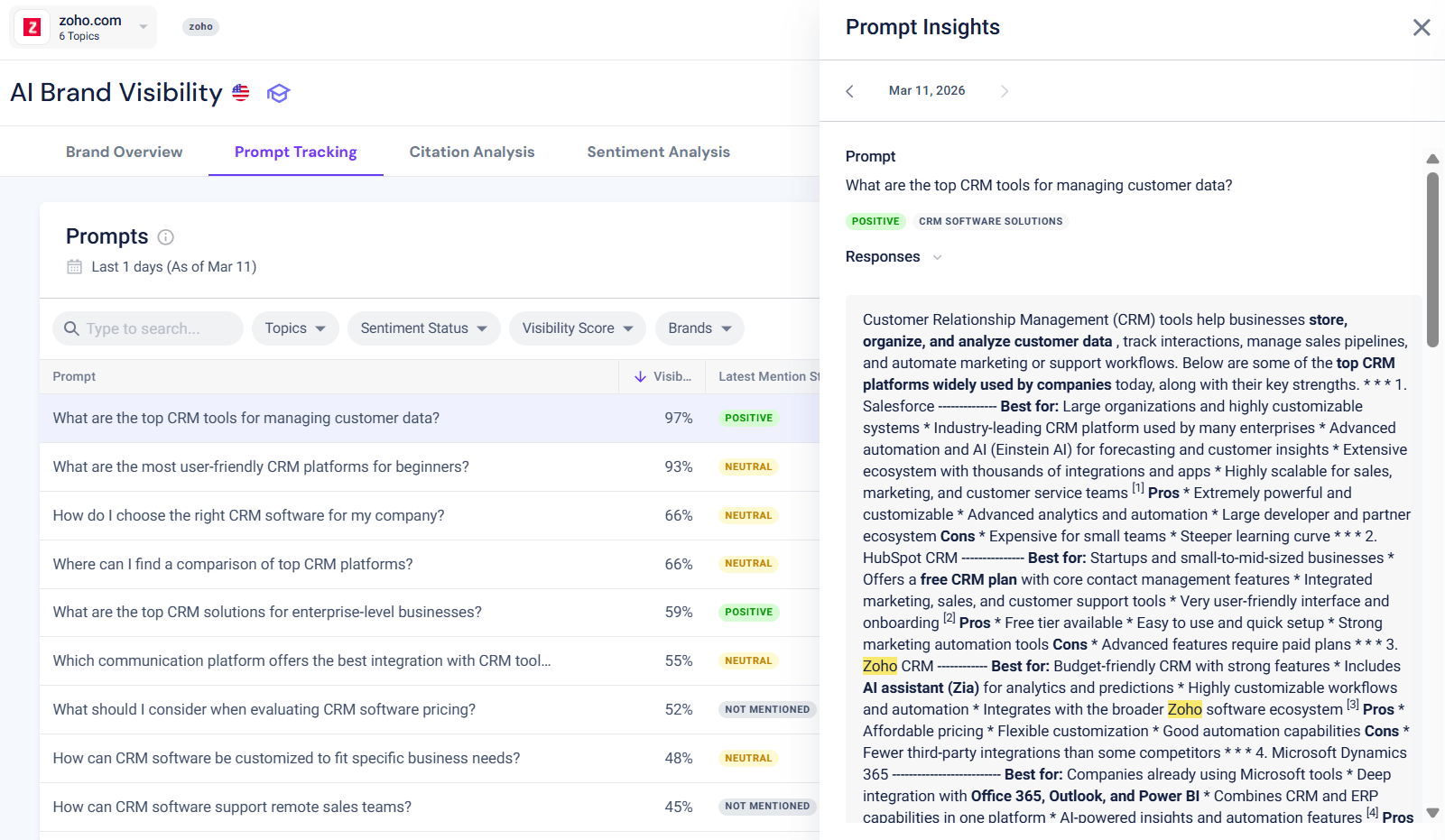
Filter prompts or edit your campaign to add prompts with high-intent modifiers such as:
- “best”
- “compare”
- “pricing”
- “alternatives”
- “vs”
These are often where mid-funnel losses occur.
This audit reveals something traditional analytics cannot:
If your brand is absent from AI answers for critical comparison prompts, there is no Google Search Console signal. No impression. No missed click. The buyer excluded you, and you would never know without AI visibility tracking.
Prompt Analysis replaces manual testing with structured, competitive insight.
Visibility alone does not tell the full story.
Add Sentiment Analysis: Visibility Is Not Enough
Use Sentiment Analysis within AI Brand Visibility to understand:
- Whether mentions are positive, neutral, or negative
- How your brand is framed relative to competitors
- Whether competitors are described as “leaders” while you appear as an “alternative”
- Whether your positioning aligns with your strategic narrative
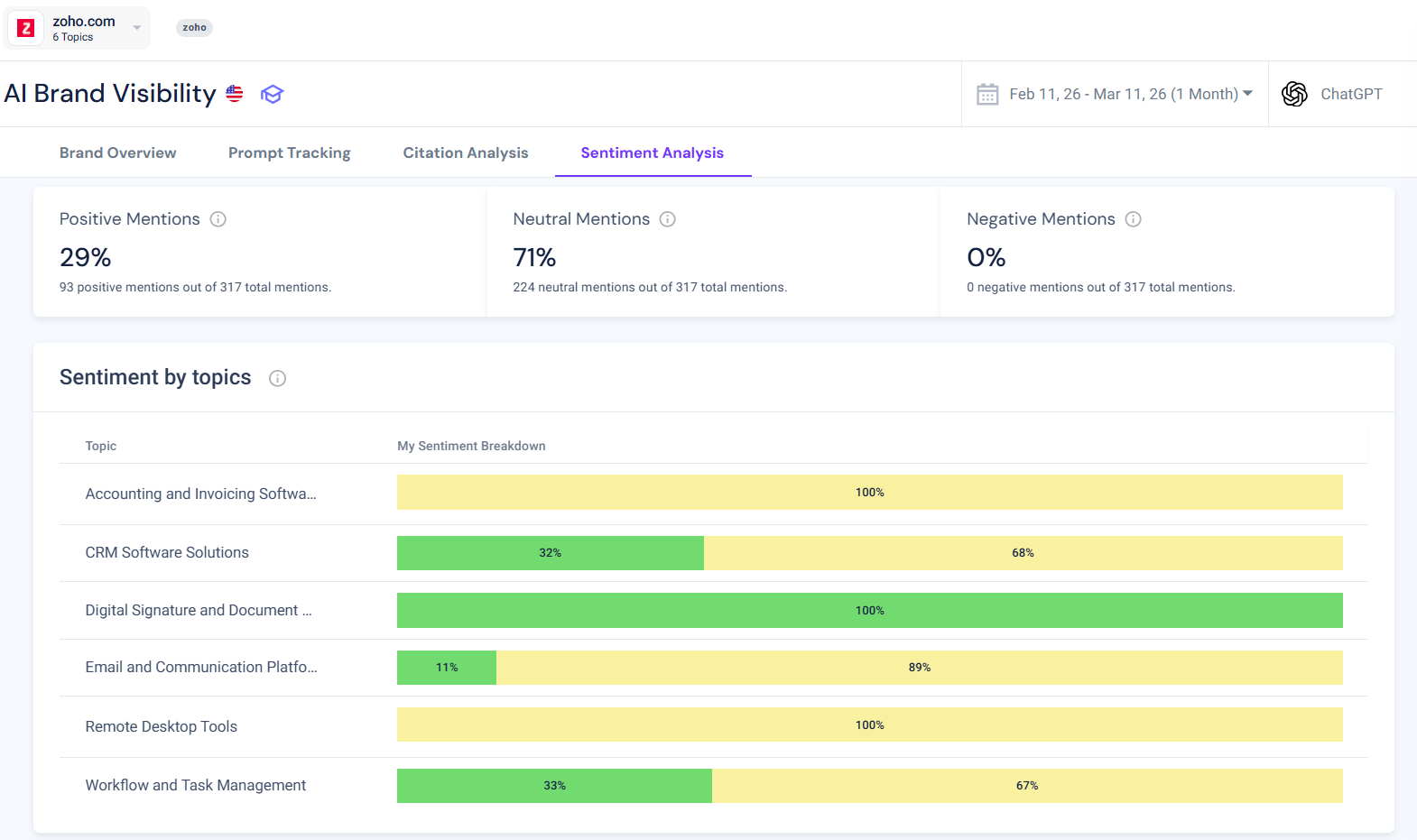
This reveals how your brand is framed, not only whether it appears.
By the end of Phase 1, you should have:
- Visibility share by topic
- Prompt-level inclusion and exclusion insights
- Competitive benchmarking
- Brand framing and sentiment trends
This becomes your AI presence baseline.
Phase 2: Build AI-Extractable Content, Guided by Citation Data
The build phase restructures owned content so AI systems can retrieve, extract, and cite it accurately.
Content optimized for generative engines can increase visibility significantly, especially when it includes authoritative citations, clear definitions, and structured answers.
But instead of optimizing blindly, use Citation Analysis to understand what AI engines already trust.
Use Citation Analysis to Reverse-Engineer Authority
Inside your campaign, navigate to Citation Analysis.
This report shows:
- The domains most cited across your tracked topics
- Domain Influence Score (how often a domain is cited)
- URL Influence Score (how often specific pages are cited)
- Source categories (publishers, reviews & UGC, competitor domains, your domain, marketplaces, social media, other)
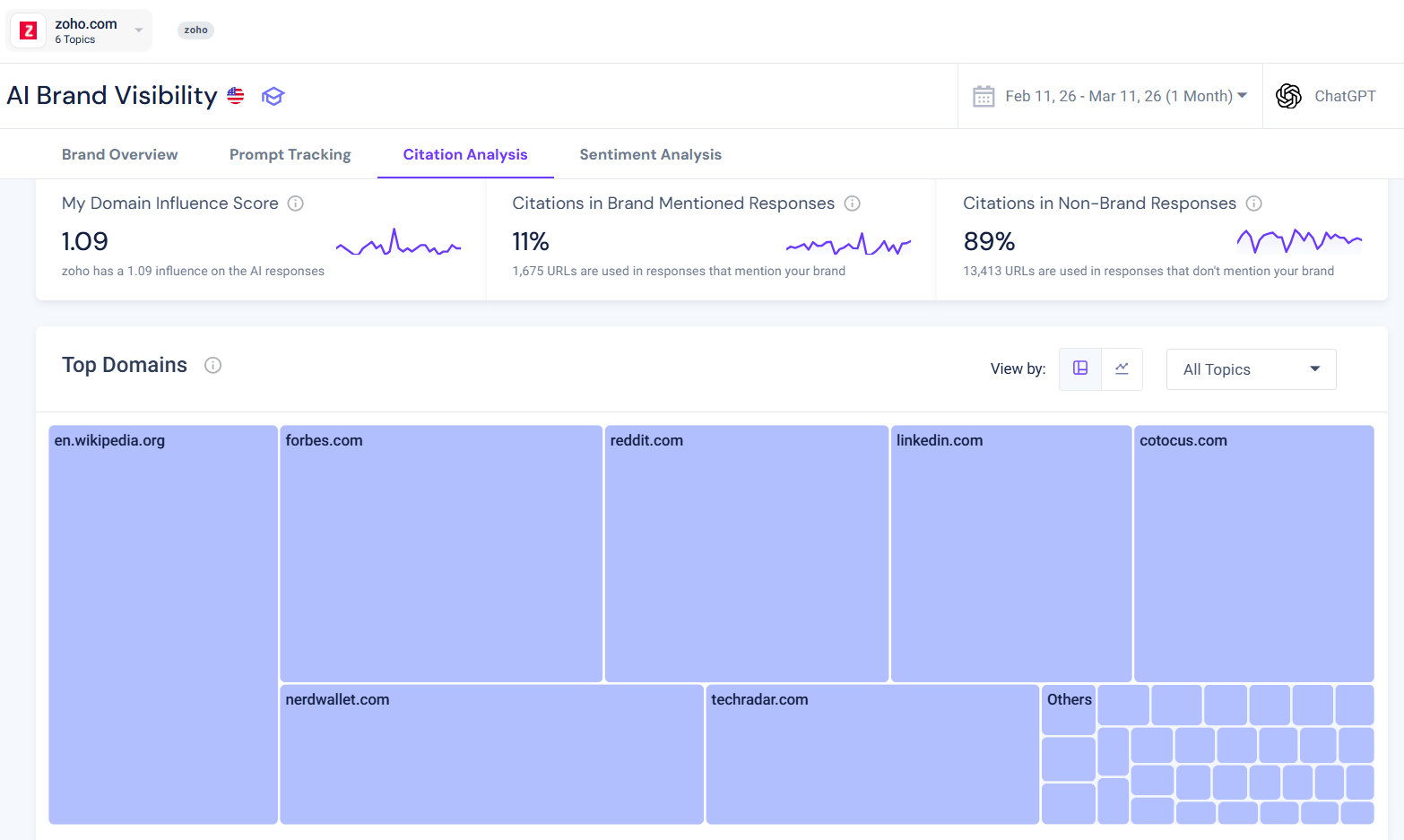
This tells you three things immediately:
- Are publishers dominating AI answers in your category?
- Do review platforms influence comparison prompts?
- Is Reddit or UGC frequently cited?
- Are competitor blogs cited more often than brand sites?
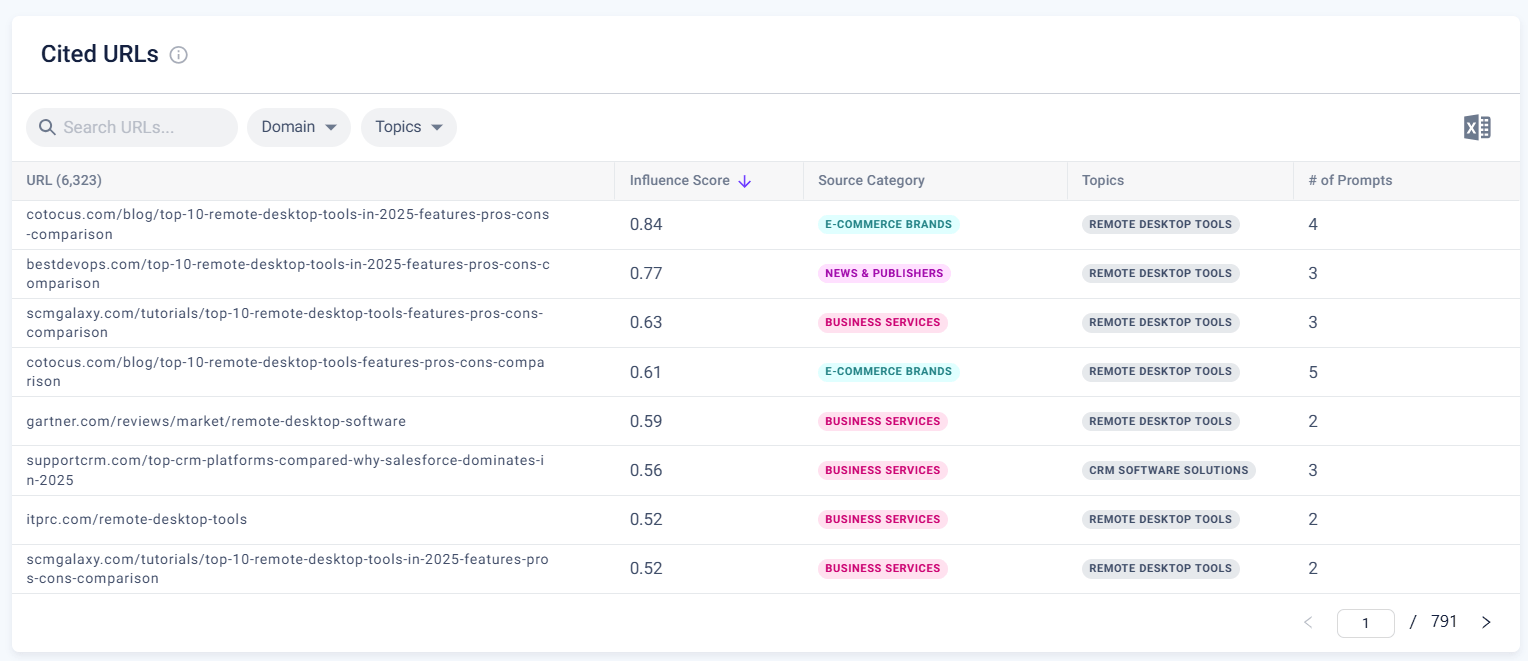
You can now identify:
- Which domains does AI trust?
- Which page formats are cited most often
- Which content types influence specific prompts
Optimize Core Pages for Extractability
Core pages (homepage, about, solutions) are often cited for branded and lower-funnel queries.
Most B2B pages are written linearly for human readers. AI systems extract sections, not narratives.
Use your Prompt and Citation insights to restructure core pages:
- Define your category clearly within the first 80 words
- Avoid jargon-first openings
- Ensure each section answers a standalone question
- Use tables, lists, and comparison elements
- Make brand and product references explicit (no pronoun ambiguity)
Each section should function independently when extracted.
Re-Architect Thought Leadership Content
Many long-form B2B articles are hard to read by AI because they build toward a conclusion rather than answering a question directly.
A reader, or AI model, should gain value from reading only the first paragraph of any section.
This architecture aligns with how AI systems extract content chunks.
Invest in Proprietary Data to Build a Citation Moat
Citation Analysis often reveals that AI systems heavily cite primary sources and publishers.
Publishing proprietary research makes it harder for competitors to displace you in AI answers.
Examples:
- Industry benchmarks
- Survey data
- Trend analyses
- Platform-derived performance insights
Primary data increases the probability that:
- Publishers reference you
- AI engines cite your URLs directly
- Your brand becomes a source, not just a mention
Here is a working template to evaluate content readiness for AI extraction:
B2B content AI-readiness audit: section-level checklist
| Check | Pass criteria |
| Opening answer | First 50 words answer the implicit question without requiring prior context |
| Explicit definition | Any technical concept or category term is defined: “X is the process by which…” |
| Data density | At least one quantified claim with source and date in this section |
| Independence | A reader who skips directly to this section understands it fully |
| Structure signals | The section contains at least one table, list, or comparison element |
| Entity clarity | Brand name, product name, or company is unambiguous (no pronoun-only references) |
Phase 3: Signal, Build the Off-Page Citation Trail
This is the phase most B2B GEO guides overlook. It is also the phase with the highest leverage.
Citation Analysis shows that AI engines rely heavily on third-party domains, including publishers, review platforms, and community-driven content, to determine the answers they generate.
Instead of generic PR, use Domain Influence Score to prioritize outreach.
Prioritize High-Influence Domains
Inside Citation Analysis:
- Sort domains by Influence Score
- Filter by topic
- Drill down to see which prompts each domain influences
This allows you to:
- Identify the publishers shaping your category narrative
- Detect review platforms influencing comparison queries
- Spot UGC sources driving peer-validation prompts
Your PR and analyst strategy should prioritize domains with measurable AI influence.
Analyst and Industry Authority Placement
Mentions from recognized analyst firms and industry bodies often carry strong citation weight.
Track whether:
- Analyst domains appear in high-influence topics
- Industry associations influence definitional prompts
Review Platforms and Community Presence
If Citation Analysis shows review platforms or Reddit with a strong influence:
- Strengthen review profile completeness
- Encourage high-quality customer reviews
- Improve category positioning
- Participate in relevant professional communities
Monitor and Iterate
AI visibility is dynamic.
Use AI Brand Visibility to:
- Track 30-day visibility trends
- Benchmark against competitors
- Monitor shifts in domain influence
- Identify new prompt patterns
- Detect sentiment changes
Generative visibility becomes a measurable KPI, not a theoretical initiative.
By integrating the above steps, your GEO strategy evolves from manual experimentation to a data-driven growth loop:
Measure visibility → Identify prompt gaps → Reverse-engineer authority → Optimize extractable content → Build citation influence → Track progress.
What Actually Increases the Likelihood of Being Mentioned in AI Answers?
At a practical level, B2B brands are usually mentioned in AI-generated answers when three conditions are met.
1. Clear entity definition
Your brand, product, and category must be explicitly defined on your site and across third-party sources.
AI systems do not infer positioning the way humans do. If your homepage does not clearly state what category you operate in, who you serve, and what problem you solve, you are harder to retrieve for category-level queries.
This means:
- Defining your category in plain language within the first section of the core pages
- Explicitly naming your ideal customer profile and use cases
- Avoiding vague positioning statements that require context to interpret
If AI cannot clearly associate your brand with a specific category and use case, you are unlikely to appear in vendor comparisons.
2. Full topical coverage across sub-queries
AI systems turn complex prompts into multiple fan-out queries.
For example, a query like:
“What are the best ABM platforms for mid-market SaaS companies?”
May be broken into:
- Best ABM platforms for mid-market SaaS
- Top ABM software for B2B SaaS companies
- ABM tools for SaaS teams 50–500 employees
- Best ABM platforms for companies with $10M–$100M ARR
- ABM platforms for SaaS with long sales cycles/enterprise deals
If your brand appears only in definition content, not on comparison pages, in pricing discussions, or in industry-specific use cases, you will be excluded.
The brands most consistently mentioned in AI answers typically have:
- Structured comparison pages
- Industry-specific landing pages
- Pricing transparency or pricing guidance
- Objection-handling content
- Clearly segmented solution pages
Coverage gaps at the sub-query level often explain why strong SEO brands fail to appear in AI answers.
3. Third-party reinforcement
Owned content alone is rarely sufficient in B2B.
AI engines frequently cite:
- Industry publishers
- Analyst firms
- Review platforms
- Community discussions
If your brand is absent from those domains, AI systems may default to competitors that are better represented externally.
Third-party reinforcement includes:
- Strong and complete review platform profiles
- Analyst mentions in relevant category reports
- Publisher coverage that explains the problem space, not just your product
- Citations of proprietary research
Being mentioned is rarely the result of one optimized page. It is the result of consistent signals across owned and earned media.
A Simple Diagnostic Question
If you removed your website from the internet, would your brand still appear in third-party discussions about your category?
If the answer is no, your AI visibility risk is high.
Being mentioned in AI answers is not random. It is the outcome of clear entity definition, complete topical coverage, and third-party validation working together.
The Audit–Build–Signal framework gives teams a practical way to apply those three conditions
Conclusion
GEO for B2B is not a content tactic. It is a big change in how enterprise shortlists are formed.
AI systems now consolidate research, comparison, and validation into a single interface. They are shaping how categories are defined, how vendors are evaluated, and which brands are treated as credible options before a sales conversation ever happens.
That changes how B2B marketing operates.
It is no longer enough to rank in Google. It is no longer enough to publish thought leadership. B2B brands must be retrievable, citable, and reinforced by third-party authority across the prompts their buyers are asking at every stage of the journey.
The Audit–Build–Signal framework gives teams a measurable way to respond:
- Audit where your brand is absent or misrepresented.
- Build content that AI systems can extract with clarity.
- Signal authority through the publishers, analysts, and platforms that influence citations.
Competitive advantage will come from treating AI visibility as infrastructure, measured, benchmarked, and improved over time.
Track your brand’s visibility across ChatGPT, Perplexity, Gemini, and Google AI Mode with Similarweb AI Search Intelligence, and make sure your shortlist presence is not left to chance.
FAQs
What is the difference between GEO, AEO, and SEO for B2B companies?
SEO (Search Engine Optimization) optimizes web pages to rank in traditional search engine results pages, with success measured by organic traffic and keyword rankings. AEO (Answer Engine Optimization) structures individual pages to appear in AI-generated responses and featured snippets, with success measured by citation rate and zero-click visibility. GEO (Generative Engine Optimization) is the broader discipline of building brand authority so that AI engines retrieve, cite, and recommend a brand across multiple platforms simultaneously. For B2B companies, all three are needed. SEO remains the foundation because AI engines favor content that ranks well in traditional search. AEO structures pages for extraction. GEO builds the off-page authority ecosystem required to be cited in the high-stakes vendor comparisons where B2B shortlists are formed.
How much should a B2B company invest in GEO in 2026?
Investment depends on company size and competitive urgency. Mid-market B2B companies ($10 to 50 million ARR) typically budget $75,000 to $150,000 per year, according to Forrester benchmarks. Enterprise companies budget $250,000 and above. Most fund GEO by reallocating 10 to 15% of existing organic search and content budget rather than requesting net-new spend. According to Conductor’s 2026 CMO Investment Report, enterprises already allocate an average of 12% of digital marketing budgets to GEO and AEO, with 94% of CMOs planning to increase that allocation. What matters most is competitive urgency: if competitors consistently appear in AI answers for your key buyer prompts, the cost of waiting adds up each month.
Why do B2B companies that rank well in Google still not appear in ChatGPT or Perplexity?
Google rankings and LLM citations can correlate, but are not the same signal. AI engines decompose each query into multiple sub-queries and retrieve content for each independently. A page that ranks for a primary keyword may be absent from the comparison, objection, and metric sub-query types that LLMs generate, because those require a different content structure. The second cause is off-page signal gaps: a brand with strong SEO but limited third-party presence on review platforms, industry publications, and analyst sources may be skipped in favor of brands with both.
Do ChatGPT, Gemini, Perplexity, and Google AI Mode cite different sources?
Yes, significantly. Optimization for one platform does not automatically translate to the other. ChatGPT draws heavily from training data and tends to favor branded web mentions and long-form editorial content. Perplexity searches the live web fresh for every query and tends to cite structured, recently updated pages with extractable data blocks. Google AI Mode and Gemini draw from the same index as Google Search, but prioritize semantic completeness and multi-modal content. B2B teams should baseline visibility across all three platforms and address gaps platform by platform rather than assuming a single content strategy covers all three.
How long does it take to see GEO results as a B2B brand?
Initial citation improvements typically appear within 3 to 4 weeks of content restructuring for brands that already have established domain authority. Measurable increases in AI-referred traffic generally emerge in months 2 to 3. For B2B companies with sales cycles of 90 days or longer, pipeline attribution from GEO investment typically becomes trackable in months 6 to 12. Off-page signal building, including earned media and analyst placements, takes longer to show results, typically 6 to 18 months, because it depends on training data update cycles and accumulated third-party citation volume. The key measurement change: track AI citation rate and brand mention rate monthly from day one, so the pipeline attribution story is clear when it materializes.
Is GEO worth investing in for B2B if AI accounts for less than 1% of current website traffic?
Yes, for two reasons that are specific to B2B. First, AI-referred visitors convert at approximately 23 times the rate of traditional organic visitors for B2B SaaS companies, meaning low volume with high conversion can outperform high volume with low conversion. Second, and more importantly, AI answers that do not generate a website click still influence how buyers evaluate and rank vendors. Buyers use AI primarily during the evaluation phase to compare and validate vendors they are already considering.
Which content types are most likely to earn AI citations in B2B?
Analysis of 23,387 AI citations across ChatGPT, Perplexity, Gemini, and Google AI Mode found that the most-cited content types for B2B brand queries are: review and third-party validation content (customer reviews, G2/Capterra profiles, which provide a 4.6 to 6.3x citation multiplier compared to basic brand mentions), comparison and evaluation pages, original data and research, and directly answerable product or solution pages. Within owned media specifically, analysis of B2B tech brands found that owned websites are cited more than twice as often as earned media sources, which means a brand’s own solution and product pages structured for AI extraction are the highest-priority content investment, not just off-page PR.
What is the first step to start a B2B GEO strategy?
The first step is a prompt audit: map 40 to 60 buyer questions across the three funnel stages described in this article, run each in ChatGPT, Gemini, Perplexity, and Google AI Mode, and document where your brand appears and where competitors appear instead. This baseline tells you the size of the gap, which sub-query types are most unaddressed, and which competitors have already built the citation authority you need to compete with. Similarweb’s AI Brand Visibility module automates this process at scale, tracking brand visibility scores, prompt-level gap analysis, and citation source mapping across tracked topics. The rest of the strategy depends on what that baseline reveals.

Related Posts



How to Be a Good Salesperson: 7 Data-Backed Fundamentals That Separate Top Performers in 2026
Sales Funnel Optimization In 2026: 9 Tactics That Actually Move Prospects Through Your Pipeline

Why Your B2B Lead Generation Strategy Fails: The MQL-SQL Gap And 8 Fixes That Work in 2026


Wondering what Similarweb can do for your business?
Give it a try or talk to our insights team — don’t worry, it’s free!