


 Marketing Intelligence
Understanding Influence Score and How To Use It for GEO

Generative AI is changing how people discover brands. Instead of browsing a search results page, users now ask a chatbot for advice, recommendations, or product comparisons. This shift creates a new challenge for SEOs. We still optimize for Google, but AI tools rely on entirely different signals. They pull information from the sources they trust most and were trained on, which means brands need to understand what those sources are and how often they appear in AI-generated answers.
Inside Similarweb’s AI Brand Visibility, the citation analysis tool helps me see exactly which pages shape the responses in the topics I track.
One of the most useful metrics in this report is the Influence Score. It shows me how frequently a specific URL is cited across AI answers in a given timeframe.
Influence Score helps me figure out why certain brands appear more often than others, which domains dominate the conversation, and where I might need to take action.
In this article, I explain how Influence Score works and show how I used it in an example campaign to understand which URLs influence AI answers about activewear. I also walk through the steps I follow to turn these insights into actionable insights that improve visibility in AI search.
What is influence score?
Our Influence Score measures how often a specific page is cited across AI responses during the timeframe I am analyzing. If a URL appears in many answers, its Influence Score will be higher. If it only appears once or twice, the score will be lower. This gives me a clear way to compare the impact of pages in the conversation around my topic.
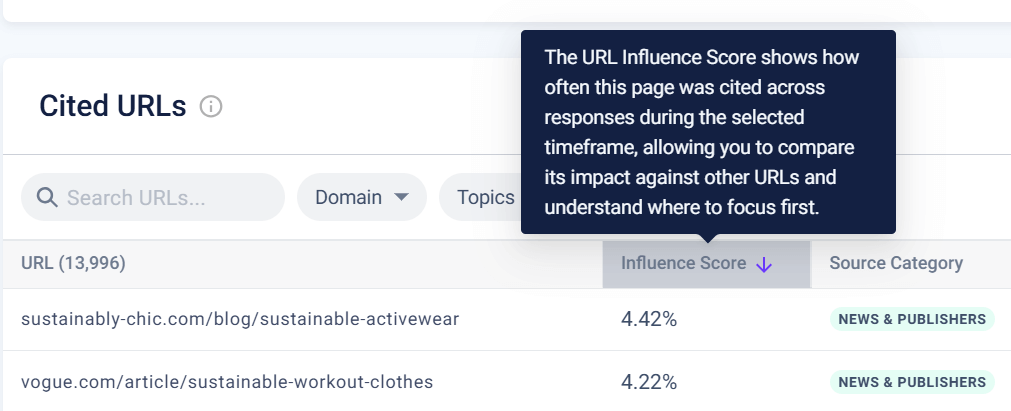
Make sure to note an important distinction between Domain Influence Score and URL Influence Score.
The Domain Influence Score indicates the frequency at which an entire domain appears across answers for a given topic.
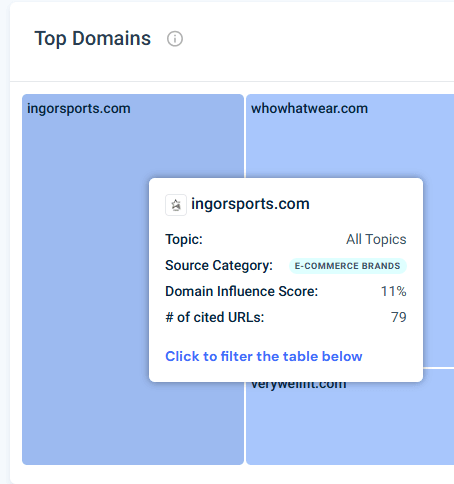
URL Influence Score shows how frequently an individual page is used as a source. I rely on the URL-level metric when I want to identify the pages that shape the model’s understanding of my category. These page-specific insights are usually the ones that lead to the clearest GEO actions.
Where influence score lives inside AI brand visibility
Influence Score appears in the Citation analysis tool. I start by looking at the top domains by topic view, which gives me a high-level view of which domains influence answers in the topic I track.
Here is what I saw for the topic Leggings and Yoga Pants in my Lululemon campaign.
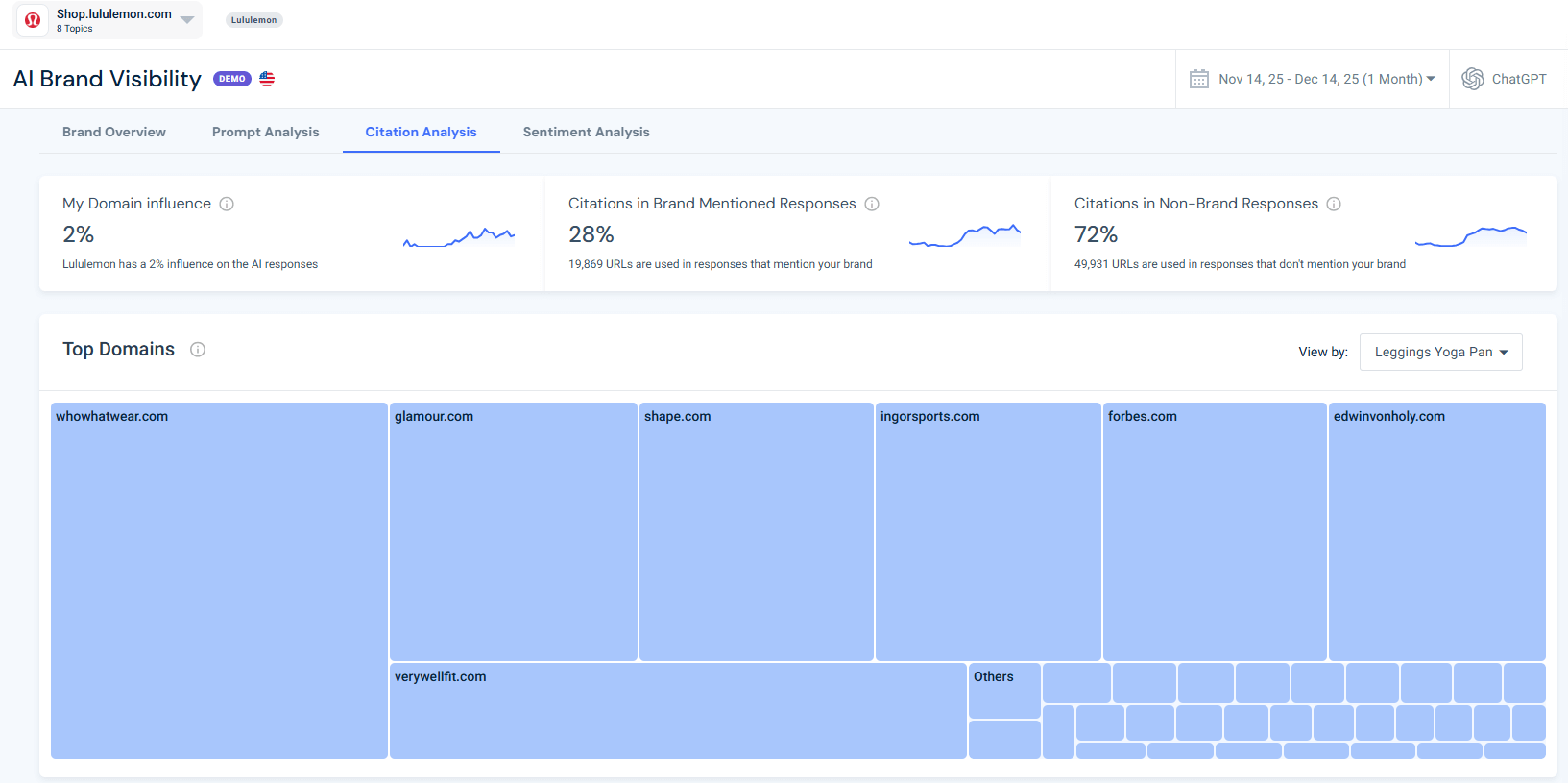
In this view, I can immediately see that whatwhatwear.com is the most influential domain for this topic, taking up the largest area in the visualization. Other major domains include glamour.com, shape.com, ingorsports.com, forbes.com, and edwinvonholy.com.
This tells me that lifestyle publishers and fashion review sites dominate GenAI’s understanding of leggings and yoga pants. My own domain influence for this timeframe is 2%, which signals that Lululemon content is being referenced, but not nearly at the level of these top publishers.
This also tells me which types of sites the model relies on. When I see publishers, review sites, or lifestyle blogs dominating the topic, I already know that list-based guides or comparison articles will probably appear in the URL view too.
Next, I scroll down to the Cited URLs table. This is where the Influence Score becomes most useful. I sorted the table by Influence Score to see which pages the model used most often when answering prompts in this topic.
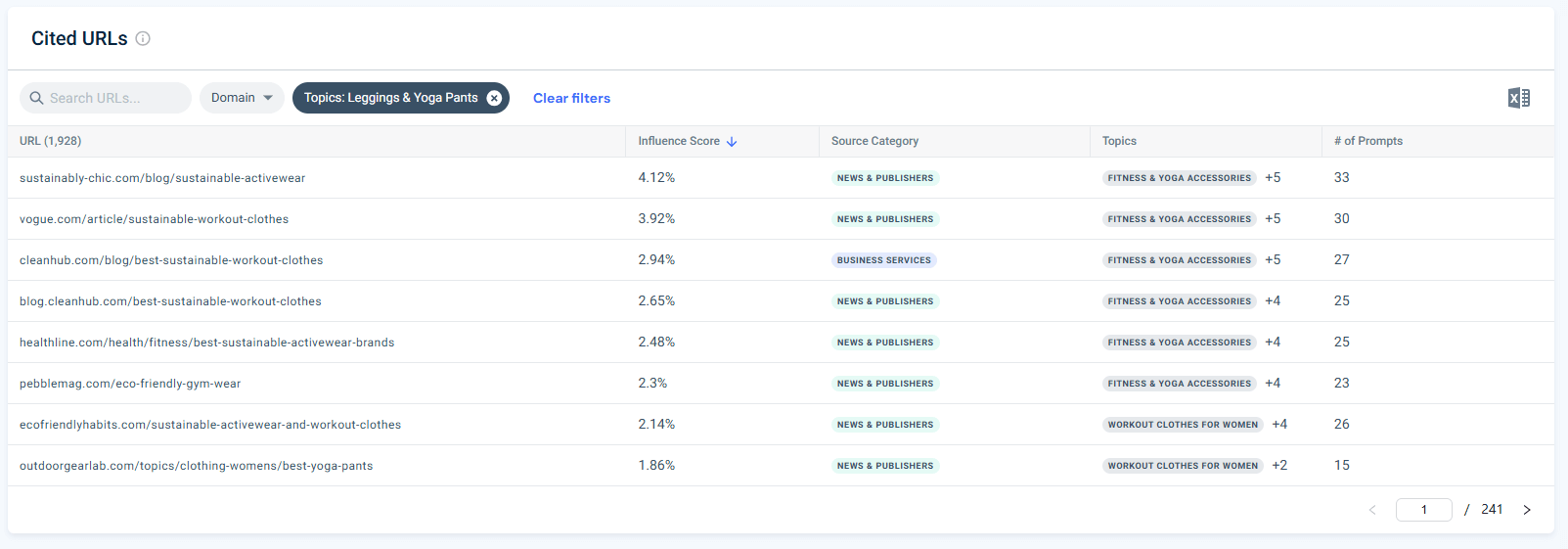
When I sorted the table by Influence Score, the top URL was from Sustainably Chic with an Influence Score of 4.12%, which means it appeared in more than four percent of all AI answers for this topic during the month-long timeframe.
Just below it, an article from Vogue had a 3.92% Influence Score, followed by Cleanhub at 2.9%. This suggests that these articles have the most influence on AI chatbots in my topic, and I should definitely reach out to them to make sure my brand is well represented.
What stands out to me is that nearly all of the top ten URLs come from the News and Publishers category. This reinforces what I saw in the Top Domains view.
I also notice that each of these URLs influences between 15 and 33 prompts, which gives me a clear sense of which sources GenAI relies on when answering questions about sustainable workout gear and leggings.
Seeing these exact numbers helps me understand the scale of influence. It also highlights how query fan-out works in GenAI. A single influential URL can shape a wide range of related prompts, even when the user phrasing varies.
This reinforces why understanding which pages influence the model is so important for GEO. A difference of even one percentage point can represent dozens of AI responses, which is why URL-level insights like these are so valuable for GEO.
The table also includes other fields that help me understand each URL. These include the source category, the topics the URL appears in, and the number of prompts it influenced. I can filter by topic or domain, or use the search box if I want to find a specific page or domain.
Why influence score matters for SEOs and GEO professionals
Influence Score gives me a way to understand how AI models build their answers, which is something traditional SEO tools cannot show.
1. It reveals which sources GenAI trusts
When a URL has a high Influence Score, it means the model relied on that page repeatedly. This is a strong signal that the content has become part of the AI ecosystem for that topic.
2. It helps me understand my content gaps
When I review high-influence URLs, I can see what types of content the model prefers. This includes page structure, expertise signals, and the angle each article takes. These patterns help me understand what kind of content is shaping the category.
3. It identifies my real competition for AI visibility
In AI answers, the competing sources are often not the same as the competing rankings in Google. Review sites, lifestyle publishers, and niche blogs often have much more influence. Influence Score helps me see which of these sites matter most.
4. It helps me identify partner brands to work with
When I see the same brands repeatedly mentioned across high-influence URLs, it shows me which companies the model already trusts within my category. These brands can become valuable collaboration or partnership targets. Strengthening relationships with them, contributing to joint content, or exploring co-marketing opportunities helps firm up my off-page presence so that my brand becomes more visible within chatbot responses.
How I use influence score for GEO and AEO
Once I know which URLs have the highest Influence Scores, I turn my attention to how these pages affect my brand.
1. Build a prioritized outreach list
Influential URLs are the most valuable targets for outreach. If a page with a high Influence Score does not mention my brand, I add it to my list for potential partnerships, content contributions, or simple brand inclusion requests.
2. Check whether these influential sources already mention my brand
In my Lululemon campaign, the URL from sustainably-chic.com had the highest Influence Score. I opened the list of prompts where this page was used and filtered them to the prompts that mentioned Lululemon.
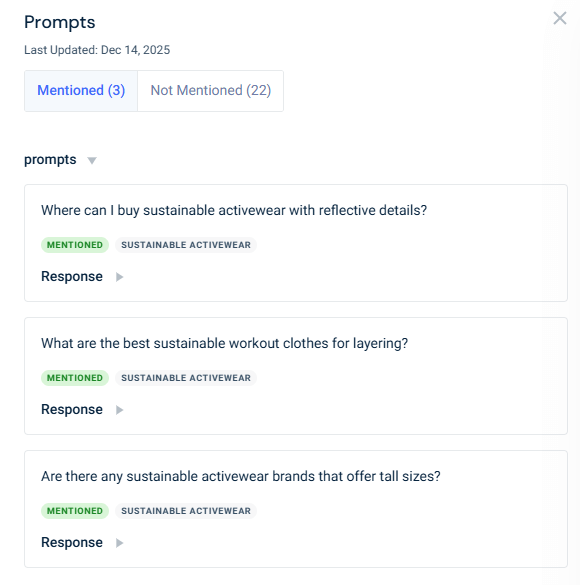
When I opened the prompt list for sustainably-chic.com, I saw that only 3 prompts included Lululemon in the answer. These prompts were:
- Where can I buy sustainable activewear with reflective details?
- What are the best sustainable workout clothes for layering?
- Are there any sustainable activewear brands that offer tall sizes?
In all three cases, Lululemon appeared as one of the recommended brands, which tells me that this URL plays a positive role in reinforcing the brand when the topic is sustainability.
This is especially useful because sustainability is not traditionally Lululemon’s strongest association. Seeing AI tools mention the brand here tells me that some publishers recognize Lululemon’s sustainable lines, and the model is picking up on that.
Then I clicked into one of the prompts to read the full response.
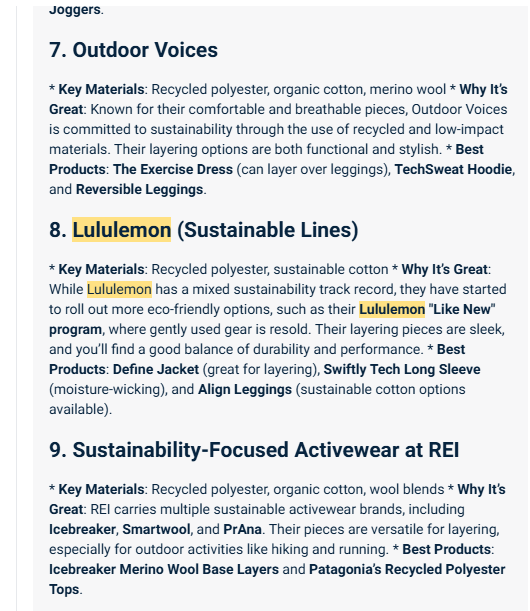
When I clicked into the prompt What are the best sustainable workout clothes for layering?, the AI answer included a detailed breakdown of recommended brands. Lululemon appeared with details on key materials, why the brand is a strong choice, and product suggestions like the Define Jacket and Swiftly Tech Long Sleeve.
This helps me evaluate the accuracy and tone of the reference. The answer mentions Lululemon’s Like New program and highlights both recycled polyester and sustainable cotton.
This is the kind of representation that strengthens the brand’s presence in sustainability conversations. It also gives me insight into exactly how the model understands Lululemon’s positioning.
When I read these answers, I check whether the mention aligns with how the brand should be represented. I look at the accuracy, tone, and whether the information reflects current products and positioning.
3. Identify URLs where the brand is missing
Next, I review the prompts shaped by the same URL where Lululemon does not appear.
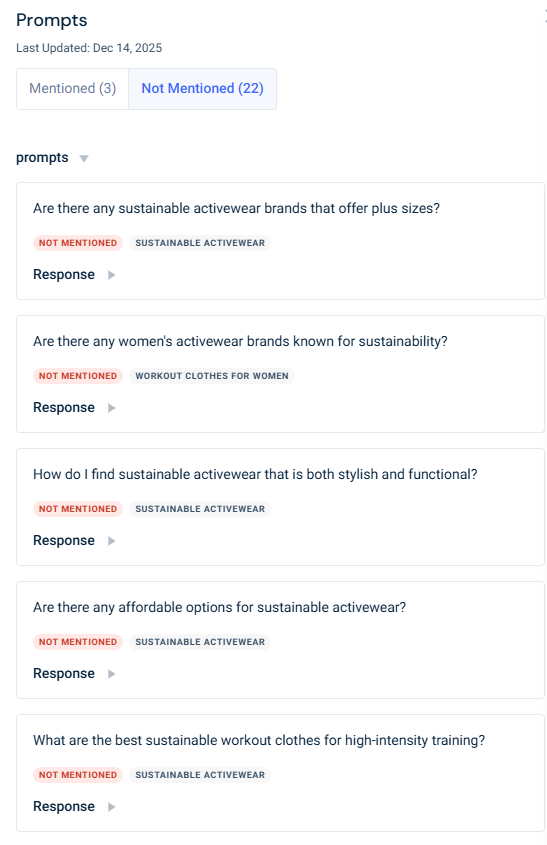
In the Not Mentioned tab, I found 22 prompts where sustainably-chic.com shaped the answer, but Lululemon did not appear at all. Examples include:
- Are there any sustainable activewear brands that offer plus sizes?
- Are there any women’s activewear brands known for sustainability?
- How do I find sustainable activewear that is both stylish and functional?
- Are there any affordable options for sustainable activewear?
- What are the best sustainable workout clothes for high-intensity training?
These tell me exactly where Lululemon is absent in conversations driven by a highly influential URL. This is where I can analyze AI citation gaps, meaning I look at the specific prompts where the source helped generate an answer, but the brand was not included in conversations driven by a highly influential URL.
When I see this pattern, I know the next step is to evaluate the page itself. If Lululemon is not mentioned in the sustainably-chic.com article, I can consider outreach to request brand inclusion.
Since this page influences more than 30 prompts, even a small update could meaningfully improve the brand’s presence in AI-generated responses, and in some cases, the site can also add a backlink to my website, which strengthens both visibility and authority.
4. Optimize my own site for model-friendly content
By studying the highly influential URLs, I start to see what the model finds useful. Often, these pages include structured comparisons, clear entity references, and authoritative explanations. I take note of these patterns and consider how I can reflect similar clarity and completeness in my own content.
5. Track topic-level influence shifts over time
Influence Scores change as new content is published and as the model evolves. I pay attention to URLs that rise in influence because they may quickly become important sources in my topic. I also watch for declines because they might indicate outdated content or missed opportunities.
How influence score fits into a broader GEO strategy
Influence Score is just one part of our broader AI visibility offering. Citation Analysis helps me see who shapes the narrative. Brand mention tracking shows me how the brand appears in the conversation.
The Prompt Analysis tool shows me what users are actually asking AI tools within the topics I track.
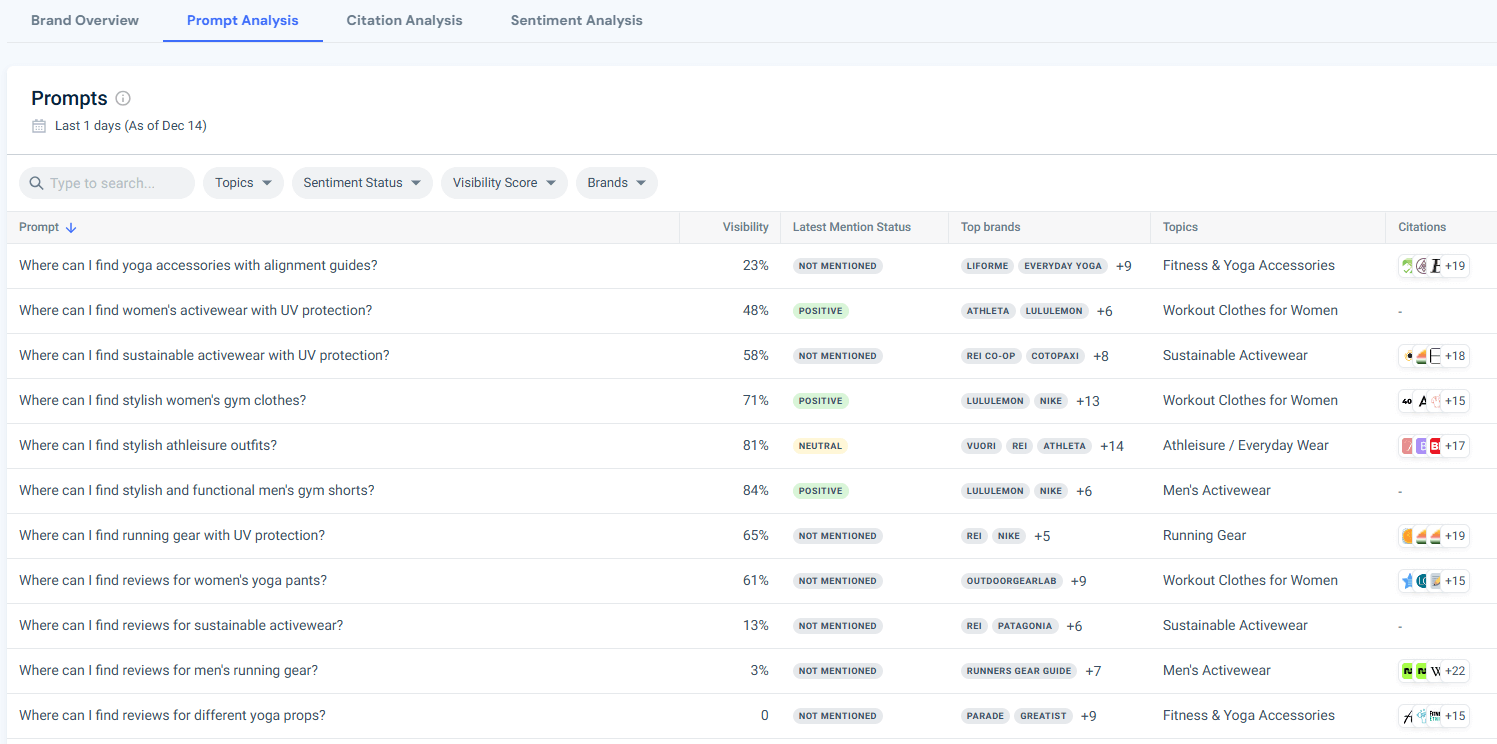
It reveals the real prompts driving the recommendations and comparisons that matter to my brand. I can see whether my brand is mentioned in the answers, understand the intent behind each prompt, and identify the prompts where competitors appear, but I do not.
This helps me build a targeted content roadmap that aligns with the questions people pose to AI tools.
The Sentiment Analysis tool helps me understand whether AI responses describe my brand positively, negatively, or neutrally.
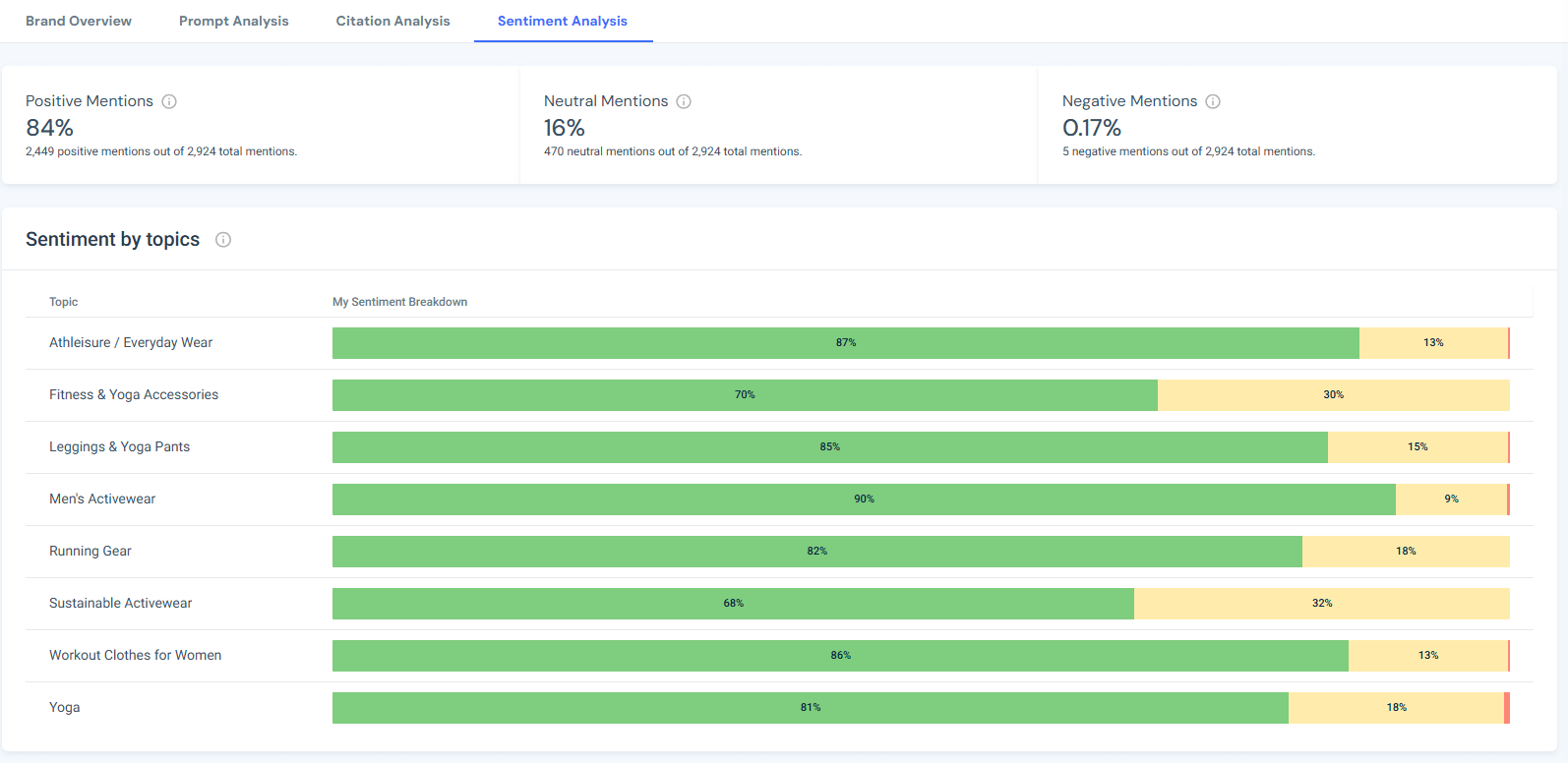
This kind of AI sentiment analysis gives me clarity on how the brand is perceived in the conversations that matter. I can see which prompts generate positive sentiment, which ones lead to negative perception, and how that compares to my competitors.
It also shows me the exact responses and sources shaping that tone, so I know where potential risks or opportunities originate.
Together, these capabilities give me a clearer view of how AI tools talk about brands, how audiences engage with my category through prompts, and where I can take action to improve visibility and perception.
Conclusion
Influence Score gives me a data-driven way to understand how AI models talk about my brand and which sources shape those conversations. For SEO teams, this metric has become as important as backlinks or topical authority because it helps us understand a new kind of visibility that happens inside AI models.
By analyzing the pages that influence answers, checking how the brand appears, and identifying where it is missing, I can take focused actions that improve the brand’s presence in AI-generated responses. This creates a more realistic and effective GEO strategy that matches how people search today.
If you want to explore these insights for your own brand, you can try AI Brand Visibility and see which sources shape how AI tools talk about you.
FAQs
How often should I check influence Score?
I check it weekly when monitoring fast-moving topics, and monthly for more stable categories. This helps me notice new influential URLs early and understand shifts in what GenAI relies on.
What is the best way to prioritize outreach using Influence Score?
I start with URLs that have both a high Influence Score and a large number of prompts influenced. These pages shape many AI responses, so even a single brand inclusion can meaningfully improve visibility.
How do I know whether an influential URL is worth engaging with?
If the URL influences many prompts and covers a topic tightly connected to my brand, it is usually worth outreach. I also evaluate the publisher’s authority, topical relevance, and whether competitors are already being mentioned.
Can Influence Score help me discover new content opportunities?
Yes. When I see patterns across top URLs, such as recurring questions or content formats, I use them to guide my own content updates. This helps me align my pages with what GenAI finds useful.
How should I interpret small Influence Scores on my own domain?
Even a small Influence Score tells me that GenAI is considering my pages in its answers. I review those pages to understand what made them influential and whether improving structure or clarity could help them become even more reliable sources.

Related Posts

Why AI Engines Cite UGC Over Brand Content And How To Leverage It For AEO

AI Mentions vs. AI Citations: What’s the Difference and Why It Matters for GEO


How to Do A Competitive Analysis: Complete Guide & Free Templates


Wondering what Similarweb can do for your business?
Give it a try or talk to our insights team — don’t worry, it’s free!