
3 of the Sharpest Minds Weigh in on the State of Gen AI in 2026
by Darrell Mordecai3 Min.
Aug 26, 2026
 Insights
A major shift is happening in how people consume political news in the UK.
Traditional search engines are not the only option when it comes to surfacing news. ChatGPT is rising fast as a trusted source for real-time insights.
According to Similarweb data, between May 2024 and May 2025, news-related prompts on ChatGPT grew by 80%.
This post explores how ChatGPT is taking center stage, especially for political topics, and what it means for publishers and platforms alike. And how it is reshaping how news is discovered, read, and shared.
Interested in more? Check out the full report ‘The Impact of Generative AI: Publishers’ here.
UK users are moving from search engines to chatbots. And they’re doing it quickly. ChatGPT’s UK user base doubled in the last year. Its mobile app users grew by 146% YoY, and web visits to chatgpt.com rose 100% over the same period.
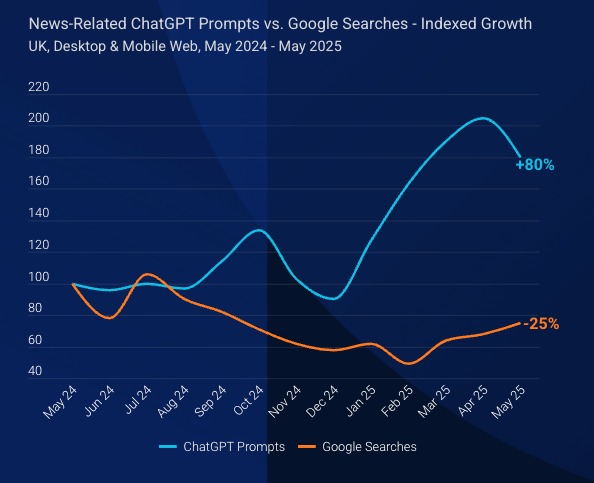
It’s about convenience as well as curiosity. People want quick, contextual answers. They want meaning, not just headlines.
As a result, SEO-driven visibility is no longer enough. AI interfaces are where discovery now begins.
Politics is leading the charge. Among all news categories, political prompts in ChatGPT saw the highest growth in 2025. That’s both year-over-year and year-to-date.
And this goes beyond just reacting to headlines. People are asking ChatGPT to explain what’s going on behind the scenes.
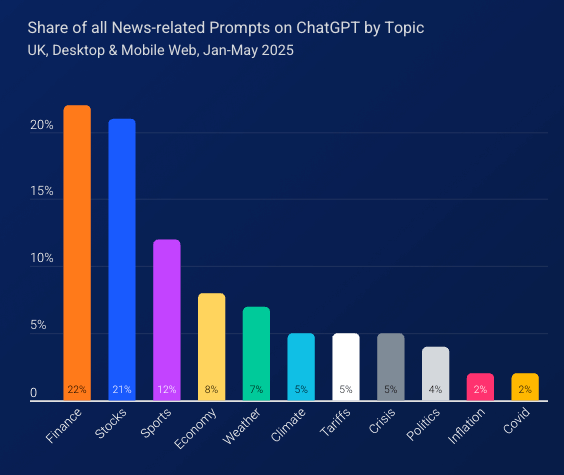
This signals a new kind of political engagement.
Even UK politicians are getting in on it. In March 2025, Peter Kyle, the Secretary of State for Science, Innovation and Technology, revealed he had used ChatGPT for media prep and research strategy.
But with that growth comes caution. A 2024 study found large language models often mirror political bias in their responses. As more people turn to ChatGPT for political clarity, the risk of unintentional skew rises too.
Google’s AI Overviews, launched in August 2024, are changing SEO. More people are getting answers straight from search results. No clicks required.
Zero-click news queries rose from 56% to 65% in the UK over just nine months. That’s a huge hit to UK publishers and news websites.
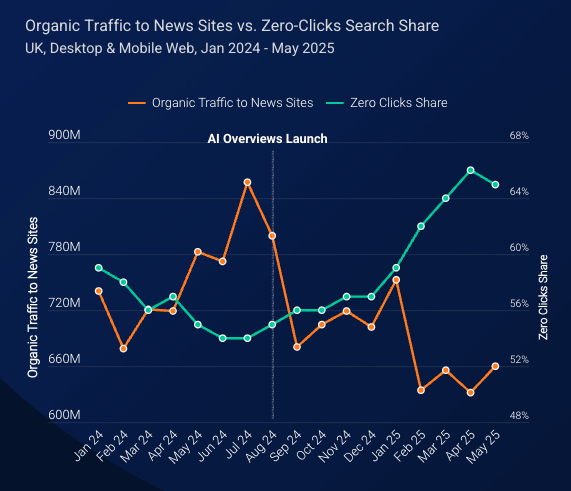
The result? Monthly visits to news sites dropped by over 200 million. Ranking high on Google doesn’t mean people are landing on your page anymore.
Some outlets are pushing back. Several UK publishers have limited how ChatGPT can use or link to their content.
Others, like The Guardian, are leaning in. In fact, it received nearly a third of all ChatGPT referral traffic to UK news sites between January and May 2025.
On the flip side, major names like the BBC are underrepresented in AI referrals. Why? Mostly due to sourcing restrictions.
AI tools aren’t going away. But newsrooms are adapting by experimenting with summaries, structured content, and partnerships.
Publishers now need to optimize for AI responses, not just search rankings. That means clear language, well-structured data, and verified sources.
Not every outlet will win. Those who embrace change and think platform-first will have the edge. Trust also matters. People want reliable summaries – and they’ll remember who gave it to them.
Political news is shifting to AI-powered platforms. Fast. ChatGPT is already the first stop for millions in the UK. And politics is one of the biggest breakout topics.
Will the GenAI genie get back in the bottle?
Unlikely, but it can be managed.
Publishers who understand how users interact with AI and adapt quickly stand to gain the most.
Want more data, charts, and insights? Get the full report for a deeper look at how generative AI is reshaping news in the UK.

Team Manager, Content Marketing
James is an former journalist & content strategist in B2B tech, who has previously created content for companies like EDF and X (Twitter). He also has a journalism post-grad from LCC.
Give it a try or talk to our insights team — don’t worry, it’s free!