TikTok Sets a Record and the RedNote Craze Subsides
by David F. Carr3 Min.
Jan 23, 2025

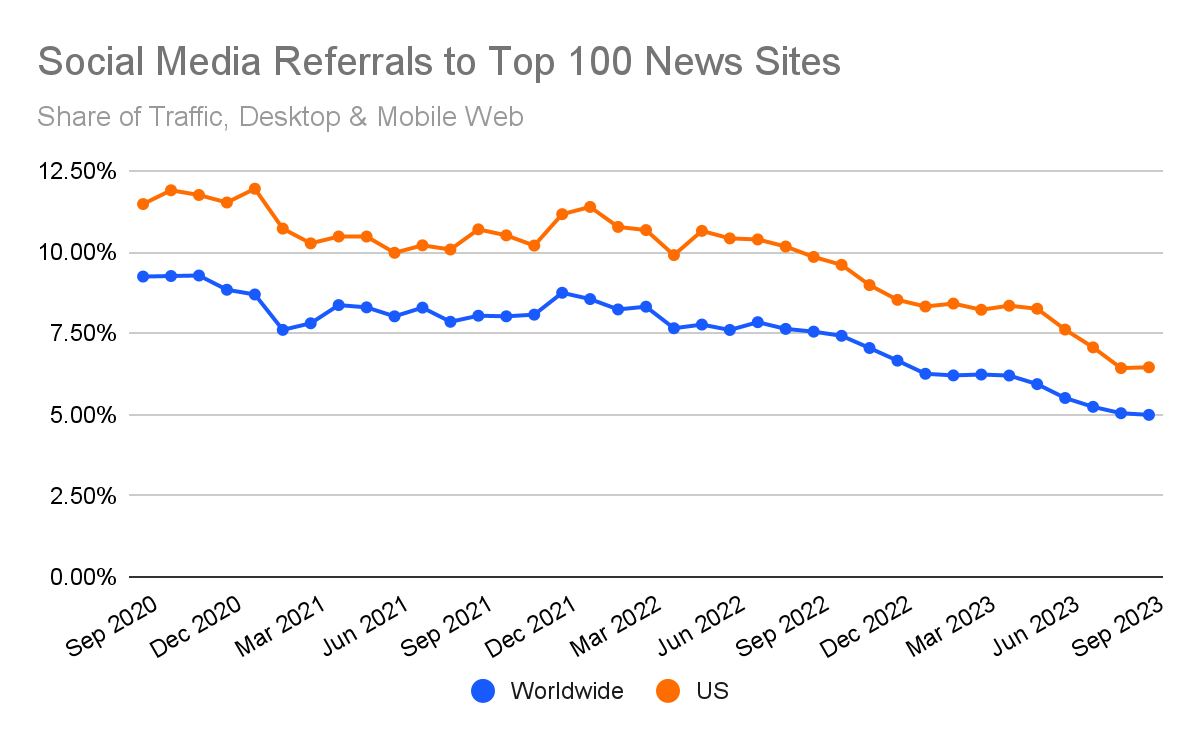
Social media referrals to news sites have been cut nearly in half over the past three years, at least partly because of changing algorithms and attitudes by the operators of the major social networks.
What follows is our version of a story based on our data previously reported in Axios (Social media news consumption slows globally and Social traffic craters), Digiday (Publishers reckon with declining Facebook referral traffic as the platform pulls away from news), Reuters (Exclusive: Meta’s Canada news ban fails to dent Facebook usage), and others. We’ve been pulling data on this topic since at least the demise of Buzzfeed News (see Digiday: How the social traffic that gave life to BuzzFeed News ultimately led to its demise) earlier this year.
In many cases, we’ve worked with journalists to develop custom reports on the traffic from Facebook and X (Twitter), in addition to sharing data on the overall trend. Here, we’ve updated and expanded on that research.
To get an overall sense of how things are trending, we prepared an analysis of the Top 100 websites Similarweb categorizes as “News and Media,” which includes traditional publications, popular digital publications, and news portals like news.google.com.
For some of the more detailed statistics on referrals from Facebook and X (Twitter), we looked at a more selective list of 40 well-known newspapers and news websites, and the analysis was based on desktop web traffic (where we have a more detailed breakdown of referral sources).
While it’s possible that the decline in news referrals is partly due to changes in consumer behavior (people becoming less likely to click on news links), it also reflects changes in the social platforms.
Both Facebook and X (Twitter) have been deemphasizing the display of news links that might cause people to click away from their platforms. Facebook owner Meta Platforms has decided that it’s better for people to see personal news from their contacts than news of the world – even if it’s world news their contacts actively want to share.
Meanwhile, X (Twitter) owner Elon Musk has decided that news and opinion shared directly on the platform ought to be favored over links to (what some might consider) the authoritative sources for news. Another Musk decree was that X would stop displaying headlines in previews of news articles when users post links. This does not yet appear to have been implemented uniformly – I’m still seeing headlines in my feed on X.
In Canada, yet another factor is a new law requiring that social platforms pay for the display of news content on the theory that they are profiting by publishing or republishing that content – prompting Facebook to simply stop displaying links to news articles to Canadian viewers.
Here is what we see happening, in two charts.
To show the decline for specific websites, we looked at the fraction of US web traffic driven to the following domains.
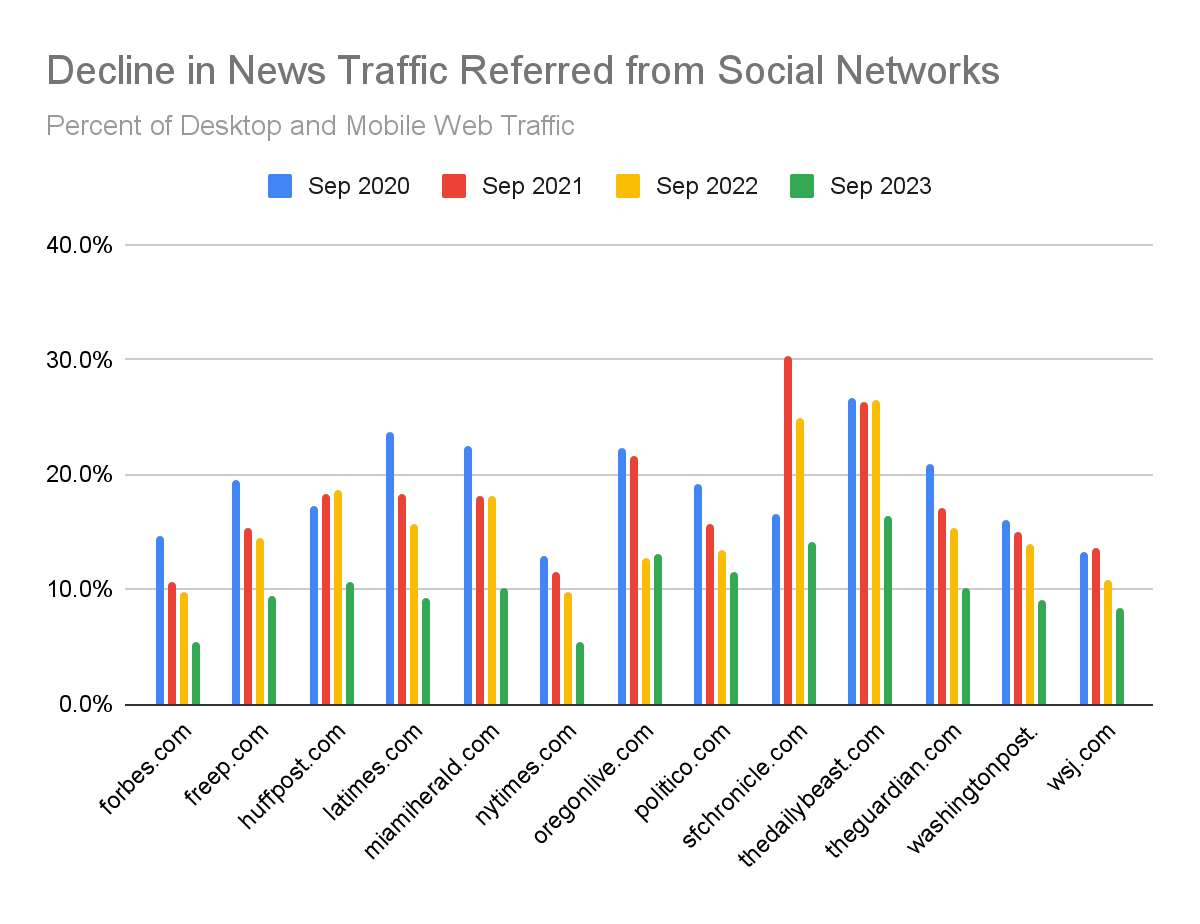
| Sep 2020 | Sep 2023 | |
| forbes.com | 14.6% | 5.5% |
| freep.com | 19.6% | 9.4% |
| huffpost.com | 17.3% | 10.6% |
| latimes.com | 23.6% | 9.3% |
| miamiherald.com | 22.4% | 10.1% |
| nytimes.com | 12.9% | 5.4% |
| oregonlive.com | 22.3% | 13.1% |
| politico.com | 19.2% | 11.4% |
| sfchronicle.com | 16.6% | 14.1% |
| thedailybeast.com | 26.7% | 16.4% |
| theguardian.com | 20.9% | 10.0% |
| washingtonpost.com | 16.0% | 9.0% |
| wsj.com | 13.2% | 8.4% |
The numbers above reflect traffic from all sites classified as social networks or online communities in Similarweb’s taxonomy. To get down to the level of referrals from social media, we have to switch to a dataset specific to desktop web usage – although we believe the overall pattern would be more or less consistent with what you see here.
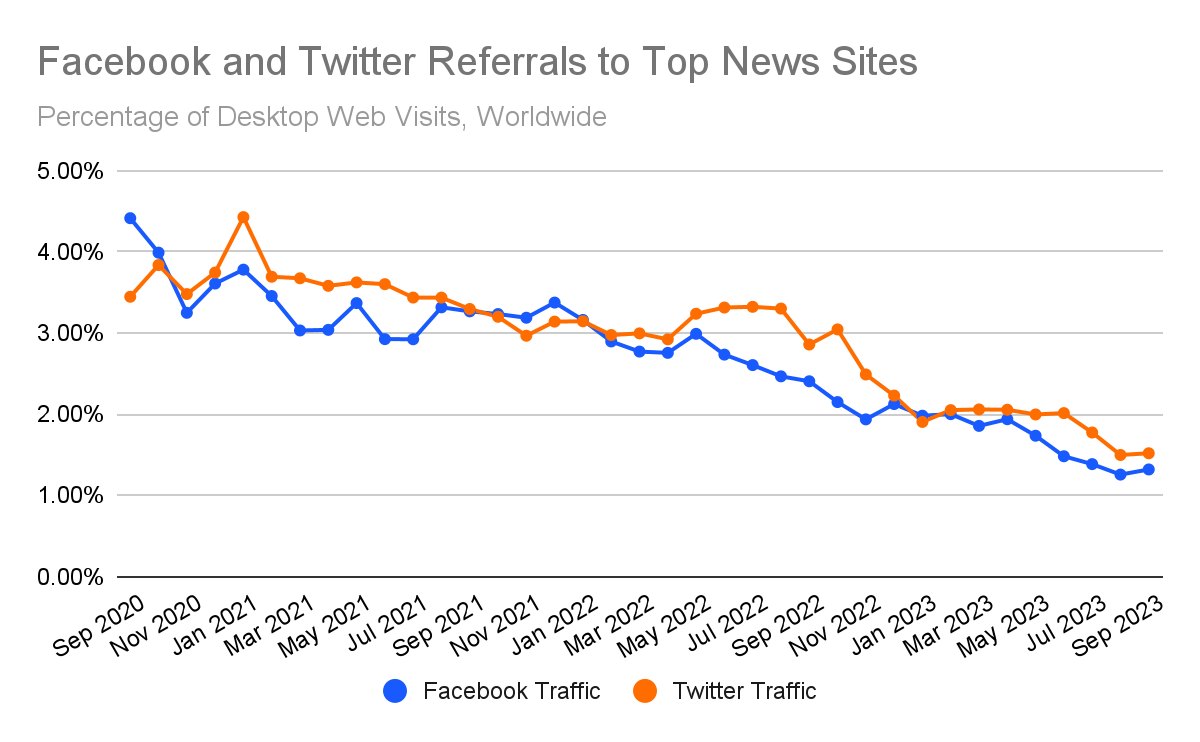
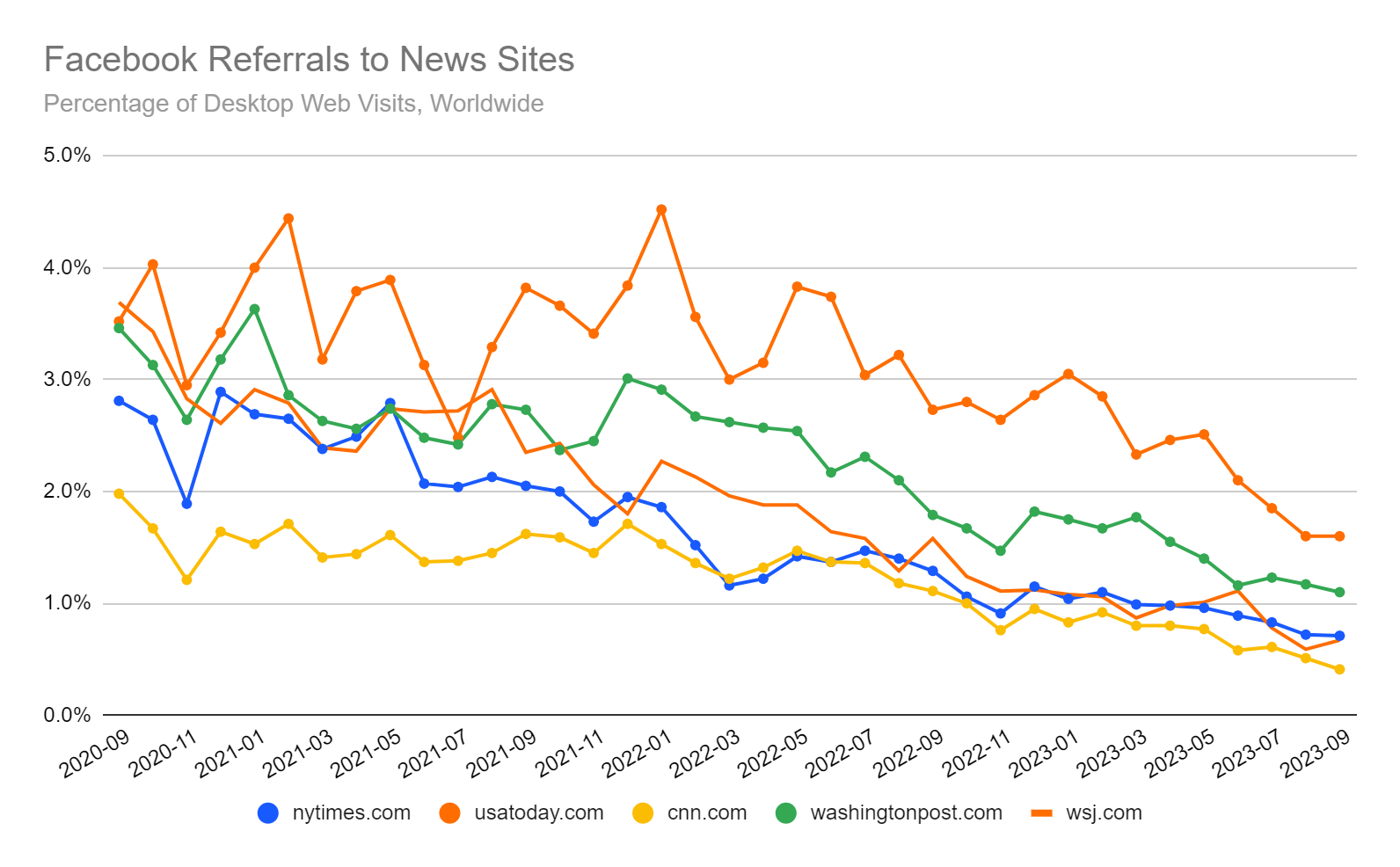
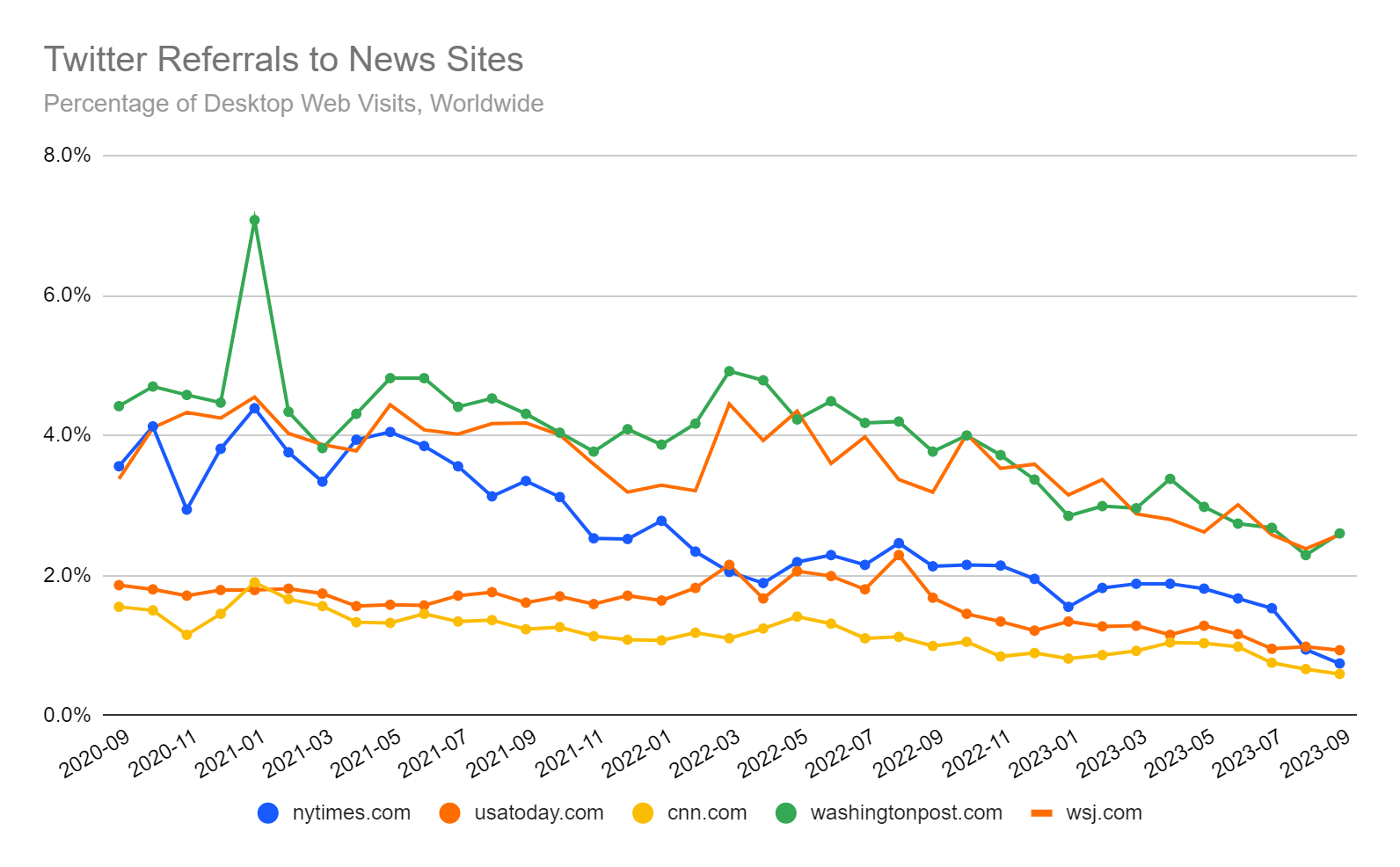
At the dawn of the social media era, social media and news media had a friendlier relationship, where sharing articles of interest was a popular activity for users and the organic traffic generated by referrals was a source of free traffic to publishers. Over time, many concerns have been raised about who was taking advantage of whom. Controversies over the information and misinformation shared by social media users may have decreased the appetite for news content at Meta, while Musk’s hostility to the mainstream media is a factor for X.
The issues have become fraught and political to the point where the marriage of media and social media is on the brink of divorce.
The Similarweb Insights & Communications team is available to pull additional or updated data on request for the news media (journalists are invited to write to press@similarweb.com). When citing our data, please reference Similarweb as the source and link back to the most relevant blog post or similarweb.com/blog/insights/.
Contact: For more information, please write to press@similarweb.com.
Report By: David F. Carr, Senior Insights Manager
Disclaimer: All names, brands, trademarks, and registered trademarks are the property of their respective owners. The data, reports, and other materials provided or made available by Similarweb consist of or include estimated metrics and digital insights generated by Similarweb using its proprietary algorithms, based on information collected by Similarweb from multiple sources using its advanced data methodologies. Similarweb shall not be responsible for the accuracy of such data, reports, and materials and shall have no liability for any decision by any third party based in whole or in part on such data, reports, and materials.

David covers social media, digital advertising, and generative AI. With a background in web trends since the 1990s, he’s also the author of "Social Collaboration for Dummies".
Give it a try or talk to our insights team — don’t worry, it’s free!