


 Marketing Intelligence
How to Adapt Your SEO Strategy to Increase Your AI Visibility

SEO has always been about understanding how people look for information and making sure your content meets that need. That foundation still holds.
What’s different today is how people move from a question to an answer. In many cases, explanations, ideas, and recommendations are delivered immediately, without requiring users to browse through a list of links. SEO still plays a role in that process, but it no longer tells the whole story on its own.
As I looked more closely at my work, I realized that rankings and traffic were still valuable indicators, but they didn’t explain everything. When I examined which brands were being referenced inside AI-generated answers, I saw a separate pattern. Strong search performance helped, but it didn’t automatically lead to being mentioned. Some brands appeared consistently in answers, while others didn’t, even though they were visible in search results and had solid content.
That’s when it became clear to me that visibility wasn’t disappearing. It was expanding into an additional layer. To stay relevant, I didn’t need to replace SEO, but I did need to adapt how I applied it.
What started to feel different
Search itself hasn’t stopped working. What’s changing is the role it plays.
People are no longer relying on short keywords to explore a topic. They’re asking complete questions. They want guidance, comparisons, and ideas, often expecting a direct answer rather than a list of options to explore.
Because of that, what matters now goes beyond whether a page exists or ranks. Content needs to be clear, well structured, and specific enough to be used as part of an answer. If the intent isn’t obvious, the content is easy to overlook.
Once I understood this shift, the goal became much simpler. I didn’t just want my pages to rank well. I wanted my content to be useful and visible at the moment an answer is formed.
How to optimize your site to improve AI visibility
That shift is at the heart of how to adapt an SEO strategy to improve AI visibility, let’s start digging in.
Thinking in questions instead of keywords
The first real change I made was critical. I stopped starting with keywords and started with questions.
But before I even got to prompts, I had to rethink what kind of questions I was paying attention to in the first place. For a long time, my focus had been on the obvious targets: short phrases, high-volume terms, and keywords everyone in the space was already chasing. They still mattered, but they no longer explained how people were actually searching.
When I looked closer, I saw that most meaningful searches weren’t short at all. They were longer, more specific, and tied to a clear situation. People weren’t just searching for a product or a topic. They were describing a need, a budget, a use case, or a comparison. Those longer searches told a much clearer story about intent.
That’s where long-tail keywords became central to how I approached content, not as leftovers or secondary targets, but as signals of how people naturally think when they expect an answer. These phrases may not always show huge volume, but they carry context. And context is what allows content to be understood, summarized, and reused.
Once I started mapping these long-tail searches, something interesting happened. Many of them already looked like full questions, or were just one step away from becoming one. That’s when the connection to prompts became obvious.
To validate this, I went into the Similarweb Keyword Generator and focused specifically on the “Questions Queries” view for the topics I’m tracking. What stood out immediately was how detailed these searches were. The questions weren’t generic at all. They reflected real situations, like how to choose gifts for specific family dynamics, values, or occasions.
Even more interesting, many of these questions showed meaningful demand despite being very specific. That reinforced the idea that people aren’t just browsing, they’re actively looking for guidance. These aren’t discovery queries, they’re decision-driven questions.
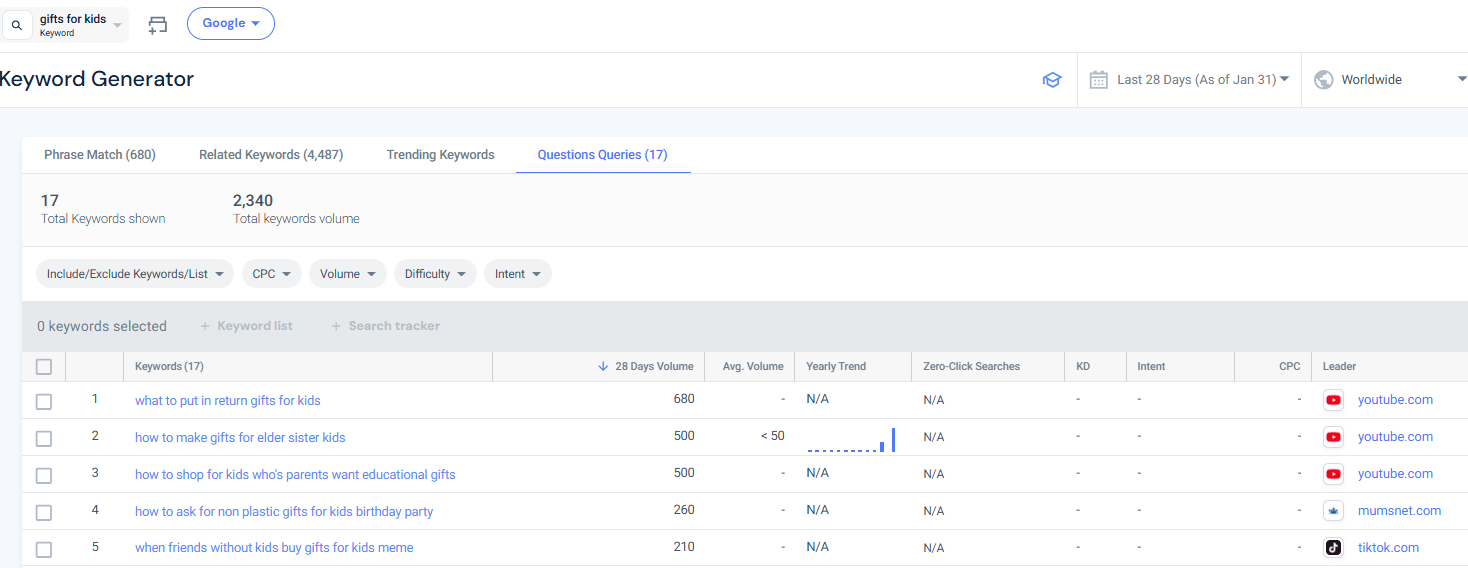
Prompts didn’t replace long-tail keywords. They built on them. A long-tail phrase showed me what people cared about. The prompt showed me how they actually asked for it. By starting with long-tail search intent and then translating it into real questions, I was able to shape content that felt natural, specific, and easy to engage with.
That shift made adapting my content far easier. I wasn’t guessing what to write anymore. I was responding to how people already search and speak when they want a clear answer.
Measuring AI visibility using Similarweb
This is the point where everything stopped being theoretical for me.
Up until then, I felt confident about the changes I was making, but confidence isn’t proof. I didn’t want assumptions or gut feelings. I wanted to see what was actually happening.
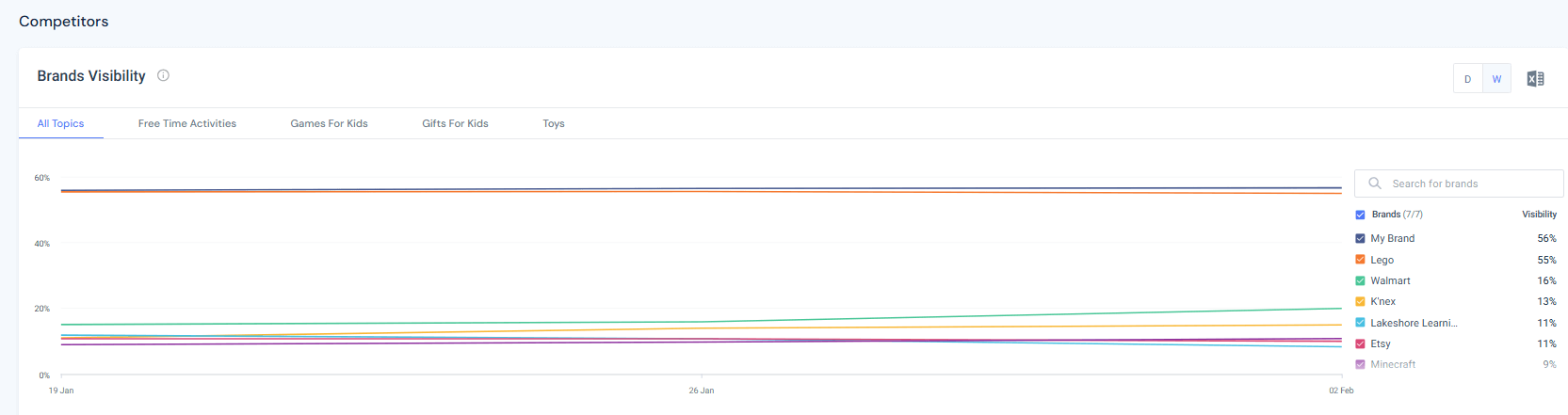
I started by narrowing my focus by using the Similarweb AI Brand Visibility tool. Instead of trying to measure everything at once, I chose the topics that mattered most to the business and matched real user intent. That decision alone made the analysis clearer. When you look at the right conversations, the signals become much easier to interpret.

From there, I looked at how visible different brands were within those topics. What stood out wasn’t just which brands appeared, but how uneven the visibility was. A small group showed up consistently, while others barely appeared at all. That pattern told me visibility isn’t random. Once a brand earns a place in these answers, it tends to show up again and again.
Next, I compared visibility across different LLMs. This was one of the most useful insights. A brand that looked strong overall could be barely present in one place and very visible in another. That made it clear that visibility depends on context. Different LLMs seem to favor different things, whether that’s depth, familiarity, or how clearly content is structured.
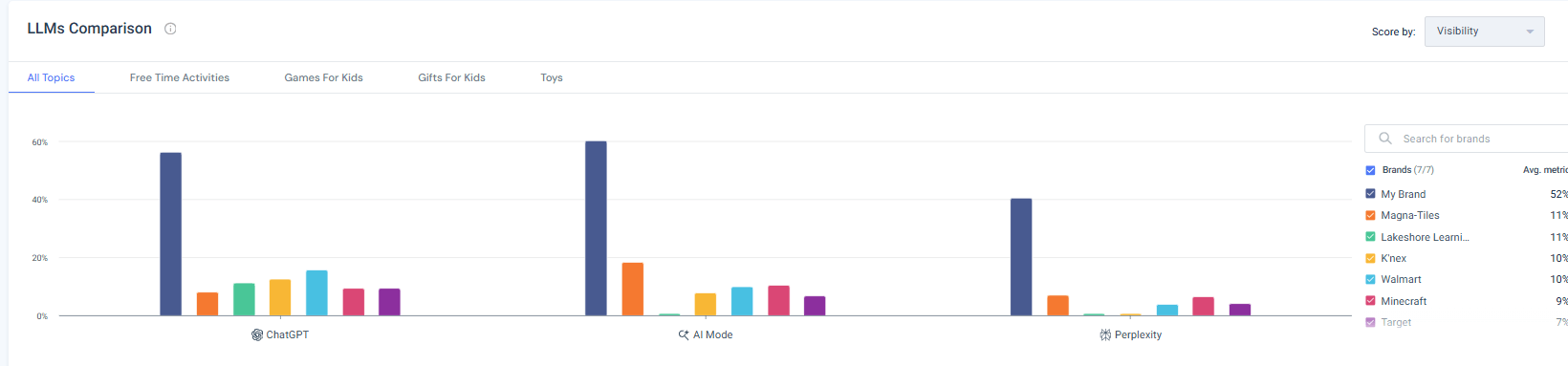
Instead of trying to force one strategy everywhere, I started asking a more practical question: where does my content already fit naturally, and where does it not?
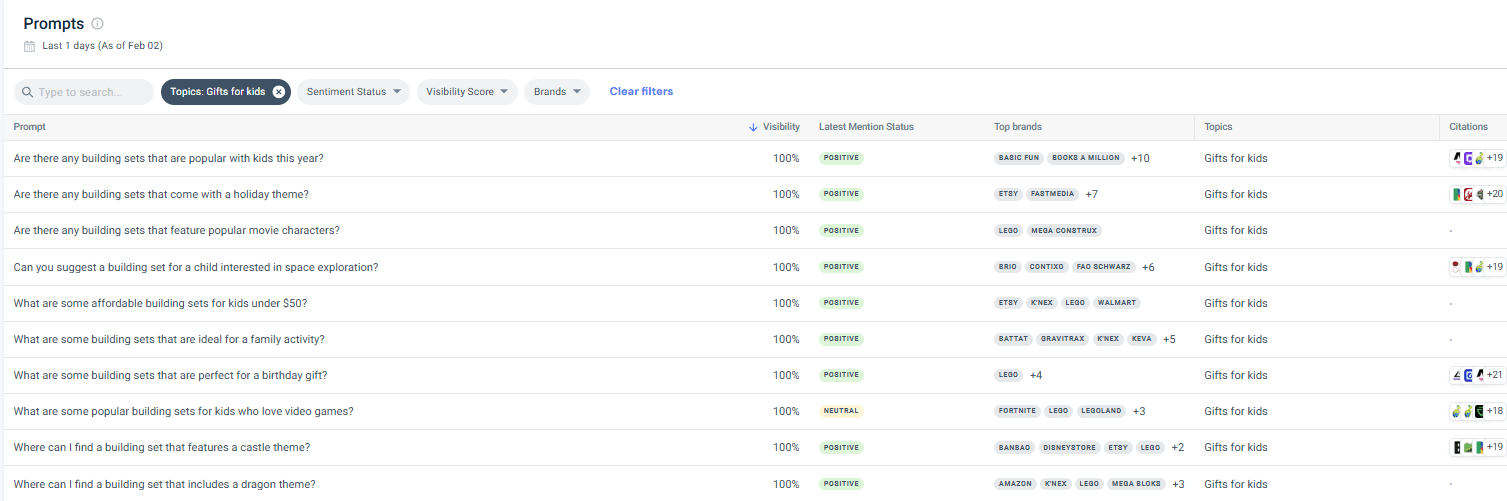
The most valuable part of the analysis came when I zoomed in even further and looked at individual prompts. I used Similarweb Prompt Analysis tool and reviewed real questions one by one and checked how they were answered. I paid attention to whether brands were mentioned, whether sources were cited, and how those mentions were framed.
For example, when looking at prompts like “Are there any building sets that are popular with kids this year?” or “What are some affordable building sets for kids under $50?”, I could see that certain brands appeared consistently across similar questions, often with clear citations. In contrast, other questions returned answers that were more generic, with no clear brand attribution at all.
That difference mattered because it helped me understand which types of questions reward clear, well-structured content and which ones don’t.
I didn’t focus on single numbers or snapshots. I looked for patterns over time. Repetition, gaps, and sudden drop-offs told a much clearer story than any single metric ever could. Those patterns pointed directly to what needed work, whether that was content depth, structure, or simply answering the question more clearly.
At that point, measurement stopped feeling like reporting. It became guidance.
Letting prompts shape the content itself
The next step was deciding what to do with it. Prompts helped me validate those signals. When I started working with real prompts, my content decisions became much more straightforward. Instead of guessing what might work, I focused on the exact questions I wanted to show up for.
When a question appeared consistently, I took it as a sign that the site needed to clearly answer it. The first place I applied this was in FAQs. I stopped writing generic FAQ sections and started building them from real questions, using both the prompts I was tracking and Google’s People Also Ask results. When the question on the page matches how people actually ask it, the intent becomes obvious.
I also went back to my existing pages and reviewed the section headlines. In many cases, the content was solid, but the headlines were too vague or abstract. Updating H2s so they reflected real questions made a noticeable difference. The same information suddenly became easier to understand because it was framed in a way that felt familiar.
Some prompts didn’t fit into existing content at all. They were too specific, or they addressed a different moment in the decision process. In those cases, creating new content wasn’t about publishing more pages, but about giving those questions the space they needed. Once each prompt had a clear home, the site felt more complete and easier to navigate.
This is where I really started to understand how to optimize my site to increase AI visibility. It wasn’t about volume or frequency. It was about making sure every important question had a clear, intentional answer.
Building authority through links and brand mentions
As I went deeper into optimizing my site, I realized that content and structure weren’t the only factors shaping visibility. There was another layer that kept showing up in the analysis: how often a brand is mentioned outside its own site.
When I looked at which brands appeared most consistently in answers, many of them weren’t just well-optimized on-page. They were talked about elsewhere. Reviews, comparisons, forum discussions, social posts, these mentions showed up again and again, sometimes with links, sometimes without.
That pushed me to rethink how PR fits into SEO. Instead of treating PR as something separate, I started seeing it as part of how visibility is built. Mentions across relevant sites and communities help reinforce what a brand is known for, even when there’s no direct link involved.
I paid particular attention to review sites, social platforms, and forums, because that’s where real conversations happen. These mentions often carry context, why a product is used, how it compares to others, or when it’s recommended. That context matters. It helps shape how a brand is understood beyond its own content.
This didn’t replace link building, but it expanded it. Links still matter, but unlinked mentions also contribute to how visible and recognizable a brand becomes across the web. When PR efforts focus on relevance and credibility, they support everything else I’m doing on the site.
Optimizing for visibility, I found, isn’t just about what you publish. It’s also about where and how your brand shows up in conversations you don’t fully control.
Getting the technical GEO basics right
All of this only works if the site is easy to read and access. In this part, I focused on the technical side, not as a separate project, but as a way to support clarity. This is where technical GEO came into play: making sure the underlying structure helped both search engines and LLMs understand the site without friction.
I used structured data where it made sense, especially around articles and FAQs. The goal wasn’t to add complexity, but to make it easier for LLMs to understand what each page and section was about.
I also reviewed how the site handled access and indexation. Important pages needed to be reachable, discoverable, and not blocked by accident. I checked that nothing essential was hidden or excluded, and that supporting files reflected how the site was meant to be understood.
As part of the technical review, I added an llms.txt file to clearly show which parts of the site should be accessible to LLM crawlers. It helps make it explicit what content is meant to be available, especially for pages that might not be easily discovered through traditional crawling. Keeping the technical foundation solid didn’t require big changes. It required attention. When the site is clear, accessible, and consistent, everything built on top of it works better.
Traditional SEO vs. SEO Adapted for AI Visibility
Traditional SEO and AI-optimized SEO share the same foundation, but they prioritize different aspects. The table below highlights where the focus shifts when success is measured by visibility and attribution rather than rankings alone.
| Factors | Traditional SEO Strategy | Adapted SEO Strategy for AI Visibility |
| Keyword Research | Starts with short keywords centered on volume and competition | Starts with long-tail intent, real questions, and prompts. Targeting topics of MSV |
| FAQs | Include FAQs, usually taken from People Also Ask results | Include FAQs from real prompts and People Also Ask results |
| Headlins | Update the headings in order to describe topics broadly and include the main keywords | Update the headings in order to reflect how people actually ask questions based on prompts |
| New Content | Write new content based on the target keywords | Write new content to answer real questions |
| Link Building | Built backlinks from trusted and high-authority websites. | Focus on PR to drive brand mentions (linked and unlinked) across review sites, social platforms, and forums. |
| Schemas | Include schemas to clarify the content meaning for search engines | Include schemas to clarify the content meaning for LLMs |
| Technical SEO & GEO | Improve your technical SEO: crawlability for search engines, indexation, site speed and mobile first. | Improve your technical GEO: crawlability for LLMs, indexation, site speed and mobile first. |
| Measurement | Measure success through rankings, traffic, and clicks. | Measure success through visibility patterns, mentions, and citations. |
Why adjusting your SEO strategy matters more than ever
When I stepped back and looked at the full picture, the shift became clear. Adapting SEO today isn’t about reacting to every new update or abandoning what already works. It’s about expanding the strategy to account for how answers are now formed and distributed.
The adaptation for me was holistic. Instead of treating SEO as a single set of tactics, I started working across four connected layers. First, I focused on intent, using long-tail searches, prompts, and People Also Ask results to understand the real questions people ask.
Second, I adapted content so those questions had clear, intentional answers, whether that meant updating headlines, building FAQs, or creating new pages.
Third, I expanded the strategy beyond the site itself by focusing on PR and brand mentions, making sure the brand showed up in relevant conversations across review sites, social platforms, and forums, with or without links.
Fourth, I made sure the technical foundation supported that work, so the content was accessible, structured clearly, and easy to interpret.
Learning how to adapt SEO strategy to increase AI visibility didn’t mean replacing traditional SEO. Rankings, crawlability, and content quality still matter. What changed was how deliberately those fundamentals were applied. The strategy shifted toward answering questions clearly, structuring content for reuse, and validating performance through visibility patterns rather than isolated metrics.
If there’s one takeaway from this process, it’s this: visibility now lives inside conversations. When SEO connects intent, content, and measurement into a single approach, visibility follows naturally.
FAQs
How is AI visibility different from traditional search visibility?
Search visibility tells me how pages perform in search results. AI visibility shows me which brands and sources are actually referenced inside AI answers. Strong rankings help, but they don’t automatically lead to being mentioned, which is why both layers need to be considered.
How do long-tail keywords help improve AI visibility?
Long-tail keywords carry much more context than short terms. They often describe a specific situation or need, which makes them easier to turn into clear questions. That context is what helps content get understood and reused inside answers.
How do prompts fit into an SEO strategy?
Prompts help validate intent. I use them to see how people actually ask questions once they move beyond keywords. They don’t replace keyword research, but they help translate intent into content that feels natural and specific.
Do FAQs really make a difference for AI visibility?
They do when they’re built from real questions. I stopped using generic FAQs and started creating them based on prompts and Google’s People Also Ask results. When the question on the page matches how people ask it, the intent becomes much clearer.
Should I update existing content or create new pages?
Usually both. I first update existing pages by rewriting H2s to reflect real questions. When a prompt doesn’t fit naturally into any existing content, that’s when creating a new page makes sense.
How important is technical SEO for AI visibility?
It’s foundational. Content can’t be used if it’s hard to access or understand. Clean structure, proper indexation, structured data, and clear accessibility all support visibility without requiring major site changes.
What role do schema and llms.txt play?
Schema helps clarify what content is about, especially for articles and FAQs. An llms.txt file helps explicitly show which parts of the site should be accessible to LLM crawlers. Neither is a shortcut, but together they reduce ambiguity.
How do I measure AI visibility using Similarweb?
I focus on topics, not individual keywords. From there, I look at brand visibility, compare performance across LLMs, and drill down into individual prompts to see which questions surface brands and citations. Patterns matter more than single metrics.
What’s the biggest mindset shift needed to improve AI visibility?
The shift is moving from ranking pages to answering questions. When content is built around real intent, structured clearly, and supported by solid technical foundations, visibility tends to follow naturally.

Related Posts


What Is AI Share of Voice? The Brand Mention Share Metric You’re Probably Missing




Wondering what Similarweb can do for your business?
Give it a try or talk to our insights team — don’t worry, it’s free!