


 Marketing Intelligence
How to Adapt Your SEO Budget for AI Search Optimization

As someone who has managed SEO budgets on both the agency and in‑house sides, I can say that in the past year, I’ve witnessed more volatility and shifts in search budgets than ever before. Brands and clients are always looking for ways to use their marketing budgets to create the most impact, but over the past few years, the entire marketing landscape has changed. Now, many brands are unsure where to invest their resources.
Looking at marketing and SEO budgets for 2026, I see this shift continues. The rising popularity and use of AI have forced brands to recognize that Generative AI engines are not just a trend but a strategic consideration when allocating budgets and resources.
Even here at Similarweb, I was debating myself for a while: How should I distribute my Budget?
- Should I allocate more for directory listings?
- Should I allocate less for content?
- How much impact can I create using PR under my budget?
- Do I need more budget to reach my goals?
- Do I need a dedicated budget for AI Optimization?
AI engines deliver consolidated answers and cite only a handful of sources, which means visibility and traffic from AI do not come easily. A business can rank #1 for a query and still be invisible if it doesn’t appear in the AI answer box. Research shows that more than half of searches will go through AI assistants by 2030, and zero‑click searches in the US have already surpassed 69%.
With generative engines synthesizing content from across the web, brands must utilize strategies tailored to Answer Engine Optimization (AEO), Generative Engine Optimization (GEO), and Large‑Language‑Model Optimization (LLMO) to remain discoverable.
In this article, I’ll outline how to adapt your SEO budget for AI search optimization. I’ll share lessons learned from building SEO teams and search strategies in-house and within agencies, and try to provide a way for you to understand the changes needed to your current workflows, as well as how to communicate them to your stakeholders or clients.
1. Looking back: How traditional SEO budgets evolved
Before the AI wave, SEO budgeting followed familiar patterns, with the budget divided between the three core SEO functions, plus measurement costs:
- Technical SEO.
- Content creation & optimization.
- Link building (backlinks).
- Analytics and competitive intelligence.
If you have an in-house SEO, #1 is usually covered, and #2 is covered for the most part (depending on the in-house content writing resources). The budget is mainly needed to cover backlink and intelligence tool costs. This can also vary depending on whether you have an in-house PR team that collaborates with SEO efforts.
To work with an agency, small businesses typically invest US$1.5K-3k per month, mid‑size companies US$3k-7.5k, and enterprises US$7.5k-20k per month.
By 2025, AI‑driven SEO services began to emerge. Many tools were launched to track, analyze, and optimize content for AI features, with services pricing ranging from US$2k-5k per project for search‑generative‑experience (SGE) optimization and US$2.5k-6k per month for entity‑based SEO. These early offerings hinted that AI search would require new budget lines.
2. Why does AI search optimization demand new investment?
Generative models work very differently from traditional search engines. They break user queries into sub‑prompts, retrieve information from multiple sources, and compose a natural-language answer.
This inverts the traditional user behavior flow: The user input is much longer and more contextual, rather than a 2-4-word search, and AI engines aim to provide a final answer rather than a list of well-trusted sources. Instead of ranking ten blue links, they cite a handful of trusted sources, and any brand not cited is effectively invisible.
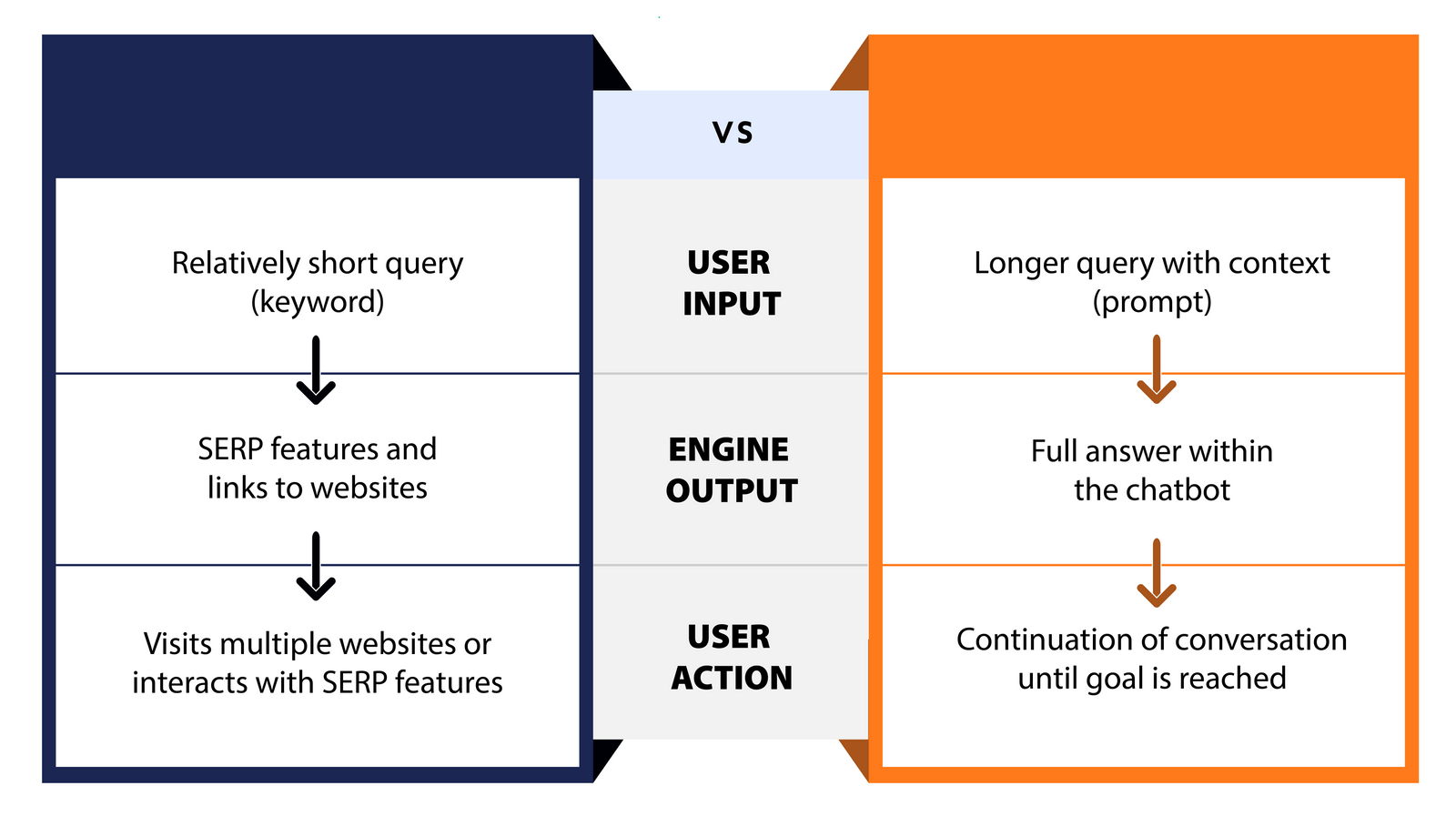
This means you need to be able to influence more sources, both on and off your brand’s website, to create a sufficient envelope of signals that trigger as many “meeting points” as possible along the user’s journey. The need for tailored action is clear.
However, assuming your SEO budget is already 100% utilized, there’s a very low chance you’ll manage to cover additional GEO and AEO needs at the same cost.
Still not sure whether you should invest in AI optimization? Well, here are 4 market dynamics that underscore why SEO teams should rethink their budgets:
Explosive growth in AI search usage
AI search tools have gone mainstream. Google’s AI Overviews (the AI answers that appear at the top of search results) reached 2 billion monthly users globally by Q2 2025, up from 1.5 billion in May 2025. These AI overviews now appear in roughly 18% of global Google searches and are among the most disruptive features Google has launched.
Outside of Google, the adoption of generative engines is equally dramatic: mainstream AI search tools like Perplexity, ChatGPT, and Microsoft Copilot have become integral to everyday research. A Cornell study cited by Digital Authority reports that 61% of global workers used or planned to use GenAI in 2023, rising to 85% in 2024. Now it’s 2026.
This exponential growth means billions of queries are now answered without a click, and AI search is quickly becoming the default discovery experience.
A new zero‑click, answer‑first user experience
Generative engines deliver instant answers directly in the interface, often without requiring the user to visit any website. Zero‑click rates jumped from 56% to 69% after the launch of Google’s AI Overviews. While this improves user satisfaction, it drastically reduces traditional SEO traffic.
To maintain visibility, brands must design content that generative engines can parse and cite. Investing in Generative Engine Optimization ensures your brand appears within these AI answers.
Different engines favor different signals.
Another reason budgets need to shift is that each AI platform favors different types of sources:
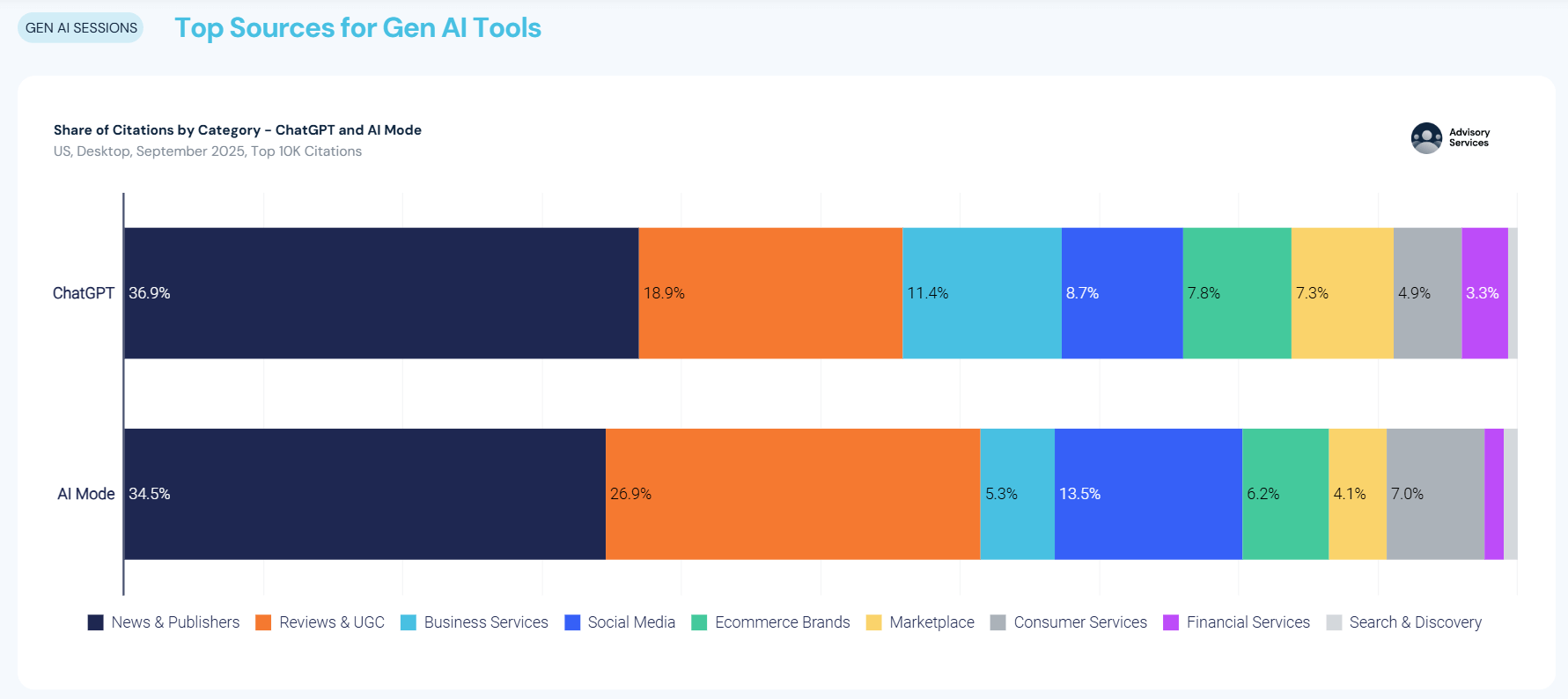
According to Similarweb’s State of Gen-AI research, the source distribution among generative AI engines varies:
- ChatGPT relies heavily on its training data and often cites retail and marketplace sources.
- Google’s AI Mode uses live web data and favors brand and OEM sites.
- Perplexity cites a mix of news, official documents, and community content.
Large language models evaluate several signals when selecting sources:
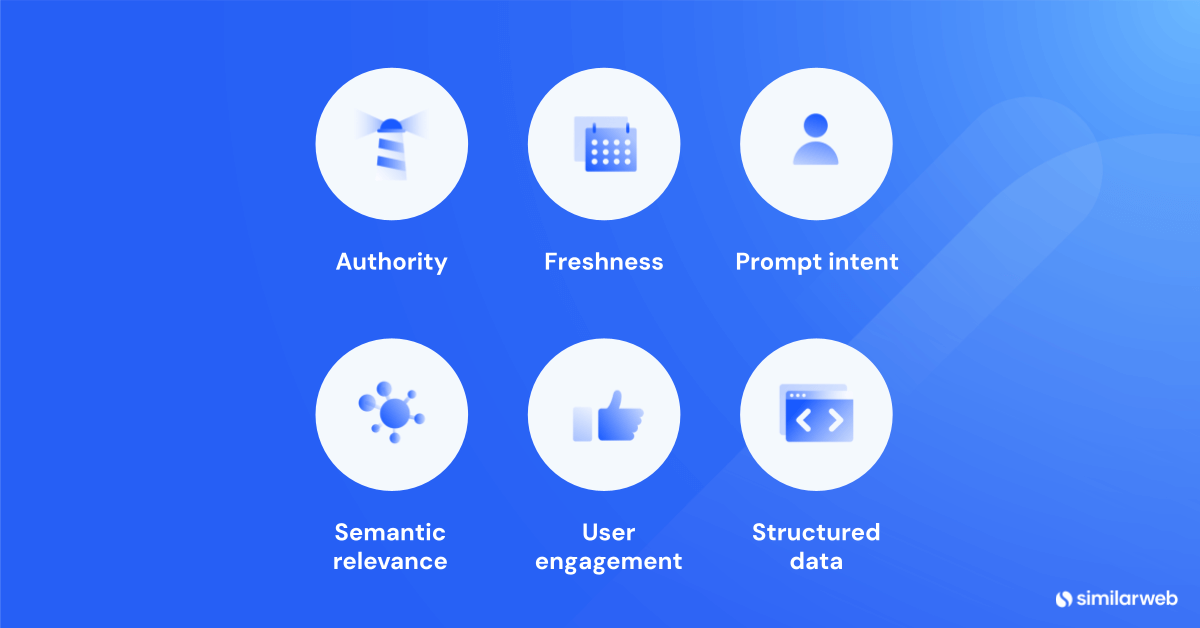
- Authority (citations and backlinks).
- Freshness.
- User prompt intent
- Semantic relevance.
- User engagement (reviews and ratings).
- Structured data.
They also consider the question type: definitions are likely to draw from encyclopaedias, how‑tos from tutorials, and comparisons from reviews.
These nuances mean that the content and SEO outreach strategy you built may not transfer directly to AI search, and that additional investment is required to align with each engine’s citation patterns.
The cost of inaction
Ignoring AI search has real financial consequences. Zero‑click behavior erodes traffic, and brands that are not cited lose visibility even if they rank highly.
Analysts warn that companies that fail to invest in AEO/GEO risk losing 60% of their digital visibility. Meanwhile, according to Forrester, competitors are already reallocating funds: mid‑market businesses spend US$75k–150k per year on GEO, and enterprises allocate US$250k+ per year.
With AI search adoption accelerating, redirecting a portion of the traditional SEO budget into AI optimization is essential for survival.
3. What are the new tasks and cost drivers in AEO/GEO?
Adapting your budget starts with understanding where the money goes:
- Content structuring and technical SEO implementation: AI engines need machine‑readable information. This means investing in implementing relevant schemas, along with emerging files such as llms.txt. Agencies can charge US$150-300 per page to implement schemas, but this can also fall under your monthly SEO retainer or the in-house SEO working hours.
- Entity and brand authority building: Generative engines favor authoritative sources. Budget must be allocated to digital PR, enhancing E‑E‑A‑T (experience, expertise, authority, and trust) signals, and entity optimization. 10fold suggests dedicating 15% of marketing budgets to PR to support brand visibility, while other publishers recommend up to 25%.
- AI visibility monitoring and reporting: Tools that track AI citations and share of voice are essential. Similarweb’s AI Brand Visibility tool lets you compare brand visibility across ChatGPT, Google AI Mode, and other engines and offers a free trial and US$99 packages. Agencies often charge US$200-500 per client per month for monitoring, which means you can save on GEO costs and subscribe directly to Similarweb.
- Cross‑team training and experimentation: AI search introduces new workflows. It’s recommended to allocate 5-10% of the marketing budget for training and experimentation with emerging channels and tactics.
4. Budget allocation frameworks for in‑house teams
As an SEO director, I recommend creating a separate pot within the SEO budget dedicated to AEO/GEO initiatives to prevent them from cannibalizing core SEO work. A Gartner survey suggests CMOs should start ring‑fencing funds specifically for AI adoption and visibility.
Here’s how teams can structure their allocation effectively:
| Dicipline | Budget Allocation | Coverage |
| Core SEO | 70-80% | Maintain investment in technical SEO, on‑page optimization, and backlink acquisition. |
| AI search optimization | 20-30% | Cover additional content and PR costs. |
I’ve read multiple research pieces debating how many resources should be explicitly allocated to AEO/GEO. Recent benchmarks range from 10% of the total SEO budget for small businesses up to 30% for large companies and 50% for aggressive adopters.
On average, SEO peers I’ve consulted with allocate about 25% of their search budget to AI optimization, in addition to their standard SEO budget.
Pro tip: Start with a pilot. Optimize one product category or business line, and then scale based on results.
Budget Considerations for Small Businesses
Small businesses don’t need a large budget to start. The most significant expense is content creation. Leverage low‑cost assets like Google Business Profile, LocalBusiness schema, and customer reviews.
Measuring the impact of your GEO/AEO activities is critical to proving success (or analyzing failure). I suggest allocating 10–20% of your broader search budget to AI search optimization and monitoring tools.
5. GEO Budget frameworks when working with agencies
Many agencies have recently added AEO/GEO as a new product line on top of their SEO services. Some companies choose to partner with specialized AEO/GEO agencies rather than build capabilities in‑house. This means additional monthly costs are involved, and should be taken into consideration.
Typical monthly retainers fall into three tiers:
| Tier | Retainer | Coverage |
| Basic monitoring & optimization | US$2.5k-5k per month | Covers citation tracking and basic schema and content tweaks. |
| Full‑service packages | US$5k-12k per month | Include multi‑platform optimization, structured content creation, and monitoring. |
| Enterprise programs | US$12k-25k+ per month
US$30k–50k for highly competitive sectors |
Provide dedicated teams for extensive product catalogs and heavy PR integration. |
Across these tiers, the average monthly retainer is roughly US$11–14k, which equates to US$50k-200k over six months. When selecting an agency, insist on a transparent breakdown of services and avoid suspiciously cheap packages (under US$1.5k/month), which often lack the resources for meaningful AI optimization.
6. How to allocate your budget based on business type and context
Budget allocation isn’t one‑size‑fits‑all.
The right number depends on company size, vertical, geographic footprint, and the extent to which your customers rely on AI search. You should treat these percentages as starting points and refine them based on evidence from your own pilots and measurement frameworks.
I’ve consulted with several colleagues (in-house experts and agency team leaders) regarding their 2026 budget planning and compiled their responses into averages by business size.
Recommended budget ranges by business type
- Small and local businesses:
- Begin by allocating 10-15% of your overall marketing budget to AEO/GEO.
- Allocate 10-20% of that budget for AI‑search tools and monitoring.
- Prioritize high‑impact, low‑cost actions: build FAQs and guides, optimize your GBP, add schema, and encourage customer reviews.
- As results improve, you can increase PR outreach spending.
- For single‑location businesses, focus on NAP (Name‑Address‑Phone) consistency, local schema, and locally focused content to appear in “near me” answers.
- Begin by allocating 10-15% of your overall marketing budget to AEO/GEO.
- Mid‑market firms:
- Allocate 15-25% of your SEO budget to AEO/GEO initiatives.
- In addition to structured content and schema, invest in adding dedicated SEO team members or cross‑functional task forces that coordinate SEO, PR, and product.
- Use Similarweb’s Gen‑AI dashboards to monitor your brand visibility, domain influence, and citation share across multiple engines.
- A phased approach works well: launch a pilot on one product line, measure improvements in citations and traffic, then scale.
- Enterprises:
- For large organizations with diverse product catalogs, consider dedicating 30% or more of your SEO budget or creating a separate AEO/GEO budget equal to 30% of your search spend.
- Early adopters in AI‑centric sectors sometimes invest 20-40% of their total search budgets.
- Enterprises often need to expand their internal SEO (AEO/GEO) teams, invest in robust entity management and digital PR, and pay for enterprise‑grade monitoring.
- Highly regulated and competitive industries (finance, health, SaaS, ecommerce):
- These verticals face strict compliance and trust requirements. Budgets should exceed generic guidelines because YMYL topics demand exceptional E‑E‑A‑T signals, rigorous fact‑checking, and proactive reputation management.
- Plan for additional resources for legal reviews, third‑party expert contributions, and PR campaigns on authoritative industry sites.
- Leveraging Similarweb’s AI Citation Analysis tool can help you identify which high‑authority domains generative engines cite so you can prioritize outreach.
- AI‑reliant audiences:
- When your customers actively use chatbots and AI assistants, your visibility depends on appearing in their answers. In such cases, shift toward the higher end of the ranges above.
- Monitor prompt‑level data with Similarweb’s Prompt Analytics to understand which AI platforms and question types drive citations.
- Allocate a larger share of the budget to prompt research, answer‑first content, and cross‑channel PR to maintain share of voice.
For your convenience, I have also summarized everything in the table below.
Budget considerations by business type and context
| Business type | Recommended budget allocation | Key actions & considerations | Notes & tools |
| Small & local businesses | 10-15% of the total marketing budget.
10-20% of search budget to AI tools and monitoring |
Create guides and local pages, optimize GBP, implement schemas, encourage reviews, focus on NAP consistency, and locally focused content | Use Similarweb’s AI Brand Visibility tool to track citations.
Scale gradually as results improve. |
| Mid‑market firms | 15-25% of search budget | Pilot AI optimization on one product line, invest in structured content, schema, and digital PR, iterate based on citation and traffic metrics. | Monitor progress with the Similarweb Gen‑AI Intelligence suite. |
| Enterprises | ≥30% of search budget.
AI‑centric sectors allocate 20-40% of search budget. |
Build or expand in‑house SEO teams, invest in entity SEO, digital PR, and enterprise‑grade monitoring, and consider a separate GEO budget. | Agency retainers around US$25k per month, plus monitoring costs. Consider monitoring in-house to reduce costs. |
| Regulated & competitive industries | >30% of search spend | Prioritize compliance, medical/legal reviews, and high‑trust PR, integrate YMYL standards, third‑party expert endorsements, and fact‑checking, and allocate extra resources for authoritative backlinks. | Use Similarweb AI Citation Analysis to identify authoritative domains and track sentiment changes. |
| AI‑reliant audiences | 35-40% of search budget | Monitor prompt trends and AI platform usage, invest in answer‑first content, and prompt research. | Use Similarweb Prompt Analysis to uncover high‑impact questions and optimize content accordingly. |
7. Implementation and measurement roadmap
Budgeting is only the first step, but execution determines success. I recommend the following budget allocation roadmap:
- Assess and audit:
- Conduct AI visibility audits, entity gap analyses, and competitor citation mapping.
- Allocate 15–20% of effort here.
- Technical and content execution:
- Spend 25–40% of effort deploying schema, creating answer‑first content, and building out knowledge hubs.
- Use Similarweb’s AI Citation Tracker template to prioritize sources that AI models consistently cite.
- Monitoring and iteration:
- Reserve 10–15% of your budget for ongoing monitoring, prompt analysis, and competitor tracking.
- Iterate content when citations decline, or competitors gain share.
- Training and governance:
- Invest in continuous education for content, PR, and engineering teams.
- Update your content governance process to ensure all new assets include structured summaries, clear answers, and authoritative references.
- Measure ROI:
- Track AI citation frequency, brand mention share, domain influence score, and AI‑driven traffic.
- Tie GEO metrics to leads and revenue.
- Use Similarweb’s AI Traffic Analytics to attribute visitors and conversions from generative search.
8. Does real-world data justify these budget allocations?
Yes. Real‑world data reinforces the need to shift budgets:
- Investment momentum: Surveys show 61.2% of companies plan to increase SEO budgets due to AI, and 55% of marketers have a dedicated AEO/GEO budget.
- Spend benchmarks: Mid‑market brands typically invest US$75k-200k per year in GEO initiatives, while enterprises allocate US$400k+ per year.
- Average allocation: Synthesizing all research, the market converges around 25% of search/marketing budgets dedicated to AI search optimization.
- Success stories: Clarius AI reports a 340% ROI for a retail client after implementing GEO, Enilon reports up to a 366% increase in AI visibility for its clients, and GetLocalLeads optimized its clients’ local visibility and business results.
As time goes on, I’m sure there will be more and more GEO and AEO success stories and case studies, helping SEOs prove GEO has great ROI.
Final Thoughts: The Director’s Perspective
Adapting your SEO budget for AI search optimization is more than adding a new line item – it’s a cultural shift. As someone who has run SEO in agency and in‑house settings, I’ve found that success hinges on three principles:
- Don’t cannibalize SEO budgets: Maintain investment in technical SEO excellence and high‑quality content. AI search optimization builds upon, not replaces, traditional SEO.
- Ring‑fence and iterate: Establish a dedicated AEO/GEO budget. Start small, prove value, and scale. Use Similarweb’s AI Brand Visibility tools to monitor progress and justify additional spend.
- Integrate PR and data teams: AI engines cite authoritative sources, and PR must collaborate to create AI‑friendly assets. Data teams should build dashboards that link AI citations to lower-funnel conversion metrics.
Looking ahead, it’s likely generative search will only become more popular. AI search budgets may soon surpass some traditional digital marketing spend. Brands that invest now will be best positioned to capture the new frontier of discovery.
As SEO professionals, our mission is evolving, but our core objective remains: connecting people with trustworthy answers. By wisely adapting budgets, we ensure our brand is included in the conversations that matter.
Stay agile and lead by example. As leaders, our job is to champion change while keeping the bigger picture in view.
AI search will continue to evolve, so treat your budget as a living document: review results quarterly, adjust allocations based on data and new opportunities, and be transparent with stakeholders about what’s working and what isn’t. Above all, foster a culture of curiosity and experimentation, because the teams that adapt the fastest will capture the next wave of search visibility.
FAQ
Why should I budget for AI search optimization now?
Adoption is accelerating, and surveys show that many businesses already invest in AI/LLM optimization and plan to increase their SEO budgets for AI optimization. Brands that don’t invest risk losing up to 60% of their digital visibility as zero‑click behaviors rise.
How much of my SEO budget should go to AEO/GEO?
Keep 70‑80% of your search budget on core SEO and allocate 20‑30% to AI search initiatives. Small businesses might start at 10‑15%, mid‑market firms at 15‑2 %, and enterprises at 20‑40%. These percentages reflect the average of multiple studies and should be adjusted based on pilot results.
What is AI search optimization (AEO/GEO)?
AI search optimization refers to tailoring your content and technical setup so that large language models and answer engines can understand, cite, and surface your brand. AEO focuses on answer boxes and direct responses, while GEO targets generative AI engines. It builds on traditional SEO but adapts to how AI engines collect and cite information.
Should I cut core SEO to fund AI search?
No. Experts advise protecting baseline investment in technical health, content maintenance, and backlinks. Create a separate, ring‑fenced pot for AI discovery to avoid cannibalizing essential SEO work.
What are the new cost drivers in AI search optimization?
Key expenses include implementing structured data and files like llms.txt, building entity authority through digital PR and E‑E‑A‑T signals, monitoring AI citations, and cross‑team training. Similarweb’s AI Brand Visibility dashboard can help track citations and share of voice.
Do small businesses need to invest in AEO/GEO?
Yes, but start modestly. Allocate 10‑15% of your marketing budget to AI search, focusing on high-impact, low-cost tasks like optimizing your Google Business Profile, adding schema, and encouraging reviews. As results improve, you can expand investment.
How do I measure success?
Track AI citation frequency, share of voice across platforms, and domain influence. Tie AI search visibility to leads and revenue using analytics tools. Investing in measurement helps defend and adjust budgets later.
Should I hire an agency or build in-house capabilities?
It depends on your resources. Agencies offer packages ranging from US$2.5k–5k per month for basic monitoring to US$12k–25k+ for enterprise brands. Building an in-house team requires a budget for skilled staff, tools, and cross‑department training. Many companies start with an agency pilot and then decide whether to scale internally.
Are there examples of AI search optimization delivering ROI?
Early case studies report significant gains: mid‑market brands invest US$75k–200k annually in GEO and see improved citations and visibility. Enterprise brands that allocate 30% or more of their search budgets to AI optimization report up to 340 % ROI. While results vary, the trend suggests that thoughtful investment pays off.

Related Posts

Why Your Competitors Dominate AI Search Results, and You Don’t

10 Best Competitor Analysis Tools for 2026 (Ranked & Reviewed)
Top Web Analytics Tools: Prepare Your Performance Measurement For 2026



Wondering what Similarweb can do for your business?
Give it a try or talk to our insights team — don’t worry, it’s free!