


 Marketing Intelligence
Beyond the Blame Game: Why AI Visibility Demands Cross-Functional Ownership (Not a Turf War)

Eli Schwartz recently published an article that every SEO director needs to read. In “Should SEO Budgets Pay for LLM Visibility?” I loved it. He makes an argument that’s both provocative and correct: when brands fail at AEO, the default response is to blame the SEO team and raid the SEO budget to fix it.
His core thesis deserves emphasis: “AEO is a reputation problem, not a technical one.”
He’s absolutely right.
You can’t canonical-tag your way into ChatGPT’s recommendations. If nobody’s talking about your brand online, no amount of schema markup will create that external consensus. LLMs learn from what the collective internet says about you, not just what you say about yourself.
The article resonated with me (and across the industry) because it captured a common frustration: SEO teams are handed strategic brand challenges and told to solve them with technical tactics.
But here’s where the conversation needs to evolve.
Eli’s diagnosis is correct, but I think his prescription (shift ownership and budget from SEO to Brand teams) creates a false choice that doesn’t reflect how modern, high-performing organizations actually operate.
The better question isn’t “Should Brand or SEO own this?” It’s “How do we build cross-functional systems where AI visibility becomes a shared capability rather than a departmental turf war?”
Because here’s the reality: AI visibility requires both brand reputation (the “who”) and strategic visibility optimization (the “how”). Separating them organizationally guarantees failure. Integrating them systematically creates a competitive advantage.
The stakes are real (And measurable)
This isn’t a theoretical debate about the future. The data from Similarweb’s Q4 2025 Generative AI Landscape Report makes the urgency painfully clear:
- Generative AI platforms now attract approximately 7 billion monthly visits, representing 76% year-over-year growth.
- Gen AI referrals to transactional sites grew 357% YoY.
- Those visitors are converting at roughly 7% compared to 5% for traditional Google traffic.
- ChatGPT alone has climbed to #6 in the global website ranking, sitting alongside established internet giants.
When Search Engine Land analyzed the shift, they found that nearly 60% of consumers now use AI tools when researching purchases. That number was 8% in 2023. The acceleration is exponential, not linear.
AI isn’t replacing search behavior. It’s sitting beside it. Our AI audience overlap analysis shows that 95% of ChatGPT users also use Google.
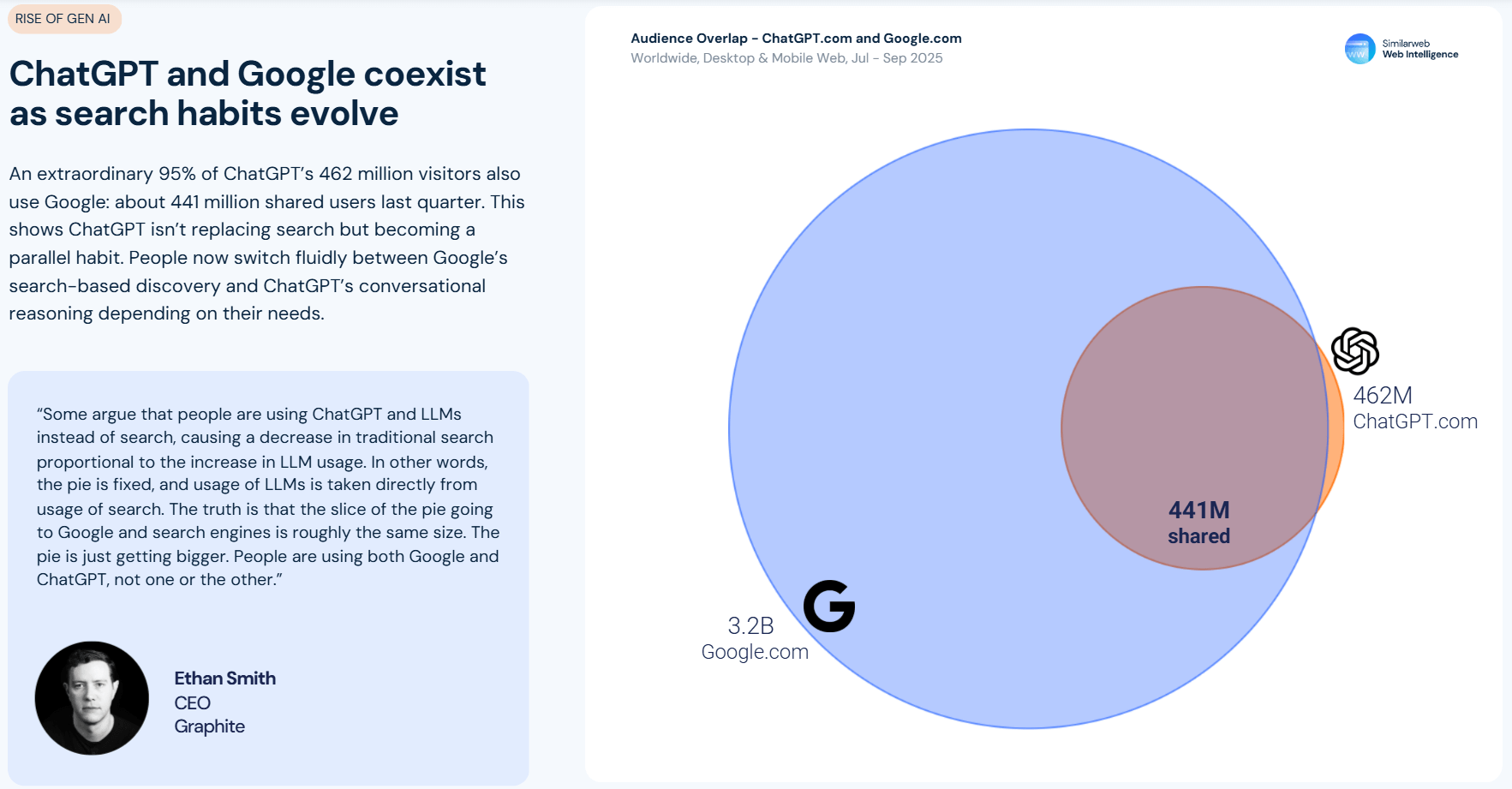
The issue isn’t migration from one channel to another. It’s the multiplication of touchpoints where your brand needs to appear. Your brand now requires visibility across traditional search AND AI-powered discovery, each with different citation patterns and authority signals.
The brands currently dominating AI citations didn’t get there through budget debates or organizational turf wars. They got there through systematic, cross-functional execution, in which multiple teams contributed their specialized expertise toward a shared visibility goal.
Three critical insights that every SEO leader needs to internalize
1. LLMs learn from collective internet consensus, not meta tags
Unlike traditional search engines, which can be gamed through technical optimization, AI models form “opinions” by processing billions of data points across the web.
When someone asks for “the best project management tool,” the AI doesn’t query a keyword database. It synthesizes what the internet collectively says about project management tools, weighing frequency, authority, recency, and context.
You can rank #1 on Google for “best CRM” and still be invisible in AI answers if the broader internet doesn’t validate your authority in that space. This is the fundamental shift Eli correctly identifies.
2. External signals matter more than owned content
AirOps research analyzing 45,000+ citations found that 85% of brand mentions came from third-party pages, not owned domains.
When your brand appears in WSJ, TechCrunch, Reddit discussions, and G2 reviews, you’re training the model that you’re relevant to specific topics. Seer Interactive’s analysis found that ranking on page one of Google correlated with LLM mentions at 0.65, while the number of backlinks showed weak or neutral correlation.
Authority distribution across the web matters more than authority concentration on your own domain. This validates everything Eli argues about brand presence.
3. You can’t buy your way in with cash alone
Startups with massive war chests hoping to “win AEO” through sheer spending are learning a painful lesson.
AI visibility follows a different economic model than paid search. You can’t bid for placement in ChatGPT’s answers. You have to earn recognition through sustained brand building, exactly as Eli describes.
The DecorMyEyes story, which he references from 2011, where terrible businesses could rank through SEO tricks, could never happen with LLMs. The collective opinion of the internet can’t be faked. This is why his diagnosis is so valuable.
Where the analysis needs development (Not contradiction)
Eli’s insights are correct. But, in my opinion, his organizational prescription (hand this to brand teams) doesn’t account for how modern SEO has evolved.
Modern SEO already owns these activities
Search Engine Journal’s analysis of 100+ SEO job postings in 2025-2026 shows that SEO roles now explicitly require digital PR strategy and execution, entity SEO and knowledge graph optimization, community management on Reddit and forums, third-party platform optimization across G2 and review sites, and cross-functional collaboration with brand, PR, and product teams.
If your SEO director doesn’t already own digital PR relationships and authority building, you have an organizational design problem. But you also have a cross-team cooperation problem.
The “brand team” doesn’t exist as a monolith
In most organizations, brand activities are split across corporate communications for narrative and PR, product marketing for positioning and messaging, demand generation for campaigns and awareness, content marketing for asset creation, and community teams for social, forums, and UGC.
Saying “brand should own AEO” is like saying “sales should own revenue.” Which part of sales? Which part of the brand? The question reveals the complexity that Eli’s framework doesn’t address.
It needs the Orchestra model
BrightEdge data shows approximately 34% of AI citations come from PR-driven coverage, 10% from social channels, and 56% from owned content, technical optimization, and third-party platforms.
This isn’t a brand activity OR an SEO activity. It’s a coordinated, cross-functional effort in which SEO provides strategic direction and measurement, while multiple teams deliver their specialized contributions. Yes, just like a conductor of an orchestra.
SEO teams have been influencing without authority for years, advocating SEO to different teams in their organizations in order to create more impact. Now it’s time for organizational R&Rs to follow.
Modern SEO teams (that have not done this yet) should evolve from technical specialists to strategic leaders who control the pace and coordinate brand authority building across all marketing functions.
The framework that actually works: SEO as orchestra conductor
The most effective approach positions SEO as the strategic lead for AI visibility while distributing execution across specialized teams. This isn’t about who pays for what, but about who orchestrates what.
Think of it like an orchestra:
- SEO is the conductor who knows the score, sets the tempo, and ensures every section plays in harmony.
- Brand and PR are the string section, carrying the melodic narrative.
- Content is the brass, providing power and reach.
- Product Marketing is the woodwinds, adding nuance and differentiation.
- Community is the percussion, creating rhythm and reinforcement.
Each section has specialized skills that the conductor doesn’t possess. But without coordination, you get noise instead of music.
The conductor doesn’t play every instrument, but they understand how each contributes to the whole performance.
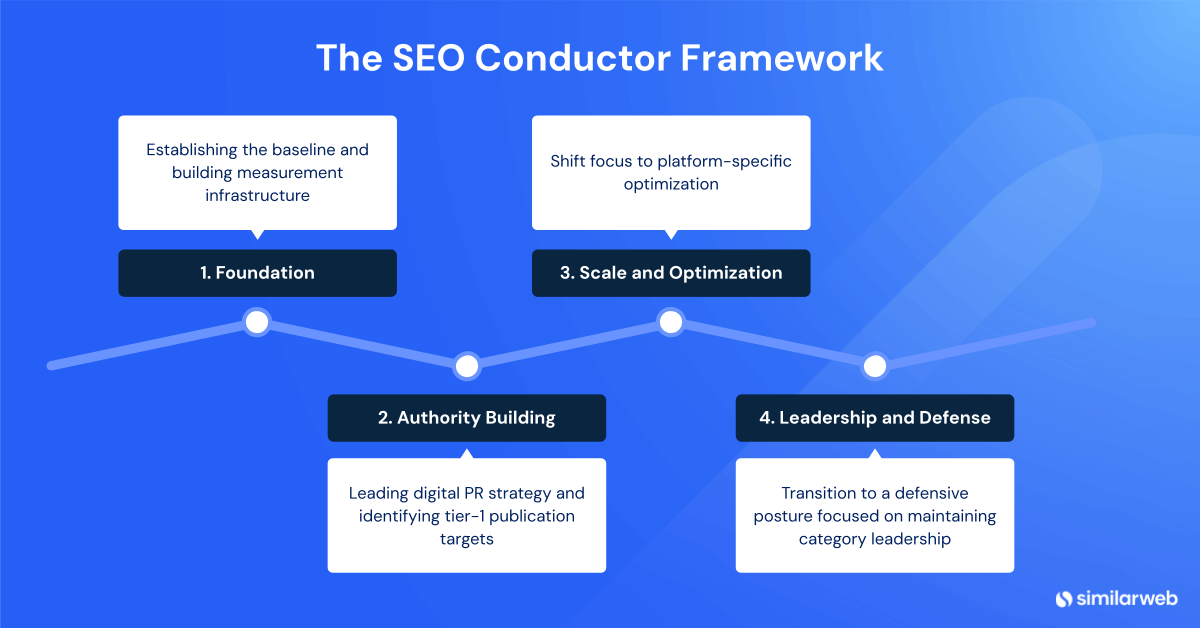
Phase 1: Foundation (Months 1-3)
The SEO team takes ownership of establishing the baseline and building measurement infrastructure. This includes conducting an AI visibility audit across generative AI engines:
- Running competitive AI analysis to understand who’s winning, why, and where.
- Performing citation gap analysis.
- Handling technical GEO foundation like schema, structured data, and llms.txt files.
- Setting up a comprehensive measurement infrastructure.
Cross-functional collaboration should begin immediately:
Product Marketing defines clear positioning and category ownership claims, answering the fundamental question of what you want to be known for.
The SEO team audits existing assets for AI-readability, identifying which pieces can be optimized versus which need complete rewrites.
Engineering implements technical requirements identified by SEO, while Analytics sets up tracking dashboards to measure downstream impact.
Budget allocation in this phase maintains 70% for core SEO activities (don’t cannibalize your foundation), allocates 15% to new AI monitoring tools, and dedicates 15% to cross-team workshops and alignment meetings.
This isn’t excessive overhead. It’s the investment in coordination that makes execution possible.
The phase concludes with four critical deliverables:
- A current-vs-target visibility scorecard showing where you are and where you need to be.
- A technical implementation roadmap with clear timelines.
- A cross-functional RACI matrix defining who does what.
- A measurement dashboard, accessible to all teams.
Phase 2: Authority Building (Months 4-8)
This is where the cross-functional model proves its value. The SEO team maintains strategic ownership by leading digital PR strategy and identifying tier-1 publication targets.
Managing entity SEO and knowledge graph optimization, analyzing and prioritizing citation sources to focus effort where it matters most, and handling performance reporting and strategy iteration based on what’s working.
Brand and PR teams execute the narrative distribution that SEO can strategize but not implement on its own. They secure tier-1 media placements by following SEO guidance on structure and formatting, ensuring press releases are optimized for AI parsing while maintaining brand voice.
Product Marketing creates thought leadership positioning pieces that establish your executives as category experts.
The Content team produces answer-first content formats, builds FAQ hubs and definitive guides that LLMs consistently cite, and ensures every asset is both human-readable and machine-parseable.
Community management becomes critical during this phase. The team builds authentic presence on Reddit and industry forums (not spam, but actual value), manages review platforms like G2, Trustpilot, and Capterra, and activates customer advocates.
Customer Success runs targeted review-acquisition campaigns that generate third-party validation signals that LLMs place significant weight on.
Budget allocation shifts to reflect execution intensity:
- 60% funds for SEO strategy, technical work, and monitoring.
- 25% goes to PR and brand execution of placements.
- 10% supports content asset creation.
- 5% covers tools and measurement platforms.
By the end of this phase, successful programs can achieve 10+ tier-1 publication placements that create authoritative external signals, complete knowledge panel optimization so that Google and LLMs understand your entity clearly, acquire 50+ high-quality reviews that build trust signals, and demonstrate a visibility share improvement of 5-12 percentage points over the baseline.
Phase 3: Scale and Optimization (Months 9-12)
As foundational work pays off, the SEO team shifts focus to platform-specific optimization. Different AI platforms favor different sources, so strategies must adapt.
The SEO team develops competitive displacement strategies to take share from rivals, manages sentiment and fixes negative mentions before they compound, and validates ROI through executive reporting that connects visibility to business outcomes.
Brand and PR maintain a sustained PR cadence rather than one-off campaigns. They book podcast tours and speaking engagements that create authoritative signals across audio and video platforms, which LLMs increasingly parse.
Product Marketing develops category education content and comparison frameworks that position your brand as the definitive source.
The Content team shifts toward dominating niche subcategories, creating comprehensive resources for specific use cases where competition is lower.
Partnership team executes co-marketing initiatives that create citation co-occurrence (your brand mentioned alongside established authorities), while Sales contributes customer case studies and testimonials that validate real-world usage.
Budget allocation adjusts to reflect scaling execution:
- 55% SEO coordination and measurement
- 30% Backlinks, PR, and brand narrative work
- 10% content production
- 5% partnerships and community management.
Realistic Phase 3 Outcomes (based on growth rate benchmarks):
Expected results vary significantly by starting position and competitive density. Brands investing $15,000-$30,000/month can achieve:
- Starting from 5-10% visibility: Progress to 12-20% by Month 12 (+7-15 percentage points)
- Starting from 10-15% visibility: Progress to 20-30% by Month 12 (+10-18 percentage points)
- Starting from 15-25% visibility: Progress to 30-45% by Month 12 (+12-22 percentage points)
AI referral traffic quality can be validated through engagement metrics (AI traffic demonstrates 23% lower bounce rates and 41% longer session duration compared to traditional organic traffic).
Phase 4: Leadership and Defense (Ongoing)
Transition to a defensive posture focused on maintaining category leadership.
The SEO team works to defend category ownership and maintain top-3 positioning against competitive threats, expands into emerging platforms as new AI tools and voice assistants gain traction, maintains competitive intelligence and continuous market monitoring, and optimizes for platform changes and algorithm updates.
All teams maintain excellence in their specialized areas rather than declaring victory and moving on.
Leadership makes strategic pivots in response to market shifts and competitive dynamics.
Product teams ensure new features achieve visibility in AI-generated comparisons and recommendations.
Budget allocation reaches a steady state at 65% for SEO, 25% for brand and PR, and 10% for innovation and testing of new platforms or tactics.
The budget reality: Ring-fence, don’t reallocate
Here’s where Eli’s article creates unnecessary anxiety and organizational confusion. He implies SEO budgets need to be diverted to brand teams, creating zero-sum competition for resources.
That’s organizationally naive and ignores how successful companies actually fund cross-functional initiatives. It also contradicts his own insight that AEO requires sustained, long-term investment, not budget shuffling.
The smart approach is to ring-fence dedicated AI visibility investment rather than cannibalizing existing budgets. This is validated by Similarweb’s research and industry benchmarks from Conductor and BrightEdge.
The Ring-Fence Model
Successful organizations maintain their core SEO investment at 70-80% of their organic search budget. The remaining 20-30% of the organic budget is dedicated to AI visibility initiatives.
It supports traditional content and on-page optimization, which still drive the majority of organic traffic. It maintains link acquisition and domain authority work that remains foundational. It funds classic competitive intelligence and keyword research.
You don’t kill the golden goose of traditional SEO while betting everything on AI. Gartner’s CMO survey found that CMOs are “ring-fencing funds specifically for AI adoption and visibility” rather than reallocating from existing high-performing channels.
Simultaneously, they create dedicated AI visibility investment representing 20-30% of the search budget. These funds AI-specific content optimization using answer-first formats, entity SEO and knowledge graph management, digital PR with explicit AI citation focus, AI visibility monitoring and reporting tools, and cross-team coordination and training.
The insight: source this AI visibility budget from growth or marketing operations pools that ALL teams can access. Not by cannibalizing SEO’s existing allocation. This removes the political battle over whose budget shrinks and focuses everyone on growing the total visibility pie.
Who Controls Budget Allocation
SEO controls tactical allocation within the ring-fenced pool. The SEO Director decides how much goes to PR placements, content production, tools, and platform-specific optimization based on competitive gaps and performance data. This isn’t advisory – SEO owns the allocation decisions.
The CMO provides oversight, not micromanagement. CMO approval is required for the overall ring-fenced amount (the total pool size) and major reallocation decisions (shifting more than 20% between activities). Day-to-day tactical allocation stays with SEO to maintain execution speed.
This structure works because it gives SEO real authority (not just coordination) while preventing budget sprawl. Teams execute their specialized roles within the allocation SEO defines, not competing for resources. Budget deadlocks get escalated to the CMO, but day-to-day decisions flow from SEO’s strategic direction.
What each team actually owns (The RACI matrix)
The mistake isn’t giving too much responsibility to SEO or the brand. It’s failing to clarify who does what.
| Team | RACI Role | Key Responsibilities |
| SEO | Responsible |
|
| Brand/PR | Accountable |
|
| Content | Responsible |
|
| Product Marketing | Consulted |
|
| Community/CS | Consulted |
|
| Engineering | Consulted |
|
The mistake isn’t giving too much responsibility to SEO or the brand. It’s failing to clarify who does what.
The measurement framework: Proving this actually works
One reason the budget debate persists is that the ROI of AI visibility feels more subjective than traditional SEO metrics. You can’t point to a ranking increase or traffic spike with the same confidence.
But with the right framework, AI visibility is absolutely measurable. The business impact is defensible to even the most skeptical CFO.
Primary KPIs (What SEO teams should report)
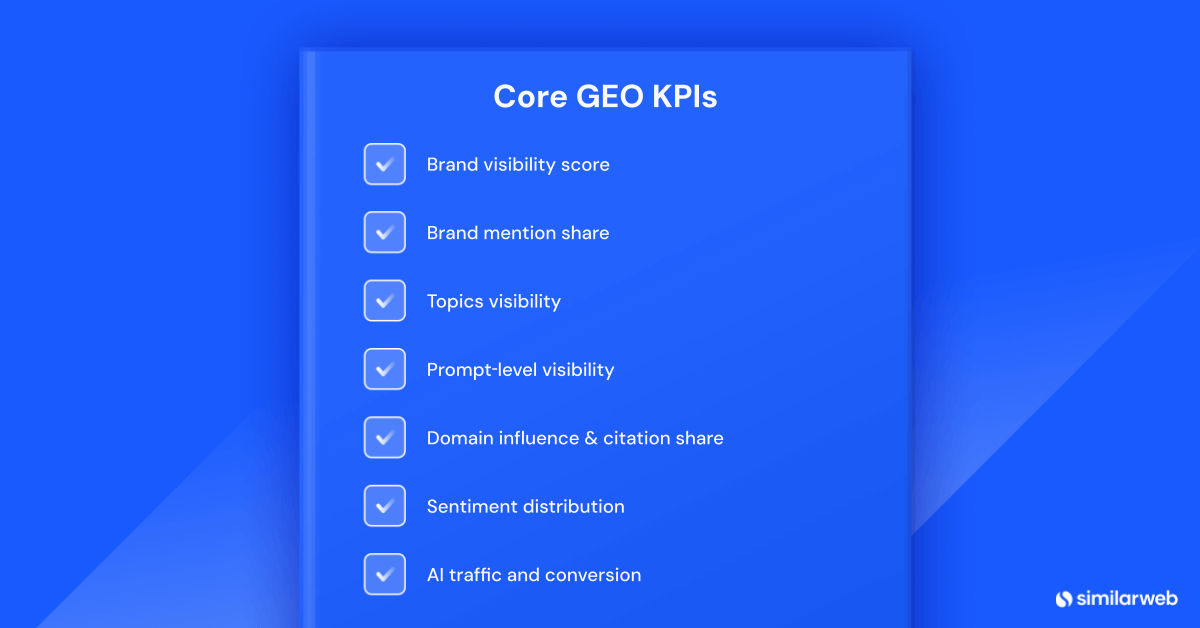
Visibility Share
This is your foundation metric. You can track it in our AI Visibility tool, or calculate it as your brand mentions divided by total category queries, then multiply by 100. This shows the percentage of relevant AI conversations that include your brand.
Domain Influence Score
This metric measures how often YOUR domain is cited, not just your brand name. It shows the share of citations coming from your own domain, and reveals whether you’re building citation authority or just passive brand awareness.
Target 3-5% domain influence in competitive categories. Higher domain influence means AI engines treat your content as a primary source, rather than just mentioning your brand through third-party references.
Sentiment Distribution
Shows how LLMs talk about you, not just whether they mention you. Similarweb’s Sentiment Analysis tool tracks the percentage of positive, neutral, and negative mentions across AI platforms.
Healthy brands maintain positive mentions above 60%, neutral mentions between 30-40%, and negative mentions below 5%. If negative sentiment exceeds 10%, stop investing in visibility and focus on fixing your reputation first. Visibility without trust works against you.
Brand Mention Share
Measures your competitive share of voice (your mentions relative to all brand mentions in AI answers). This is defined by Similarweb as “how often your brand is mentioned relative to all brands within AI answers.”
Track this to understand competitive momentum. If competitors gain mention share faster than you, your authority may be eroded.
Secondary KPIs (Validation signals)
Topical Visibility
Measures your brand’s presence within specific topic areas. Similarweb’s Topics summary shows your visibility per topic and helps identify which areas drive your brand’s presence and where you need improvement.
Use this to prioritize content investment. If you’re absent in high-value topics, that signals where to focus GEO efforts.
Prompt-Level Visibility
Tracks how often your brand appears in responses to specific user questions. Similarweb’s Prompt Analysis tool lists individual prompts, their visibility percentage, and whether the brand is mentioned.
This reveals query gaps (specific questions where your brand should appear but doesn’t). Create content that explicitly answers missing prompts to improve coverage.
AI Traffic & Conversions
Grounds visibility metrics in measurable business impact. Similarweb’s AI Traffic Analytics shows “the volume of visits to your site from AI engines” and which pages receive AI-driven traffic.
Track conversion metrics (sign-ups, purchases) to understand ROI. Although AI traffic is currently small (often under 10%), the data we showed here suggests that it converts better.
Real-world validation: What’s actually working
The most effective approach positions SEO as the strategic lead for AI visibility while distributing execution across specialized teams. This isn’t organizational theory, it’s what companies are actually implementing with measurable results.
The data validates the cross-functional model
BrightEdge’s 2025 Enterprise SEO Study (mentioned earlier) shows where AI citations actually originate. Approximately 34% come from PR-driven coverage in authoritative publications. Another 10% come from social channels and community platforms. The remaining 56% come from owned content combined with technical optimization and third-party platforms.
The translation is clear: this represents a 66/34 split between traditional “SEO stuff” and “brand stuff.” But both components are required, and neither works in isolation. This is exactly why the conductor model matters.
Seer Interactive’s research found that branded search volume (MSV) correlates with AI mentions at 0.18, one of the strongest correlations they observed. However, correlation doesn’t equal causation.
Strong brands generate both AI visibility AND high search volume simultaneously because they’ve built genuine market authority. This validates Eli’s point about reputation while showing why SEO measurement capabilities matter.
The University of Indiana analyzed over 140,000 conversations across AI platforms and found significant variation in citation patterns. ChatGPT relies heavily on publishers and review sites, with 81% of citations coming from these sources.
Perplexity shows the broadest source diversity, making it ideal for B2B audiences conducting serious research. Claude shows the lowest SERP influence score at 55 and relies more on internal analysis, attracting a premium technical audience. Gemini favors YouTube and Wikipedia, leveraging Google’s ecosystem integration.
These platform-specific differences matter enormously. You can’t optimize for “AI” generically. You need tailored approaches by platform, which requires SEO-level analytical sophistication to execute effectively.
Published case studies show what works
Chemours (Chloride Manufacturing): Cross-Functional Integration
Working with ABM Agency, Chemours unified 12 regional websites, built comprehensive product specification databases, and strengthened thought leadership around chloride process manufacturing. The cross-functional approach combined technical SEO foundation, content strategy, and PR execution.
Result: 67% share-of-voice advantage over primary competitors, driving over $48 million in pipeline and more than $18 million in revenue.
Triangle IP (B2B SaaS): Strategic Prioritization
Concurate agency focused on consideration and decision stage content rather than top-of-funnel listicles. They structured each piece to be “answerable” with clear headings, question-led sections, and scannable modules, optimized for both traditional search and AI citation.
Result: AI traffic converting nearly 3x better than traditional channels, validating the strategic focus on high-intent content over volume metrics.
PSA Software Client: Product-Led Content
The Rank Masters built a lean, product-led content program with an ICP-first, problem-led framework. They created 49 posts over 5 months (July-December 2025) structured for AI parsability.
Result: The content became the primary non-homepage acquisition engine, demonstrating how structured, answer-first content drives both traditional SEO and AI visibility
Industry investment validates the approach
The Conductor’s Benchmarks Report I mentioned earlier also surveyed marketing leaders across industries:
- 97% of CMOs report that AEO/GEO delivered positive impacts in 2025
- 56% of companies made significant AEO/GEO investments in 2025, with 94% planning to increase investment in 2026
- 12% of digital marketing budgets are now allocated to AI visibility optimization on average
- AI-referred traffic is consistently described as higher-intent and more conversion-ready than traditional organic traffic
The pattern is clear: companies that invest in cross-functional AI search optimization see measurable results. SEO leads strategy and measurement, brand/PR executes narrative distribution, and content creates AI-ready assets.
The integration delivers outcomes neither function could achieve on its own.
The organizational patterns that fail
Having consulted with several organizations about AEO implementation, I’ve seen three failure modes repeat with depressing consistency. Understanding these patterns can help avoid them.
Failure mode 1: “Brand will handle it.”
In this scenario, the CMO assigns AEO to the VP of Brand or Communications. The brand team runs awareness campaigns and PR placements, focusing on impressions, media value, and tier-1 logo collecting.
They execute traditional PR playbooks without any technical optimization. Nobody measures AI citation impact systematically. Six months later, there has been minimal improvement in visibility despite significant spending.
This fails because brand teams think in terms of reach and awareness metrics. They don’t understand entity disambiguation, topical authority, passage-level optimization, or semantic relationship mapping.
They can execute PR brilliantly, but they can’t build topical authority or measure whether those placements are actually increasing AI visibility. They optimize for human readers and media impressions, not for machine parsability and citation potential.
Failure mode 2: “SEO will figure it out.”
Here, the SEO team gets tasked with AEO using their existing budget without additional resources. They try to “optimize” for AI using technical shortcuts and gaming tactics.
They start spam campaigns on Reddit, treating it like a backlink farm. They build low-quality listicles that temporarily game LLMs but provide no real value.
This fails because, when SEO operates without brand collaboration, it defaults to what it knows: “technical” manipulation. A technical mindset without brand narrative guidance leads to short-term hacks that damage long-term trust.
Many of them treat Reddit like a directory, third-party platforms like link opportunities, and narrative as “just content” rather than strategic positioning. As Marketing Dive noted, this approach fails because “AI’s growing influence is already reshaping team structures” and requires new operational disciplines.
Failure mode 3: “Everyone’s responsible” (Which means nobody’ accountable)
In this pattern, the CMO declares AEO a “cross-functional priority” without assigning a single-threaded owner. There’s no clear leader and no budget allocation.
Everyone assumes someone else is handling the important tasks. Six months of meetings have produced zero execution because no one has explicit accountability. When nothing improves, blame spreads across teams rather than focusing on fixing the broken structure.
This fails because cross-functional efforts without single-threaded ownership succumb to the diffusion of responsibility. McKinsey’s research on marketing effectiveness found that “demonstrating marketing’s contribution via robust ROI calculations is essential to create credibility across the C-suite.”
When everyone owns something, nobody owns it. Coordination costs explode while actual progress stalls.
Stop asking “Whose budget?” Start asking, “Are we building something worth citing?”
The budget debate is organizational theater, distracting from the real question:
Most organizations fall between these extremes. The solution isn’t picking SEO OR Brand, it’s systematic collaboration with clear ownership.
The cross-team playbook: Four operational workflows
What does daily collaboration actually look like? Theory is useless without operational specifics. Here are four workflows that successful organizations use to coordinate AI visibility efforts.
Workflow 1: Content creation (SEO + Product Marketing + Content)
Before any content gets created, SEO analyzes which topics matter, which questions users actually ask, and which AI platforms to target.
Product Marketing defines the positioning angle, unique perspective, and competitive differentiation that make the content worth citing.
Content receives a combined brief that includes both SEO technical requirements and brand voice guidelines, ensuring the final asset satisfies both machines and humans.
During creation, Content writes naturally in brand voice without “SEO-speak”. SEO reviews the draft for structure, passage-level optimization, and entity relationships that help LLMs understand context. Product Marketing reviews for positioning accuracy and competitive framing, ensuring claims are defensible and differentiated.
Before publishing, SEO implements schema markup and technical optimizations, and validates AI parsability and citation readiness by testing how LLMs interpret content. Final approval comes from the SEO Lead who ensures quality meets brand standards.
The result: assets that sound authentically like your brand AND perform technically when AI systems parse them.
Workflow 2: Digital PR (SEO + Brand/PR + Product Marketing)
SEO provides the strategic foundation by prioritizing citation sources (which publications LLMs trust most in your category), identifying data angles that journalists will actually cover, defining technical requirements for press releases on structure and schema, and measuring how each placement affects visibility, share, and sentiment.
Brand and PR execute what SEO cannot: cultivating journalist relationships through consistent, valuable interaction:
- Developing pitches and conducting outreach
- Negotiating placement terms and coordinating coverage
- Amplifying placements through social channels to maximize reach.
Product Marketing supports the effort by providing executive positioning and quotable perspectives, analyzing and interpreting proprietary data for story hooks, and supplying customer proof points that validate claims.
The result: press coverage that’s both brand-appropriate (sounds like you, positions you correctly) AND citation-worthy (structured for AI parsing, published in sources LLMs trust).
Workflow 3: Review acquisition (SEO + Customer Success + Community)
SEO defines the strategic parameters: priority platforms based on which review sites LLMs cite most frequently, review volume and quality targets needed to build authority signals, and structured data implementation requirements for proper review display in search and AI contexts.
Customer Success executes the campaign mechanics: running review-request campaigns at optimal moments in the customer journey, cultivating customer-advocacy relationships, and developing success stories that serve as testimonials.
Community manages ongoing engagement by handling review responses to demonstrate active listening, monitoring reputation across platforms, and encouraging user-generated content that reinforces authentic usage patterns.
The result: review signals that build both AI authority (LLMs weigh review data heavily) and social proof (humans trust peer validation).
Workflow 4: Performance review (SEO + All Teams + Leadership)
Monthly cross-team reviews create accountability and shared visibility.
SEO provides visibility metrics, competitive benchmarks, and a gap analysis that show where the program stands. Each contributing team reports execution progress, identifies blockers that need leadership intervention, and celebrates wins that build momentum.
Leadership decides on budget adjustments, priority shifts, and resource allocation based on the data.
- Quarterly strategic planning maintains long-term direction.
- SEO proposes priorities for the next quarter based on performance data and competitive shifts.
- Teams commit to capacity and specific deliverables they’ll own.
- Finance approves budget adjustments if targets or market conditions change.
The result: continuous optimization based on what actually works rather than what should theoretically work.
The uncomfortable truth about startups
Eli’s right about one thing that deserves emphasis. Startups with vast funds trying to “win” AEO through brute-force spending will likely fail. AI visibility isn’t for sale the way Google Ads is.
You can’t simply outbid competitors for placement in ChatGPT’s recommendations. This is the harsh reality of the new visibility economy.
But his framing that startups are doomed because they lack a brand footprint misses a critical strategic nuance. Startups CAN win in AI visibility by dominating narrow subcategories where competition is manageable, rather than competing head-to-head with established category leaders.
Consider the math using the ABMV model. Instead of competing in “project management software,” where 25+ major brands fight for mentions, a startup should own “async project management for distributed teams,” where only 3-5 serious competitors exist.
For a broad category competition with 8M queries per month, achieving even 5% visibility share against 20+ competitors reduces your Competitive Density Weight to 0.55 (a 45% penalty). The monthly value might reach only $15K, but the required investment would be $40K-$50K per month. That’s a losing proposition with negative ROI.
Switch to a narrow subcategory approach with 400K queries per month (smaller absolute numbers). Target 25% visibility share against 3-5 competitors, and your Competitive Density Weight stays at 1.0 with no penalty.
Monthly value reaches approximately $22K, but required investment drops to $10K-$15K per month. That’s a winning proposition with 1.5x to 2.2x ROI. The absolute TAM is smaller, but your share and efficiency are dramatically better.
The strategy is straightforward and proven. Dominate a niche worth owning, prove the model works, then expand to adjacent categories.
This is exactly how ClickUp initially positioned itself against Asana (not “project management” but “everything app for remote teams”). How Notion is positioned against Confluence (not “collaboration” but “all-in-one workspace”). How Airtable is positioned against traditional databases (not “database” but “spreadsheet-database hybrid for non-technical teams”).
They didn’t try to beat Microsoft and Google in the broad category of “productivity software.” They carved out specific use cases and owned them completely before expanding. Startups don’t need Under Armour’s budget. They need Under Armour’s strategic clarity about where to compete and win.
Why this matters more than you think
The organizational question of “who owns AEO” isn’t academic. It determines whether companies can adapt to the biggest shift in discovery since the advent of mobile.
Eli’s article correctly identifies that the stakes are high. But the solution space is more nuanced than a simple SEO-to-Brand handoff.
Three futures (Only one works)
Future 1: SEO Owns It Alone
SEO teams get the mandate but not the resources to execute at the pace AI visibility demands. They’re expected to cover technical optimization, content creation, competitive SEO research, citation analysis, Reddit and Wikipedia presence, digital PR outreach, review management, and emerging AEO/GEO tactics simultaneously.
Future 2: Brand Owns It Alone
Brand teams run PR and awareness campaigns that generate tier-1 coverage. But the coverage is poorly structured for AI parsing.
Future 3: Cross-Functional with SEO as Conductor
SEO provides strategic direction, measurement frameworks, and technical optimization. Brand and PR execute narrative distribution and media placements in accordance with SEO structural guidance.
Content creates AI-ready assets that satisfy both brand voice and technical requirements. Product Marketing defines positioning that translates to entity relationships. Community builds third-party validation across reviews and forums.
Budget comes from growth or marketing ops pools, removing departmental competition. Clear accountability with shared success metrics. Only this future delivers sustainable AI visibility.
The real question Eli identified (And how to operationalize it)
Eli’s article asks: “Should SEO budgets pay for LLM visibility?“
That’s the right provocation because it forces organizations to confront a deeper issue. But the question underneath is even more important: “Is your organization structured to build the authority that machines and humans both recognize?”
This is where Eli’s analysis is most valuable. He correctly identifies that technical SEO tactics alone can’t create the market consensus that LLMs seek.
If the answer to his deeper question is no, then shuffling the budget between teams won’t fix the problem. You need to build organizational capabilities you currently lack.
Consider the symptoms of structural dysfunction. If your SEO team operates in a silo without access to executive thought leadership, tier-1 media relationships, customer advocacy programs, clear product positioning, and cross-functional coordination, then you have an organizational design problem, not a budget problem.
The SEO team can’t succeed, regardless of funding, because they lack the strategic input that only other teams provide.
Similarly, your brand team will generate impressive media coverage that doesn’t translate to AI citations because they can’t bridge brand narrative to machine-readable signals.
The solution Eli points toward is correct: brand building matters. Where the framework needs development is recognizing that modern SEO already includes brand building as a core capability.
I think that the answer isn’t reorganization. It’s the integration of the brand capabilities Eli correctly identifies with the measurement and technical capabilities that SEO teams bring. As IDX’s Authority Flywheel framework explains: “The future of digital visibility is earned, not bought.”
Practical implementation: The 5-step audit
If you’re unsure whether your organization is set up for AI visibility success, run this diagnostic. It reveals whether you have the foundations for cross-functional execution or need to address structural problems before investing.
1. Measure Current Cross-Team Collaboration
Start by honestly assessing your baseline for collaboration:
- Does SEO have standing meetings with PR and Brand teams (weekly or bi-weekly meetings indicate real partnership, not just occasional check-ins)?
- Does SEO review all press releases before distribution to ensure they include proper structure and schema markup?
- Do PR placements include SEO-defined anchor text and structured formatting more than 80% of the time?
- Does Product Marketing consult SEO on all positioning content?
- Can SEO access executives for thought leadership quotes on-demand within 48 hours?
Score yourself honestly. If you answer yes to all five questions, you’re ready for AI visibility leadership and should invest aggressively.
Three to four yeses mean you can succeed with focused process improvements and clearer workflows. Zero to two yeses indicate organizational restructuring is needed before major investment. You’ll burn money on efforts that teams can’t coordinate.
2. Audit Authority Distribution (R&Rs)
Using Similarweb’s Citation Analysis tool or manual AI queries across platforms, examine where your competitors are getting cited. Distinguish between their own domains and third-party sources to understand patterns of authority distribution.
- Calculate your current domain influence score (target 30-50% of mentions citing your owned properties).
- Assess how diverse your citation sources are (target 15+ different authoritative domains).
- Check your sentiment distribution across AI platforms (target above 70% positive mentions).
3. Assess technical foundation
Run systematic checks on your technical readiness:
- Verify that your key pages have comprehensive schema markup covering Organization, Product, and FAQ structured data.
- Confirm your site structure is clear and hierarchical, since research shows most AI citations come from root-level pages rather than deep hierarchies.
- Ensure AI crawlers can access your content by reviewing robots.txt rules and JavaScript rendering.
- Check whether you have an llms.txt file, an emerging practice for AI-friendly site documentation.
4. Evaluate budget flexibility
Before building a plan, confirm financial feasibility. Ask your CMO and finance team whether you can ring-fence 20-30% of the search budget specifically for AI visibility initiatives. Determine if a growth or innovation budget exists for cross-team initiatives beyond departmental allocations.
Verify that leadership will support an 18-month investment cycle, since AI visibility follows brand-building timelines rather than performance marketing sprints. Confirm that success can be measured by visibility share rather than immediate traffic, since awareness effects precede conversion effects.
5. Check measurement capability
Finally, verify you have the tools to track progress:
- Confirm you can measure AI visibility share across platforms using Similarweb AI Brand Visibility or Conductor.
- Determine whether you can track citation sources and sentiment manually or through platform automation.
- Ensure AI referral traffic and conversion tracking work in GA4 with proper source segmentation.
- Verify access to branded search trend data via Google Trends and Search Console.
If you can’t measure results, you can’t manage the program. Investment without measurement is gambling, and CFOs won’t fund gambles beyond the first quarter.
Eli is right about the problem, it just has a different solution
Eli’s article reveals an important point often overlooked in tactical discussions. Many people still think SEO is what it was in 2015. Technical tweaks. Keyword targeting. Link building. A specialist function operating separately from brand strategy and business goals.
If that’s your mental model of SEO, then Eli’s argument makes perfect sense. Of course, brand teams should own awareness. Of course, the SEO budget can’t fund it.
But that version of SEO no longer exists in high-performing organizations. Or rather, it exists only in companies that haven’t evolved with the market and are still treating SEO as a technical department rather than a growth function.
Modern SEO is growth operations with a visibility lens. The role has fundamentally transformed over the past decade, accelerated by AI’s impact on discovery.
The most successful SEO leaders I know own digital PR strategy and execution, not just the technical requirements. They drive cross-functional collaboration because they understand visibility requires multiple specialized capabilities working in concert.
They understand brand positioning and narrative deeply enough to translate it into entity relationships and semantic signals that machines can interpret. They manage community and reputation across platforms because third-party validation drives modern authority.
They build partnerships specifically for co-visibility and citation co-occurrence. They measure business impact through revenue and pipeline contribution, not just rankings and traffic.
They operate as strategic growth leaders who happen to specialize in visibility, not as technical specialists isolated from business strategy.
If your SEO leader can’t do these things, Eli is right that you shouldn’t hand them the AEO budget. You have a talent problem. The role has evolved, and leaders who haven’t evolved with it become bottlenecks rather than force multipliers.
But the solution isn’t to take AEO away from SEO. The solution is to expand the SEO function to better match market demand.
The future belongs to organizations that integrate brand and SEO into a unified visibility strategy in which both play essential roles, and track AI visibility as rigorously as traditional search metrics using Similarweb’s AI Brand Visibility suite.
They invest systematically in both “who we are” (brand positioning and narrative) and “how we show up” (SEO measurement and technical excellence).
As HubSpot’s 2026 State of Marketing report found, 40.6% of marketers are updating their SEO strategies in response to algorithm shifts, and 24% are optimizing specifically for generative AI.
AI visibility isn’t an SEO problem or a brand problem. It’s a business problem that requires every marketing function to work from the same playbook with clear ownership and shared accountability.
Eli asked the right question: “Should SEO budgets pay for LLM visibility?” The answer: SEO should lead it, multiple teams should fund it, and everyone should benefit from it.
The real question isn’t whose budget funds it. The question is: Are you building a brand that deserves to be cited?
If the answer is yes, figure out the org chart details through execution and iteration. If the answer is no, shuffling the budget between teams won’t save you. Fix the brand foundation first, exactly as Eli argues, then worry about visibility optimization.
FAQ
Should SEO or Brand teams own the AI visibility strategy?
AI visibility requires SEO as the strategic conductor with cross-functional execution. SEO leads measurement, strategy, and technical optimization. Brand and PR execute narrative distribution and tier-1 placements. Content creates AI-ready assets. Product Marketing defines positioning.
How much should we budget for AI visibility optimization?
Budget 20-30% of your search budget specifically for AI visibility, sourced from growth or marketing ops pools rather than cannibalizing core SEO. Using Similarweb’s ABMV model, calculate your visibility value and ensure the investment delivers at least a 2x ROI on reach value alone.
Can we run traditional SEO and AI optimization simultaneously?
Yes, and you must. Maintain 70-80% of search budget on core SEO (technical health, content, links). AI optimization builds on top of strong SEO foundations. AI isn’t replacing search. It’s sitting beside it. Brands need visibility across both traditional search AND AI-powered discovery platforms with tailored strategies for each.
What’s the biggest mistake organizations make with AI visibility?
Creating a responsibility vacuum where SEO and Brand both claim they’re contributing, but neither owns outcomes. Cross-functional efforts without single-threaded ownership die from diffusion of responsibility.
The second-biggest mistake: SEO teams trying to solve brand reputation problems with technical shortcuts (e.g., spamming Reddit or using AI-generated content farms), which damage long-term trust while providing only temporary visibility boosts.
How long does it take to see AI visibility results?
Expect a 10-12-month period for a positive ROI. Months 1-3 show foundation work with baseline to +5% visibility. Months 4-6 bring acceleration with +5-12% visibility as content gets indexed. Months 7-9 deliver growth with +10-18% total visibility from compounding effects. Months 10-12 are the maturity period, with +15-25% total visibility and a positive ROI.
This timeline reflects brand-building cycles, not performance marketing sprints.
How is AI search optimization different from traditional SEO?
Traditional SEO optimizes for rankings and clicks. AI search optimization focuses on citations and mentions that do not result in clicks. Success requires distributing authority across the web (digital PR, reviews, forums) rather than concentrating it on your domain. Measurement shifts from rankings to visibility share and sentiment.
Which teams need to collaborate for AI visibility success?
Five core teams must coordinate. SEO provides strategy, measurement, technical foundation, and prioritization of digital PR. Brand and PR execute narrative distribution, tier-1 media placements, and speaking engagements. Content creates answer-first assets and definitive guides. Product Marketing defines positioning and messaging architecture. Community manages reviews, Reddit participation, and customer advocacy. Engineering implements technical requirements. Cross-functional alignment is mandatory, not optional.
What metrics prove AI visibility ROI to executives?
Track visibility share (your brand mentions divided by category queries), citation quality through Attention Factor (position, context, source, competitive density), sentiment distribution (target 70%+ positive), domain influence score (target 30-50% of mentions cite your domain), branded search lift (expect 10-25% within 6 months), and AI referral conversion rates (should be 2-3x organic average).
Do startups need different AI visibility strategies than enterprises?
Yes. Startups should focus on dominating narrow subcategories with 3-5 competitors rather than compete in broad categories with 20+ brands. A startup targeting “async project management for distributed teams” (400K monthly queries, 25% visibility target) needs a $10K-$15K monthly investment to achieve 2.2x ROI.
The same startup targeting broad “project management software” (8M queries, 5% visibility target) would need $40K-$50K per month due to competitive density penalties, resulting in a negative ROI.
What’s the risk of not investing in AI visibility?
Brands risk losing 60% of digital visibility as zero-click behaviors rise, according to industry analysts. Similarweb data shows Gen AI referrals grew 357% YoY. Nearly 60% of consumers use AI for purchase research. Competitors investing now capture early-mover advantages in brand authority and citation patterns.
Playing catch-up after competitors dominate AI citations is exponentially harder than proactively building presence.
How do we measure the effectiveness of cross-team collaboration?
Score collaboration health across five dimensions. If you score 5/5, you’re ready for aggressive investment. Scoring 0-2/5 indicates organizational restructuring is needed before major budget allocation.
Can we optimize AI visibility on a small budget?
Yes. At $5K-$10K monthly, focus on measurement (our AI Search Intelligence Suite costs 99$), dedicate 60% on high-leverage content (answer-first FAQs, definitive guides), 30% on strategic authority building (select tier-2 publications, review platforms), and 10% on basic technical optimization (schema, structured data).
Better to dominate a niche subcategory than be invisible across a broad market. Small businesses can achieve a 5-15% visibility share over 18 months with focused investment.
What happens if Brand and SEO teams don’t align?
Two failure patterns emerge:
- Brand runs PR campaigns optimized for media impressions but not for AI parsability, generating tier-1 coverage that doesn’t translate into citations because the structure and schema are missing.
- SEO builds technically correct content without narrative authority, creating keyword-stuffed assets that LLMs ignore.
Both scenarios waste the budget. Successful programs require SEO as the strategic conductor coordinating specialized team contributions, with clear accountability and shared metrics.

Related Posts

How to adapt your SEO strategy to increase your AI visibility

Introducing ABMV (AI Brand Mention Value): A Complete Framework for Measuring AI Visibility ROI




Wondering what Similarweb can do for your business?
Give it a try or talk to our insights team — don’t worry, it’s free!