


 Marketing Intelligence
AEO vs. GEO: What’s the Difference (and Which One Matters Most in 2026)?
Over the past two years, the search industry has been swept up in a whirlwind of rebranding. Marketers now use acronyms like AEO, GEO, LLMO, AISEO, SXO, GSO, and any number of “AI search optimization” nicknames, each promising to capture the future of search.
There’s no doubt we see a genuine change in how people search and how machines respond, but does it really justify all this debating and confusion?
Even experienced SEOs debate whether “Answer Engine Optimization” is distinct from “Generative Engine Optimization” or just another spin on established best practices, and skeptics question whether these labels are more hype than substance.
Fun fact: In terms of search, GEO is winning big time. Global searches for “Generative Engine Optimization” reached 54.3K in January 2026, while searches for “Answer Engine Optimization” were only 30K.
Based on this data, GEO wins the popularity vote, but let’s keep digging.
AEO and GEO through the eyes of an SEO
From my perspective, after working in SEO for over 20 years, I’d call these new fields sublayers of SEO. Each of them focuses on practices relevant to the AI system they are targeting, which means not all SEO practices are relevant to them, but all of their practices have long been under the organic growth umbrella.
It’s also possible to say that AEO is the bridge between traditional SEO and full-on GEO, since its fundamentals lie in featured snippet optimization and semantic SEO, with a slight wink toward chatbot visibility optimization.
What’s clear is that optimizing for AI-driven answers and generative systems requires a different approach or prioritization than traditional SEO, and understanding those differences will help us cut through the buzzwords and focus on what actually moves the needle.
The bottom line is that search today extends far beyond blue links, and as Gen AI engines get more and more traffic (ChatGPT just passed the 7 billion visits mark, according to our 2025 Gen AI research), while outgoing referral traffic from them plateaus (according to our 2026 AI brand visibility research). Even if you’re a skeptic (and we all are), you can’t ignore them entirely.
In this article, I decided to zoom in on AEO and GEO (the two most popular acronyms) specifically from an SEO’s perspective. I’ll compare their guiding principles, goals, strategies, and metrics, and provide practical guidance on how to monitor performance using Similarweb’s SEO & GEO tools.
Let’s start by quickly defining each of them:
What is Answer Engine Optimization (AEO)?
AEO involves structuring content so that AI systems can directly extract and cite succinct answers.
It recognizes that users often pose specific questions (“How do I reset my router?”) and rely on featured snippets, People Also Ask boxes, or voice assistants rather than clicking through search results.
In practice, AEO requires building a question inventory, writing answer‑first paragraphs, implementing FAQPage and HowTo schema, and monitoring where your pages appear in answer boxes.
What is Generative Engine Optimization (GEO)?
GEO optimizes content for retrieval‑augmented generation (RAG) systems that fetch data and synthesize answers. It focuses on optimizing technical infrastructure, data structures, content, and authority signals so generative engines can understand, extract, and present your information.
GEO requires analyzing which prompts cite your brand, mapping query fan‑outs, building multimodal assets, and ensuring your domain is referenced in authoritative sources.
AEO vs. GEO principles
Both AEO and GEO rest on machine‑friendly content and credible authority, but diverge in scope and complexity.
AEO evolves from snippet‑level optimization: it breaks pages into question‑answer units and applies structured markup so that AI answer engines can easily extract snippets.
GEO, however, extends to the entire information ecosystem: content must be semantically coherent, entity‑rich, and available across modalities (text, tables, video).
Both disciplines leverage E‑E‑A‑T and credible citations, yet GEO demands more profound domain influence and sentiment management because generative models weigh co‑citations and narrative context.
| Principle | AEO | GEO |
| Machine‑friendly structure | Break pages into question‑answer snippets. Use clear headings, lists, and FAQ markup. | Structure content into semantic clusters and atomic passages compatible with vector embeddings and knowledge graphs |
| Authority & trust (E‑E‑A‑T) | Demonstrate expertise with author bios, citations, and research. Prioritize citation authority over link volume. | Build domain influence through mentions and citations across high‑authority sites, podcasts, and research. Manage sentiment and narrative |
| User intent alignment | Target specific natural‑language questions and long‑tail queries | Cover entire topics and latent intents through comprehensive entity‑rich content and topical clustering |
| Content scope | Focus on informational snippets and direct answers (FAQs, PAA) | Optimize the entire information ecosystem so that generative engines can retrieve and synthesize information |
| Modality | Primarily text enhanced with schema and speakable markup | Multimodal: text, tables, charts, code snippets, video, and audio transcripts |
| Monitoring & agility | Track featured snippets, PAA boxes, and AI Overview visibility to adjust content | Continuous monitoring of brand visibility, citation share, and sentiment across AI models. Adjust topic coverage and semantics based on retrieval simulation. |
AEO vs. GEO goals & objectives
AEO and GEO target different stages of AI‑driven discovery.
AEO’s goal is to win answer boxes (featured snippets, PAAs, and voice responses) so that users hear your brand when they ask direct questions.
GEO’s goal is to become a trusted source for generative answers. Success means your content is retrieved and cited within longform responses across ChatGPT, Perplexity, and Gemini.
AEO success builds brand awareness and credibility in zero‑click environments. Users may recall your brand even if they don’t click through (might lead to increased brand searches).
GEO success shapes deeper research interactions and narrative control because generative answers incorporate your insights into multi‑step dialogues and research tasks.
| Aspect | AEO Goal | GEO Goal |
| Audience & surface | Informational searchers using AI Overviews, Bing Copilot, voice assistants, and PAA | Generative chat users on ChatGPT, Perplexity, Gemini, and future RAG‑driven platforms |
| Desired outcome | Have your snippet selected as the direct answer to a specific question to boost brand awareness and trust. | Have your content retrieved and cited as part of a synthesized, generative response that influences narrative and brand positioning. |
| Impact on user journey | Drives zero‑click impressions and voice assistant citations. Encourages brand recall and may lead to follow‑up clicks | Shapes deeper research interactions and influences perceptions. Fosters sustained engagement across multiple queries. |
AEO vs. GEO optimization strategies
AEO tactics focus on capturing answer intent:
- Build a question inventory from People Also Ask boxes, search logs, and customer queries.
- Write answer‑first paragraphs (40–80 words) followed by elaboration.
- Use of Q&A sections, bullet lists, and tables.
- Implement FAQPage, HowTo, and Speakable schema to signal answers to AI systems.
- Format headings and lists to mirror Google’s featured snippet patterns, and test variations to increase selection.
- Earn citations on high‑overlap sources like Wikipedia, Reddit, and reputable publishers.
GEO tactics address broader retrieval and synthesis:
- Conduct prompt analysis and map query fan‑outs.
- Cluster content by topic and entity to cover latent intents.
- Structure content with semantic triples and atomic passages to build knowledge graphs and support vector embeddings.
- Produce multimodal assets and ensure consistent entity references.
- Secure co‑mentions and citations across news sites, research publications, podcasts, and directories.
- Invest in digital PR.
- Run retrieval simulations and prompt tests to continuously refine topic coverage and semantics.
| Optimization dimension | AEO | GEO |
| Content planning | Build a question inventory. Target long‑tail questions and PAA topics | Conduct prompt analysis and map query fan‑outs, cluster content by topic and entity |
| Content structure | Answer‑first paragraphs; Q&A sections, structured content, and schemas | Semantic triples, atomic passages, knowledge graphs, structured data for entities, vector‑friendly language, and multimodal assets |
| Schema & markup | FAQPage, HowTo, Speakable markup to signal answers | Comprehensive schema plus ontologies, structured data defining relationships, optimization for vector and knowledge‑graph ingestion |
| Off‑site signals | High‑authority citations, distribution to high‑overlap sources | Co‑citations and brand mentions across high-influence domains, presence in datasets and directories, links from transcripts and videos |
| Testing & iteration | Monitor featured snippets, People Also Ask, and voice results. Adjust quarterly | Run retrieval simulations and prompt tests, and continuously adjust topic coverage and semantics. |
AEO vs. GEO KPIs & metrics
Metrics reflect the different surfaces AEO and GEO target.
AEO metrics are largely SERP-based: How often your pages appear in AI Overviews, People Also Ask boxes, and featured snippets. Additional KPIs include voice‑search visibility, zero‑click impressions, and direct answer click‑throughs. These align closely with traditional SEO dashboards.
GEO metrics measure AI share of voice: Brand Visibility Score, Brand Mention Share, Topical coverage, Prompt coverage, Domain influence scores, and Sentiment distribution. These indicate how often generative engines cite your brand relative to competitors and whether the narrative is positive or negative.
GEO measurement often requires custom scripts and specialized tools such as Similarweb’s AI Brand Visibility.
| Metric | AEO | GEO |
| Visibility KPIs | Featured snippet count, People Also Ask appearances, AI Overview citations, and voice‑search visibility. | Brand visibility score, brand mention share, topical coverage, prompt coverage, domain influence |
| Engagement KPIs | Zero‑click impressions, voice assistant citations, direct answer click‑throughs | AI‑search traffic, sentiment distribution, citation prominence, share of voice across prompts |
| Benchmarking | Compare snippet win rate against competitors, track changes after schema updates | Compare brand visibility and citation share against competitors, monitor sentiment trends, and co‑citation frequency. |
| Tools | Similarweb Rank Tracker, Similarweb Keyword Research, Google Search Console, voice analytics | Similarweb AI Brand Visibility, Similarweb AI Traffic, custom prompt testing scripts, server log analysis to identify AI bot crawls |
SEO vs. AEO vs. GEO
Once you understand AEO and GEO, it’s important to place them alongside traditional SEO.
SEO remains the foundation: it ensures pages are indexable, fast, and user‑friendly. It communicates metadata and authority to search engines.
AEO builds upon SEO by structuring optimized content for answer selection in AI Overviews and voice assistants.
GEO extends further to optimize the entire information ecosystem for generative retrieval and synthesis (as any self-sustaining SEO does).
The table below summarizes the distinctions among the three disciplines:
| Aspect | SEO | AEO | GEO |
| Goal | Rank pages on SERPs. Drive clicks | Get content selected as direct answers in AI Overviews and voice assistants | Ensure content is retrieved, cited, and synthesized by generative engines |
| User input | Keywords and short phrases | Natural‑language questions & prompts | Conversations & complex queries decomposed into sub‑prompts |
| Primary evaluation | Organic position in SERP | Impressions. Visibility score | Brand visibility and mention share within AI answers |
| Metrics | Keyword rankings, organic traffic, CTR, sessions | Featured snippets, voice‑search visibility, zero‑click impressions | Brand visibility score, citation share, domain influence, sentiment distribution |
| Trust signals | Backlinks & domain authority | Citation authority, E‑E‑A‑T, platform‑specific trust | Authority across modalities, co‑mentions & domain influence |
| Content format | Whole‑page optimization with keywords and meta tags | Chunk/snippet optimization, structured answers, comparison tables | Semantic clusters, structured data, knowledge graphs, and multimodal assets |
| Personalization | Low-medium personalization | High personalization (contextual answers vary by user) | Highly personalized answers shaped by RAG models and latent intent analysis |
How to Measure AEO and GEO with Similarweb?
AEO Metrics: Rank Tracker SERP Features Report
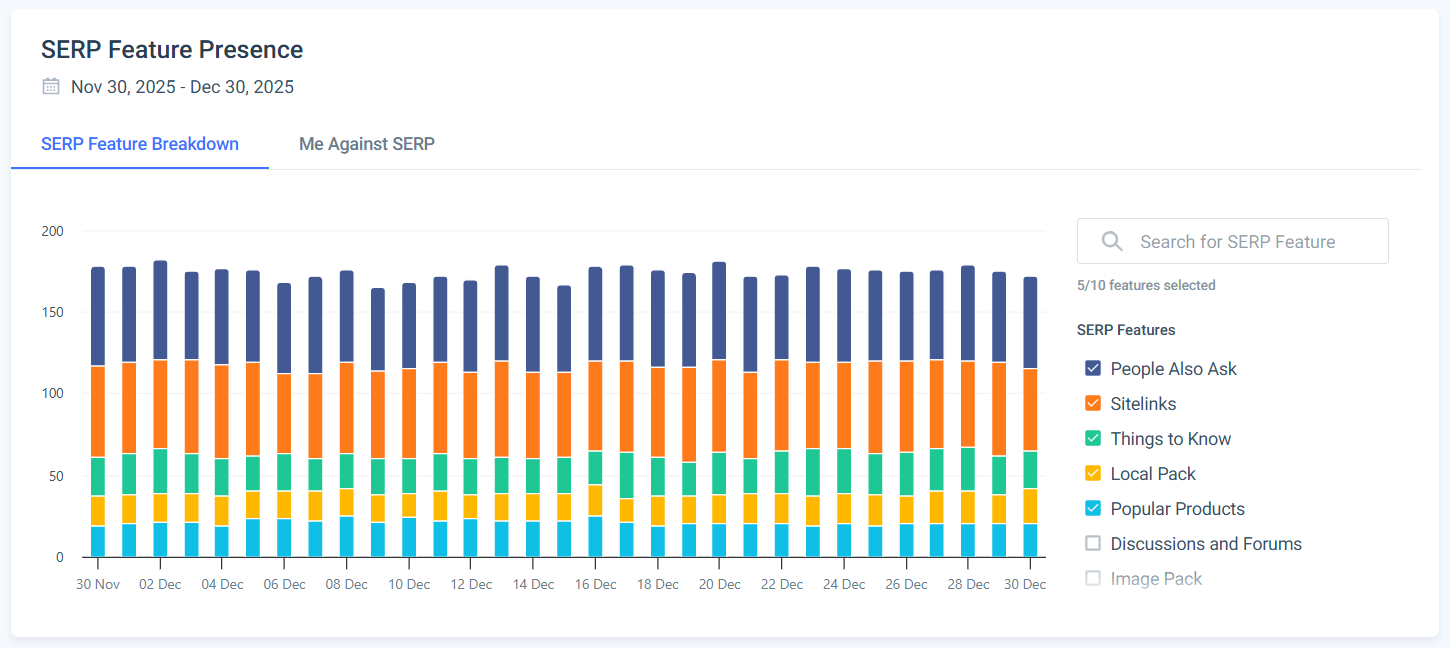
Similarweb’s Rank Tracker SERP Features report is invaluable for measuring AEO success. Here’s how to use it:
- Navigate to Rank Tracker: After logging in, choose your campaign and select SERP Feature dashboard from the left‑hand menu. Here you can track the performance of SERP features over time.

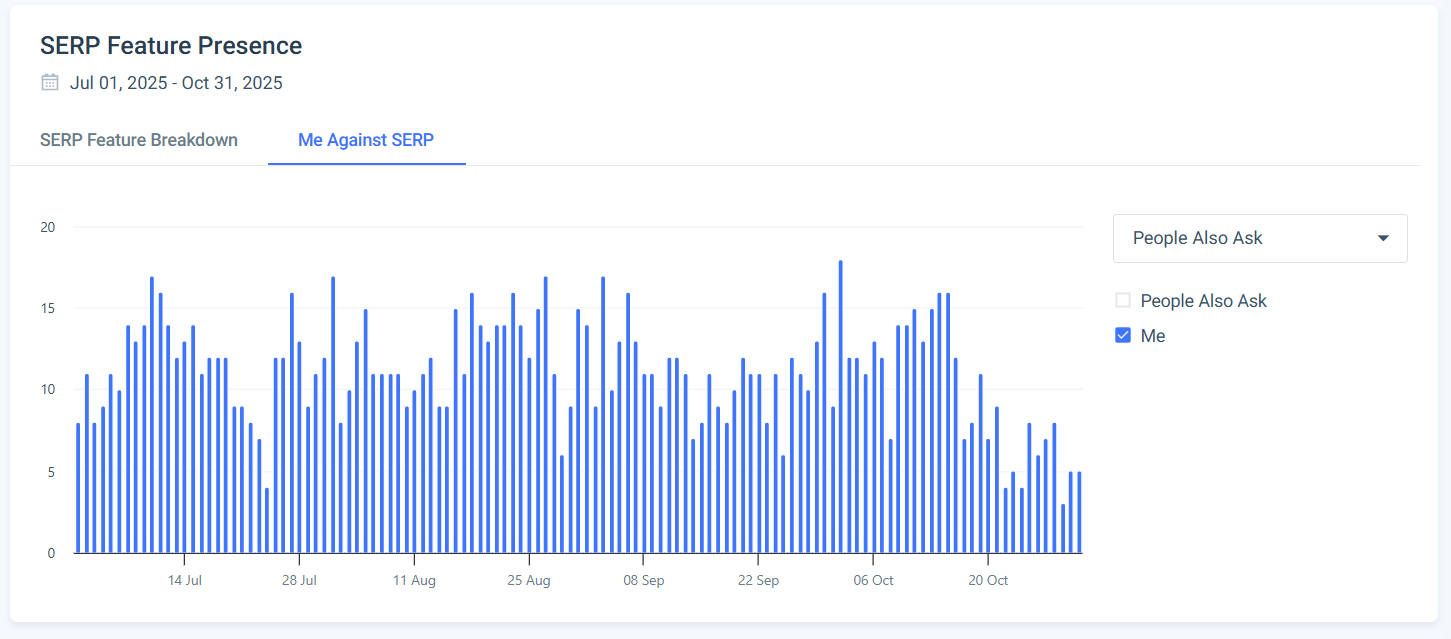
- Review People Also Ask presence: The report lists the percentage and count of tracked keywords that generate PAA boxes featuring your pages. This reveals which question‑based queries you already cover and highlights gaps for new Q&A content.

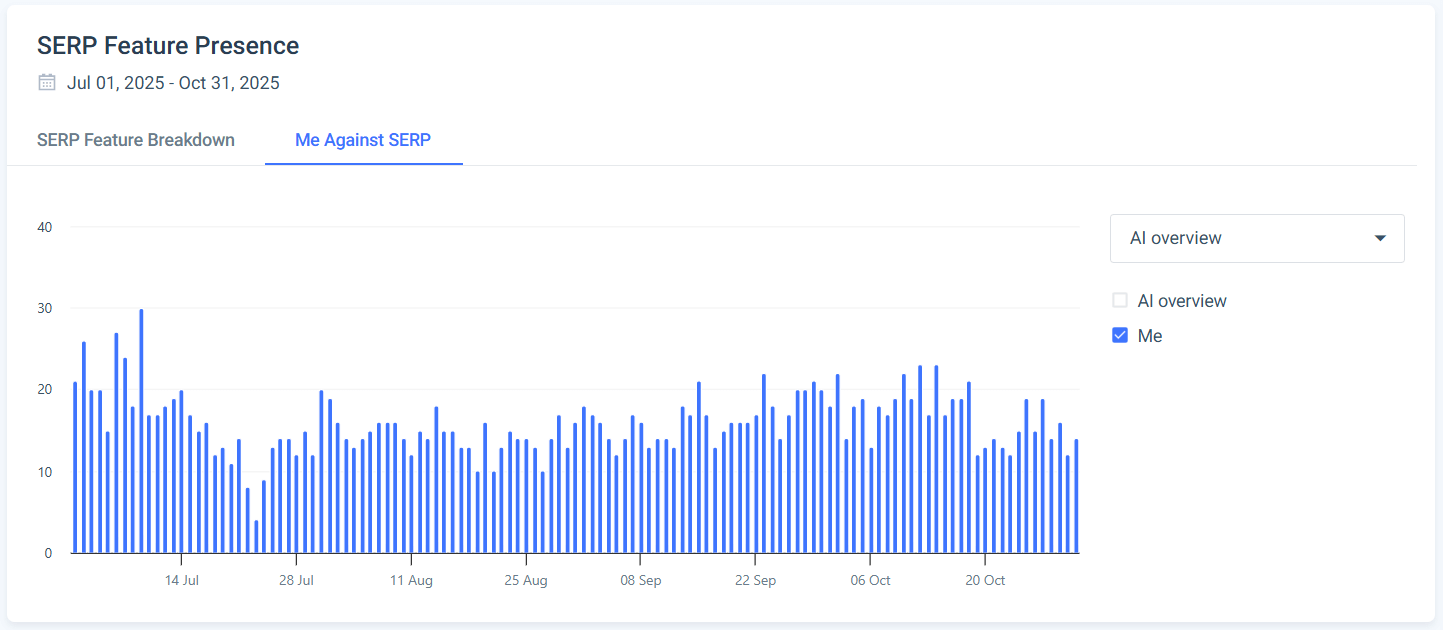
- Analyze AI Overview appearances: The same dashboard shows how many keywords trigger Google’s AI Overview, citing your content, helping you gauge the impact of updating FAQ sections or adding schema.

- Use trend charts: Switch to daily or weekly views to observe how PAA and AI Overview counts evolve after publishing new content or adjusting structure. Export charts for reporting.
GEO Metrics: AI Brand Visibility tool
GEO performance can be monitored using AI Brand Visibility within Similarweb’s Generative AI Intelligence suite:
- Open AI Brand Visibility: Under Generative AI Intelligence, select Brand Visibility and choose your campaign.
- Check the primary visibility metrics in the Brand Overview. Make sure you’re looking at data from the correct model (AI Mode, ChatGPT, etc.)

- Examine the Topics Summary: Topics show your My Visibility percentage and Mention Share. The mention share indicates the proportion of all brand mentions.

- Explore citation and sentiment analysis: The top-cited domains table in the citation analysis tool shows where your domain is cited, the sentiment of those citations, and which sources contribute most to your visibility. This helps gauge narrative quality.

- Track brand visibility score & share: The dashboard provides a Brand Visibility Score and Brand Mention Share. These are core GEO KPIs that quantify how often your brand appears in generative answers compared with competitors.
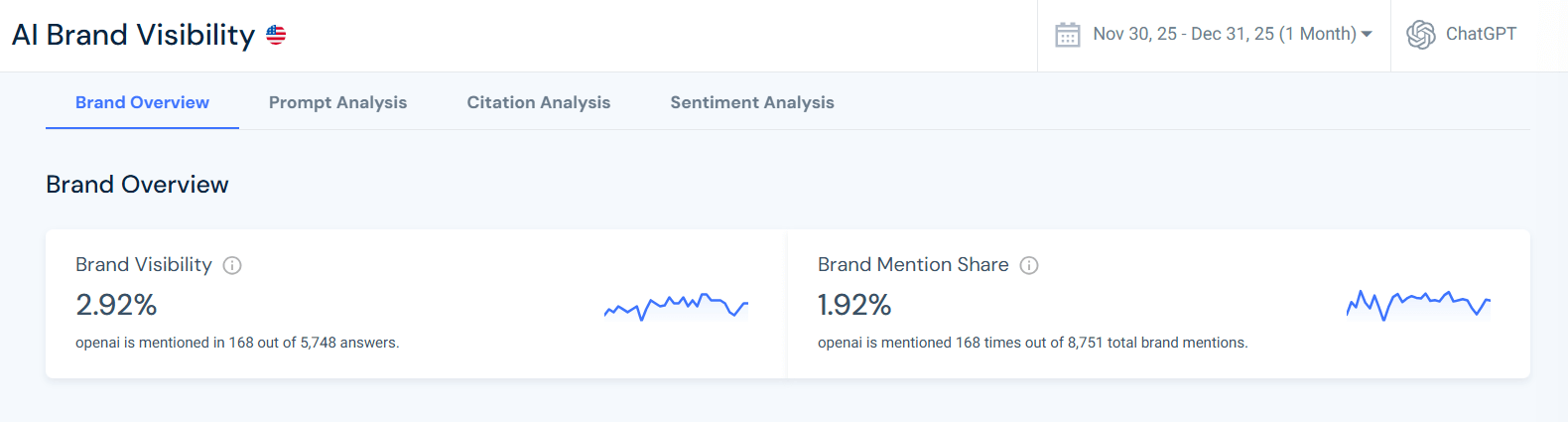


These metrics highlight where generative engines currently perceive a brand.
How to consolidate SEO & AEO & GEO Strategies?
1. Start with SEO Foundations
Robust SEO remains the bedrock for both AEO and GEO. Ensure pages are crawlable, load quickly, and display well on mobile. Implement HTTPS, fix broken links, and avoid duplicate content. Clear information architecture and descriptive metadata help both search engines and AI models access your content.
2. Layer AEO to Win Answer Boxes
- Question inventory: Build a library of high‑value questions using keyword research, People Also Ask boxes, customer support logs, and sales conversations.
- Answer‑first structure: Lead with concise answers, followed by supporting details. Use Q&A formats, how‑to lists, and comparison tables.
- Schema coverage: Implement FAQPage, HowTo, Product, and Organization schema. Align markup with visible text. Add speakable markup for voice search.
- Authority & distribution: Publish research and expert commentary on high‑overlap sources (Wikipedia, Reddit, authoritative publishers). Update content regularly.
- Monitor results: Track featured snippets, PAA counts, and AI Overview appearances in Similarweb’s Rank Tracker to identify gaps and adjust content.
3. Expand into GEO for Generative Answers
- Semantic clarity & entity focus: Create content that clearly describes entities and their relationships. Use semantic triples and consistent naming conventions. Consider building internal knowledge graphs.
- Vector‑friendly structuring: Break content into atomic passages. Label sections with descriptive headings and embed facts in machine‑readable tables.
- Multimodal assets: Include images, videos, podcasts, and downloadable reports with transcripts and alt text.
- Off‑site presence: Maintain up‑to‑date listings in directories (Google Business Profile, Yelp, etc.) and cultivate reputation through reviews and third‑party citations. Participate in forums, podcasts, and webinars to create co‑mentions.
- Measurement & iteration: Use the Similarweb AI Brand Visibility tool to monitor topic‑level visibility and citation share. Analyze prompts that do not mention your brand and create targeted content. Run retrieval simulations to test how AI models ingest your pages.
4. Align Teams and Reporting
AEO and GEO initiatives span SEO, content, PR, product, and data analytics.
Establish shared dashboards that integrate SEO metrics (rankings, sessions) with AEO metrics (snippets, PAA counts) and GEO metrics (visibility score, citation share, sentiment).
Educate stakeholders that success now includes being the answer (not just ranking first) and that AI visibility influences brand perception and the entire pipeline.
Conclusion
The rise of AI‑driven discovery demands more than traditional SEO.
Answer Engine Optimization ensures your content is selected for AI Overviews and voice answers through concise, structured snippets and citation authority.
Generative Engine Optimization prepares your entire information ecosystem for retrieval‑augmented generation, emphasizing semantic clarity, multimodal accessibility, and new KPIs like brand visibility and citation share.
Neither discipline replaces SEO. Together, SEO, AEO, and GEO form the triad that determines whether your brand is discovered, referenced, and trusted in the AI‑first era.
By adopting integrated strategies and using Similarweb’s Rank Tracker and AI Brand Visibility, you can monitor and optimize your presence across search, answer, and generative surfaces, ensuring your brand remains visible wherever people (and machines) seek information.
FAQs
Where do AI answer engines get their information?
AI‑driven systems draw from far more than just your own website. Chatbots pull data from user‑generated platforms, open knowledge hubs, and credible blogs or news sites. Ensuring your brand is mentioned in authoritative forums and media outlets can therefore influence whether AI tools cite your content.
Which traditional SEO tactics are losing relevance and which are gaining importance?
As generative search evolves, specific keywords and chasing #1 rankings are less effective. Instead, emphasis shifts toward building topical authority, implementing structured data, frequently refreshing your content, nurturing brand mentions and digital PR, and writing clear, concise answers. These signals help AI engines understand and trust your content more than keyword repetition does.
How will AI‑powered search change my traffic and conversion patterns?
Generative interfaces reduce overall click‑throughs because many users get their answers directly in the AI tool. However, those who do click through after reading an AI response often convert at higher rates thanks to stronger intent. Tracking both the volume of AI referrals and the quality of conversions is essential.
What are the first steps to improve AEO and GEO performance?
Begin with an AI visibility audit: test common prompts across platforms to see how and whether your brand appears. Next, conduct a content gap analysis and optimize existing pages by adding structured data. Finally, engage on community platforms and industry forums to earn authentic mentions and citations.
What types of content work best for AEO and GEO?
AI engines favor well‑structured information. Q&A sections, how‑to guides, and “Top X” lists work particularly well because they deliver concise, digestible answers. Blogs that integrate FAQ blocks, YouTube videos with transcripts, user‑generated discussions, and optimized home or product pages improve visibility. Evergreen guides updated annually and machine‑readable formats with clear headings and metadata are also effective.
How often should content be refreshed to remain relevant for AEO/GEO?
Freshness is a key ranking factor for AI engines. Review and update your most important pages every 3 to 6 months, ensuring that statistics and references are up to date. Conduct an annual audit of your broader content library, and refresh articles promptly when significant industry developments occur.
Which AI platforms should I prioritize?
Focus on the major players with the widest adoption. At present, this includes Google’s AI Overviews and Gemini, ChatGPT, Perplexity, and Microsoft Copilot. Monitor citation share and referral traffic from each platform, but also be prepared to adapt as new tools emerge.
How can I tell if my content is being featured in AI answers?
Look for referral traffic in your analytics from domains like chat.openai.com or perplexity.ai. In Google Search Console, queries that generate high impressions but few clicks can indicate zero‑click answers referencing your site. Manual tests provide direct insight.
Do I need separate strategies for ChatGPT, Perplexity, and Gemini?
The core principles apply across all AI platforms. That said, each engine has nuances: Gemini benefits from strong organic SEO signals because it integrates closely with Google, Perplexity rewards recency and credible citations, and ChatGPT leans on established knowledge bases like Wikipedia and news archives. Tailor your approach subtly while maintaining consistent messaging.
Can I block AI crawlers?
You can disallow specific AI bots using robots.txt, but doing so may prevent your content from being included in AI‑generated answers and thus undermine your AEO and GEO efforts. Instead of blocking, focus on managing sensitive data selectively and ensuring the content you want indexed is accurate and up‑to‑date.
How is attribution changing with AI search?
Research often begins and ends within AI chat windows, complicating attribution. Users may gather insights without ever clicking through. To measure impact, track the frequency and sentiment of citations in AI answers and correlate those exposures with downstream conversions. Expanding your attribution models to incorporate social media, PR, and other channels will help connect AI‑driven exposure to business results.
How do AEO and GEO complement SEO?
SEO remains the foundation for crawling and ranking. AEO extends SEO by structuring content into concise answers that AI Overviews and People Also Ask boxes can cite. At the same time, GEO ensures that long-form, entity‑rich content is semantically robust and credible enough for generative models to retrieve and synthesize. Together, they offer a comprehensive strategy that addresses classic search, answer features, and generative AI responses.

Related Posts



Why AI Engines Cite UGC Over Brand Content And How To Leverage It For AEO

AI Mentions vs. AI Citations: What’s the Difference and Why It Matters for GEO


Wondering what Similarweb can do for your business?
Give it a try or talk to our insights team — don’t worry, it’s free!