


 Marketing Intelligence
What are AI Brand Mentions and How to Increase Them

Generative AI is changing how brands are discovered and evaluated. When users ask ChatGPT, Gemini, or Perplexity for product recommendations, AI generates responses based on the brands it recognizes, influenced by brand mentions in web content and social media. Monitoring and optimizing these AI brand mentions is a critical aspect of Generative Engine Optimization (GEO).
What are AI brand mentions?
Brand mentions, in the context of AI, refer to how frequently a brand’s name appears in AI-generated content, including search engine results powered by generative AI and responses from AI chatbots. Monitoring and understanding these mentions is crucial for brand reputation management and Generative Engine Optimization (GEO).
Unlike traditional online mentions, which are often manually indexed or tracked, AI brand mentions are highly dynamic and can appear in synthesized responses, summaries, or search features. They don’t always link back to your site or provide direct referral traffic, but they influence perception and authority across digital channels.
Why AI brand mentions matter for your visibility
Since AI engines currently send very little traffic to websites (see a recent Cloudflare report showing ChatGPT accounts for only 0.23% of website referral traffic), having your brand mentioned in AI responses is especially important. AI engines may not send traffic to your site, but they can mention your brand, influencing buyer decisions. This makes the effort to drive AI brand mentions a critical part of Generative Engine Optimization (GEO).
A study by Seer Interactive showed a strong correlation of 65% between branded web mentions and brand mentions in AI engines: Brands with higher web mentions tend to earn significantly more AI brand mentions. In addition to web mentions, factors like branded search volume and branded anchors also influence AI visibility. As AI systems rely on language and text-based data to understand brand authority, increasing your brand’s recognition through frequent mentions and searches is critical to improve AI brand mentions.
Interestingly, traditional SEO metrics such as backlinks and domain authority show weaker correlations with AI brand mentions. The rise of AI-driven content has shifted the focus towards broader web engagement and brand recognition. Therefore, investing in content that encourages natural brand mentions and optimizing for branded keywords will better position your brand for visibility in AI results.
AI mentions vs AI citations
AI mentions refer to the inclusion of a brand’s name in generative AI responses, while AI citations are the specific sources that an AI model references or attributes in its answer. Citations may include URLs, article titles, author names, or publication names and are included when AI systems aim to provide transparency or support factual claims. Perplexity and Gemini always show these citations to help users verify information, while ChatGPT and Claude may not include citations in their responses.
The key distinction is that a brand can be mentioned without being cited. For example, an AI model might reference a product by name based on aggregated data but not include a clickable source. This makes mentions more common, but citations more authoritative. From a strategy perspective, earning citations usually requires being listed in well-ranked, credible sources that AI systems trust, such as in-depth reviews, expert roundups, or data-backed content.
How generative AI models determine brand authority
Perhaps the most significant question for marketers in the AI revolution is this: when a buyer opens ChatGPT and asks which product in your category is best, which products does it suggest?
A large-scale study of AI engine ranking algorithms by First Page Sage broke down the key factors that influence how AI engines recommend products. Here are the factors found most significant for some of today’s popular AI answer engines: ChatGPT, Gemini, Perplexity, and Claude.
Common ranking factors used by generative AI engines
Generative AI engines use a variety of factors to evaluate and generate recommendations for brands. These factors help AI systems decide which brands to mention and how to rank them in various outputs, such as summaries or responses to user queries. The weight assigned to each factor can vary across different generative engines, but generally, they include the following:
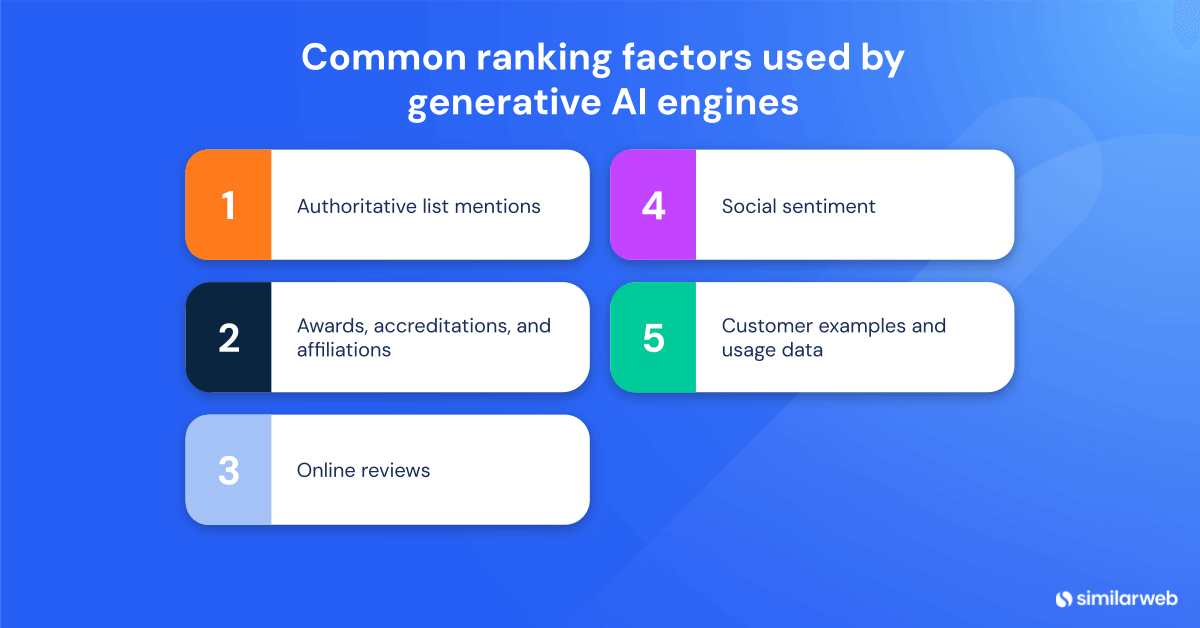
- Authoritative list mentions: Generative AI engines rely heavily on studying authoritative lists and directories. For example, Google’s ranking algorithm influences AI systems by prioritizing high-ranking sources that feature well-known and trusted companies. These authoritative lists are often curated by well-established entities such as industry-leading publishers, ranking websites, and directories. AI engines then integrate data from these sources into their recommendations.
- Awards, accreditations, and affiliations: Mentions of awards, certifications, or affiliations contribute significantly to a brand’s authority. When an authoritative website mentions that a company has won an award or holds an important accreditation, it signals trustworthiness. AI engines use this information to gauge the credibility of the company or product, increasing its likelihood of being featured in their recommendations.
- Online reviews: Online reviews affect how AI engines assess a brand’s reputation. Platforms like Google My Business, Amazon, Gartner Peer Insights, TrustPilot, G2, and others contribute to this factor, where reviews are weighted based on trustworthiness. These reviews can serve as indicators of customer satisfaction and brand quality, influencing AI models to elevate companies with positive feedback.
- Social sentiment: The overall sentiment surrounding a brand on social media, news articles, and discussion forums is considered. Positive or negative sentiment helps the AI systems gauge how a brand is perceived by the public, which in turn affects how often it is recommended. For instance, brands with higher positive sentiment are more likely to be included in AI answers.
- Customer examples and usage data: Public partnerships, case studies, and customer data can improve a brand’s credibility. When recognized brands publicly associate with products or services, it signals to AI models that the brand holds industry trust. Customer base size or usage data can also be used to make inferences about the brand’s authority and reliability.
Similarweb Tools for AI Brand Mentions
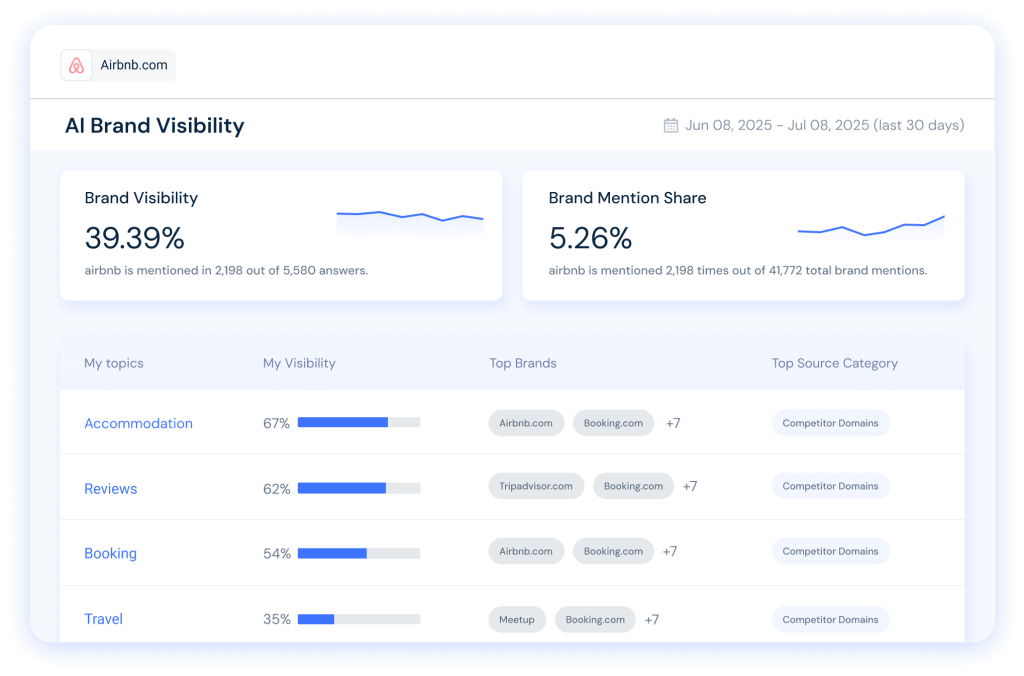
Our AI Brand Visibility tool is designed to actively run prompts across AI engines and extract brand mentions from the responses. The tool simulates common user questions related to a brand’s category or product and monitor whether the brand or its competitors are referenced. You can find results over multiple prompt variations, industry topics, and time periods to build a comprehensive visibility profile.
The AI Brand Visibility tool includes 4 main features:
- Brand Overview: A complete snapshot of how your brand appears across AI-generated responses based on Brand Visibility % and Brand Mention Share %. You can even get a topic summary and see the visibility % per competitor.
- Prompt Analysis tool: It provides direct insights into the real questions people ask AI systems. You can see the prompt itself, its topic, your brand’s mention status, and any sources the AI cited.
- Citation Analysis tool: You can find which websites and domains AI systems most often reference when generating responses within your industry or topic areas. There is also a table with all the cited URLs, their topic, # of prompts, and the influence score.
- Sentiment Analysis tool: A clear picture of how AI-generated answers reflect your brand, positively, negatively, or neutrally.
Tracking AI brand mentions helps marketers identify where their brand is appearing, which AI platforms are giving them visibility, and how to optimize their digital footprint to increase AI visibility.
3 ways to boost your visibility with AI brand mentions
Here are some of the ways to boost your visibility in the AI era by keeping track of your brand mentions.
1. Invest in branded campaigns
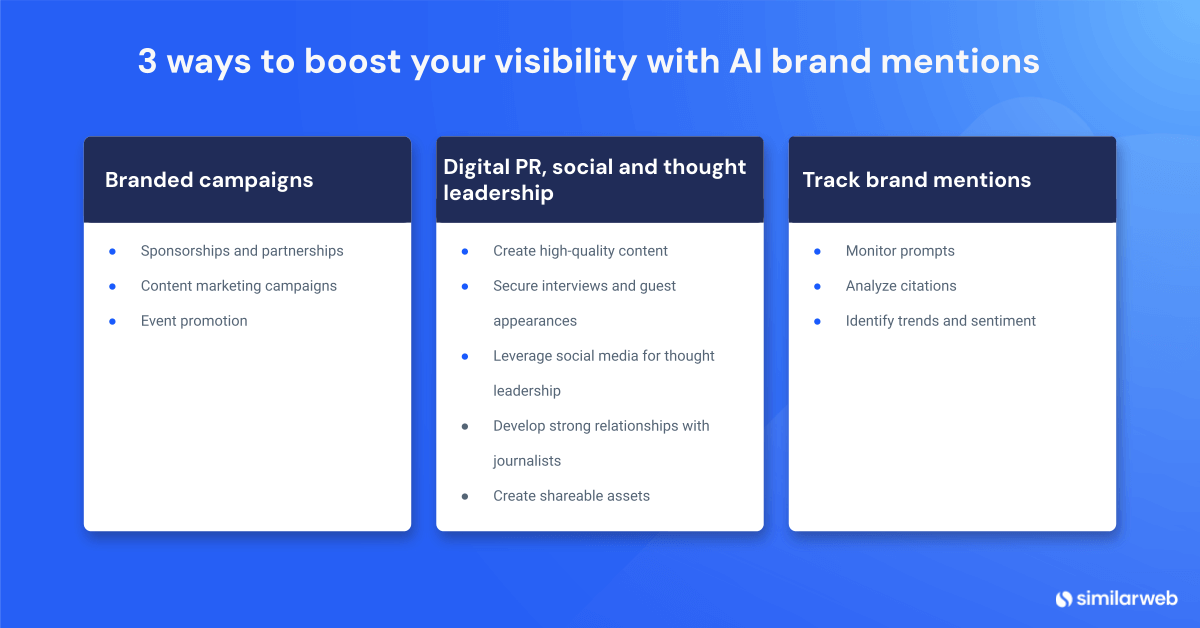
Investing in branded campaigns can significantly improve your AI brand mentions by making your brand more visible in digital spaces. Branded campaigns help increase your online presence, drawing the attention of AI systems that monitor digital content for mentions. Here’s how to execute effective branded campaigns:
- Sponsorships and partnerships: Partner with influencers, thought leaders, or other brands within your industry. Joint ventures or sponsored content can result in more mentions across various online platforms, which boosts your brand’s chances of being recognized by AI models.
- Content marketing campaigns: Run campaigns that include blog posts, eBooks, webinars, and videos. These types of content are highly shareable and likely to attract links and mentions from other websites, driving up your brand’s presence in AI-generated content.
- Event promotion: If you host or participate in events, whether virtual or physical, promote them widely. Events often generate a lot of online discussions, social media posts, and mentions, increasing the likelihood that AI-driven tools will pull your brand name when relevant topics arise.
2. Invest in digital PR, social, and thought leadership
Digital PR, social, and thought leadership not only boost your brand’s authority but also improve your chances of being featured in AI-generated mentions. Here’s how to focus your efforts:
- Create high-quality content: Publish articles, white papers, and case studies that showcase your expertise in your industry. AI models are more likely to recognize your brand when it’s associated with authoritative, well-researched, and data-driven content.
- Secure interviews and guest appearances: Participate in interviews with industry leaders, podcasts, webinars, and live discussions. These appearances can get transcribed and indexed by AI systems, making your brand more likely to appear in AI-generated summaries.
- Leverage social media for thought leadership: Share valuable insights and commentary on social media platforms like LinkedIn, Twitter, and others where your industry is active. Frequent contributions to discussions can establish you as a thought leader, improving AI recognition.
- Develop strong relationships with journalists: Build relationships with journalists, bloggers, and influencers who can amplify your brand’s voice. These relationships often result in more mentions in high-traffic publications, which AI models use to evaluate your brand’s credibility.
- Create shareable assets: Infographics, videos, and original research are highly shareable content types that encourage mentions and backlinks, further boosting AI recognition.
3. Track brand mentions across the web
Tracking brand mentions is essential to understanding how your brand is perceived and recognized by AI systems. By monitoring your online presence, you can see where and how your brand is being mentioned, allowing you to optimize for further AI visibility:
- Monitor prompts: check prompts per domain and topic, and see if your brand/ competitors are mentioned.
- Analyze citations: see the top domains and URLs the AI uses to generate responses for a topic.
- Identify trends and sentiment: discover if the sentiment is positive or negative for your brand and competitors’ brands.
Start optimizing AI brand mentions with Similarweb
AI brand mentions are becoming a critical part of how search engines, chatbots, and generative AI models present information to users. As AI adoption grows, the visibility of your brand in AI-driven results can directly influence perception, trust, and sales opportunities.
Unlike traditional SEO, which focuses heavily on ranking pages, AI brand mentions measure your presence across an entire digital ecosystem, spanning articles, lists, conversations, and user-generated content that AI draws from.
Similarweb makes tracking and improving AI brand mentions more strategic. Its AI Brand Visibility tool goes beyond keyword rankings, showing exactly where and how your brand appears in generative AI responses, and benchmarking your performance against competitors. This insight helps you refine your content, target influential sources, and ensure your brand is included when AI systems answer relevant queries.
By integrating Similarweb into your brand monitoring workflow, you can spot gaps, capitalize on emerging opportunities, and maintain strong visibility as AI continues to reshape search and discovery.
FAQs
Why are AI brand mentions important?
AI brand mentions indicate how often your brand appears in AI-generated responses, summaries, or recommendations. They influence brand visibility, authority, and trust in a search environment increasingly driven by generative AI.
How do AI brand mentions differ from traditional online mentions?
Traditional mentions are usually tied to specific links or references on web pages. AI brand mentions may come from synthesized information in AI models, which might not link directly to your site but still impact brand perception.
What factors influence AI brand mentions?
Factors include your presence on authoritative websites, the frequency of branded searches, positive reviews, social sentiment, and inclusion in trusted lists or directories. AI systems pull from these signals to decide whether to reference your brand.
Can AI brand mentions be tracked?
Yes. Tools like Similarweb’s AI Brand Visibility can monitor AI-driven references to your brand, identify their sources, and benchmark them against competitors.
How often should brands monitor their AI mentions?
Monitoring should be ongoing, as AI systems continuously update and learn from new data. Regular tracking helps you identify visibility trends, discover which platforms or topics your brand appears in, and detect shifts in sentiment. Using tools like Similarweb’s AI Brand Visibility ensures you stay informed about where your brand stands in real time and how it compares to competitors.
How can I increase my AI brand mentions?
Invest in authoritative content, secure mentions in reputable directories and media outlets, encourage positive reviews, and build a strong digital presence. The more credible your brand appears across the web, the more likely AI systems are to feature it.
How do AI brand mentions impact Generative Engine Optimization (GEO)?
AI brand mentions are a core signal in Generative Engine Optimization (GEO). When AI systems generate responses, they rely on patterns of brand recognition found across web content. The more frequently your brand is mentioned in credible sources, the more likely it is to appear in AI-driven answers, improving both visibility and perceived authority.

Related Posts


LLMs Comparison: How Different LLMs Contribute to Category Visibility
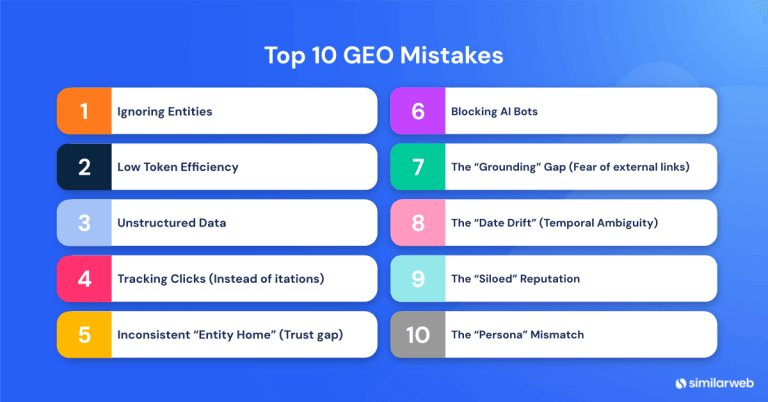
The 10 Biggest GEO Mistakes That Keep You Invisible to AI (+ One You May Be Doing Without Knowing)


The UCP Era: Why Visibility Matters More Than Ever In Agentic Commerce


Wondering what Similarweb can do for your business?
Give it a try or talk to our insights team — don’t worry, it’s free!