


 Marketing Intelligence
Introducing ABMV (AI Brand Mention Value): A Complete Framework for Measuring AI Visibility ROI

You’re in a budget meeting. Your CMO asks: “We’re seeing competitors mentioned in ChatGPT responses. Do we have a plan to increase our own visibility for 2026? Should we invest in AEO? What’s the ROI?”
You have no answer.
Traditional SEO metrics don’t apply. You can’t measure impressions, track rankings, or calculate CPCs. AI platforms are black boxes. And every SEO agency gives you a different price with no clear methodology.
Meanwhile, Similarweb data from Q4 2025 shows AI discovery is exploding: 7 billion monthly web visits to generative AI platforms, up 76% year-over-year. Gen AI referrals to transactional sites grew 357% YoY, and those visitors are converting at approximately 7% (higher than many traditional channels).
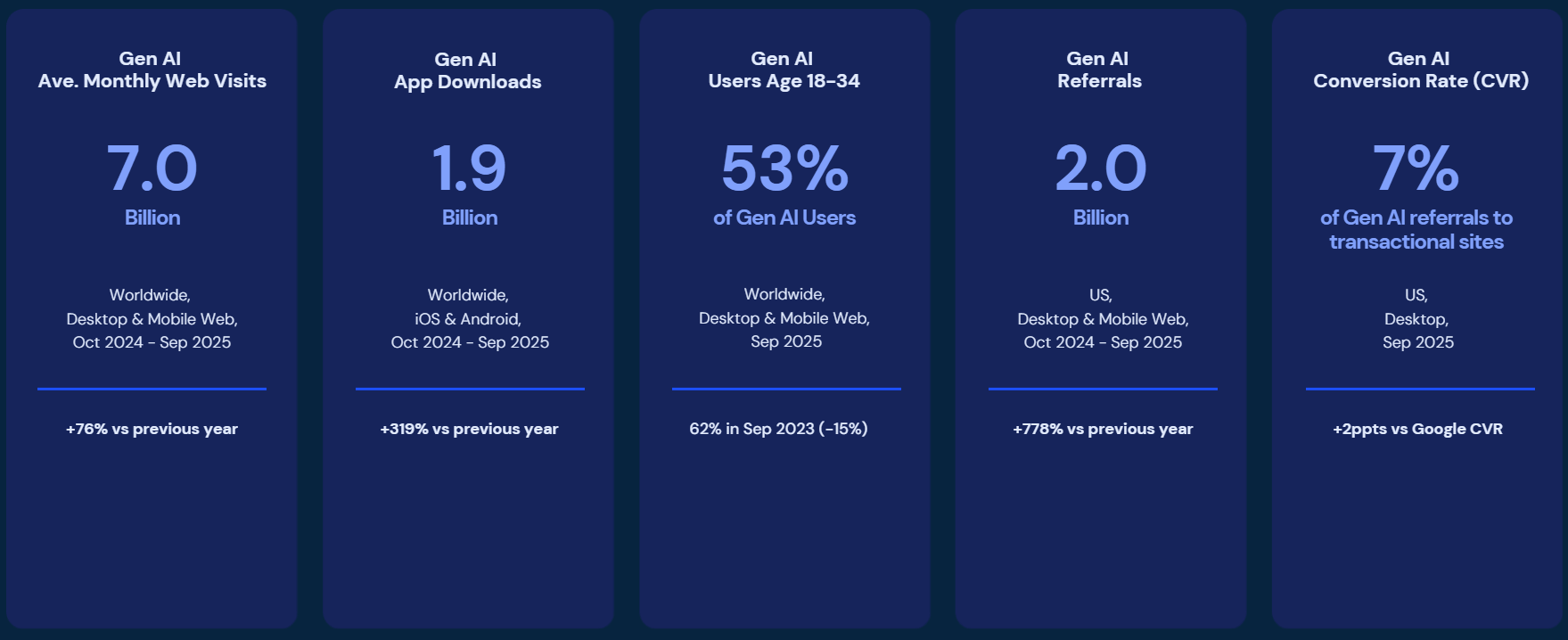
The question isn’t whether to invest in AI visibility optimization. The question is how much is that visibility actually worth?
After extensive research, analysis of industry benchmarks, and validation against real AI visibility campaigns, I’ve built a framework that solves this problem. Not perfect, but practical. Not attribution, but valuation. Not performance marketing, but reach pricing.
This is the AI Brand Mention Valuation Model (ABMV). You can view it as a practical model for pricing AI visibility before you invest a dollar in AEO.
The core insight: AI mentions are premium advertising inventory
Here’s the mental model that led me here, based on many prior years of working in a large advertising agency:
AI brand mentions should be valued like TV commercials or billboards, not like Google Ads.
When Coca-Cola buys a Super Bowl commercial, they’re paying for guaranteed reach. 115 million viewers. That’s it. No clicks, no conversions, just eyeballs.
When your brand appears in ChatGPT responses to 1 million queries, you’re getting something arguably more valuable:
✅ Contextual placement: Appears as an answer, not an interruption
✅ Zero skepticism: No “ad” label triggering dismissal
✅ Recommendation framing: AI is endorsing, not just displaying
✅ High-intent audience: Only shown to people actively asking
This isn’t performance marketing. This is reach-based brand visibility in a premium, trusted context.
And like all advertising inventory, it should be priced upfront based on estimated reach, not after the fact, based on conversions.
Why AI mentions behave like reach advertising
Three data points validate this mental model:
Branded search correlation without direct attribution:
Seer Interactive’s 2024 analysis of LLM visibility found that brand search volume (MSV) correlates with AI mentions at 0.18 (“among the strongest correlations we’ve observed”), excluding organic ranking keywords. Separately, Ahrefs’ study of 75,000 brands found that branded search volume correlates with AI Overview visibility at 0.392.
Translation: AI visibility drives brand searches, but tracking which AI mentions led to which search is nearly impossible, exactly like TV advertising.
The “research now, buy later” pattern:
According to Brainlabs, “AI often influences decisions without generating trackable clicks. Someone asks ChatGPT for recommendations, gets your brand name, then searches for you directly or types your URL. That branded search or direct visit is the downstream signal of AI-driven awareness.”
This time-delayed pattern mirrors traditional awareness advertising rather than performance marketing’s immediate attribution model.
Conversion quality over volume:
Early adopters tracking AI referral traffic report “conversion rates up to 3x higher than traditional search traffic” because “users arriving via AI recommendations are pre-qualified and arrive with context about your expertise already established.”
Additionally, Yotpo’s benchmarking of 100+ brands found structured review implementations drove “up to a 25% lift in conversion and 3x higher visibility in AI-generated shopping flows.”
The implication: You can’t measure AI visibility ROI using Google Ads attribution. There’s no last-click. No same-session conversion tracking. Instead, you value AI visibility the way traditional media buyers value a Times Square billboard: by reach, context quality, and audience composition, priced upfront and measured by awareness lift and increases in branded search volume.
Now that we got it out of the way, let’s review the framework.
The ABMV framework: Four components that define AI visibility value
The ABMV model values monthly AI visibility using this formula:
Vmonthly = (TAMqueries × VStarget × Af) × (CPMAI ÷ 1,000)Let me break down each component:
Component 1: Total Addressable Market (TAMqueries)
This is the total monthly queries in your category across all AI platforms. According to Similarweb’s 2025 Generative AI Landscape report, the AI ecosystem now includes:
- ChatGPT: 40-50 billion monthly queries (commands ~80% of Gen AI traffic, ranked #6 globally by traffic)
- Google Gemini: 6-7 billion monthly queries (13-14% market share)
- Perplexity: 780M-1 billion monthly queries (6.4% market share)
- Claude: 1.9-2.4 billion monthly queries (3.8% market share)
Conservative total: 40-70 billion global queries monthly
To calculate your TAM, apply category filters:
TAMqueries = 50B × Category% × Subcategory% × Geographic%
Example: B2B CRM Software (US + Europe):
50B global queries

× 8% (Technology category)

× 0.4% (CRM software subset)

× 50% (US + Europe geography)

= 8 million queries/month
Category concentration varies significantly. Based on query pattern analysis:
- Ecommerce/Shopping: 15-20%
- Travel: 18%
- Technology/Software: 8-15%
- Healthcare & Wellness: 10-15%
- Financial Services: 4-7%
- Legal: 2-4%
The specificity of your subcategory matters enormously. For example, “Running shoes” can be 0.5% of ecommerce. “Marathon training shoes for overpronators” might be 0.05%. Make sure to check the updated numbers in our reports periodically.
Component 2: Visibility Share Target (VStarget)
What percentage of category queries should mention your brand?
This is your strategic goal. Think market share, not vanity metrics.
Similarweb’s AI Search Intelligence suite tracks exactly this: “how often and how favorably [brands] are mentioned in chatbot answers.” Our Citation Analysis tool shows which brands dominate AI-generated answers for specific prompts.
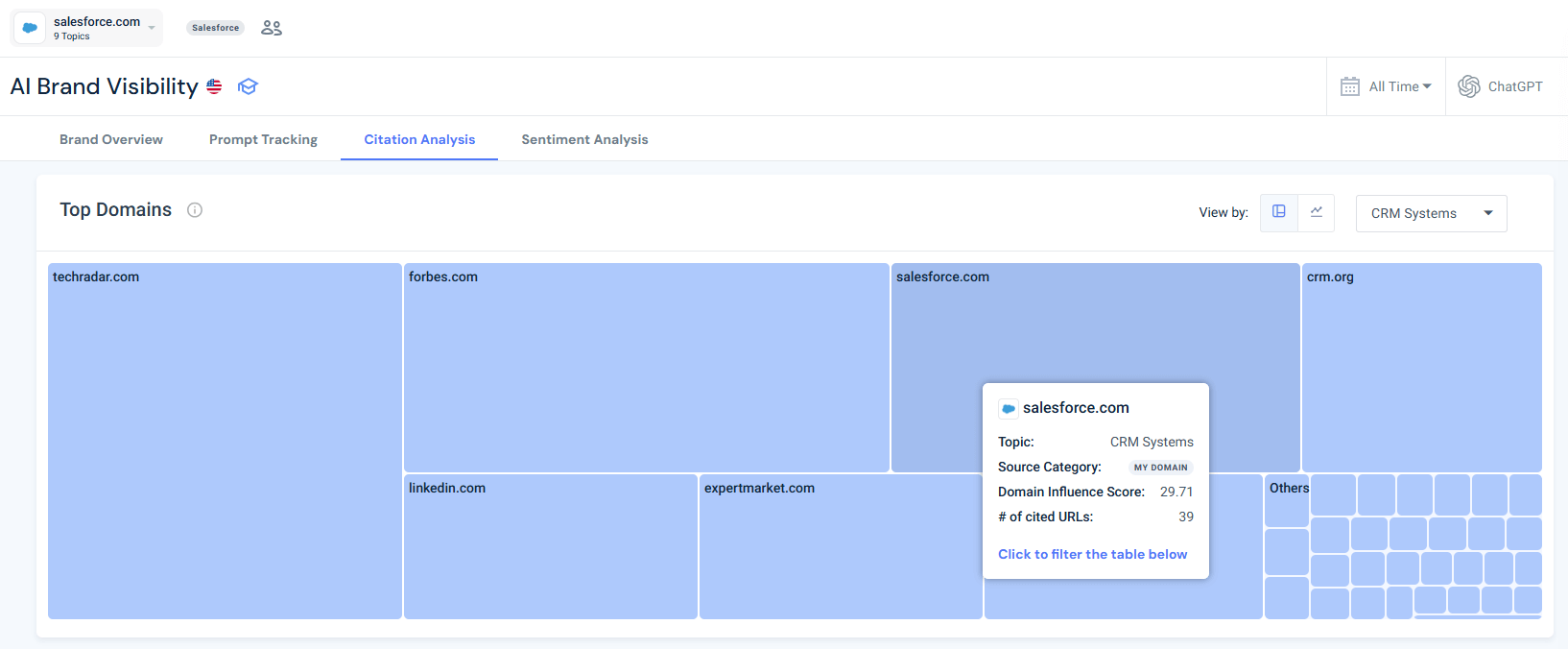
Visibility share benchmarks:
| Target Share | Market Position | Examples |
| 80-100% | Category ownership | Salesforce (CRM), Kleenex (tissues) |
| 50-80% | Leader, top 3 brands | HubSpot, Airbnb, Shopify |
| 30-50% | Competitive, established player | Asana, Vrbo, Zendesk |
| 15-30% | Present, known alternative | Monday.com, Booking.com |
| 5-15% | Emerging, new entrant | Startups, niche players |
Setting realistic targets:
If you have 12 competitors and 8% market share, targeting 80% visibility in Year 1 is a fantasy. Target 15-20%.
Growth rates slow as you approach saturation (based on 2024-2025 campaign data):
- 5% → 15%: Achievable in 12 months with $15-30K/month investment
- 15% → 35%: Requires 18-24 months and $30-50K/month
- 50% → 70%: Extremely difficult. 2-3 years at $50K+/month
Component 3: Attention Factor (Af)
The Attention Factor measures the quality of your AI mentions, not just the quantity.
Not all mentions are equal. Being mentioned 7th in a list of 10 competitors is different from being the solo recommendation, or the number one brand in a “top x” list.
This is where the model gets sophisticated:
Af = PositionWeight × ContextWeight × SourceWeight × CDW
Let’s understand each of this formula’s separate parts:
Position Weight (PositionWeight/PW)
Measures where you appear in the AI answer
| Position | Weight | Impact |
| Solo recommendation | 1.5x | “I recommend Salesforce for enterprise CRM.” |
| First in the list | 1.0x | “Top options include: Salesforce, HubSpot, Pipedrive…” |
| 2nd-3rd position | 0.7x | “Consider HubSpot, Salesforce, or Pipedrive.” |
| 4th-6th position | 0.4x | Listed 5th in a list of 8 competitors |
| 7th+ | 0.2x | Mentioned last or buried deep in a long list |
Context Weight (ContextWeight/CW)
Measures how you’re framed in AI answers (recommended, neutral, or conditional).
How AI platforms describe you matters more than just being mentioned.
| Context | Weight | Example |
| Strong endorsement | 1.5x | “Salesforce is the best choice for enterprise teams.” |
| Neutral mention | 1.0x | “Salesforce is a popular CRM platform.” |
| Qualified/conditional | 0.7x | “Salesforce works well if you have the budget.” |
| With caveats | 0.5x | “Salesforce is powerful, though expensive and complex.” |
| Negative mention | -0.5x | “Salesforce is overpriced compared to alternatives.” |
Using Similarweb’s Brand Sentiment analytics, you can track how brands show up in AI, from sentiment changes over time to relative brand strength against competitors.
See an example of a dashboard for Salesforce brand sentiment below. It’s clear that they are in good shape, with only 1% negative sentiment across all their topics:
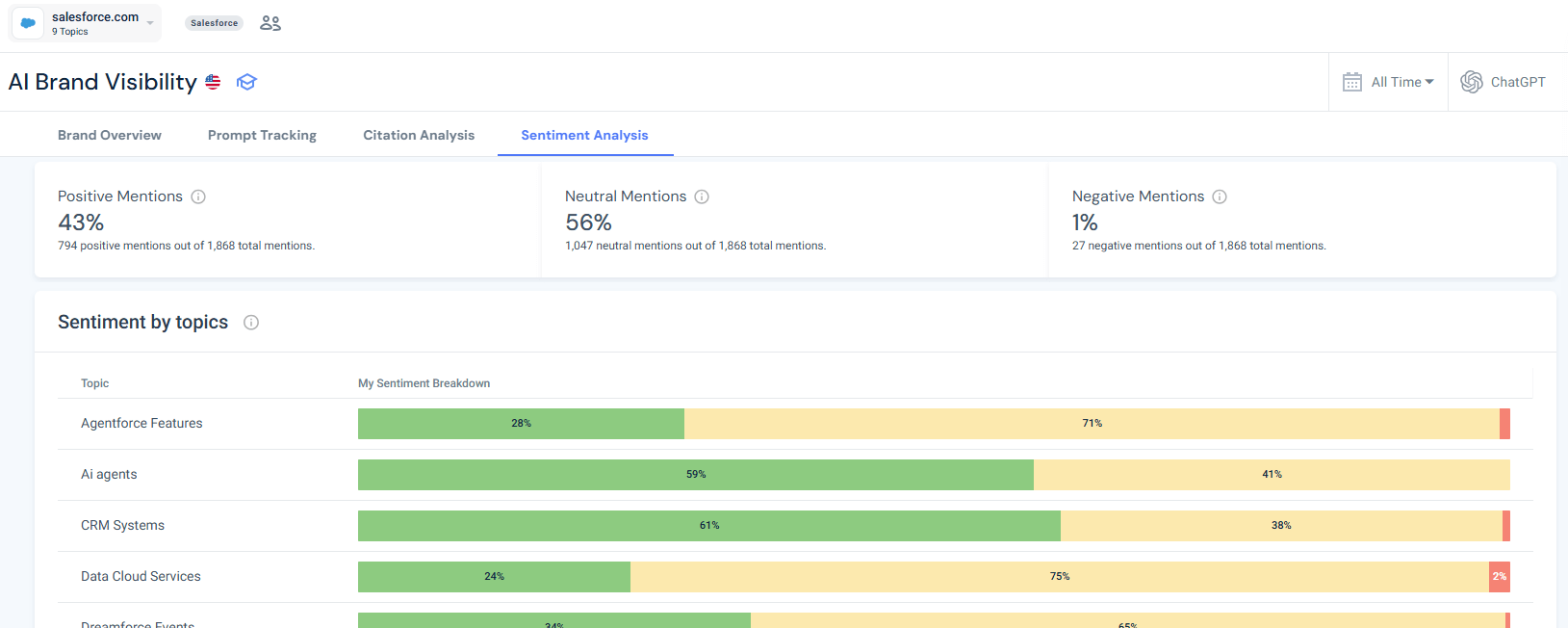
Critical warning: If your average context weight is below 0.7, fix your reputation first. Analyze the prompts and answers in your target topic, and develop a strategy to fix negative sentiment toward your brand.
Source Weight (SourceWeight/SW)
AI models cite sources. Quality matters. Getting mentioned in a WSJ citation in ChatGPT is worth more than being mentioned without any source attribution. Source quality compounds your visibility value.
Yext research shows that ChatGPT relies heavily on Wikipedia and Reddit, while Gemini relies on YouTube and Wikipedia. Perplexity demonstrates the highest source diversity.
Source Weight measures where the AI platform cites you from.
| Source Quality | Weight |
| Tier 1 authority (NYT, WSJ, .gov, Wikipedia) | 1.3x |
| Industry publication (TechCrunch, HBR, Forbes) | 1.1x |
| Standard source (company website, verified reviews) | 1.0x |
| Low-quality source (forums, unverified) | 0.8x |
| No citation (AI-generated without attribution) | 0.7x |
Competitive Density Weight (CDW): The hidden killer
Measures market saturation effect (how many competitors fight for the same mentions).
This is the most important factor nobody talks about.
AI platforms typically show 3-5 brands per query. If you have 25+ competitors vying for those 3-5 slots, your chances of appearing plummet (even with perfect AEO & GEO execution).
The Competitive Density Weight uses tiered values based on market saturation:
| # of Competitors | CDW Value | Market Type | Impact on Value |
| 1-3 | 1.2 | Oligopoly | +20% value premium |
| 4-6 | 1.0 | Low competition | Baseline (no adjustment) |
| 7-10 | 0.85 | Moderate competition | -15% penalty |
| 11-15 | 0.70 | High competition | -30% penalty |
| 16-25 | 0.55 | Crowded market | -45% penalty |
| 26+ | 0.40 | Saturated market | -60% penalty (floor) |
Calculation examples:
- 6 competitors: CDW = 1.0 (baseline value)
- 12 competitors: CDW = 0.70 (30% penalty)
- 20 competitors: CDW = 0.55 (45% penalty)
- 26+ competitors: CDW = 0.40 (60% penalty, capped at floor)
Example impact:
Running shoes (20+ major brands, CDW = 0.55) means even a perfectly executed mention is worth only 55% of baseline value due to market saturation.
Luxury Mediterranean resorts (4-6 major brands, CDW = 1.0) face no density penalty and actually command a 20% premium in oligopoly markets (1-3 competitors).
Combined Attention Factor examples:
Premium mention in low competition:
Af = 1.5 (solo) × 1.5 (strong endorsement) × 1.3 (WSJ citation) × 1.2 (3 competitors)


Af = 3.51
Weak mention in a saturated market:
Af = 0.4 (6th in list) × 0.7 (conditional) × 0.7 (no citation) × 0.55 (22 competitors)

Af = 0.11
That’s a 32x difference in value between best-case and worst-case scenarios.
Component 4: AI CPM pricing (CPMAI)
How much is an AI impression worth?
Traditional display advertising CPMs provide our baseline. Then we apply AI-specific premiums:
Premium Multipliers:
- Trust Premium: 2.2x
AI mentions appear as answers and recommendations, not paid advertisements, creating an “editorial endorsement effect.”- Real trust differential data:
- Nielsen’s 2021 Trust in Advertising Study (40,000+ global respondents) found that 88% of consumers trust recommendations from people they know, and 67% trust editorial content such as newspaper articles, compared to much lower trust in paid digital advertising.
- Nielsen’s 2013 global study found that only 42% trust online banner ads and 37% trust text ads on mobile phones. This is the closest analogue to display advertising.
- Trust ratio calculation: Editorial recommendations (67%) vs. display/banner ads (37-42%) = 1.6-1.8x trust differential
- Real trust differential data:
However, AI recommendations benefit from an additional “algorithmic authority” premium. BrightEdge analysis found that ChatGPT mentions brands 3.2x more than it cites them, meaning when AI platforms do cite brands, it signals elevated trust.
A University of Melbourne study found that nearly half of people trust AI recommendations, and the format feels like expert guidance rather than advertising.
Conservative trust premium: 2.2x (accounting for editorial-like presentation + algorithmic endorsement effect, while avoiding overstatement)
- Intent Premium: 1.5x (unchanged)
Users querying AI are high-intent, actively seeking solutions.
Evidence: AI traffic converts 3-17x higher, depending on the platform. Similarweb AI stats show ~7% conversion rate for Gen AI referrals to transactional sites.
Combined AI Premium: 3.3x display CPM (2.2 × 1.5)
Calculated AI CPM rates by industry:
AI CPM rates vary by industry, depending on customer lifetime value, competitive intensity, and purchase complexity. We calculate AI CPM by applying a 3.3x premium (2.2x trust + 1.5x intent) to industry-standard display advertising rates.
Higher CPMs reflect higher-value customers: Legal services ($99 AI CPM) have client values of $10K-$50K, justifying premium visibility costs. Mass ecommerce ($27 AI CPM) operates on volume with lower margins per transaction.
Use the closest comparable industry if yours isn’t listed.
| Industry | Display CPM | CPMAI (3.3x) |
| B2B SaaS | $20 | $66 |
| Ecommerce (Mass) | $9 | $29 |
| Ecommerce (Luxury) | $15 | $50 |
| Financial Services | $28 | $92 |
| Healthcare | $29 | $96 |
| Travel (Luxury) | $20 | $66 |
| Legal | $33 | $109 |
| Real Estate | $15 | $50 |
Display CPM sources: Gupta Media, Pixis, eMarketer 2025 benchmarks
Note: These rates apply to premium display advertising (LinkedIn and industry publications), not toremnant programmatic inventory.
Complete worked example: B2B SaaS CRM
Let me walk through an example scenario using the model:
Company Profile:
- Product: Cloud CRM for small businesses
- Current market share: 8%
- Competitors: 12-15 established players
- Geographic focus: US + Europe
STEP 1: Calculate TAM
50B global queries/month


× 8% (Technology category)


= 4 billion tech queries


↓


× 0.4% (CRM software subset)


= 16 million CRM queries


↓


× 50% (US + Europe)


= 8 million queries/month
TAM = 8,000,000 queries/month
STEP 2: Set Visibility Target
15 competitors = 6.7% equal share
As an emerging player (8% market share):
Target: 20% visibility share
Why 20%? With 15 competitors, an equal share would be 6.7% each. We have 8% actual market share, but we’re targeting 3x our “fair share” in AI visibility (the established player strategy of punching above your weight).
This is ambitious but achievable: our benchmarks show 20-35% visibility is realistic for established players investing $30-50K/month over 18-24 months, making 20% a strategic Year 2 goal.
STEP 3: Determine Attention Factor
This is where we assess mention quality, not just quantity. We audit 50 representative queries to see how we currently show up:
- Position: Typically 2nd-3rd in lists → PositionWeight = 0.7
- Context: Neutral mentions → ContextWeight = 1.0
- Sources: Mix of company site + industry pubs → SourceWeight = 1.0
- Competition: 12-15 major CRM players → CDW = 0.70
Af = 0.7 × 1.0 × 1.0 × 0.70 = 0.49
This means our mentions are worth ~49% of the theoretical maximum. It’s realistic for an emerging player in a competitive space. As we improve positioning and context, this factor will increase.
STEP 4: Select AI CPM
We look up our industry in the AI CPM table: B2B SaaS = $66
This represents:
Display CPM baseline: $20 (premium inventory like LinkedIn ads)
× 3.3x AI premium (2.2x trust + 1.5x intent)
= $66 AI CPM
B2B SaaS ($66) is higher than mass ecommerce ($29) because of longer research cycles and higher customer values, but lower than Legal ($109) or Financial Services ($92), which have extremely high client lifetime values and intense competition.
No seasonal adjustments: B2B SaaS demand is relatively stable year-round.
CPMAI = $66
STEP 5: Calculate Monthly Value
It’s time to combine everything into one formula:
Vmonthly = (8,000,000 × 0.20 × 0.49) × (66 ÷ 1,000)

Vmonthly = 784,000 × 0.06

Vmonthly = $51,744
Breaking it down step by step:
- 8M queries × 20% target = 1.6M target impressions
- × 0.49 attention factor = 784,000 quality-adjusted impressions
- × $66 CPMAI (÷ 1,000 to get cost per impression)
- = $51,744/month
This is the advertising-equivalent value of achieving 20% AI visibility in our category.
Monthly AI Visibility Value: $51,744
Strategic interpretation:
Achieving 20% visibility = $51,744/month in reach value.
Competitive density (CDW = 0.70) reduces value by 30% compared with less crowded markets.
Investment needed depends on competitive intensity:
Investment scales with competition:
- Low competition (4-8 competitors): $12-18K/month via agency retainers. Expected ROI: 2.6-3.9x
- Moderate competition (9-15 competitors): $20-28K/month. Expected ROI: 1.7-2.4x
- High competition (15+ competitors): $30-40K/month using the CPPP framework. Expected ROI: 1.2-1.6x
For this CRM example with 12-15 competitors, the realistic investment range is $22-28K/month, yielding an expected ROI of 1.8-2.1x in reach value alone. This excludes click-through value, conversions, and brand lift.
Pure reach valuation justifies the investment at a 2x+ return threshold.
This is defensible to a CMO, CFO, client, or any other stakeholder. Not a guess. A valuation.
How do we factor in platform differences?
Not all AI platforms behave the same. A University of Indiana research analyzing 140,000+ conversations reveals significant differences:
Citation patterns:
- Perplexity: Broad source diversity, ideal for B2B/professional services.
- ChatGPT: Publisher & review sites have a heavy, dominant market share (81%).
- Claude: 55 SERP influence score (lowest), trusts internal analysis, premium technical audience.
- Gemini: Favors YouTube and Wikipedia, Google ecosystem integration.
Platform-Specific Multipliers:
If you know your audience skews to specific platforms, apply these adjustments:
- ChatGPT: 1.0x (baseline).
- Perplexity: 1.25x (premium for citation quality + high-intent research audience).
- Claude: 1.15x (premium for technical/developer audiences).
- Gemini: 0.95x (growing but slightly lower current value).
- Copilot: 1.05x (enterprise Microsoft 365 audiences).
Example:
Let’s take a developer tools company with:
- 60% ChatGPT audience
- 20% Claude audience
- 10% Perplexity audience
- 10% other
Weighted multiplier = (0.60 × 1.0) + (0.20 × 1.15) + (0.10 × 1.25) + (0.10 × 1.0)

↓

= 1.055x

↓

Adjusted monthly value = $51,744 × 1.055 = $54,589
A 5.5% premium for having the right audience on the right platforms.
Investment planning: What does it actually cost?
The model values visibility. But what does it cost to achieve that visibility?
Based on published industry benchmarks:
AEO/GEO Investment Tiers:
| Monthly Budget | Best For | Expected 12-Month Visibility Gain |
| $1,500-$5,000 | Local services, emerging brands | +3-8 percentage points |
| $5,000-$15,000 | Established SMBs, regional focus | +8-15 percentage points |
| $15,000-$30,000 | National brands, competitive categories | +12-22 percentage points |
| $30,000-$50,000+ | Enterprises, dominant strategy | +20-35 percentage points |
Budget allocation (Recommended distribution):
This is a recommended breakdown of your AI Search Optimization budget. I separated “Authority building” and “Review & Reputation” since they don’t translate to “backlinks” alone.
| Field | Allocation % |
| Content Optimization | 35-40% |
| Authority Building | 25-30% |
| Technical Optimization | 15-20% |
| Review & Reputation | 10-15% |
| Tools & Monitoring | 10-15% |
Each field includes different actions and tools (many of which would already be covered by traditional SEO in most organizations) that need budget and resource coverage:
- Content Optimization (35-40%): AI-friendly content, FAQ pages, comparison content
- Authority Building (25-30%): PR outreach, citation building, expert positioning
- Technical Optimization (15-20%): Structured data, schema markup, entity management
- Review & Reputation (10-15%): Review generation, sentiment management
- Tools & Monitoring (10-15%): GEO tracking tools, web analytics, reporting dashboards
For a full guide on this topic, read my post about “How to adapt your SEO budget for AI Search”.
Cost Per Percentage Point (CPPP) benchmark:
Using First Page Sage’s GEO CAC study, we can calculate CPPP by industry:
| Industry | Investment per % Point |
| B2B SaaS | $800-$1,500 |
| Ecommerce (Mass) | $1,200-$2,500 |
| Financial Services | $1,500-$3,000 |
| Legal (Local) | $400-$800 |
| Travel (Luxury) | $500-$1,000 |
Example calculation: CRM company:
- Current: 8% visibility
- Target: 20% visibility
- Gap: 12 percentage points
- Industry CPPP: $1,150 (midpoint)
- Competitive multiplier: 1.8x (12-15 competitors)
- Required investment: 12 × ($1,150 × 1.8) = $24,840/month
ROI Validation:
- Expected monthly value at 20%: $51,744
- Required investment: $24,840
- ROI: 2.08x in reach value alone
This excludes click-through value, conversions, and brand lift. Pure reach valuation justifies the investment.
Limitations: What this model does NOT include
Before you start, we need to be very clear about the scope of this evaluation model:
✅ What ABMV models:
- Potential reach value of AI visibility
- Forward-looking budget planning
- Competitive benchmarking without detailed tracking
- ROI justification vs. paid channels
❌ What ABMV does NOT include:
- Click-through value (traffic/conversion modeling requires separate analysis)
- Brand lift effects (long-term awareness impact not quantified)
- Assisted conversions (users who research with AI but buy elsewhere)
- Negative mentions (assumes neutral/positive only (apply sentiment adjustment))
- Competitive displacement value (being mentioned vs. competitor)
This is a reach valuation, not performance attribution. Think TV commercial pricing, not Google Ads CPA.
Implementation: From model to reality
Phase 1: Baseline assessment (Weeks 1-2)
- Calculate your category TAM using the model
- Set realistic visibility targets (conservative Year 1)
- Audit current visibility:
- Test 50-100 representative queries across ChatGPT, Gemini, Perplexity, and Claude
- Record: mention rate, position, context, source quality, competitor count
- Calculate current visibility share and attention factor
- Value the gap: Target value – Current value = Opportunity size
Phase 2: Investment planning (Weeks 3-4)
- Calculate the required investment using the CPPP framework.
- Validate ROI: Value ÷ Investment ≥ 2.0x.
- Allocate budget across activities.
- Build a quarterly roadmap with visibility into milestone targets.
Phase 3: Execution (Months 2-12)
Focus areas by AEO & GEO best practices:
- Content optimization: Create AI-citation-friendly content (structured, authoritative, cited)
- Authority building: Earn Tier 1 and Tier 2 publication mentions (NYT, WSJ, TechCrunch)
- Technical GEO implementation: Structured data, schema markup, entity management, site speed
- Review & reputation: Generate positive reviews on industry platforms (G2, Capterra, Trustpilot)
Expected timeline:
- Months 1-3: Foundation (-20% to +5% visibility) – heavy setup investment
- Months 4-6: Acceleration (+5-12% visibility) – content starts getting indexed
- Months 7-9: Growth (+10-18% total visibility) – compounding effects
- Months 10-12: Maturity (+15-25% total visibility) – ROI positive
Phase 4: Measurement (Monthly)
Primary KPIs:
- Current visibility share (% of queries mentioning you)
- Current domain influence
- Month-over-month change
- Realized monthly value (based on actual visibility)
- Gap to target
Secondary (Validation) KPIs:
- AI referral traffic
- AI traffic conversion rate
- Share of voice vs. top 3 competitors
Use Similarweb’s Citation Analysis tool to track which content sources and brands dominate AI-generated answers for the topics and prompts that matter most to your business, and use it yourself to gain market share in AI engines.
Advanced consideration: Seasonal query volume adjustments
Note: Apply seasonal adjustments only after calculating your baseline monthly value. This is an advanced multiplier for categories with significant demand fluctuations.
Many categories see 2-5x swings in query volume across seasons. If your category experiences more than 2x seasonal variation, adjust your monthly valuations and budget allocations accordingly.
How to apply:
- Calculate your baseline monthly value using the ABMV formula (as demonstrated in the CRM example)
- Identify your peak vs. off-peak query multipliers based on historical search trends
- Adjust monthly values by season
- Redistribute the annual budget to concentrate spending during peak periods
Retail example: Winter Apparel (2025 benchmarks)
If your baseline monthly value is $80,000 (calculated at average query volume):
- Q2 off-season: $80K × 0.40 = $32,000/month
- Q4 peak season: $80K × 3.30 = $264,000/month
- Annual value: $1,536,000 (despite $80K monthly baseline)
Strategic implication: Don’t spread budget evenly across the year. Concentrate 60-75% of your annual AEO investment during peak query periods (typically 3-4 months). Front-load content optimization and authority-building 90 days before peak season to ensure AI models have indexed your improvements.
When NOT to apply seasonal adjustments:
- B2B SaaS and professional services (relatively stable year-round)
- Healthcare and financial services (consistent demand)
- Most technology categories (unless the product is seasonally tied, e.g., tax software)
How we measure our AI Visibility at Similarweb
At Similarweb, we trust our data and eat our own dog food. Our AI Search Intelligence suite tracks exactly what this model measures:
Our GEO measurement stack:
- Visibility Share: Our % of mentions vs. competitors across ChatGPT, Gemini, Perplexity, and Claude.
- Citation Analysis: Which sources and brands dominate AI answers for our target queries
- Domain influence score: How often is our own domain cited in AI answers
- Brand Sentiment: How we show up: positive, neutral, or conditional mentions
- Traffic Impact: Measuring traffic from LLM sources to validate the model
Here’s a glimpse from one of our dashboards. It shows AI visibility and brand-mention share, a topical breakdown, competitors, and more:
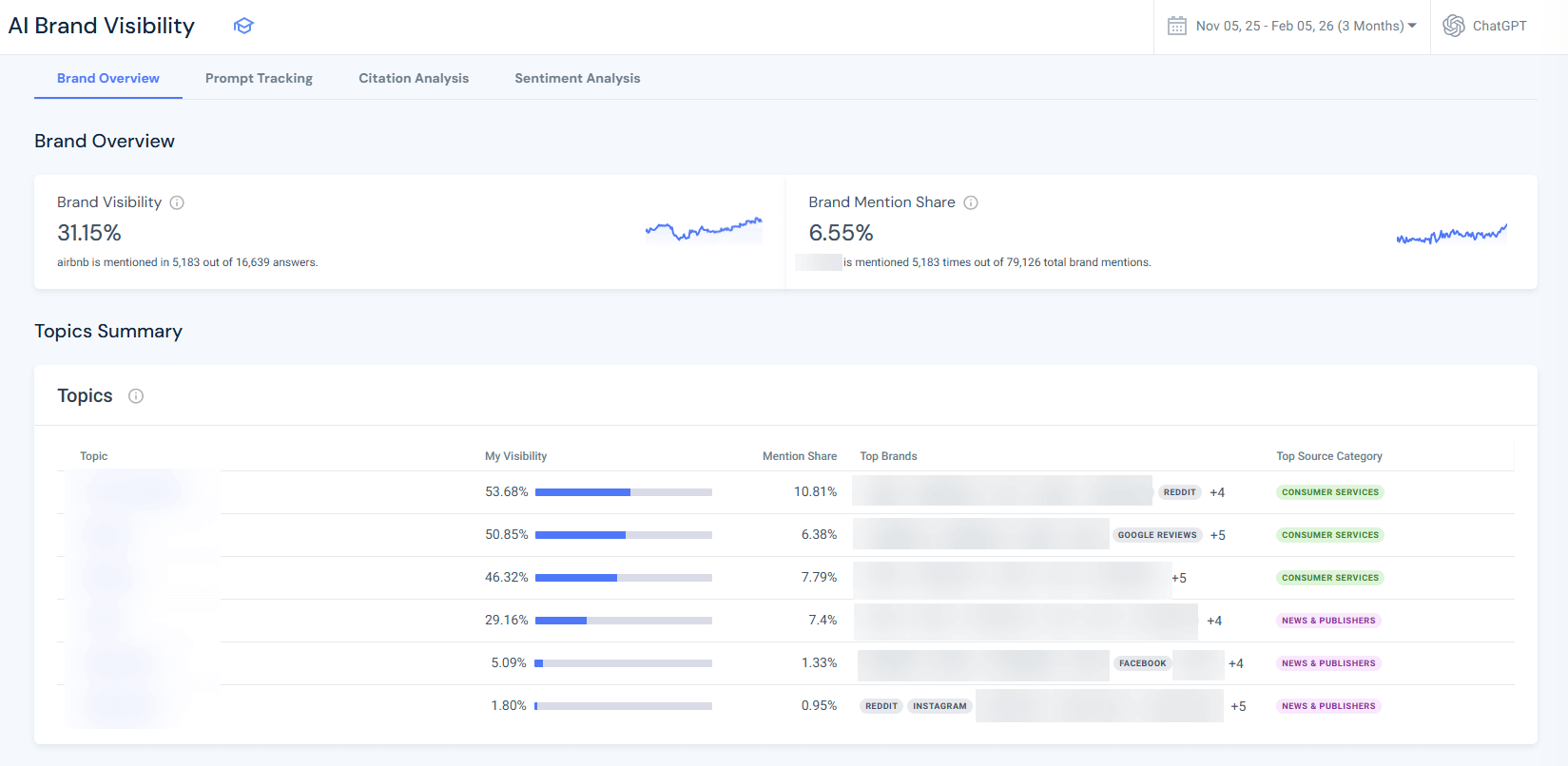
Having all the metrics presented in one place, with a topical breakdown over time, is extremely useful. Using this dashboard, my team and I analyzed our performance across AI engines (Similarweb tracks AI Mode, Perplexity, and Gemini as well) and created a strategy and roadmap to increase our visibility in each.
What we’ve learned:
- You can’t optimize what you don’t measure: Without visibility tracking, AEO and GEO are guesswork.
- Sentiment matters more than frequency: 10 conditional mentions < 5 strong endorsements.
- Competitive density is the biggest predictor of ROI: Shifting focus to subcategories with fewer competitors (5-8 vs. 15+) improves performance and increases ROI.
- Platform behavior varies dramatically: Perplexity is highly used by B2B audiences, so we prioritize content that performs there.
The ABMV model provides the planning framework. Similarweb’s AI Search Intelligence provides our measurement reality check.
The strategic implication: Visibility is the new ranking
SEO taught us that “ranking #1” was the goal. That metaphor doesn’t work in AI.
There is no ranking #1. There’s only one question: Are you in the conversation?
Similarweb data from Q4 2025 shows 95% of ChatGPT users also use Google. “AI isn’t replacing search, it’s expanding what discovery means.”
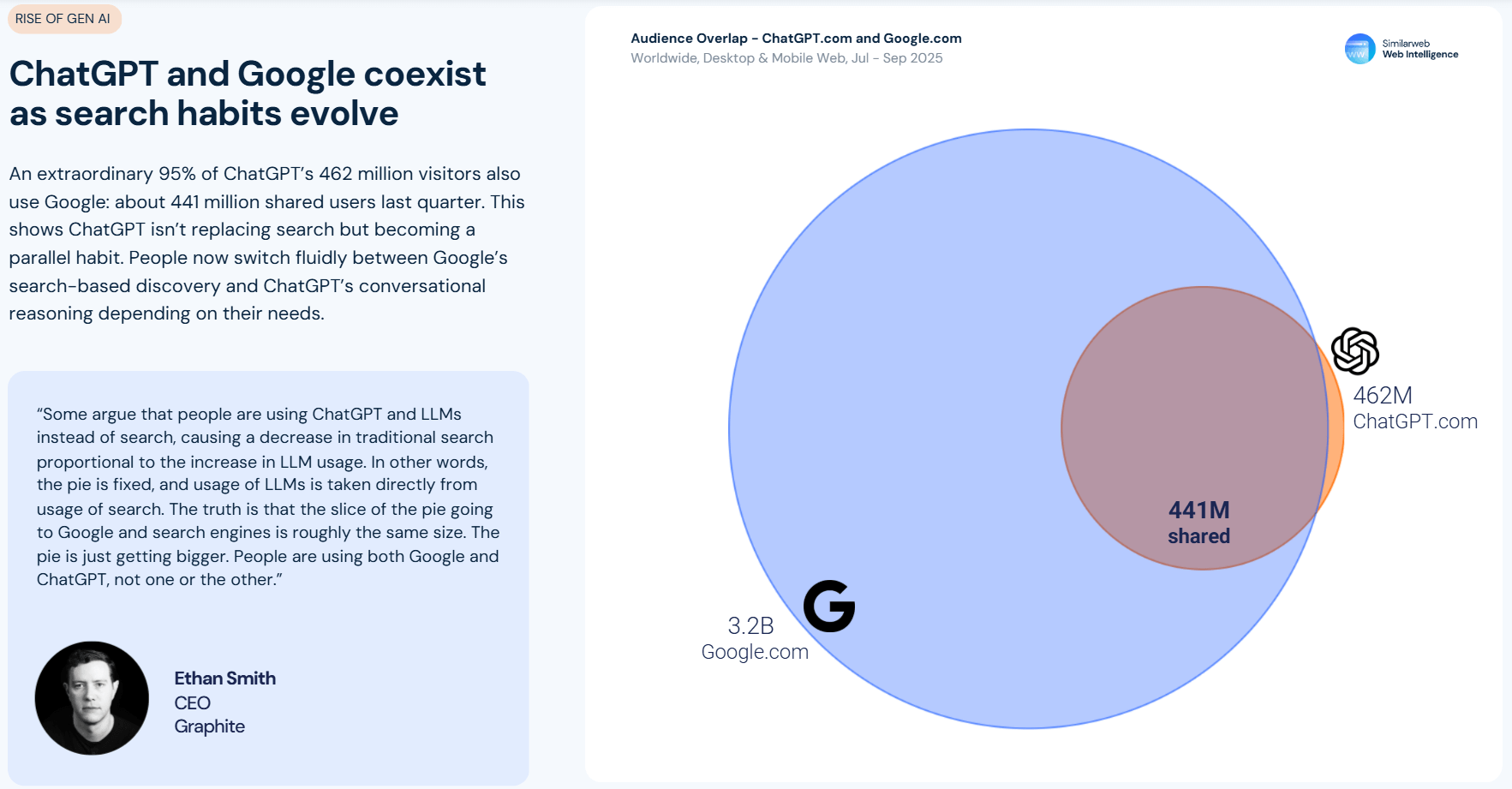
The brands that win will be visible everywhere:
- Traditional search (Google, Bing)
- AI search (ChatGPT, Gemini, Perplexity)
- Social search (TikTok, Instagram)
- Voice search (Alexa, Siri)
GEO and AEO are not “instead of SEO.” They’re in addition to SEO.
The ABMV model helps you price that additional visibility investment. As Similarweb’s research shows, AI discovery is no longer optional: it’s 7 billion monthly visits, growing 76% YoY, with referral traffic converting at rates that match or exceed those oftraditional channels.
From model to budget: Free ABMV & Visibility ROI calculator
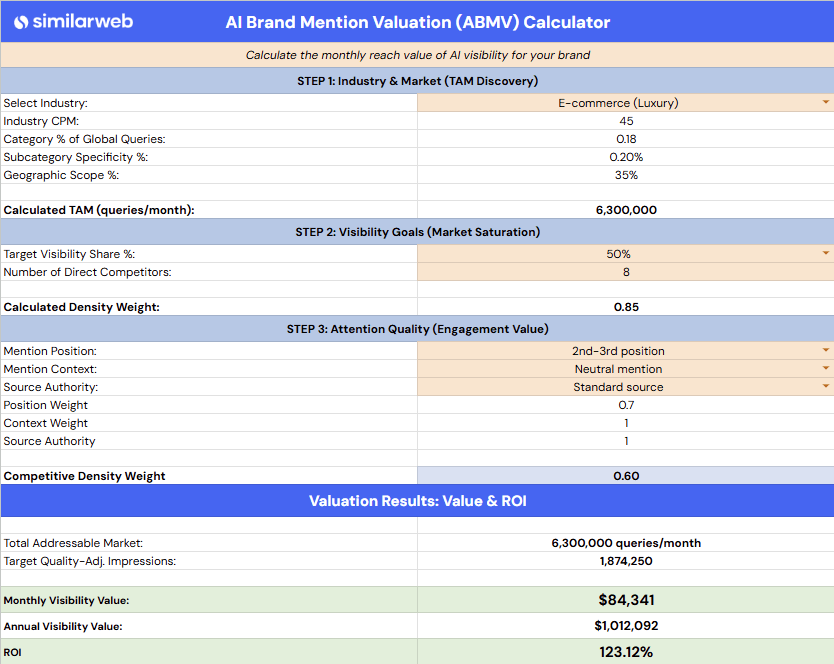
Good news! I’ve built a Google Sheets ABMV & ROI calculator that does the math for you.
Enter your industry, competitor count, and visibility targets, and it calculates your monthly AI visibility value, recommended investment, expected ROI, and timeline in under 10 minutes.
Access The ABMV & ROI Calculator
What’s inside the ABMV calculator?
The calculator includes six integrated tabs designed to handle everything from basic valuation to advanced scenario planning:
- Main Calculator: Three-step workflow (TAM → Visibility Goals → Attention Quality) with automated formulas. No spreadsheet expertise needed.
- Advanced Modeling: Multi-platform breakdowns, competitive scenario planning, and sensitivity analysis for better accuracy. This is very important when you’re trying to justify a budget request to your CMO.
- Investment Planning: Budget allocation guidance and Cost Per Percentage Point data showing what it takes to increase visibility in your market.
- Seasonal Adjustments: Quarter-by-quarter multipliers for retail, travel, and other seasonal categories. Helps you concentrate on the budget during peak query periods.
- Industry Benchmarks: Pre-loaded benchmarks for 10+ industries. Each industry includes category concentration percentages, subcategory-specificity multipliers, and baseline CPM ranges, sourced from Similarweb’s 2025 market analysis.
How to use the ABMV calculator?
Step 1: Define your market (2 minutes)
Select your industry from the dropdown or enter custom values if your category isn’t listed. The calculator automatically populates:
- Category concentration % (e.g., Technology = 8-15% of global queries)
- Typical subcategory specificity (e.g., CRM software = 0.4% of Technology)
- Geographic scope (e.g., US + Europe = 50% of global)
- Baseline CPM range for your industry
- TAM (For most businesses, expect 2-20 million queries/month in your specific category.)
Step 2: Set your visibility goals (3 minutes)
Here, you need to enter two critical inputs:
- Target visibility share %: What percentage of queries should mention you?
- Number of direct competitors: How many brands compete for AI mentions in your space?
The calculator automatically applies the Competitive Density Weight (CDW). Markets with 15+ competitors get penalized (lower value per mention). Oligopolies with 3-6 competitors get a premium.
Step 3: Score your mention quality (5 minutes)
Rate the typical quality of your AI mentions across three dimensions:
- Position: Are you usually mentioned first, or buried 7th in a list?
- Context: Are AI platforms endorsing you strongly, or mentioning you with caveats?
- Source: Are citations coming from Tier 1 authorities (WSJ, NYT) or standard sources?
The calculator multiplies these factors to give you an Attention Factor (Af) between 0.1 (worst case) and 3.5 (best case).
What will you get from the ABMV calculator?
The calculator outputs six key numbers:
- Monthly Visibility Value: What your target AI visibility is worth in advertising-equivalent dollars. This is your benchmark for “is this worth investing in?”
- Annual Visibility Value: Monthly value × 12, with optional seasonal adjustments if your industry has peak periods.
- Expected ROI: The expected return on your investment in AEO. Calculates the monthly visibility value vs. the recommended monthly investment.
- ROI Timeline: Expected months to positive ROI based on your budget level and visibility targets. Most scenarios show 10-14 months.
- Recommended Monthly Investment: Based on CPPP (Cost Per Percentage Point) data, the calculator suggests how much to budget each month to meet your visibility targets. Typically $15-50K/month depending on goals and competition.
- Investment Allocation: Breakdown of how to split your budget: 40% content optimization, 30% authority building, 20% technical implementation, 10% measurement tools. Adjust as needed based on your specific organizational status.
Copy the ABMV calculator and make it your own
Make a copy of the template and customize it with your data. Use it as your living budgeting tool, and update it quarterly as your visibility improves and market conditions change.
Access The ABMV &ROI Calculator
Note: The calculator uses Similarweb’s Q4 2025 benchmark data. Update your copy quarterly with the latest query volumes and market share data from our Generative AI Landscape reports to maintain accuracy.
Final thoughts
This model isn’t perfect. AI platforms are black boxes. Query volumes are estimates. CPM benchmarks vary. Attention factors are directional.
But it’s better than guessing.
Better than “let’s try $10K/month and see what happens.”
Better than “our competitor is doing it, so we should too.”
It’s a defensible, data-driven framework for pricing AI visibility before you spend a dollar.
At Similarweb, we’re using this model to guide our AI Search Optimization strategy. We’re tracking visibility with our own AI Search Intelligence tools. We’re validating with traffic and conversion data.
The model isn’t perfect, but it gives us a starting point based on reason, not hype.
That’s what every CFO wants. That’s what every CMO needs.
Now you have it too.
Copy The ABMV & ROI Calculator
FAQ
What is the ABMV model?
The AI Brand Mention Valuation Model (ABMV) calculates the monetary value of brand visibility across AI platforms using the formula Vmonthly = (TAMqueries × VStarget × Af) × (CPMAI ÷ 1,000). It uses four components: Total Addressable Market queries, Visibility Share target, Attention Factor, and AI CPM pricing.
Why value AI mentions like advertising instead of SEO?
AI mentions behave like reach-based advertising because direct attribution is nearly impossible (like TV ads), conversion patterns are delayed (“research now, buy later”), and AI referral traffic converts higher than traditional search. You’re paying for guaranteed reach in a premium context, not trackable clicks.
How much does AI visibility cost?
Expect to invest $15,000-$30,000 per month for 12 months to achieve a 5-15% share of visibility. Budget breakdown: 40% content optimization, 30% authority building, 20% technical implementation, 10% tools. Moving from 15% to 35% visibility requires $30K-$50K/month for 18-24 months.
What’s the typical ROI timeline?
Most organizations see positive ROI within 10-12 months. Progression: Months 1-3 (foundation, -20% to +5% visibility), Months 4-6 (acceleration, +5-12%), Months 7-9 (growth, +10-18%), Months 10-12 (maturity, +15-25%, ROI positive).
Can I do GEO with a smaller budget?
Yes. At $5K-$10K/month, expect 3-8% visibility share over 18 months in moderately competitive markets. Focus 60% on high-leverage content, 30% on strategic authority building, 10% on basic technical optimization. Better to dominate a niche subcategory than be invisible across a broad market.
How do I measure my current AI visibility?
Track mention rate (were you mentioned?), position (1st vs 7th in list), context (recommended vs conditional), and competitor count. Calculate visibility share: (your mentions ÷ total queries) × 100. Use Similarweb’s AI Search Intelligence to automate tracking at scale.
What’s a realistic visibility target for Year 1?
Depends on starting position: New entrants (0-5%) should target 5-15% with $15K-$30K/month. Established players (10-20%) should target 20-35%, with $30K-$50K/month. Market leaders (25-40%) should target 40-60% with $50K+/month. Growth slows dramatically as you approach saturation, 50% to 70% is exponentially harder than 5% to 15%.
Which AI platforms matter most?
As of Q4 2025: ChatGPT (40-50B monthly queries, 80% market share) is priority #1. Gemini (6-7B queries, 13-14% share) is #2. Perplexity (780M-1B queries, 6.4% share) is #3 for citation quality. Claude (1.9-2.4B queries, 3.8% share) is a bonus. Optimize primarily for ChatGPT to capture 80% of the impact.
How does competitive density affect my AI visibility value?
AI platforms show 3-5 brands per query. With 25+ competitors fighting for those slots, even perfect optimization loses value. The formula CDW = 1.2 – [0.035 × (competitors – 3)], with a minimum of 0.40 value.
What if I’m in a crowded market with 20+ competitors?
Three options:
- Niche down: focus on subcategories with 5-10 competitors where you can dominate 25% vs. a broad 3% (recommended).
- Differentiation: a unique positioning that reduces effective competition.
- Volume warfare: outspend everyone at $50K-$100K/month for 18-24 months (high risk). Most companies should pick option 1.
Can’t I just track AI referral traffic instead of measuring visibility?
No, because attribution is broken. When someone asks ChatGPT for recommendations, then searches your brand directly or types your URL, that shows as branded/direct traffic, not an AI referral. The “research now, buy later” delay (days or weeks) makes tracking impossible.
Measure visibility share proactively and validate with secondary signals such as branded search volume trends and AI referral conversion rates (should be 2-3x higher than average).
Won’t AI algorithm changes make this effort worthless?
Partial risk, but overblown. By optimizing for fundamental quality signals (authority, recency, structure), you’re algorithm-resilient. Google changed 500+ times over the past decade, and sites that optimized for quality survived, while keyword-stuffing sites died. The same principle applies here.
Is this actually driving revenue or just another marketing buzzword?
Driving revenue, but early. As of Q4 2025, Similarweb data show 7B monthly AI platform visits (+76% YoY). Referrals from generative AI to transactional sites grew 357% YoY. AI referral traffic converts at ~7% (matching traditional search), with conversion quality up to 3x higher. Brand search correlates with AI mentions at 0.18-0.39. Direct attribution is murky (like TV ads), but visibility → awareness → revenue correlation is validated.
Do I need expensive tools to implement the ABMV model?
No, you can use the Similarweb AI Search Intelligence suite for $99 to automate tracking in AI engines for 500+ queries, with competitor benchmarking. If you’re spending $15K-$30K/month on optimization, spending $1-3K/year on measurement (10% of your tools budget) using the most accurate datasets in the world is worth it.
Can I use the ABMV model for platforms beyond ChatGPT/Gemini?
Yes, with modifications. The four-component framework (TAM × visibility share × attention × CPM) works for voice assistants, social search, and emerging platforms. Adjust TAM calculation method, attention factor weights, and CPM benchmarks by platform, but the logic holds: Calculate addressable queries × your share × attention quality × cost per thousand.
How does the ABMV model work for international markets outside the US?
Adjust TAM by geography and platform mix. While ChatGPT dominates globally (~80%), regional platforms matter: Baidu’s ERNIE (China), Naver’s HyperCLOVA (Korea), Yandex’s YaLM (Russia).
Calculate TAM separately per region, apply local CPM rates (typically 30-50% lower outside the US/Europe), and weight visibility by platform usage. For global brands, sum regional values: Vglobal = VUS + VEurope + VAsia + VLatAm.
Should I adjust my ABMV calculation for seasonal demand fluctuations?
Yes, if your category sees >2x seasonal variation. Calculate baseline monthly value using average query volume, then apply seasonal multipliers. Example: Winter apparel might be $32K/month in Q2 (0.4x) but $264K/month in Q4 (3.3x). Redistribute the annual budget to concentrate 60-75% during peak periods, and front-load optimization 90 days before peak season.
Does ABMV work differently for B2B vs B2C brands?
Yes. B2B: Lower TAM (smaller query volume) but higher CPM ($25-$80 vs $8-$35 for B2C). Position Weight matters more, and a solo recommendation carries 3-5x value. Target 15-30% visibility. B2C: Higher TAM, lower CPM, but Competitive Density hits harder (more brands competing). Need 25-40%+ visibility for meaningful impact.
When should I change my AI visibility strategy or admit it’s not working?
Review at 6 months. Pivot if: >20 competitors and <5% visibility after 9 months, shift to narrower subcategory.
Red flags:
- <2% visibility growth despite $15K+/month investment.
- Context Weight declining (more negative mentions).
- Competitors are growing 2x faster.
- AI referral traffic converting <3%.
Beyond visibility share, what metrics can help verify the accuracy of the ABMV model?
Track correlation metrics quarterly:
- Branded search lift (should increase 10-25% within 6 months).
- AI referral conversion rate (should be 2-3x higher than organic).
- Share of voice vs. top 3 competitors (gap should close).
- Assisted conversions (AI should appear in 15-30% of customer journeys by month 12).
If visibility grows but these don’t translate into business impact, you’re gaining mentions without business impact.

Related Posts

What Is AI Share of Voice? The Brand Mention Share Metric You’re Probably Missing



Why AI Engines Cite UGC Over Brand Content And How To Leverage It For AEO

AI Mentions vs. AI Citations: What’s the Difference and Why It Matters for GEO

Wondering what Similarweb can do for your business?
Give it a try or talk to our insights team — don’t worry, it’s free!