


 Marketing Intelligence
GEO KPIs: What Are The GEO Metrics SEOs Should Know And Measure?
Why do we need new KPIs & why do they matter?
Search behavior has shifted dramatically. Traditional SEO metrics like rankings and organic traffic still matter, but zero‑click searches now account for roughly 69% of Google queries. To top that, AI summaries now appear in about 18% of searches and often cite three or more sources.
When people get a complete answer from an AI engine without clicking a link, the only way your brand is visible is if you are in the answer. That’s where Generative Engine Optimization (GEO) comes in: the discipline of making your brand the easiest, most trustworthy source for AI systems to cite.
As an SEO director at a SaaS company, I report on my brand’s organic performance and the SEO team’s activities to stakeholders. Lately, I’ve learned that GEO requires us to add new key performance indicators (KPIs) to our reporting mix.
In this article, I’ll explain which KPIs matter for GEO, and how to measure them using both qualitative best practices and data from Similarweb’s AI Search Optimization Suite. I’ll show why they’re essential for modern search success, and wherever possible, I’ll give real-data examples and hands-on recommendations.
What makes GEO KPIs different from SEO KPIs?
GEO KPIs shift the focus from keyword ranks and page clicks to measuring how often your brand and content appear in AI‑generated answers, and are trusted by generative models and incorporated into their answers. Rather than traditional metrics, you measure the frequency and quality of citations and authority signals within generative answers.
As Avinash Kaushik notes, answer engines require “answer engine analytics (AEA)”: new success metrics such as brand visibility and citation frequency.
Rankings, website traffic, and click‑through rates become less relevant. To measure our GEO & AEO performance, we must track our visibility, domain influence, and the frequency with which our brand is mentioned and cited in AI responses.
GEO KPIs vs AEO KPIs vs SEO KPIs
The way we measure success changes according to the relevant channel. GEO, AEO, and SEO are complementary, but they focus on different parts of the search landscape.
This table details the key KPIs and metrics for each:
| GEO KPIs | AEO KPIs | SEO KPIs |
|
|
|
When we know which metrics and KPIs belong to each of these channels, we can better measure our own initiatives in optimizing them.
Now, it’s time to drill down into the core GEO KPI’s.
Core GEO KPIs and how to measure them
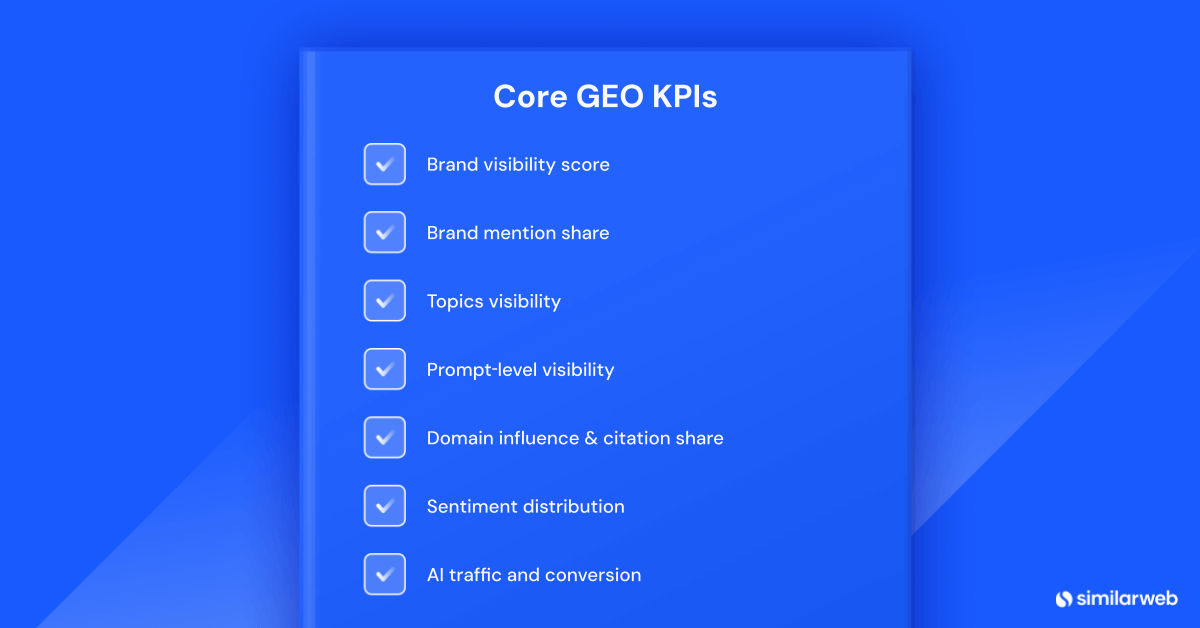
Below, I’ll outline the key metrics every SEO should monitor for GEO. I’ll describe each KPI and then show how to measure it using an AI Brand Visibility campaign for Hootsuite (Nov 16-Dec 16, 2025) to illustrate how the metrics are calculated and why they matter.
1. Brand visibility score (share of answers mentioning your brand)
What it is:
This KPI measures how often your brand is mentioned in AI‑generated answers relative to all answers in the chosen timeframe. It tells you if AI engines consider your brand relevant enough to include in responses.
How to measure Brand visibility score?
In the AI Brand Visibility tool, you can see this data right in the overview section. It shows you both the actual number of mentions and AI answers, as well as the percentage of your brand mentioned out of the total number of answers. This is your visibility score.
This percentage is the primary visibility KPI. A lower number indicates either a lack of content relevant to the model’s prompts or insufficient authority, and a high number means that AI engines frequently use your brand to answer queries.
Why it matters:
If your brand visibility is low, you’re effectively invisible in AI conversations. Improving AI visibility KPIs involves creating answer‑friendly content, building authority, and earning citations across trusted sources.
2. Brand mention share (share of total brand mentions)
What it is:
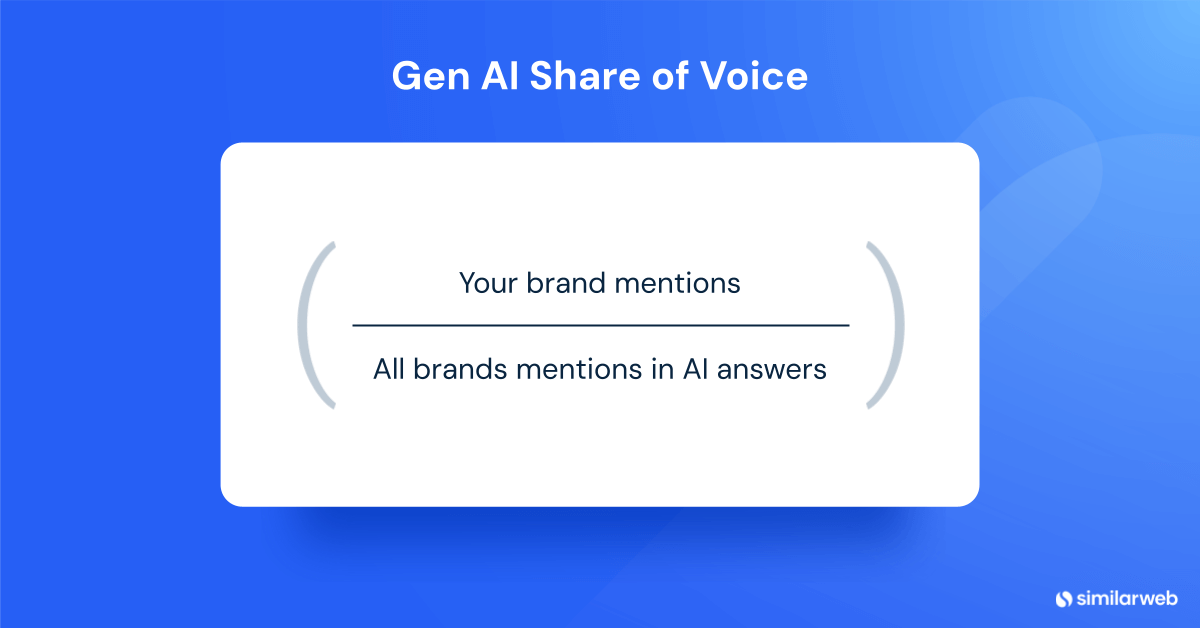
While Brand Visibility measures whether your brand appears at all, Brand Mention Share looks at how often your brand is mentioned relative to all brands within AI answers. Think of it as share‑of‑voice for generative answer engines.
How to measure brand mention share and Gen AI share of voice?
This data appears at the top of the overview section in the AI brand visibility tool, making it easier to track and log. Once you benchmark your AI share of voice, you can take actions to increase it and measure your progress using this metric.
A low brand mention share might be acceptable for a niche brand in a broad market, but tracking changes over time helps gauge competitive momentum.
Why it matters:
Share of voice indicates how well your brand competes for attention against direct and indirect competitors. If competitors are gaining mentions faster than you, your authority may be eroding.
3. Topical visibility and competitor benchmarking
What it is:
Generative answer engines organize queries into topics. Topical visibility measures your brand’s presence within each topic, while competitor benchmarking compares your visibility with other brands. This KPI helps you understand where you are strong or weak.
How to measure topical visibility?
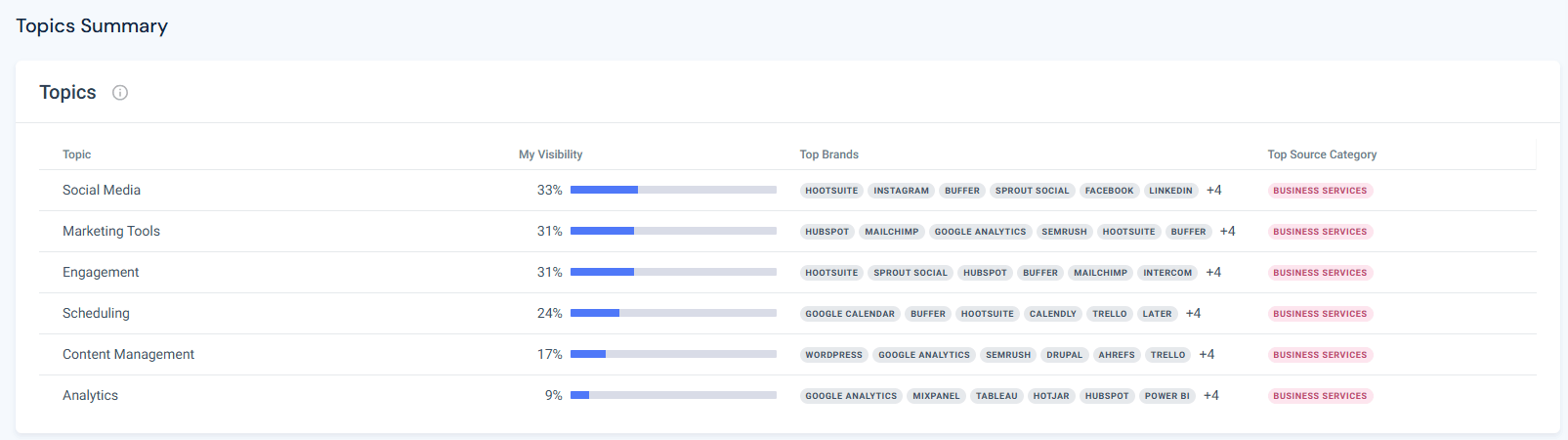
In the Topics Summary section, filter for the relevant timeframe (e.g., 1 month). Inspect your visibility per topic and track your growth in each topic vs. the relevant competitor set.
Why it matters:
Topic‑level visibility reveals which areas drive your brand’s presence and where you need improvement. It also shows whether you are competing against direct rivals or unexpected players.
If your brand is absent in high‑value topics, that’s a cue to create targeted content or increase off‑site citations in that domain.
4. Prompt‑level visibility and query gap analysis
What it is:
Generative answer engines decompose user queries into many prompts. Prompt‑level visibility measures how often your brand appears in responses to specific questions. A prompt gap analysis identifies prompts where your brand is absent or underrepresented.
How to measure prompt‑level visibility?
The Prompt Analysis tool lists individual prompts, their visibility percentage, and whether the brand is mentioned.
By grouping prompts by topic and intent, you can uncover gaps. If your brand is absent in a prompt, adding content that answers that exact question can improve visibility.
Why it matters:
According to query‑fan‑out principles, generative answer engines break complex questions into multiple sub‑queries. If you aren’t optimized for those sub‑queries, your content won’t be retrieved or cited.
Prompt‑level analysis lets you prioritize questions to answer and ensures your brand becomes part of the AI’s “knowledge base.”
5. Domain influence and citation share
What it is:
Domain Influence score measures how often your domain is cited relative to all domains used in AI answers. The Citation Share metric distinguishes between citations in answers that mention your brand and those that don’t. These metrics show whether your content is considered a trusted source.
How to measure domain influence and citation share?
In the Citation Analysis tool, record the data from the overview section. Review the influence trend to make sure you’re steadily growing. Digging into the Top Cited URLs list reveals which specific pages drive influence.
Why it matters:
A high domain influence score means AI engines trust your site. A low score signals that your own content is seldom used as evidence, even when your brand is mentioned. Improving this KPI requires publishing authoritative resources, earning backlinks, and ensuring your pages are machine‑readable.
6. Sentiment distribution and brand perception
What it is:
The sentiment analysis process categorizes brand mentions as positive, neutral, or negative. This KPI indicates how AI engines perceive your brand and how they position it in answers.
How to measure sentiment distribution?
The Sentiment Analysis tool shows you this data from top to bottom. First, review the overall sentiment scores and record your positive, neutral, and negative shares.
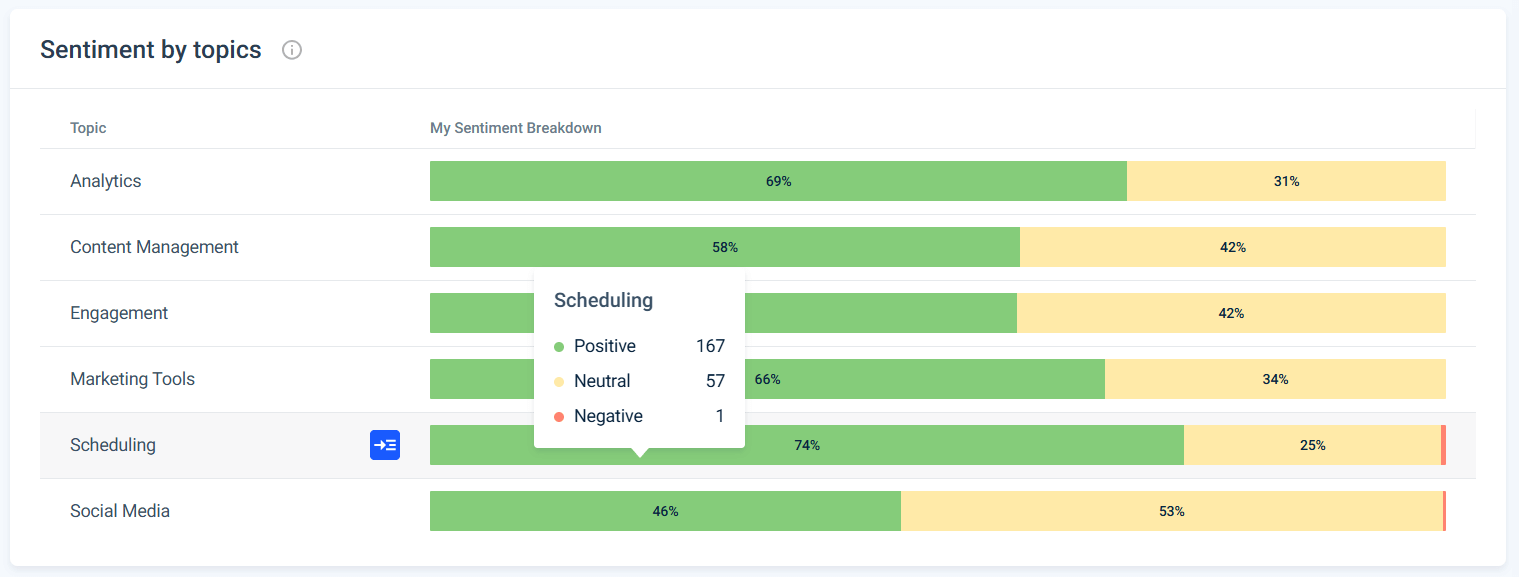
Then scroll down to see sentiment by topic. This chart breaks down your overall sentiment score by the topic you’re tracking, showing you if you have issues around specific topics or intent.
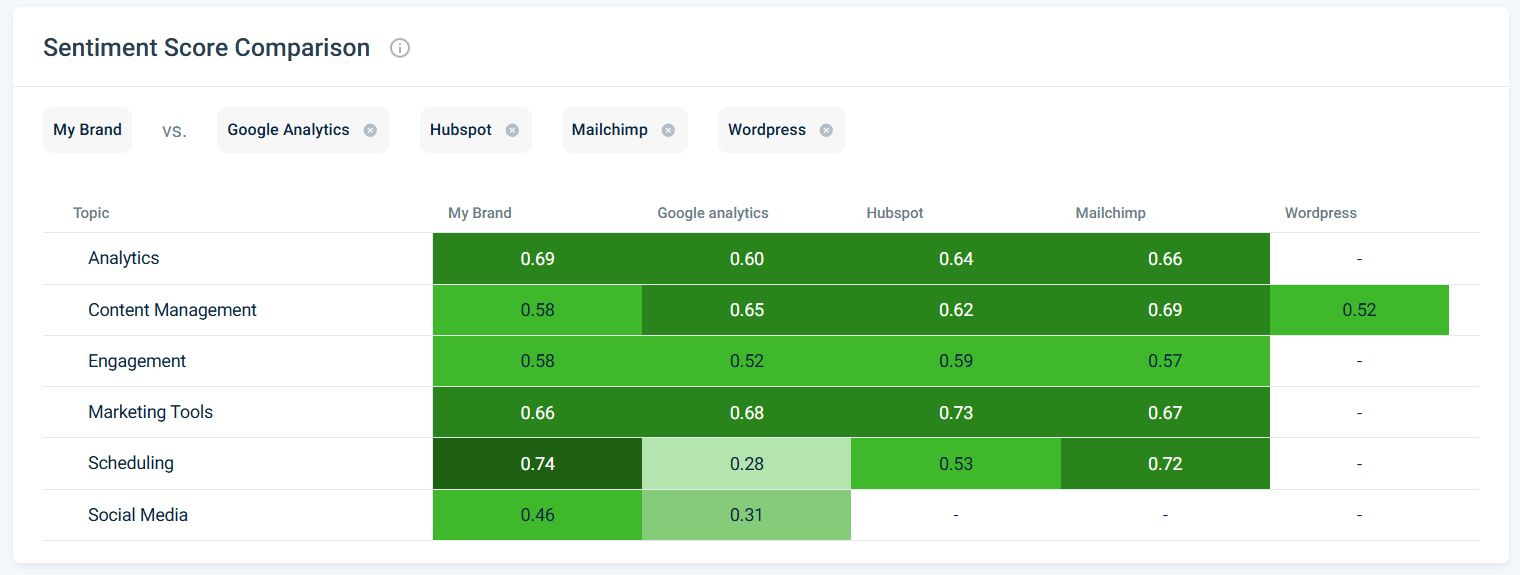
Next, scroll down to the competitors’ chart and compare your sentiment scores with competitors to see where you lead or lag. The chart shows you how you measure in each topic vs your competitors, who has the most positive sentiment, and who’s entirely out of the conversation.
Why it matters:
Positive sentiment enhances trust and increases the likelihood of being cited. If a topic has high negative sentiment, you should inspect what’s causing it. The AI visibility tool lets you see each prompt and answer, helping you zoom in on the reason for any negative sentiment.
Once you understand the reasons, you can address the sentiment for your brand if it isn’t positive. You may need to update content, address customer concerns, or improve product features to shift the narrative.
7. AI traffic and conversion (optional KPI)
What it is:
The AI traffic tool measures the volume of visits to your site from AI engines. You can add conversion metrics (like sign‑ups or purchases) to get a broader view of how that traffic performs.
I like measuring it because it grounds the visibility metric into measurable clicks, which is a critical aspect of measuring SEO, AEO, and GEO success.
How to measure AI search traffic?
AI Traffic analytics show the number of visits from each chatbot and the share of total AI traffic. Once you select the domain you need, the tool will show you the relevant data for that domain.
- Record your total AI traffic, and each generative AI engine’s share of it.
- Check the AI traffic trend from each engine to spot high-level changes.
- Drill into URLs getting traffic from AI, and analyze each URL’s distribution of AI engine traffic.
- Bonus: Drill into the prompts, driving traffic to each URL to start planning your roadmap
Why it matters:
Although AI search traffic is currently small (often under 10%), it converts at high rates because users arrive at your website with strong intent. Tracking conversions helps justify investment in GEO and demonstrates ROI.
Step‑by‑step: Using Similarweb to track GEO KPIs
To make these KPIs actionable, let’s walk through a step‑by‑step process using the Hootsuite campaign. Each step explains how to extract the metric, why it matters, and what action to take.
Step 1: Get a baseline of brand visibility and mention share
- Open your AI Brand Visibility campaign and select your most important topics to track.
- Choose the AI engine and date range. For Hootsuite, I chose ChatGPT and a 1‑month window, but Similarweb lets you choose Gemini and Perplexity as well.
- Record your Brand Visibility and Brand Mention Share. These are your benchmarks.
- In the AI Brand Visibility overview for Hootsuite, I see that Hootsuite’s Brand Visibility is 24.23%, meaning the brand is mentioned in 1,346 of 5,556 total AI answers.

- Hootsuite’s Brand Mention Share is 2.86%. This means that out of 47,020 total brand mentions, Hootsuite is mentioned 1,346 times.

- In the AI Brand Visibility overview for Hootsuite, I see that Hootsuite’s Brand Visibility is 24.23%, meaning the brand is mentioned in 1,346 of 5,556 total AI answers.
- Interpretation:
- A high Brand Visibility indicates a strong presence.
- A low value means you need more content or authority.
- Brand Mention Share tells you if your competitors are dominating the conversation.
- Action: Compare with previous periods to measure improvement (set realistic targets, e.g., increase visibility by 5% in 3 months).


Step 2: Analyze topics to find strengths and gaps
- Go to the Topics Summary section.
- Sort by the ‘my visibility’ column.
- Identify your top topics and weak topics.
- The table shows Hootsuite’s visibility by topic:

- Note that the top brands vary by topic. Log your competitive set and metrics per topic:
- For Social Media, Hootsuite competes with Instagram and Buffer
- For Analytics, Google Analytics and Mixpanel are the top competitors.
- The table shows Hootsuite’s visibility by topic:
- Compare competitor visibility trends.
- Are there topics where a competitor dominates?
- Are there topics where your brand is trending down, but your competitors are trending up?
- Are there topics where your brand is the weakest of the set?
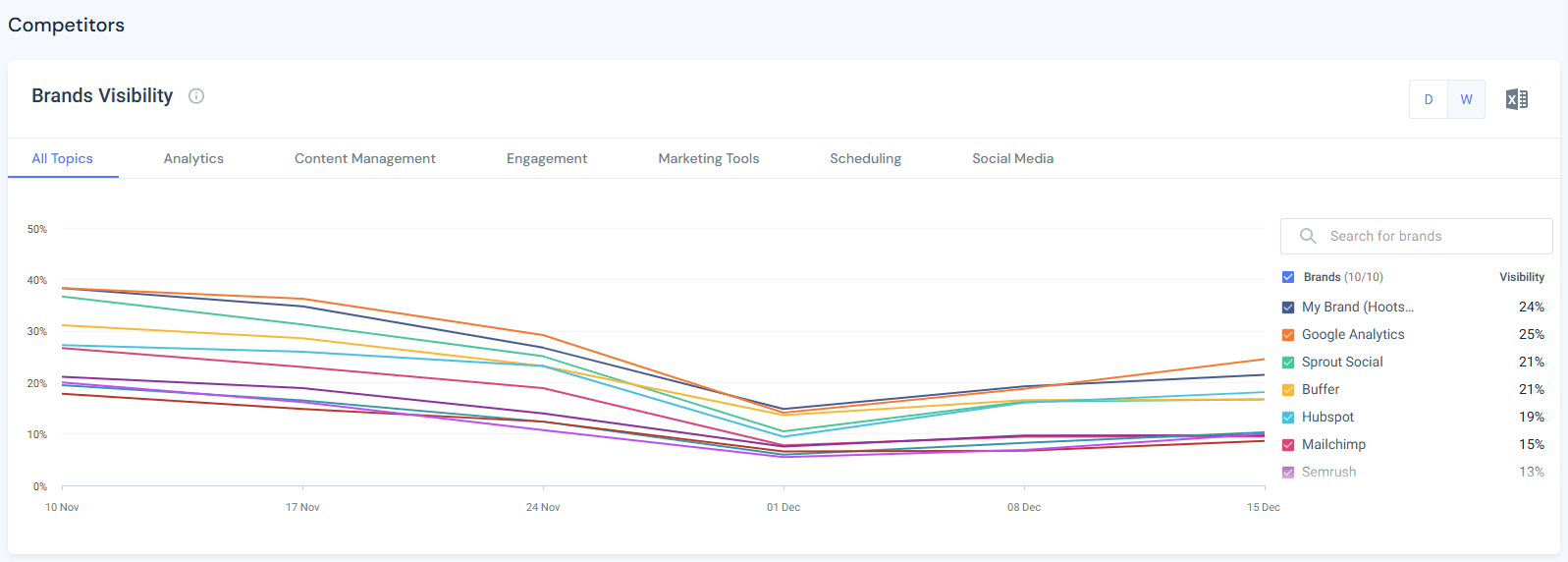
- The Competitors chart below shows that Hootsuite’s overall visibility (24%) is slightly behind Google Analytics (25%) and ahead of Buffer (21%) and Sprout Social (21%).

- Action:
- For high‑value topics with low visibility, plan new content or improve existing pages.
- Use schema (FAQPage, HowTo) and answer‑first formats to make content AI‑friendly.
Step 3: Conduct prompt‑level gap analysis
- Open the Prompt Analysis tool and filter prompts by topics or keywords you care about.
- Group prompts by intent:
- Purchaseable products (Transactional).
- Seeking information.
- Practical guidance.
- Writing & creative ideas.
- Technical & others.
- Classify prompts by type:
- Definitions.
- How‑to questions.
- Comparisons.
- Check your visibility for each prompt. Export and record this data so you can measure your progress per prompt within each topic.
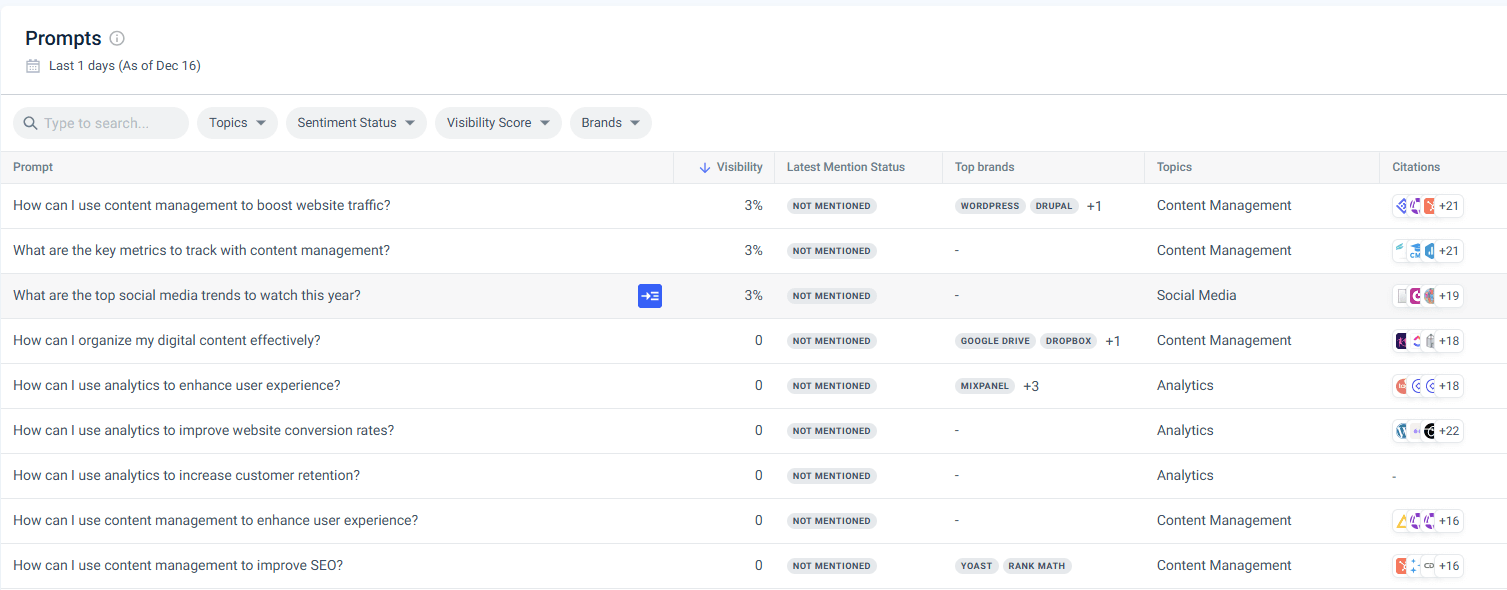
- For example, the prompt “What are the top social media trends to watch this year?” shows Hootsuite at 3% visibility, while many others have 0%.

- For example, the prompt “What are the top social media trends to watch this year?” shows Hootsuite at 3% visibility, while many others have 0%.
- Action:
- Create content that explicitly answers the missing questions.
- Use the prompt as an H2 heading and provide a concise 40‑ to 60‑word answer followed by details.
Step 4: Evaluate domain influence and citations
- Open the Citation Analysis tool.
- Log your Domain Influence and the percentage of citations in brand‑mentioned responses vs non‑brand responses.
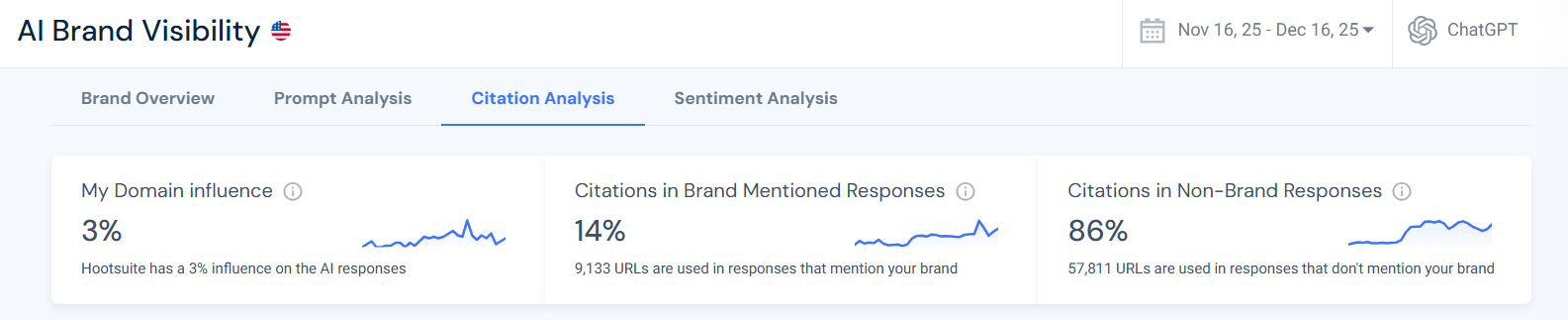
- Hootsuite’s Domain Influence is 3%, meaning that 3% of all URLs cited in ChatGPT answers during the period were from hootsuite.com.

- Hootsuite’s Domain Influence is 3%, meaning that 3% of all URLs cited in ChatGPT answers during the period were from hootsuite.com.
- Inspect the Top Cited URLs list. Check if your own domain appears.
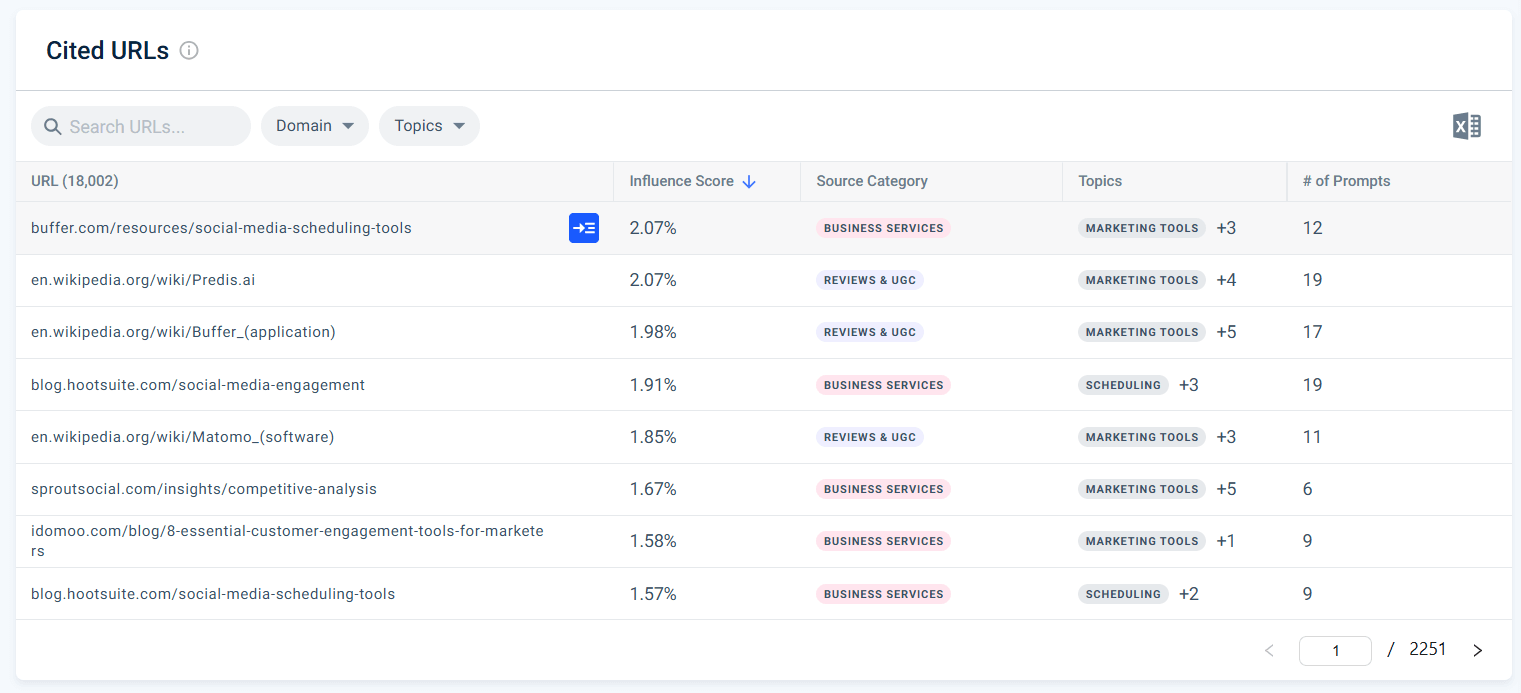
- For Hootsuite, third‑party articles rank highest.

- For Hootsuite, third‑party articles rank highest.
- Track your domains cited URLs growth over time.
- Export the list of cited domains to perform a citation analysis and extract insights to gain visibility.
- Action:
- Increase domain influence by publishing high‑quality resources (e.g., guides, research studies).
- Earn backlinks from authoritative websites.
- Consider updating or creating Wikipedia articles (if appropriate) to improve brand citations.
Step 5: Monitor sentiment and take corrective action
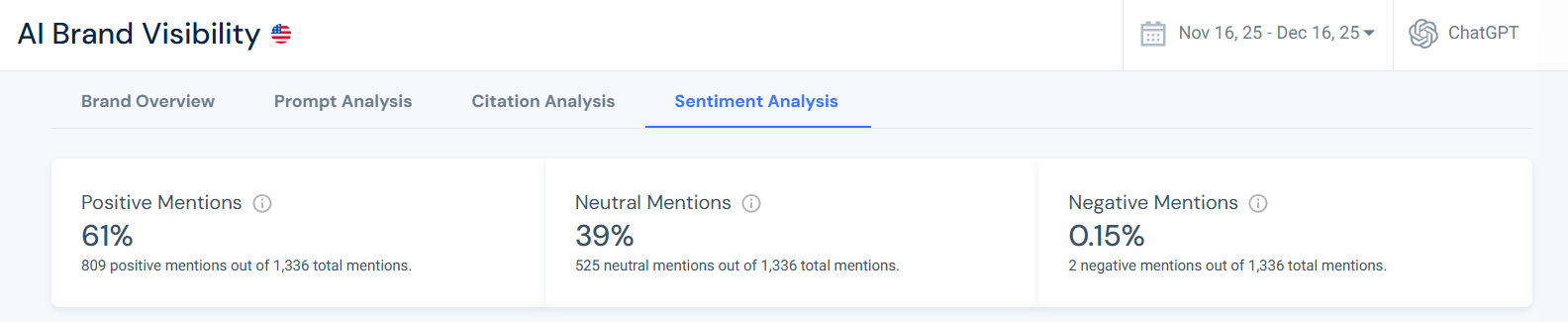
- Go to the Sentiment Analysis tool and record the percentages of positive, neutral, and negative mentions.
- The Sentiment Analysis tool shows that Hootsuite’s mentions are 61% positive, 39% neutral, and 0.15% negative.

- The Sentiment Analysis tool shows that Hootsuite’s mentions are 61% positive, 39% neutral, and 0.15% negative.
- Review sentiment by topic. Identify which topics have lower positivity.
- Sentiment by topic reveals that Scheduling has the highest positivity (74%), while Social Media is more mixed (46% positive).

- Sentiment by topic reveals that Scheduling has the highest positivity (74%), while Social Media is more mixed (46% positive).
- Review sentiment scores per topic vs. competitors to see where you lead or lag.
- In our Hootsuite example, their advantage in scheduling topics is clear. However, in the Content Management topic, they have lower sentiment scores than their competitors.

- In our Hootsuite example, their advantage in scheduling topics is clear. However, in the Content Management topic, they have lower sentiment scores than their competitors.
- Action:
- If negative or neutral sentiment is high, examine the underlying content. Are there product issues or misconceptions?
- Update messaging, provide better support documentation, or engage with communities to improve perception.
Step 6 (optional): Track AI traffic and conversions
Use Similarweb’s AI Traffic Analytics to see which pages are receiving visits from AI engines. Monitor conversion metrics (sign‑ups, purchases) to understand ROI. A small but growing share of traffic comes from generative engines.
- Go to the AI Traffic tool and insert the domain you’d like to analyze.
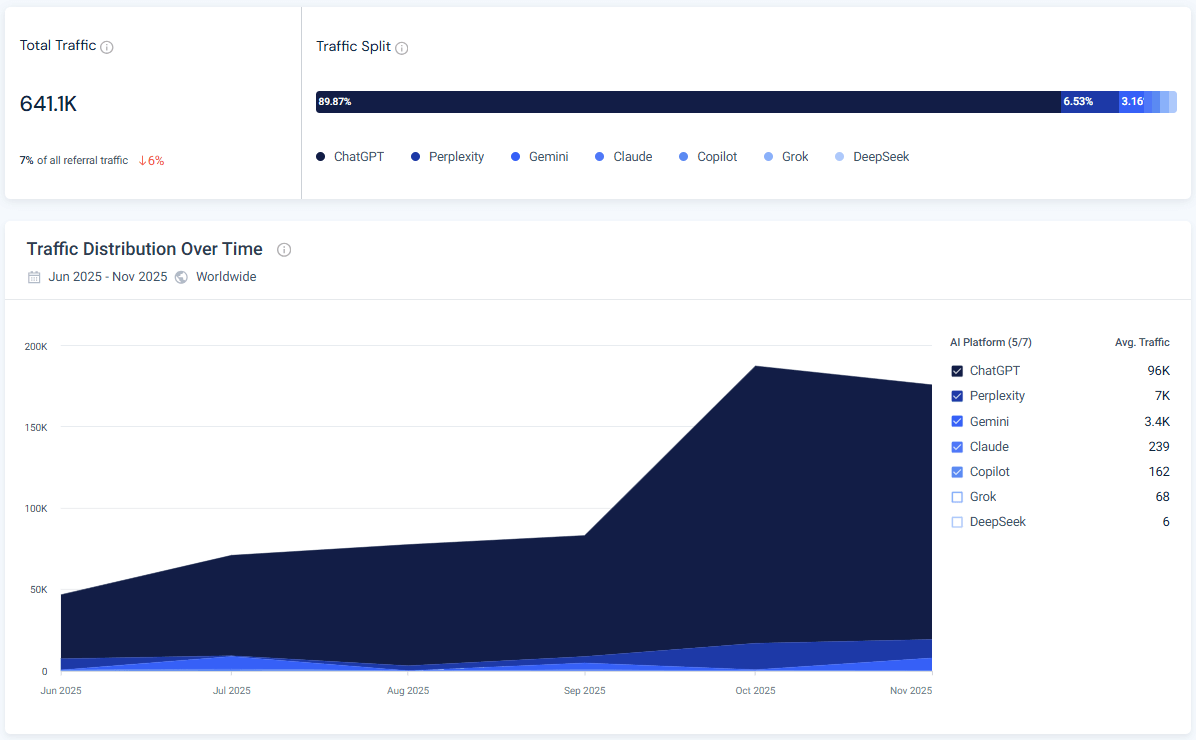
- AI traffic data for the selected domain will load on the page, showing the total traffic the domain receives from Gen AI engines, along with each engine’s share.
- Scroll down to see the AI traffic trend over time. You can choose the relevant timeframe from the top filter.
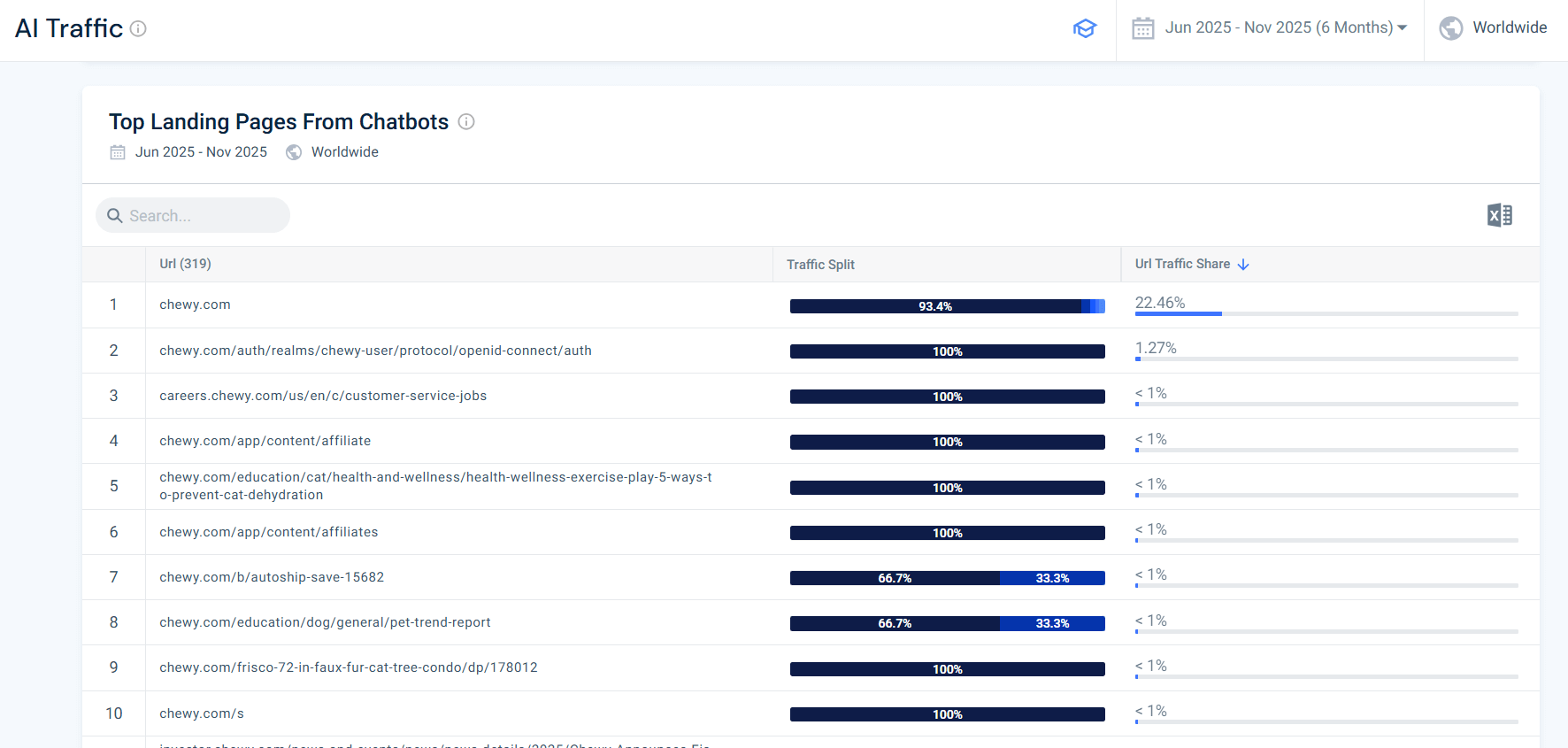
- For example, in a previous post, I showed that ChatGPT generated around 641k visits for an e‑commerce brand over six months, accounting for 7% of all referral traffic.

- Scroll further down to see the AI traffic split by URL. Check each AI engine’s share of referral traffic for each URL.

- Export and log this data, then track each URL’s progress and share from each AI engine.
- For further insights, you can click each URL to see the prompts that drive traffic to it.
- For example, in a previous post, I showed that ChatGPT generated around 641k visits for an e‑commerce brand over six months, accounting for 7% of all referral traffic.
At this stage, you’ve collected your core metrics and walked through each one using Hootsuite as a real‑world example. These KPIs form the backbone of a Generative Engine Optimization dashboard.
To take your analysis further, you can also track engagement metrics and conversions from AI search traffic, though many brands are still exploring how to incorporate this data.
With your benchmarks in hand, it’s time to consolidate your findings into a report that anyone can understand. The following section shows you how to pull these metrics into a simple reporting template.
Free GEO KPI reporting template
This streamlined template helps you monitor the performance of your key Generative Engine Optimization metrics. It brings together brand‑level visibility, topic coverage, prompt‑level insights, citation share, sentiment breakdown, and optional AI traffic into a single Google Sheet.
Use it to benchmark your position in AI results, spot gaps, and track progress over time.
Report template structure:
1. Brand Overview
- Brand Visibility: The share of AI answers that mention your brand.
- Brand Mention Share: Your share of all brand mentions across the AI model.
- Domain Influence: The share of citations coming from your own domain.
- Citation share:
- Branded responses.
- Non-branded responses
- Sentiment distribution: The percentage of positive, neutral, and negative mentions.
Compare each metric with the previous period to track gains or declines and decide whether to boost authority, improve sentiment, or strengthen off‑site signals.
2. Visibility by topic
- List your tracked topics.
- Record the visibility percentage and the top competing brands for each topic.
- Highlight which topics drive the most visibility and which show gaps.
- Use these insights to prioritize content creation and outreach.
3. Prompt Analysis
- List your top target prompts.
- Record your visibility percentage and mention the status for each prompt.
- Note prompts where your brand appears and classify them by intent: definition, how‑to, or comparison.
- Apply the PROMPT checklist to prioritize which gaps to close (Popularity, Relevance, Ownership, Mentions, Pages, and Trust).
4. Citation Analysis
- Measure how often your site is cited compared to other domains.
- List your top-cited pages and the external domains dominating AI answers.
- Identify opportunities to create more authoritative content or partner with frequently cited domains.
5. Sentiment Analysis
- Break down positive, neutral, and negative sentiment by topic.
- Compare sentiment scores with key competitors.
- Focus on areas with low positivity to improve brand perception.
6. AI Traffic & Conversion (optional)
- List total AI traffic and traffic by chatbot
- Note which pages attract AI traffic and how well they convert.
- Use this information to assess business impact and optimize calls to action.
7. Insights & Recommendations
- Use this section to summarize your findings and outline next steps.
- Tie each recommendation back to a specific KPI and set timeframes (e.g., 30/90/180 days).
- Encourage data‑driven actions to improve visibility, fill content gaps, strengthen authority, and enhance sentiment.
8. Bonus: GEO KPI checklist
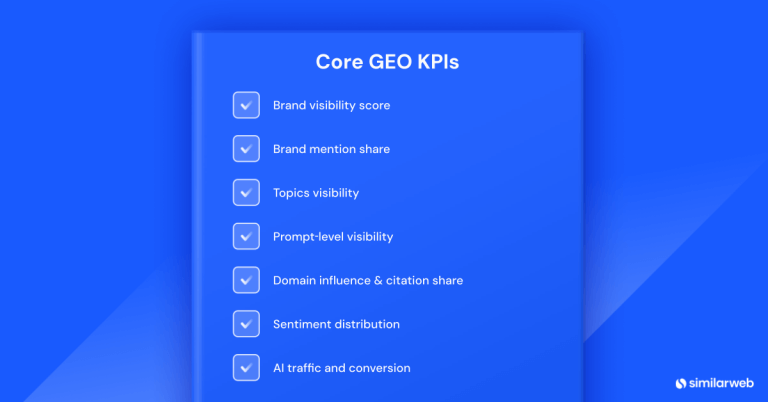
- Maintain a list of critical GEO & AEO metrics you’re tracking: brand visibility, brand mention share, topic gaps, prompt gaps, domain influence scores, sentiment distribution, and AI traffic/conversions.
- Specify how frequently to review each KPI and set target goals.
- Keep this checklist handy to ensure you stay on track.
Guidance: When filling out this template, use simple, clear language and base your commentary on real data. Regularly updating this template will help you track progress and stay focused on the GEO KPIs that matter.
Copy the template, fill in your data, and start measuring GEO performance.
Limitations and ethical considerations
Generative AI engines are relatively young, and Generative Engine Optimization is even younger. There are no standards set yet, not for the AI engines and not for measuring their output for GEO.
- There is no industry‑wide standard for GEO metrics.
- AI behavior can change as models update.
- Data from AI visibility tools is proprietary and may not always reflect the entire picture.
- AI engines sometimes hallucinate or draw on outdated sources.
As you build your GEO strategy, acknowledge these uncertainties and adopt a cautious approach:
- Validate AI‑generated answers.
- Update your content regularly.
- Respect user privacy when analyzing conversational prompts.
Closing thoughts: Measuring what matters for GEO
GEO KPIs shift the lens from ranking positions to being the answer. It’s about becoming a foundational source for generative AI models to generate comprehensive answers.
Metrics like Brand Visibility, Brand Mention Share, Topic Visibility, Prompt‑level presence, Domain Influence, Citation share, Sentiment, and AI Traffic give SEOs a complete view of their performance in AI ecosystems. Tracking these KPIs ensures you focus on building trust, authority, and relevance (signals that generative answer engines reward).
Remember that optimizing for Gen AI platforms does not replace SEO, only extends it. You still need technically sound, crawlable pages and strong topical authority. By layering GEO KPIs on top of your existing metrics, you can future‑proof your brand for a world where answers matter more than clicks.
FAQs
How often should I measure GEO KPIs?
At a minimum, monthly. Many brands run 30‑day campaigns to see short‑term trends and track quarterly to evaluate strategy effectiveness. Adjust the time frame based on your content cadence.
How are GEO KPIs different than AEO KPIs?
AEO KPIs measure how often your content appears in direct‑answer positions, such as featured snippets, voice‑assistant results, and “People Also Ask” boxes. GEO KPIs focus on generative AI platforms: they track how frequently AI engines mention, cite, and accurately reference your brand, mentions on authoritative domains, and backlinks.
Are GEO and AEO KPIs consistent across AI engines?
No. Citation patterns vary by engine: a recent study found only 11% overlap in citations between ChatGPT and Perplexity and noted that about 50% of cited domains change each month. Track each model separately and compare results.
What’s the difference between Brand Visibility and Brand Mention Share?
Brand Visibility measures the percentage of AI answers that mention your brand, while Brand Mention Share compares your mentions to the total mentions of all brands. Visibility shows presence; share shows competitive strength.
How do I improve Domain Influence?
Publish authoritative content, earn high‑quality backlinks, and ensure your pages use structured data. Off‑site assets (e.g., Wikipedia pages) also boost influence.
What’s the role of sentiment in GEO?
AI engines prefer to cite brands with positive or neutral sentiment. If your sentiment score is low, address product issues, improve user experience, and update content to present balanced, factual information.
Is traffic from AI engines valuable?
Yes. Although AI‑derived traffic is still small, it often comes from users with strong intent and converts at higher rates than typical organic traffic. Monitoring AI traffic helps you quantify the business impact of GEO.
What’s the difference between Brand Visibility and Brand Mention Share?
Brand Visibility measures the percentage of AI answers that mention your brand. Brand Mention Share compares your mentions to the total mentions of all brands. Visibility shows presence; share shows competitive strength.
How do I improve Domain Influence and Citation Share?
Publish authoritative resources, earn high‑quality backlinks, and ensure your pages use structured data. Off‑site assets like Wikipedia pages or industry guides can also boost influence.

Related Posts

What Is AI Share of Voice? The Brand Mention Share Metric You’re Probably Missing



Why AI Engines Cite UGC Over Brand Content And How To Leverage It For AEO

AI Mentions vs. AI Citations: What’s the Difference and Why It Matters for GEO

Wondering what Similarweb can do for your business?
Give it a try or talk to our insights team — don’t worry, it’s free!