


 Marketing Intelligence
Query Fan Out: What It Is, How It Works & Why It Matters for SEO

If you’ve tried Google AI Mode or asked ChatGPT a question recently, you may have noticed that the answers look more thoughtful and layered than traditional search results. These responses are built through several steps of reasoning and information gathering behind the scenes.
Behind almost every AI-generated result is a hidden reasoning process called query fan-out – a system where AI rewrites a user’s question into multiple sub-queries, runs many searches in parallel, and merges the retrieved information into one cohesive answer.
For SEO teams, content creators, and brands, this is a significant change.
You’re no longer competing for one search query. You’re competing across every sub-query the AI system generates.
This article explains what query fan-out is, how it works, how it connects to concepts like GEO, and how brands can apply these principles when using AI for SEO. In Google AI Mode and other LLM platforms, its implications for SEO, how to optimize for it, and how Similarweb helps measure visibility in this new era.
What is query fan-out?
Query fan-out is the process by which an AI model breaks a single query into multiple smaller, related sub-queries. Each sub-query explores a different aspect of the user’s intent, helping the model gather information from multiple sources before synthesizing everything into a comprehensive answer.
Example: A user asks: “What are the best protein powders for runners?”
An AI system might expand this into sub-queries like:
- “best protein powder for post-run recovery”
- “Whey vs plant-based protein for endurance athletes”
- “runner-friendly protein options with long-term benefits”
- “protein supplements for marathon training reviews”
- “protein powder with clean ingredients 2025”
Here’s a quick illustration I created with ChatGPT to show an example of how query fan-out works:

The final answer combines the insights discovered across all of these.
Key idea: AI search no longer looks for one perfect page. It builds a set of sources across many micro-queries.
How the query fan-out technique works
Query fan-out happens in three major stages: expansion, routing, and synthesis.
1. Query expansion: Understanding latent intent
AI systems don’t treat your query as a final instruction-they treat it as a starting point.
During expansion, the AI:
- Classifies prompt intent (research, commercial, comparison, how-to, etc.)
- Identifies variables (e.g., runner profile, protein type, purpose)
- Predicts the follow-up questions users often ask
- Generates alternative phrasings and deeper sub-intents
- Projects latent topics using embeddings and knowledge graphs
A recent industry analysis by Nectiv found that Google typically generates around 5–11 sub-queries per prompt, and sometimes far more. This confirms that fan-out is not an edge case-it is the core of AI search.
2. Sub-query routing: Finding the best sources
Each sub-query is then routed to the sources most suited to answer it.
AI may search:
- The web index
- Google’s Knowledge Graph
- Shopping/Product feeds
- Reviews
- Forums & UGC
- Video transcripts
- News & publishers
- Structured data repositories
Routing is modality-aware. For example:
- A “step-by-step stretching routine” might target videos + transcripts
- A comparison query might favor tables and product specification pages
- A definition query may favor authoritative, structured sources
This is why multimodal content and clean structure matter more than ever.
3. Chunk selection and answer synthesis
AI systems rarely lift entire pages. Instead, they extract content chunks that represent coherent units of meaning.
Preferred chunks are:
- Self-contained
- Fact-dense
- Clearly scoped
- Recent
- Trustworthy
- Easy to cite
- Structurally clear (headings, lists, tables)
The final AI response is a curated synthesis from many such chunks, often collected across different sites, formats, and content types.
This is why traditional “keyword ranking” is an incomplete model for AI visibility, as your content only surfaces if the AI selects your chunks.
Why query fan-out matters for SEO
Query fan-out fundamentally rewrites how visibility works in search.
1. You’re competing across many queries, not one
A page optimized for one keyword might only address a fraction of the sub-queries AI generates.
If your competitors answer more of the likely sub-questions, they may appear more often in AI responses, subtly.
2. Zero-click search becomes the default
AI Mode answers, and many brands are still learning how to adapt. If you need a deeper breakdown of this surface, see our guide on optimizing for Google’s AI Mode. directly, often reducing the need to click through.
Visibility becomes the new KPI, as covered in our guide on getting traffic from AI. Brand mentions become the new impression. Citations become the new ranking.
3. Freshness and comparisons matter more than ever
Fan-out queries frequently include:
- Current-year modifiers (2024/2025)
- Reviews
- “vs” comparisons
- Pricing
- Alternatives
If your content doesn’t address these formats, you risk being filtered out during chunk selection.
4. SEO must shift from keywords to topics and intent clusters
Topic hubs with structured subpages outperform isolated keyword-optimized pages.
AI prefers content ecosystems that cover a subject holistically.
Can you see fan-out queries in AI chatbots?
You cannot usually see full fan-out query sets inside chatbot interfaces, but some platforms reveal hints of the underlying process.
On ChatGPT, certain queries display a small “Thinking” panel. When expanded, it shows pieces of the model’s reasoning, including references to searches it performs. These are not full fan-out queries, but they offer a glimpse into what the model looked for.

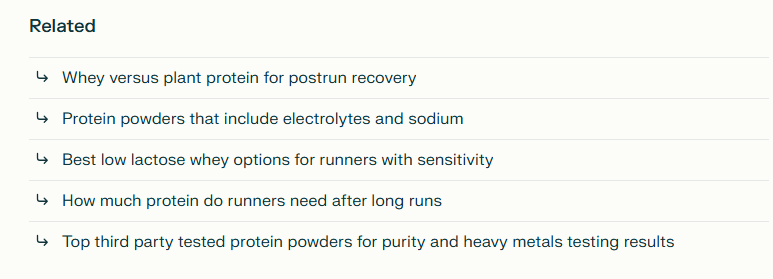
On Perplexity, a “Related” section appears below many answers. These related queries often mirror the follow-up or adjacent questions the system considers during retrieval.
On Claude, some queries surface clearly at the top of the answer, showing the searches the model performed before responding. These can include product reviews, comparisons, or variations of the original query.

While none of these platforms expose fan-out queries in a complete or official way, they provide helpful clues about how your prompts expand into broader intent networks.
Measuring real visibility in a fan-out world with Similarweb
Query fan-out determines which sources AI pulls from, which is why understanding and closing the AI citation gap matters. But brands need to know a different thing:
Are we actually showing up in AI-generated answers?
This is where Similarweb’s AI Brand Visibility tool becomes essential.
Real example: What fan-out visibility looks like for Lululemon
To make this more practical, I analyzed Lululemon using Similarweb’s AI Brand Visibility tool. Looking at the data firsthand helped me understand how query fan-out plays out in real AI environments.
When I opened the Prompt Analysis tool, I could immediately see the types of questions people ask ChatGPT around Lululemon’s categories. Queries like “Where can I find sustainable activewear with UV protection?” or “Where can I find stylish athleisure outfits?” revealed the intent clusters AI associates with the brand.
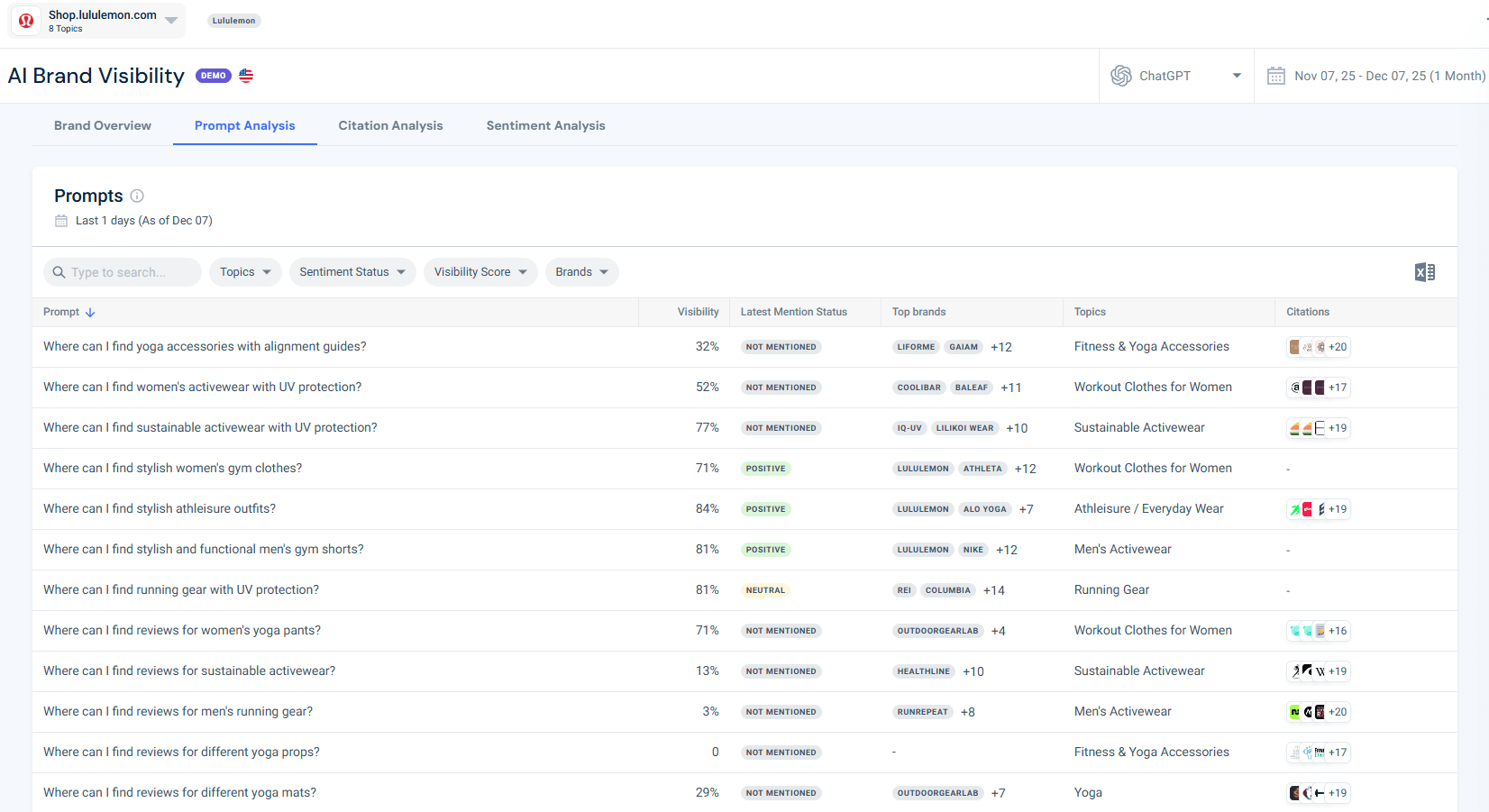
What stood out to me was how often competitors like Athleta, Alo Yoga, and Outdoor Voices appeared instead. In several high-value prompts, Lululemon wasn’t mentioned at all, which clearly signals where the brand is losing visibility.
Digging into the Citation Analysis tool, I reviewed the domains AI relies on most frequently. For Lululemon, the citations leaned heavily toward Nike.com, REI.com, ingorsports.com, Reddit, Vogue, Verywell Fit, and Who What Wear.

These sites meaningfully shape both brand and non-brand answers across running gear, yoga apparel, and sustainable activewear. Seeing this mapped visually made it easy to understand who actually influences AI’s responses in this space.
The Top Cited URLs section made things even clearer. Many of the highest‑influence pages were publisher articles reviewing “best sustainable activewear,” “eco-friendly workout clothes,” or “top gym wear brands.”

These URLs consistently appeared across dozens of prompts. It confirmed that review-style, comparison-style content from trusted publishers drives a disproportionate share of influence in Lululemon’s category.
Finally, when I looked at the Brand Overview, I could see Lululemon’s visibility broken down by topic.

The brand had a strong presence in leggings, yoga pants, and women’s workout clothes. But visibility dropped sharply for running gear and sustainable activewear. This showed exactly which intent clusters need stronger coverage, fresher content, or improved off-site visibility.
Analyzing Lululemon in this way helped me see how fan-out visibility is shaped by the broader content ecosystem. The prompts users ask, the domains AI pulls from, and the URLs that AI trusts all highlight specific opportunities to strengthen a brand’s position across the full intent network.
Why is this critical
Query fan-out is invisible. AI Mode doesn’t reveal which sub-queries it used.
But Similarweb shows the outcome:
- Did your brand make it into the synthesized AI answer?
- Which sources did AI rely on instead?
- Which competitors dominate conversation topics?
This moves AI search away from guesswork to a clear strategy.
Similarweb delivers what SEOs can’t get from other tools by letting you analyze AI citations and understand which sources shape AI answers. From GSC, keyword tools, or fan-out simulations: actual AI visibility based on real AI outputs.
More tools to explore or analyze query fan-out
Here are a few tools that caught my eye. They make it easier to see how AI systems might expand a single query into multiple related directions, which can help guide your content planning.
queryfanout.ai (Dejan) is a web-based interface that extracts real fan-out queries directly from Google’s API. It shows the exact search strings Google generated, which makes it useful when you want authentic fan-out data rather than modeled predictions.
Using the example I gave at the beginning of the article, let’s see what it gives me for the query “What are the best protein powders for runners?”

Otterly Query Fan-Out Simulator provides a modeled expansion based on Google AI Mode behavior. It visualizes how a single seed query can expand into multiple related intents, which helps understand broader topic structures and plan content coverage.
And let’s try this tool for the same query:

Moving Traffic Media – Fan-Out Content Gap Tool accepts two simple exports: fan-out queries and your Google Search Console data. The tool highlights which content formats perform best today, where the biggest gaps exist across query types, and which topics deserve priority. It also creates visual heatmaps and a 30-day action plan based on real performance rather than generic advice.

Screaming Frog + Gemini JS Script (Metehan) is not a standalone tool but a technique that uses Screaming Frog combined with a custom Gemini script. It analyzes pages at a granular level by extracting semantic chunks and predicting 8 to 10 likely fan-out queries per page. It then scores whether your content answers each one fully, partially, or not at all, helping you pinpoint weaknesses such as missing comparisons, pricing details, or scenario-based explanations.
Together, these methods give you a clearer view of which types of pages on your site are at risk, which fan-out branches you consistently miss, and how your real performance compares to your potential coverage.
How to optimize content for query fan-out (a quick playbook)
1. Build topic clusters, not isolated pages
- One pillar page → multiple subpages answering distinct sub-intents
- Include comparisons, reviews, pricing, workflows, and alternatives
2. Write in extractable chunks
Each section should function as a standalone chunk that AI can pull:
- Start with a direct answer
- Keep 2–4 sentence paragraphs
- Use scannable lists & tables
- Add FAQ blocks that address hidden sub-queries
3. Increase semantic breadth and depth
Address:
- Related entities
- Adjacent concepts
- User-level variables (experience, use case, audience, budget, timeline)
4. Add freshness signals
Include current-year modifiers in titles, headings, and examples where appropriate.
5. Prioritize comparisons and reviews
Fan-out queries heavily emphasize:
- “vs” terms
- “reviews”
- “top” lists
- “best for X use case”
Missing these is a major visibility gap.
6. Use schema, multimedia and structured content
FAQ schema, product schema, lists, tables, charts, images with alt text, and transcripts all help AI extract chunked meaning faster.
7. Improve off-page authority
AI frequently cites:
- Publishers and news sites
- Review and UGC platforms
- Marketplaces
- Social platforms and forums
- Brand and competitor domains
Look at which domains and URLs appear most often in Similarweb’s Citation Analysis. Then:
- Strengthen your own content in those topic areas
- Pitch relevant publishers for coverage or expert quotes
- Encourage reviews and user-generated content on trusted platforms
- Build comparison pages that match the angles reviewers already cover
8. Track AI visibility and iterate
Query fan-out patterns and AI behavior change over time. Make AI visibility tracking a recurring part of your performance review.
On a regular cadence:
- Review AI brand visibility trends for your key topics
- Check prompts where you are missing or mentioned less than competitors, and use techniques from competitive AI analysis to close those gaps.
- Identify new content formats and source types that AI is favoring
- Update or expand topic clusters to close the biggest gaps
This turns AI search from a one-off project into an ongoing, measurable channel.
How to measure success in the fan-out era
Traditional SEO metrics do not tell the full story anymore.
New GEO metrics to watch
- AI visibility: how often your brand is mentioned in AI answers for your tracked topics
- Citation frequency: how often your domain and key URLs are used as sources
- Domain and URL influence: how strongly your content shapes answers to a topic
- Intent coverage: how many of the likely sub-intents your content addresses
- Chunk readiness: how extractable, scoped, and clear your information units are
- Business outcomes: leads, signups, or revenue influenced by AI discovery
SEO now has to measure influence, authority, and representation, even when clicks do not always happen.
Bringing it all together
Query fan-out is not just an internal AI trick. It is the foundation of how modern answer engines like Google AI Mode, ChatGPT, and others research, retrieve, and compose results.
Instead of ranking pages for a single keyword, AI systems build answers by exploring entire intent networks, retrieving many sub-queries, and selecting only the most useful chunks from across the web.
For SEO teams, this means:
- Covering full topic ecosystems, not just single phrases
- Anticipating sub-intents and follow-up questions
- Structuring content so it can be lifted as clean chunks
- Creating comparisons, reviews, and up-to-date resources
- Building authority both on-site and across trusted external domains
- Tracking how often your brand actually appears in AI answers
Search is changing quickly. With the right content structure and with visibility measurement from tools like Similarweb’s AI Brand Visibility, which is part of Similarweb’s Web Intelligence suite, brands can adapt instead of guessing.
FAQs
What does query fan-out mean in AI search?
It is the process where an AI system breaks a single query into many sub-queries to understand intent, retrieve diverse evidence, and synthesize a fuller answer.
How many fan-out queries does Google generate per search?
It varies by query and context, but industry analyses suggest that many prompts expand into roughly 5 to 11 sub-queries, and complex topics can trigger more.
Why is query fan-out important for SEO?
Because AI visibility is no longer determined by one keyword. It depends on how well your content answers an entire cluster of related sub-intents and follow-up questions.
Is query fan-out the same as keyword expansion?
No. Keyword expansion focuses on lexical variants. Fan-out expands the reasoning paths and latent questions behind the query, then searches for each.
What types of content do LLMs prefer to cite?
They tend to favor structured, clear chunks of information, such as lists, tables, short summaries, definitions, comparisons, reviews, and recent, authoritative explanations.
Do I need special tools for query fan-out analysis?
You can use fan-out simulators or extractors to see likely sub-queries, and content analysis tools to see where you have content gaps. To understand real visibility in AI answers, you can use Similarweb’s AI Brand Visibility.
How do I know if my brand appears in ChatGPT or Google AI Mode answers?
Use AI visibility measurement tools that track mentions, citations, domains, and prompts. Similarweb’s AI Brand Visibility shows how often your brand appears, which prompts drive mentions, and which sources shape the answers.
Can small brands succeed in a fan-out world?
Yes. Smaller brands can still win if they focus on narrow topical authority, clear structure, useful comparisons, and content that answers very specific questions that larger competitors overlook.

Related Posts



Why AI Engines Cite UGC Over Brand Content And How To Leverage It For AEO

AI Mentions vs. AI Citations: What’s the Difference and Why It Matters for GEO


Wondering what Similarweb can do for your business?
Give it a try or talk to our insights team — don’t worry, it’s free!