


 Marketing Intelligence
The Top GEO Templates by Similarweb for Winning Visibility in AI Search

Generative Engine Optimization has changed how brands earn visibility.
Citations, AI Overviews, and AI-generated answers now shape discovery just as much as classic rankings. What I’ve learned quickly is that GEO and AEO favor structured, repeatable strategies over improvised ones.
When I first started working seriously on AI visibility, I had plenty of insights but no system. I could see where competitors were cited and where traffic came from, yet I struggled to manage it. Everything changed once I started using dedicated GEO templates. They gave me a way to move from random insights to clear, repeatable actions.
Below are the top GEO templates I like, use, and recommend, all designed to help turn AI visibility into a real growth channel.
Top 5 GEO Templates
1. AI Citation Tracker Template
This template helps me understand which sources AI engines consistently rely on when answering questions in my space.
When I use the AI citation analysis template, I start by listing domains that frequently appear in AI answers for my core industry topics. For example, when working on cloud infrastructure or machine learning topics, I’ll often see the same cloud provider documentation, technical architecture blogs, and research-style resources showing up across multiple prompts. I log each domain or URL, note the topic it’s associated with, mark whether competitors are cited, and track how many prompts trigger that citation. When a source appears repeatedly, it’s a strong signal that AI systems trust it.
A good example of this is when a highly influential source shows up with a very high influence score and is associated with multiple prompts, while also citing competitors. That combination tells me this isn’t a random mention, it’s a foundational source for how AI answers are constructed. At that point, I don’t think in terms of chasing the citation. Instead, I analyze why that source is being cited and what role it plays in the answer.
What really makes this template powerful, though, is the “recommended action” mindset. If I see an industry-specific technical resource consistently cited for high-intent prompts like “machine learning best practices on GCP” or “ML architecture on Google Cloud,” I don’t treat it as a low-impact mention. I flag it as a priority opportunity and plan content that addresses the same prompt in a clearer, more structured, or more audience-appropriate way. In some cases, that means simplifying complex explanations, in others, it means adding practical examples or comparisons AI can easily reuse.

This approach has helped me focus on opportunities that actually influence AI visibility, rather than just collecting citation data. Instead of tracking everything, I’m constantly asking what each citation tells me about intent, trust, and where my content can realistically fit into AI-generated answers. If you want to apply the same process, you can download the AI Citation Tracker template here and adapt it to your own industry and competitors.
2. Prompt Intent Template
Keyword-based thinking eventually breaks down, especially when the goal is to understand what users are actually trying to accomplish. This is the framework I rely on when I need to move beyond surface-level queries and start analyzing prompt intent the way AI systems do.
What makes this approach different is that it doesn’t classify prompts the way SEO traditionally has. Instead of forcing queries into broad buckets like informational or transactional, it pushes me to think in terms of task-level intent, the same way modern LLM-powered systems and semantic search engines operate. The goal isn’t to label a query, but to understand the underlying problem the user is trying to solve so content can be created in a way AI systems can confidently retrieve and reuse.
I usually start by exporting a list of prompts from an AI visibility or prompt analysis tool and working through them using this framework. For each prompt, I identify the primary task the user is trying to complete and any secondary intent that might be implied. This step alone is often revealing. Two prompts that look similar on the surface can represent very different tasks, which helps explain why one gets surfaced in AI answers and the other doesn’t.
The most valuable part of the framework for me is the interpretation layer. Writing down how an AI system would likely read the prompt forces clarity. I’m not asking what I think the user means, I’m asking what signals the model would pick up on, such as constraints, use cases, comparisons, or risk considerations. That perspective shift changes how I identify and prioritize content gaps.
Finally, I use the recommended content type output to translate intent into action. Instead of defaulting to “write a blog post,” I can see whether a prompt calls for a step-by-step guide, a comparison table, a buyer framework, a troubleshooting article, or a use-case explainer. Over time, this creates a content roadmap built around how AI systems retrieve information to resolve user needs, not around traditional website structure.
You can copy the prompt intent template here and adapt it to your own industry, topics, and content strategy to build a prompt-led roadmap that AI systems are more likely to mention and, cite.
3. AI Traffic Opportunity List Template
This template helps me move from AI visibility to traffic potential. When I want to understand which AI answers actually drive clicks, this is the framework I use.
Here’s how I typically do it. I take competitor prompts driving AI traffic, alongside prompts generating citations and map them with AIO keywords driving competitor clicks.
This combination is critical because it connects AI visibility to real outcomes. It helps me see not only what AI systems choose to answer, but which answers are already translating into user clicks and measurable traffic.
Once those signals are clear, I bring them together into a single, focused opportunity list. This becomes my roadmap, helping me prioritize the exact topics and questions where AI visibility already shows real potential for traffic. By combining these signals in a single template, I end up with a focused list of content opportunities that already have proof of demand. Instead of creating generic pages about streaming services, I can plan content that directly answers the specific questions AI systems are surfacing, especially around family entertainment value, content availability, and use-case-driven comparisons. This dramatically increases the likelihood of earning both AI citations and AI Overview clicks.

If you want to apply this workflow yourself, you can download the AI Traffic Opportunity List template here and tailor it to your own vertical and competitors.
4. AI Citation Gap Analysis Template
When I need to understand where competitors outperform me and what the AI citation gap is, this is the framework I use.
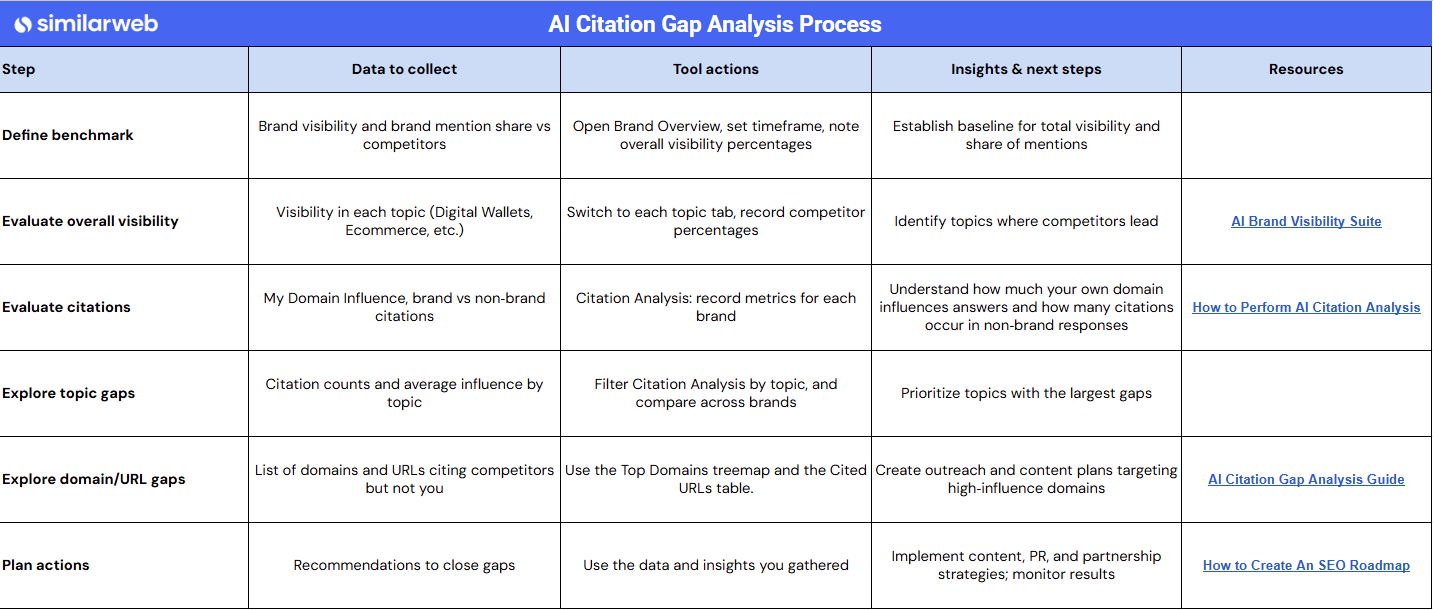
I start by defining scope and goals so the analysis doesn’t lose focus. I list my brand and one to three competitors, choose a small set of topics that really matter to the business, and set a concrete target I can measure. Then I capture baseline visibility and citation metrics so I’m not guessing later whether things improved or just felt better.
From there, I move into topic-level visibility. This step is where the template really earns its keep, because it quickly shows me where I’m strong and where competitors dominate the conversation. Instead of relying on a single overall view, I can pinpoint the exact topics where I’m losing visibility and decide whether those topics are strategic enough to prioritize.
Once I know which topics matter most, I evaluate citation sources in a more disciplined way. I fill in the citation analysis tab with signals like domain influence, citations in brand versus non-brand answers, and the influence of top domains and URLs. The point here isn’t to collect numbers for the sake of it, it’s to spot patterns that explain why competitors show up more often and where the gaps are most realistic to close, whether that’s a topic gap, a publisher gap, or a specific type of content gap.
Finally, I plan actions. I prioritize the topics and domains with the biggest gaps, then turn that into a practical plan: improve my own pages with a clearer structure and stronger coverage, and target high-authority publishers where relationships or partnerships can actually shift outcomes. I assign owners, timelines, and KPIs so it doesn’t stay stuck in “analysis mode.” And because AI citation patterns change quickly, I treat this as a repeatable workflow, something I revisit regularly to adapt and keep momentum. You can download the AI Citation Gap Analysis template here and adapt it to your own industry and competitor landscape to follow the same process.
5. GEO KPI Template
What I like about this template is that it reframes performance tracking around visibility and trust, not rankings or clicks alone. Instead of asking whether a page moved up or down, I’m looking at whether my brand is increasingly present in AI answers, across the topics and prompts that matter most. This shift is important because when AI provides the full answer, visibility is the outcome.
I usually start by defining a small set of core topics I care about and logging baseline GEO KPIs for each one. From there, I track how often my brand appears in AI answers, how my citation share changes relative to competitors, and whether sentiment shifts as new content or partnerships go live. The goal isn’t to obsess over daily changes, but to spot clear trends over time.
What makes this template especially useful is how it brings multiple GEO signals into one place. By looking at brand visibility, topic coverage, citation share, and sentiment together, I can understand why performance is changing. If visibility improves but sentiment weakens, that’s a different problem than visibility growing alongside stronger citations from authoritative sources. The template helps me interpret those patterns instead of reacting blindly.

I also use this template as a reality check. If AI visibility increases but downstream impact doesn’t follow, that’s a signal to revisit how content is framed or whether the prompts I’m targeting actually align with user intent. On the other hand, when citation share and visibility steadily grow month over month, I know the strategy is compounding, even if traffic gains come later.
Because GEO performance evolves as AI systems change, I treat this template as a living dashboard. I update it regularly, compare periods side by side, and use it to guide what to double down on and what to deprioritize. That’s why I recommend it, since it turns GEO measurement into an ongoing discipline instead of a one-time report.
You can download the GEO KPI template here and adapt it to your own topics and competitors to track progress the same way.
6. AI Mode Visibility Roadmap Template
Tracking AI Mode visibility is essential for turning execution into measurable progress.
What I like about the AI Mode Visibility Roadmap is that it forces me to translate insights into a plan that a team can actually run with. I start by identifying a small number of focus areas based on my AI visibility data, things like topic gaps, prompt coverage issues, weak citation sources, sentiment risks, or technical blockers. Each of these becomes a separate line in the roadmap, which immediately prevents the plan from becoming vague or overloaded.
From there, I turn each focus area into a clearly defined action. That means writing down the specific change I want to make, not just the goal. For example, instead of saying “improve AI visibility for a topic,” I’ll define an action like updating a key page to better answer a group of high-value prompts, adjusting page structure so AI Mode can extract answers more easily, and following that with targeted outreach to a small set of influential sources that frequently shape citations in that space.
Next, I use the roadmap to structure the work. I assign an owner to each action, set realistic start and end dates, and estimate impact so I can prioritize properly. This is where the template becomes especially practical. The Visual Timeline tab lets me see how initiatives overlap, which workstreams can run in parallel, and where resource constraints might slow things down. That visibility makes it much easier to align GEO work with broader marketing and content plans.
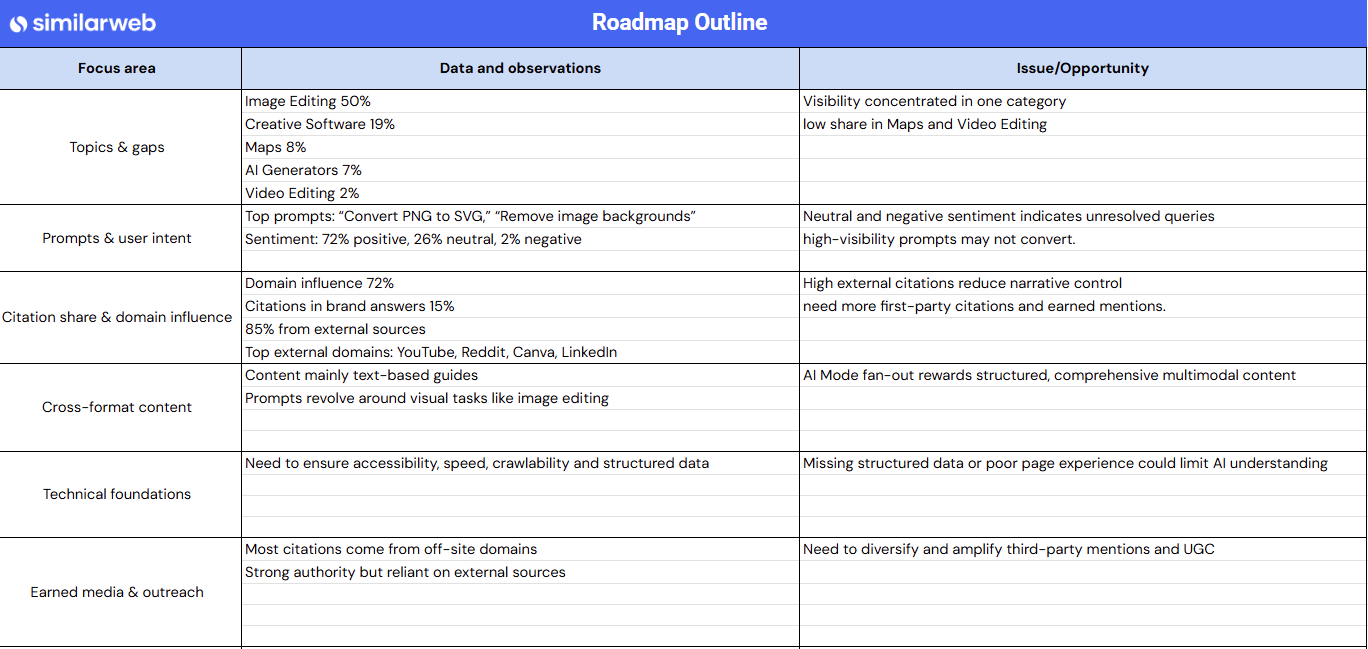
I also treat this roadmap as a living document. After each reporting cycle, I revisit it, review what moved the needle and what didn’t, and adjust priorities accordingly. Because AI Mode patterns change quickly, this step is critical. It ensures the roadmap reflects current reality, not last quarter’s assumptions.
I recommend this template because it closes the loop between insight and execution. It gives me a repeatable way to decide what to work on next, who owns it, and how success will be measured.
You can download the AI Mode Visibility Roadmap template here and adapt it to your own topics, competitors, and reporting cadence to turn AI visibility insights into a structured, executable plan.
My Personal Take on Working With GEO Templates
Working on GEO has taught me how quickly things can get unclear without structure. AI visibility moves fast, signals change often, and it’s easy to get distracted by isolated mentions or short-term shifts that don’t actually matter. Having the right templates in place helps me cut through that noise and focus on decisions that are grounded in patterns, not guesswork.
I’ve learned that GEO doesn’t reward instinct or one-off optimizations. It rewards consistency, prioritization, and the ability to interpret signals in context. These templates give me a way to step back, understand why something is happening, and decide whether it’s worth acting on. That’s especially important in a space where visibility can shift and not every change deserves a response.
Another reason I rely on these templates is that they make trade-offs visible. They highlight where effort is likely to pay off and where it probably won’t. That clarity makes it easier to deprioritize work that looks interesting but doesn’t move the needle, and to stay focused on actions that actually influence how AI systems surface and use content.
For me, these templates aren’t about process for process’s sake. They’re about reducing uncertainty. They help me think clearly about AI visibility, explain decisions with confidence, and keep my work focused even as the systems underneath continue to change.
Moving GEO From Ideas Into Execution
Generative Engine Optimization is no longer optional for brands that care about future visibility. As AI systems increasingly decide which sources are surfaced, summarized, and cited, the cost of being unstructured keeps rising. Visibility is no longer just about ranking pages, it’s about earning trust and relevance in how generative engines choose their answers.
This is where a structured approach becomes a real competitive advantage. When GEO is treated systematically, teams can move beyond reactive experiments and start making deliberate, repeatable decisions about where to invest time and effort. Instead of chasing every possible prompt or citation, you’re focusing on the opportunities that actually influence AI outcomes.
If you’re serious about GEO, I recommend starting with these templates. They don’t just organize data, they shape how you think. They help you prioritize impact over noise, connect insights to execution, and turn AI visibility into something you can actively manage, not just observe. To put this into practice with real data, you can use Similarweb’s AI Brand Visibility tool and AI Traffic Tracker to track citations, visibility, and AI-driven traffic over time.
FAQs
What makes GEO templates different from SEO templates?
GEO templates are built around prompts, citations, and AI-generated answers rather than rankings alone.
Are these templates only useful for Google AI Mode?
No. The principles apply to any generative engine that surfaces answers and sources.
How often should GEO templates be updated?
Monthly is usually enough, though fast-moving industries may update more often.
What’s the biggest GEO mistake these templates prevent?
The biggest GEO mistake is chasing low-impact citations instead of prioritizing influence and intent.
Are these templates meant to replace tools?
No. They work best when paired with AI visibility and traffic data from tools like Similarweb.
Do I need technical SEO skills to use GEO templates?
Not necessarily. Strategic thinking and content understanding matter more.
Can these templates be used by non-SEO teams?
Yes. Content, brand, and growth teams often get strong value from them.

Related Posts


What Is AI Share of Voice? The Brand Mention Share Metric You’re Probably Missing




Wondering what Similarweb can do for your business?
Give it a try or talk to our insights team — don’t worry, it’s free!