


 Marketing Intelligence
How to Track AI Visibility Using Similarweb

As a veteran SEO who’s seen my industry evolve over the past 2 years, I know that search behavior is changing rapidly. SEO is still the most essential foundation, but “add-on” practices like AEO (Answer Engine Optimization) and GEO (Generative Engine Optimization) have been added to our day-to-day pool of organic efforts.
Generative AI models like ChatGPT and Google’s AI Overviews rewrite queries, synthesize information from across the web, and surface brands inside direct answers. Traditional organic rankings still matter, but they no longer give the full picture of your brand’s presence in AI search.
Google Search Console currently lumps AI Overview impressions together with organic impressions, leaving marketers blind to how often AI results appear and whether their pages are cited.
AI visibility depends a lot on how often your brand is cited across the paid, earned, shared, and owned (PESO) media mix, as well as on how large language models interpret those signals.
In this guide, I’ll walk you through a simple, repeatable process for tracking and improving your AI visibility using Similarweb’s AI Search Intelligence suite. I’ll keep using the DEEP framework since it’s pretty simple and effective.
Why measuring AI visibility matters
Generative AI engines now influence purchasing decisions throughout the funnel. They aggregate information from product feeds, category pages, reviews, and trusted articles to recommend brands and products.
Because Google lumps AI Overviews into organic impressions, you might see impressions increase while click‑through rate drops. Without a dedicated AI visibility measurement, you can’t tell whether AI results are cannibalizing your clicks or boosting brand awareness through mentions and citations.
A search reports explain that generative search visibility refers to your brand’s ability to appear in AI‑generated answers across generative AI tools and Google AI Overviews.
Tracking AI visibility, therefore, helps you:
- Understand how often your brand is mentioned or cited by AI engines.
- Uncover the specific prompts and topics where your brand shows up or is absent.
- Identify which domains and URLs generative models trust when answering questions in your category.
- Measure sentiment around your brand within AI answers to spot opportunities to reduce confusion or highlight strengths.
- Benchmark your performance against competitors and build a roadmap to close visibility gaps.
Throughout this guide, I’ll use Walgreens as an example brand and set the reporting period to the last three months. Feel free to follow along with your own campaign.
Step 1: Define goals and topics
Begin by clarifying your goals, competitors, and topics of interest. The DEEP framework (Define, Explore, Evaluate, Plan) is a simple way to structure this process.
1. Define the scope.
Decide which brand or product line you want to measure and what success looks like. For Walgreens, I’m focusing on pharmacy‑related services, vitamins, and personal care products.
2. Set the date range.
In Similarweb’s AI Brand Visibility tool, click the date picker and choose Last 3 Months. This ensures that the metrics you see reflect recent performance.
After applying the filter, the Brand Overview report shows Walgreens’ Brand Visibility (16.03%) and Brand Mention Share (3.84%) for 2,580 mentions across 16,097 answers.

These numbers tell me how often Walgreens appears in generative answers relative to the total number of answers and how its share of all brand mentions compares to competitors.
3. Review topic summaries.
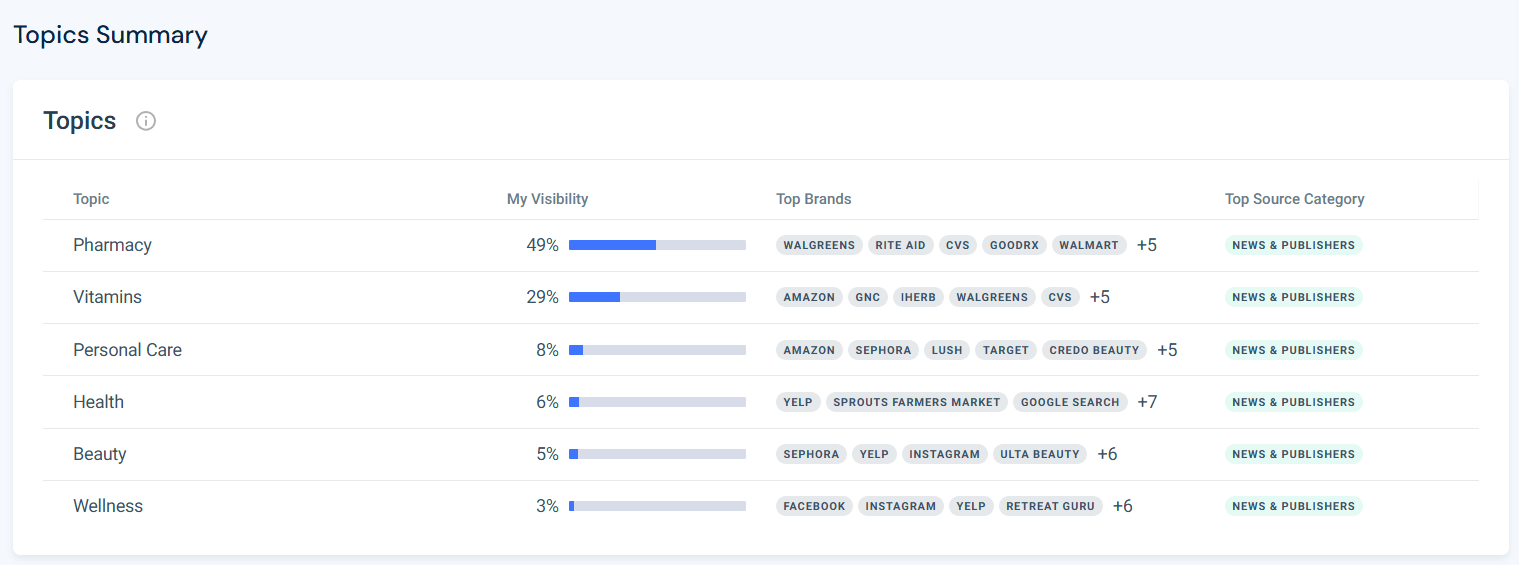
The Topics Summary table highlights the share of answers by category and lists top competitor brands for each topic.
For example, in Pharmacy, CVS Pharmacy and Costco appear frequently. This helps prioritize which categories need more attention.
Main benefits of predefining goals and topics:
Defining goals gives you clarity and focus, helps you prioritize what really matters, and keeps your work consistent and aligned with your overall strategy.
It speeds up execution and makes it more efficient, simplifies collaboration by aligning everyone in the same direction, and lets you measure results and optimize based on clear objectives rather than guesswork.
Defining the topic scope and date range focuses your analysis on the correct time period and competitors, ensuring the insights you derive are actionable. Without a clear definition, you might chase irrelevant prompts or misinterpret seasonal variations.
Step 2: Explore prompts
Next, identify the specific user questions where AI engines mention (or omit) your brand. In the Prompt Analysis tool, you’ll find a table of real prompts, the visibility score for your brand, the latest sentiment classification, competing brands, and associated topics.
1. Filter by topic or sentiment.
Use the search and filter tools to focus on particular topics (e.g., “Pharmacy”) or to find prompts with negative sentiment.
For Walgreens, we have prompts like “Which pharmacy offers the best rewards program?” and “What are the best customer service ratings?”
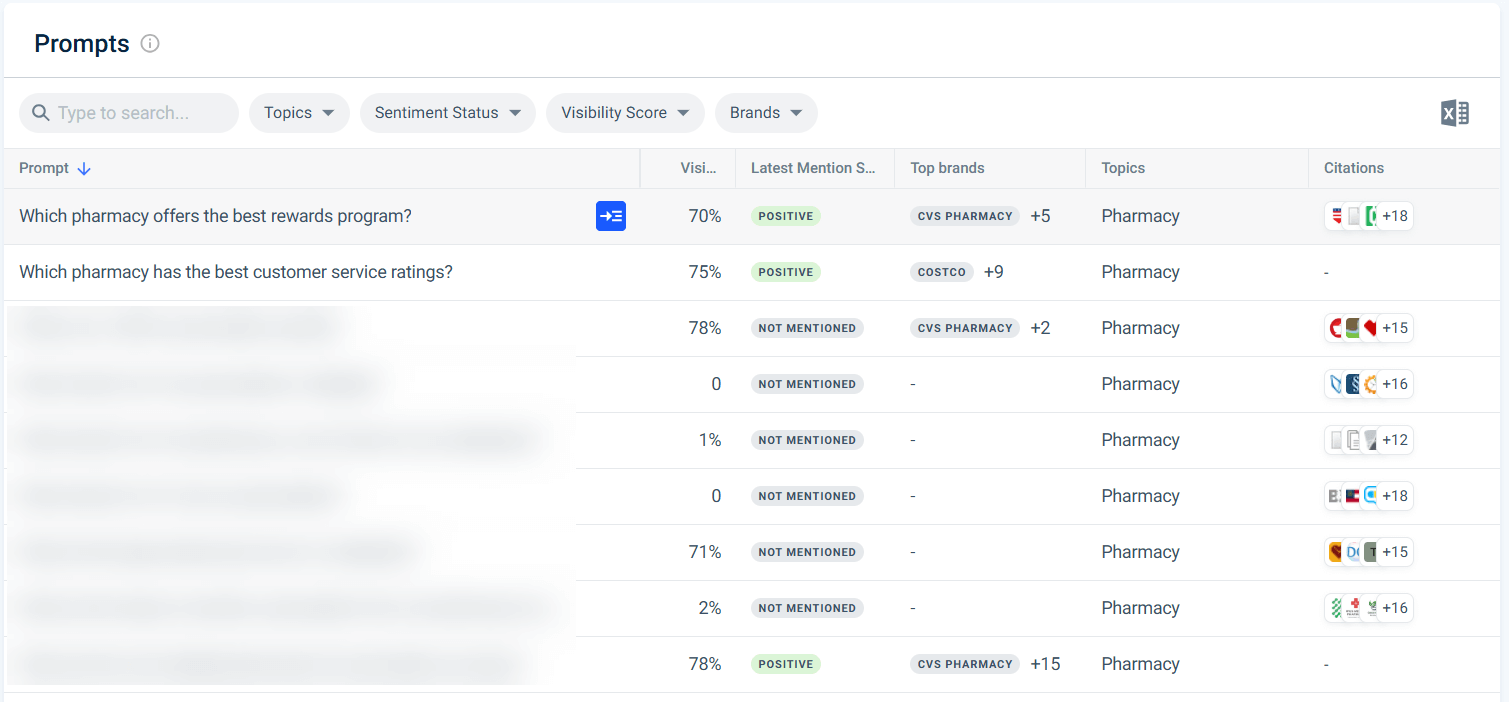
The visibility score indicates the proportion of recent answers that mention Walgreens for each prompt (e.g., 70% visibility means the brand is named in most answers).
2. Identify competitor gaps.
In several high-intent prompts, Walgreens was absent, while CVS Pharmacy or Costco dominated.
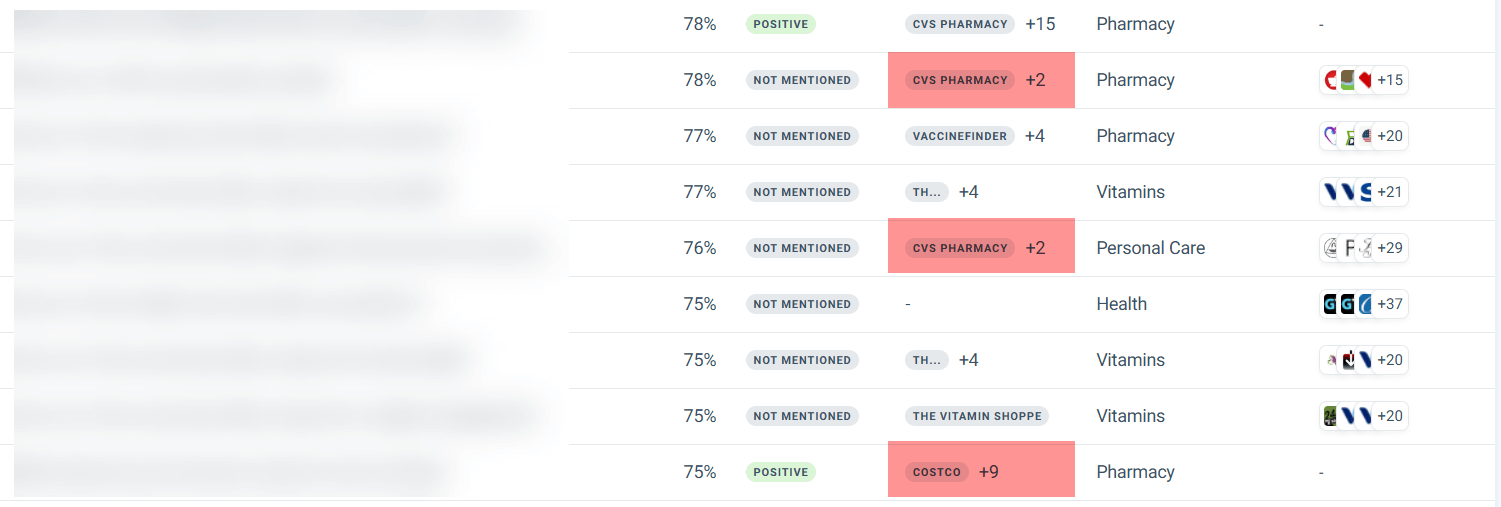
Having High visibility metrics but not showing up in prompt answers usually signals:
- Content-intent gap
- Your brand has “high visibility” in the category overall, but low semantic relevance for that narrow prompt intent, so it doesn’t get mentioned.
- You may have comparatively weaker organic content around the exact question, so the AI answer engine doesn’t see you as a top candidate.
- Category or entity clarity gap
- Your brand doesn’t clearly “declare” itself as part of the category in the way models expect. This means the model doesn’t see you as the obvious, unambiguous fit for that category and query.
- Your brand might have an ambiguous name (like “Monday”), which AI engines can interpret incorrectly.
- Third-party & SERP presence gap
- You’re not in enough “Top X / Best Y” resources that the model leans on for list-style answers.
- You’re not engaging in enough PR activities.
These gaps highlight deficiencies in content or trust signals: perhaps competitor loyalty programs, content, and products are better documented or more widely cited.
3. Examine full answers.
Click any row to view the full chatbot answer and its sources. A sidebar will open with all the data you need about the prompt you’re analyzing (including the full AI answer):
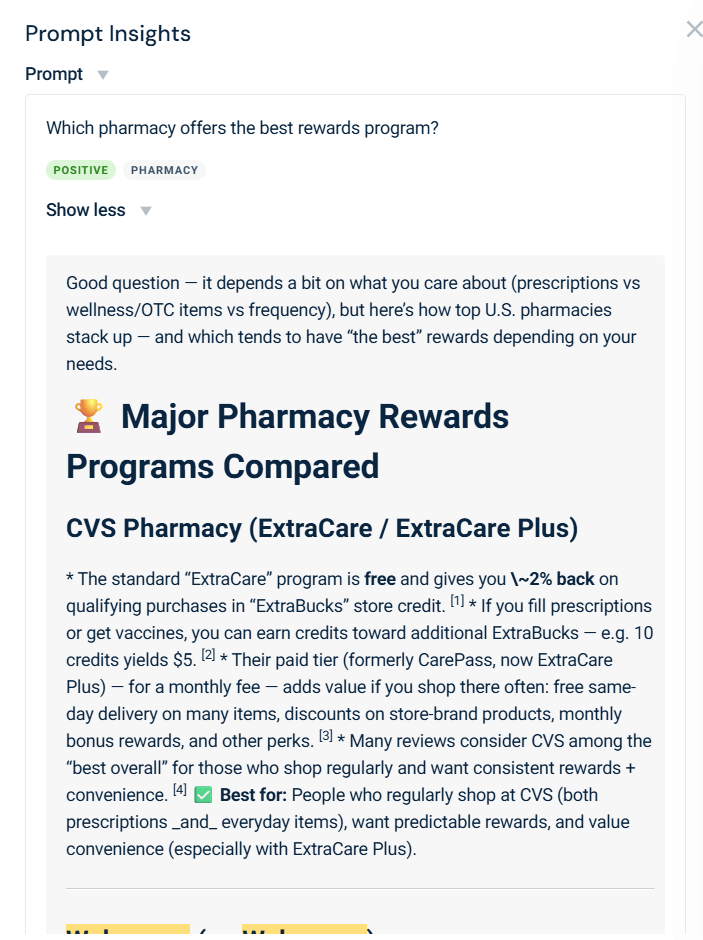
This reveals exactly how the AI describes your brand and provides context for the sentiment classification.
You can see where and how you’re mentioned inside the prompt response, in what context, and which sources are used to back the answer up. In cases you’re not mentioned, you can check how your competitors are mentioned and take actions to “demote” them.
Main benefits of performing prompt analysis:
Analyzing prompts shows you the language and questions real users ask AI, which often differ from traditional search queries.
By seeing where you’re mentioned (or missed), you can create content that answers those questions better and fills citation gaps. It also helps you anticipate follow‑up questions, which is one of the key practices recommended for GEO optimization.
Step 3: Analyze and track citations
Gen AI engines cite sources to justify their answers. Understanding which domains influence answers in your category helps you decide where to invest in content partnerships or outreach.
The Citation Analysis tool breaks down citations in responses mentioning your brand vs. non‑brand responses and visualizes top domains.
1. Interpret high‑level metrics.
For Walgreens, the report shows a Domain Influence of 4%, meaning Walgreens.com accounts for 4% of answers across its topics. In comparison, 9% of citations appear in answers mentioning Walgreens and 91% appear in answers that do not.
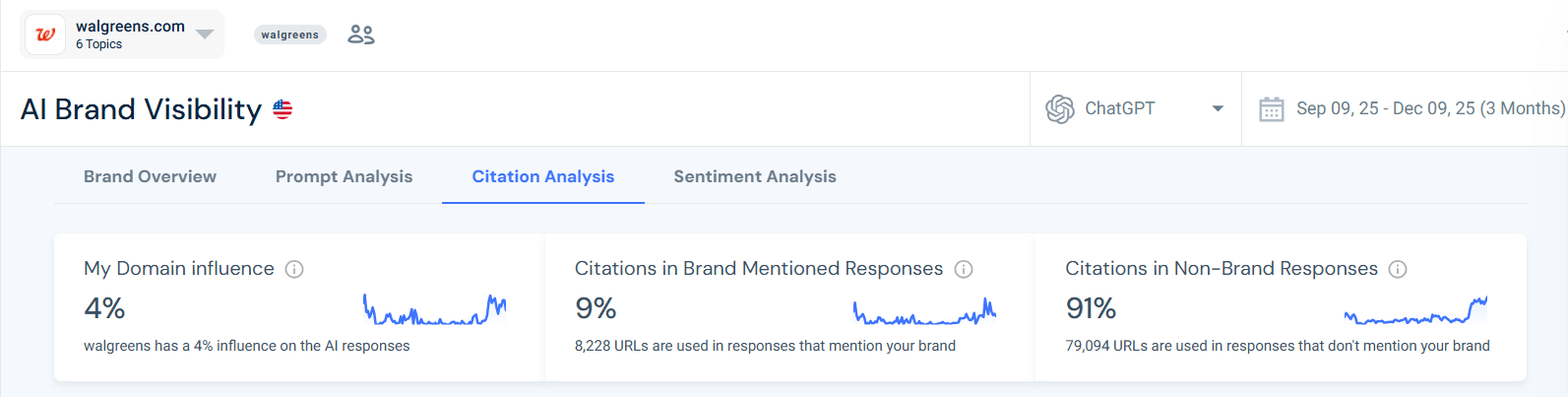
A low influence score suggests your domain is under‑represented as a trusted source.
2. Inspect top domains.
The treemap of Top Domains reveals which sites are most frequently cited. In this example, you can see that healthline.com, locations.vitaminshoppe.com, target.com, pubmed, walmart.com, sofiahealth.com, and reddit.com are cited most often.
Many of these are reputable health publishers or large retailers, so this makes sense. These are authoritative domains with strong influence.
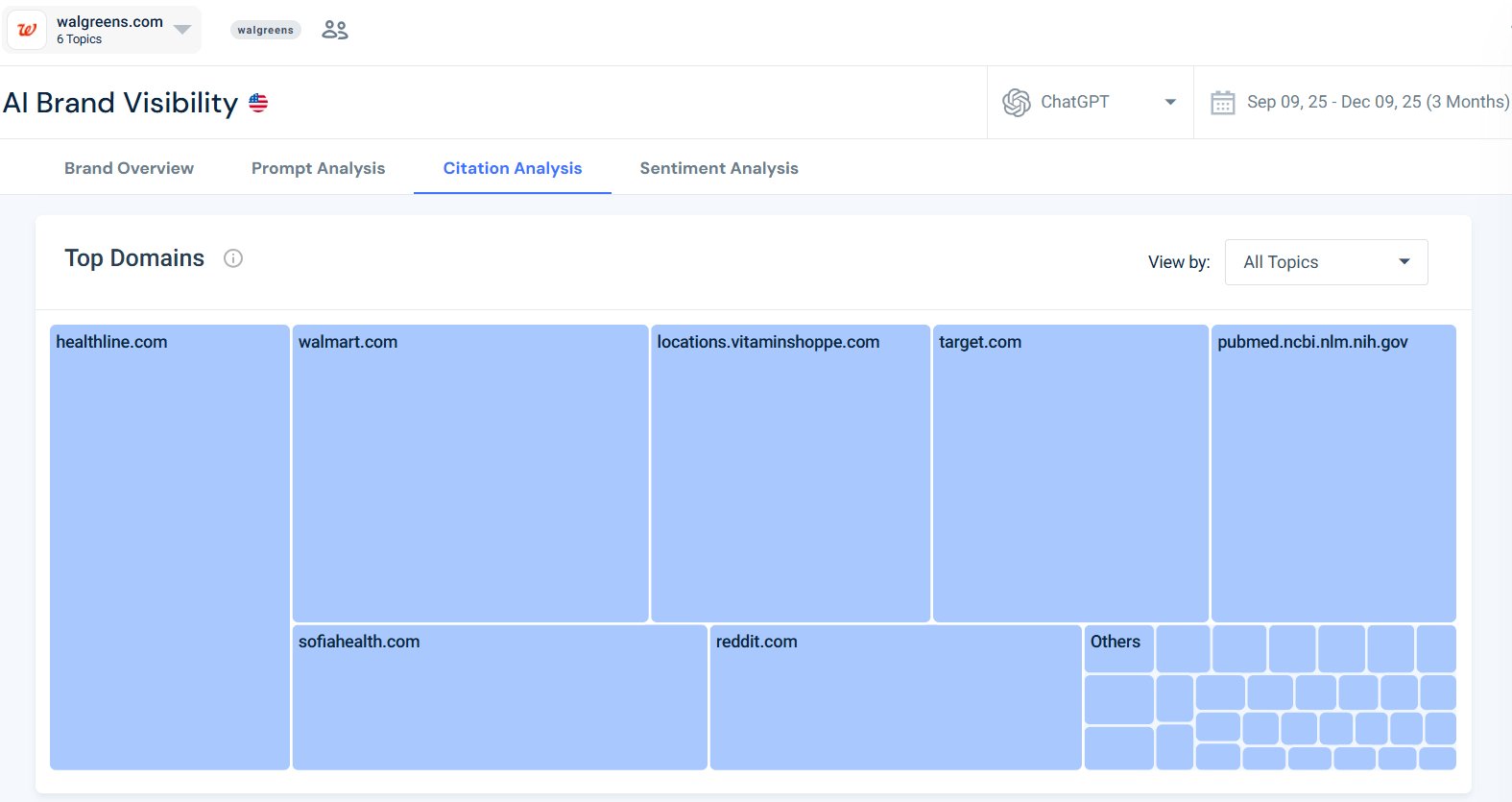
According to Search Engine Land, generative models rely on credible, recent, and well‑structured content across news, forums, product documentation, and reviews. This means that being cited by high‑authority domains increases your chances of appearing in AI answers.
This is where the importance of using your owned and shared/rented brand assets becomes clear: there’s only so much you can cover and get cited for with owned assets.
Check any domain to see its individual influence score on generative AI engines. The higher the score, the greater the source’s influence on AI answers. The most influential sources would be the ones you’d like to optimize (get mentioned and cited by) first.
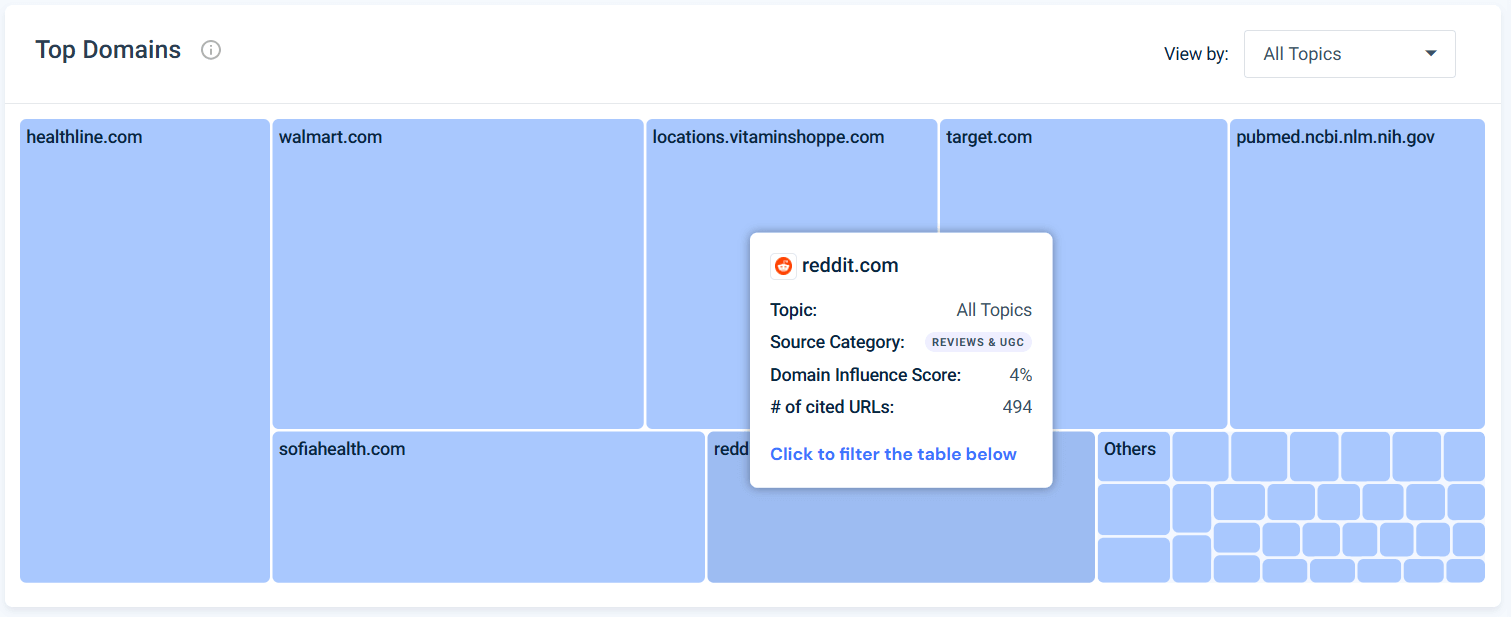
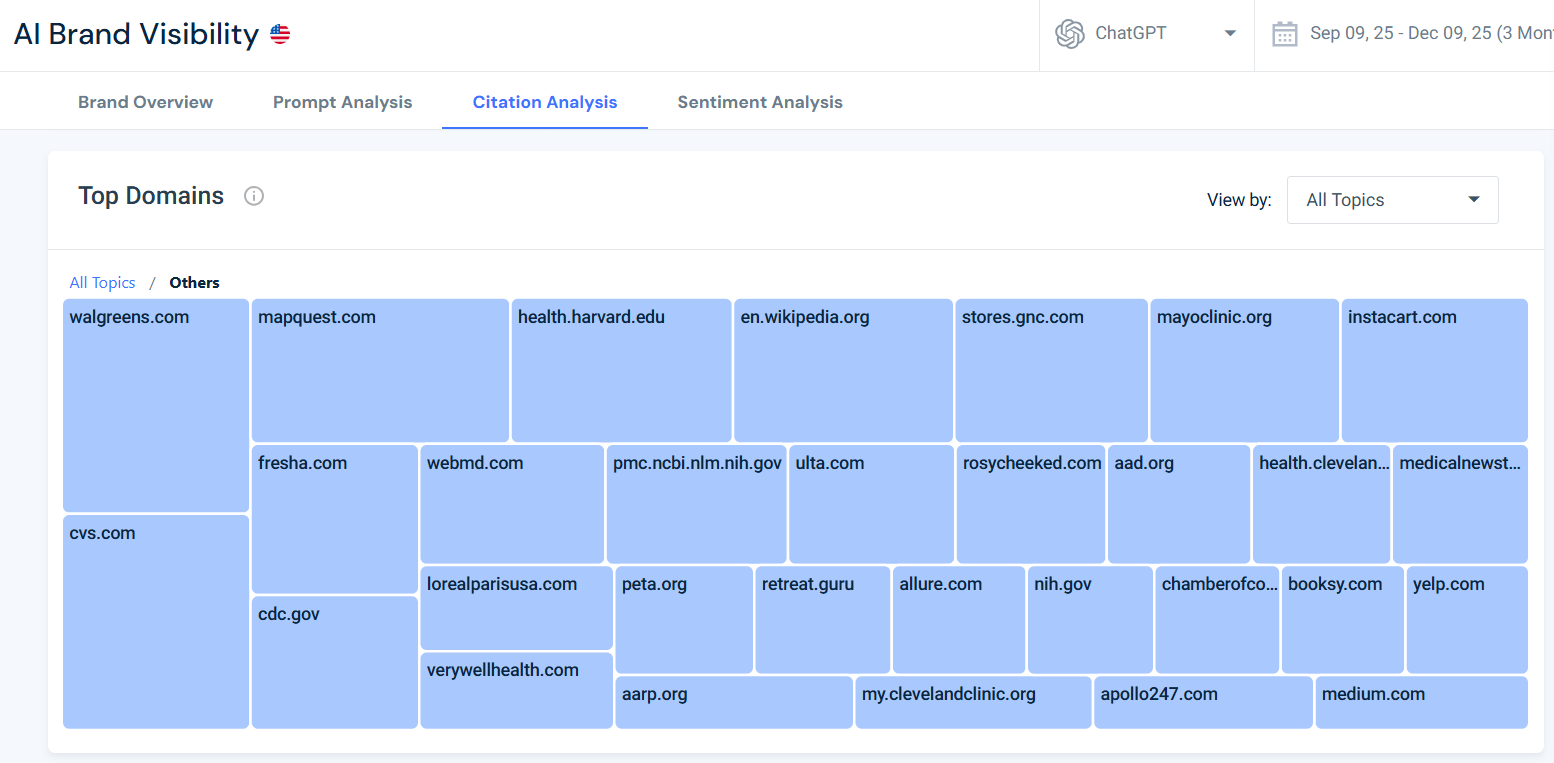
When you’re done with the top sources, you can drill down into the “others” section, where you’ll find the less influential cited sources.
Double-click on the “others” section to expand smaller cited domains.
The websites listed here may be smaller, but they still influence AI engines and should be treated as opportunities to increase visibility (and they’re still cited where you might not be). Analyze and add those to your roadmap as well.
3. Analyze individual URLs.
Scroll down to the Cited URLs table to see specific pages along with their influence score, source category, and number of prompts.
For example, Harvard Health’s article on getting your prescriptions refilled appears in pharmacy‑related answers, while L’Oréal Paris’ skincare guide influences beauty topics (0.4% influence score).
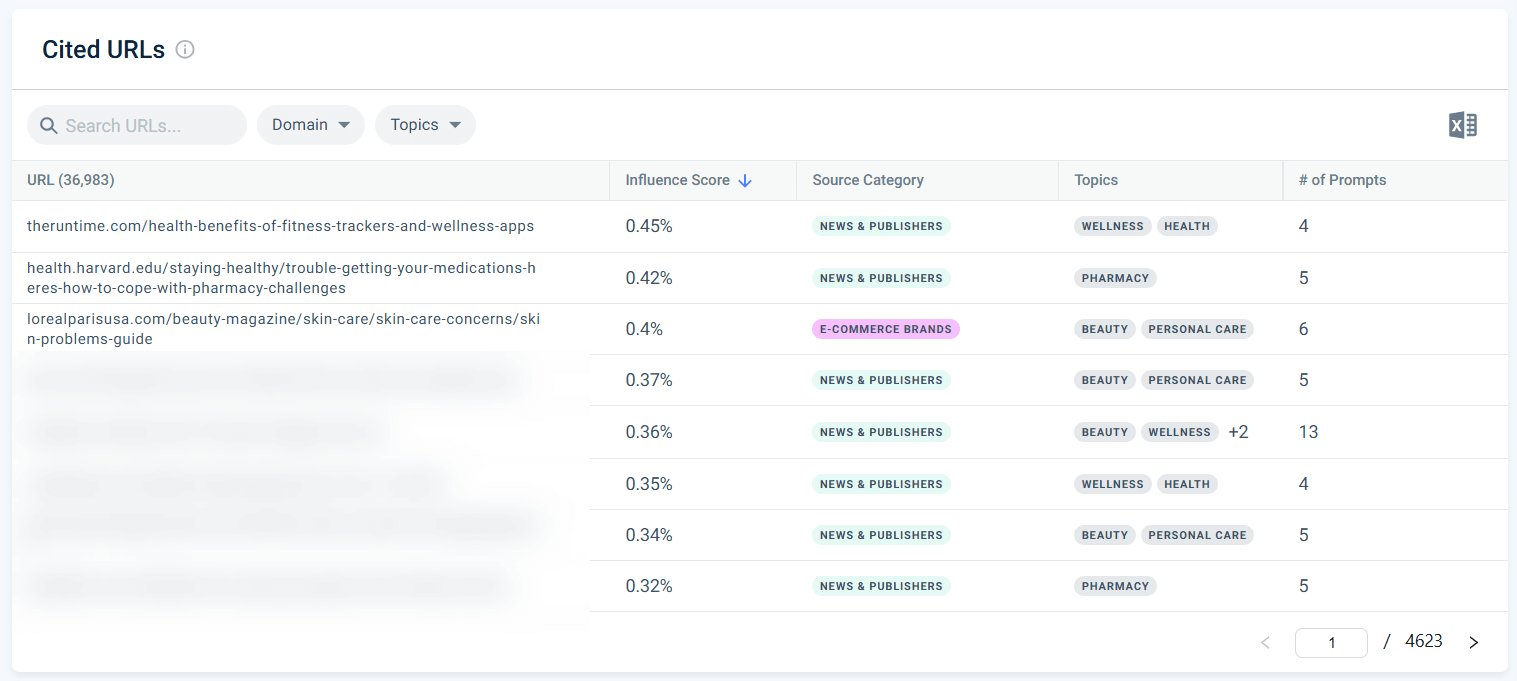
Use these insights to drive your outreach and content development priorities. For example, you can partner with health publishers or ensure your own product pages offer structured Q&A sections.
Main benefits of performing citation analysis:
Performing AI citation analysis lets you see beyond your own site. It highlights the external sources AI trusts for your topics, allowing you to build relationships or create content aligned with those standards.
It also reveals whether your domain’s content is structured in a way that AI can extract snippets.
Generative AI engines prefer “content chunks” that are self‑contained, fact‑dense, and structured. Optimizing your pages accordingly improves citation potential.
Step 4: Analyze and monitor sentiment
Knowing whether AI talks about your brand positively, neutrally, or negatively helps you prioritize messaging and customer‑experience improvements. The Sentiment Analysis tool summarizes sentiment across all mentions and by topic.
1. Assess overall sentiment.
In our example, 16% of Walgreens mentions were positive, 83% neutral, and 0.43% negative.
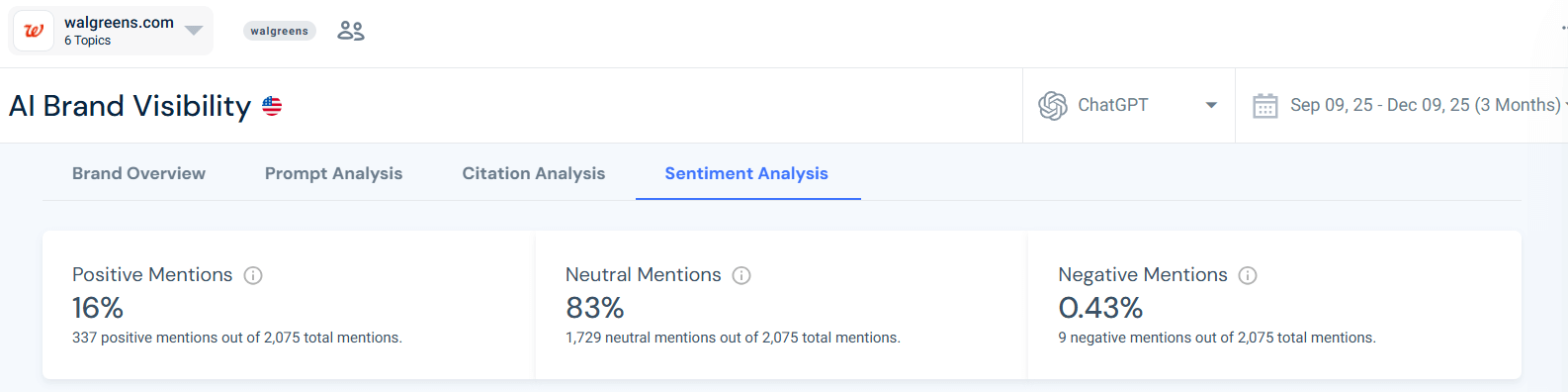
Neutral sentiment suggests that users ask factual questions (e.g., store hours, prescription transfers) without strong opinions.
Negative mentions often relate to fees or confusing policies, as noted in our AI Sentiment Analysis guide.
2. Drill down by topic.
The way your audience feels about you vs. your competitors can vary by topic. On some topics, your brand may enjoy very positive sentiment, while in others, you might be seen negatively.
It’s important to understand how your audience’s sentiment on each topic can influence your overall visibility and the context in which you appear.
Let’s go back to our example: The bar chart shows the sentiment breakdown for each topic. The differences in sentiment are already evident.
For Walgreens, “Pharmacy” had a mix of neutral (70%) and positive (29%) sentiment, while “Health,” “Vitamins”, and “Wellness” were almost entirely neutral. “Pharmacy” is also the only topic in which Walgreens has negative sentiment.
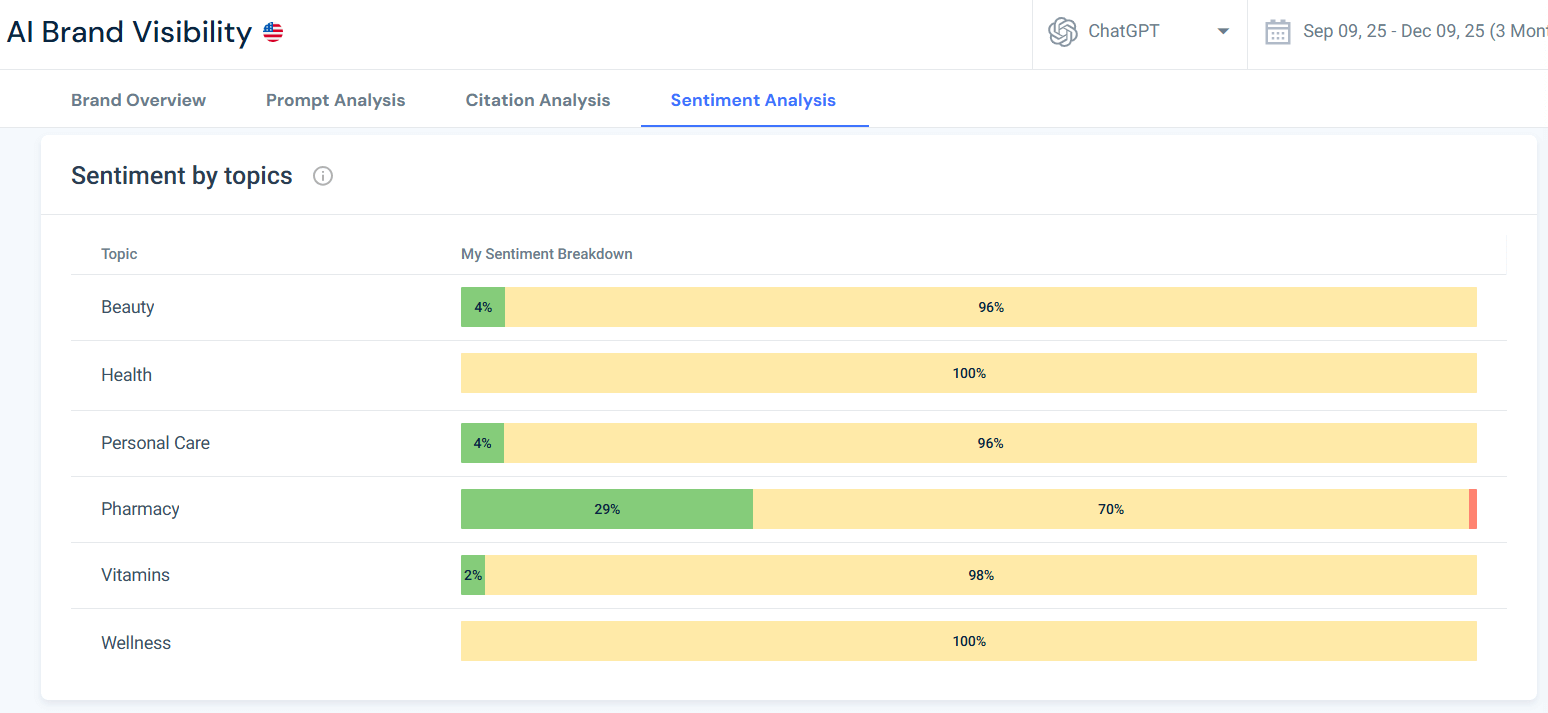
When drilling down into the “Pharmacy” topic, Walgreens can analyze the exact prompts and answers provided and identify the root cause of the negative sentiment toward the brand.
In this example, checking a few prompts shows that customers have many doubts about pharmacies’ reliability:
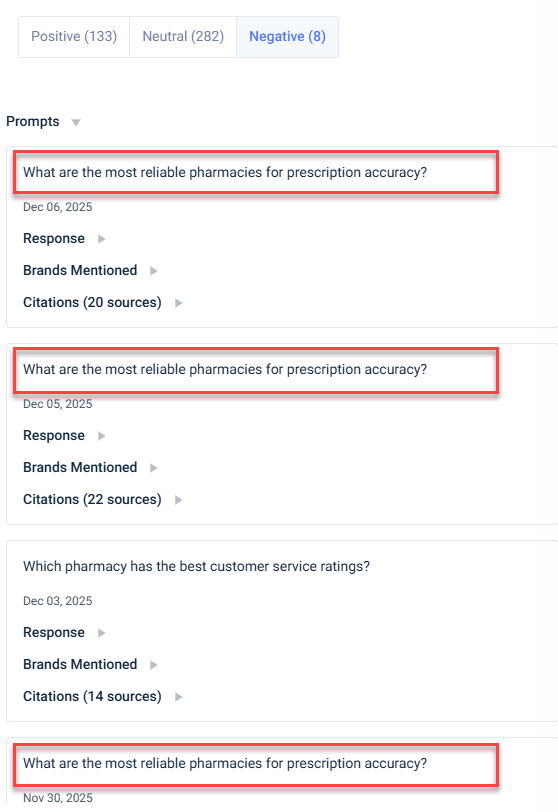
Customers are concerned about their prescriptions being filled correctly by the pharmacist. This is a pain point Walgreens should address to improve sentiment towards the brand.
To improve user sentiment scores, focus on turning neutral queries into positive experiences. In many cases, this can be done by clarifying return policies, loyalty programs, or unique selling points.
Strategies include addressing common questions, highlighting strengths, and studying competitors’ positivity to emulate what works for them.
Main benefits of performing sentiment analysis:
Performing sentiment analysis enables you to spot messaging issues and potential reputation risks.
By understanding which topics generate negative or neutral sentiment, you can create content, offers, or service improvements that shift perception. It also helps you segment outreach, for instance, by inviting satisfied customers to share experiences in forums or encouraging positive reviews.
Step 5: (Optional) Analyze AI traffic as validation
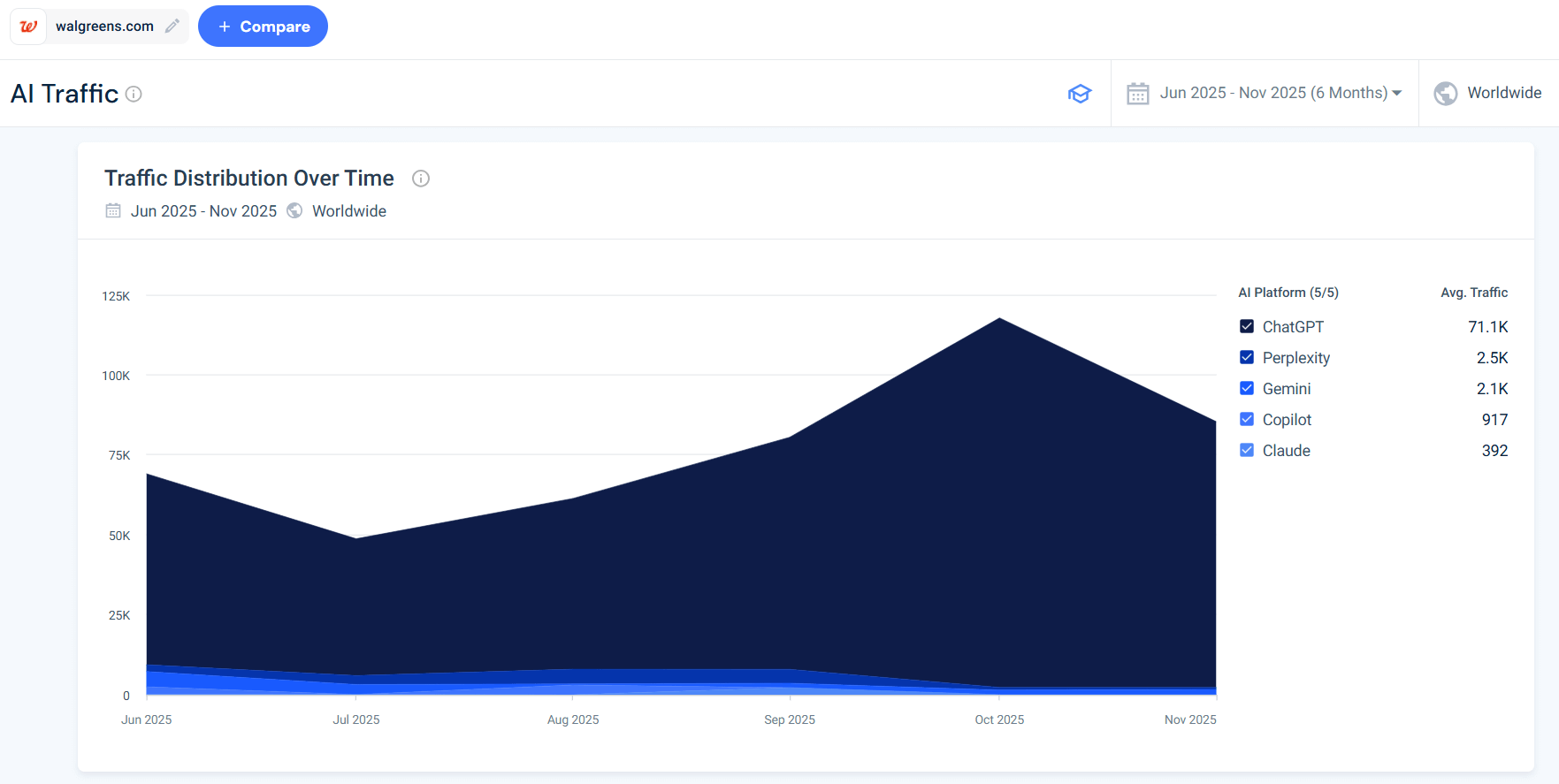
Similarweb’s AI Traffic tool tracks visits driven by AI chatbots. The process is straightforward:
- Open AI Traffic in the Gen‑AI Intelligence section.
- Enter your domain (e.g., walgreens.com) in the search bar.
- The report shows the share of chatbot traffic, a comparison with traditional web traffic, domain distribution (e.g., ChatGPT vs. Perplexity), and examples of prompts that drove visits.
- Use this insight to measure the real downstream impact of AI visibility and to prioritize prompt‑driven content creation.
Main benefits of tracking AI traffic:
- Tracking AI traffic helps you tie visibility and brand mentions to actual site visits and conversions, and also perform competitive AI traffic analysis periodically to benchmark your AI traffic vs. competitors.
- It clarifies whether optimizations yield measurable results beyond visibility alone.
- It also gives you the ability to identify new, potentially lucrative traffic sources beyond ChatGPT that produce valuable, converting traffic.
Step 6: Evaluate & plan
The final stage of the DEEP framework is about turning insights into action.
A structured plan ensures that insights translate into measurable actions.
By aligning topics, citations, and sentiment improvements with business goals, you allocate resources effectively and build a sustainable advantage in AI search.
Here’s how to create an SEO/AEO/GEO roadmap to increase your brand visibility:
1. Benchmark your metrics.
Compare your brand visibility, domain influence, and sentiment with key competitors. In our example, the Brand Overview shows competitors like CVS Pharmacy and Costco dominating specific topics.
Measuring the most relevant topic for your brand and determining realistic targets for share of voice and domain influence based on these benchmarks is the first step of building your roadmap.
2. Prioritize topics and queries.
Focus on high‑intent prompts where your brand is absent or sentiment is negative. Use the Prompt Analysis tool to list these queries and craft new content or structured FAQs that directly address them.
3. Strengthen citations through your ecosystem.
Generative search visibility depends on signals from earned, shared/rented, and owned media. Muck Rack explains that AI engines draw from billions of data points across news articles, blogs, LinkedIn posts, forums, and customer reviews.
Invest in authoritative earned media (e.g., thought leadership articles or research studies) and ensure your owned content is structured with schema markup, Q&A sections, and clear headings.
4. Improve off‑page authority.
Build partnerships with reputable health publishers, retailers, and review sites. Encourage satisfied customers to leave reviews on trusted platforms.
Similarweb’s Gen AI Landscape 2025 report shows that up to 61% of AI citations come from earned media, showing that PR and UGC & Reviews efforts have a significant impact on AI visibility.
When looking at AI Mode, it’s apparent how social media & UGC sites carry much more weight on citations than in ChatGPT, while business services websites (usually brands) have much lower visibility.
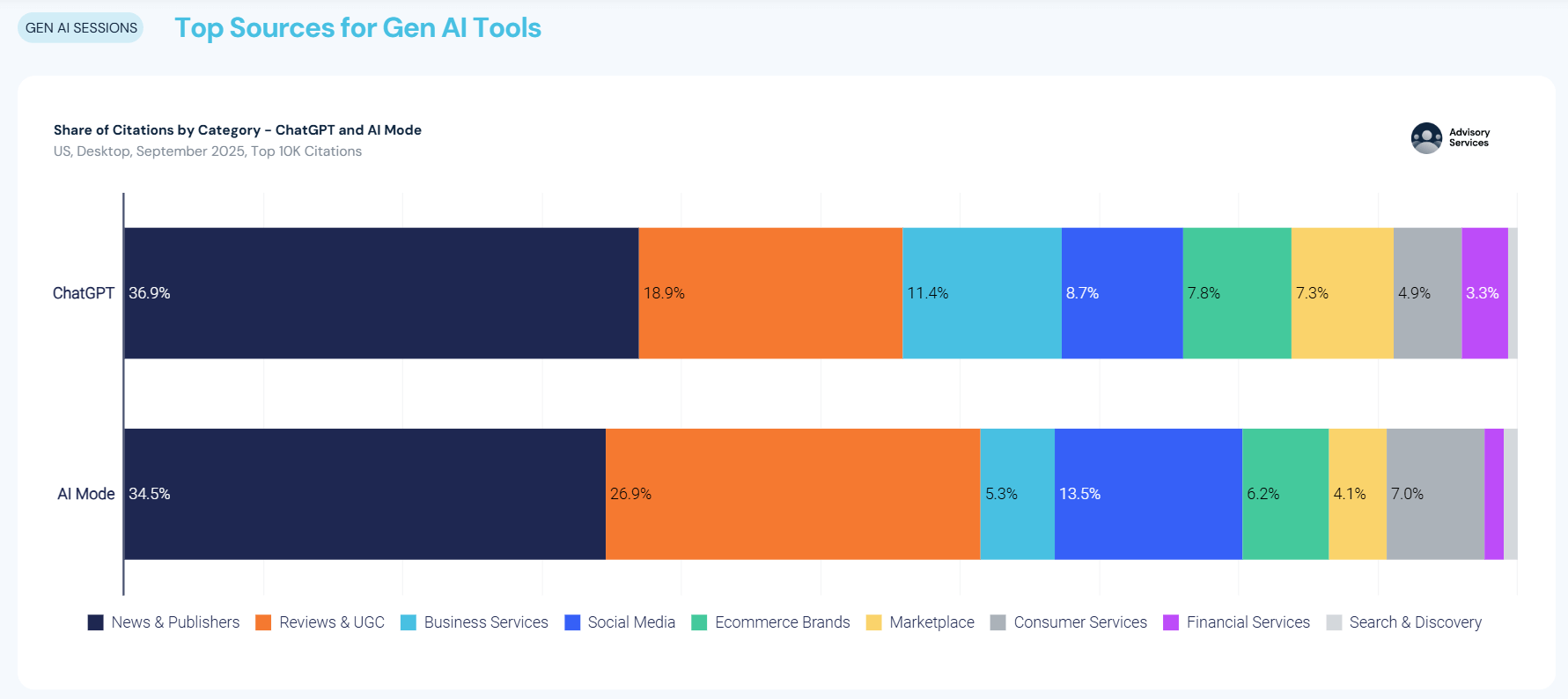
With this type of landscape, it becomes essential to collect as many positive signals as you can from these website categories.
Many of these signals can be collected from existing brand assets (owned/rented), such as social media profiles.
5. Iterate and monitor.
AI models evolve quickly. Revisit your reports monthly, track improvements in visibility and sentiment, and adjust your strategy accordingly.
Don’t lose sight of your traditional SEO metrics. Add the new, softer AEO/GEO metrics (domain influence, citation frequency, and intent coverage) to evaluate progress.
Template for tracking AI visibility
Use the following template as a repeatable workflow for analyzing your brand’s presence in generative AI engines. The table summarizes each step, the required data, and the purpose.
| Step | Data to gather | What you learn / action |
| Define | Brand name, competitors, topics, date range | Sets scope and ensures consistency; reveals baseline visibility and share of voice. |
| Explore prompts | Prompt list, visibility score, sentiment per prompt | Shows which questions include or exclude your brand, competitor dominance, and language used. |
| Analyze citations | Domain influence, top domains, cited URLs | Identifies trusted sources influencing AI answers, highlights outreach opportunities, and content gaps. |
| Analyze sentiment | Positive, neutral, negative mentions by topic | Pinpoints messaging strengths and weaknesses, guides improvements to customer experience and communications. |
| Analyze AI traffic | AI‑driven visit counts by chatbot and prompt (optional) | Connects visibility to actual visits and conversions, helps prioritize prompt‑driven content. |
| Evaluate & plan | Benchmarks vs. competitors, topic priority, mention opportunities | Translates findings into an action plan, focusing on high‑impact prompts and trust‑building activities. |
Conclusion
Generative AI has changed the rules of search. It rewrites queries, routes them through multiple sources, and surfaces answers that blend information from across the web.
Traditional SEO is still irreplaceable, but the GEO (generative engine optimization) “addon” requires additional steps like understanding how AI sees your brand, which prompts drive visibility, and which sources it trusts.
Similarweb’s Gen‑AI Intelligence suite provides a unified dashboard to track all these elements. By applying the DEEP framework, you can define your goals, explore real user prompts, analyze citations, measure sentiment, connect visibility to traffic, and develop a plan to close gaps.
Invest in improving your owned assets, optimize your shared/rented assets, and invest in credible earned media to reinforce messages across channels and structure your content for easy extraction.
With regular monitoring and iteration, you’ll not only know how AI perceives your brand today, but also shape how it recommends you tomorrow.
FAQ
What is AI visibility?
AI visibility refers to how often and in what context your brand appears in responses generated by AI engines and Google AI Overviews. It includes both mentions of your brand name and citations of your content or third‑party sources referencing you.
Unlike traditional search rankings, AI visibility focuses on presence within generated answers rather than positions on search results pages.
Why is tracking AI visibility important if I already track SEO rankings?
SEO rankings measure your performance in traditional search results, but generative AI answers can appear above those results, reducing click‑through rates. Google Search Console currently merges AI Overview impressions with organic ones, creating blind spots.
Tracking AI visibility helps you understand whether your brand is being surfaced or cited by AI systems, which can influence brand awareness and trust, even when users don’t click through to your site.
How often should I review AI visibility reports?
AI models and prompt volumes evolve quickly. I recommend reviewing your AI Brand Visibility, Prompt Analysis, and Citation Analysis reports monthly. For campaigns with rapid changes or major launches, weekly checks may be appropriate..
What if my domain has low citation influence?
A low influence score means generative AI engines rarely cite your pages. Focus on improving the structure and authority of your content by adding clear headers, schema markup, and Q&A sections. Publish authoritative resources like research studies or how‑to guides, and build high‑quality backlinks from reputable publishers. Over time, these efforts increase the likelihood that AI engines will consider your domain a trustworthy source.

Related Posts



Why AI Engines Cite UGC Over Brand Content And How To Leverage It For AEO

AI Mentions vs. AI Citations: What’s the Difference and Why It Matters for GEO


Wondering what Similarweb can do for your business?
Give it a try or talk to our insights team — don’t worry, it’s free!