


 Marketing Intelligence
Claude vs. ChatGPT: Which AI Model Is Right for You?

AI is everywhere, and if you’ve spent any time exploring the space, you’ve probably heard two names more than most: Claude and ChatGPT.
But what exactly sets them apart?
Let’s dig into the main differences (and surprising overlaps) between Claude and ChatGPT. If you’re wondering what Claude can do that ChatGPT can’t—or vice versa—we’ve got you covered.
Here’s what you’ll learn:
- How each tool works behind the scenes
- What makes them unique for creative tasks, coding, or day-to-day productivity
- Which model might be a better fit based on pricing, capabilities, and use cases
This post is for anyone curious about how these AI platforms stack up, whether you’re a tech pro, an early adopter, or just looking for the right tool to get things done.
We’ll discuss everything from company origins and model architecture to language support and pricing. By the end, you’ll have a clear picture of what each AI offers—and which matches best with what you need.
What’s the difference between Claude and ChatGPT
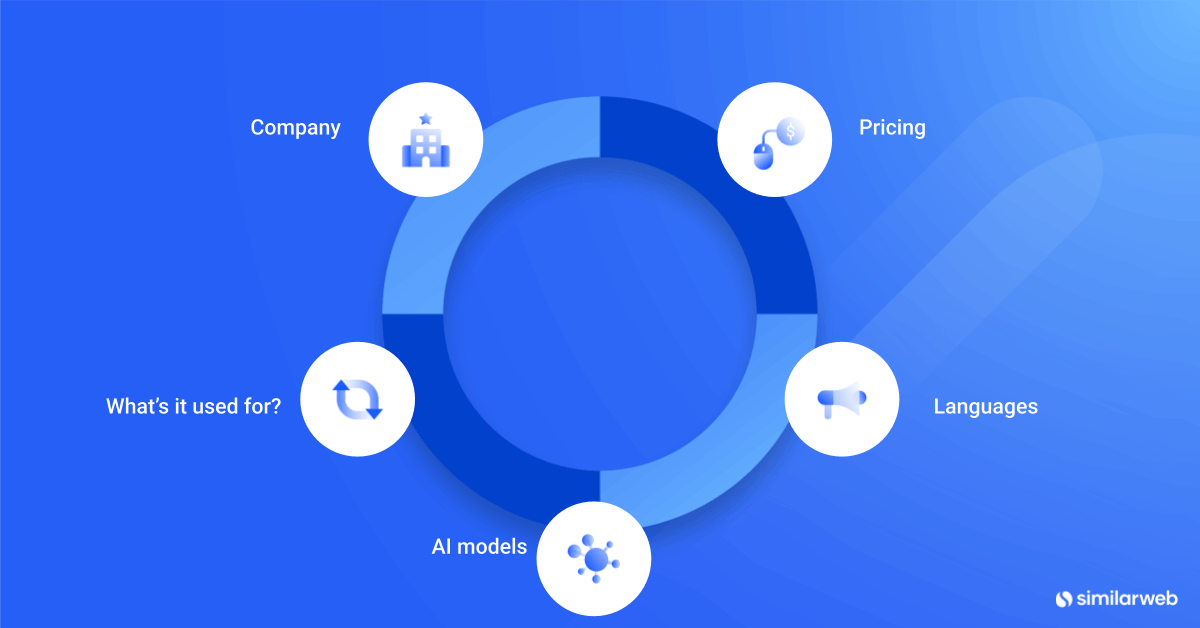
If you’re trying to decide between Claude and ChatGPT, you’ll want to look past the surface-level chatter. We will compare the companies behind them, how each is used, their model architecture, pricing plans, and language capabilities.
Claude
Company
Claude is built by Anthropic, a company founded by former OpenAI execs with one big focus: AI safety. From day one, they’ve prioritized building AI systems that are powerful, but also trustworthy. That shows in everything Claude does.
Their process to AI ethics is baked into the DNA. While ChatGPT evolved rapidly to serve broader consumer and enterprise needs, Anthropic carved a more cautious, deliberate path. For anyone asking “what’s the real difference between Claude and ChatGPT?”—this ethos is a major piece of the puzzle.
If you need a model that’s dependable, thoughtfully designed, and built to handle high-stakes use cases without going rogue, Claude’s your pick.
What’s it used for?
Think long-form content, complex summaries, technical analysis, or anything that demands coherence across lots (and lots) of text. With a context window stretching up to 200,000 tokens, it’s built for researchers (it still can’t replace a dedicated market research tool), legal analysts, and content pros who need consistency and depth over long spans.
Many users will tell you Claude handles things better than ChatGPT, especially when sticking with the thread in dense, structured documents. It also excels in creative ideation, editing, and detailed analysis, where context and tone must carry across thousands of words without dropping the thread.
What’s the difference between ChatGPT and Claude AI in real-world use? Well, Claude doesn’t just write. It reasons through complexity and holds onto it like a pro.
AI models
Claude is a suite of models. Here’s what’s under the hood:
- Claude 3.7 Sonnet: The heavyweight. This is Anthropic’s most advanced model to date. It comes with a hybrid reasoning mode and an optional “extended thinking” feature that unlocks longer, more intricate outputs. Ideal for deep contextual work or creative challenges that need more than just surface-level smarts.
- Claude 3.5 Sonnet: Two flavors here—v1 and v2. Both versions strike a sweet spot between intelligence and versatility, handling creative and technical tasks without missing a beat.
- Claude 3.5 Haiku: Speed is the game. This is the model to reach for when you need a response now. It’s optimized for low latency and handles text and image inputs like a pro.
- Claude 3 Opus: Think depth and fluency. Opus is tuned for high-complexity tasks and excels when nuance and context matter most.
- Claude 3 Haiku: This model delivers near-instant responses for ultra-fast, lightweight interactions. It’s quick, agile, and ideal for fast-moving use cases.
The common thread? That massive context window. With support for up to 200,000 tokens, these models are built for detailed analysis (too bad it still cannot integrate with a competitive analysis tool) and uninterrupted workflows.
So when people talk about what makes Claude different from ChatGPT, this flexible, multi-model design—and how it handles extended content—is often where the line gets drawn.
Pricing
Claude is priced to be flexible, without nickel-and-diming you on performance.
If you’re flying solo, Claude Pro usually costs $17/month. For teams, expect to pay around $25 per user per month. Developers get access through API billing based on token usage (input and output combined).
It’s a tiered system that doesn’t overcomplicate things. Regardless if you’re a freelancer or part of a research team, the structure is clear: pay for what you need, scale as you go. Compared to ChatGPT, Claude’s pricing is competitive, especially considering its context handling and reliability.
Languages
Claude is fluent in English. Period.
Sure, it supports a few other languages, but its sweet spot is crisp, accurate English—especially in technical, formal, or structured content. That’s not by accident. Anthropic has doubled in depth over breadth, betting that quality English output beats spread-thin multilingualism.
Claude delivers if your work is in English. But this could be a limitation if you regularly work across languages. That’s where ChatGPT has the edge.
So what’s the difference between Claude and ChatGPT regarding language support? ChatGPT goes broad. Claude goes further.
ChatGPT
Company
ChatGPT is OpenAI’s headline act—and with good reason. As one of the most recognized names in AI, OpenAI has built a track record for developing high-performing language models that push boundaries across industries.
From early experiments to today’s multi-modal system, ChatGPT has steadily improved, thanks to user feedback and extensive research. When conversations turn to ChatGPT vs. Claude, OpenAI’s scale, engineering resources, and rapid iteration cycles often tip the balance.
AI tools like ChatGPT continue to evolve at a pace, with new functionality added every few weeks, from voice to vision to memory-aware prompts.
What’s it used for?
ChatGPT wears many hats. Whether you’re writing a pitch, fixing a block of code, drafting a blog post, or brainstorming social copy, the AI can handle it.
Want to generate an image from text? Plug in DALL·E. Need it to read content aloud or search the web for updated info? It does that, too. It’s the kind of tool that adapts and changes with your ambition.
For many users comparing ChatGPT and Claude, the big differentiator is just how much ChatGPT can do across writing, coding, conversation, and creative tasks.
Want to optimize SEO performance? Try AI keyword research using Similarweb tools and ChatGPT.
Clearly, this is no longer a chatbot. It has advanced into a go-to utility for day-to-day problem-solving.
AI models
ChatGPT runs on a stack of high-performance models:
- GPT-4o with scheduled tasks: Think of this one as your online assistant with a memory. You can ask it something now, then schedule a follow-up for later—and it won’t forget. It’s great for continuity and context retention.
- GPT-4.5: Need to write something from scratch? Or maybe you’re staring at a blank page waiting for inspiration to strike? This model lives on open-ended tasks. Ideal for free-form writing and brainstorming.
- o1: This is the logic-first model. Designed for multi-step reasoning, o1 is what you turn to when the problem isn’t simple—or when precision matters. Think of it as your analytical wingman.
- o3-mini: Fast, but smart. o3-mini keeps up the pace while handling logic-heavy tasks. It’s built for scenarios where you need quick and clean answers, especially when a logical structure is involved. Great for step-by-step problems when time is tight.
- o3-mini-high: Focused on code and complex logic, this model works through the gritty technical stuff. Whether it’s debugging, writing scripts, or solving intricate logic puzzles, this version delivers precise support with solid technical grounding.
- GPT-4o mini: Lightweight and nimble. This one’s all about speed without compromising too much on depth. It’s a streamlined version of GPT-4o that responds fast and handles a broad range of questions with ease. Good when you just want answers—fast.
Each upgrade brings faster response times, smarter replies, and better contextual learning. The modular setup means you can switch gears: one minute, generate long-form content, and the next, create an image or crunch data.
One feature that sets ChatGPT apart is its tight integration with Google SGE, which allows it to provide enriched search-refined responses in the browser.
We’re no longer talking about the intelligence behind the scenes here. It’s how flexible the platform is. You’re not locked into one way of working. Instead, you’ve got a toolkit that adapts to your use case.
Pricing
ChatGPT’s pricing model hits a sweet spot between accessibility and power.
For $20/month, ChatGPT Plus gets you priority access and GPT-4 level performance. Need more horsepower? ChatGPT Pro and Enterprise tiers are available for organizations that want longer memory, bigger context windows, and full-scale API integration.
The point here is flexibility. Whether you’re a solo creator or part of a Fortune 500 team, OpenAI’s tiered pricing gives you the value you need, without paying for what you don’t. That balance of price and power is another primary distinction in the ChatGPT vs. Claude debate.
Languages
If reach matters, ChatGPT has it. They support dozens of languages—from global standards like English, Mandarin, and Spanish to regional dialects that open the door for broader use cases.
That multilingual capability makes it functional across borders, industries, and audiences. Compared to Claude, which currently supports fewer languages, ChatGPT gives users a clear edge in global communication.
If your customers, teammates, or readers aren’t all in the same linguistic bucket, ChatGPT helps keep the conversation flowing.
Claude vs. ChatGPT: Who to choose?
It comes down to what you need.
If you’re looking for long-form context retention, a deep focus on ethics, or exceptional creative writing chops, Claude makes a strong case. It’s built for users who care about precision and want help unpacking complex documents or crafting compelling narratives.
But if you’re after an all-in-one toolkit (think image generation, voice capabilities, AI overviews, and multilingual muscle), then ChatGPT is tough to beat.
Power users can even deploy AI agents within ChatGPT to automate workflows, run scripts, or complete multi-step tasks with minimal input.
It’s versatile, fast, and packed with features that support everything from quick tasks to complex workflows.
Both tools are excellent at what they do. But they’re not interchangeable.
So here’s the move: match the platform to your goals.
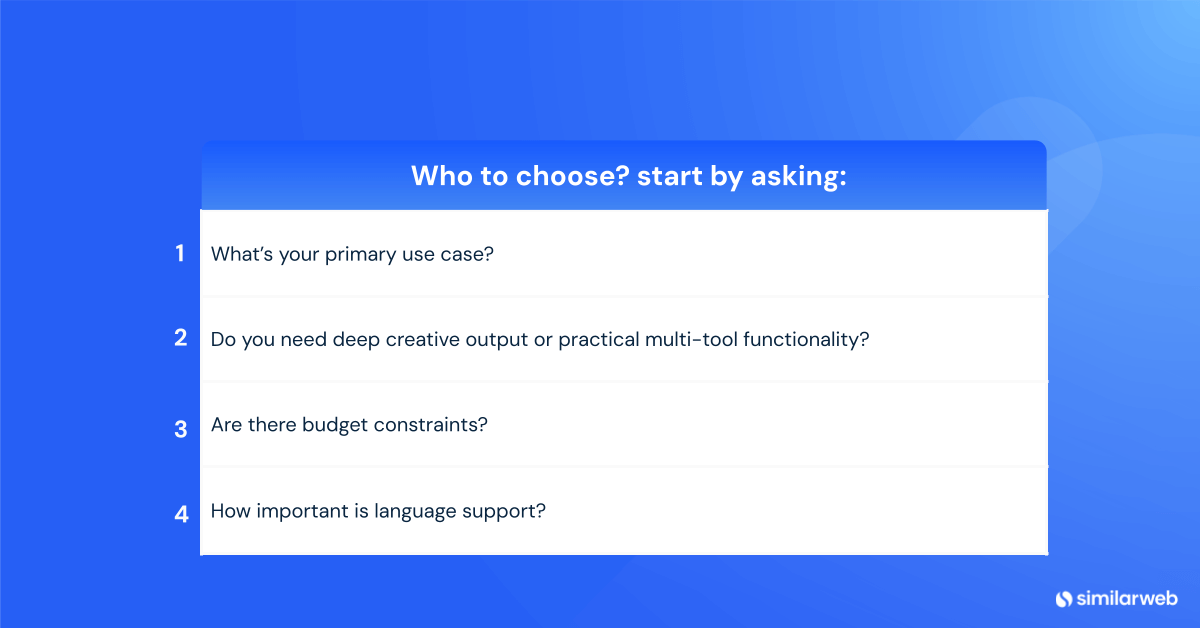
Start by asking:
- What’s your primary use case?
- Do you need deep creative output or practical multi-tool functionality?
- Are there budget constraints?
- How important is language support?
Choosing between Claude and ChatGPT is about which one is better for you.
If you’re new to these platforms, start with guided AI prompts to explore their range, whether writing content or building automation.
This comparison of ChatGPT vs. Claude is designed to help you weigh the trade-offs clearly, so you can confidently move forward and get the most out of whichever AI tool you choose.
When you can’t choose – Use Similarweb’s AI Agents
Get to know Similarweb’s new AI agents:
Whenever you need to build competitive SEO content strategies, turn digital signals into account-specific outreach, spot trend spikes, and eventually show up ready and confident for every meeting. Similarweb AI agents are your answer.
FAQs
How do Claude and ChatGPT handle long documents differently?
Claude plays the long game, literally. With an extended context window that stretches up to 200,000 tokens, it’s designed for handling heavy tasks like analyzing sprawling documents or threading together long-form narratives. ChatGPT is still powerful, but its shorter memory span means it can struggle to maintain coherence in lengthy interactions. Great for versatility, less so for marathon sessions.
What’s the difference in pricing between Claude and ChatGPT?
Claude keeps it simple and affordable: individual subscriptions start around $17/month, with team plans closer to $25 per seat. API costs scale based on token usage, making it pretty flexible. ChatGPT’s pricing follows a similar pattern with a Plus plan in the same ballpark, but also branches out into enterprise territory, offering flexible options and competitive API tiers for bigger teams or heavier usage.

Related Posts

How to Do A Competitive Analysis: Complete Guide & Free Templates

How to Build an AI Search Intelligence Dashboard for Client Presentations Using Claude and Similarweb MCP

AI Visibility Momentum: The VAMP Framework For Tracking What Visibility Scores Miss

The Dark Funnel Paradox: Why Your Best B2B Leads Are Invisible (And How to Find Them Anyway)
![GEO Framework For Growth Leaders [+Free Template]](https://www.similarweb.com/blog/wp-content/uploads/2026/02/attachment-growth-leader-geo-decision-framework-768x429.png)
Your full marketing toolkit for a winning strategy
The ultimate solution to help you build the best digital strategy