


 Marketing Intelligence
Keywords Vs Topics: The Main Differences & The Right Strategy

Let’s clear up something right away: keywords and topics aren’t interchangeable. But in SEO circles, the lines between them have blurred, and that’s created confusion.
Should you chase high-volume keywords for quick wins? Or build authority around broader topics for long-term performance?
This guide cuts through the noise. We’ll discuss the ongoing debate around keywords vs. topics in SEO, highlight what each strategy offers, and explain how to strike the right balance.
We’ll cover:
- Why keywords still matter (and how to use them smarter)
- How topic-based SEO helps build authority and depth
- When to go tactical and when to go strategic
By the end, you’ll have a clear game plan for matching content with user intent, ranking better, and growing your organic traffic the right way.
What are keywords in SEO content?
Think of keywords as your first handshake with Google.
They’re the exact words people type into search engines like ‘best running shoes for flat feet’ or ‘B2B content strategy template.’ When used well, they help connect your content with high-intent queries.
In traditional SEO, this is where most strategies started and ended: pick the keyword, write the content, and track your URL. Simple.
But here’s the thing: search engines evolved, and keywords no longer work in isolation.
Today, keywords are data points. You still need them. Search volume, competitiveness, and intent all matter, but they sit within a broader structure. You’re not just targeting ‘one keyword per page’ anymore.
For SEO specialists, the real value lies in strategic keyword placement naturally embedded in content that’s actually useful.
And while keywords help you win tactical battles (like earning a top-3 ranking for a key query), they also support your larger content strategy, if you use them intentionally.
What are topics in SEO content?
Now zoom out a bit.
Topics are the bigger picture. The themes your content is built around. Unlike keywords, topics capture the why behind the search.
If ‘content calendar template’ is the keyword, then ‘content planning’ is the topic.
Topic-driven SEO is about depth, structure, and context. It’s how you build content that answers not just one query, but all the surrounding topical queries. Think pillar pages, content clusters, internal links, semantic relevance, the whole package.
Here’s why it matters: Google is rewarding topical authority more than ever. Covering a subject in depth signals to search engines that your site is a go-to resource. That earns trust and traffic.
The trade-off? It takes longer. Building topic clusters doesn’t usually deliver overnight rankings. But it pays off with more user interaction, higher-quality traffic, and better rankings across a wider set of keywords.
So while keywords give you the entry point, topics give you staying power.
Topics vs. keywords: What’s the difference?
If you’ve ever wrestled with whether to go deep on keywords or zoom out to cover broader topics, you’re not the only one. Both have their place in a modern SEO strategy, but knowing when to lean into each can make or break your visibility.
Here’s a side-by-side comparison to help you sharpen your strategy:

1. Scope
Think of keywords as laser-focused. They’re the exact search phrases people type into Google, tight, specific, and built for precision.
And topics? They’re the umbrella. A topic covers a cluster of related keywords and gives your content breathing room to explore an idea in depth.
If keywords are slices of pie, topics are the whole dessert table.
2. SEO strategy
Keyword-first SEO often turns into a game of whack-a-mole. Optimizing for one term at a time, creating content in isolation, and hoping it sticks. The result? A patchwork of disconnected pages that may rank, but rarely lead.
Topic strategies flip the model.
They organize content around central themes. Think of them as content hubs with spokes. These interconnected clusters build a stronger web of relevance that Google can actually understand. The outcome? A clearer signal of authority and a tighter grip on the SERPs.
3. Search intent
Keywords often match a single, high-intent query. Something specific like ‘how to fix a cracked screen.’
But topics? They’re broader.
They pull in multiple layers of user curiosity, including related questions, follow-ups, and comparisons. Instead of answering one narrow query, topic-driven content addresses the entire experience. That builds trust and keeps users coming back.
4. Ranking factors
Sure, keywords still matter. Matching user queries gives you a seat at the table.
But these days, Google wants more.
Topical authority is the new game. This means you must create content that shows depth, breadth, and actual expertise on a subject. Instead of just using the right terms, your content needs to earn trust by covering all angles.
That means: less about chasing one keyword. More about owning the conversation around a topic and satisfying multiple queries in one fell swoop.
Keyword vs topics example
To make this simple, here is an example that demonstrates the difference between keyword and topical thinking.
Let’s say you’re building out content for people obsessed with Italian cooking. Here’s how you’d break things down:
Take the keyword ‘homemade penne pasta recipe.’
That slots neatly into the topic: Pasta Shapes → Short Pasta
You’re zeroing in on a very specific shape and serving a highly targeted search intent.
Then there’s ‘how to make spaghetti.’
That keyword? It fits under: Pasta Shapes → Long Pasta
Again, laser-focused, but tied to a broader content bucket.
Now, consider ‘pomodoro sauce recipe.’
That’s clearly part of: Pasta Sauces → Tomatoes
It’s about the star ingredient here: simple, classic, and unmistakably tomato-driven.
What about ‘best alfredo sauce recipe’?
That belongs to: Pasta Sauces → Cream
Totally different vibe, but same structural logic.
‘Who invented pasta?’ doesn’t live in a sauce or shape.
It goes in: Pasta History.
It’s there to satisfy those curiosity-driven searches with big-picture context.
And then there’s ‘spaghetti alla Nerano.’
This one fits under: Pasta Sauces → Olive Oil
It’s about focusing on a less mainstream, but still important, sauce base.
Each of these pairings shows how keywords = specific search intent, while topics = the structural buckets you’re organizing them into.
Use this method and you’ll create cleaner site architecture, avoid keyword cannibalization, and build a content strategy that works for both users and search engines.
Topic research vs keyword research
If you’re building out a serious content strategy, you need to know the difference between topic research and keyword research.
They may sound interchangeable, but they’re not. And how you use them could be the difference between quick wins and long-term dominance.
1. User intent
Let’s start with how people search.
Some queries signal a clear, immediate need: “pomodoro sauce recipe’ or ‘how to make spaghetti’ suggest the user wants a specific answer or actionable solution right now. These are precise, task-driven searches aimed at quick resolution.
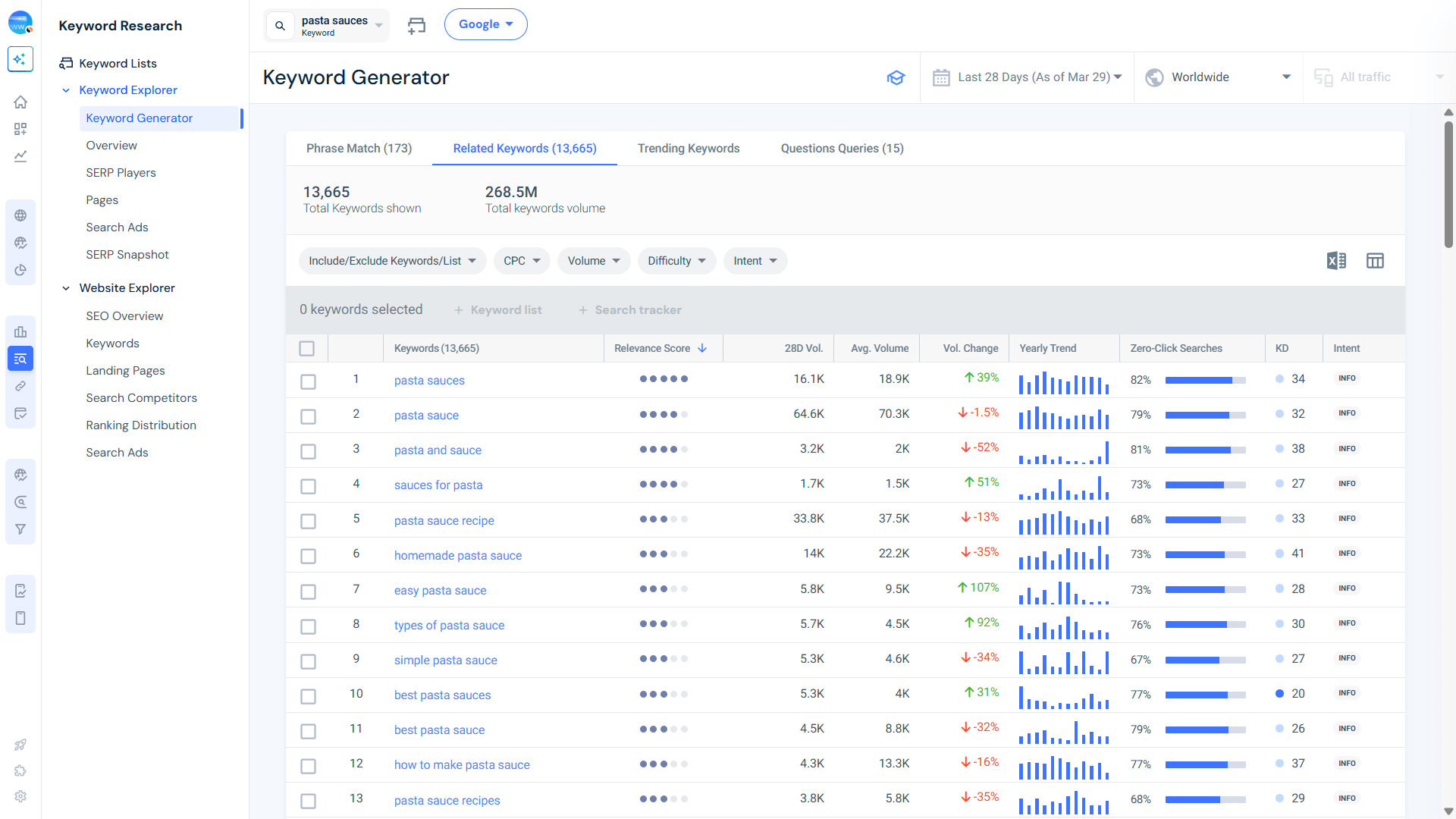
Other queries are more exploratory. A search like ‘pasta sauces’ hints at a broader intent, maybe the user wants to compare types, learn about regional variations, or get inspiration for future meals. There’s curiosity, not just a question.
This is where the difference between keywords and topics becomes important.
Keywords are tied to narrow, direct intent. Topics capture broader patterns of interest, clusters of questions, ideas, and needs that evolve as the user learns.
Think of keywords as precision tools. Topics are the blueprint guiding the whole project.
2. Short-term vs. long-term goals
Here’s the tradeoff.
Keyword research gives you fast movement. Rank for the right term, and you might see a traffic spike this week.
But if you want staying power? That’s where topic research pulls ahead.
By building content around a full topic, not just a phrase, you’re covering angles, answering follow-ups, and giving Google (and readers) a reason to stick around. It takes longer, sure, but the results compound. And over time, topic-driven content builds authority that individual keywords just can’t match.
Start focusing on topics instead of keywords with Similarweb
Still stuck optimizing for one keyword at a time? It’s time to zoom out.
Focusing on broader topics, not just individual keywords, opens up a smarter, more sustainable path to SEO success. Why? Because users are asking questions, looking for ideas, and expecting content that understands them.
That’s where Similarweb steps in. With access to in-depth keyword and topic-level insights, your content team gets a clear line of sight into what audiences care about right now. Instead of writing for an algorithm, you’re building content hubs that actually serve user intent. The result is more relevance, better visibility, and increased chances of landing in Google’s Featured Snippets and People Also Ask boxes.
In short: more real estate on the SERP. Less guesswork.
Here’s where it gets tactical. Use Similarweb’s Website Explorer Keywords report to see what topics your competitors are winning on and where you’re barely making a dent.

Just drop in your domain alongside a competitor’s, hit Opportunities, and you’ll get a breakdown of the keywords where your site is underperforming. That’s your cue to build new content, or refresh existing pages, with richer, topic-led coverage that matches what searchers are actually looking for.
Less chasing keywords. More creating answers.
So, is it a keyword or a topic?
You don’t have to choose.
Keywords bring structure and focus. Topics bring breadth and context. And today’s smartest SEO strategies combine both.
By mixing topic-first planning with keyword-level optimization, you get the best of both worlds: content that ranks and resonates. Plus, this dual method matches how Google’s Knowledge Graph and semantic search systems are evolving, which means better long-term visibility.
Want to future-proof your SEO?
Then start building with topics in mind, while still keeping those high-intent keywords in your sights. Similarweb gives you the data to do both: uncover emerging trends, monitor competitors, and craft content that hits user intent from every angle.
FAQs
How should I structure my content to meet various user queries?
Break your content into clear, digestible sections. Think big-picture themes paired with laser-focused questions. Use a mix of broad topics and precise keywords to hit multiple user intents in one go. This strategy improves organic reach and creates a smoother experience for readers.
How do semantic signals affect my content strategy?
Semantic signals help search engines connect the dots. They show how your topics and keywords relate, giving your content depth and context. Instead of just targeting individual terms, you’re building a web of relevance that improves rankings today and keeps working tomorrow.
How can I prevent content fragmentation when targeting multiple keywords?
Don’t spread your ideas too thin. Anchor your content around a single core topic, then layer in supporting keywords naturally. This keeps your pages working together instead of cannibalizing each other, and search engines reward that kind of structure.

Related Posts



Why AI Engines Cite UGC Over Brand Content And How To Leverage It For AEO

AI Mentions vs. AI Citations: What’s the Difference and Why It Matters for GEO


Track Gen-AI And Organic KPI's On The #1 SEO Platform
Give it a try or talk to our marketing team - it’s free!