






The Top 100 Most Visited Websites in the USA (August 2026)
by Shai Belinsky10 Min.
Sep 29, 2026
 Marketing Intelligence
As SEOs, we encounter many cases of website keyword cannibalization. Sometimes it’s when we get a new client’s website to audit, sometimes it’s when we start working in a new role, and sometimes it’s when someone publishes a page on a website without consulting anyone. No matter which of the above it is, though, now we have to fix it.
In this post, I’ll explain what keyword cannibalization is, why it’s bad for our SEO efforts (and increasingly for our AI search visibility), and how to identify, fix, and avoid it.
Keyword cannibalization is when two or more pages on the same website target the same keyword, splitting search engine ranking signals and AI citation signals between them instead of concentrating authority on one clear page. It’s a self-inflicted competition: your own content becomes the obstacle between your best page and the ranking (or citation) it should have.
Here’s how I think about this, and it shapes everything else in this article: SEO is about telling engines – search or AI – which pages to surface, when, and for which query. That’s the job. Left alone, Google and AI systems will make that decision for you, and that’s the real problem that cannibalization creates. Not just a lower ranking, but a decision that should be yours, getting made by an algorithm instead.
Picking the wrong winner doesn’t just cost you a ranking spot. It can cost you performance even on a page that ranks fine, because different page types are built to do different jobs.
A support or help center page and a product page might both technically satisfy the same keyword, but a support page is written to resolve doubt and answer questions, not to close a sale.
If a search engine or AI system surfaces your support page for a query that actually carries purchase intent, the click-through rate can look perfectly healthy while conversions quietly underperform, because the visitor’s intent and the page’s purpose don’t match.
I see the same mismatch when a blog post gets pulled instead of a product or pricing page, or a generic category page instead of a specific one: The traffic arrives. It just arrives on a page that was never built to handle it.
Every fix in this article comes back to that one philosophy: take the decision back. Make sure the page that gets surfaced for a given query is the one you’d choose yourself, built for that intent, not whichever one an algorithm happened to pick.
This happens unintentionally to even the biggest sites with the best SEO teams, so don’t feel too bad if you come across a cannibalization problem of your own. Luckily, identifying a cannibalism problem isn’t difficult, especially with the right keyword tools, and there are some easy ways to stop your content from eating itself up.
Keyword cannibalization means two or more pages target the same exact-match keyword. Content cannibalization is broader: pages compete for the same search intent even when they don’t share a single target keyword. Fixing only exact-match overlap misses the intent-level competition that increasingly decides which page a search engine or an AI system treats as authoritative.
Here’s how it would look in practice: Two blog posts titled “How to structure a content calendar” and “Content calendar templates for marketing teams” share almost no exact-match keyword overlap. But if both are trying to answer “how do I plan my content,” they’re competing for the same reader intent, and Google’s site diversity system, which generally limits any single domain to two listings per query, will only reward one of them with a visible slot.
| Keyword cannibalization | Content cannibalization | |
| What overlaps | The exact target keyword | The underlying search intent (keywords can differ) |
| Example | Two pages, both targeting “best cat toys” | “How to structure a content calendar” vs. “Content calendar templates for marketing teams” |
| How to catch it | Rank tracker cannibalization alerts, site: search. | Manual intent audit, mapping pages against reader questions |
| Typical fix | Run the Keep-or-Cut check: merge, redirect, noindex, or re-optimize | Consolidate around one page per intent, or clearly differentiate audience and angle |
That diversity cap is worth understanding on its own terms: Google has publicly stated it usually won’t show more than two results from the same domain for a given query, per Google SearchLiaison’s original announcement.
Keyword cannibalization fights for one of those two slots. Content cannibalization can quietly lose you the fight before you even notice you’re in it, because nothing in your keyword tracker flags an exact-match overlap.
The takeaway: audit for shared intent, not just shared keywords. If two pages would satisfy the same reader with the same answer, they’re competing, regardless of what’s in the title tag.
Here’s how to actually check, rather than guess. Two data-backed tests settle most cases:
If either test comes back overlapping, that’s your answer. If the data is ambiguous, or you’re checking a case where volume tools don’t help, like two blog posts with genuinely different phrasing, run the Same-Reader Test as a gut check. Take the two pages and ask:
If most of your answers are yes, that’s shared intent, whether or not the two pages share a single keyword. Treat it the same way you’d treat exact-match cannibalization: pick one page to own that intent and consolidate or clearly differentiate the other.
There are three main ways that keyword cannibalization can hurt your SEO.
The first way is when Google ranks an undesirable page on your site above your targeted page for a certain keyword.
Let’s say you have a website about cats. You recently published a great article with the target keyword “best cat toys”. When you check your rankings, however, you find that Google ranks an old article you wrote years ago about cat toys above this newer article. Let’s say the new one is at position #5, and the old one is at position #4.
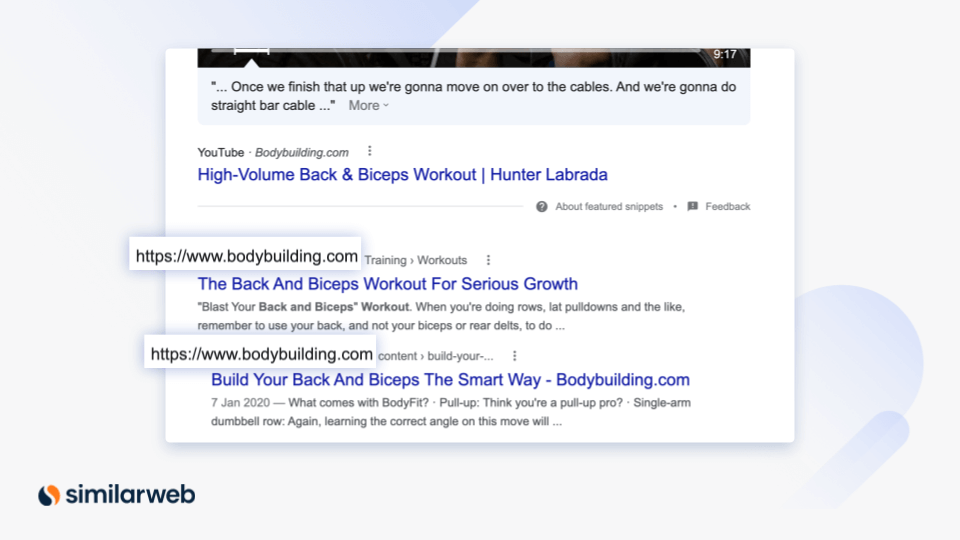
This means your older article, which contains outdated and low-quality information, is “eating up” organic traffic that you actually want directed to your new and improved article.
Why is that bad? Searchers are landing on the wrong page.
If that old article didn’t rank for “best cat toys”, then your shiny new article could take its place in the rankings, and thus, receive a whole lot more traffic.
Additionally, there may be other reasons (besides out-of-date content) why you might want one page to rank over another on your site. Perhaps one page in particular has a higher click-through rate (CTR), is better optimized for a high conversion rate, or profit margin. Sure, it would be a pity to let that page go to waste.
Let’s crawl back to our cat site example.
If we have two similar articles both competing for the “best cat toys” keyword, this also means both pages are competing for backlinks.
The number and quality of backlinks pointing to a page can affect its ranking. If you look at any page on the internet that ranks on the first page of Google, chances are it has dozens, if not hundreds or even thousands, of backlinks.
But if you have two similar pages competing with one another, these backlinks effectively get split between these two pages, hurting both their rankings in the process.
As a hypothetical example, let’s say the old cat toy article has 78 backlinks and the new cat toy article has 31. Now imagine if the combined number of referring domains all pointed to a single page. That single page, with 109 backlinks, would be pretty much guaranteed to rank higher in the SERPs.
When a site has valuable information spread across several pages, but none of them offers a complete resource on its own, this is called content dilution. The result is pages that all feel a bit incomplete and mediocre. Ultimately, these diluted pages may not attract many quality backlinks, and their search engine rankings suffer once more.
So what should you do if you’ve got multiple articles competing for the same demand?
It depends on whether that demand is actually the same, and that’s worth checking with real keyword data rather than guessing from the titles alone.
Say you have “Best Cat Toys for 2026” and “Top Cat Toys Your Kitty Will Love.” Keyword data settles this fast: “best cat toys” gets 2,483 monthly searches in the US, while “top cat toys” and “top rated cat toys” each get close to zero on their own.
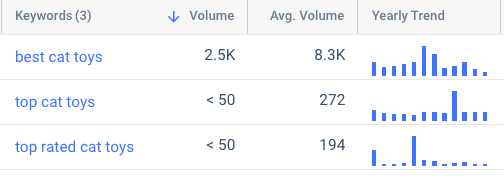
That’s not two audiences. It’s the same intent, reworded. Those two pages are cannibalizing each other and should be merged into a single page.
Now add a third article: “Interactive Cat Toys That Keep Bored Cats Busy.” That one’s different. “Interactive cat toys” carries its own 669 monthly searches with its own difficulty score, a genuinely separate pocket of demand from people specifically looking for puzzle feeders and motion-activated toys, not just any toy that happens to be good.
Folding that into the “best cat toys” page would blur its targeting rather than sharpen it.
The rule isn’t “fewer pages are always better.” It’s: check whether the demand is actually the same before you merge anything. Consolidate true duplicates and leave genuinely unique pages standing on their own.
AI Overviews and AI chatbots generally have to settle on a small number of sources to build an answer from, rather than cite every page that touches on a topic. When your own pages compete for the same query, the AI system faces the same dilemma a search engine does, and it can resolve the tie by picking neither of your pages instead of your best one.
Microsoft made this explicit in a December 2025 Bing Webmaster Blog post: AI systems group near-duplicate pages into a single cluster and select just one to represent the whole set. When the pages are similar enough, the one selected can be an outdated version rather than the one you’d have chosen. That’s a direct, named confirmation that cannibalization now carries an AI-citation cost in addition to the traditional ranking cost.
Google’s systems create a related but distinct version of the same problem through what Google calls query fan-out. Google’s own documentation on AI features in Search describes AI Overviews and AI Mode running multiple related sub-queries across a topic’s subtopics before selecting supporting sources for a response. When one of those sub-queries turns up several near-identical pages from the same domain, the system faces the same choice Bing described: pick one. Duplication itself reads as a confidence problem rather than a depth signal.
Here’s what that looks like in practice, measured rather than asserted. Similarweb’s AI Search visibility tracking of Home Depot’s product-guide pages shows the two ends of this outcome side by side on the same domain over the same ten-week window (May 5 to July 14, 2026).
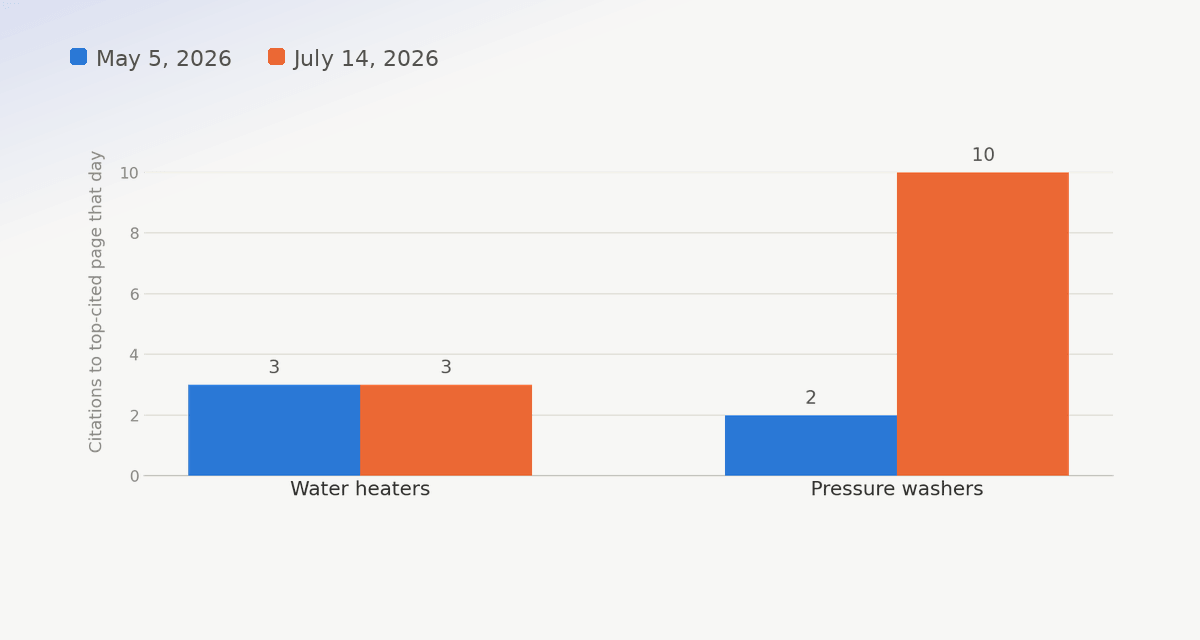
For “water heaters,” Home Depot runs at least six overlapping guides: separate installation instructions for gas, electric, and tankless-gas units, plus a buying guide, a cost page, and a flush/drain guide. Citation activity for this topic has never been consolidated.
On May 5, no single Home Depot URL was cited more than 3 times across that day’s tracked prompts; by July 14, the picture was identical, still capped at 3, spread across 10-13 different pages. According to Similarweb Search Intelligence data (June 2026), Home Depot’s own top-ranking page for “how to install a water heater” ranks 4th with a 3.0% traffic share, behind Reddit, Angi, and a single consolidated guide from Lowe’s, its direct competitor.
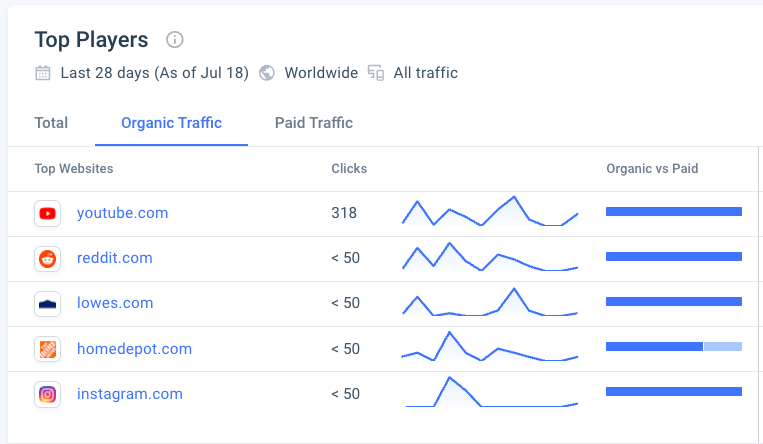
For “pressure washers,” the same tracking shows the opposite trend. On May 5, Home Depot’s citations were scattered across product SKU pages and category listings, with no URL cited more than twice. By July 14, the one-page pressure washer buying guide had pulled ahead to 10 citations that day alone, more than the rest of that topic’s Home Depot URLs combined.
Nothing else changed about how the campaign tracks these two topics. The only difference is that one set of pages was consolidated into a single authoritative source over the period, and the other wasn’t.
Now, let’s be precise about what this does and doesn’t prove:
What it doesn’t prove: that any overlap between near-identical pages is automatically a problem. The gas-vs-electric-vs-tankless split arguably reflects genuine intent differentiation. The installation steps really do differ by fuel type, just as Apple’s product, checkout, and specs pages differ by intent for “macbook pro 13 inch.”
What it does prove: that pages with no real differentiation split the citation signal. The buying guide, the cost page, and the generic services page are all answering the same underlying question, roughly “should I get this installed, and what will it cost,” with nothing distinguishing one from another. That’s the overlap actually responsible for the fragmentation shown above, not the fuel-type split.
Fixing cannibalization for AI visibility isn’t a separate workflow from fixing it for rankings. The same consolidation, canonicalization, and differentiation moves below address both. But now, the cost of skipping the fix is two-sided: You’re not just risking a ranking swap between two of your own pages, you’re risking a citation going to a competitor entirely, in a channel where there’s no “page two” to fall back to.
It’s important to regularly identify instances of keyword cannibalization across your site, as rankings are constantly changing. Here are five ways to go about it and discover cannibalism in one minute.
Similarweb’s keyword rank tracker does not only store your keywords and check their ranking every day, but it also alerts you regarding keyword cannibalization on its main screen.
This means you can simply go to the tracker to analyze and drill down on any cannibalization issues. All you have to do is scroll down in the main dashboard, and the alerts are right above your keyword list.
Clicking the “Organic cannibalization” filter, filters the term list below to show only the keywords affected by this issue. You can also view all competing pages in the URL column.
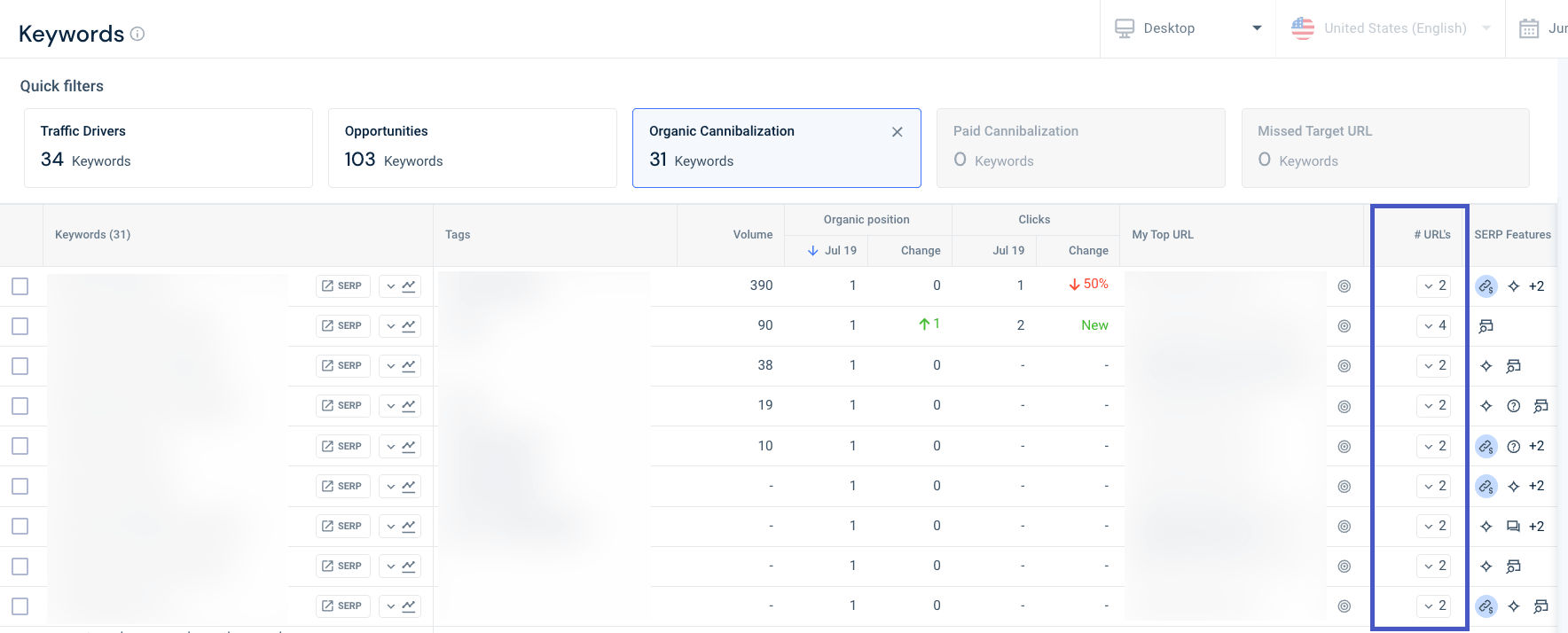
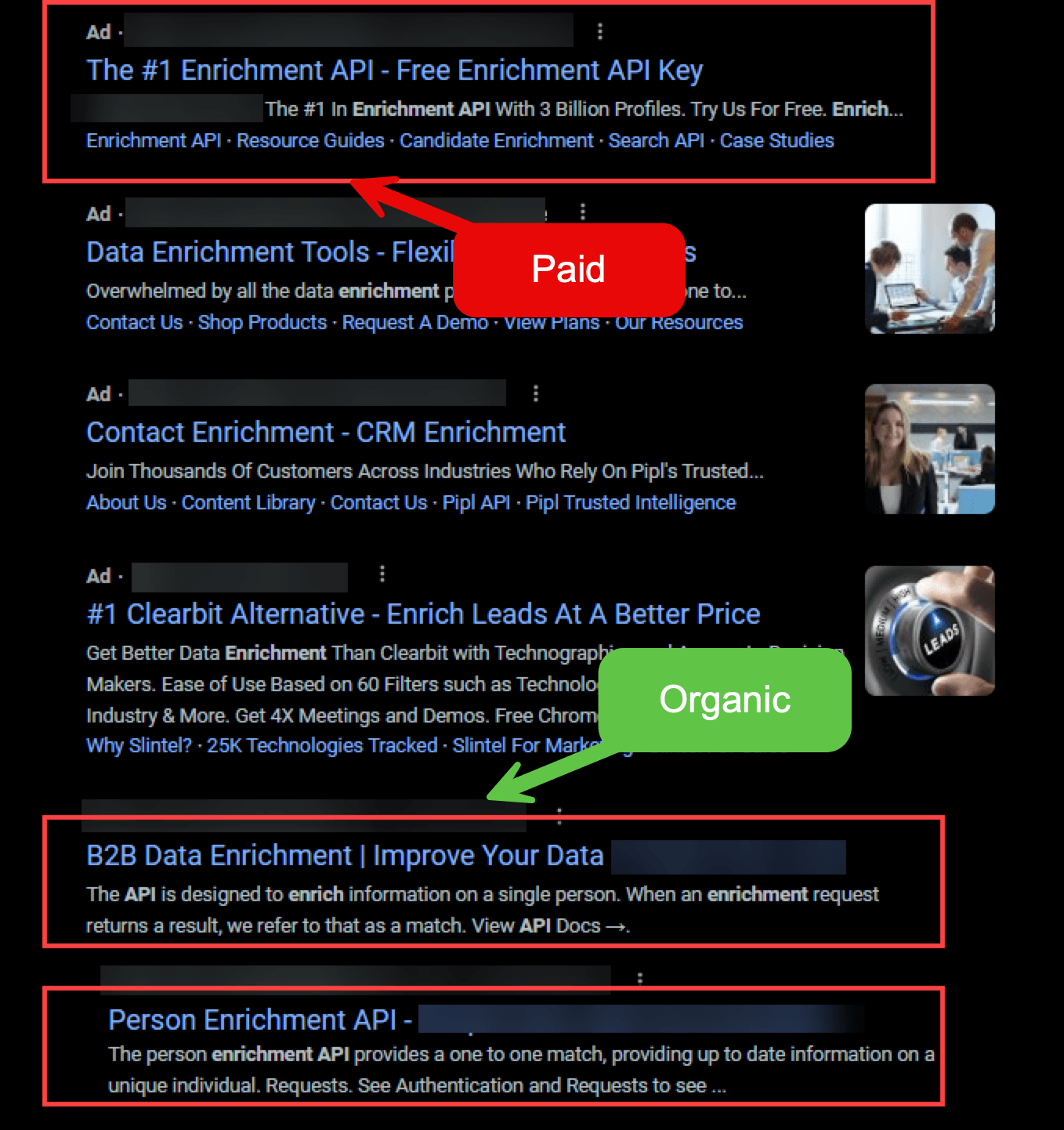
Bonus: we also show you paid cannibalization in your PPC campaigns, not just in organic SERP. Each of the terms reported for this issue can also be analyzed within the platform.
If you don’t have access to Similarweb’s tracker, or want a free supplementary view, use the Cannibalization Explorer (made by StrategiQ) by connecting your Google Search Console to Looker Studio. Once you’ve connected your data, the board will show you queries that are getting multiple pages associated with them on Google, by analyzing for how many URLs each query is getting impressions.
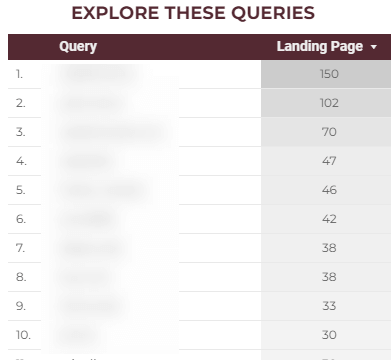
Once you reach that point, you can analyze your data more deeply using the bubble chart and page filters. Additionally, if you navigate to tabs 2 and 3, you’ll discover visual representations of your cannibalizing pages over time. This will give you another perspective to investigate your content.
If you don’t have any keyword tools at your disposal, the easiest way to check for keyword cannibalization is:
Here’s an example:
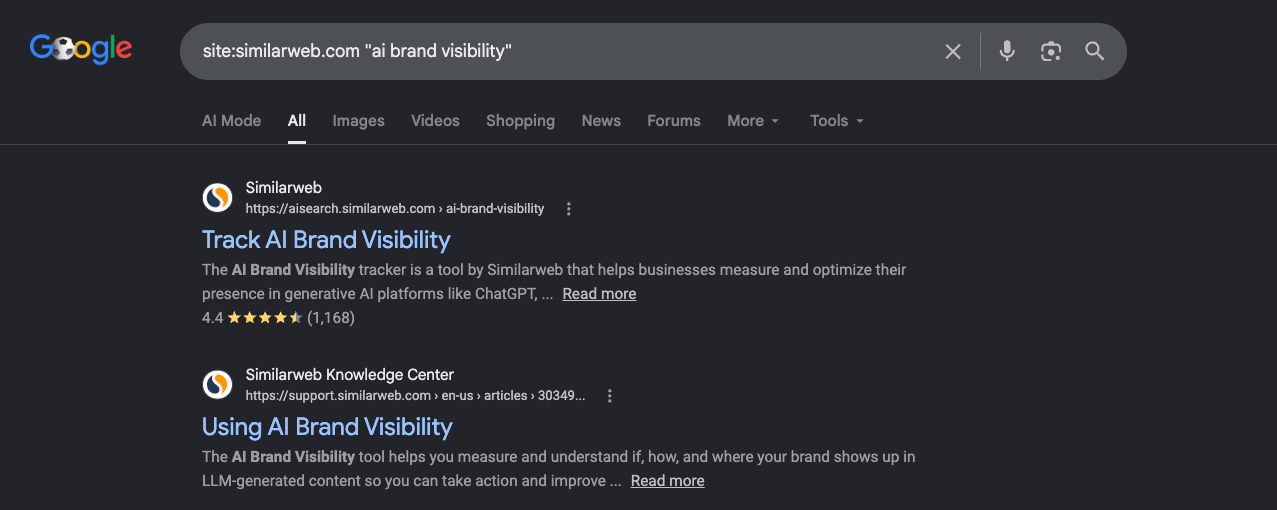
As you can see, the term “AI brand visibility” ranks for multiple pages on Similarweb. However, this is not an instance of keyword cannibalization because the correct page we want is ranking at #1.
Remember the intent check from the section above: a “site:” search only catches exact-match overlap. Run it alongside a manual scan of pages that answer the same underlying question, even with different wording, to catch content cannibalization as well.
The three methods above catch keyword-level and content-level overlap, but none of them will show you whether an AI system is splitting citations across your own pages for the same topic. Similarweb’s AI citation analysis tool will.
Pull the citation data for a topic across your tracked prompts and look at how many distinct URLs from your own domain get cited, and whether one page is pulling ahead or citations stay scattered across many.
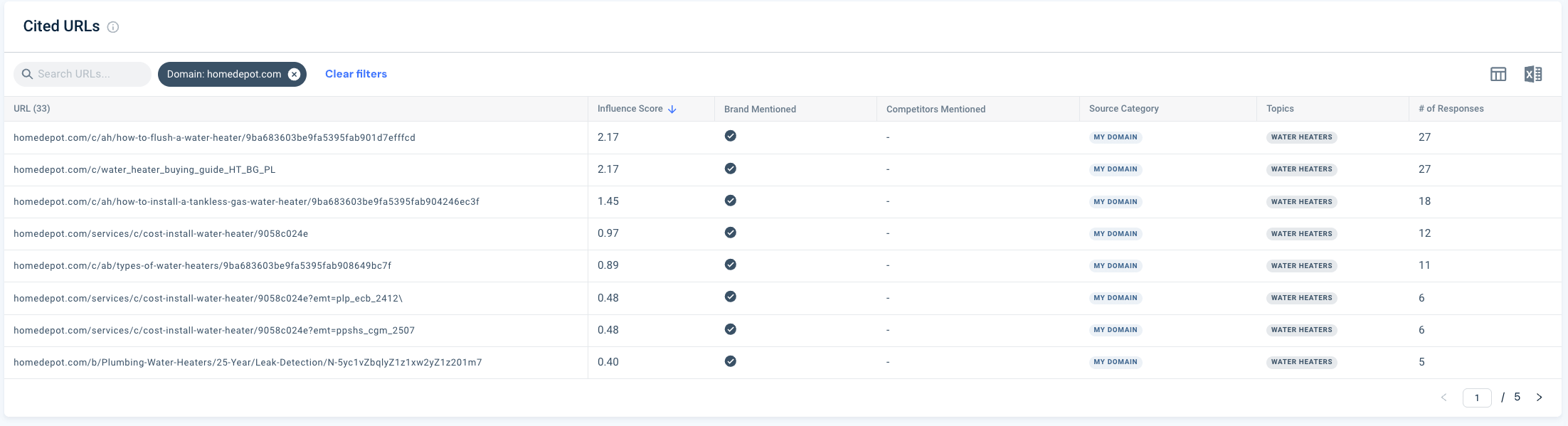
That’s the exact check that surfaced the Home Depot pattern earlier in this article: one topic where a single buying guide pulled from 2 to 10 citations over ten weeks, and another where citations stayed capped at 3, spread across 10 to 13 different pages, with no page ever pulling ahead.
If your own domain’s citation pattern for a topic looks like the second case, that’s AI-citation cannibalization, and it’s invisible to a rank tracker or a site: search.
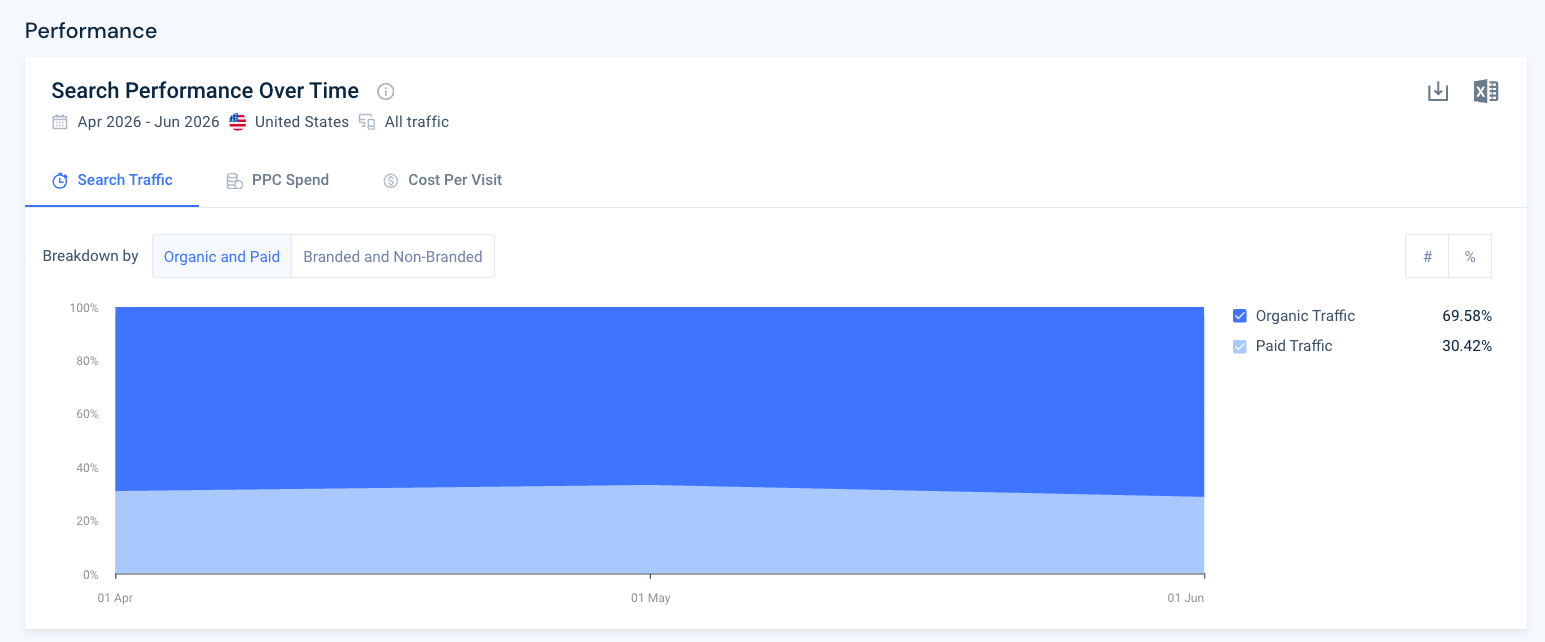
None of the methods above will catch this, because both pages can be technically healthy on their own. If a paid campaign is bidding on a term your own page already ranks well for organically, you’re paying for clicks you’d likely have gotten free.
Pull the paid vs. organic keyword overlap view (Similarweb’s Paid vs. Organic breakdown, or Google Ads’ auction insights alongside GSC) and check whether your organic click-through rate for that term drops in a way that correlates with when the PPC campaign started running. If it does, that’s paid cannibalizing organic, not a ranking problem at all.
Gotten yourself into a keyword cannibalization quandary? There are a few things you can do to fix it before it eats up all your efforts, and before it costs you an AI citation on top of a ranking.
Before picking a method, run what I call the Keep-or-Cut check:
That one question, keep both URLs or not, decides which of the four fixes below actually applies.
What to do: combine two or more pages targeting the same keyword and audience into one comprehensive page, then redirect the others to it.
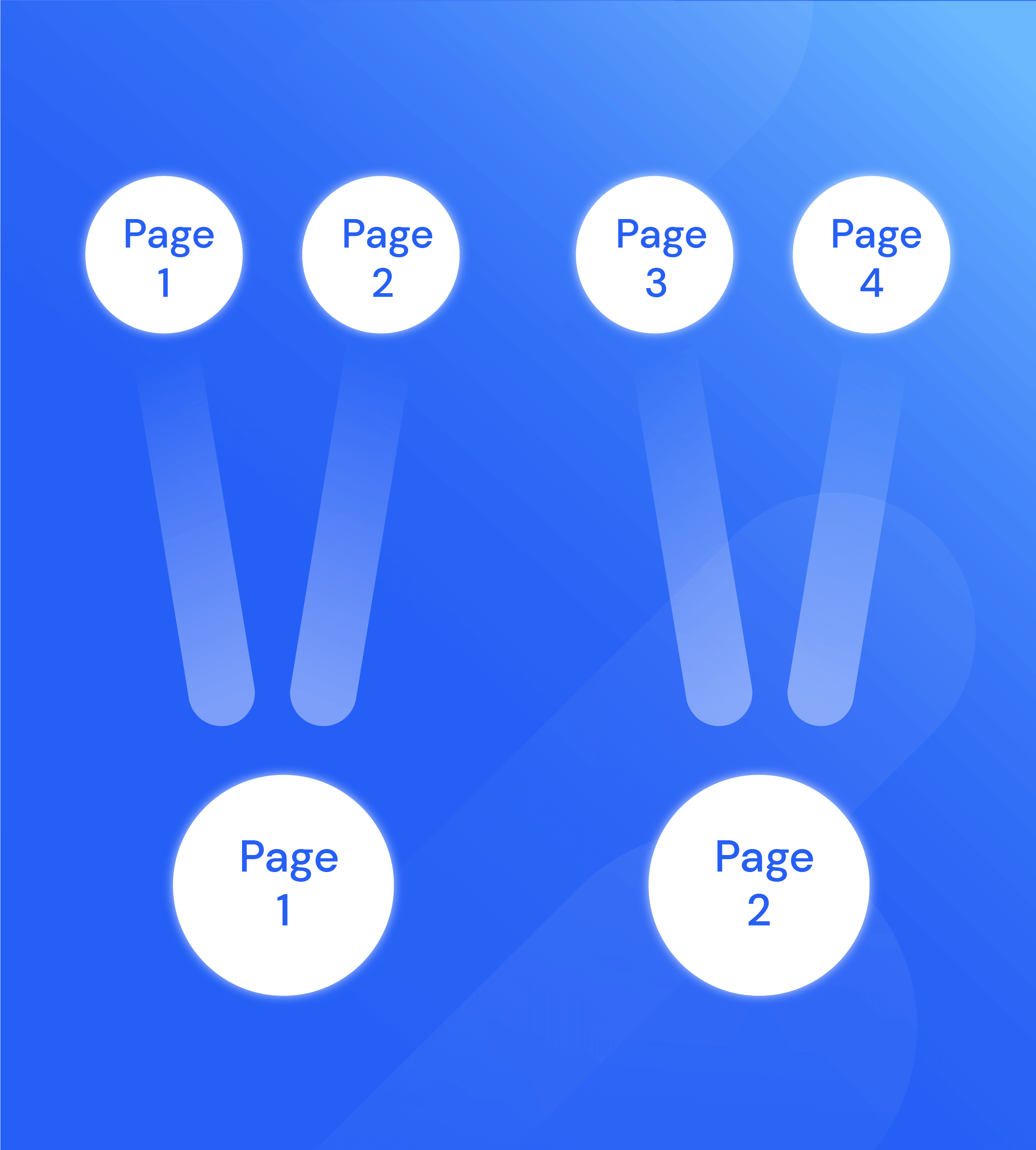
First, identify any pages that have the same target keywords. If multiple content pages essentially serve the same purpose, it could be a good idea to merge them.
If both pages target different audiences while covering the same topic and are each performing well, there’s no reason to change anything.
Otherwise, merging multiple pages will simplify your site, improve your SEO, and likely result in the mega-page ranking higher in the SERPs, thereby improving your overall digital marketing metrics. It also gives an AI engines exactly one comprehensive page to cite instead of three thin ones to sort through.
This scales to templated content too. If a programmatic set, say, country by category combination pages, is cannibalizing itself because the template doesn’t differentiate enough between combinations, you don’t need to fix each page individually. Changing the one template that’s generating thin, near-identical output can resolve the conflict across the entire batch in a single pass.
What to do: delete the outdated or lower-quality page and 301-redirect it to the page you want to rank.
Depending on the content that is cannibalizing your keywords, it might be best to delete it entirely.
If your site has a ton of outdated content that’s no longer relevant or not as high-quality as your most recent posts, it might be time to cut the cord. These posts may be cannibalizing other content on your site by ranking higher than the new pages you actually want your audience to see.
Once you’ve deleted the dead weight, redirect traffic to other, more relevant pages on your site. You’ll drive traffic to your best content and strengthen your SEO at the same time.
What to do: add a noindex tag to the weaker page so it stays live for users while preventing it from competing for rankings.
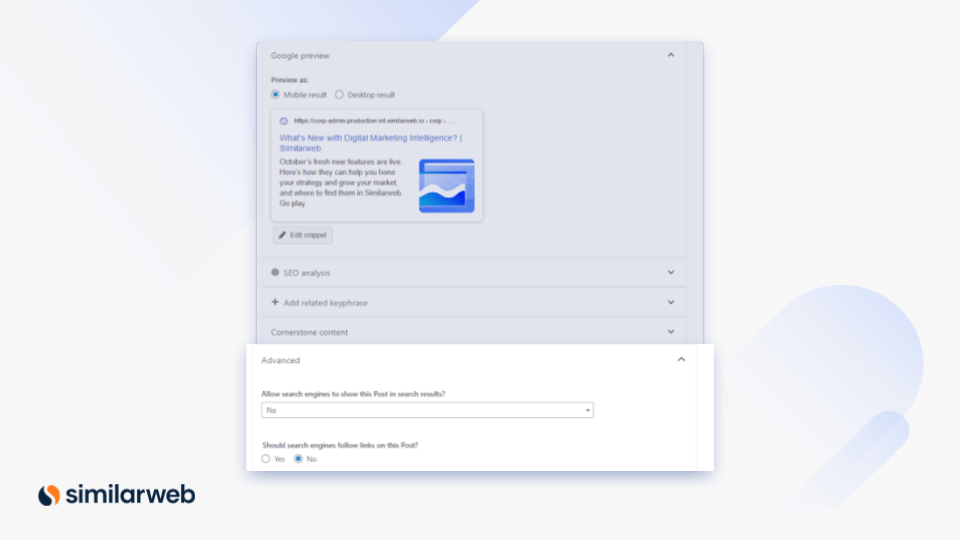
Alternatively, you may choose to noindex duplicate content. This is a good option for pages that are valuable in some way, like A/B test pages, but you don’t want to rank them in search engines at the expense of your other content.
Why not redirect instead? For a page you’re genuinely retiring, redirect is the right call, it consolidates signals, and a 301 doesn’t break anything for a person clicking an old link. Noindex is for a narrower case: a page that still needs to serve its own actual content, not forward to something else.
The clearest example is when a paid campaign sends traffic to an actual page on your website instead of a dedicated landing page. Dedicated landing pages are usually noindex by default already, so this doesn’t come up there. But if a campaign points straight at a real site page, one deliberately built or tweaked to match a specific ad’s messaging, you can’t redirect it without breaking the live campaign, and you don’t want it competing organically against your main page either.
Redirecting it mid-campaign can also hurt ad quality scores and violates several ad platforms’ policies outright. The same logic applies to a live A/B test variant, redirecting ends the test and you lose the comparison entirely, or a page a regulator, partner, or API integration expects to find actually served at that exact URL, not forwarded elsewhere.
Redirect when the page’s only remaining job is to point somewhere else. Noindex when it still has a job of its own, just not one that involves ranking.
Make these pages no-indexed, and they’ll still be on your site, but will essentially be invisible to search engines.
What to do: keep both pages live and re-optimize the weaker one around a different, genuinely relevant keyword instead of merging or deleting it.
You don’t necessarily need to delete or merge posts to kick your keyword cannibalization issues. You can keep all your content by optimizing it for different keywords instead. If you do this well, you’ll double your SEO efforts without having to cut or create any content.
For example, say you have two articles on your site, “25 Fun and Easy Craft Projects” and “Step-by-Step Macrame Craft Projects,” both optimized for the keyword “craft projects.” Both are high-quality, informative articles, but the first post is most relevant to people searching for “craft projects.” So, take the other post and optimize it for a different keyword that is also relevant to your SEO strategy and target audience, such as “macrame.”
Pro Tip: Don’t guess what keywords you should target. Use Similarweb’s keyword research suite to choose the most valuable keywords. Similarweb can show you which keywords are most relevant to your target audience, the search volume for relevant terms, and the seasonality of your keywords.
This will take a bit of time and effort, and you’ll want to be sure to remove all of the original keywords, but it’s worth it to end up with two strong, non-competing articles that can each rank for their own keyword instead of fighting over one.
Internal linking can also help address keyword cannibalization by persuading search engine algorithms to rank your preferred content over other pages on your site.
If you have an internal linking structure that leads to your most important content, this signals to search engines that the linked content is important. This, in turn, means that the search engine is more likely to rank that page higher in its results. So check your internal links and make sure they point toward the content you want to rank.
However, search engines don’t just look at internal links when deciding how to rank your content. They also look at how many other sites link to your content, especially reputable, high-authority web pages. So if your older content has more backlinks from high-authority sites, it will likely rank higher than your newer, more relevant content.
If you have links leading to old page content that you don’t want to rank, or content that you’re planning to merge or delete, get in touch with the site owner and ask them to update them to your new and improved content.
This consolidation is best practice for AI search optimization, too. Internal links are one of the clearest signals of which page you consider authoritative, and that signal feeds directly into which page an AI engine chooses as the representative one when it decides what to cite.
Cleaning up internal links doesn’t just help a page rank. It helps that page win the citation instead of losing it to a competitor, or to a weaker page of your own.
A fix isn’t finished when the redirect goes live. If your link-building or outreach team is still pointing new backlinks at the page you just merged away, you’re rebuilding the exact split you fixed.
After you consolidate a keyword onto one page, update your outreach targets and any standing link-building briefs to point at that winning URL specifically.
If you found a paid vs. organic conflict using the detection method above, the fix isn’t just pausing the ad, since that leaves you guessing whether the organic page can hold the traffic on its own.
Set explicit rules between your paid and SEO teams for which keywords each channel owns, and keep testing the combined organic-plus-paid CTR for the term, not just each channel’s CTR in isolation, to confirm the fix actually improved total performance rather than just moving the number around.
If your site has forums, comments, or any other user-generated content, that content can end up ranking for the same terms as your official pages, and you didn’t write a word of it. Three link attributes handle the outbound side: rel=”ugc” on links within user-generated content, rel=”nofollow” on outgoing links in UGC areas to avoid passing authority into spam, and rel=”sponsored” if any of that content was created as part of a paid or affiliate arrangement.
If you’d rather not manage the area at all, a blanket noindex, nofollow meta robots tag on the UGC section prevents it from competing in search entirely.
Fixing cannibalization after it happens is necessary, but it’s reactive. Avoiding it is a workflow problem, not a one-time cleanup, and it comes down to catching the overlap before a page ever gets published rather than after.
Use an SEO mapping. This is what I mean by keeping a detailed URL-to-keyword map, a practice I covered at BrightonSEO 3 years back.
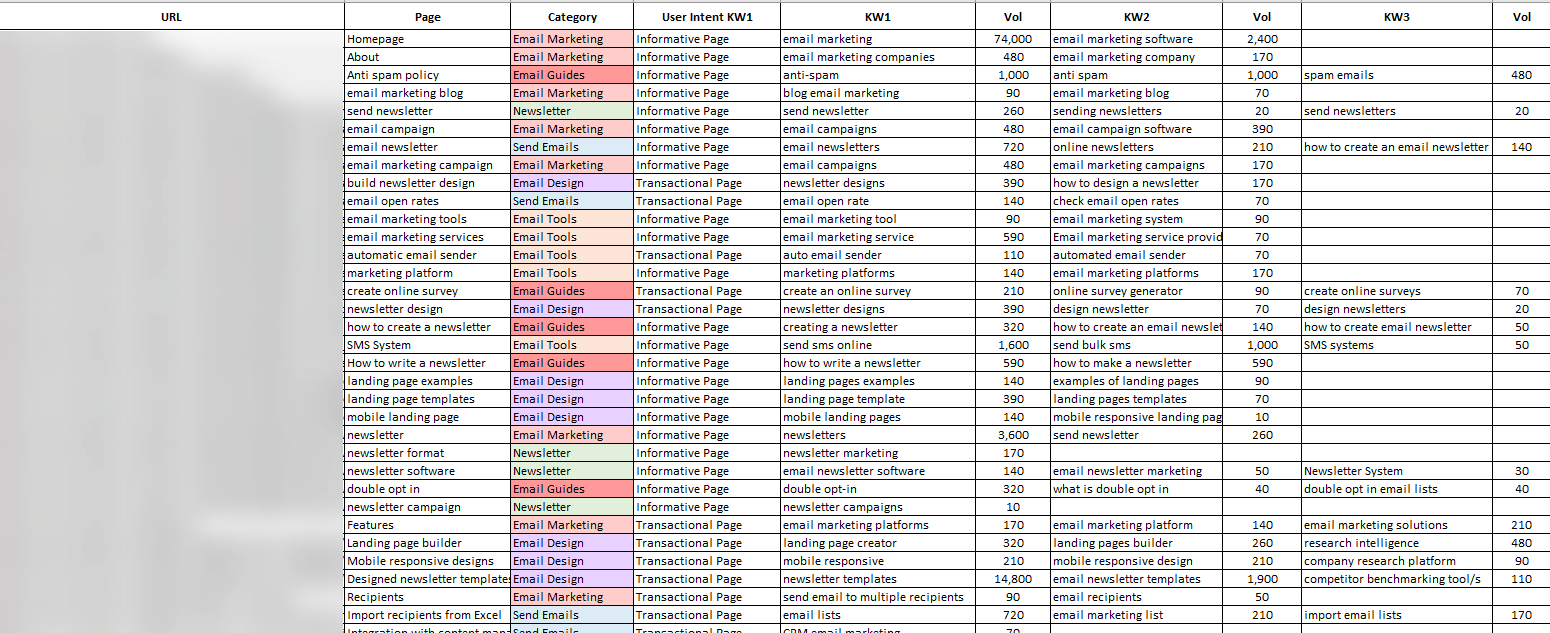


From that point on, if anyone assigns a keyword to a new URL that’s already assigned to an existing one, the cell lights up automatically.
Ta-da, no manual cross-checking required.
Organized mapping like this is what lets you spot keyword overlaps in seconds instead of after the second article is already live.
Before a new brief gets approved, that map is the first thing to check. If “best cat toys” is already assigned to a page, a second brief targeting the same term isn’t a new opportunity, it’s a collision the spreadsheet would have caught.
SEO teams that avoid cannibalization treat “does this already exist on our site” as a mandatory step in the brief approval process, not an afterthought. Before a topic gets assigned, search your own site the way a reader would: run the site: search from earlier in this article, check your CMS, and check your keyword tracker’s cannibalization alerts. If something close already exists, the decision isn’t “write it anyway.” It’s a merge into the existing page, or deliberately differentiate the angle before anyone starts drafting.
The Keep-or-Cut check from earlier in this article works just as well before a page exists as after. When a new brief overlaps with something you already have, ask the same question up front: does this need to be a separate URL? If the answer is no, that’s a merge decision at zero cost, rather than a redirect decision after two writers have already spent time on two competing pages.
Cannibalization gets easier to avoid when every page on your site has one clearly stated purpose before it’s built, not just a keyword. A support page’s job is to answer a specific question. A product page’s job is to convert a specific buyer intent. When two planned pages could plausibly serve the same job, that’s the signal to stop and consolidate the plan, not the finished pages, before either one gets written.
The keyword map catches overlap after someone’s already picked a topic. Building around pillar-and-cluster architecture catches it earlier, at the planning stage, before a topic even gets proposed. Assign each pillar page ownership of a core topic, then map every planned cluster piece as answering one distinct sub-question that links back to the pillar, rather than restating it. If two planned cluster pieces would answer the same sub-question, that overlap shows up on the cluster map before either one gets written, not after.
Just because you have several pages ranking for a single search term doesn’t always mean it’s a case of keyword cannibalization. But when you have a page ranking higher than the page you want to be ranking on top, or when your own pages are splitting an AI citation that should have gone to one clear answer, then you need to take action.
With AI Search Intelligence in your arsenal, identifying and eliminating keyword cannibalization on your site is pretty easy. As rankings and AI Overview selections are constantly changing, I recommend you perform a cannibalization checkup every few months.
What is keyword cannibalization?
Keyword cannibalization happens when two or more pages on the same website target the same keyword, causing search engines to split ranking signals between them instead of concentrating authority on one page. This can lower rankings for both pages, dilute backlink value, and, in AI search, reduce the odds that either page gets cited.
Is keyword cannibalization always a problem?
No. Multiple pages can rank for the same keyword without conflict if they serve different search intents (a blog post vs. a product page) or if the term is a branded keyword. It only becomes a real problem when the pages compete for the same intent and neither one wins clearly.
What’s the difference between keyword cannibalization and content cannibalization?
Keyword cannibalization is exact-match: two pages target the same keyword. Content cannibalization is broader: pages compete for the same search intent even without shared keywords. A site: search only catches the first type, so a full audit needs to check for intent overlap too, not just keyword overlap.
Does keyword cannibalization affect AI Overviews and AI search visibility?
Yes, at least for systems that document this behavior. Bing’s December 2025 webmaster guidance confirms its AI systems cluster near-duplicate pages and cite only one, sometimes an outdated one. That same competing-for-a-limited-slot dynamic likely applies more broadly, though it isn’t independently confirmed for every AI platform, so cannibalization risks losing a citation entirely, not just swapping rankings between your own pages.
How do you fix keyword cannibalization?
Start with the Keep-or-Cut check: decide whether both competing pages need to stay live. If not, merge them or 301-redirect the weaker URL. If yes, but only one should rank, add a noindex tag or canonical to the other. If yes, and each page could serve a genuinely different reader, re-optimize the weaker one for a different keyword instead of fighting over the same one. Update internal links to the winning page afterward.
How often should you check for keyword cannibalization?
Check every few months, or immediately after a content push that covers overlapping topics. Rankings and AI Overview source selection both shift continuously, so a cannibalization issue that didn’t exist last quarter can appear the moment a new page goes live on a similar topic.
Can paid search cause keyword cannibalization?
Yes. If a paid campaign bids on a term your page already ranks well for organically, you can end up paying for clicks you’d have gotten free. Check whether your organic CTR for that term drops in a way that correlates with the PPC campaign’s start date, and set explicit rules between paid and SEO teams for which keywords each channel owns.
How do I handle UGC that competes with my own pages?
Add rel=”ugc” to links inside user-generated content, rel=”nofollow” on outgoing UGC links to avoid passing authority into spam, and rel=”sponsored” if the content was part of a paid or affiliate arrangement. If you’d rather not manage the area, apply a noindex, nofollow meta robots tag to the whole UGC section instead.

Director of SEO & AI Search at Similarweb
Limor brings 20 years of expertise in SEO and AI Search. She thrives on solving complex problems, creating scalable strategies, and building amazing dashboards.
The Top 100 Most Visited Websites in the USA (August 2026)
Similarweb Named in Forrester's Answer Engine Optimization Technologies Landscape, Q3 2026

Anthropic IPO: What Claude's Web and App Data Show
Give it a try or talk to our marketing team - it’s free!
