by Darrell Mordecai4 Min.
Nov 18, 2026
 Insights
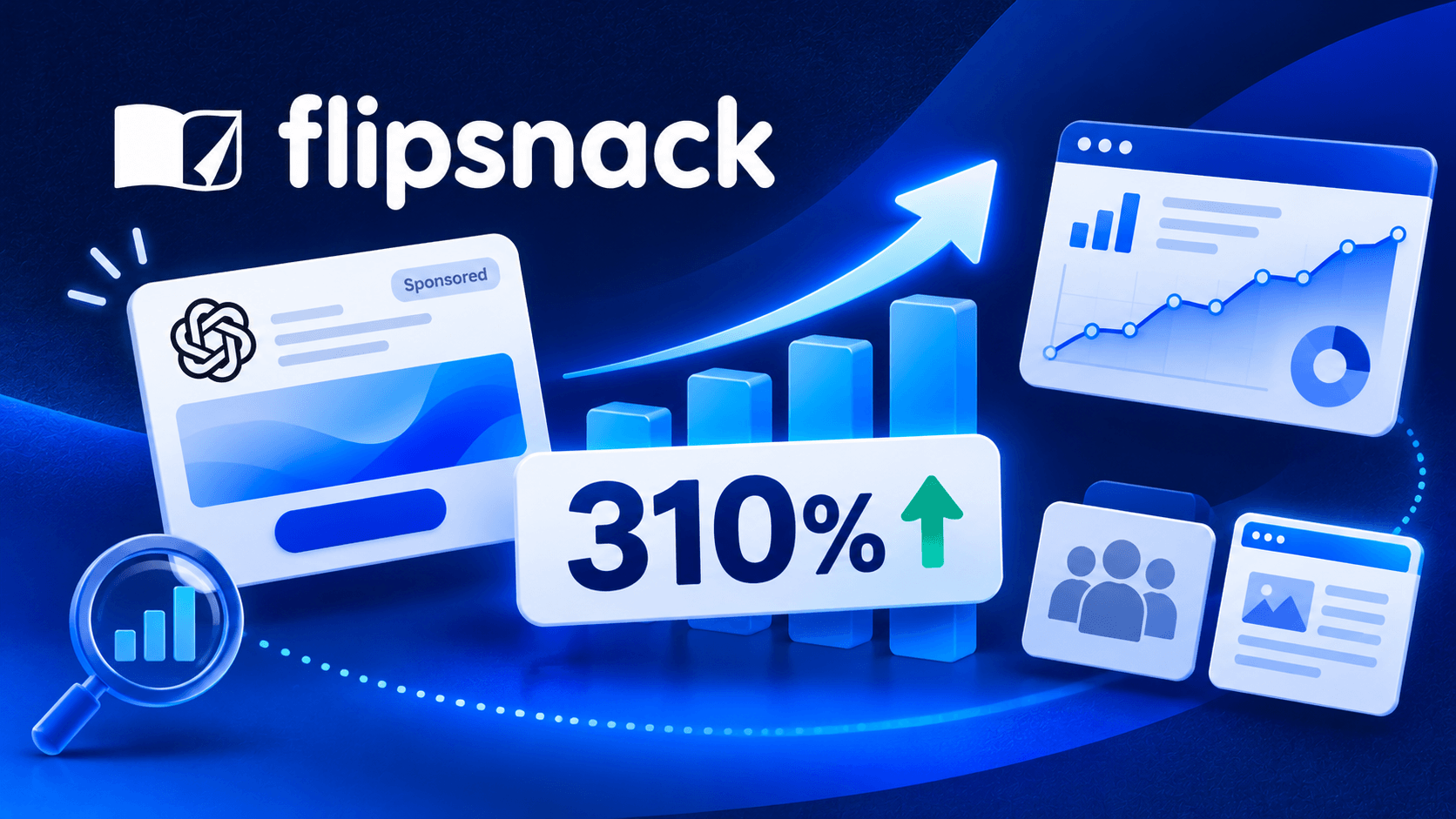
OpenAI’s Flipsnack case study reports ~310% more registrations and ~75% lower cost per registration across five US campaigns after Flipsnack moved from click bidding to conversion bidding. It is a strong result, reported by the advertiser.
Similarweb Ad Intelligence shows the other side of the story: the ads people actually saw in ChatGPT, how they changed, and who else showed up. Here is what that adds.
Scope and caveats: unless noted, figures are ChatGPT ads shown to Free and Go users in the US, May to mid-November 2026; the message-mix figures cover all markets. Ad volume for a single brand is small, so weekly shares are directional. OpenAI’s results are advertiser-reported.
Flipsnack went from one generic “interactive flipbook” message to a portfolio of use-case ads. Generic flipbook-maker copy was 100% of its ChatGPT ad impressions in May and June. By August it was about 25%.
OpenAI’s case study lists campaigns by use case: magazines, catalogs, brochures, sales enablement, employee benefits, real estate and hospitality. Flipsnack’s ads follow the same split. The real ads are shown further down.
We count tens of distinct ad copy variants, and a handful of them launched in the two weeks OpenAI compared (Aug 25 to 31 and Sep 2 to 8, 2026) indicating a strong testing approach, which we see across many leading ChatGPT advertisers.
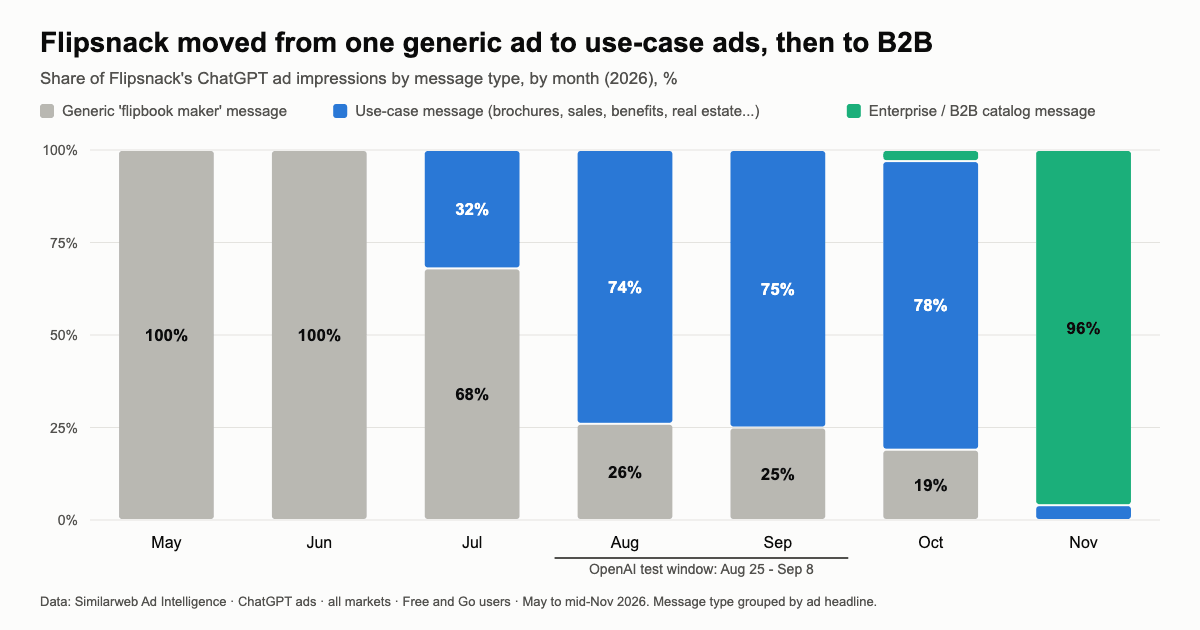
| Period | Generic “flipbook maker” ads | What replaced them |
|---|---|---|
| May to June | ~100% of impressions | Nothing yet |
| July | ~68% | Real estate, hospitality |
| August to September | ~25% | Sales enablement, benefit guides, catalogs, brochures |
| November | 0% | ~96% enterprise and B2B catalog messages |
OpenAI notes that objectives and bidding changed together. The ad data adds a third variable that moved in the same weeks: the message. The lift cannot be pinned on bidding alone.
Similarweb’s data has seen about 58,000 advertisers run ChatGPT ads in the US since launch, and about 12,000 in a typical week now. Worldwide, OpenAI reports more than 100,000 advertisers, and the number keeps growing.
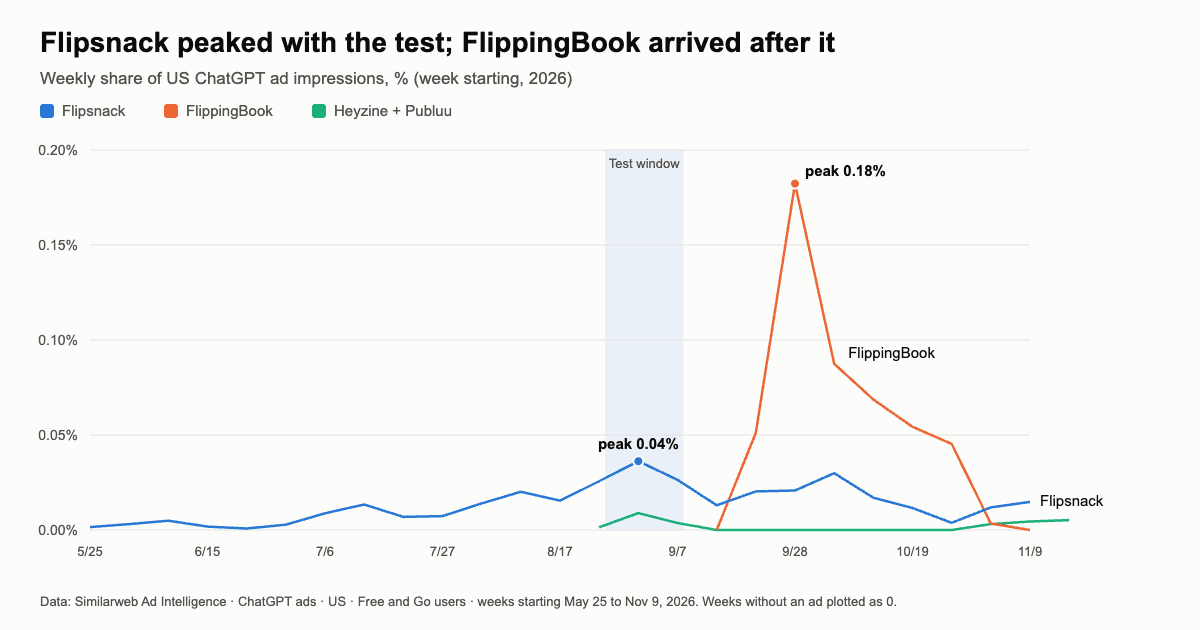
The advertiser base has a very long tail. Looking at the US, In the test window (Aug 25 to Sep 8), the top 10 held about 13% of impressions and the top 100 about 37%. Flipsnack ranked #496 of about 14,000 advertisers seen (the top ~4%) with about 0.03% of impressions. Its share grew ~25x from late May to the week of August 31, then fell ~90% by the week of October 26. In the last four weeks it ranked in the top ~6% with about 0.01%.
Similarweb’s Ad Intelligence caught FlippingBook’s first ChatGPT ad the week of September 21, two weeks after the case-study window. In its peak week it held ~9x Flipsnack’s share that week, with ~20 ad variants. By early November it was near zero. Heyzine ran briefly, from late August to mid-September. Publuu started October 19 with a “free” offer.
| Advertiser | Typical headline | Angle |
|---|---|---|
| Flipsnack | “Create brochures people actually explore” | The job: sales, HR, real estate, hospitality |
| FlippingBook | “Make digital flipbook from PDF” | The format (~70% of impressions came from three near-identical headlines) |
| Heyzine | “PDF to flipbook” | The format |
| Publuu | “Flipbook maker, convert your PDF for free” | Price |
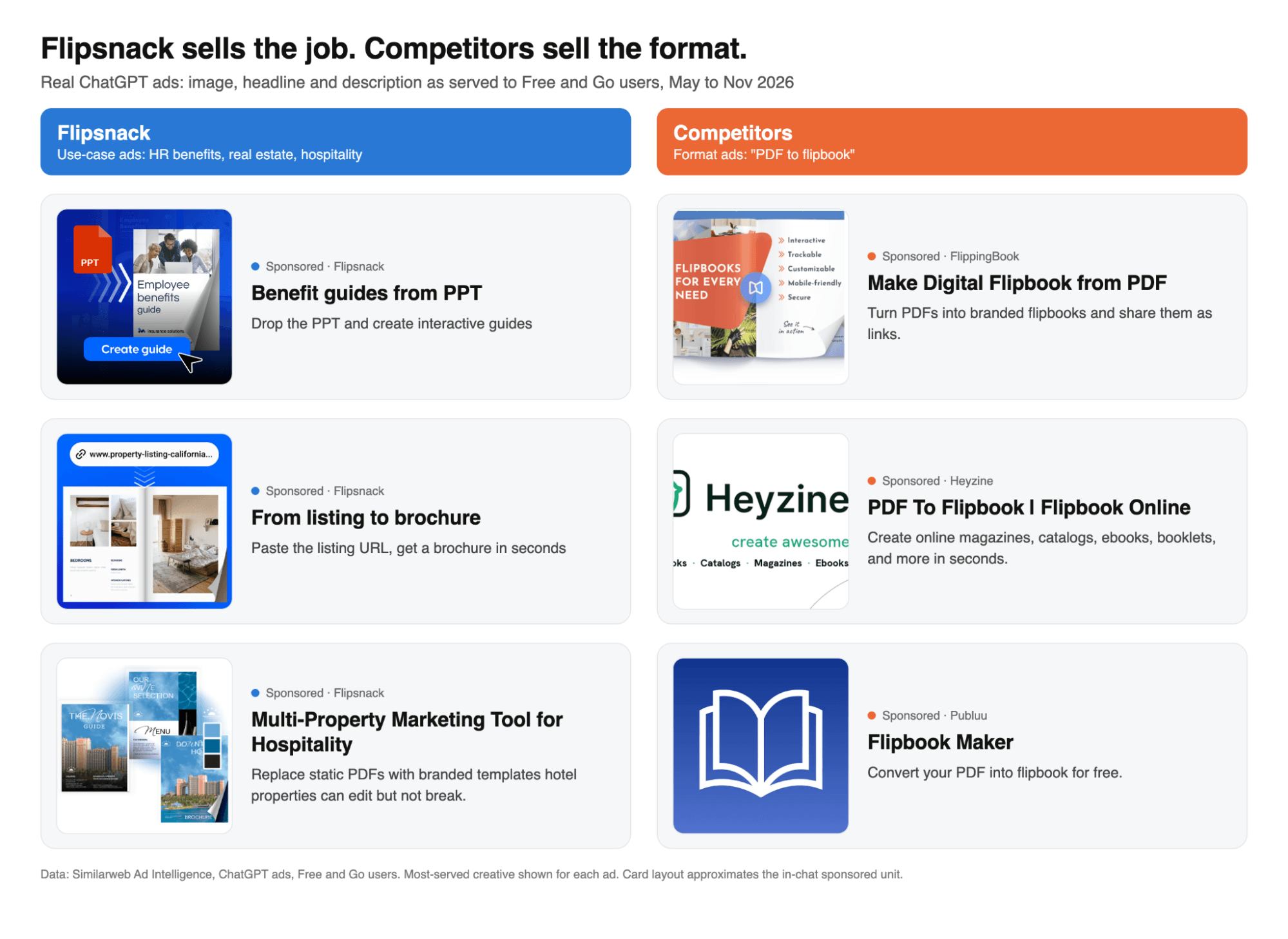
Intent is broad, too. By our keyword grouping (directional), only about 1 in 10 Flipsnack ad impressions appeared in conversations about flipbooks, catalogs, brochures or PDFs. Copy that names a job travels further than copy that names a category.
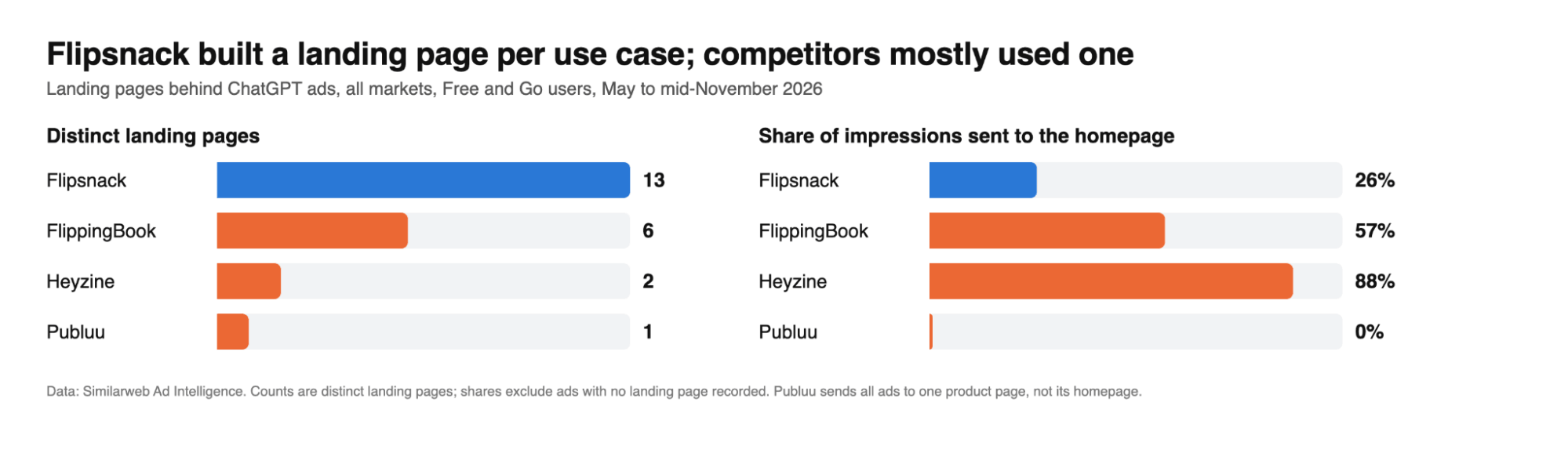
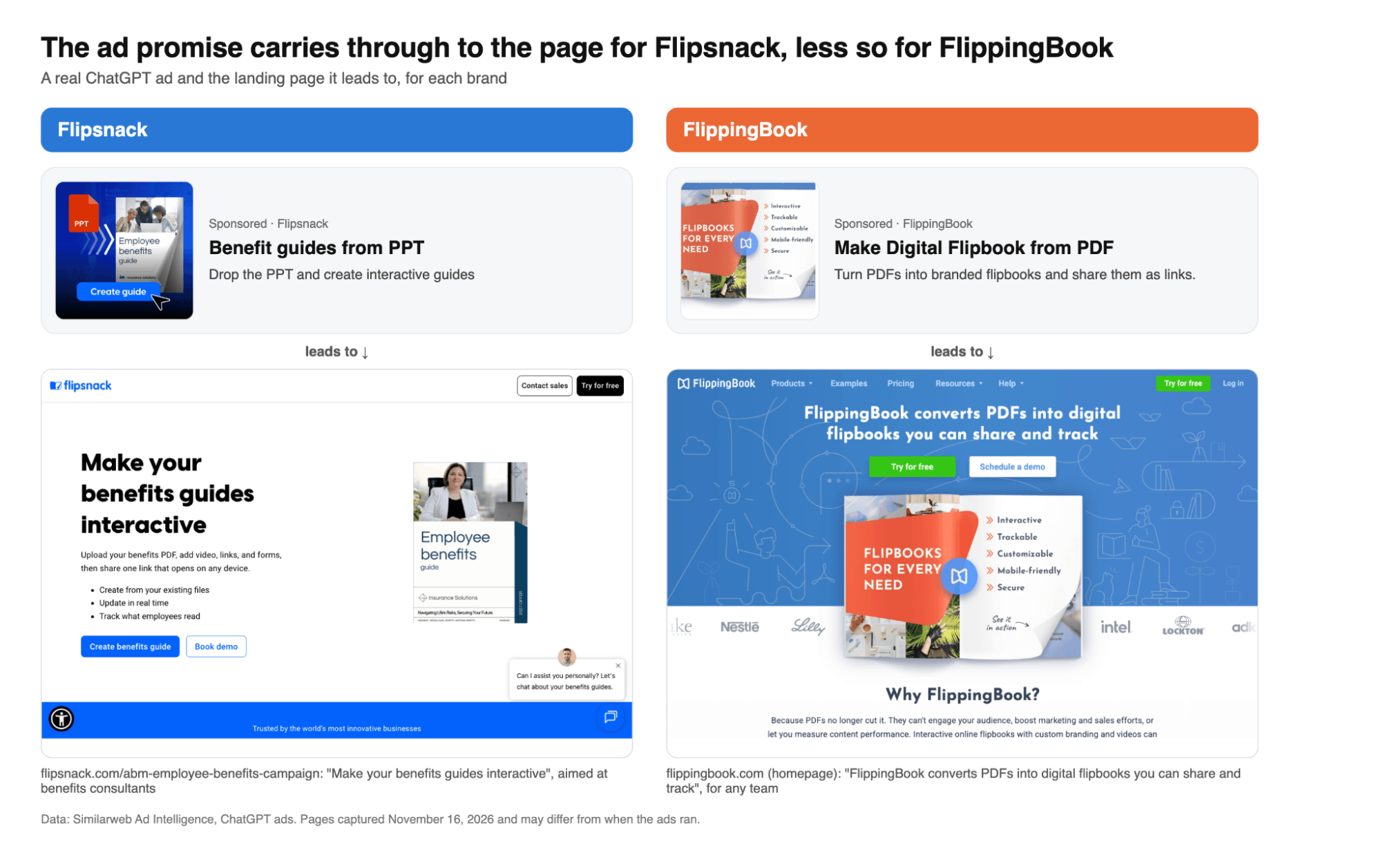
Flipsnack’s ads sent people to about 13 different pages, and about three-quarters of impressions went to dedicated use-case pages. The benefits ad lands on a page headed “Make your benefits guides interactive”, the hospitality ad on “One hub for hospitality marketing” and the real estate ad on “Your listing brochure, ready in 60 seconds”. Competitors mostly sent ads to one page (ChatGPT ads, all markets, May to mid-November 2026; pages read November 16, 2026, so they may differ from when the ads ran):
Similarweb’s October 2026 webinar found 60% of ChatGPT advertisers use five or fewer landing pages, so Flipsnack’s setup is unusually broad. Our hypothesis, not a finding: matching the page to the ad is part of why its use-case ads could work. This data cannot show conversion.
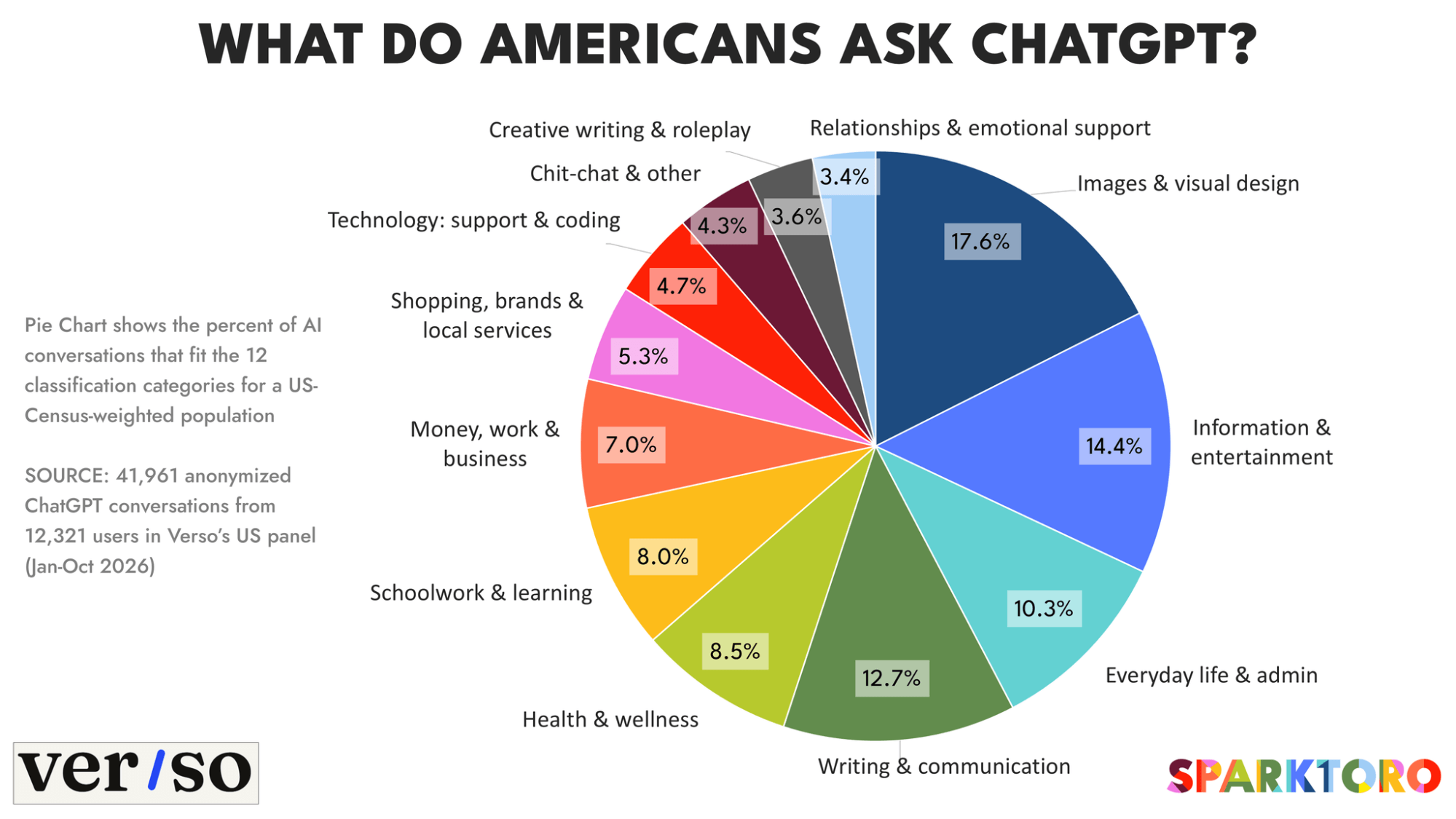
A study of about 42,000 US ChatGPT conversations (SparkToro and Verso, January to October 2026) found that the largest categories are images and visual design (17.6%), information and entertainment (14.4%) and writing and communication (12.7%). Flipsnack’s use cases sit in those and in two smaller ones: money, work and business (7.0%) and shopping, brands and local services (5.3%).
That supports the point above. People rarely ask ChatGPT for a flipbook maker. They ask for a benefits guide, a listing brochure or a menu. Our ad data shows the same pattern.
One large category has no Flipsnack ad: schoolwork and learning (8.0% of conversations), even though many of the sites linking to Flipsnack are universities and schools. That is our inference from referring sites, not measured demand. The study’s categories and sample differ from Similarweb’s ad data, so treat the link as directional.
Build one campaign per use case. Flipsnack replaced its generic ad with use-case ads, and Similarweb data shows top advertisers write about 98% net new copy for ChatGPT. Send each ad to a page that matches it: Flipsnack used about 13 landing pages.
Objective, bidding and new creative landed together. Stagger them, or you will not know what worked. Budget it as a test: CTR has about doubled since launch, but the advertiser base has not settled (Similarweb, October 2026 webinar).
Both Flipsnack and FlippingBook went from a peak to near zero within weeks, and few advertisers hold a steady top spot. Plan to re-test: the advertiser still in the auction owns the use case.
The case study tells you what Flipsnack optimized. Ad data tells you what it said, when it said it and who was not there to answer. The Similarweb figures above come from Similarweb Web and Ad Intelligence, which tracks ads in ChatGPT, Google AI Mode and Google AI Overviews using anonymous, representative data from real users, not synthetic queries. It shows what your competitors run and how it changes:
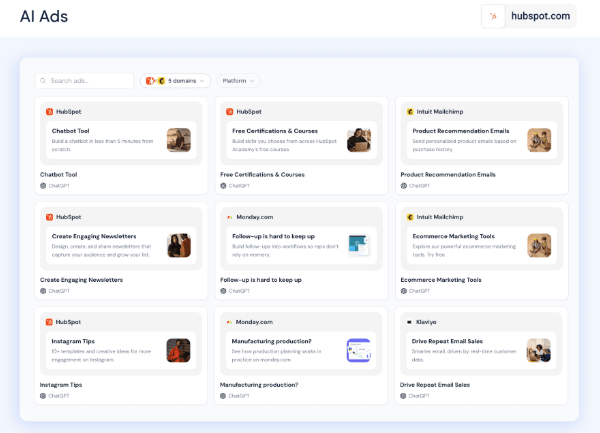
browse the ads shown in ChatGPT, Google AI Mode and Google AI Overviews. Filter by domain: see every ad a competitor runs, with its copy, visuals and landing page. Explore ad details: first seen, last seen and duration, so you can tell a test from a lasting campaign.
Go deeper in the State of ChatGPT Ads report (written with Graphite) and the guide to how advertising works on AI platforms.
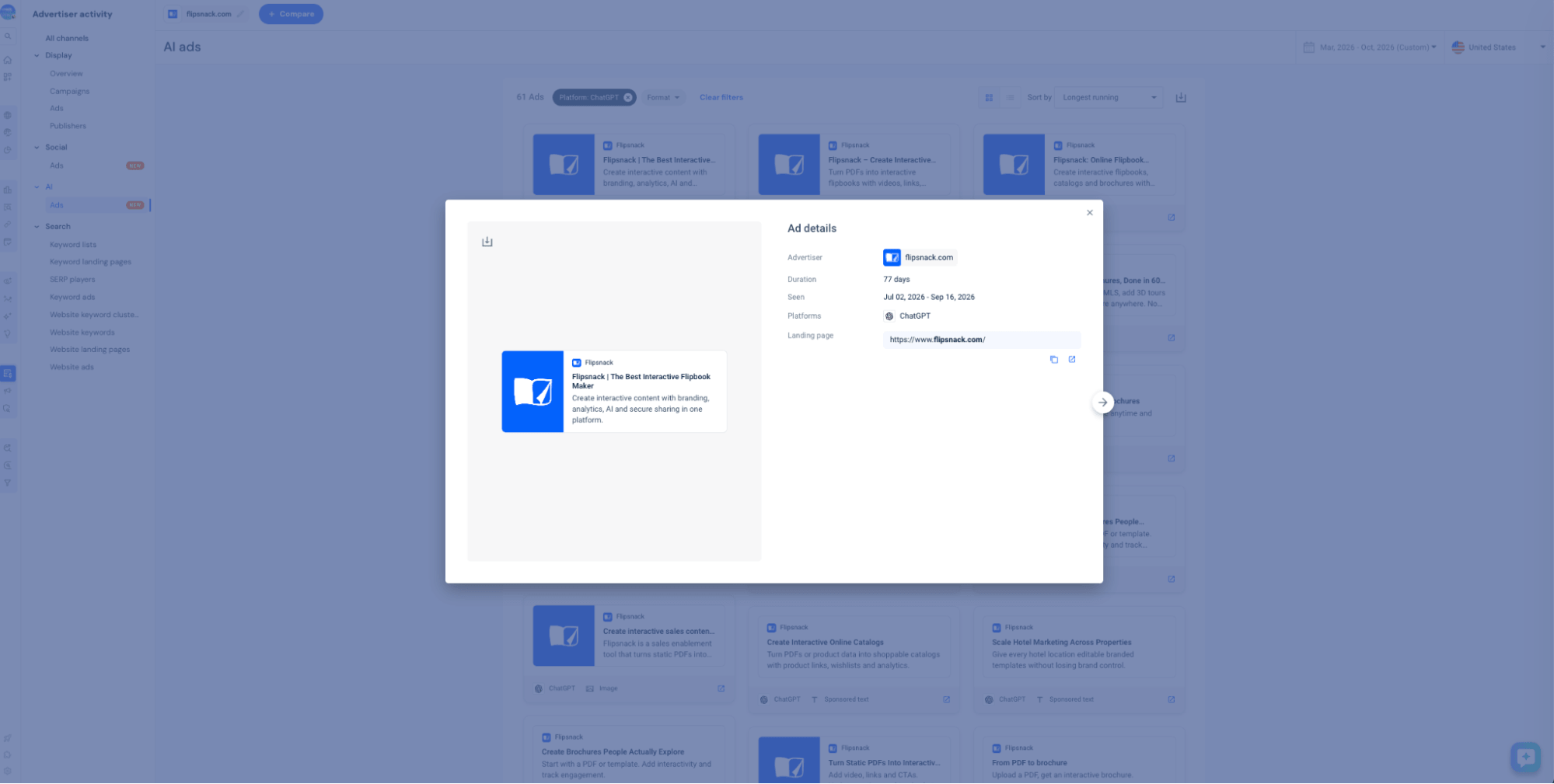
A brand’s share of attention is relative to its competitors. Similarweb’s AI visibility tracking shows which brands AI answers mention and cite, and Ad Intelligence shows which advertisers appear in ChatGPT, Google AI Overviews and Google AI Mode ads.
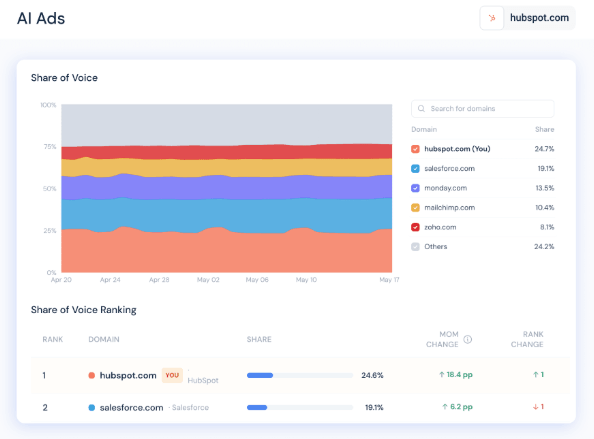
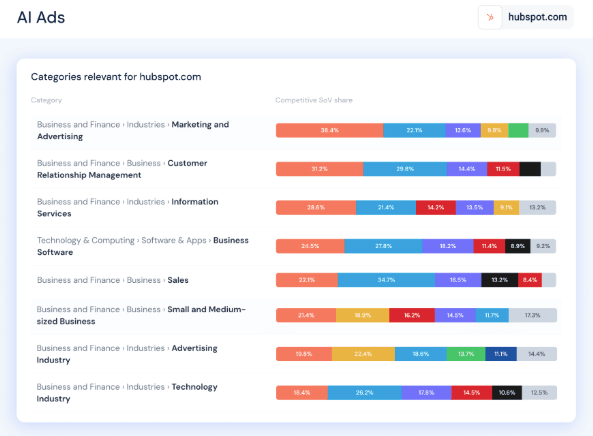
Ad Intelligence lists AI ads next to display, social and search ads, and each ad shows when it was first and last seen, how long it ran and its landing page. For the data itself, custom data feeds label every ChatGPT, AI Mode and AI Overviews ad with an industry and ad category, and let you cut by domain, market, platform and the intent of the prompts that triggered it, including how many advertisers and ads sit in each category, so you can see who competes where.
A new ad channel rewards the teams that test fast. Flipsnack tested its messaging by use case, built a landing page for each one, and was in market while most competitors were late, brief or absent. The ad data shows how: what others run, which message they lead with, where they send people and when they stop. Knowing what others are doing turns testing from guesswork into a plan. To follow competitors’ ChatGPT ads, messaging and landing pages yourself, explore Similarweb Ad Intelligence.
OpenAI’s case study reports that Flipsnack grew registrations by about 310% and cut cost per registration by about 75% across five US campaigns. The result followed a switch from click bidding to conversion bidding. The figures are advertiser-reported and relative, with no absolute numbers, so they show direction rather than scale.
Similarweb Ad Intelligence shows the ads people actually saw in ChatGPT. It adds the message timeline, the landing pages and the competitor presence. Flipsnack’s generic flipbook copy fell from 100% of its impressions in May and June to about 25% by August, as use-case ads replaced it. The lift cannot be credited to bidding alone.
Yes. Flipsnack moved from one generic flipbook-maker message to a portfolio of use-case ads for benefit guides, sales enablement, real estate and hospitality. It ran tens of distinct ad copy variants, and a handful launched in the two weeks OpenAI compared (Aug 25 to 31 and Sep 2 to 8, 2026). By November, about 96% of its ad messages targeted enterprise and B2B catalog use cases.
Yes. Flipsnack’s ads led to about 13 distinct pages, and about three-quarters of impressions went to dedicated use-case pages such as employee benefits, sales enablement, hospitality and real estate. FlippingBook used about 6 pages, Heyzine 2 and Publuu 1, mostly the homepage or one generic product page.
Use an ad intelligence tool built on real user data. Similarweb Ad Intelligence shows which brands advertise in ChatGPT, their creatives, how messages change and who leads each market. Filter by market, then compare your competitors’ copy and presence with your own before planning campaigns or bids.

by Liat Sagiv
Senior Product Marketing Manager - Ad Intel
Liat Sagiv is a Senior Product Marketing Manager at Similarweb. She shapes the stories that help companies understand the value of Similarweb data for their business.
Give it a try or talk to our insights team — don’t worry, it’s free!