Muse app breakdown: what Meta's AI agent means for brands
by Shiran Mor5 Min.
Oct 29, 2026
 Insights

TL;DR
On November 2, we hosted Pulse 26, Similarweb’s closed-door executive event, at the Barbican in London. CMOs and digital leaders from brands and agencies spent the day on one question: what does AI mean for how brands grow? Here is our recap of what was shared on stage.
The theme of the day is easiest to see through one customer. A shopper in the UK asks an AI assistant which running shoe suits flat feet. It suggests three. She opens a new tab, searches one brand by name and buys on a retailer’s product page. Your analytics log a search visit. The AI conversation that made the decision never appears.
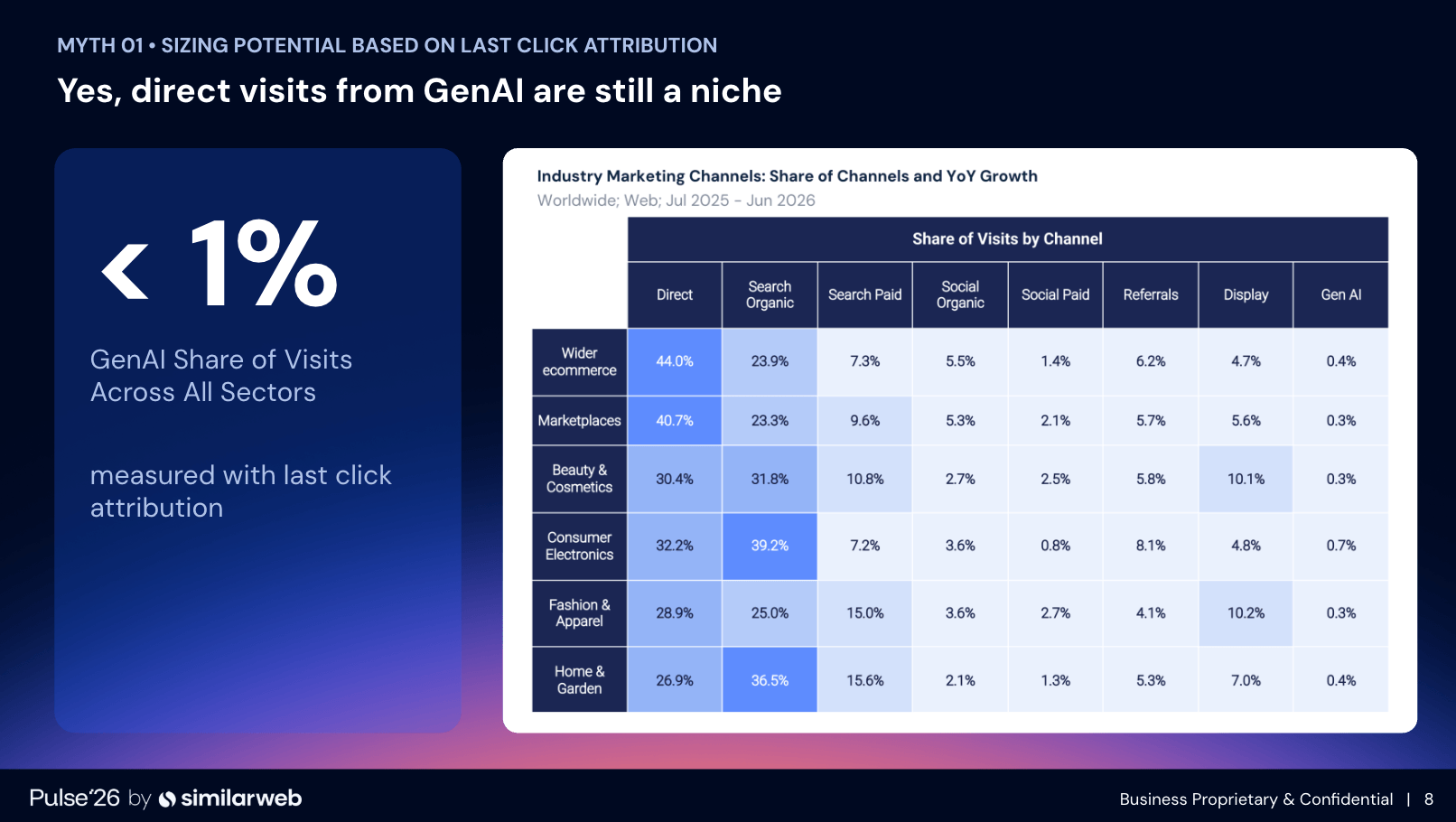
That gap is the story of the AI customer journey in 2026. Similarweb data shows AI tools drive under 1% of website visits when you count only the last link clicked. Widen the window to the 30 minutes before a visit and, on UK retail product pages, about 10% of visits follow an AI conversation. Customers are deciding inside AI, and much of today’s reporting cannot see it.
That blind spot was the thread running through the day. The programme mixed keynotes, fireside chats, panels and executive discussions on the new customer journey, agentic and digital commerce, and brand growth. Speakers from OpenAI, Google, Mastercard Services, NielsenIQ, Condé Nast, WPP Media, Boots, Kingfisher plc and Golin Ketchum joined Similarweb’s own product and data experts.
Below are the main ideas and numbers from each session, with a checklist for your 2027 planning at the end.
Last-click credits only the final link a customer clicked before a visit. AI conversations rarely end in a click, so shoppers research in AI, then arrive through search or direct.
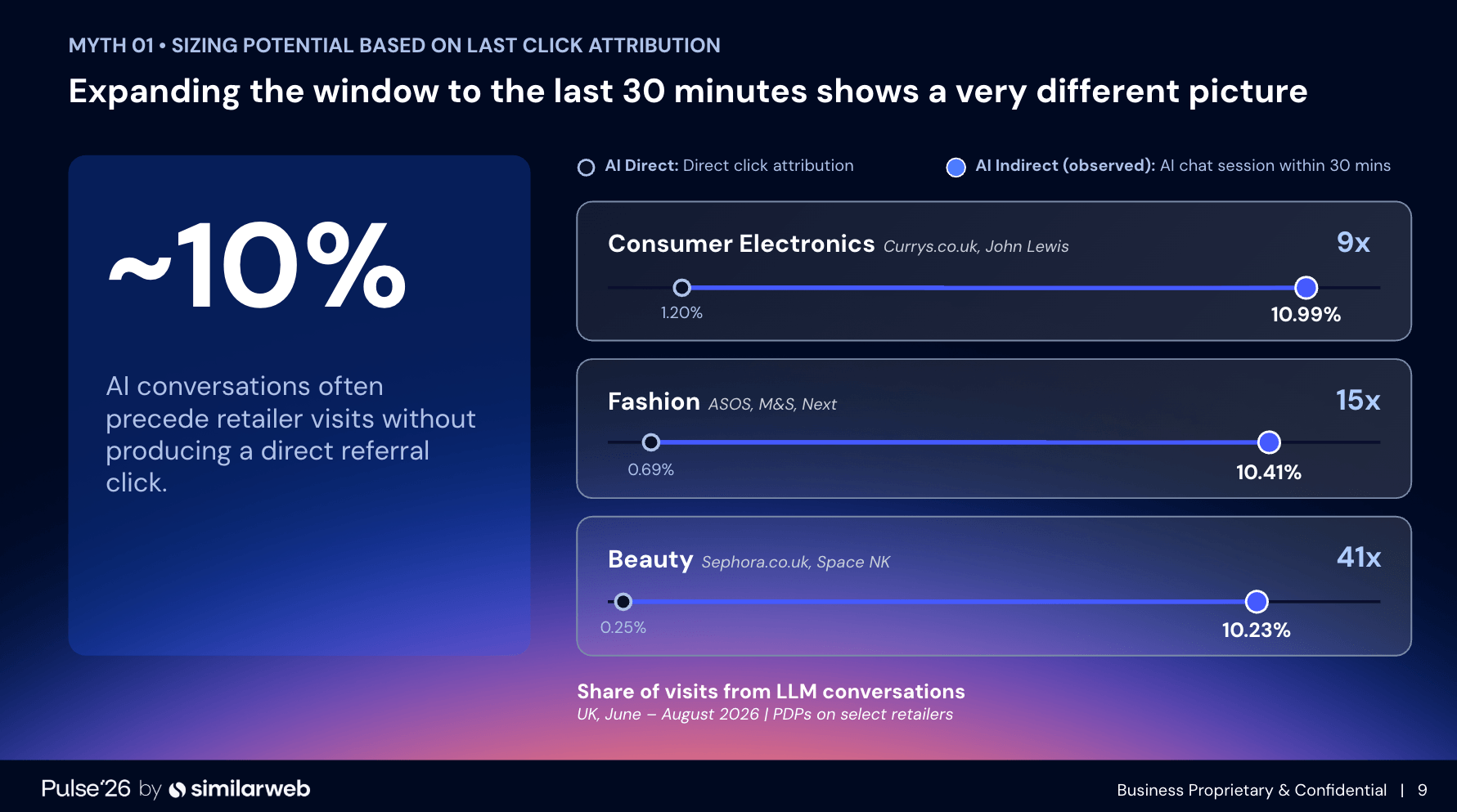
The two numbers describe the same behaviour measured two ways. In its Pulse 26 session, Similarweb compared last-click share with the share of visits preceded by an LLM conversation in the prior 30 minutes, on product pages of select UK retailers, from June to August 2026.
| UK retail category | Share of visits by last click | Share of visits after an AI conversation (30-minute window) | Gap |
|---|---|---|---|
| Consumer electronics | 1.20% | 10.99% | 9x |
| Fashion | 0.69% | 10.41% | 15x |
| Beauty | 0.25% | 10.23% | 41x |
Source: Similarweb, UK, June to August 2026, product pages on select retailers.
The lower a category’s last-click share, the larger the hidden influence.
Over half of these AI-influenced visits arrive through search, so search gets the credit. Combining the two works best: visits that combine AI and search convert at 23%, compared with 17.3% for search alone and 12.5% for AI alone.
Action: add a pre-visit lens to your reporting. Ask what happened in the 30 minutes before a visit, not only which link was clicked last.
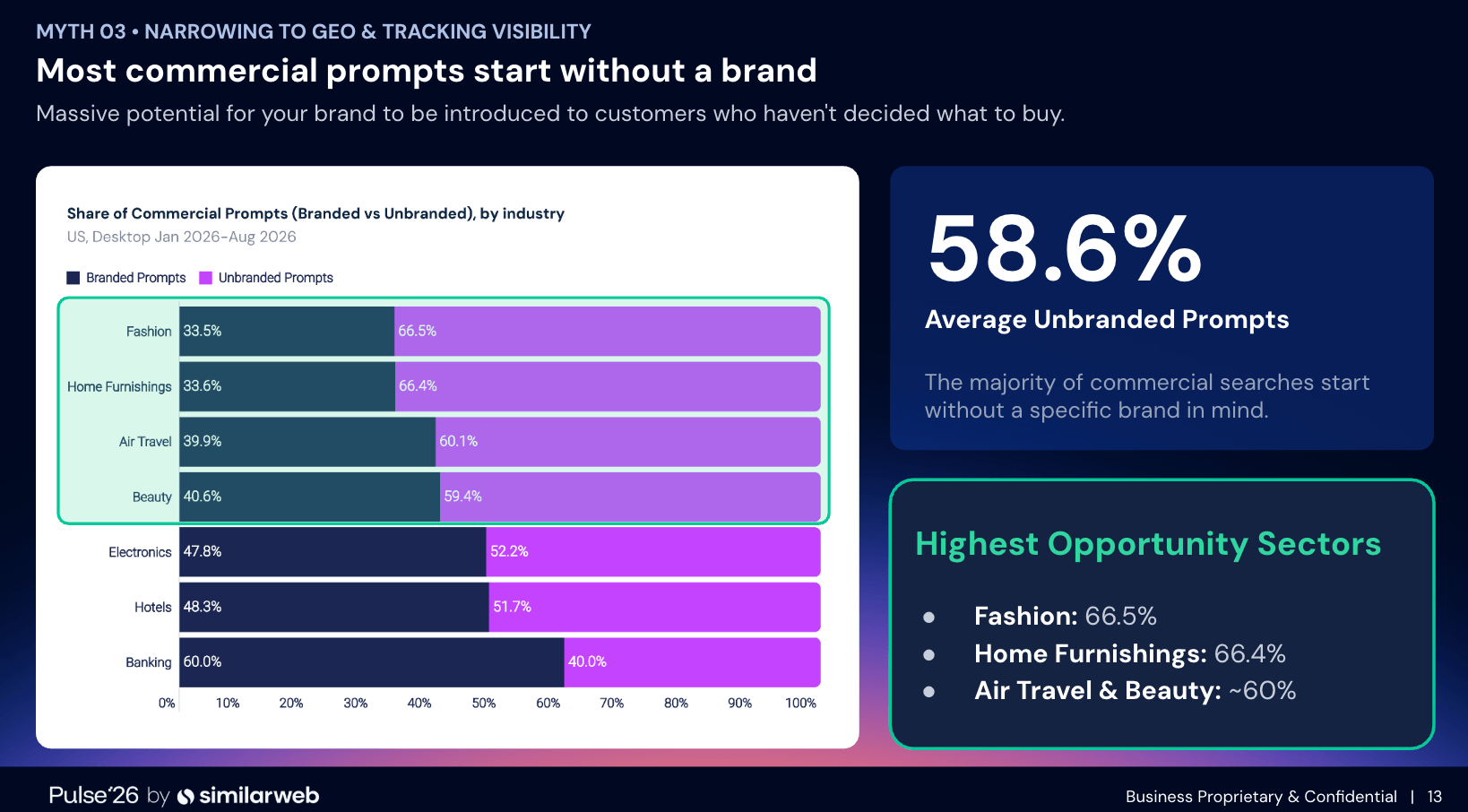
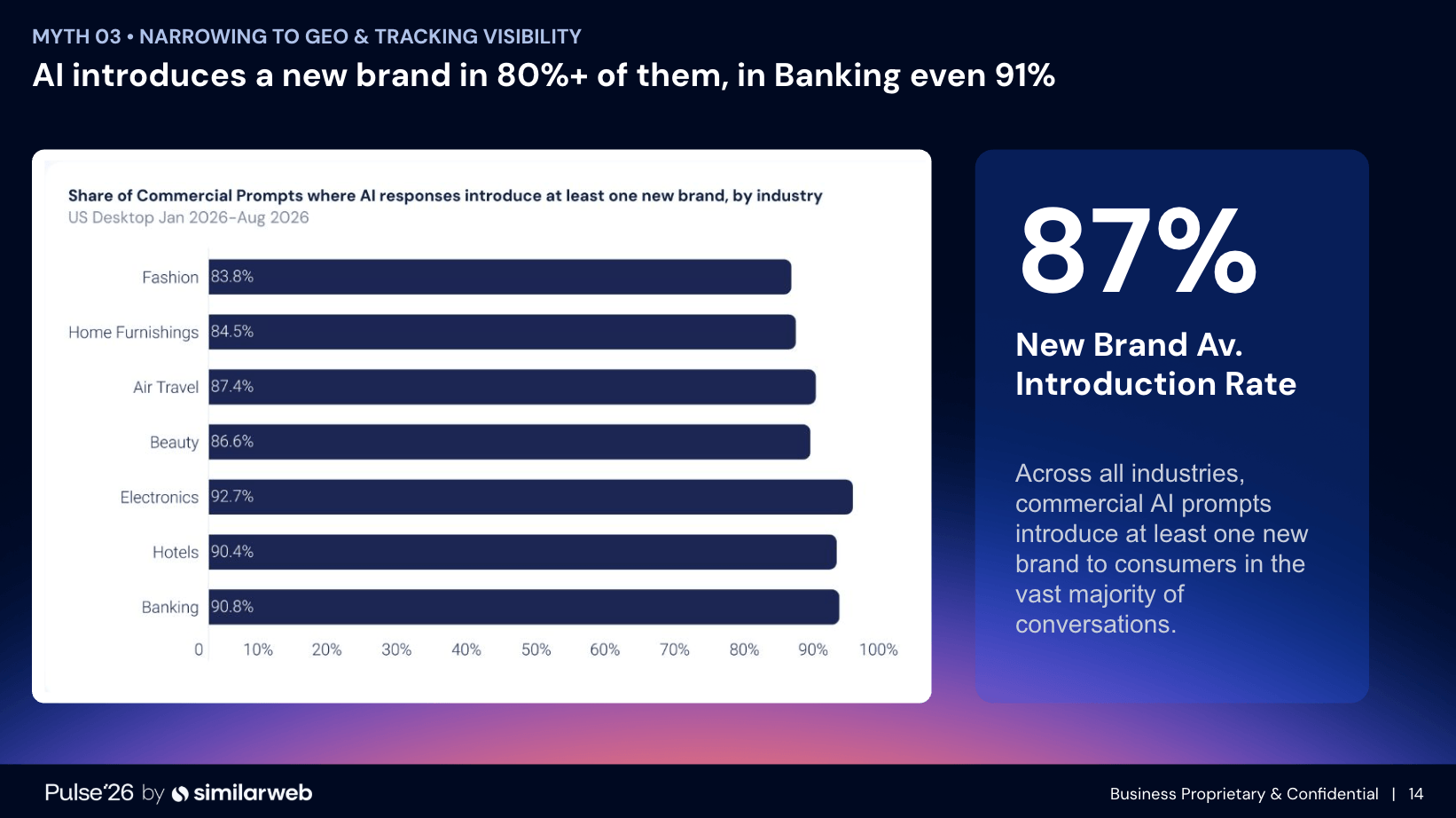
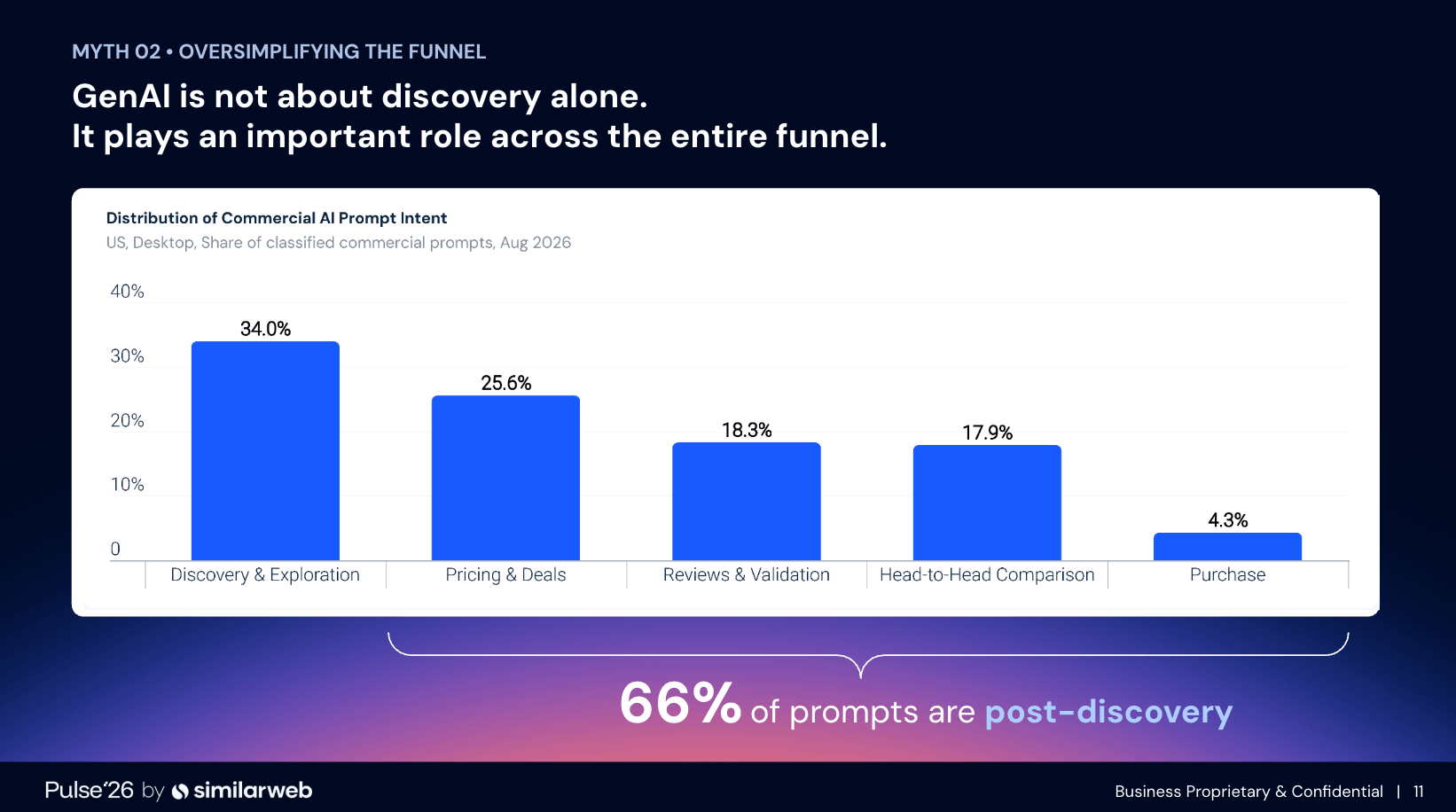
Yes. Similarweb prompt clickstream data shows 58.6% of commercial prompts start with no brand in mind, and AI introduces another brand in 87% of commercial conversations. With 66% of prompts coming after the discovery stage, AI covers the full funnel, not just the top of it.
Marta Sułkiewicz (VP Enterprise Solutions) and Andrew Bonnici of Similarweb shared findings from real user prompts, the questions people type into AI assistants. The focus was commercial prompts: questions in shopping and buying categories such as beauty, fashion, home furnishings and air travel. Three numbers carry the argument:
AI also reshapes who gets considered. In Similarweb’s skincare prompt data, The Ordinary was the brand customers mentioned most (8.1% of conversations), but CeraVe was the brand AI recommended most. CeraVe was recommended in 27.8% of conversations, about seven times its share of questions.
The full report, “The Digital Blindspot,” is coming soon. Stay tuned.
Action: stop treating AI as a top-of-funnel line item. Map where your category’s prompts fall across the funnel and fund the stages that matter.
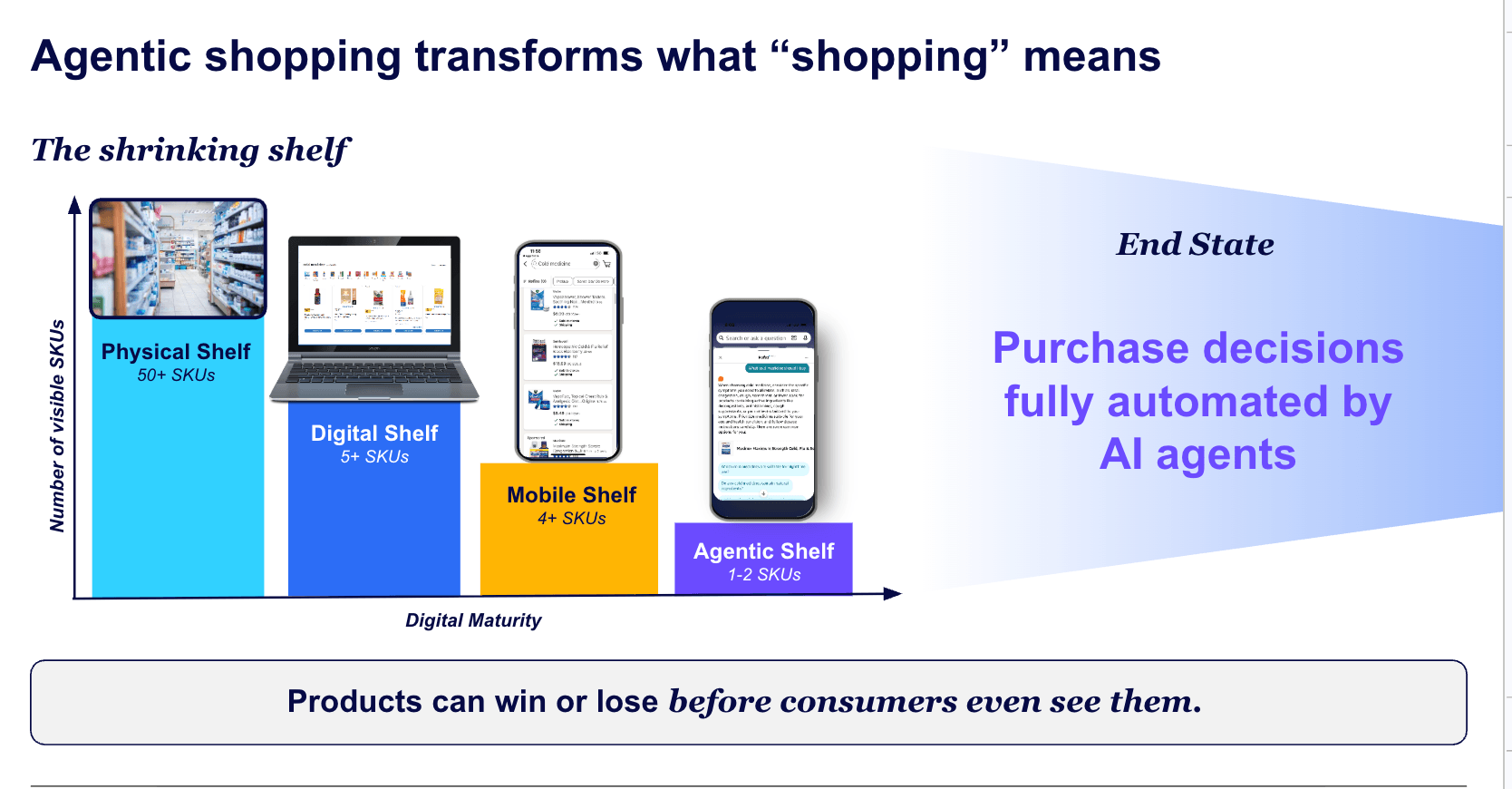
When an AI agent recommends on a customer’s behalf, it shows one or two products. By NIQ’s count, a physical shelf shows 50 or more products, a digital shelf five or more and a mobile shelf four or more. An agentic shelf, where an AI agent chooses, shows one or two. Being the recommended answer now decides sales.
At the event, Troy Treangen, Chief Product and AI Officer at NielsenIQ, framed it as a shrinking shelf. The scale of influence is already large: 55% of consumers say AI recommendations at least sometimes influence their household and grocery purchases, according to NIQ’s Consumer Outlook (October 2026), a survey of more than 21,000 consumers in 31 countries.
Troy’s line that stuck: products can win or lose before consumers even see them. NIQ and Similarweb are building Agentic Commerce Measurement, a joint solution that connects what shoppers ask AI to what they buy. It combines NIQ’s sales and product data with Similarweb’s real prompt and clickstream data, and the first release is planned for December 2026, covering US facial skin care on ChatGPT.
Action: audit your top products as an AI agent would see them. If a product’s data is thin or inconsistent, it will not make the shortlist of one or two.
Customers now move across more touchpoints, and their questions are longer and richer. Google reports that questions in AI Mode are about three times longer than in traditional search. The journey is harder to see, but what customers want from your brand has not changed.
At Pulse 26, Alexandros Fragkos of Google shared the 3x figure from the Gemini team’s view of AI Mode and added that longer queries carry more context, which means more of the decision happens before any click.
Danielle Deighton, Digital Analytics Manager at Boots, offered the corrective: “more data doesn’t automatically mean better understanding.” Her answer is to democratise data across the organisation, so every person works from the best and most accurate data. Insight turns into action, and action into value, faster.
Nathalie Horley, Director of Brands at Kingfisher plc, shared real consumer notes as evidence. She called AI a great equaliser, and no substitute for creativity.
Action: pair new measurement with old discipline. Track the AI-influenced path, and keep investing in the clear brand promise customers have always wanted.
Most GEO work starts from a list of guessed prompts, each given equal weight. That is the wrong starting point. Real prompt data shows which topics matter most to customers and in what proportion, so brands can focus effort where demand actually sits.
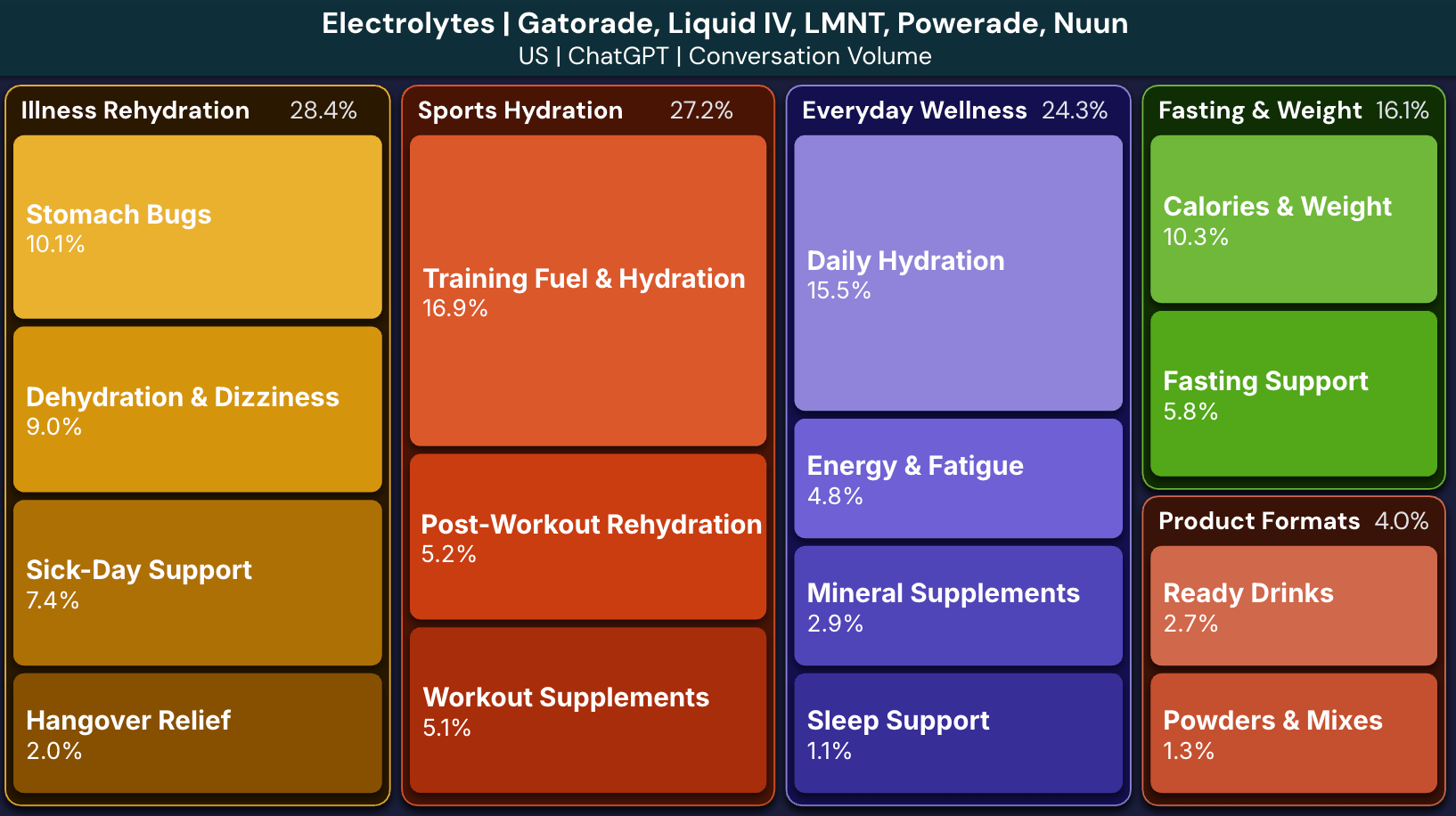
GEO, or generative engine optimisation, means getting your brand seen in AI answers. At the event, Jonny Bentwood, Chief Data and Analytics Officer at Golin Ketchum, and Priyesh Patel of Similarweb used anonymised, aggregated data from millions of real AI conversations to show how uneven real demand is. The data comes from Similarweb’s panel of real user behaviour, which also provides clickstream data, so the findings reflect what people actually do rather than modelled or synthetic prompts.
Here is how conversation volume about electrolytes split in the US on ChatGPT:
| Topic | Share of conversation volume |
|---|---|
| Illness rehydration | 28.4% |
| Sports hydration | 27.2% |
| Everyday wellness | 24.3% |
| Fasting and weight | 16.1% |
| Product formats (ready drinks, powders and mixes) | 4.0% |
Source: Similarweb, US, ChatGPT, electrolytes category conversation volume.
A team that guessed “best electrolyte powder” prompts would cover the 4.0% slice and miss the other 96%. The biggest topics are about needs, such as recovering from a stomach bug, not about product formats. Jonny called generative AI a window into your customer’s soul: it shows what people actually want, in their own words.
Action: build your prompt set from real demand and weight each topic by volume. Do not use synthetic prompts as a starting point.
AI visibility is a team sport. It needs shared KPIs across brand, content, product, data and commercial teams, because what AI says about a brand reflects the whole business, not one channel.
At Pulse 26, the panel on the new AI visibility economy began with a boardroom question: what is AI saying about our brand? Three answers stood out:
Rice Tong of Similarweb, who moderated, closed on the point that matters for planning: shared KPIs across five functions, not five separate scorecards.
Action: pick two or three KPIs that all five teams report against, such as brand presence in answers and share of recommendations.
ChatGPT is moving from helping people research to helping them buy. Its 1.2 billion weekly active users (source: OpenAI) bring a goal and context, and often move from first question to final choice in one conversation. Brands need to show up across organic answers, product feeds, ads and sponsored agents.
On stage, Stephanie Tran, Client Lead for ChatGPT Ads at OpenAI, described the surfaces brands can use: organic answers for exploring, shopping to compare products, apps for interactive services, and ads as separate, labelled sponsored messages. Sponsored agents are AI assistants that let customers talk directly with your brand.
Organic visibility in ChatGPT cannot be bought, which is why the product data underneath matters. Stephanie’s setup list for brands starts with allowing OpenAI’s search crawler, OAI-SearchBot, to read your site, and setting up product feeds, the structured files that give AI accurate product details.
Stephanie’s close: the decision is the opportunity.
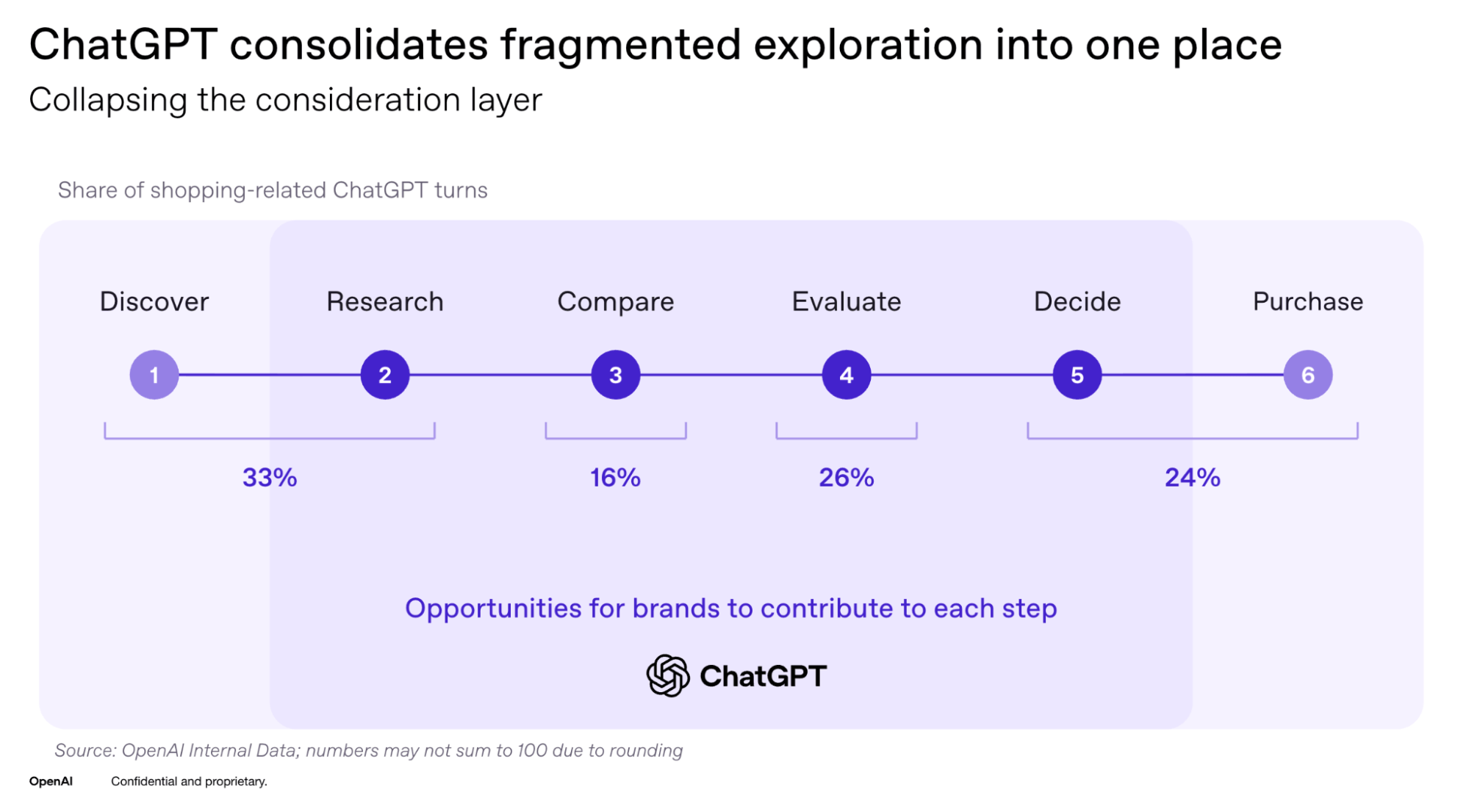
Action: treat your product feed as a growth asset. Accurate, complete product data is what lets AI recommend you with confidence.
Pulse 26 left marketers with three lessons for 2027 planning:
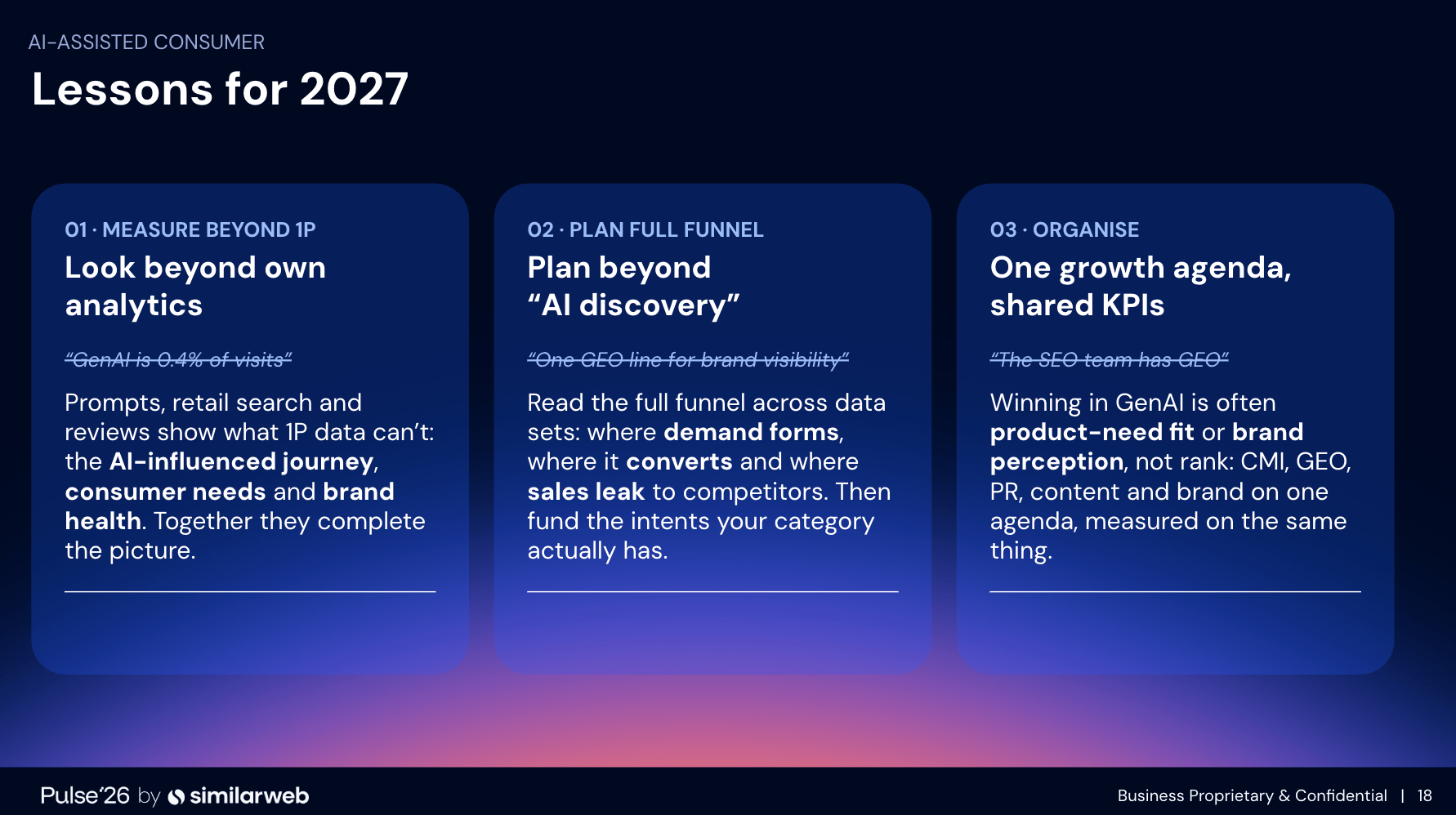
2027 planning checklist
The consumer journey is no longer a straight line. It can start in an AI conversation, move through search, reviews and retailer pages, and end on a brand’s site or a marketplace, often in a different order each time. Teams that measure only their own site see the last step and miss the rest.
Similarweb connects real AI prompts to clickstream data, which tracks the path from AI answer to site visit to checkout. That shows where demand forms, where it converts and where it leaks to competitors. Accurate measurement is what makes everything else possible. For deeper reading, see Similarweb’s analysis of how AI is changing the consumer buying journey, the latest generative AI statistics and the AI impact on retail.
Every session at Pulse 26 landed on the same point from a different direction. Customers are deciding inside AI conversations, AI is adding brands they had not considered, and last-click reporting shows a fraction of it. The AI customer journey is not a new channel to add to the plan. It is the place where the plan is won or lost.
For 2027, measure beyond clicks so you can see the journey. Invest in product data that earns a place on a shelf of one or two. Get your teams aligned so what AI says about your brand reflects one agenda, not five.
If your analytics say AI drives under 1% of your visits, they are not measuring AI. They are measuring the last click.
The AI customer journey is the path a customer takes when AI tools are part of research, comparison and decision. It can start in an AI conversation, move through search, reviews and retailer pages, and end on a brand’s site or marketplace, often in a different order each time.
Last-click attribution credits only the final link before a visit. Customers often research in an AI conversation, then arrive through search or direct, so the AI step goes unrecorded. Similarweb data shows under 1% of visits by last click but about 10% of UK retail product-page visits following an AI conversation within 30 minutes.
No. Similarweb prompt data shows 58.6% of commercial prompts start with no brand in mind, but 66% of prompts come after the discovery stage. Customers use AI to compare, evaluate and decide, as well as to discover.
GEO, or generative engine optimisation, is the practice of getting your brand seen and recommended in AI answers. It works best when built on real customer prompts weighted by volume, not on guessed prompt lists.
Use a pre-visit window, such as the 30 minutes before a visit, and combine prompt data, retail search and review data with your own analytics. Agree shared KPIs across brand, content, product, data and commercial teams.
An AI agent is software that acts on a customer’s behalf, such as researching, recommending or choosing a business. Joey Lai of Mastercard Services expects the question to shift from whether AI cites your brand to whether an agent chooses it.

by Liat Sagiv
Senior Product Marketing Manager - Ad Intel
Liat is a product marketer with 7+ years of experience shaping go-to-market and marketing strategies across B2B technology companies. At Similarweb, she leads product marketing for Ad Intelligence.
Give it a try or talk to our insights team — don’t worry, it’s free!