
What Is Retail Intelligence? How It Works and Why It's Essential to Digital Commerce
by Ida Lorenz12 Min.
Oct 19, 2026
 Marketing Intelligence
AI search is changing how consumers discover, research, and make purchasing decisions, and for marketers, the rules are being rewritten in real time.
I recently hosted a webinar on this topic alongside my colleague Harel Amir, Head of Product and Business at Ad Intelligence, and Jonathan Bar Vardi, Head of Strategy at Natural Intelligence, one of the top three spenders on ChatGPT ads globally. Together, we covered the state of the AI search landscape, what Similarweb’s real user data reveals about how advertising is working across ChatGPT, Google AI Mode, and Google AI Overviews, and what it actually looks like to run and optimize campaigns on these new surfaces.
What follows is a structured summary of everything we shared.
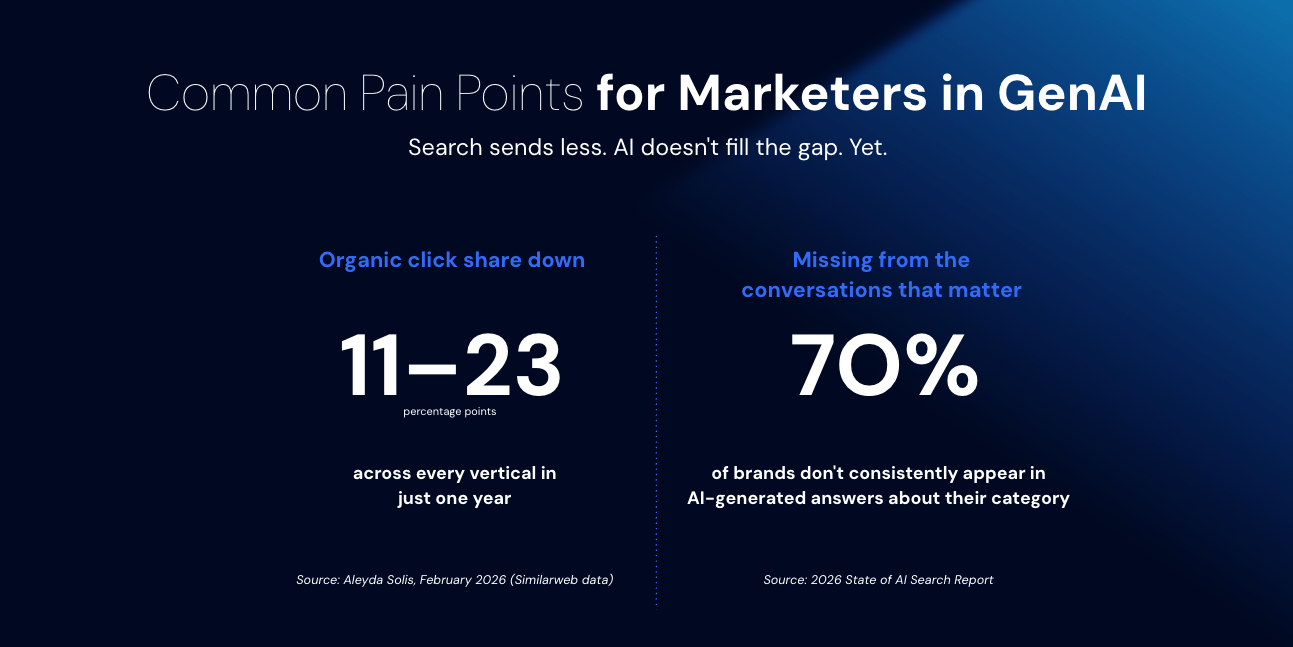
The starting point for understanding why AI advertising matters is recognizing the twin pressures marketers are already under.
First, organic click share is down 11% to 23% across almost every vertical. People are visiting websites less and less.
Second, even brands investing heavily in AI visibility are finding that most don’t consistently appear in AI-generated answers within their category. Many are not appearing in the conversations that matter.
A lot of effort is being put into visibility, but the results aren’t yet there.
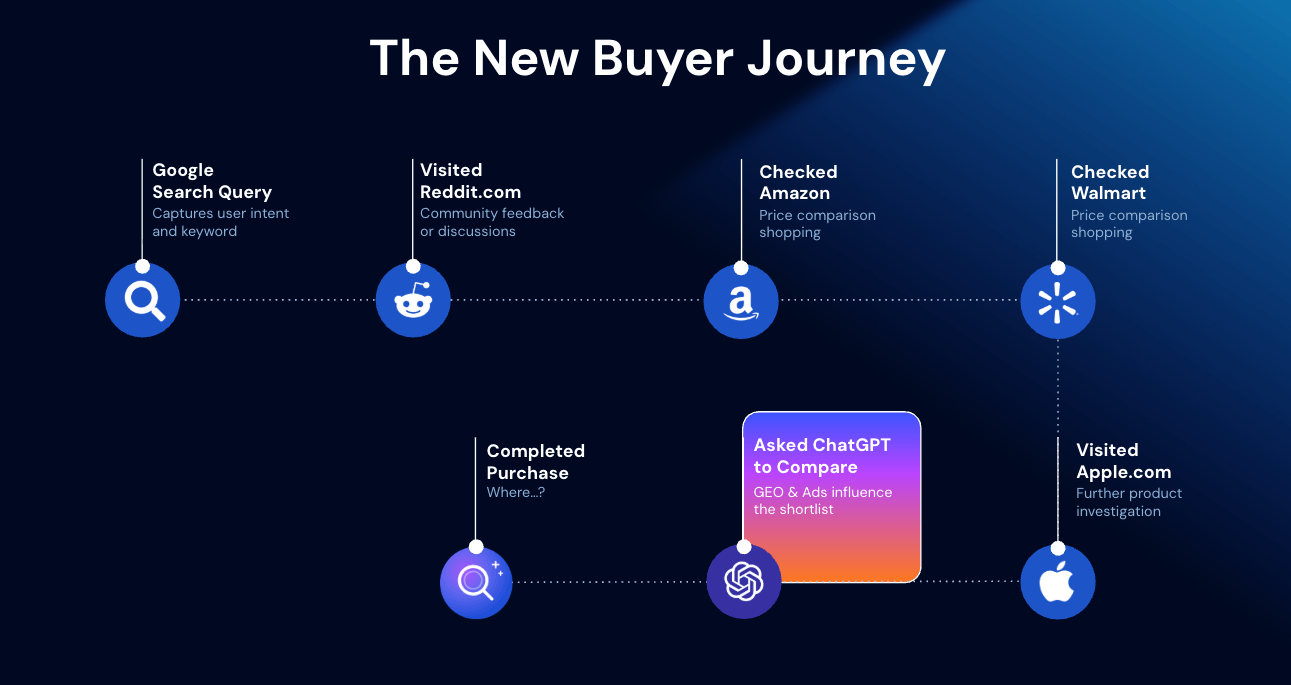
The buyer journey has gained a new and significant stage.
Where consumers once moved from Google search to community feedback on Reddit, then to price comparisons on Amazon or Walmart, and finally to a brand’s website, many now turn to ChatGPT as a trusted advisor along the way.
For some, the journey begins in ChatGPT and ends on a retailer or brand website, without a single intermediary visit before the purchase decision is made. That’s what makes this channel so important.
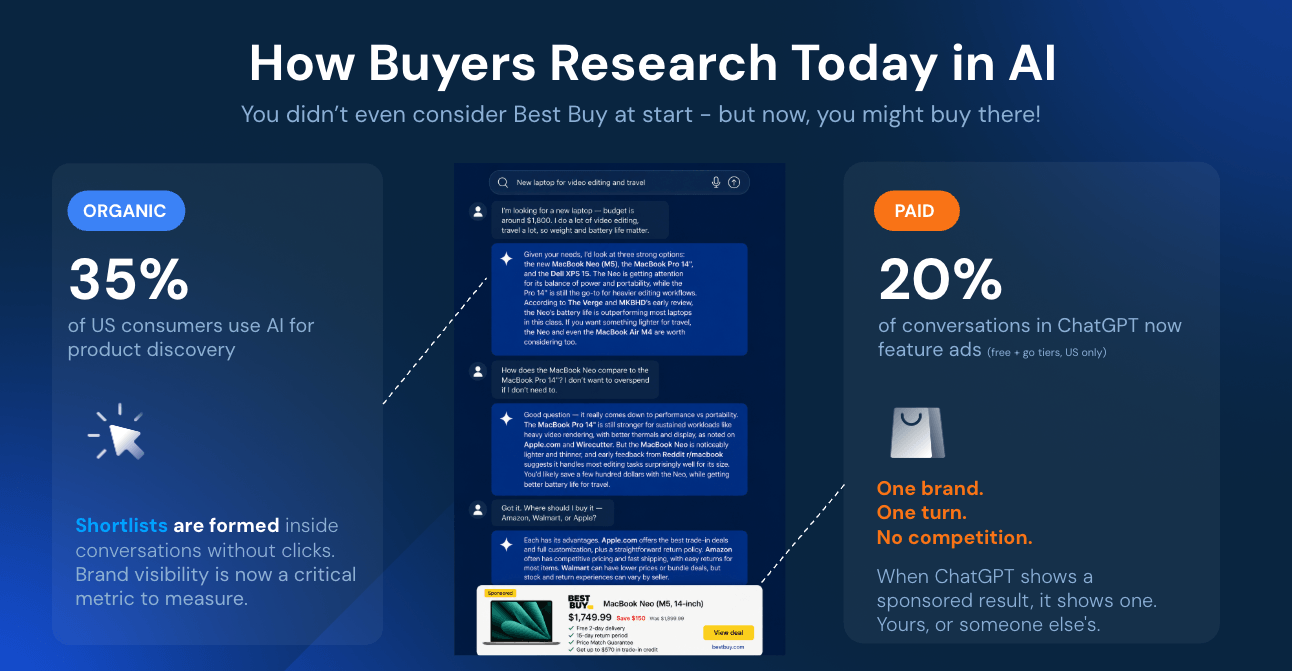
It’s where shortlists are formed, comparisons are made, and recommendations are given in the context of a full, rich conversation. Unlike a keyword search, the user is sharing their budget, their needs, their constraints, and the brands that appear in that conversation make the consideration set.
The brands that don’t, don’t.
35% of US consumers now use AI for product discovery, and that number is growing. When your brand shows up in an AI-generated answer, which is what traditional search marketing is designed to achieve, few of those appearances result in someone clicking through to a website. People tend to read the AI’s answer and move on without clicking anything.
So while it’s still worth investing in being mentioned and recommended by AI tools, that visibility alone doesn’t mean your site will get traffic from AI.
That gap is where paid advertising enters the picture.
Ads on ChatGPT offer two things that organic search can’t. CPM campaigns allow brands to join conversations they weren’t part of organically, filling the visibility gap and appearing in front of users at the moment their shortlist is forming. CPC campaigns go further, driving the user directly to the brand’s website with a specific, relevant offer tied to the context of the conversation. Brands running ads on ChatGPT are already seeing peak CTRs of 5.4%, demonstrating that this channel is sending real, meaningful traffic back to websites.
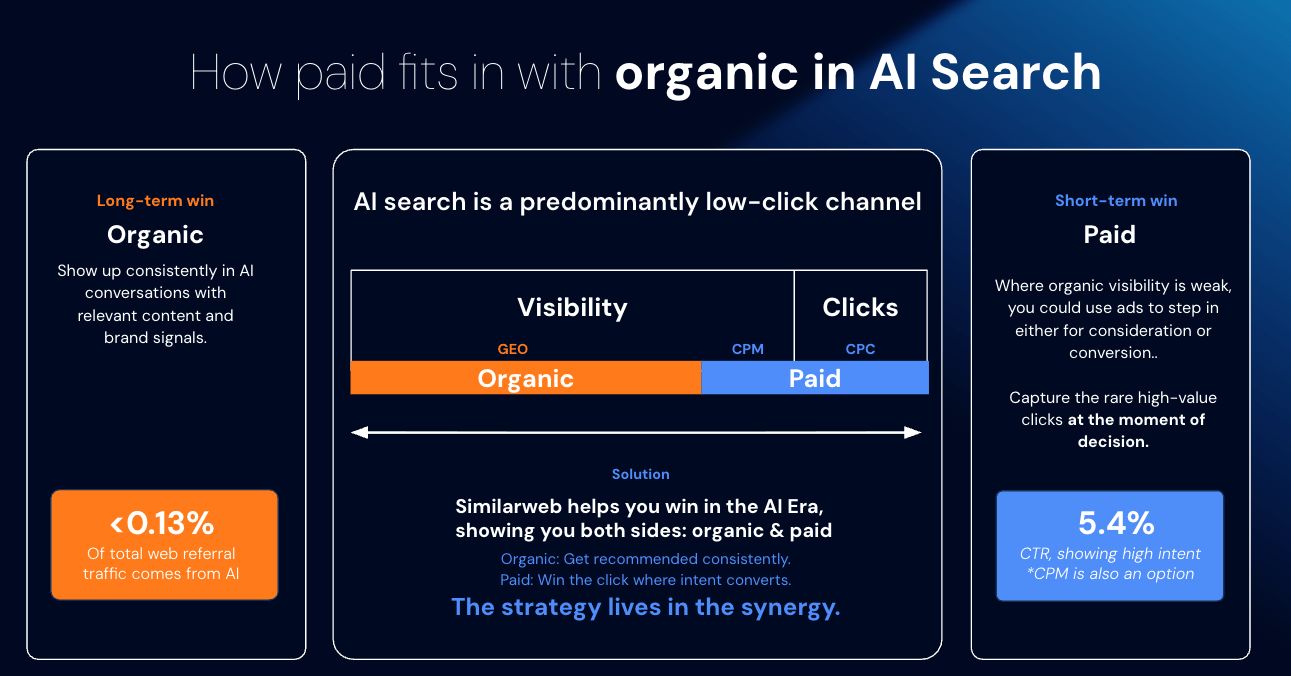
The overarching message is that organic and paid in AI search are not alternatives. They are complements.
Just as they have always been in traditional search.
The winning strategy is to get recommended consistently through organic AI presence, and to win the click and appear in conversations you weren’t part of through paid. One builds long-term visibility, the other captures the high-value moment of decision.
Together, they represent the full picture of what it means to compete in AI search.
My colleague Harel Amir leads our Ad Intelligence product and research, and the following insights come from our AI ads report, based on real user behavior.
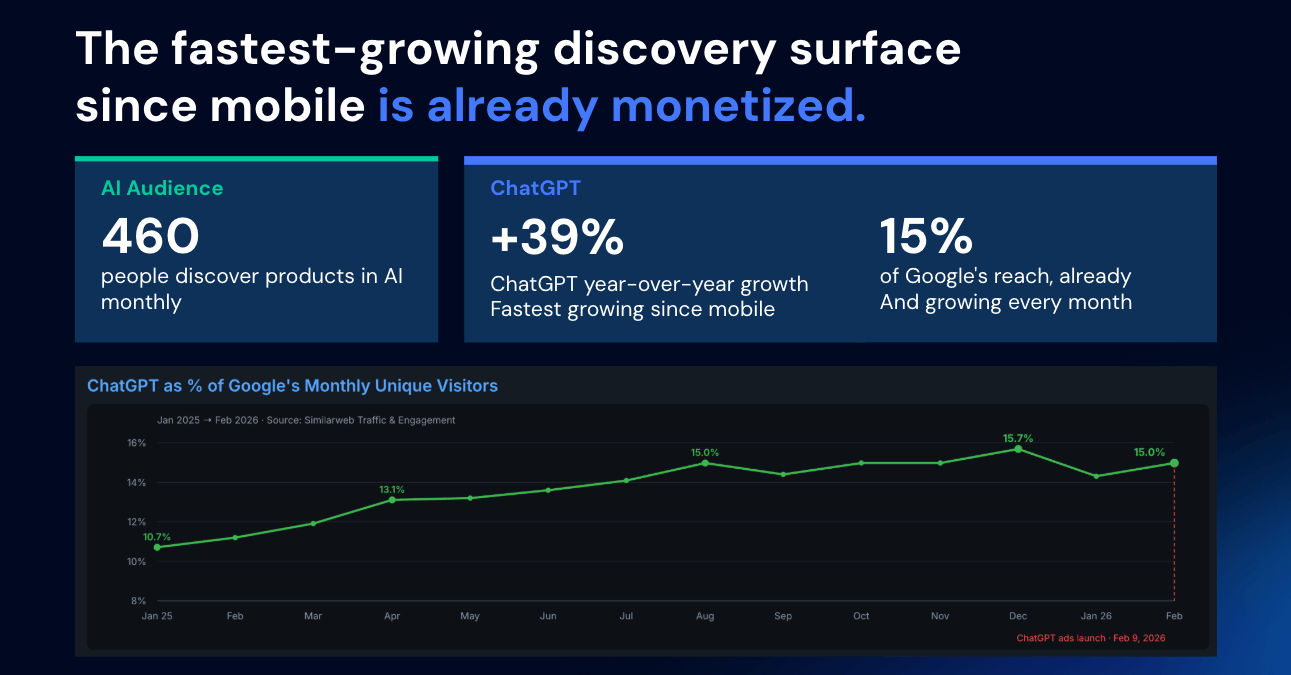
ChatGPT is no longer a niche channel. Similarweb AI Search Intelligence estimates that around 460 million people discover products inside ChatGPT conversations every month, and the platform is growing at 39% year-over-year, putting it at roughly 15% of Google’s search reach.
That growth is happening while Google search is essentially flat. The fastest-growing discovery surface since mobile is already monetized, and the window to move early is open now.
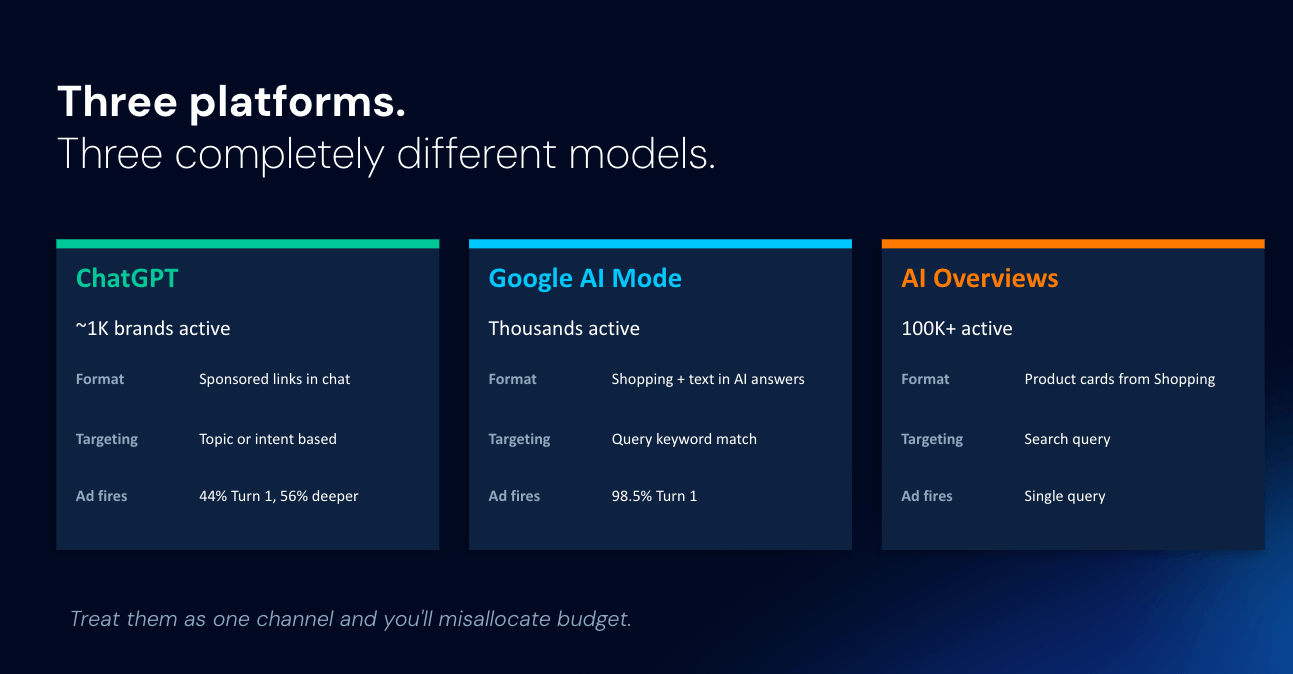
One of the most important things Harel’s research highlights is that ChatGPT, Google AI Mode, and Google AI Overviews are not the same channel wearing different clothes. They behave in fundamentally different ways, and treating them as one will lead to misallocated budget.
ChatGPT has around 1,000 active brands, uses sponsored links in chat, and targets based on topic or intent.
Critically, only 44% of ads fire on the first turn, 56% appear deeper in the conversation, once intent has developed.
Google AI Mode has thousands of active brands but behaves much more like traditional search. Ads are keyword-matched, firing almost entirely on the first turn (98.5%), with very little conversational depth.
AI Overviews operates at a massive scale, over 100,000 active brands, auto-populated from Shopping feeds, targeting the search query.
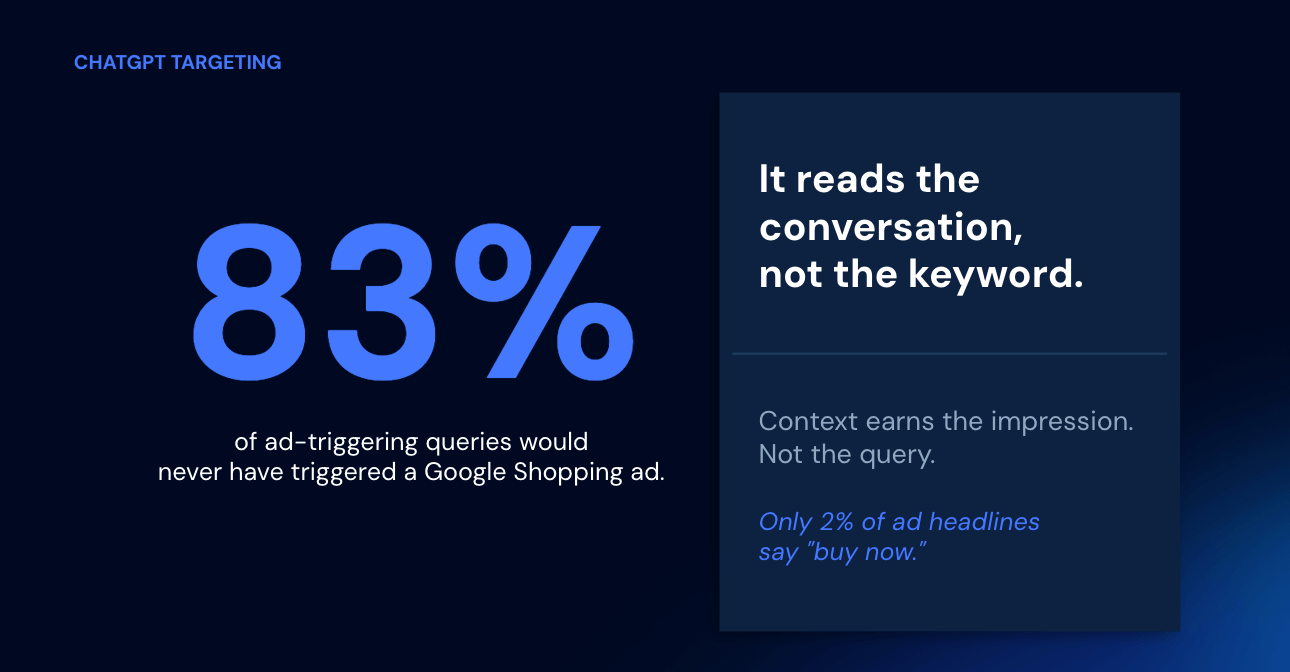
The defining characteristic of ChatGPT ads is that the platform reads the entire conversation, not just the last query. 83% of the prompts that trigger ads would never have triggered a Google Shopping ad.
The last message before an ad fires might be a single word, a “yes,” or a conversational reply, nothing that could be mapped to a keyword.
Context earns the impression, not the query. Notably, only 2% of ad headlines say “buy now,” reflecting how different the tone and approach need to be on this surface.
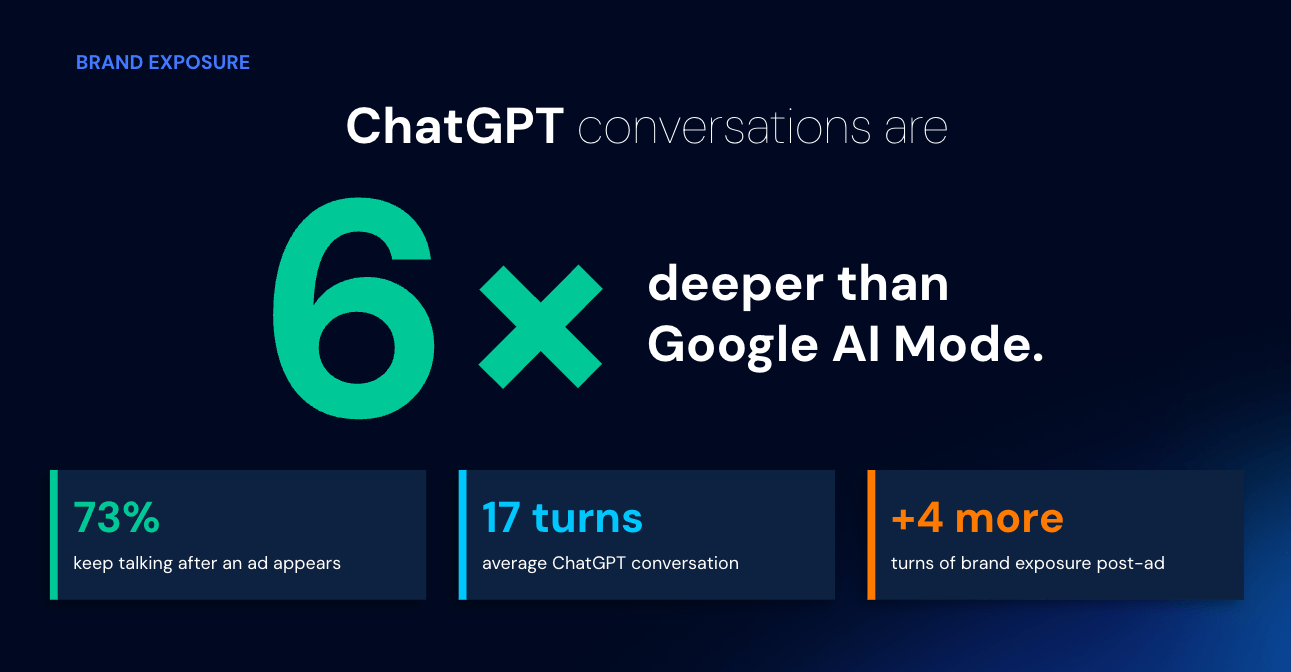
ChatGPT conversations are six times deeper than Google AI Mode, averaging 17 turns. When an ad appears. 73% of conversations continue for at least 4 more turns afterward, meaning the ad does not kill the conversation or damage trust.
It becomes part of an ongoing exchange, giving brands a level of post-exposure presence that no other format currently offers.
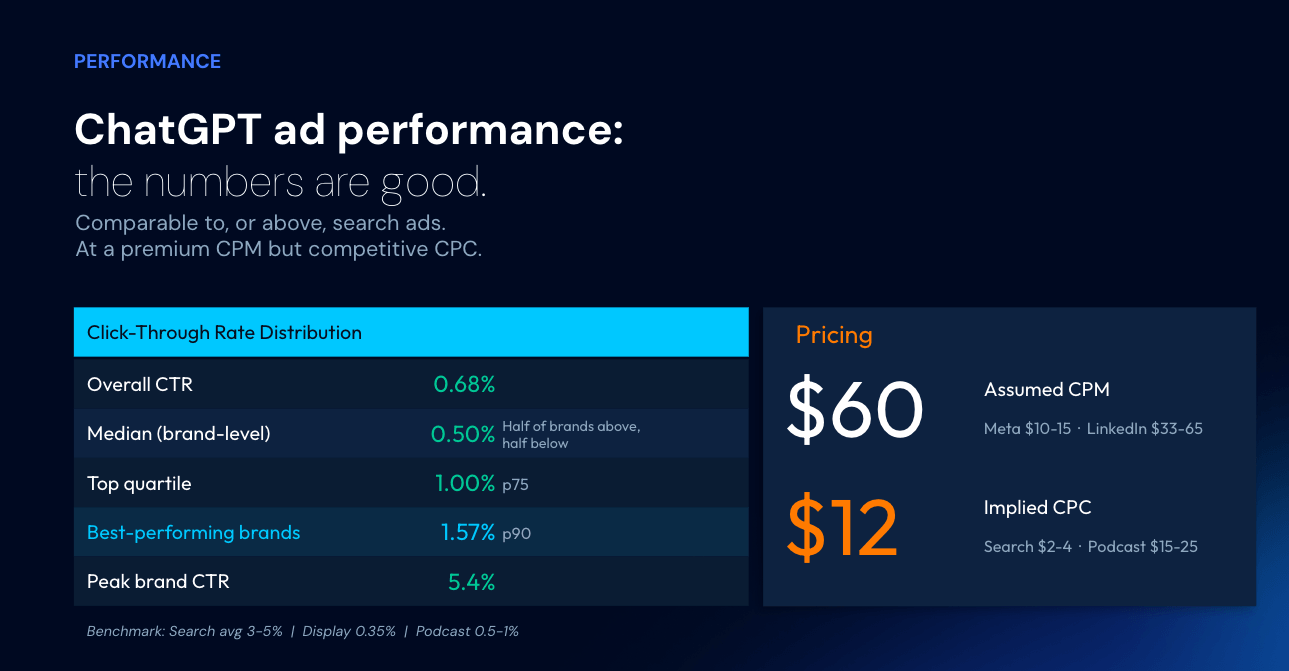
The numbers are encouraging. The overall CTR sits at 0.68%, with the median brand-level CTR at 0.50%, the top quartile reaching 1.0%, and peak performance hitting 5.4%.
For context, display averages 0.35% and podcasts 0.5–1%. The implied CPC, based on an assumed $60 CPM, works out to around a $12 premium compared to search’s $2–4, but is competitive when optimized toward CPC goals.
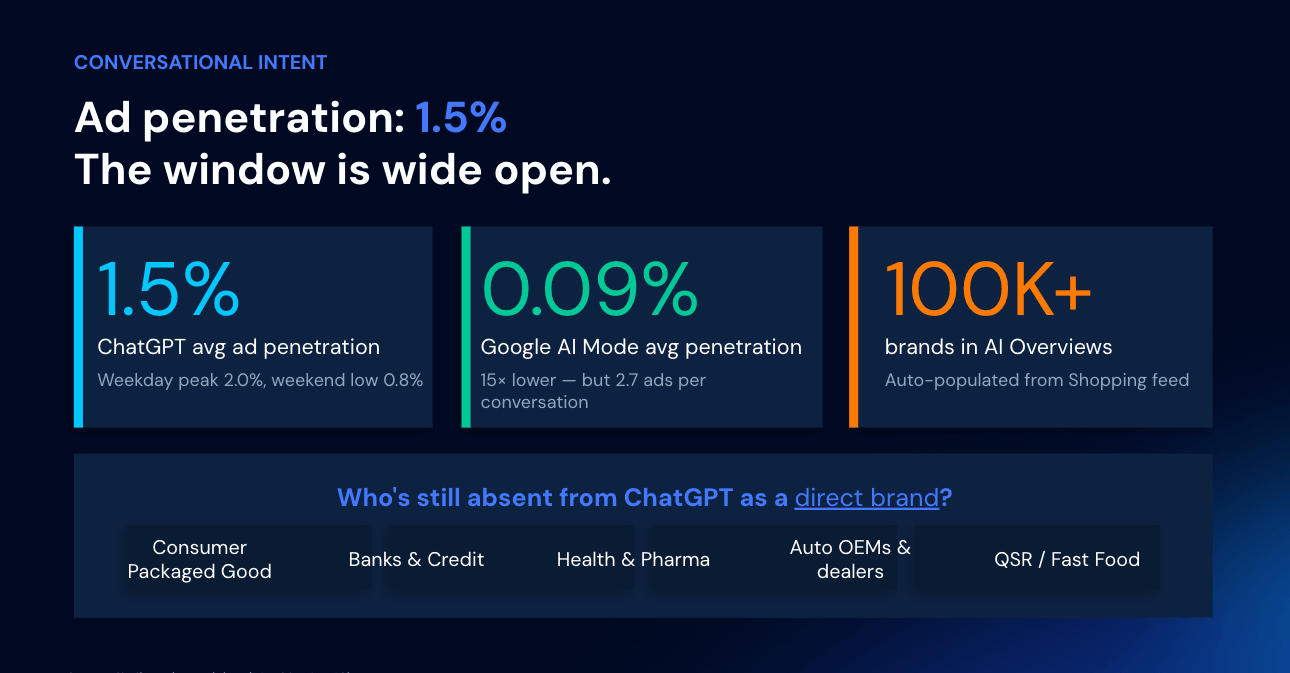
Globally, only 1.5% of ChatGPT conversations currently include ads, peaking at around 2% on weekdays and dropping to 0.8% on weekends.
Google AI Mode sits even lower at 0.09%.
That 1.5% figure illustrates how much room for growth remains. Several major categories, consumer packaged goods, banks and credit, health and pharma, auto OEMs, and fast food are still entirely absent from ChatGPT as direct advertisers, representing significant open space for brands willing to move first.
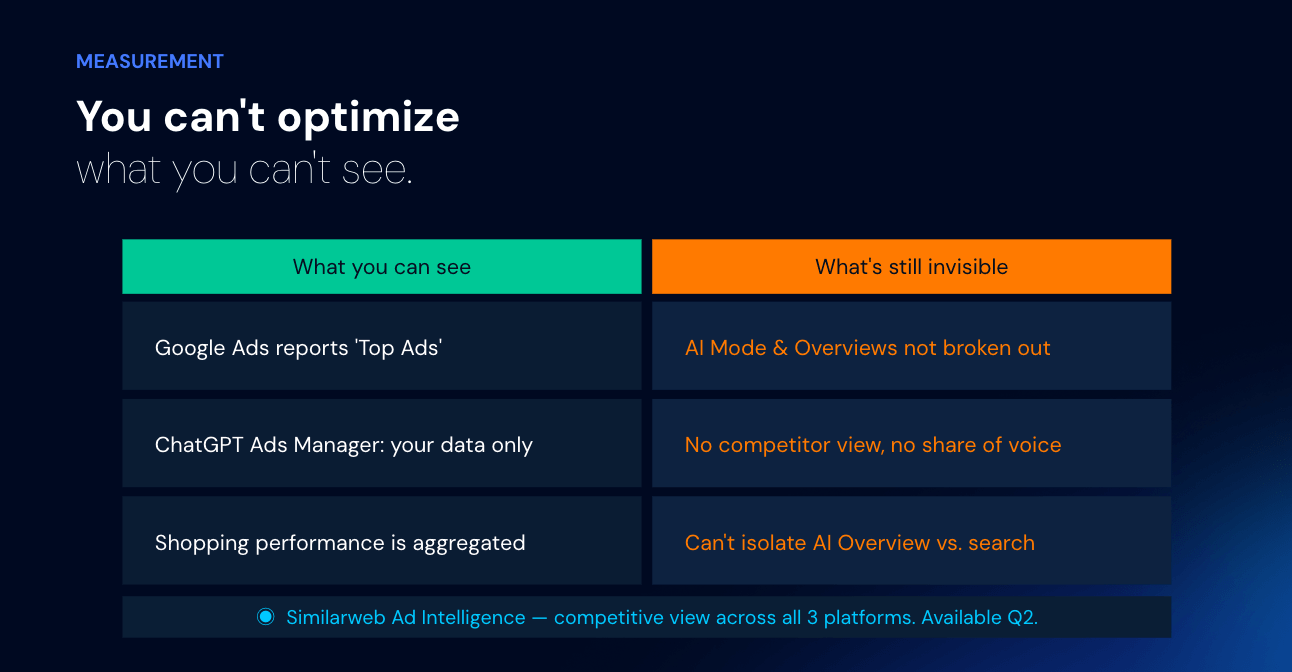
The hardest part of operating in this channel right now is the data you don’t have.
On Google, AI Mode and AI Overview performance are not broken out from the rest of your campaign reporting. That means you can’t isolate what served where.
On ChatGPT, the Ads Manager shows you your own data only. No competitor view, no share of voice, no visibility into the conversations your ads appeared in.
Shopping performance is aggregated, making it impossible to isolate AI Overview from standard search results. As Harel puts it, you can’t optimize what you can’t see.
That is the gap that Similarweb is building toward closing.
For Jonathan Bar Vardi and the team at Natural Intelligence, one of the largest spenders on ChatGPT ads since the platform launched, the channel has already proven its value, but has also forced a fundamental rethink of how advertising works.
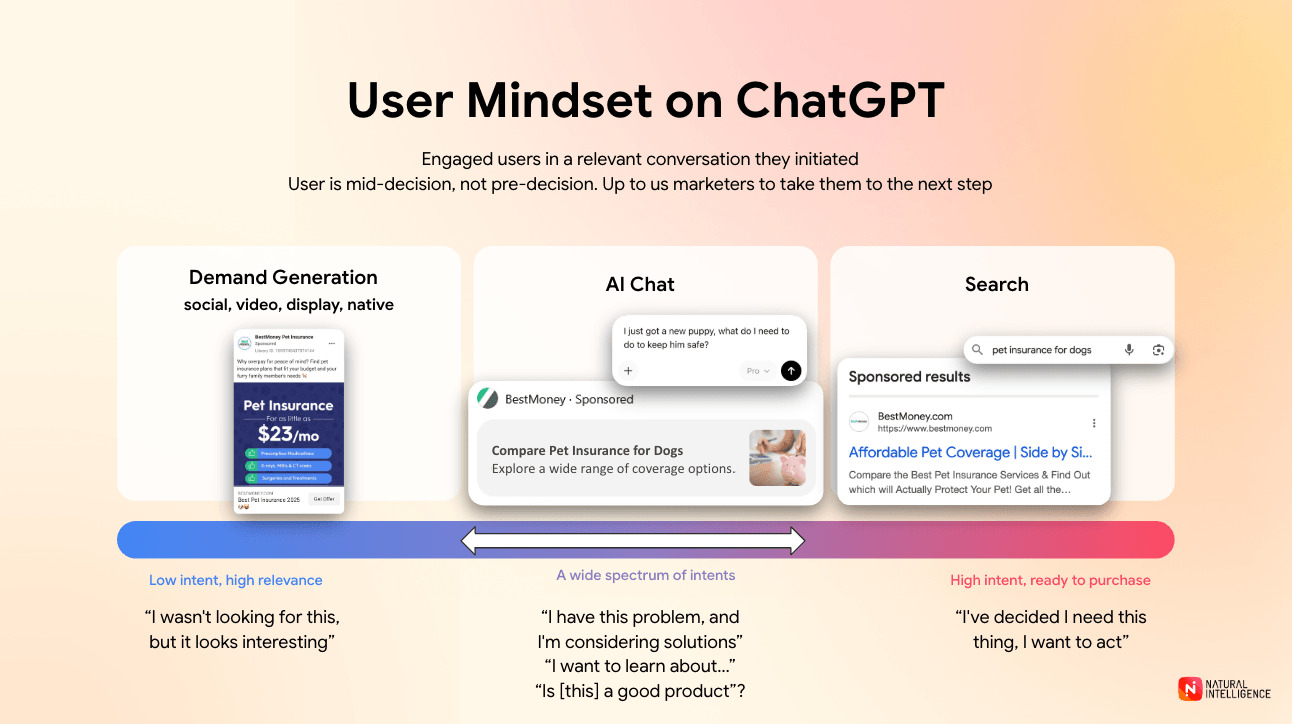
The starting point, as Jonathan framed it, is mindset.
ChatGPT users are not passive scrollers who happen to see an ad, and they are not search users who have already decided what they want.
They sit in a wide spectrum in between. Meaning, mid-decision, engaged in a conversation they started, working through a problem.
The user might be asking whether a product is right for them, trying to understand a category, or comparing options. As Jonathan puts it, the ad is your chance to raise your hand during that conversation and say something, not to interrupt, but to offer the next step at the right moment.
That framing changes everything about how campaigns are structured. The instinct to reach for keywords simply does not apply.
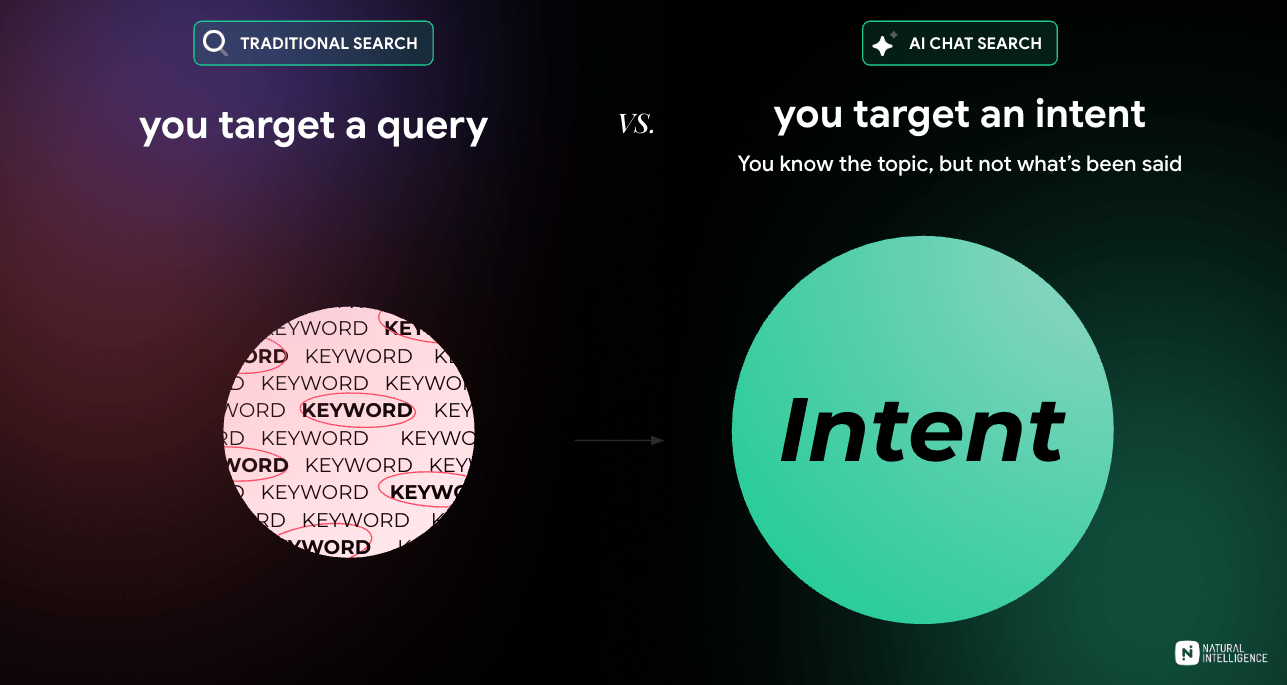
You don’t know what words the user typed, and even if you did, the last prompt before an ad fires is often a single word or a short conversational reply, nothing that would ever trigger a traditional search campaign.
Instead, Natural Intelligence works backward from its most valuable landing pages. What intent does each page actually serve, and how can the ad bridge the gap between that intent and the conversation the user is already having?
Context hints signals given to the algorithm about what topics and conversations are relevant, replacing the keyword list entirely.
On the question of what works, both CPM and CPC campaign types have proven their value, but they serve different purposes.
Jonathan’s advice is to treat these as separate objectives, allocate budget accordingly, and resist the temptation to collapse them into one campaign goal.
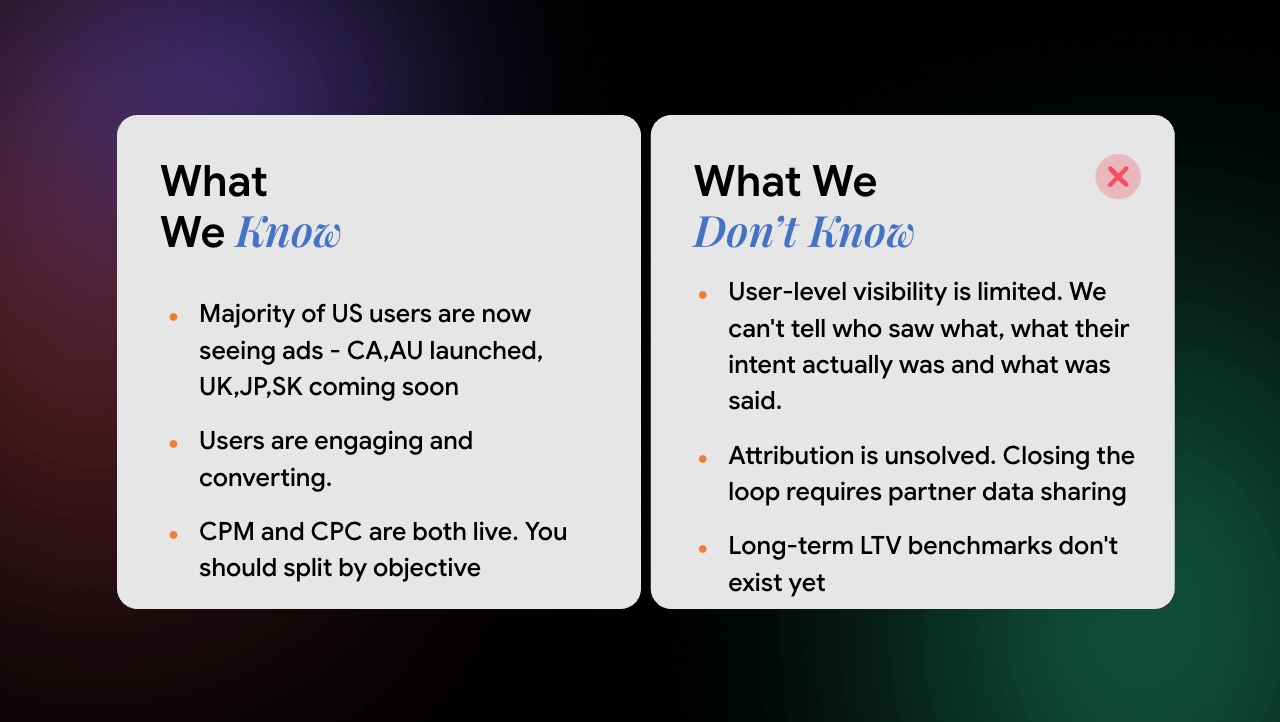
On what remains unknown, Jonathan is direct.
User-level visibility is very limited. Advertisers cannot tell who saw their ad, what the conversation actually contained, or what the LLM said before the ad appeared.
Attribution is unsolved, particularly for CPM campaigns where the exposure may influence behavior without a direct click. And because no one has been running this channel long enough, there are no long-term LTV benchmarks yet.
Nobody knows how these user cohorts will behave over time compared to users acquired through other channels.
AI search is not a future consideration. It is where a growing share of consumer decisions are already being shaped, and the advertising infrastructure to reach those consumers is live today.
The picture that emerges from this webinar is one of a channel that works, with real engagement, real clicks, and real conversions, but that demands a different way of thinking. Keywords give way to intent. Campaigns need clear objectives. Attribution remains unsolved. And the platform is moving fast enough that standing still is itself a strategic choice.
For brands in markets where ChatGPT ads are already available, the early mover advantage is tangible.
Cheaper data, faster learning, and a less crowded environment.
For brands in markets where the rollout is still coming, the time to prepare, mapping intents, understanding the surfaces, thinking about the synergy between organic presence and paid placement, is now.
The conversation between your potential customers and AI is already happening. The only question is whether your brand has a voice in it.
Yes. Natural Intelligence confirmed that users are clicking through and converting, with strong KPIs for a channel this new.
Instead of keywords, you target intent across an entire conversation. ChatGPT reads the full context, so advertisers provide “context hints” rather than keyword lists.
Both work, but for different goals. CPM builds visibility and brand presence, CPC drives measurable traffic and performance. Treat them as separate objectives with separate budgets.
The US is the primary market, with Canada and Australia also live. The UK, Japan, and South Korea are expected next, with broader European and APAC rollouts anticipated later in the year.
ChatGPT serves one brand per ad moment and reads the full conversation. Google AI Mode behaves like traditional search, matching on keywords at the first turn. AI Overviews is a shared moment at a massive scale, auto-populated from Shopping feeds.
Very little. The Ads Manager shows your own performance only, no competitor view, no share of voice, and no visibility into the conversations your ads appeared in. Attribution remains largely unsolved.
It depends on your learning appetite. Only 1.5% of ChatGPT conversations globally include ads, major verticals are still empty, and early movers are collecting data cheaply in a less competitive environment. The question is whether the learning value justifies the investment.

by Liat Sagiv
Senior Product Marketing Manager - Ad Intel
Liat is a product marketer with 7+ years of experience shaping go-to-market and marketing strategies across B2B technology companies. At Similarweb, she leads product marketing for Ad Intelligence.
Give it a try or talk to our marketing team — don’t worry, it’s free!