






The Top 100 Most Visited Websites in the USA (August 2026)
by Shai Belinsky10 Min.
Sep 29, 2026
 Ecommerce Intelligence
Two-thirds of consumers worldwide say they look up prices online before deciding where to buy. Online retail runs on that fact: show the wrong price, even for an hour, and your product may lose attention it will never get back.
For this reason, companies use data-backed processes for analyzing market dynamics and price trends to make informed pricing decisions. Sources used for price analysis include competitors’ prices, consumer demand, and data collected via web scraping.
But price intelligence isn’t the raw scrape itself. It’s what happens after that data gets collected: matched to the right products, validated, and turned into something a pricing or category team can act on.
This article defines price intelligence precisely, separates it from the terms it gets confused with most, price monitoring and dynamic pricing, and walks through how the software works, who uses it, and why.
Price intelligence is the systematic collection and analysis of competitor pricing, packaging, availability, and promotional data across the market, structured so a business can benchmark its own position to make better pricing decisions.
In practice, it means continuously tracking what others charge for similar products or services, understanding how their prices change over time, and using that insight to set smarter prices that protect margins while staying competitive.
Mature price intelligence tools built for brands and retailers handle this end-to-end rather than leaving a team to reconcile spreadsheets by hand. That distinction matters more than it sounds. A spreadsheet full of scraped competitor prices is not price intelligence any more than a pile of unsorted invoices is an accounting system.
The value shows up in the structuring: matching your product to the correct competitor equivalent, flagging when a price moves outside a defined range, and rolling thousands of individual data points into a benchmark someone can act on in a pricing meeting.
Price intelligence is a strategic engine that impacts demand, conversion, and sales. Businesses invest in price intelligence for several reasons:
Building customer trust and retention by keeping prices fair, consistent, and in line with customer expectations is not a minor factor in that decision. In McKinsey’s survey of nearly 26,000 consumers across 18 markets, rising prices ranked as the number one cause for concern among shoppers, ahead of inflation-adjacent worries like job security or the broader economy.
Some of these objectives require real-time action. Others require having the data available when a decision needs to be made. See how you compare and prioritize the product pricing alterations that genuinely influence performance.
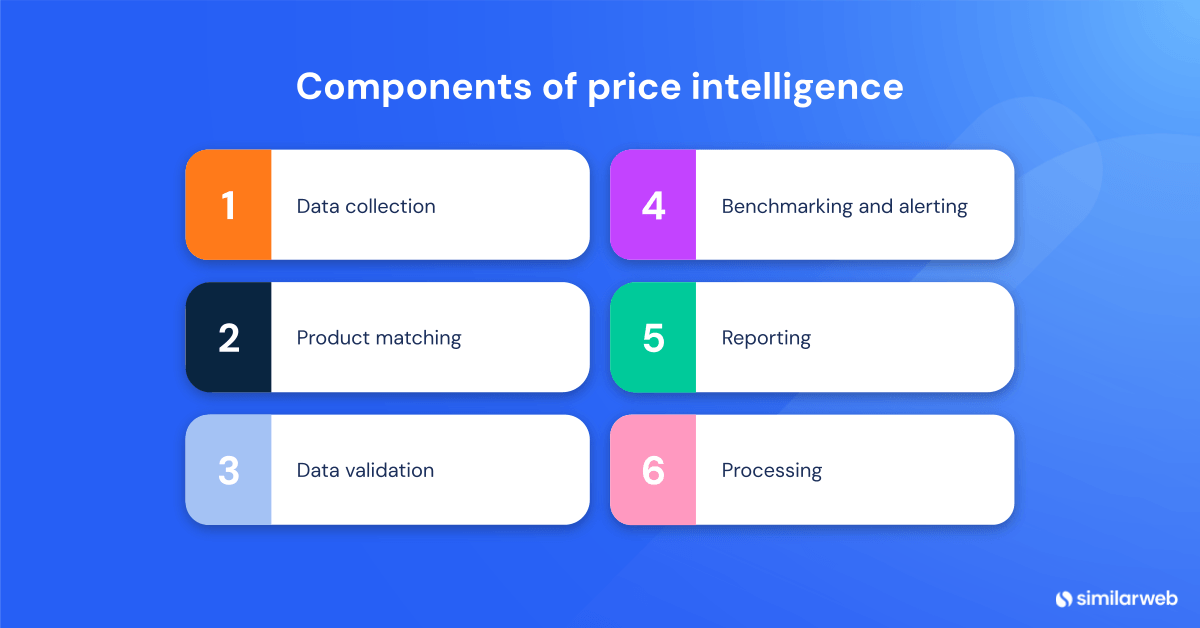
To develop an effective price intelligence capability, businesses should follow a structured process. This is the core of what Similarweb Retail Intelligence does under the hood. The key elements to consider are:
Miss the matching step and your benchmark compares the wrong products. Miss validation and a single scraping glitch looks like a competitor price war. The components are sequential for a reason.
Plus, keep in mind data collection frequency should vary by product rather than sit on one fixed schedule for an entire catalog. This is where most of the operational judgment in the whole system lives.
A high-velocity electronics SKU that a competitor might reprice several times a day needs far more frequent collection than a slow-moving, once-a-month seasonal item. Treating both the same way either wastes crawl budget on the slow mover or leaves the fast mover dangerously stale.
Processing time also plays a major role. Data collected in the morning and processed that afternoon can already be stale by the time a team acts on it, particularly in categories where competitors reprice multiple times a day. So, the collection schedule needs to match the decision schedule, not run on a convenient but disconnected clock.
Use this to classify products before setting crawl intervals, rather than defaulting to one interval for the whole catalog:
These three terms get used interchangeably, and that is the single biggest source of confusion for anyone evaluating pricing tools. They are not the same thing, and pricing analytics is really a fourth, separate layer hiding underneath them. Each layer answers a different question, and most pricing failures trace back to a business buying one layer while believing it got them all.
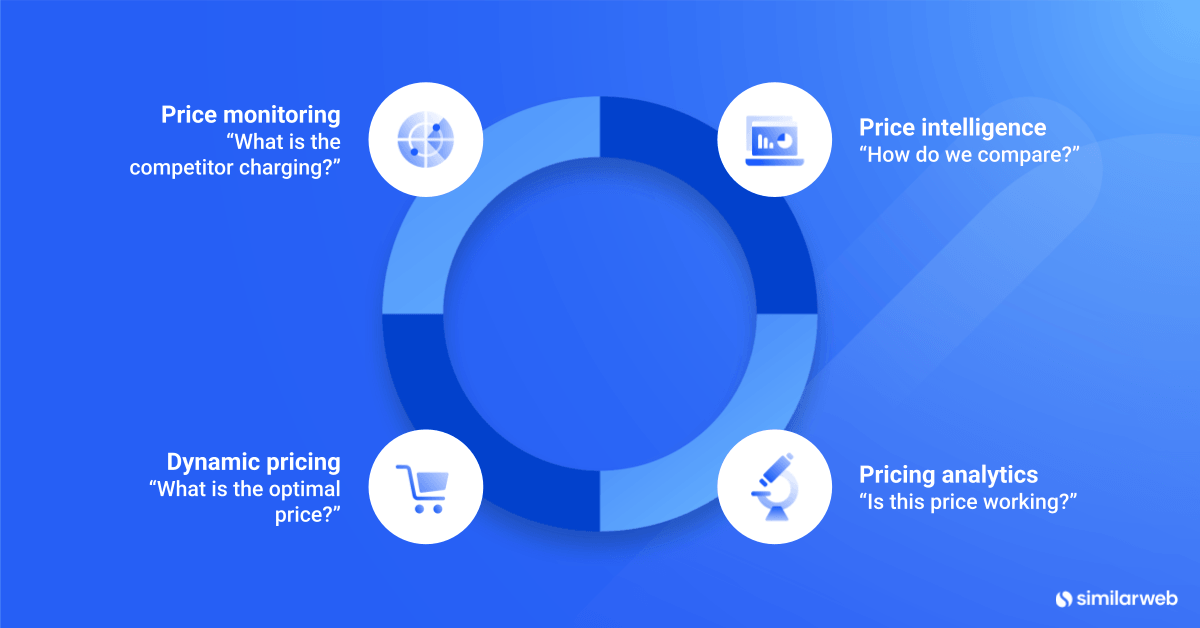
Call it the pricing visibility stack. It has four layers, and each one depends on the one below it:
Layer 1, price monitoring, answers “what price is a competitor or a retailer showing right now?” It is the raw capture layer: a bot visits a page, records a price, and reports it. For a brand, this often involves identifying which retailers are selling which SKU at what price across all their storefronts. Monitoring alone produces alerts and raw numbers, not a strategy. This is why many companies integrate the data directly into their own in-house tools.
Layer 2, price intelligence, answers “what’s happening in the market right now, and how do I compare to it?” It focuses on collecting and monitoring external pricing signals, such as competitor pricing, market trends, discounting behavior, and packaging changes, to inform strategic decisions.
It takes monitoring’s raw output, matches it to the correct products, validates it, and turns it into a benchmark: where you sit relative to your top competitors, by SKU or category, updated on a schedule. It also surfaces competitors you may not have been tracking at all: sellers who turn out to be a close match for your product, or private-label brands quietly competing for the same shelf space.
Layer 3, pricing analytics, answers “is this price actually working?” This is where the view turns inward: instead of just comparing prices, it asks whether those price levels are actually converting, protecting margin, and beating the alternatives, using elasticity analysis (how demand responds to a given price change), win/loss data, and margin analysis rather than just competitive position.
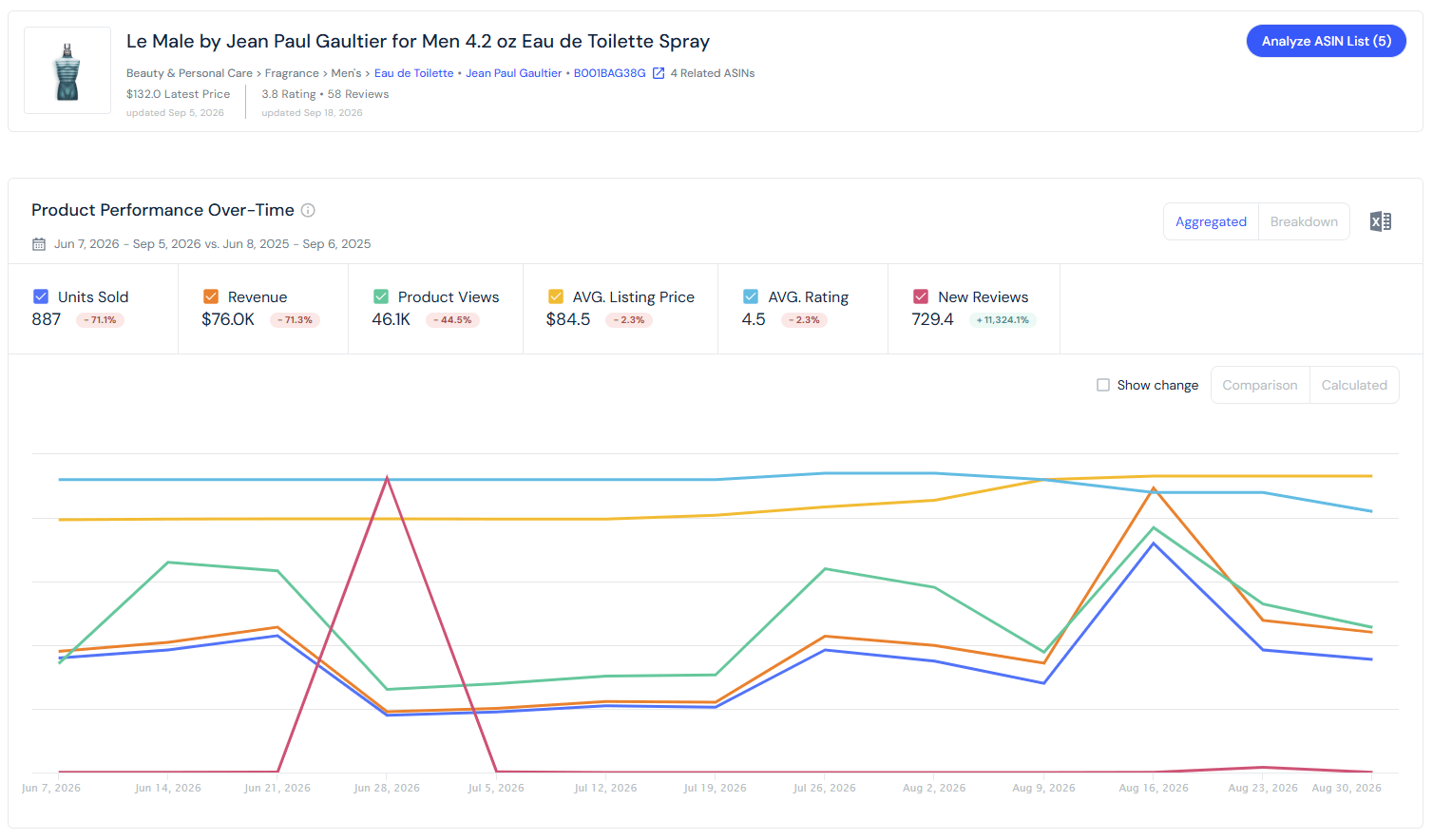
Similarweb combines consumer demand insights with behavioral data to show you what led shoppers to you (or your competitors), so you can act faster and plan more effectively.
Layer 4, dynamic pricing, answers “what is the optimal price right now?” It’s the execution layer: it takes intelligence’s structured competitive view and pricing analytics’ read on what’s working, and combines both with internal signals such as cost, margin targets, and inventory levels to adjust prices automatically based on predefined rules or algorithms.
| Layer | Primary inputs | Typical output |
| Price monitoring | Scraped listings across competitor sites, marketplaces, and comparison portals | Raw price feed, alerts |
| Price intelligence | Monitoring data + product matching + validation | Competitive benchmark, positioning report |
| Pricing analytics | Intelligence data + margin, demand, elasticity, win/loss data | Performance insight, effectiveness read |
| Dynamic pricing | Intelligence data + analytics data + cost, margin targets, inventory | Automated price adjustments |
The boundaries blur in practice. A competition-based pricing strategy (built on price intelligence) is often used as a direct input into a dynamic pricing engine, so vendors and buyers alike end up calling the whole stack “dynamic pricing” even when most of the actual work happened one layer down.
Similarweb can supply data, insights, and price recommendations across all four layers, which is exactly why the starting point is worth discussing directly. The right layer, or combination of layers, depends on which gap a business has, and there’s a fitting setup at Similarweb whether that’s a small catalog just getting started or an enterprise team running the full stack at once.
Price is only one data point among many that determine whether a product wins or loses on the digital shelf, and price intelligence tools are built to collect the full set, not price alone.
Similarweb’s platform also focuses on this combination. It pulls data from competitors’ and marketplaces’ product pages (search, price, stock status, delivery estimate), price comparison portals, and your own and competitors’ promotions and discounts.
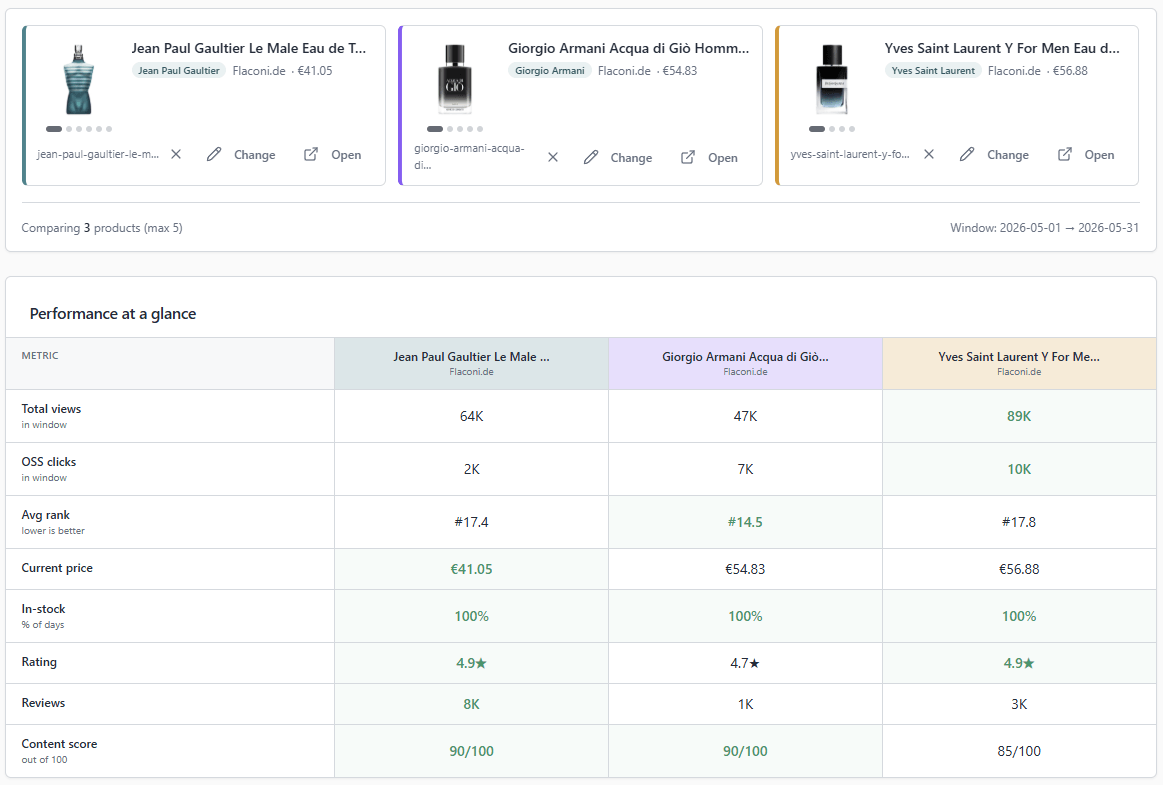
Viewing digital shelf performance alongside pricing data from different retailers transforms a price benchmark into a comprehensive competitive picture.
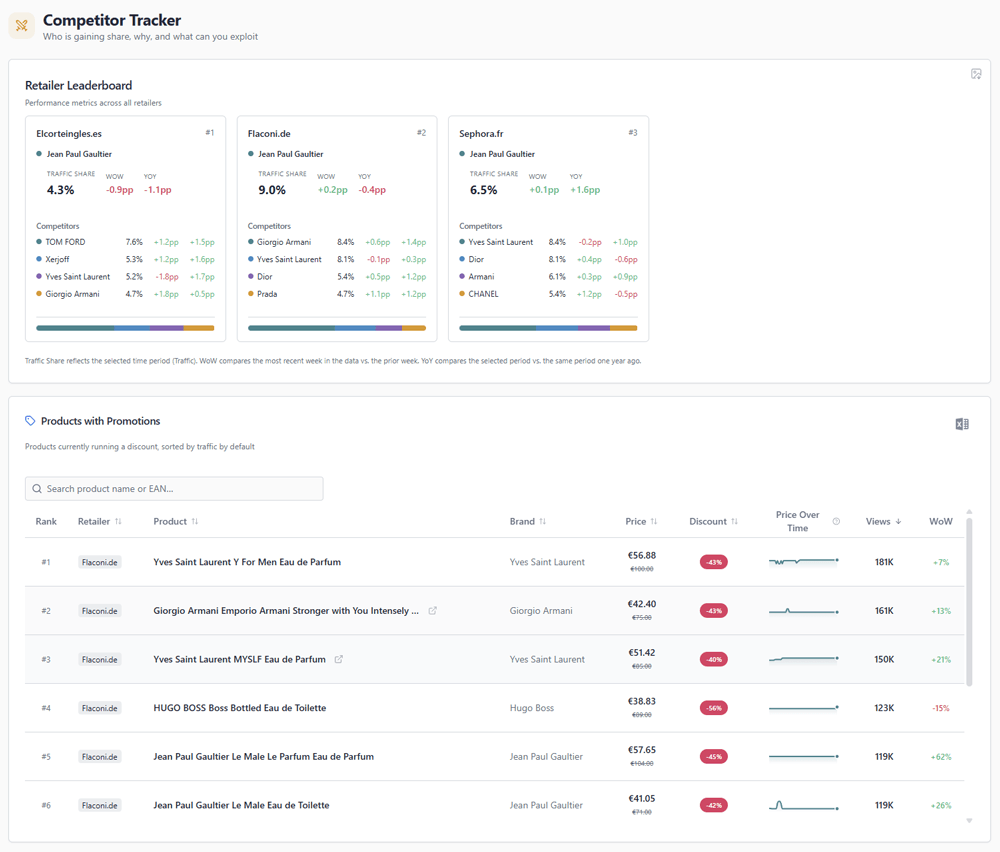
See the product comparison image above. Although Jean Paul Gaultier beats both rivals on price, rating, and review volume, it has a weak average search rank and receives far fewer organic search clicks relative to its views than Yves Saint Laurent. This is a shelf visibility problem.
An ecommerce manager would handle this issue by posing the following questions to the owner of the on-site search and retail media bidding on Flaconi:
Additionally, she would use these figures to counteract the pressure from sales to “just discount harder.”
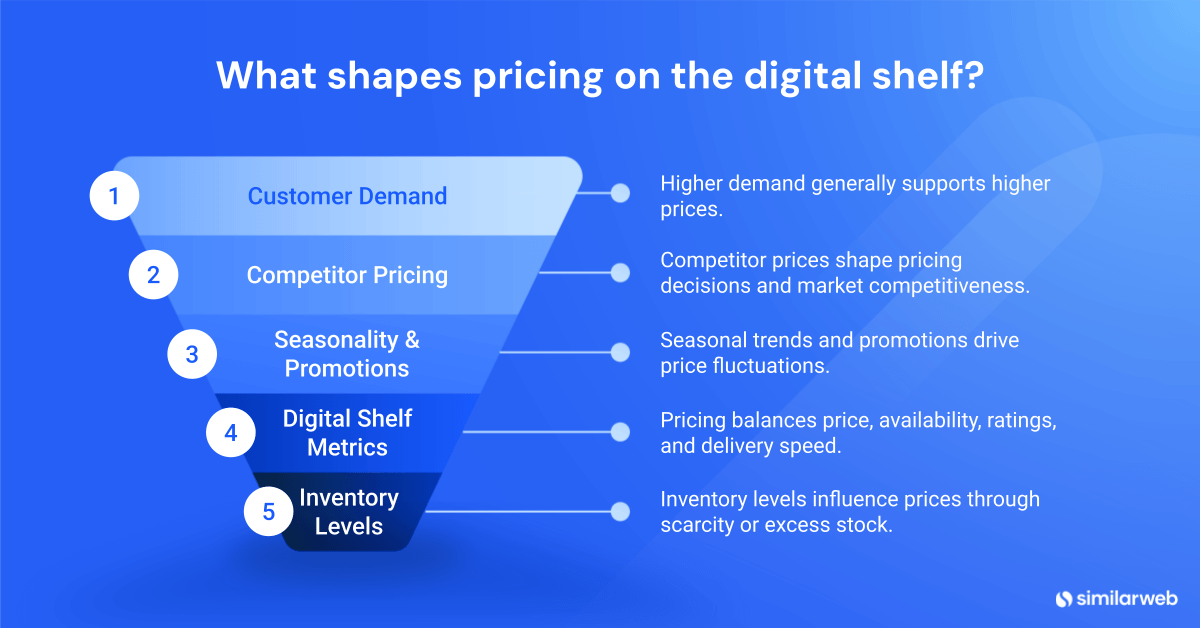
The “digital shelf” framing matters because a product’s real competitive position depends on more than the number next to the price tag. A retailer selling a garden umbrella at a competitive summer price but showing three-week delivery and a 3.2-star rating does not win the shelf, even if the price benchmark looks favorable.
Tracking those other metrics is important because of what they can prevent you from doing. If you can stand out based on faster delivery or outstanding reviews, for example, lowering the price of your product may not be necessary.
This matters most for Buy Box-style placements, where price, availability, rating, and delivery speed are weighed together, not price alone. Similarweb calls this broader view Retail Intelligence, since a price-only benchmark misses exactly the kind of gap that costs a sale.
Price intelligence has diverse use cases, each of which produces a different downstream action. Every vertical can benefit from it. Enterprise teams tend to run these use cases through advanced, predictive pricing engines at scale, while smaller businesses start with basic scraping and reporting tools.
A clear plan is the foundation of successful price intelligence.
The first step is to understand which competitors have the greatest impact on your pricing decisions. Start with whoever competes for your buyers’ attention, not just businesses selling an identical product: suppliers, vendors, retailers, and substitutes count too.
Four questions surface the full list: what are customers buying instead, who do they compare you to, where do they look for a better deal, and what else sits in the same category?
Search and website data often reveals competitors quietly pulling interest a business didn’t know it was losing. Define the set deliberately rather than tracking everyone available and revisit it periodically as competitors enter and exit.
Collect data on competitors’ prices, promotions, and offer mix, not just the sticker price: premium positioning, loss leaders, and bulk discounts each send a different signal. Availability, delivery times, and other digital shelf KPIs, like rating, review count, and search placement, matter just as much, and any one of them can outweigh price itself.
Look for patterns in how competitors price. Consider geographic targeting, loyalty discounts, and how consistently they hold a position. Uncover additional granular insights into where they succeed, and where you can thrive. However, not every pattern is worth mirroring. A competitor’s discount structure may reflect a different cost base or segment entirely, and matching it blindly is a common way this data gets misapplied.
Once the competitor set is defined, most implementations follow the same sequence: set collection frequency by product tier, decide which pricing rules run automatically versus stay manual, and choose whether to build scraping and matching capability in-house or use an established provider.
In-house looks cheaper until the maintenance burden shows up, since sites change structure and a small team babysitting a scraper tends to churn.
The best tools go further, weighing market conditions and competitor moves with predictive algorithms rather than reacting to price alone, and connecting that output to broader digital shelf data, the kind Similarweb tracks across retailers, for a fuller picture alongside price.
Price monitoring, price intelligence, pricing analytics, and dynamic pricing are four layers of one stack, not four separate purchases. A competitor’s discount pattern doesn’t mean much until it’s matched and validated. And a validated benchmark doesn’t tell you what to do next until it’s checked against whether your own price is converting.
If pricing conversations still run on a gut feeling about a handful of named competitors, the gap is price intelligence. If prices are already automated but nobody can say whether that automation is protecting margin, the gap is analytics. Similarweb Retail Intelligence is built to cover the full stack, from monitoring through analytics, rather than leaving a team to stitch the layers together themselves.
Closing that gap has less to do with buying more software and more to do with treating external market visibility and internal performance visibility as two connected inputs into the same decision.
Price intelligence is the practice of collecting and structuring competitor pricing, availability, and promotional data so a business always has an accurate, matched, validated view of where it stands in the market. It turns raw scraped prices into something a pricing or category team can act on with confidence.
No. Price monitoring is the raw capture layer: recording what a competitor’s price shows right now. Price intelligence takes that raw data and matches, validates, and structures it into a usable competitive benchmark. Monitoring produces data points, price intelligence produces a decision-ready view.
Price intelligence tells you what competitors are charging, structured and validated. Dynamic pricing takes that structured competitive data and combines it with internal signals, such as cost, margin targets, and inventory levels, to adjust your own prices automatically. Price intelligence informs the decision, dynamic pricing executes it.
Price intelligence looks outward at the competitive market. Pricing analytics looks inward at your own pricing performance: elasticity analysis, win/loss data, and margin analysis that show whether your prices are converting and protecting profitability. Businesses that combine both get a complete picture.
Beyond price, price intelligence software typically collects stock status, delivery estimates, promotional activity, product ratings, and assortment data showing which SKUs a retailer carries and which products a competitor offers. On a digital shelf, all these factors, not price alone, determine whether a product wins the sale.
It depends on the product, not a fixed rule for the whole catalog. High-velocity or frequently repriced products may need multiple checks per day, while long-tail items with stable pricing can be checked weekly or monthly without losing anything.

by Ida Lorenz
Content Writer & Marketing Manager
Ida is a Content Writer & Marketing Manager at XPLN, specializing in Digital Shelf Analytics, ecommerce, and digital transformation. With 18 years of experience in B2B marketing, she transforms complex data and technical concepts into clear, actionable content that helps businesses navigate the evolving digital commerce landscape. She holds a Diploma in Media Studies with a focus on Media Informatics from the University of Paderborn, Germany, and is also a certified Graphic Design Assistant. Her published articles combine data-driven insights with compelling storytelling to help companies understand how the digital world is changing and what it means for their business. Outside of work, she enjoys reading, hiking, spending time with her family, and discovering great coffee.
The Top 100 Most Visited Websites in the USA (August 2026)
Similarweb Named in Forrester's Answer Engine Optimization Technologies Landscape, Q3 2026
Anthropic IPO: What Claude's Web and App Data Show
Put the full picture at your fingertips to drive product views and sales
