
The Top 100 Most Visited Websites in the World (August 2026)
by Shai Belinsky10 Min.
Sep 17, 2026

Every SEO knows what a keyword ranking is. In 2026, the gap between tracking ranks and understanding visibility has never been wider.
The position number is still meaningful, but it is no longer the whole story. SERP features, Sitelinks, People Also Ask, Video Boxes, and Image Packs occupy the real estate above and around the organic listings. A brand can hold position one for a high-volume keyword and still be invisible to a significant portion of searchers.
This article covers what rank tracking actually measures today, how to read the data Similarweb’s Rank Tracker surfaces, using a real project as the example, and how to build a dual-tracking practice that connects organic rankings with AI visibility so neither channel is running blind.
Rank tracking is the regular monitoring of where your pages rank for targeted keywords across search engines, devices, locations, and time periods.
At its core, a rank tracker does three things: records your position for each tracked keyword, stores that data over time so you can spot trends, and surfaces changes so you can act on them before they become problems. Similarweb’s SEO tools cover all of this in one place, from keyword tracking to SERP feature monitoring to AI overviews, so the data you need to act on is never split across separate systems.
In practice, a full rank tracking setup captures much more than position alone. The data you actually need includes:
Yes. But the question worth asking has shifted from “where do I rank?” to “what is my total search visibility, and where are the gaps?”
Zero-click searches, where a user gets their answer directly from the SERP and never visits any website, now account for a meaningful share of all searches. AI Overviews accelerate this pattern, particularly for informational queries. That does not make organic rankings irrelevant. It makes them insufficient as the only thing you track.
The SERP features that appear around organic results are not separate from your rank tracking practice, they are part of it. A brand that holds position two organically but also owns Sitelinks and an AI Overview citation for the same query has far greater effective visibility than position two alone suggests. Tracking that full picture is what separates useful rank data from misleading rank data.
The screenshots below are from a real Similarweb Rank Tracker project tracking 200 keywords for Netflix.com over the period May 15 to June 15, 2026. Walking through each view illustrates what good rank tracking data actually looks like in practice.
Start with the Position Distribution chart, it shows how your tracked keywords are distributed across ranking buckets over time, and it’s the fastest way to read the shape of your keyword portfolio at a glance.
What you want to see: a healthy concentration in positions 1-3, with a manageable tail in positions 4-10 as your optimization pipeline. The danger signal is keywords migrating into the 11-30 bucket, that movement typically surfaces in rank data two to three weeks before it shows up as a traffic drop in analytics, which is exactly why daily tracking matters.
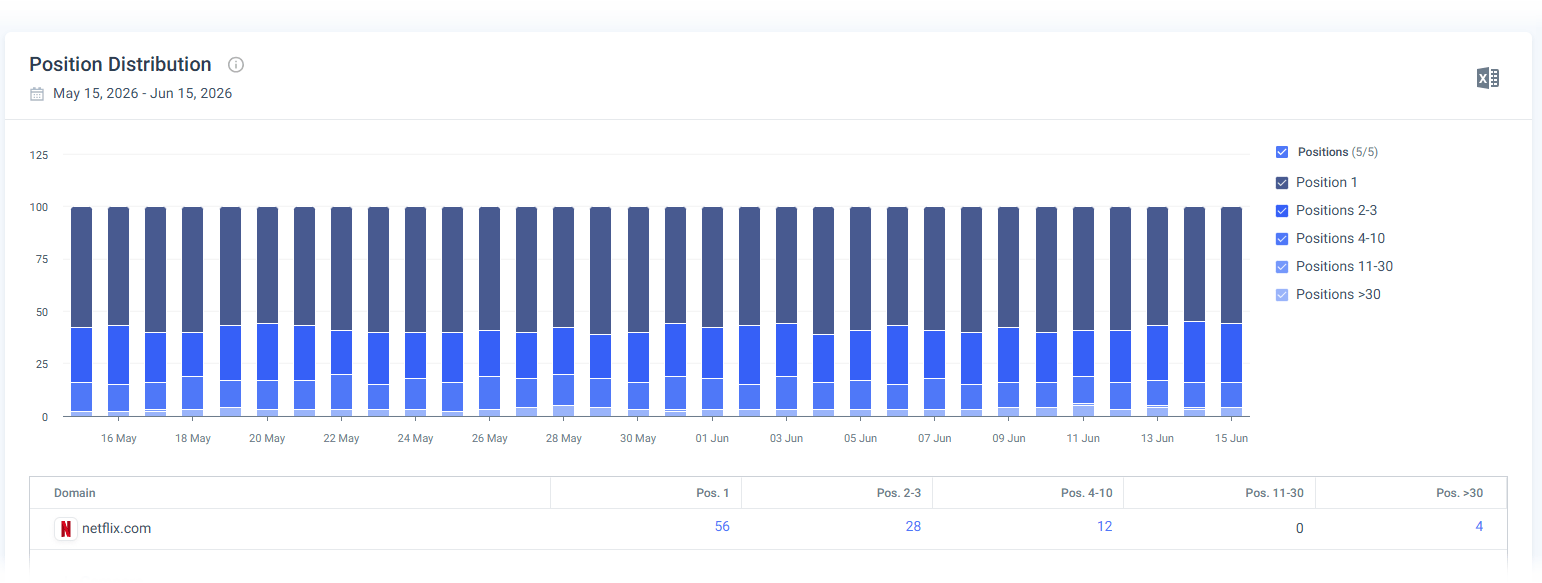
For a brand like Netflix, with strong topical authority across both branded and content-discovery keywords, you’d expect the distribution to look stable, and it does. That consistency is the baseline you’re trying to protect. The moment those bars start shifting shape, something has changed: an algorithm update, a content decision that Google is re-evaluating, or a competitor who quietly gained on a cluster of your keywords. Stability isn’t boring in rank tracking, it’s the goal.
The Performance Over Time view is where rank tracking connects to business reality. The four KPIs at the top: Clicks, Share of Voice, Visibility, and Weighted Average Position, tell different parts of the same story, and they are worth reading together rather than in isolation.
Clicks and Share of Voice tell you where you stand commercially right now. Visibility and Weighted Average Position tell you where you have room to grow. A brand can see clicks rising while visibility drops, which sounds contradictory but usually means you are winning harder on your strongest keywords while quietly losing ground on the periphery. That gap compounds if you ignore it.
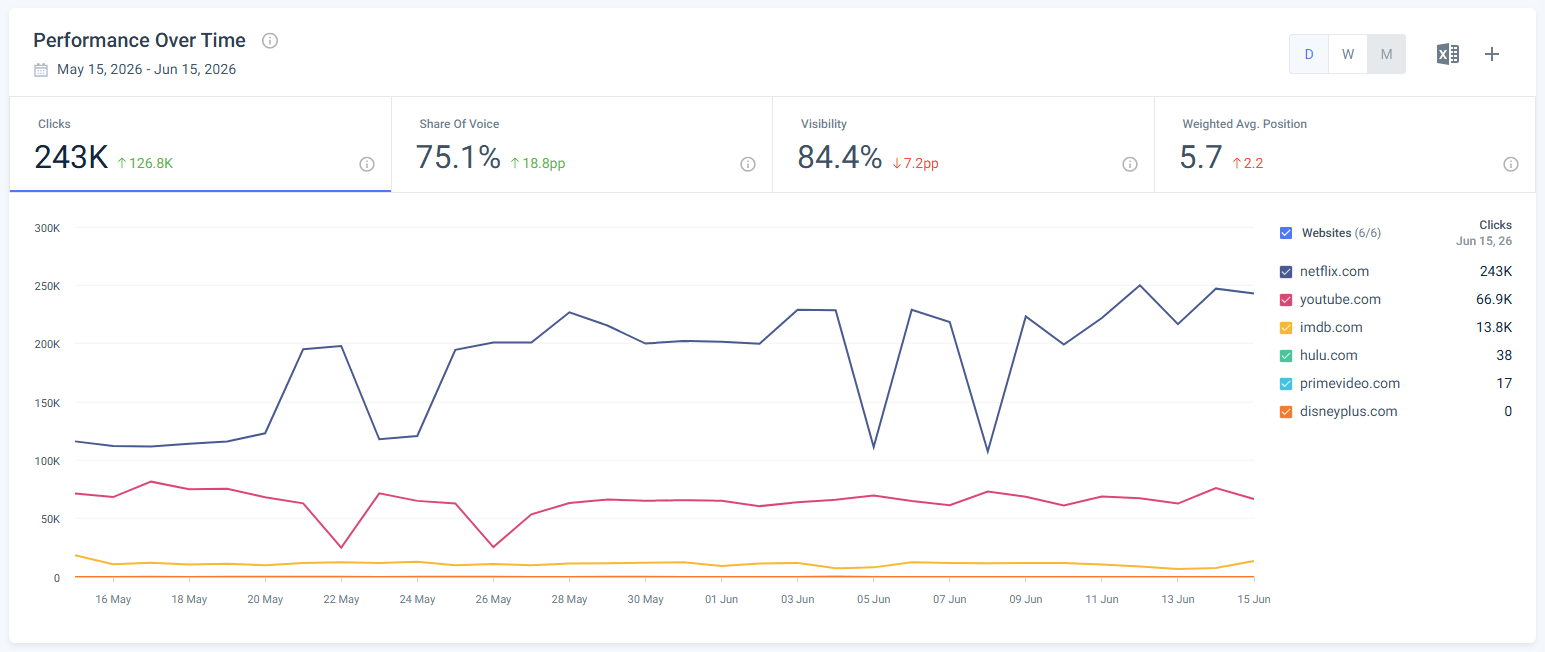
In this view, that tension is visible. Clicks are up significantly and Share of Voice is strong, but Visibility is down. That combination is a specific kind of signal: Netflix is dominating on its highest-volume keywords while losing impressions on the edges of its tracked set. For a content brand, those edge keywords are often where new audience discovery happens, show titles, genre queries, and character searches. Worth a closer look at which keyword cluster is dragging visibility down, and whether it maps to a content gap or a SERP feature taking over.
The competitor lines in the chart are just as important as your own. This view lets you benchmark your trajectory against the other players’ ranking for the same keyword set, not just whether you are up or down in absolute terms, but whether you are pulling away, holding steady, or being caught. A flat click line on your end means nothing if a competitor’s line is climbing toward yours. That is the signal rank tracking is built to catch early.
The Keyword Trends heatmap is where rank tracking becomes genuinely actionable. Each row is a keyword, each column is a day, and the color tells you the position at a glance, deep green for position 1, fading toward yellow and red as rank drops. The pattern you’re looking for is a wall of green with isolated anomalies, because a single off-color cell in an otherwise stable row is far more actionable than a gradual drift you’d only catch in a monthly review.
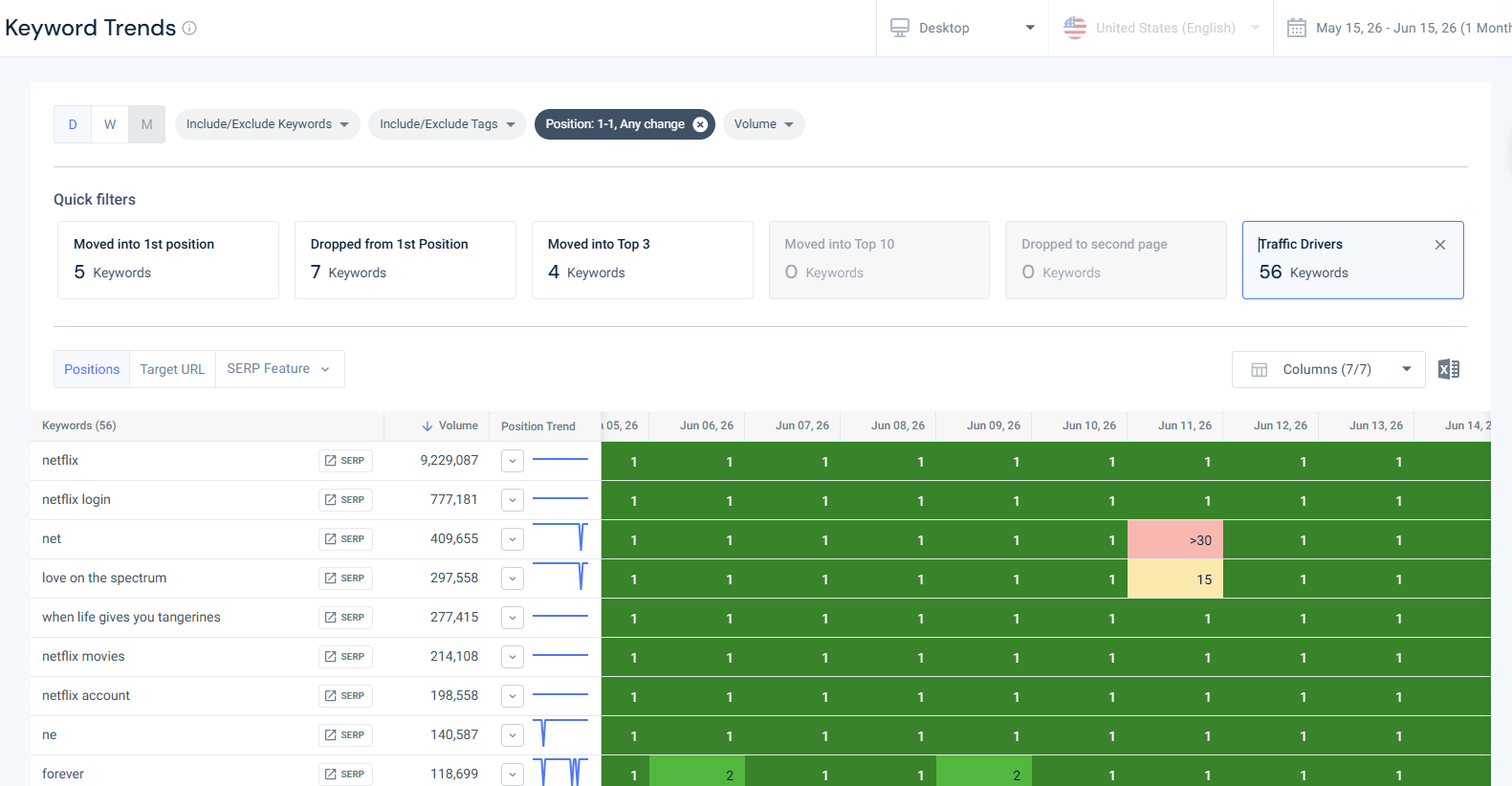
What makes the heatmap useful for diagnosis is the cross-row pattern. A single keyword dropping for a single day is usually noise, a SERP experiment, a crawl delay, a temporary index shift. Two keywords dropping on the same day is a pattern worth investigating. It could point to a broader SERP event on that date, an algorithm signal affecting a specific content category, or a technical issue that hit multiple pages simultaneously. The heatmap makes that kind of correlation visible at a glance in a way that position averages never would.
The quick filters at the top are your weekly triage list: which keywords moved into position 1, which dropped from it, which entered the top 3. Start there every Monday. It takes five minutes and tells you exactly where to focus optimization effort and where to investigate a potential problem before it compounds.
The Pages view answers a question that position tracking alone cannot: which specific URLs on your site are responsible for your rankings, and how each one is performing independently.
This is where top-line metrics can mislead you. A healthy Share of Voice number at the account level can mask a page that is quietly losing keywords, or hide a help article that suddenly exploded in visibility for reasons you haven’t attributed yet. The Pages view surfaces both.
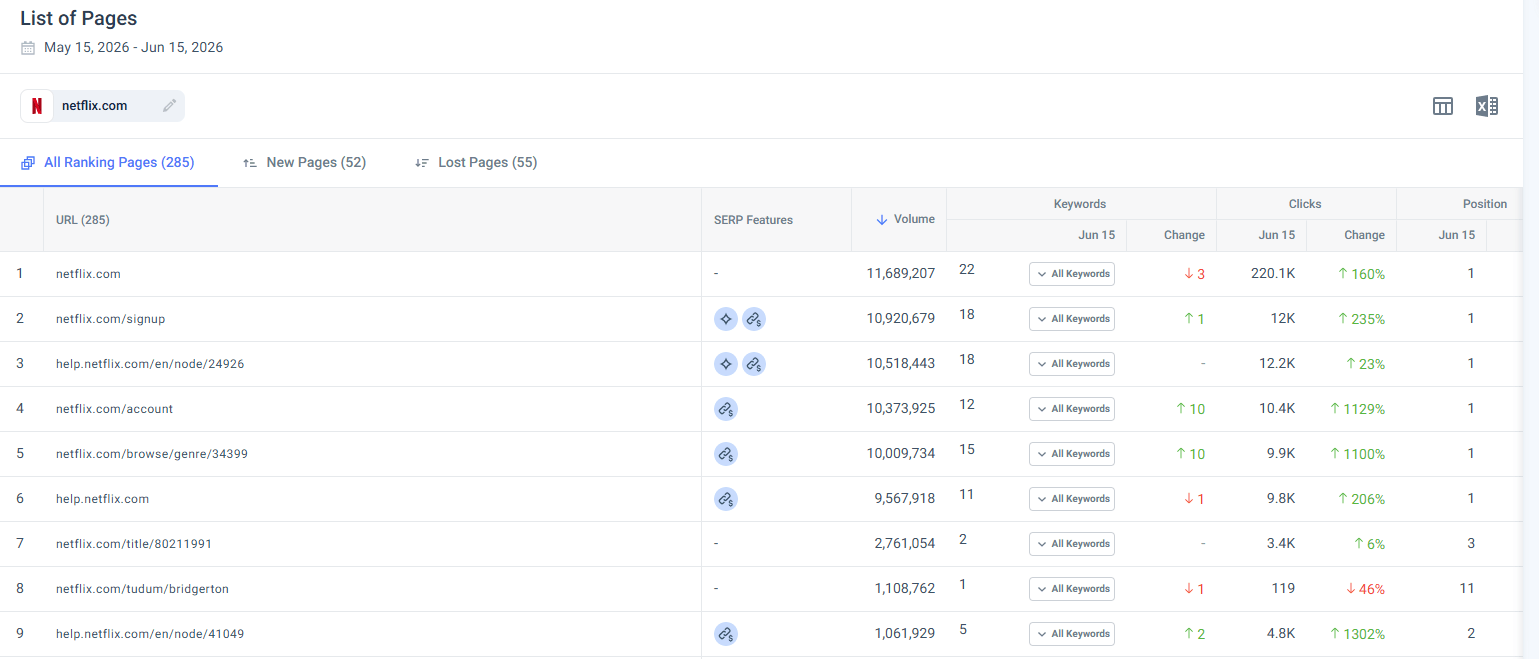
The most important column here isn’t position, it’s the keyword count change combined with the clicks change. A page gaining keywords and clicks at the same time is compounding: more queries are finding it, and searchers are choosing it. A page losing keywords while clicks hold steady is a warning sign, it may be surviving on branded queries while losing relevance on everything else. And a page gaining keywords but not clicks suggests a SERP feature, often an AI Overview or a featured snippet, is intercepting the traffic before it reaches you.
The three tabs: All Ranking Pages, New Pages, and Lost Pages, are each a different kind of alert. New pages entering your tracked set are wins worth understanding and amplifying. Lost pages need immediate investigation: is it an indexation issue, a content quality signal, or a competitor who optimized harder for the same query? You won’t know until you look, and you won’t look if you’re only watching the aggregate.
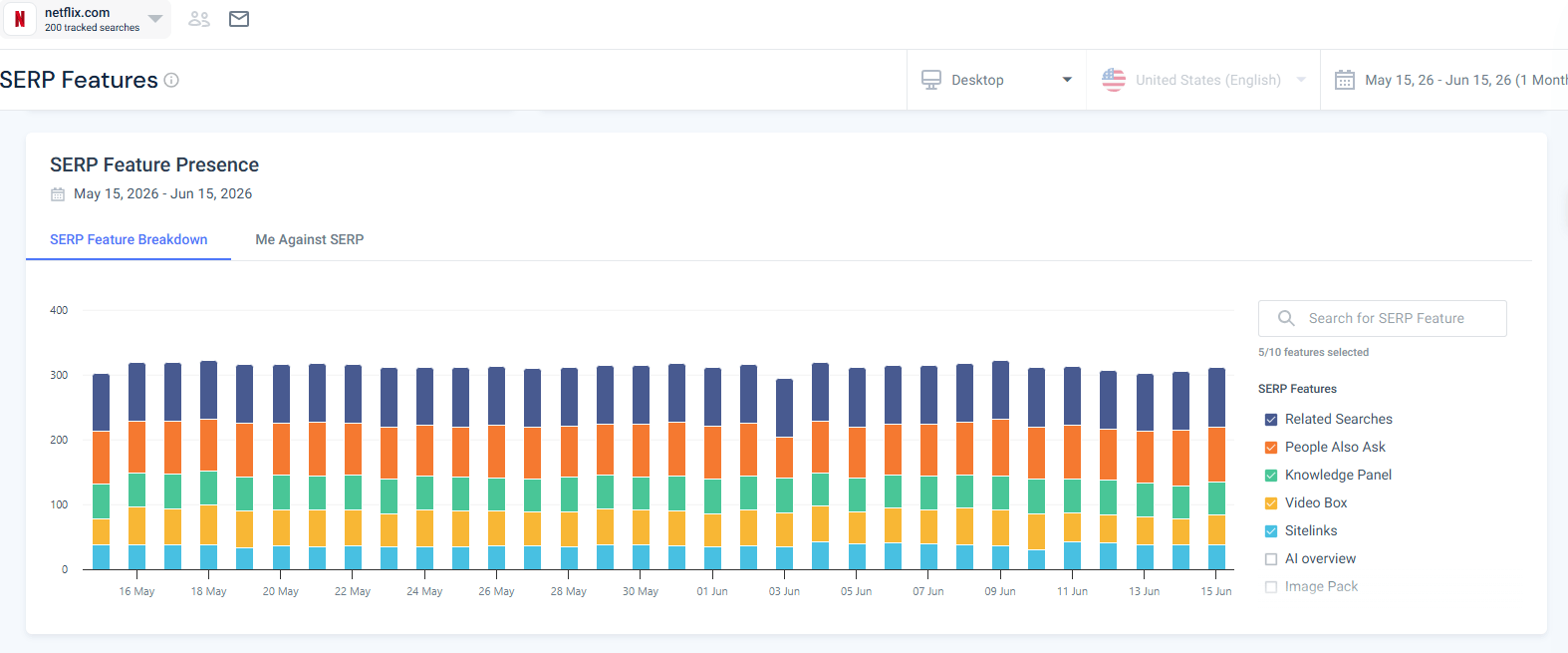
The SERP Feature Breakdown chart shows which features are present across your tracked keyword set each day, and how that mix evolves over time. Think of it as a daily read on how “busy” your SERPs are, the more features stacked on a given day, the more real estate sitting between the searcher and your organic listing.
What you’re watching for is movement in the layers, not just the total height of the bars. A sudden growth in the People Also Ask band, for example, means more queries are now generating Q&A boxes you could be competing for. A growing AI Overview band means more queries where your organic position alone no longer determines whether you get seen.
The table is where you move from observation to action. For each feature type, it shows how many you appear in, how that changed over the period, how many exist across your total keyword set, and who the leader is, which indicates whether the gap is closeable or whether a competitor has a structural lock on that feature.
Two columns matter most: the “Change” column and the “You vs. SERP Presence” percentage. Change tells you whether your capture rate is improving or eroding. The percentage tells you how much of the available opportunity you’re actually taking. A low percentage on a high-volume feature isn’t a problem to note, it’s a brief to write.
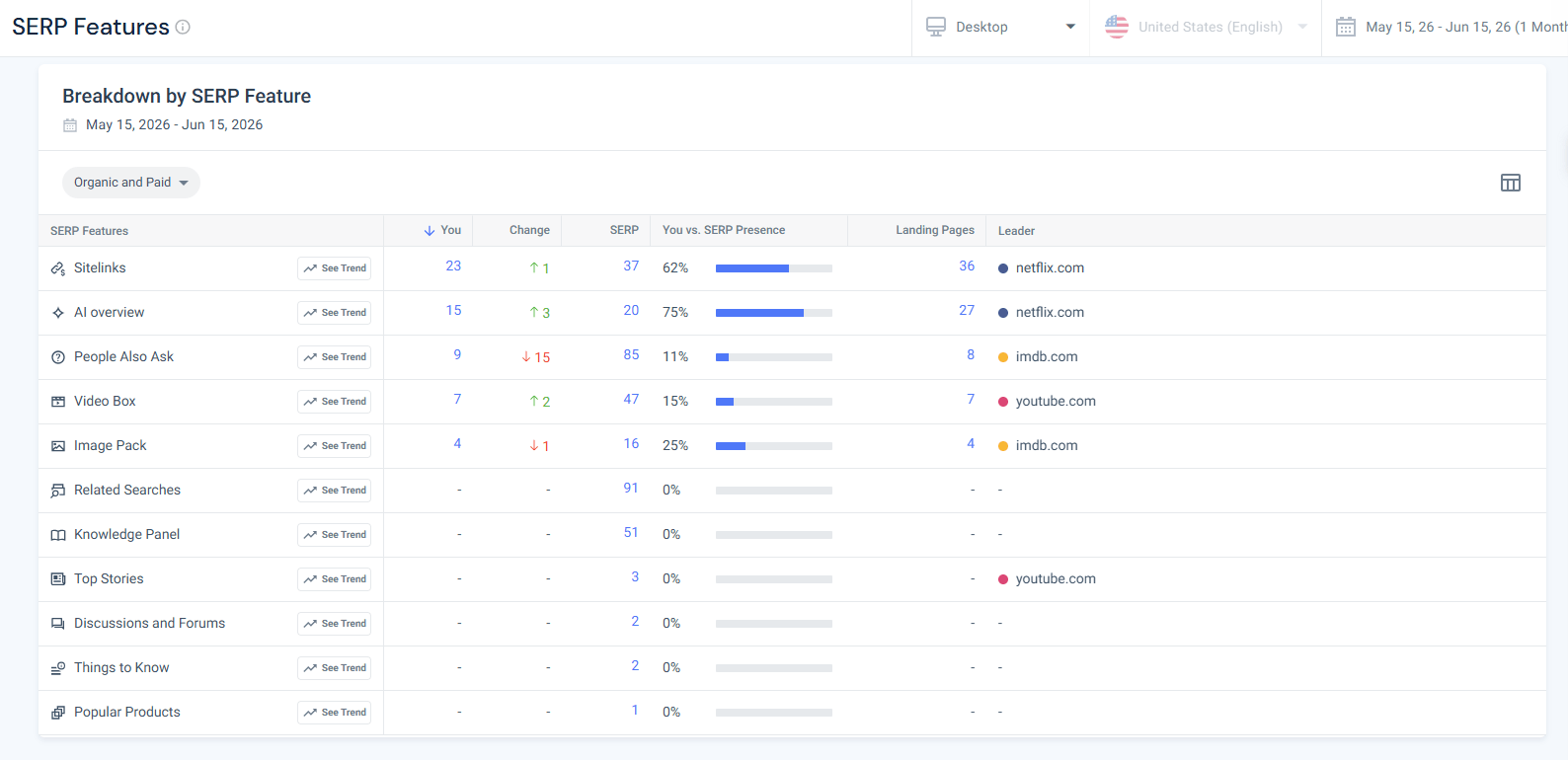
In this data, the People Also Ask row stands out. It’s the largest feature pool by far, 85 instances across the tracked keyword set, yet the capture rate is low and it dropped significantly in the period. For a content brand with hundreds of pages answering specific questions about shows, genres, and viewing experience, that gap is disproportionate. It’s the clearest optimization signal in the entire SERP features view: the opportunity is large, the current presence is weak, and the leader isn’t a direct competitor.
The Leader column is worth a separate look. On any feature where you’re not leading, that competitor has figured out something about their content or structure that you haven’t matched yet. That’s your starting point for optimization.
The honest answer to “how do you track rankings now?” is: you track both organic positions and AI visibility, because they measure different things and neither tells the full story on its own.
Here is how to think about combining them.
Traditional rank tracking tells you where your pages appear in the ten blue links. It captures position, movement, Share of Voice, and SERP features like Sitelinks and featured snippets. It answers: “When someone searches this keyword, can they find me in the organic results?”
AI visibility tracking tells you whether your brand or content is referenced in AI-generated answers, ChatGPT, Perplexity, Gemini, and AI Mode. It answers: “When someone asks an AI about this topic, does my brand appear in the response?”
The divergence matters because a page can rank well in organic results and still be absent from AI answers, and increasingly, for research and consideration queries, the AI answer is where the user’s decision gets shaped. The reverse is also possible: a brand can be heavily cited in AI answers while ranking modestly in organic results, typically because AI models are drawing from sources that are not the brand’s own site.
In 2026, treating these as separate practices, one handled by the SEO team, one by whoever owns GEO, misses the point. They are separate practices. The mistake is running them against different topic maps and never reading them together. They share the same content foundation and surface the same signals about topical authority, which means a drop in one is often a reason to check the other.
You need two tracking practices aligned around the same topic and keyword map, so you’re measuring the same territory in both channels, and reading them together when making decisions.
In Similarweb’s Rank Tracker: monitor organic positions, Share of Voice, SERP feature capture, and AI Overview presence for your tracked keywords. This is your traditional search layer, where you rank, how stable it is, and how much of the available SERP real estate you’re occupying.
In Similarweb’s AI Search Intelligence: track Brand Visibility and Brand Mention Share across ChatGPT, Perplexity, Gemini, and Google AI Mode. The Brand Visibility score tells you how often your brand appears in AI-generated answers at all. Brand Mention Share tells you your slice of all brand mentions across the competitive set, which is a different question. A brand can appear frequently in AI answers while owning a small share of mentions, meaning AI treats it as one option among many rather than the default answer. That gap between the two numbers is often the most actionable signal in the view.
The two tools track different things and that’s exactly the point. Neither replaces the other, and neither explains the other on its own. What connects them is your topic map. The keywords you track in Rank Tracker should directly inform the prompts you track in AI Search Intelligence, same topics, two channels, two separate measurements. A gap in one often points to where to investigate in the other.
Not every visibility gap deserves equal attention. Here is a decision framework:
This is your most urgent gap. You have earned the organic click, but AI is potentially deflecting a share of searchers before they reach you. Audit the page for answer engine optimization: add clear, structured definitions, use question-based headings, and make the core answer extractable in the first 150 words of the relevant section.
Fix the ranking first. AI models primarily cite well-indexed, high-authority content, so strong organic fundamentals feed AI citation in both channels. This means building topical authority through keyword research that maps the full question space around your topic, not just the head terms. When the ranking improves, check both your AI Overview capture rate in Rank Tracker and your topic visibility score in AI Search Intelligence, they should follow.
This is the gap that’s easiest to miss because your search dashboard looks healthy. You’re ranking well, traffic is stable, but in AI Search, your Mention Share on those same topics is low, meaning when someone asks an AI about the category rather than your brand directly, you’re not the answer it reaches for. The fix isn’t more SEO work on those pages. It’s content that establishes category-level authority: original data, clear definitions, comparative analysis that answers the question AI is being asked, not just the keyword you ranked for. When both signals improve together, organic position holding, and Mention Share rising on the same topic cluster, that’s confirmation that your content is working across both channels.
Position numbers still matter. But in 2026 they are one input into a larger picture that includes Share of Voice, SERP feature capture, AI Overview presence, page-level click data, and LLM citation visibility. Tracking only positions is like reading only the headline, you know something happened, but not what it means or what to do next.
The brands pulling away in this environment are not checking their rankings more obsessively. They are running two aligned tracking practices, one for search, one for AI, built on the same topic map, read together, and acted on in the same reporting cadence. That combination is what turns rank tracking from a monitoring exercise into a growth practice.
What is keyword rank tracking?
Keyword rank tracking is the regular monitoring of where your website’s pages appear in organic search results for a set of targeted keywords. A rank tracker records position data over time so you can identify trends, spot drops early, and measure the impact of your optimization work.
What is Share of Voice in rank tracking?
Share of Voice measures the percentage of total available clicks for a set of tracked keywords that your site earns. It accounts for both your ranking position and the click-through rates associated with that position, making it a more reliable measure of competitive momentum than raw position numbers alone.
How often should I check my keyword rankings?
For traffic-driving keywords, daily monitoring is the right cadence, it is the only way to catch single-day drops that a weekly check would smooth over. For broader keyword sets, weekly reviews of performance metrics and monthly SERP feature audits are sufficient for most teams.
How do I track both organic rankings and AI visibility?
Use your rank tracker’s SERP Features data to monitor AI Overview presence for your tracked keywords, and layer in a dedicated AI visibility tool, such as Similarweb AI Search Intelligence, to track brand mentions and citations across LLMs like ChatGPT, Perplexity, and Gemini. Report on both in the same cadence so your team sees the full visibility picture, not just the organic position slice.
Does ranking at position one still matter if there is an AI Overview?
Yes, but context matters. For navigational and branded queries, position one alongside an AI Overview typically means strong total visibility. For informational queries where the AI Overview satisfies the intent completely, position one earns fewer clicks than it once did. Track both your organic position and your AI Overview presence for these queries so you know your true share of available visibility.
What is the difference between rank tracking and AI visibility tracking?
Rank tracking monitors where your pages appear in traditional search engine results, the organic listings, SERP features, and positions that a search engine returns for a given query. AI visibility tracking monitors whether your brand or content is referenced in AI-generated answers from tools like ChatGPT, Perplexity, Google AI Overviews, and Google AI Mode. In 2026, a complete search visibility practice requires both.

Senior SEO Specialist at Similarweb
Maayan is a senior SEO specialist with 7+ years of experience in SEO. She loves complex research projects, creating SEO strategies and performing technical audits.
Give it a try or talk to our marketing team - it’s free!