


 Marketing Intelligence
Why You Need SEO AI Agents and Step-by-Step Adoption Guide

SEO is growing more complex each year, and many marketing teams are managing complex workflows at scale. AI agents are emerging as a way to automate routine SEO tasks, act on data faster than human teams can, and enable continuous monitoring and real-time optimization.
What is an SEO AI agent?
SEO AI agents are AI-powered software designed to automate and optimize various aspects of search engine optimization, including keyword research, content optimization, and technical SEO audits. These agents analyze websites, identify areas for improvement, and implement changes to boost search rankings, with minimal human intervention.
Modern SEO AI agents are powered by large language models (LLMs), especially those with reasoning capabilities, which allow them to follow complex instructions, create plans and follow through to execute them.
In practice, an SEO AI agent can:
- Continuously monitor keyword rankings and technical issues, instead of waiting for alerts or manual checks.
- Generate and test content variations to improve visibility and engagement.
- Analyze competitor activity and adapt strategies in real time.
- Interface with APIs, analytics platforms, and content management systems to implement changes directly.
The key difference from standard automation is adaptability. An AI agent does not just follow preset rules; it can learn from new data, adjust to changes in the search environment, and coordinate multiple-step workflows. However, AI agents have their limitations and must be carefully instructed and controlled by human SEO experts.
The impact of AI agents in SEO
AI agents represent a major shift from earlier SEO tools by combining analysis, decision-making, and execution into a continuous feedback loop. Traditional platforms required manual setup, periodic audits, and separate tools for different tasks. In contrast, AI agents can autonomously manage and coordinate end-to-end workflows, like keyword research, technical fixes, and content updates, based on real-time data.
For SEO professionals, this means less time spent on diagnostics and more focus on strategy and experimentation. Instead of running manual audits or combing through keyword lists, SEO teams can oversee agent-driven initiatives, review prioritized recommendations, and refine outcomes.
Tasks that previously took days, like content gap analysis or SERP tracking, can now be updated hourly or done continuously based on real time insights. As agents mature, SEO experts will shift toward roles that emphasize oversight, quality assurance, and aligning AI actions with business and brand goals.
Core capabilities of SEO AI agents
1. Automated keyword research and clustering
An AI agent can process large keyword datasets quickly, grouping them into clusters based on semantic similarity and search intent. This avoids the manual effort of sorting and classifying large numbers of search terms.
Instead of just providing keyword lists, AI agents can identify parent topics, related subtopics, and long-tail variations, allowing SEOs to structure content around topic clusters. This approach improves coverage of a subject, supports internal linking strategies, and aligns with how modern search engines interpret topical authority.
2. Semantic SEO and user intent optimization
AI agents can analyze how users phrase queries, the entities mentioned, and the context of search results to detect intent behind searches. By mapping this to your existing content, the agent can recommend adjustments in wording, structure, or metadata to better match intent.
For example, an SEO AI agent can review a list of search terms and identify which have transactional intent and are relevant for a specific list of products.
3. Competitor content and SERP analysis
An agent can continuously track how competitors perform in search results, identifying what types of content, formats, and optimizations are working.
Instead of static competitor audits, the agent runs ongoing comparisons, highlighting when new competitors enter rankings or when SERP features (like featured snippets or videos) become important. It can also flag opportunities where your site is underperforming relative to competitors on similar topics, and suggest relevant content optimizations.
4. Technical SEO audits and issue resolution
AI agents can crawl a website regularly to detect indexing problems, broken links, slow-loading pages, or missing metadata. Unlike traditional audit tools, they can prioritize issues by potential impact on traffic and in some cases fix them directly, such as updating XML sitemaps or correcting tags through a CMS integration.
5. Link building and internal linking automation
For external links, AI agents can scan the web for relevant unlinked mentions, broken links, or potential outreach targets, automating parts of prospecting. For internal linking, agents can analyze content clusters and propose or insert links where topical connections exist, improving crawlability and distributing authority across the site.
How Similarweb SEO AI Agent Builds a Content Strategy
Our SEO AI Agent is designed to take you from raw keyword input to a complete, data-driven content strategy.
Here’s the full process, step by step:
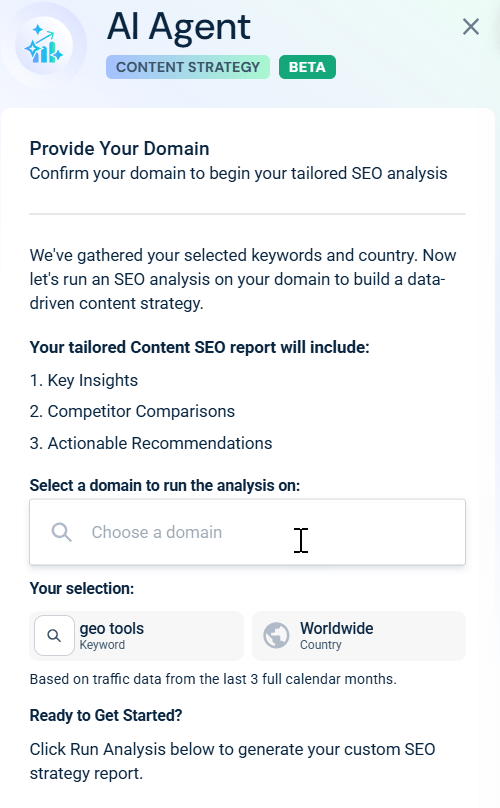
1. Data Intake and Context Setup
Once you provide your target domain, country, and keyword list, the agent begins a large-scale data analysis process. It cross-references Similarweb’s keyword database and traffic intelligence to understand your organic footprint and identify relevant competitors.
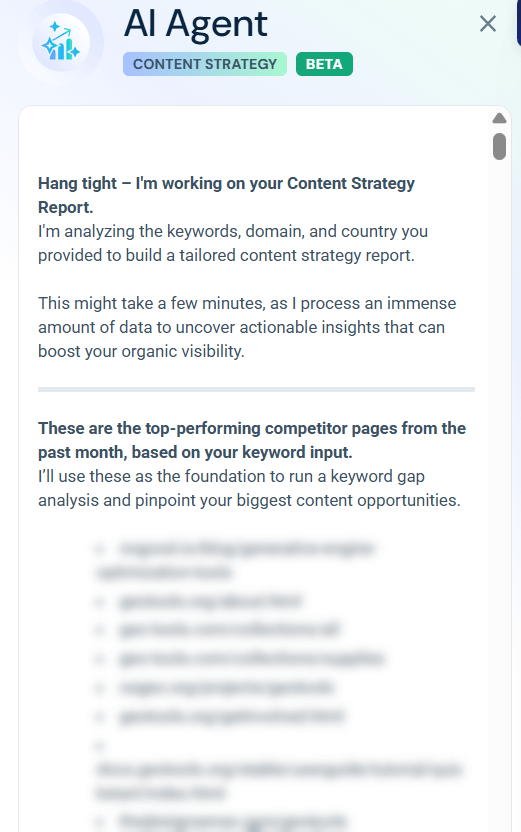
2. Competitor Discovery and Benchmarking
Next, the agent identifies top competitor URLs based on your keyword set, those that have captured the most organic clicks and share in the past month.
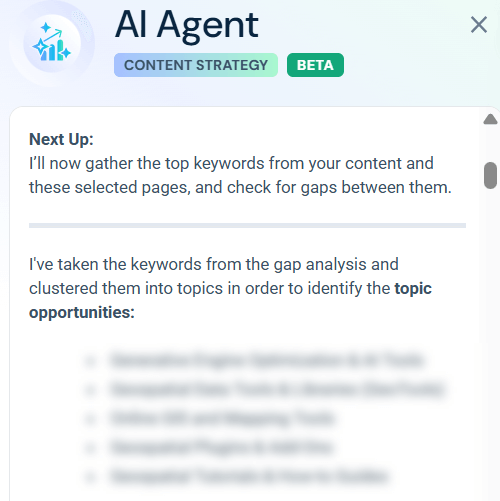
3. Keyword Gap and Topic Clustering
The agent then runs a keyword gap analysis: comparing your domain’s keyword coverage against competitors’.
All uncovered opportunities are automatically clustered into topical groups using semantic similarity and search intent signals.
This clustering helps structure your site’s future content architecture around high-potential topic hubs.
4. Opportunity Scoring and Topic Prioritization
Each topic is scored using Similarweb’s proprietary metrics: search volume, organic clicks, click share, and competition level.
The agent ranks topics from “massive untapped potential” to “quick-win opportunities.”
5. Strategic Content Recommendations
Using this intelligence, the agent builds a tailored topic strategy plan, including:
- Proposed content types (e.g., PDP pages, buying guides, video reviews)
- Target keyword clusters and subtopics
- SERP feature optimization opportunities (FAQs, video, sitelinks)
- Competitor examples to model successful structures

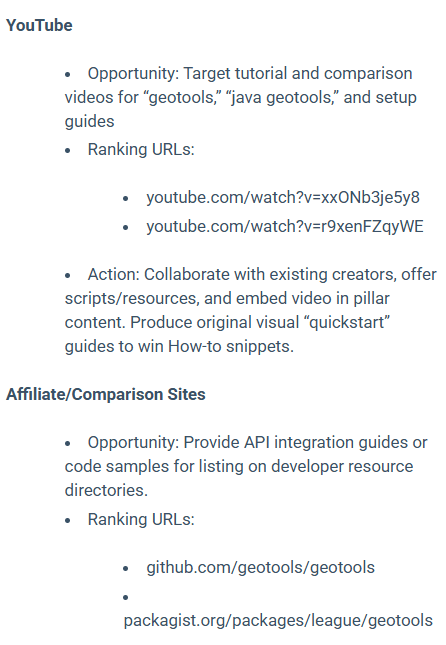
6. Offsite and Cross-Channel Insights
Beyond on-site SEO, the Similarweb AI Agent also recommends off-site amplification tactics, from influencer partnerships (e.g., YouTube unboxing videos) to content syndication on authoritative domains and PR-based link acquisition.
SEO AI agents vs. AI chatbots for SEO
AI chatbots like ChatGPT and SEO AI agents are both powered by similar underlying models, but they serve very different roles in SEO workflows:
- Chatbots as assistants: AI chatbots are interactive tools that respond to prompts. You can ask a chatbot to brainstorm blog titles, suggest keyword ideas, or summarize a competitor’s page. These tools are useful for ad-hoc assistance and ideation, but they rely on you to guide every step. They don’t retain context across sessions or execute tasks autonomously.
- Agents as executors: An SEO AI agent, by contrast, operates continuously and independently. Instead of simply responding to prompts, it can analyze your entire site, generate a structured keyword clustering plan, map those clusters to existing pages, and propose new content, all without being asked each time. It can also monitor performance, adapt strategies, and push updates directly through connected platforms.
The key differences lie in autonomy and scope. Where a chatbot helps with SEO tasks when asked, an agent handles SEO tasks as part of an ongoing system. Chatbots are great for fast answers or one-time content ideas. Agents are better suited for scaling SEO operations, managing workflows, and making real-time decisions based on live data.
Benefits of implementing SEO AI agents
Adopting SEO AI agents can deliver measurable improvements across efficiency, accuracy, and scalability. Instead of replacing human strategy, they improve day-to-day execution and reduce the burden of repetitive tasks:
- Accelerated task execution: SEO AI agents simplify and speed up time-consuming processes like content analysis, keyword discovery, and competitor monitoring. What once required manual workflows across different tools can now be executed autonomously by agents working in coordination.
- Improved adaptability to change: Agents aren’t just reactive, they can adjust strategy on the fly by ingesting live data, detecting shifts in SERPs or trends, and altering tactics without waiting for manual input. This allows SEO efforts to stay aligned with changing search environments and algorithm updates.
- Better use of specialized tools: Like ants in a colony using different tools for specific roles, AI agents access various data sources and services such as search engines, APIs, and content repositories to handle specialized SEO tasks in parallel.
- Scalable content operations: Agents can be programmed to generate content outlines, analyze existing pages, or surface opportunities at a scale that would overwhelm a human team. As more agents are added or connected, the system becomes more capable without requiring proportional increases in headcount.
- Continuous system optimization: With agents reporting on performance, sharing findings, and triggering adjustments automatically, the SEO process evolves into a continuous optimization cycle. This reduces reliance on periodic audits and one-off campaigns.
- Foundation for agentic marketing: SEO is shifting from optimizing for search engines to optimizing for agents, tools that process and act on content automatically. Implementing SEO AI agents helps with execution and prepares websites to interface with the next generation of agent-driven discovery and recommendation systems.
Limitations and challenges of SEO AI agents
While SEO AI agents bring clear advantages, they also come with practical limits and risks. Understanding these challenges is key to using them effectively and safely:
- Contextual judgment: Agents may miss nuances in brand tone, legal requirements, or sensitive topics.
- Dependence on data quality: Incomplete or poorly structured data reduces accuracy and value.
- Over-optimization risks: Automated adjustments at scale can cause keyword stuffing or unnatural linking.
- Integration complexity: Connecting multiple platforms requires technical setup and ongoing maintenance.
- Cost and resource investment: Advanced agents demand subscriptions, infrastructure, or internal expertise.
- Measurement challenges: ROI is harder to measure when impact comes from workflow improvements, not just rankings.
- Regulatory and compliance concerns: Automated actions must follow search engine rules and privacy laws, limiting scope.
Making the most of AI agents for SEO
AI agents are reshaping how SEO work gets done. Instead of relying solely on manual processes, teams can delegate repetitive and time-sensitive tasks to software that learns, adapts, and executes continuously.
The key is balance: using agents for speed and scale while keeping human oversight for judgment and strategy. This hybrid approach reduces errors and ensures outputs align with brand and compliance requirements.
As search moves toward agent-driven ecosystems, businesses that adopt SEO AI agents early will be better prepared to handle changes in visibility, attribution, and user behavior. The role of SEO professionals will move further toward system design, quality control, and strategy, supported by agents handling execution.
FAQs
What is an SEO AI agent?
An SEO AI agent is software that automates optimization tasks such as keyword research, technical audits, and content improvements. Unlike simple automation, it can learn from data and adjust strategies in real time.
How are SEO AI agents different from AI chatbots?
AI chatbots interact directly with users, usually answering questions or guiding navigation. SEO AI agents run in the background, executing tasks like fixing metadata, clustering keywords, or tracking rankings without waiting for user input.
What tasks can SEO AI agents handle?
They can perform keyword clustering, monitor rankings, audit technical issues, optimize metadata, build internal links, and analyze competitors. Many agents also integrate with CMS and analytics tools to apply changes automatically.
What are the main benefits of using SEO AI agents?
They save time on repetitive tasks, resolve technical issues faster, scale optimization across large sites, and adapt to algorithm changes automatically. This allows teams to focus on strategy instead of manual execution.
What challenges come with implementing SEO AI agents?
Limitations include integration complexity, dependence on data quality, risk of over-optimization, and difficulty measuring ROI. Human oversight is still necessary to ensure brand alignment and compliance with search engine guidelines.

Related Posts



Why AI Engines Cite UGC Over Brand Content And How To Leverage It For AEO

AI Mentions vs. AI Citations: What’s the Difference and Why It Matters for GEO


Track Gen-AI And Organic KPI's On The #1 SEO Platform
Give it a try or talk to our marketing team - it’s free!