





Top Ecommerce Companies in the USA: The 100 Brands Winning the Traffic Race in 2026
by Inbar Eytan6 Min.
Aug 30, 2026
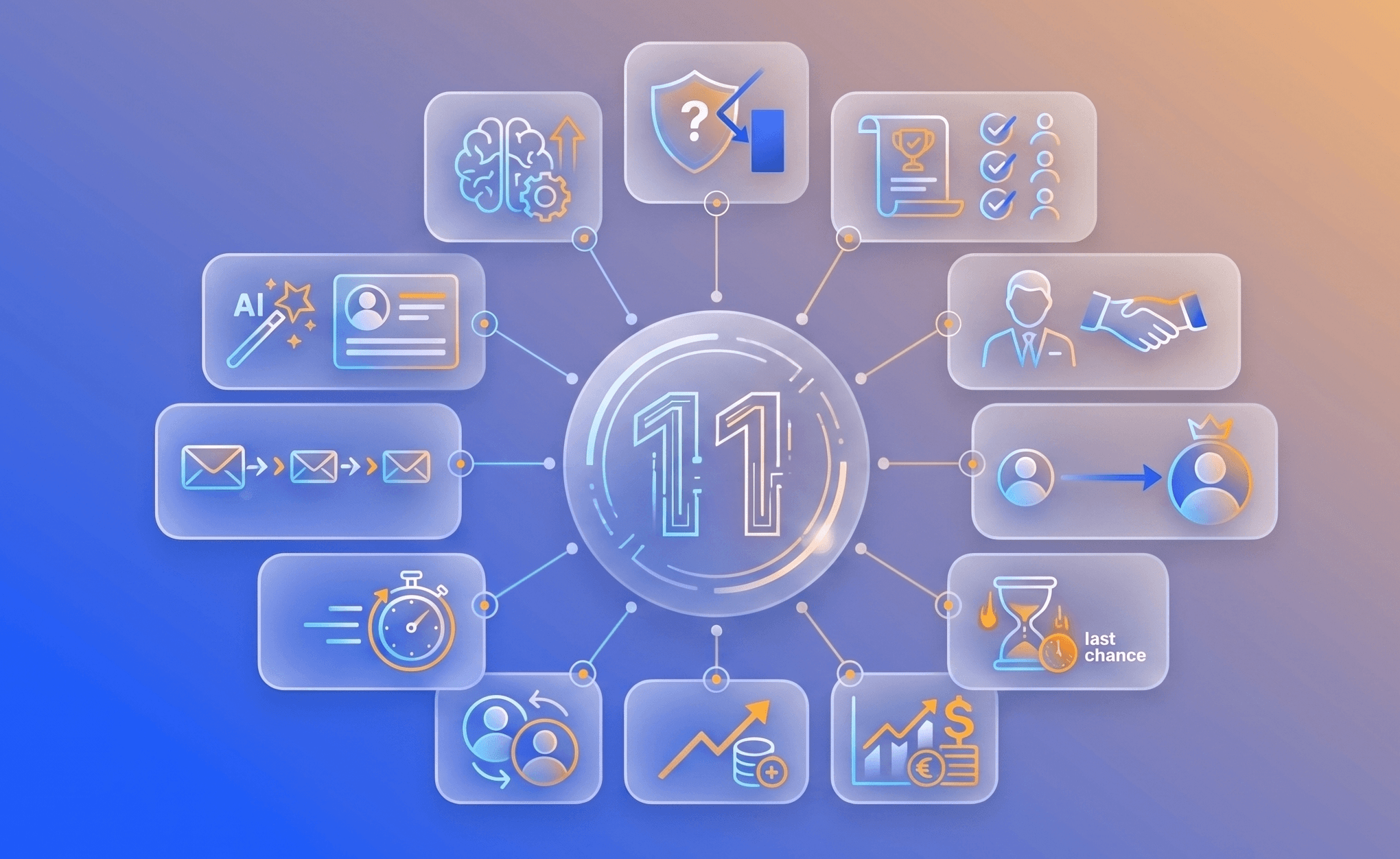
B2B sales techniques are methods salespeople use to nurture leads and convert them into paying customers.
Sales techniques are the “how” that enable sales teams to achieve their goals of closing more deals and increasing revenue. They include proven, practiced tactics for engaging prospects and motivating them to start using a product or service.
It’s important to distinguish B2B sales techniques from common traits of successful salespeople.
Charisma, enthusiasm, confidence, and experience are all valuable personality traits in B2B sales, but none are sales techniques. Neither are connections, although they may help you get a foot in the door.
If you want to thrive in sales, you need a robust toolkit of techniques to draw from so you can maximize every interaction with prospects.
In this article, we’ll cover 11 B2B sales techniques that have proven results, including the AI-powered one most reps are already behind on.
Unlike B2C sales, in which you need to convince individual buyers to purchase your product or service, B2B sales are usually far more complex.
Often, converting a lead involves proving your company’s value to multiple stakeholders. And decision-makers, often executives, are driven by business metrics like value, ROI, and cost savings.
Here’s why getting the techniques right matters more than ever in 2026: the B2B buyer has fundamentally changed. According to a March 2026 Gartner survey of 646 B2B buyers, 67% now prefer a rep-free buying experience, meaning they want to research, evaluate, and shortlist solutions without talking to a salesperson until they’re ready.
That doesn’t mean your reps are irrelevant. It means the techniques that earn a buyer’s time now have to be sharper. Gartner’s survey also found that 73% of B2B buyers actively avoid suppliers who send irrelevant outreach. The bar for relevance, specifically for earning the right to interrupt someone’s day, is now higher than it’s ever been.
In short, there are many barriers to break through to close a deal. Depending on the complexity of your offering, price, market maturity, and other factors, you could be staring down a long sales funnel.
The question of how to do B2B sales and succeed is a question of sales strategy.
Fortunately, there’s no need to reinvent the wheel. There are dozens of B2B sales tips and lead-generation techniques that have been proven to work for thousands of salespeople worldwide.
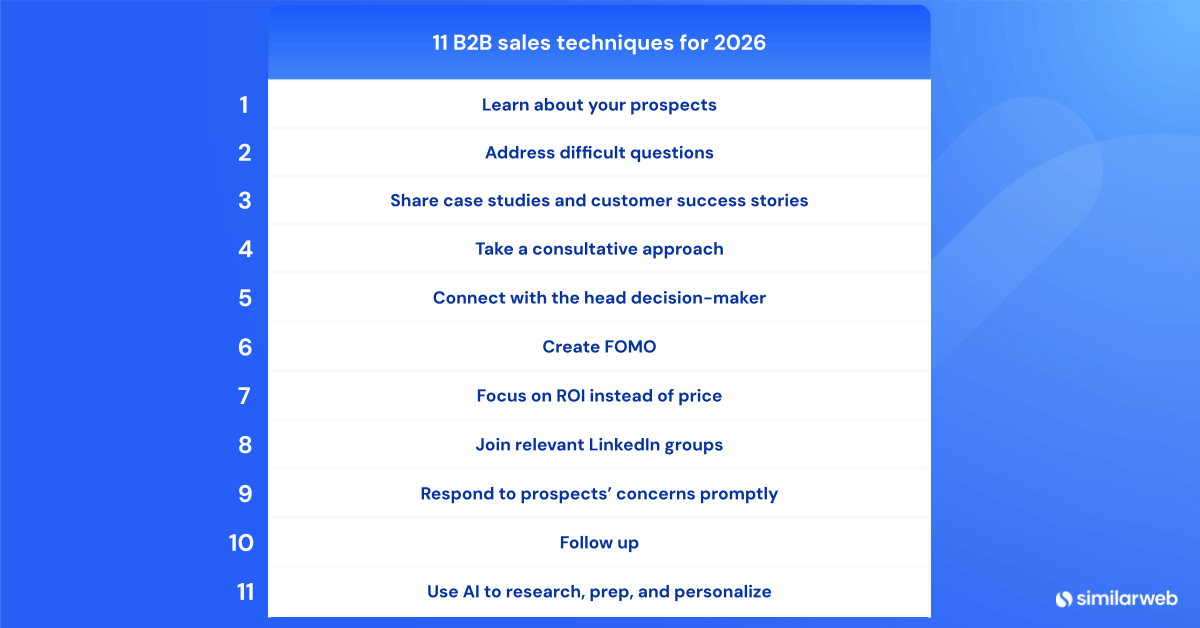
Here’s an overview of 11 sales techniques in B2B marketing and sales.
You should know several basic points about your prospects before you reach out and ask for their time. At a minimum, you should know:
A simple search on the company’s website and LinkedIn should quickly answer these questions. As you start digging, you’ll also want to uncover answers to more complex questions: those that provide meaningful talking points and help inform how you should position your product or service.
The answers to these questions will likely be found in different places, such as interviews with company executives, social media posts, industry news and reports, and more.
By subscribing to your prospects’ email newsletters, you’ll gain a condensed, curated view of the topics, achievements, and updates that are most important to them. You’ll also learn the vocabulary they use to describe their offering and get a sense of their target customer personas.
Most companies’ blog posts focus on two things: the challenges their prospects face, and how their product or service solves pain points. By reading through some blog posts, you’ll gain a very clear idea of your prospects’ offerings and how they provide value to other companies.
Who is the person you wish to contact within the prospect company, and are they on X (formerly Twitter)? LinkedIn? Facebook? More likely than not, you’ll find your leads and prospects on social media. If they post about business-related topics, you can gain a super authentic and personal view of what’s top of mind.
The cost of a poorly researched cold call is more than a lost deal: it’s a damaged brand impression that puts you on the “avoid” list permanently. That’s why sales technology like Similarweb Sales Intelligence has become one of the most effective prospecting tools on the market: it offers an AI agent for prospecting that turns the research that used to take an hour into a two-minute brief on any account.
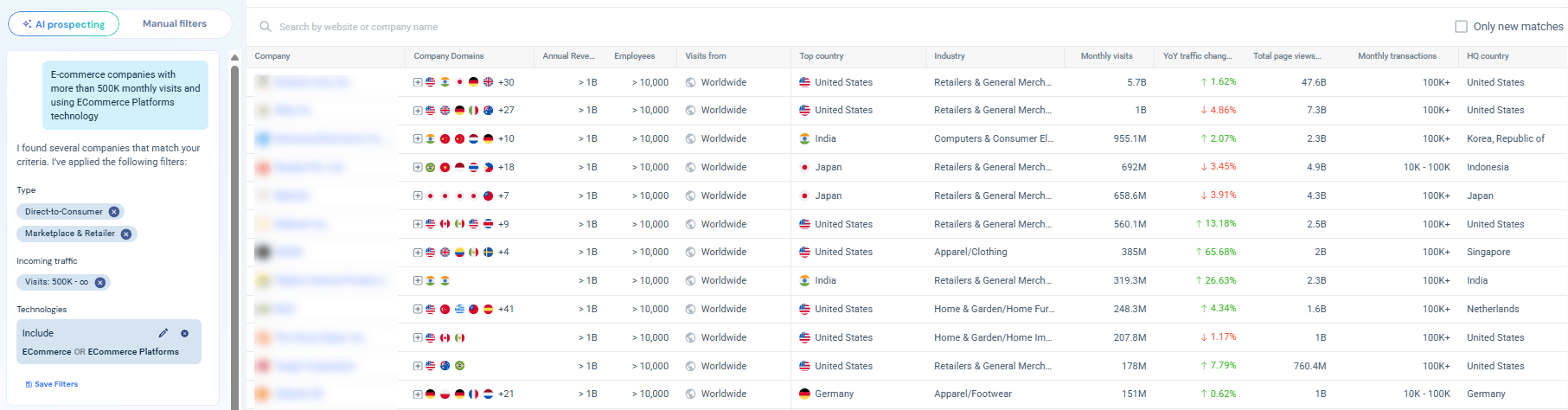
Similarweb’s unique website traffic and engagement datasets provide useful insights into prospects, including traffic trends and sources, audience demographics, and technologies used, delivering a multidimensional look at their digital performance.
You can even set alerts and be notified of specific sales triggers, such as when a prospect enters a new market, shows increasing digital revenue, expands into additional marketing channels, or ramps up marketing spend. Pair this with buyer intent data, and you’re not just knowing when to show up, you’re knowing exactly what to say.
Once you’ve gathered all of the relevant information, compare your findings to your most relevant B2B buyer persona. Buyer personas help you quickly understand the behavioral tendencies and communication preferences of your prospects, so you can tailor your outreach accordingly. When combined with your unique insights into individual leads, buyer personas are powerful additions to your B2B marketing strategy.
Addressing difficult questions directly and honestly, rather than deflecting them, is one of the most effective ways to build prospects’ trust. Buyers remember which vendors gave them straight answers, and which ones squirmed.
Once you do make contact with prospects and begin establishing correspondence, difficult questions are sure to arise. A prospect might ask if your product could do something it’s not able to do, inquire about a churned customer, or compare you to a competitor.
Don’t panic. It may sound counterintuitive, but one of the best B2B sales techniques is to be honest. Don’t lie about your product’s limitations, or promise additional services your CSMs can’t provide.
Instead, answer difficult questions honestly, and do what you can to turn them into a positive. You can explain that your product doesn’t currently offer the requested feature, but mention you’ll speak to R&D about building it.
If a well-known company ended its contract with you, focus on what did work well, then send case studies that highlight just how much value your company has provided other customers.
And, if difficult questions lead prospects to cut ties, it’s better to scrap a deal earlier in the game than later on, after you’ve already invested significant time and resources nurturing them.
Having said that, you don’t need to wait for a prospect to mention a churned customer before you share success stories.
Sharing case studies and customer success stories is a top technique in B2B marketing and sales because it provides concrete examples of the many ways you provide value and help customers achieve their business goals.
Examples of prior customer success also provide social proof. When a prospect sees that other reputable brands, or even a competitor, improved business metrics after becoming your customer, it will be much easier to prove that you can offer them the same.
The key is to share relevant case studies. First, identify which use case is most relevant for your prospect, then choose stories that focus on that use case.
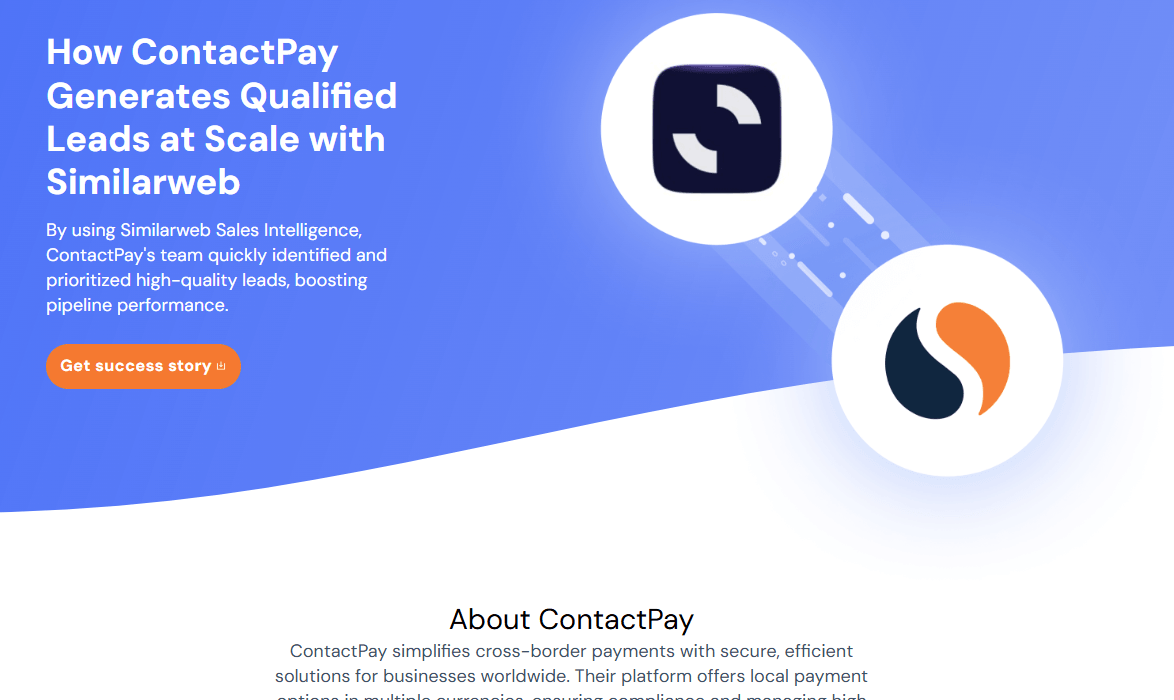
If you don’t have many case studies available, get in contact with your CSMs and marketing colleagues to start developing them. Case studies can support a wide range of marketing and sales activities.
One of the best B2B sales tips is to engage in consultative selling. In this selling approach, you, the salesperson, assume the role of a trusted advisor. Instead of aggressively pushing your product, your main objective is to be a source of valuable insights for your prospect.
Consultative selling helps your prospects:
Consultative selling is a long-game technique. Eventually, after you’ve provided prospects with some value, you’ll have demonstrated that you understand their pain points, goals, and needs, and can deliver the appropriate solution.
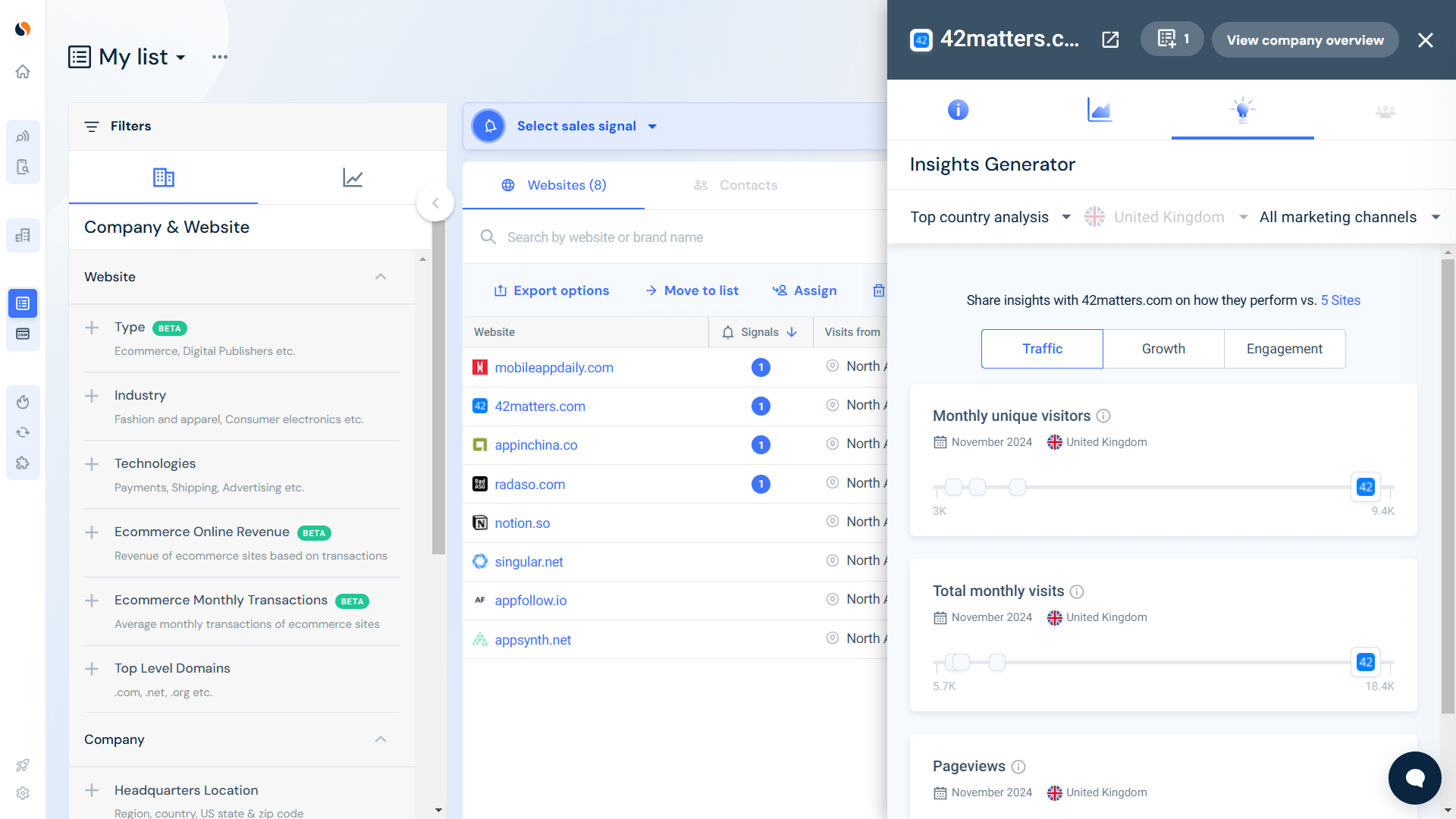
For example, you could use the Similarweb Insights Generator to identify robust, up-to-date information on a broad range of metrics, such as:
In many organizations, the person you’re corresponding with isn’t the final decision-maker. Connecting with the authority who can actually approve a purchase is essential to closing complex B2B deals, regardless of how well the relationship with your initial contact is going.
These leads, known as influencers, may be individual contributors, team leads, or would-be end users of your product or service. Although nurturing them is definitely worthwhile, you’ll also want to contact the person who can make purchasing decisions.
One way is to locate their contact details and reach out via phone or email. The fastest approach is usually to ask the lead you’re corresponding with to connect you to the appropriate decision-maker. You already have an “in” in the company, and they know exactly who you should talk to.
This B2B sales tip comes from the field of behavioral economics. When faced with a decision, people tend to be more driven by loss aversion than they are by potential gains. With this in mind, you can be far more persuasive in your pitch by emphasizing what a prospect stands to miss by not doing business with you.
Of course, that’s not to say that you shouldn’t talk about all of the benefits your product offers. You should. But at crucial moments, like when your lead is expressing doubts, playing up on their sense of loss aversion can help you build confidence and increase B2B sales.
Deals that come with hefty price tags are sure to make decision-makers pause. For some prospects, cost might be an insurmountable barrier. For others, buyers simply want to be sure that they’ll gain more in benefits than they spend in cash.
When prospects ask about price, a great B2B sales technique is to reframe the conversation around ROI. Business-minded people understand price as the cost of an investment. If the investment can yield sufficient benefits and be scaled up over time, it’s easier to address cost-related concerns.
For example, software that costs a company $500,000 per year but allows it to double its productivity and triple its revenue is surely worth it.
LinkedIn is the largest professional network in the world, and it’s the place where business influencers are most active, which is why it’s one of the hottest B2B lead generation tools. LinkedIn groups focused on specific topics, trends, or companies can be prime real estate for connecting with prospects and cultivating rapport.
The important thing to remember is to be active. Don’t just join a group and be invisible among its thousands of members. Like and comment on your prospects’ posts, ask questions, and share relevant articles or polls. All of these can create engagement and help position yourself as a knowledgeable resource.
Responding to prospect concerns quickly, even just to acknowledge receipt, signals attentiveness and prevents deals from going cold while you’re preparing a full answer. Response speed is a proxy for quality of service.
When a prospect expresses any type of concern or problem, you don’t want to keep them waiting for a response. A slow reply could signal that your company isn’t attentive or doesn’t have the means to provide adequate customer support.
Of course, it’s not always possible to drop everything and resolve issues immediately, but there’s always time to acknowledge them. For example: “I’ve received your email, and I’m working on answering all of your questions. I’m going to speak with my boss and our customer success managers to give you the most accurate information I can.”
This type of response shows that you’re on it. Even if it takes a few days to come up with a more comprehensive response, they won’t be wondering why you aren’t answering.
The final traditional B2B sales technique in this article is a simple but crucial one: follow-up.
Most B2B deals require 5 to 12 touchpoints to close, yet research consistently shows that most salespeople abandon follow-up far too early. According to Invespcro study, 48% of salespeople never make a single follow-up attempt after initial contact (note: vendor-commissioned research. The directional finding is consistent with patterns reported across multiple independent sales studies).
In sales, you’re tasked with juggling numerous conversations with different prospects at the same time, all of whom are at different points along the sales nurturing funnel. It’s understandably difficult to keep tabs on everyone, but it’s important to develop a system to follow up at the right times.
The B2B buyer’s preference for self-directed research (that 67% rep-free figure from Gartner) doesn’t mean salespeople are losing. It means the window in which a rep’s time actually matters has narrowed. Buyers now arrive at the conversation already educated, already skeptical, and already partway decided. The reps who win are the ones who show up to that conversation knowing more about the account than the buyer expects.
AI-powered selling is what makes that possible at scale.
This isn’t a prediction about where sales are headed. It’s already the operating reality. In the same March 2026 Gartner survey, 45% of B2B buyers reported using AI during a recent purchase. Buyers are using AI to research vendors. Sellers who aren’t using it to research buyers are entering the conversation at a structural disadvantage.
Pre-call research in minutes, not hours. Similarweb Sales Intelligence surfaces a prospect’s traffic trends, technology stack, marketing channel mix, and growth signals before you’ve picked up the phone. What used to be a 45-minute manual dig through LinkedIn, company websites, and industry news now takes two minutes and is more accurate.
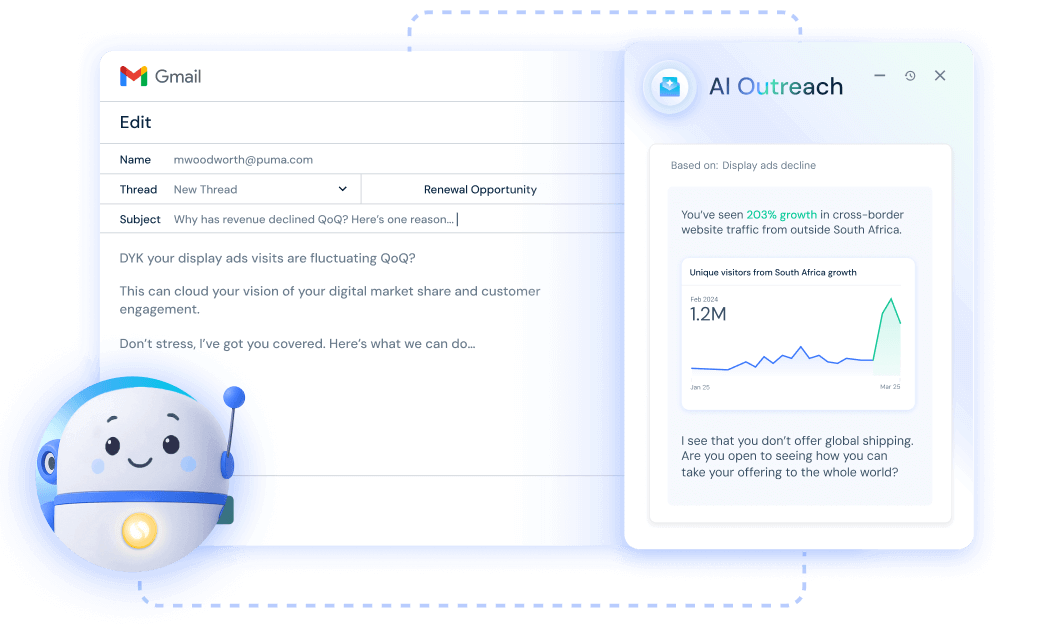
Outreach that earns a response. Similarweb’s AI Outreach (integrated into Gmail and Google Calendar) generates personalized, insight-led messages based on real account data. The output isn’t a template with a first name swapped in. It’s outreach built around something the prospect actually cares about, like a traffic spike in a channel they’re under-investing in or a competitor moving into their market.
Meeting prep that makes you the smartest person in the room. The AI meeting preparation agent pulls together account summaries, recent company news, and competitive context before every call. A rep who walks in knowing the prospect’s recent performance trends and their top competitors’ latest moves isn’t just prepared. They’re demonstrating the kind of informed engagement that modern buyers expect.
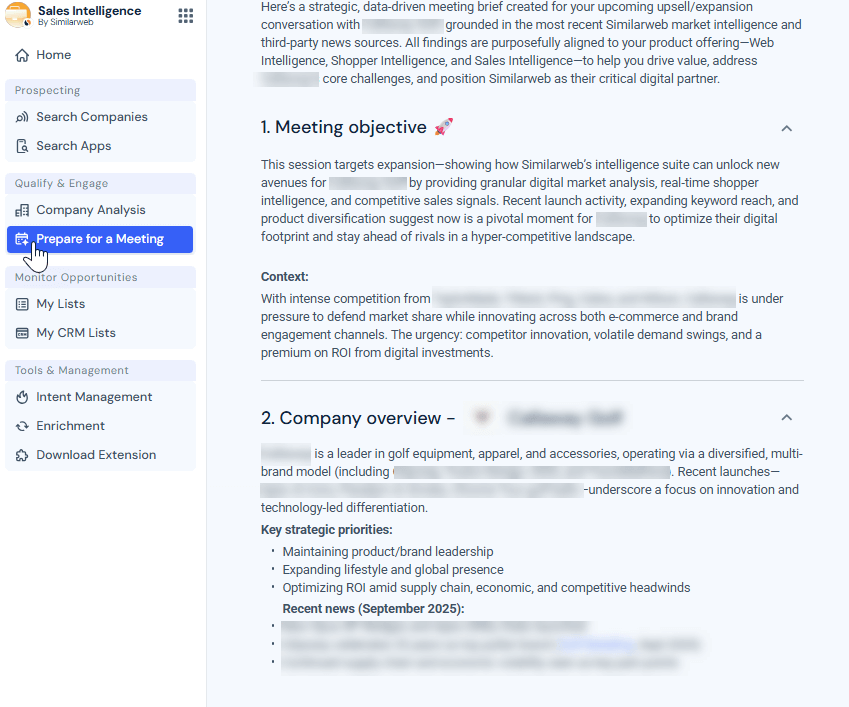
The important balance to strike: AI accelerates the top of the funnel, handling prospecting, prioritization, and outreach at scale. But Gartner’s research also points to a critical counterbalance: by 2030, 75% of B2B buyers are expected to prefer sales experiences that prioritize human interaction over AI at the point of decision.
The implication is clear: use AI to earn access to the conversation, then show up as a human who can actually close it.
A practical framework for splitting the work:
| Sales stage | Best approach |
| Account research and prioritization | AI (Similarweb AI prospecting agent) |
| Outreach personalization | AI (Similarweb AI outreach agent) |
| Meeting prep and account briefing | AI (Similarweb AI meeting prep agent) |
| Discovery call and needs assessment | Human |
| Objection handling | Human |
| Multi-stakeholder alignment | Human |
| Negotiation and close | Human |
The amazing thing about these B2B sales tips is not just that they work. They’re also incredibly easy to put into practice.
Simple tweaks to the way you interact with prospects, such as which points to emphasize, how to answer tough questions, and how to address their concerns, can have a dramatic impact on your sales success.
Other sales techniques, such as in-depth prospect research and consultative selling, help position you and your company as a domain expert and make it easier to build trust. The newest addition to this list, AI-powered selling, multiplies the effectiveness of every technique that came before it: better research for technique #1, sharper FOMO framing for technique #6, and more timely follow-up for technique #10.
With Similarweb Sales Intelligence, accessing the data and insights that turn each of these techniques from generic advice into account-specific execution is exactly what the platform is designed to do.
What is a B2B sales technique?
B2B sales techniques are the “how” for converting leads into paying customers. They include a variety of tactics that are time-tested for attracting, engaging, and nurturing leads until they’re ready to close a deal.
Why is it important to learn B2B sales techniques?
Sales techniques provide structure and guidance to salespeople on how to communicate with prospects, nurture them through the sales funnel, identify sales triggers, and persuade them to become customers.
How has AI changed B2B sales techniques?
AI hasn’t replaced traditional B2B sales techniques. It’s made them faster and more precise. AI tools now handle prospect research, outreach personalization, and meeting prep that previously required significant manual effort. The biggest shift is that buyers are also using AI during their research process: 45% in a March 2026 Gartner survey reported using AI during a recent purchase, which raises the preparation bar for sellers.
What’s the difference between B2B and B2C sales techniques?
B2B sales techniques differ from B2C primarily in complexity and timeline. B2B deals typically involve multiple decision-makers, longer sales cycles, higher contract values, and ROI-driven purchasing criteria. Techniques like consultative selling, multi-stakeholder management, and detailed prospect research matter far more in B2B contexts than in B2C, where decisions are often faster and more emotionally driven.
How do you measure the effectiveness of B2B sales techniques?
Track conversion rates at each stage of your sales funnel, along with deal velocity, win rate by outreach type, and average deal size by method. The most telling metric is often the first-contact-to-meeting conversion rate, which reflects directly how well your prospecting and outreach techniques are working before any consultative selling begins.

by Inbar Eytan
Product Marketing Manager
Inbar Eytan is the Product Marketing Manager for Sales Intelligence at Similarweb. With 8 years of experience in marketing, she believes in the power of turning data into actionable insights that make a real impact.
Top Ecommerce Companies in the USA: The 100 Brands Winning the Traffic Race in 2026

3 of the Sharpest Minds Weigh in on the State of Gen AI in 2026

Try Similarweb Sales Intelligence today — free of charge
