






The Top 100 Most Visited Websites in the USA (August 2026)
by Shai Belinsky10 Min.
Sep 29, 2026
Leads don’t just fall into your lap. Not the good ones, anyway. If your pipeline’s humming, there’s a system behind it. One that connects every click, form fill, and follow-up into a clear B2B lead generation strategy. And the best teams? They run funnels, fully mapped from attraction to conversion, with Similarweb sales intelligence, the right lead generation tools, and AI.
Let us walk you through how to do lead generation in digital marketing today, showing you what works, what doesn’t, and how to turn raw interest into real revenue.
In B2B, a lead is more than just an email in your inbox. It’s someone, or some company, showing real signs they might buy. That could be anything from downloading a whitepaper to bouncing around your pricing page three times this week.
The trick is pairing that behavior with actual data you can use. That’s where lead enrichment tools become useful. And since buying decisions usually involve a crew, not just one person, a single account might contain multiple leads at different stages.
The right move is logging all that inside your CRM, tagging each with firmographic signals, and giving marketing and sales one shared source of truth. Because lead generation starts before scoring, segmentation, or automation. It starts with knowing who’s in the room.
Lead generation is the engine that turns curiosity into pipeline. It’s how you move people from “I’ve heard of you” to “let’s talk.” And it’s built on repeatable, trackable motions that power your lead generation funnel.
So, how does lead generation work in your business? That depends on your motion. But whatever path you take, a strong tech stack, CRM, lead enrichment tool, analytics, and AI, makes the difference between chaos and clarity. The goal is simple: a system where marketing, sales, and ops all have the same answer to, “Where’s this lead coming from and what’s next?”
Lead generation is the engine room behind predictable growth. Here’s why top-performing teams take it seriously:
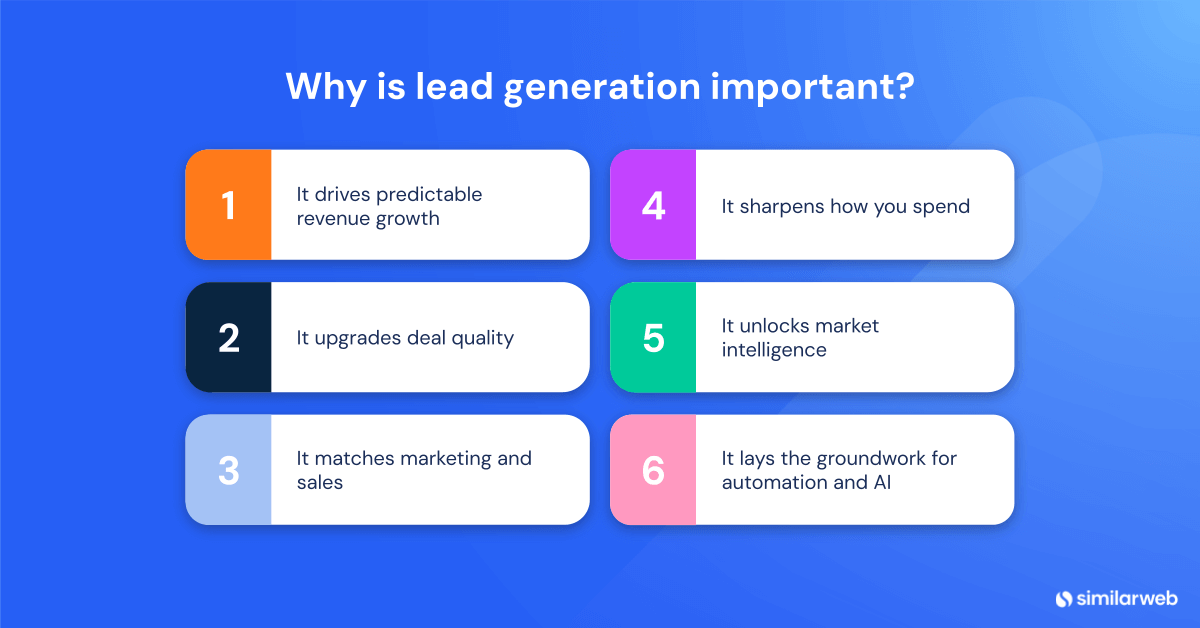
A well-oiled lead generation strategy gives structure to your pipeline. When you know how many inputs lead to actual deals, revenue forecasting becomes less of a guessing game and a lot more like planning with purpose.
With a reliable qualification loop, your team filters out the tire-kickers early. By the time a rep picks up the phone, the lead already checks the important boxes: industry fit, buying power, timeline, and intent. That means faster sales cycles and fewer wasted calls.
Nothing kills momentum like finger-pointing. A shared lead scoring framework and clear dashboards keep everyone focused. Marketing owns the top and middle of the funnel. Sales handles the bottom. No debates, just flow.
Running lead gen without performance data? You might as well light your ad budget on fire. When you know what channels convert, you can double down on what works and drop what doesn’t. Less waste, more wins.
Every form fill, click, and open tells you something. Feed those signals into your sales intelligence tools and suddenly you’ve got a radar for rising trends, new segments, and what the competition’s up to.
Want AI to route leads? Start by feeding it clean, structured lead data – AI is as good as the data it leans on. No clean input means no good output.
Here’s how high-growth B2B teams consistently turn cold traffic into revenue, step by step. This is your full-funnel playbook, built to move prospects from “never heard of you” to “where do I sign?”
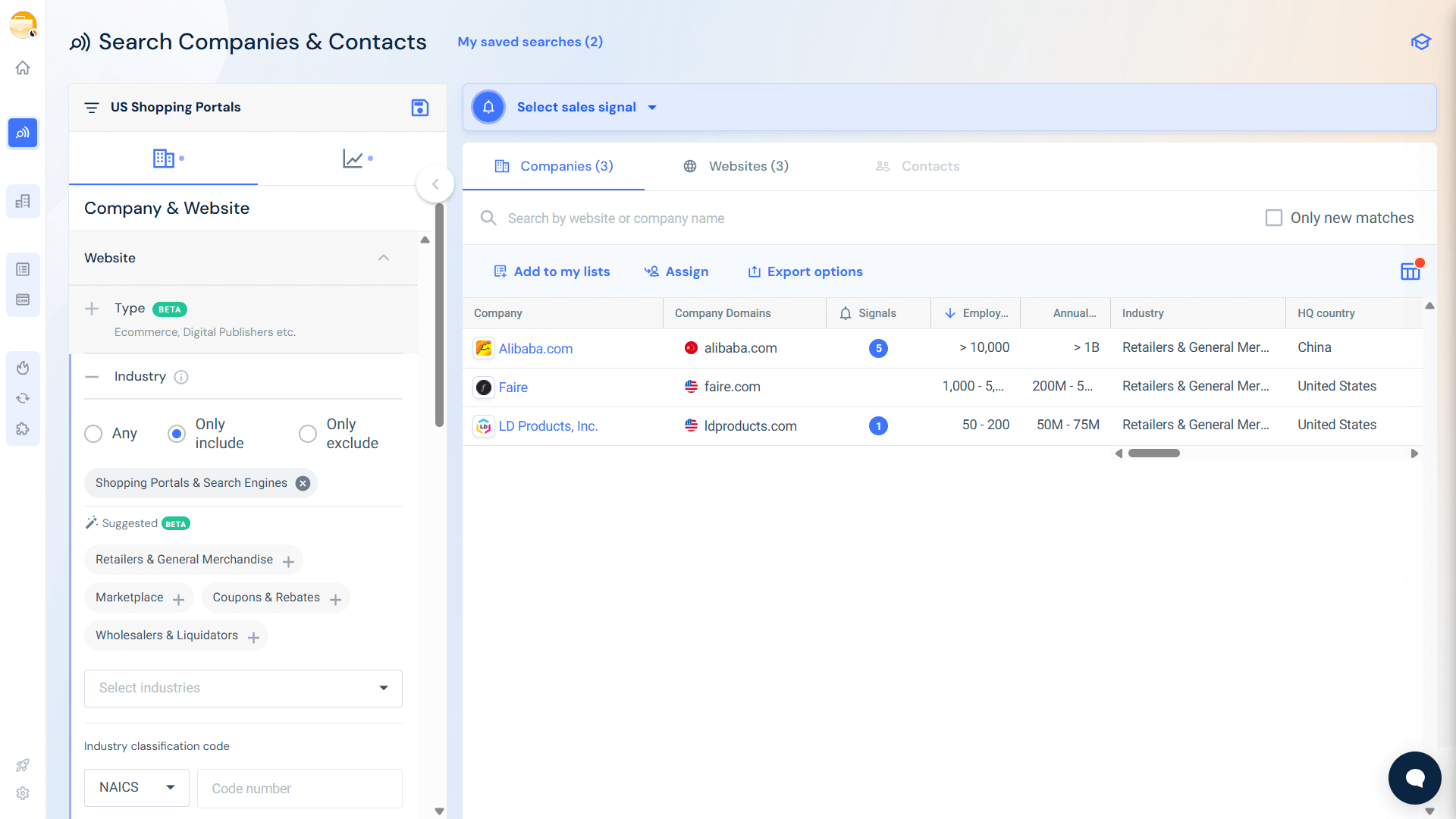
Start with clarity. Define your Ideal Customer Profile (ICP). Slice it by firmographics and technographics. Then filter for the companies where you can drive the most effect: those on the rise, showing growth in traffic and interest. Look at global trends, specific geos, and whether they’re climbing or falling.
Pull insights from Similarweb’s Sales Intelligence and lock in the exact language your prospects use. Precise targeting here prevents wasted budget later.
Now bring them in. Use lead generation digital marketing tactics (SEO, PPC, paid social, webinars, and partner plays) to meet prospects where they’re already searching.
Position your content around a clear problem your product solves. Don’t sell, but solve. That’s how you earn attention before a form ever enters the picture.
And don’t forget timing; matching outreach to active sales signals like traffic spikes, product page visits, or competitor comparisons can make the difference between ignored and interested.
Got their attention? Time to get their info. Use landing pages, chatbots, and tools that exchange value for data.
Keep forms tight. Use a lead enrichment tool to auto-fill missing fields and push clean records into the CRM. This is where anonymous visitors become trackable, actionable leads.
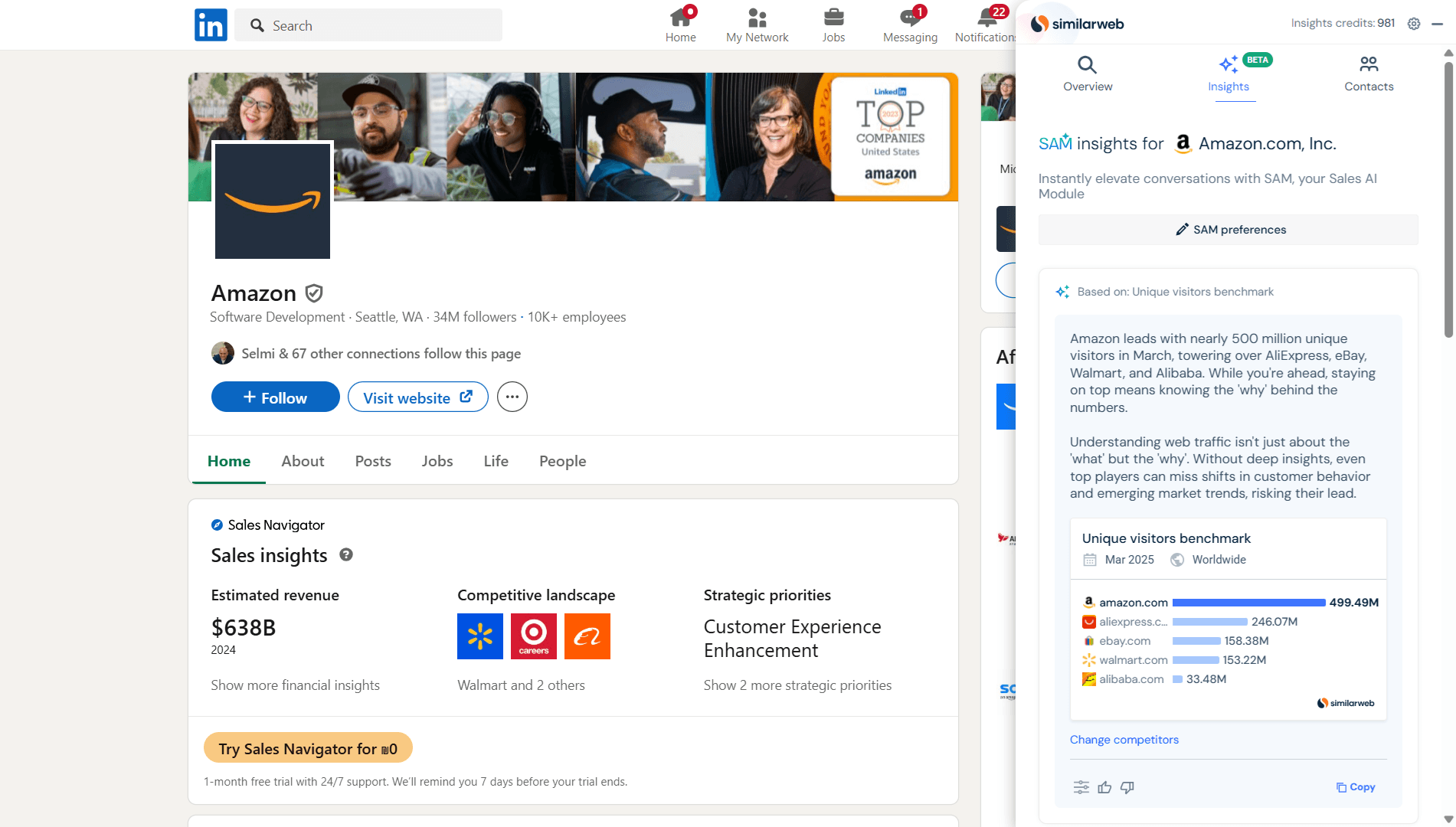
Are you still using cold outreach? It’s time to make your message noticeable with personalized insights using Similarweb’s AI Outreach (previously known as SAM) by showing prospects your value and insights before they even click.
Don’t go quiet now. Run a multichannel nurture track: emails, retargeting ads, customized content, even in-app nudges.
Let AI tweak frequency and messaging based on engagement signals. The goal is to build trust and create momentum. Get them leaning in without your SDR team lifting a finger yet.
Once a lead hits your MQL threshold, pass it to your sales engagement tool, complete with tags, behavior history, and score.
Reps walk in with full context, skip the small talk, and go straight into value. It’s how you avoid the “so… what do you do again?” conversation that kills pipeline velocity.
Now it’s showtime. Reps qualify the lead, confirm urgency, and customize demos or trial offers.
Because you know exactly how and why that lead entered the funnel, you can connect ROI to their pain points in minutes, not weeks. That’s how deals close faster.
Don’t stop at closed-won. Push every outcome, win or loss, back into your marketing systems. Use that intel to refine your scoring models, creative hooks, and campaign spend.
With time, machine learning pinpoints the next best leads to prioritize. It’s a self-improving engine rather than just a cycle.
This is how lead generation actually works when it’s done right. Flexible, data-backed, and constantly getting better.
There’s no shortage of advice on lead gen. The problem is that most of it’s outdated, or too generic to matter.
Here are the proven, modern tactics that actually work. Use them, combine them, and watch your pipeline stay full.
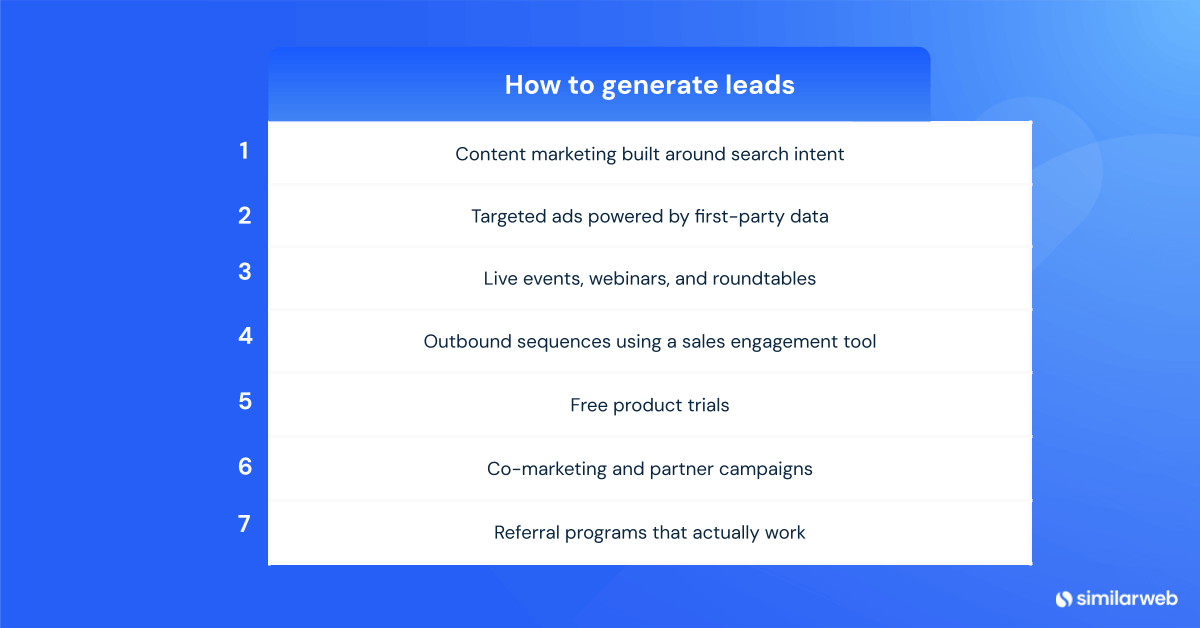
Start where your buyers do: Google. Figure out what they’re searching for and build content that answers those questions. Think: helpful blog posts, calculators, videos. Now pair each one with a sharp CTA. That’s how you turn search traffic into a real pipeline.
Got a high-intent account list? Upload it to LinkedIn or Google Ads. Serve creatives tailored to job titles or industries, then route those clicks to laser-focused landing pages. When the message meets the audience, your conversion rates will jump.
Whether it’s virtual or in-person, events still work. Host workshops or roundtables. Keep them helpful, not salesy. Your reward? A list of registrants (aka leads), plus accurate buying signals of who’s asking the right questions and when to follow up or invite them to the next session.
Combine customized email, cold calls, and social touches in one tight sequence. Don’t spray and pray. Use sales intelligence to trigger outreach. Think: funding news, leadership hires, new product launches. Strike when there’s context.
Sometimes, seeing is believing. Let prospects test-drive a time-boxed, limited-feature version of your product. Layer in smart in-app nudges and have your reps ready to follow up. If they’re using it, they’re halfway there.
Team up with a vendor in an adjacent space. Run a joint webinar. Publish original research. Their audience sees you, yours sees them, and both of you win. It’s reach without renting more ad space.
Make it worth their while. Give happy customers a reason to introduce you to others in their circle. These are warm intros, not cold leads, and they often convert faster than anything you’ll find in your CRM.
Use multiple channels. Why? Because one will always underperform eventually. When that happens, the others keep your pipeline humming. That’s how real lead gen works.
Let’s move from theory to practice.
Here are lead generation strategies that actually get results, complete with real-world-style examples that show how value + data capture = pipeline growth.
A SaaS company in the logistics space builds a “Cost-to-Serve Estimator.” Prospects plug in their monthly shipment volume and get back an estimated savings report.
To access the full breakdown, a business email is required. It educates, qualifies, and tees up sales, all in one move.
A cybersecurity vendor drops a natural language chatbot onto high-intent landing pages. It answers common questions, captures lead info like company size and job title, and books meetings directly to the rep’s calendar.
No forms, no friction. This is how to use AI for lead generation that actually converts.
The marketing team targets 500 logistics companies with ads customized to each sector. Clickthroughs land on a pre-filled form, powered by a lead enrichment tool.
From ad spend to CRM in under 10 seconds, with zero manual entry. That’s how ABM should look in 2025.
A manufacturing ERP brand surveys 300 plant managers, then wraps the findings into a gated report. Downloaders get a customized performance scorecard based on their industry.
What follows? Inbound calls turn into consultative sales. Insight + exclusivity = qualified leads.
Rather than one giant webinar, an analytics vendor runs three back-to-back micro-events: one each for product, finance, and marketing leaders.
Smaller rooms spark better questions and better scoring signals. Customized content drives more intent rather than just attendance.
Anyone who bounces from the pricing page gets retargeted with case studies featuring companies just like theirs.
One click unlocks a deeper success story via short form. A gentle nudge, wrapped in social proof, that pulls fence-sitters back into the funnel.
A project management platform launches a free Trello plug-in. Users connect their account, triggering opt-in and syncing usage data.
Product adoption becomes qualification. And now, sales knows exactly who’s interested and how much.
A data quality company cuts a CPL deal with an industry site. Leads flow directly into the CRM, tagged by source. ROI tracking? Built in.
This method extends your reach and locks down quality control without blowing the budget.
And don’t overlook in-person events like conferences. For startups, they’re one of the most effective lead gen tools, especially when you’re up against bigger players. You get organic visibility, real conversations, and paid amplification all in one place.
Every tactic here shares a common thread: it delivers value upfront while capturing the data that fuels your lead gen funnel. Creative formats work, but the fundamentals still win.
Want to build your own version? Start with value, layer on targeting, and never make a prospect work harder than they have to.
Time is your most valuable (and limited) sales resource. So how do you decide which leads are worth chasing?
Here’s how to get ruthless about qualification without losing your edge.
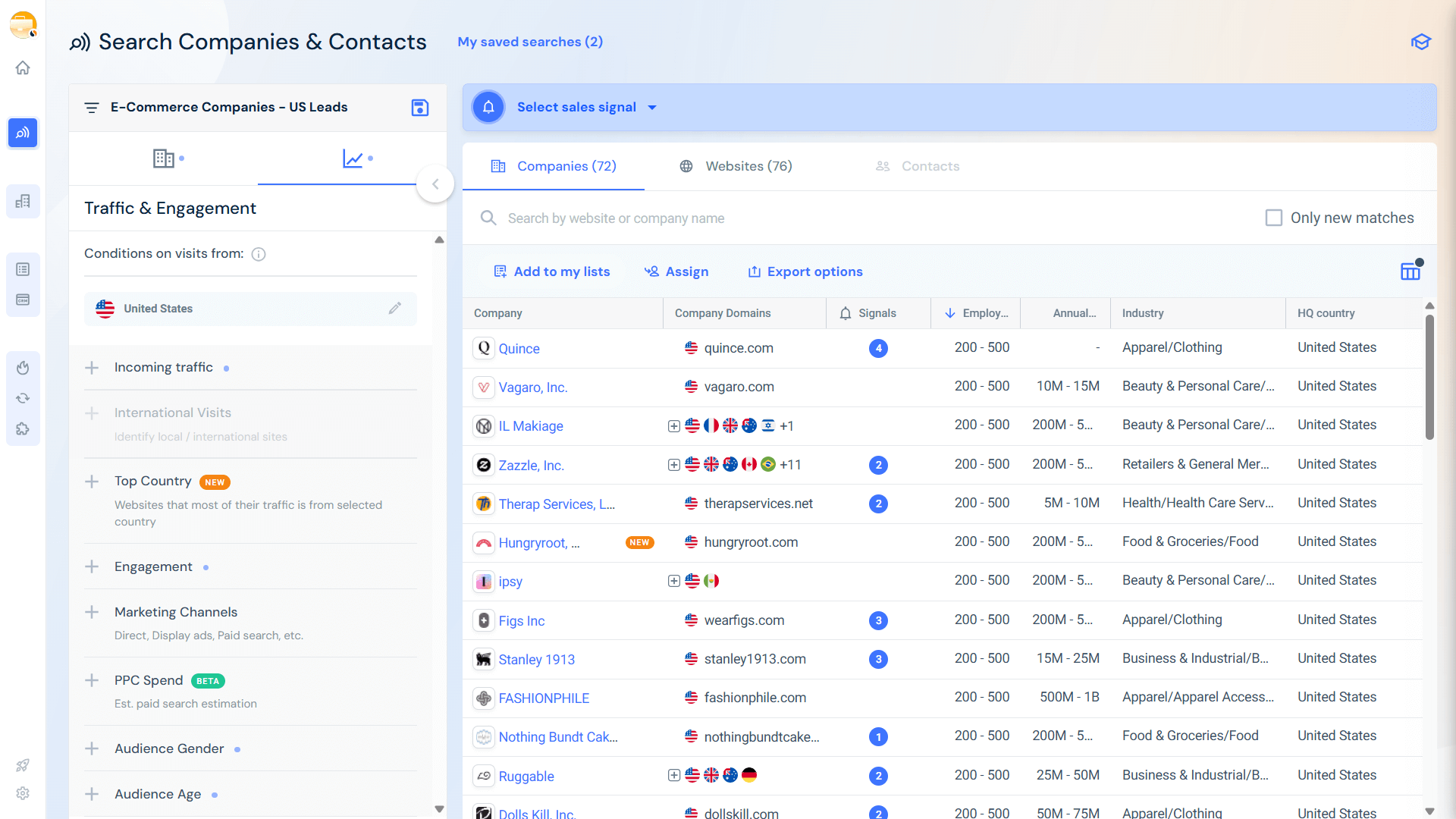
Build a simple, objective model. Assign points for firmographic fit (industry, size, region), which is data that you can pull straight from Similarweb’s Sales Intelligence, and layer in behavior: webinar signups, pricing page views, product tours.
Prioritize what actually correlates with the pipeline and automate where you can. It keeps things consistent and prevents your best reps from chasing ghost leads.
Pick your weapon, BANT, CHAMP, MEDDICC, it doesn’t matter, so long as you use it.
Train your team and make it muscle memory. Then log every answer in your CRM. That’s how you keep discovery sharp and reporting clean.
Is the account hiring a Head of RevOps? Did they just raise a Series B? These are urgency triggers.
Similarweb’s Sales Intelligence and LinkedIn Sales Navigator surface this intel in real time. Use it to prioritize like a pro.
Someone just spent 40 minutes reading about your category on G2? That’s a live wire.
Third-party intent data with your own engagement signals is a qualification goldmine. Spot active buyers early and skip the cold open.
Open with context. “Saw you checked out our pricing page after the webinar, what caught your eye?”
Dig deep and get honest. If they lack authority or don’t have a clear pain, don’t force the demo. Route to nurture and move on.
MQL, SAL, SQL, PQL, pick your acronyms, but make them matter.
If marketing owns the top, sales owns the close, and product handles expansion, then clear labels keep the handoffs tight and the follow-ups timely.
Stalled deal? Budget killed? Doesn’t matter. Tag it and log the reason. Then schedule a revisit. Maybe in six months, maybe post-Q4.
The point is, you already paid CAC on that lead. Don’t let it go to waste.
Machine learning can spot patterns your reps can’t, like a weirdly consistent combo of product page views + 51-100 headcount companies that convert 3x higher.
Use that to prioritize, not to predict the future.
Similarweb takes it a step further. Beyond just pattern recognition, AI can process company data, traffic shifts, and sales signals to surface reliable insights that your team can act on.
Work through this checklist, and you’ll protect seller time, match better with marketing, and stop clogging your funnel with leads that were never going to close anyway.
Ads, chatbots, content, you name it. It’s about building a system where every click, conversation, and question feeds into the same engine.
A good lead generation process cuts through the noise. It’s structured, focused, and when you combine it with intelligent qualification, you build a predictable pipeline.
Now layer in AI, traffic data, and sales intelligence. This is where things get interesting.
That’s the power of an integrated setup. Similarweb’s Sales Intelligence brings together your audience targeting, traffic analytics, and enrichment APIs in one place, so instead of jumping between platforms, you execute your entire playbook from one workspace. Plug those insights into your CRM and suddenly, leads stop slipping through the cracks. Outreach gets faster, messaging gets sharper, and the whole funnel starts moving.
How can AI improve my lead generation funnel?
AI learns and doesn’t just make guesses. It scans past wins and losses to spot the common threads (industry, job title, time of year). Then it ranks leads based on the ones most likely to close. You get better outreach, without second-guessing every decision.
What metrics show whether your lead gen strategy’s working?
Look at cost per lead, conversion to opportunity, and how many leads actually get picked up by sales. Then break it down by cohort to see if your newest plays are bringing in better leads or just more noise. The north star is rising opportunity rate.
Where does a sales engagement tool come into play?
After marketing’s done the warming-up job, through ads, SEO, or gated content, it’s the sales engagement tool that takes over. That’s where reps run their sequences, track every touchpoint, and sync it all back to the CRM for the full feedback loop.

Ayelet Mechany, Sales Intelligence Product Marketing Manager by day, rock climber by weekend. Equally obsessed with helping sales teams reach their peak as I am conquering mountain summits.
The Top 100 Most Visited Websites in the USA (August 2026)
Similarweb Named in Forrester's Answer Engine Optimization Technologies Landscape, Q3 2026
Anthropic IPO: What Claude's Web and App Data Show
Try Similarweb Sales Intelligence today — free of charge
