





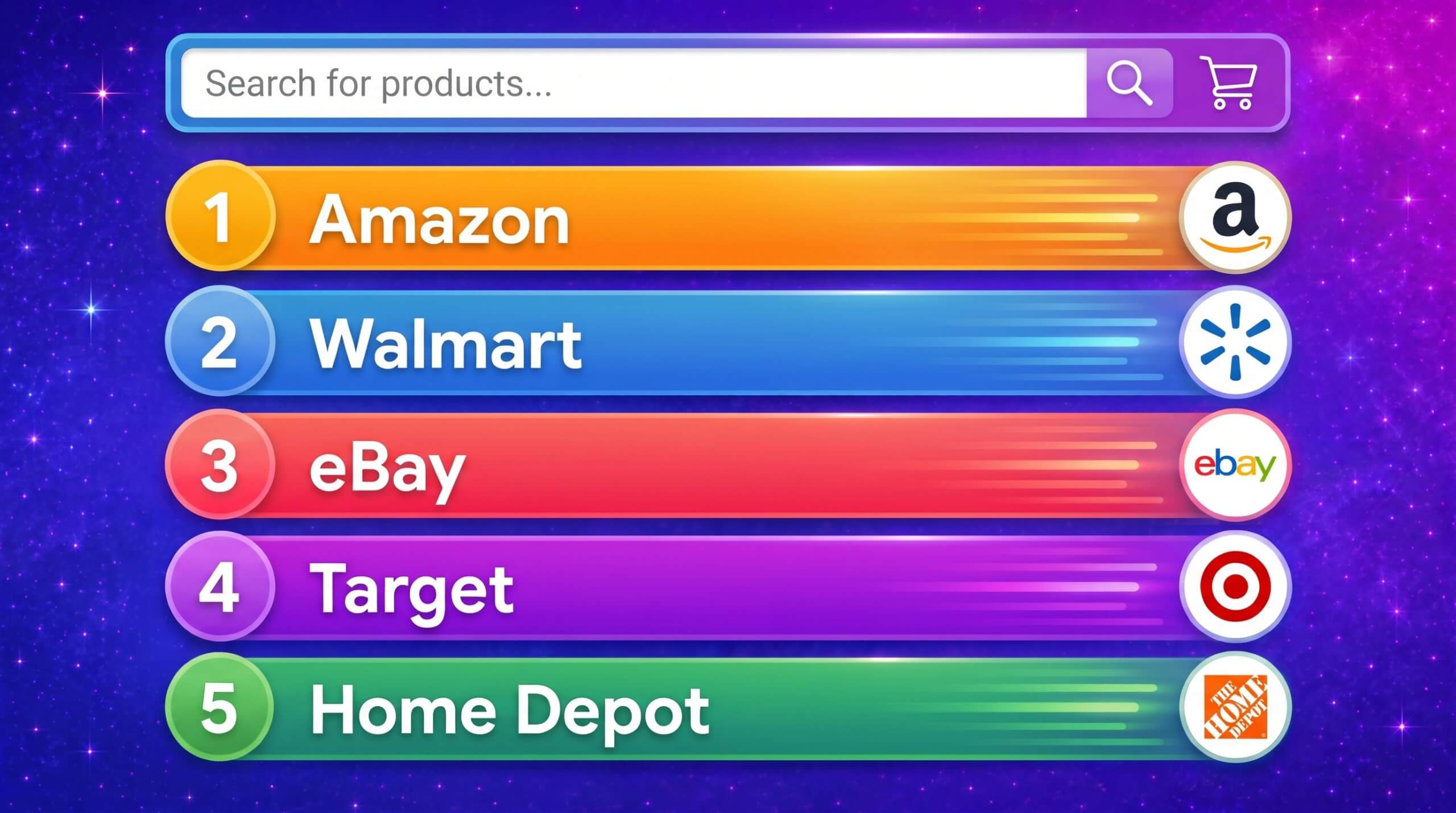
Top Ecommerce Companies in the USA: The 100 Brands Winning the Traffic Race in 2026
by Inbar Eytan6 Min.
Aug 30, 2026
How do you increase B2B sales?
Today, sales teams have a huge range of sales tools at their disposal, helping them boost efficiency and identify more relevant leads faster. However, it also means there’s higher competition for your prospects’ time and attention.
The key to increasing B2B sales is figuring out how to reap the benefits of modern sales techniques and overcome the obstacles that are so common in a competitive and pretty crowded digital space.
In this article, we’ll cover eight best practices and tools you can implement to shift your sales team performance into high gear, increase B2B sales, and add high-value accounts to your book of business.
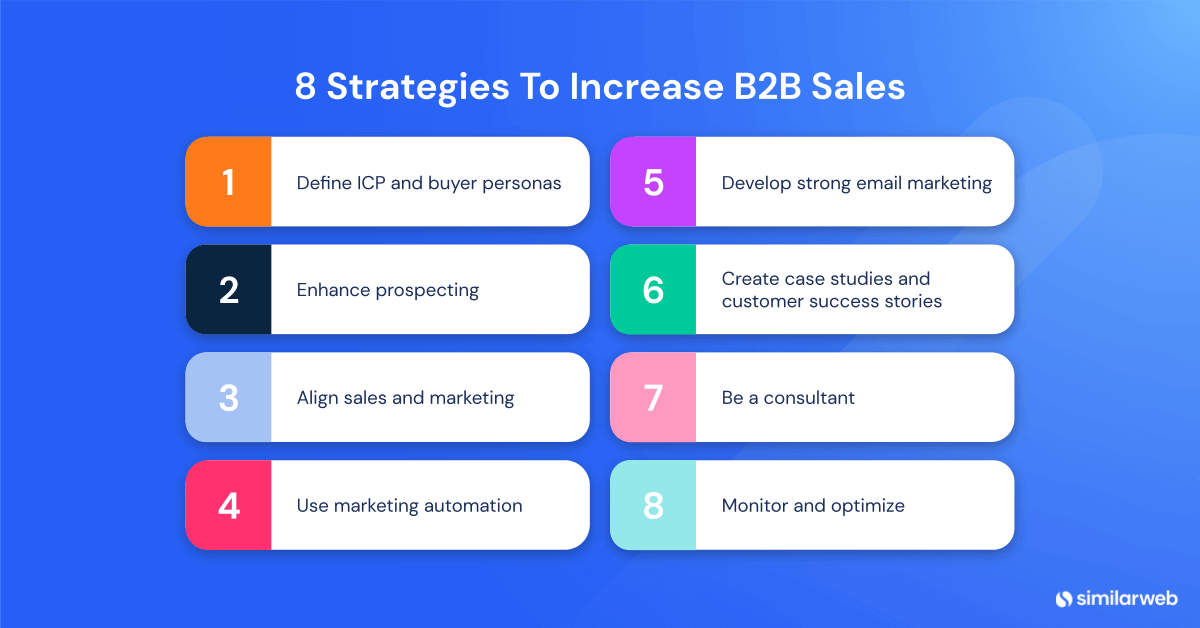
If boosting your win rate sounds good to you, take a look at these eight steps that are guaranteed to increase B2B sales:
When you want to give your sales performance a boost, sometimes you need to re-examine everything. Let’s go back to square one.
Who is your target audience? What kinds of companies would make the best customers? Who are the people you need to reach with your marketing and sales (ie. smarketing) campaigns?
To answer those questions, you need to define your ideal customer profile and B2B buyer personas.
When you define what your ICP looks like, you’ll be positioned to create more precise, targeted marketing and sales material that attracts the right leads.
To determine your ICP, start by consulting company executives, marketing team leaders, R&D, and customer success specialists. Most companies start with demographic information, such as:
Although understanding what kinds of companies would make a good customer in general, such a broad list of traits will still produce a large list of prospects, many of which wouldn’t be truly relevant or “ideal.”
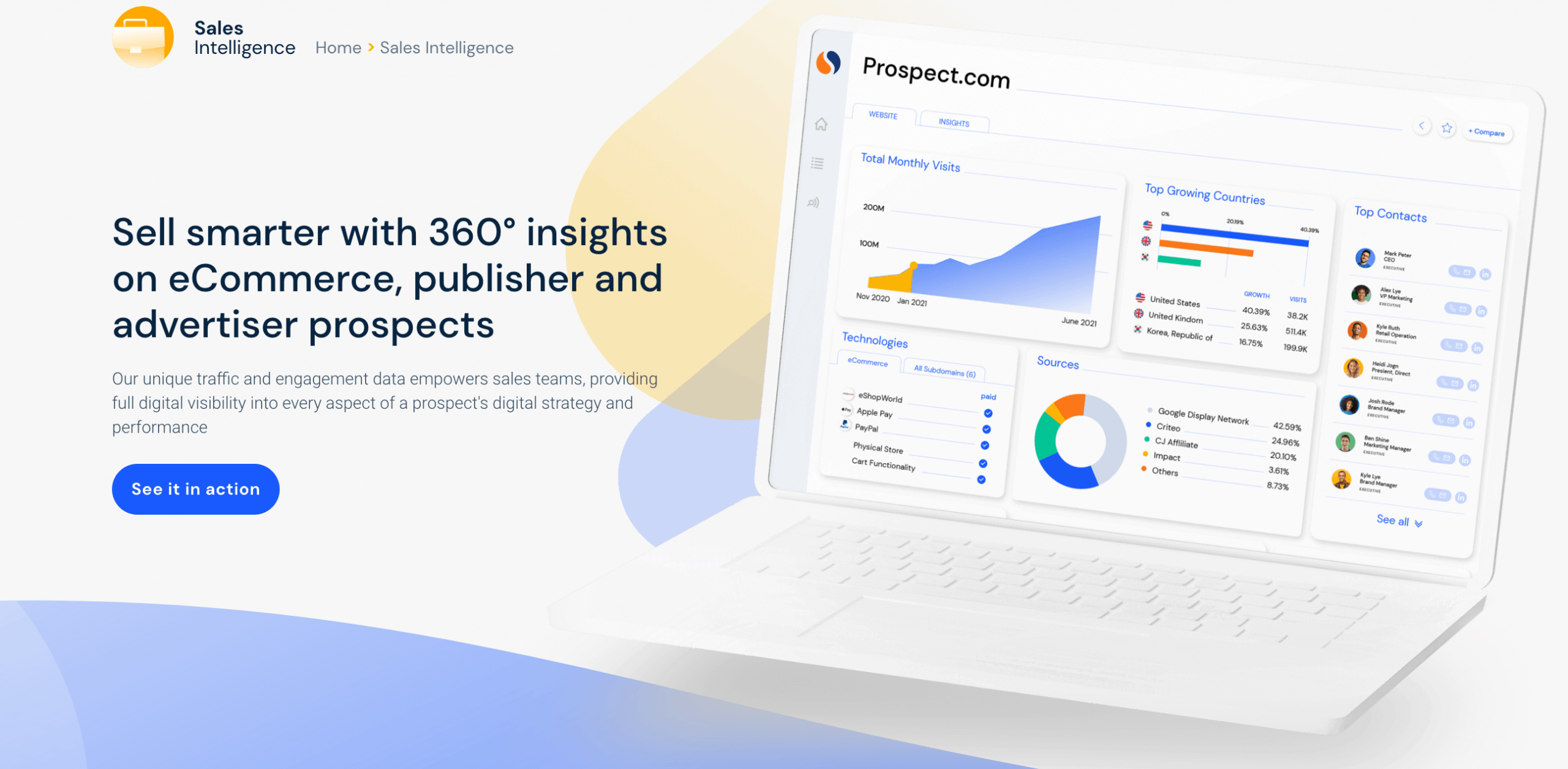
With the help of Sales Intelligence solutions like Similarweb, you can include far more granular digital performance metrics to define your ICP. This ultimately allows you to focus on the highest potential and most valuable prospects.
ICP metrics can include:
But when it comes to defining your ICP, the more specific you are, the better. Try our template for size:
After you determine which kinds of companies would make the right customers, you need to figure out who to speak to within those companies.
That’s where buyer personas come into play.
A buyer persona is a fictional representation of a decision-maker or influencer that you want your sales and marketing campaigns to speak to.
Most companies have multiple buyer personas to represent all the possible stakeholders they should target. Here are the main criteria to consider when determining the traits of your B2B buyer personas:
Taking the time to define (or redefine) your ICP and buyer personas enables you to build highly effective and conversion-oriented marketing campaigns, increase sales efficiency, and weed out irrelevant leads earlier.
Gaining a deep understanding of who your users and buyers are can also help guide the development of your product or service so your offering better fulfills customer needs.
An effective way to increase B2B sales is to improve speed and efficiency while building out your prospect list.
Manually searching for prospects and adding them to your CRM is an extremely time-consuming and monotonous process. Not to mention, it requires energy and resources that could otherwise be directed at more complex tasks. Fortunately, there are effective sales prospecting tools and techniques that make this easy.
The Similarweb Lead Generation Tool allows you to instantly identify relevant prospects that meet all your unique ICP criteria – pretty powerful, right? With unique traffic and engagement data on more than 100 million websites, Similarweb empowers sales teams with full digital visibility into every part of a prospect’s digital strategy and performance, as well as direct phone numbers and email addresses of company decision-makers.
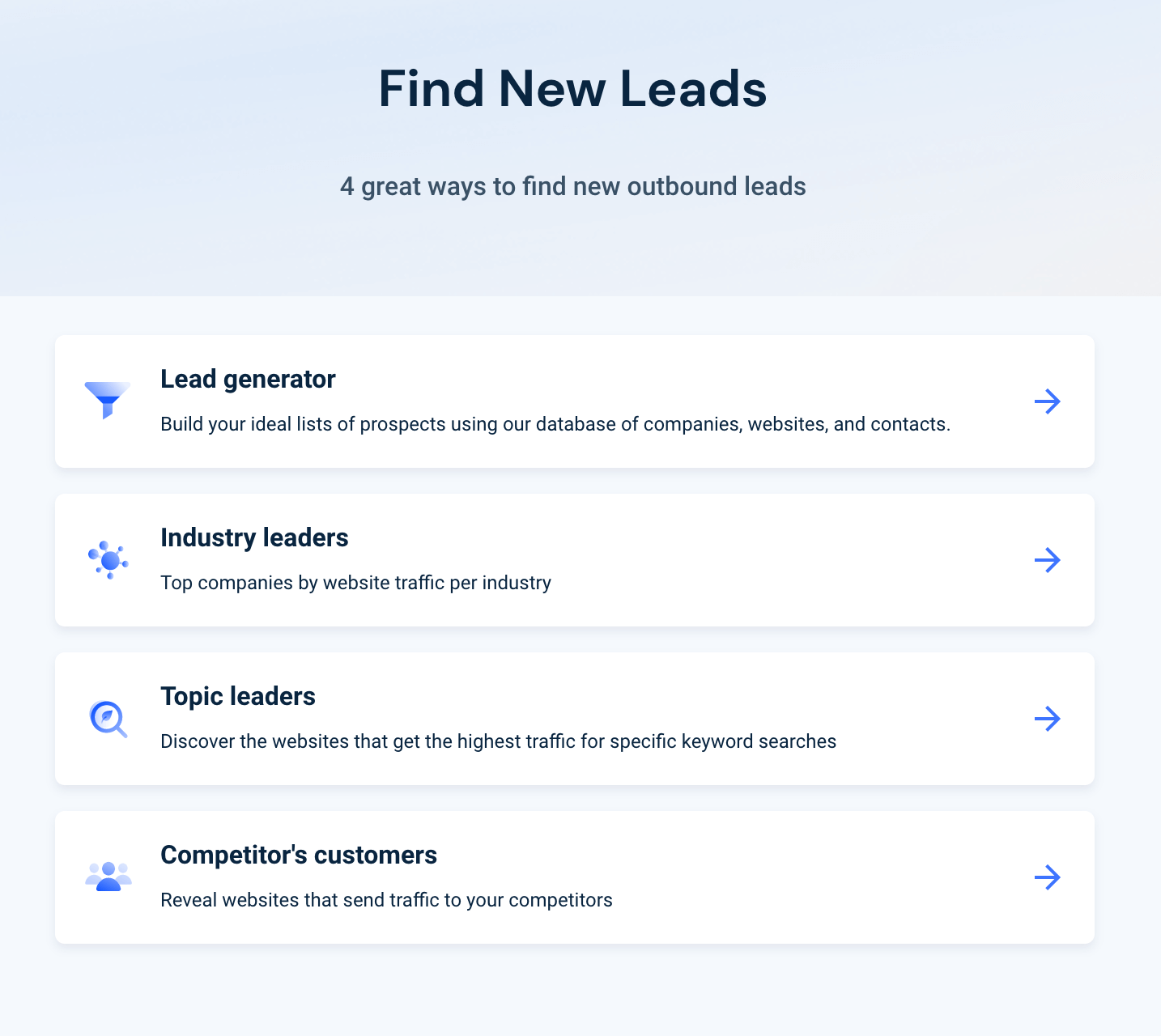
The Lead Generator allows you to effortlessly identify hundreds or thousands of prospects with a clear need for your product or service who are ready to buy. Plus, you can automatically refresh your prospect list with up-to-date information so you never have to waste time manually prospecting again.
When sales and marketing are aligned, it’s way easier to increase B2B sales. Although these departments are commonly siloed, working together to coordinate goals, campaigns, and tactics is one of the easiest ways to increase B2B sales.
To succeed, marketing and sales need to:
One of the best B2B marketing strategies to increase B2B sales is marketing automation.
Marketing automation refers to software that automates repetitive or monotonous marketing tasks, such as email marketing, social media posting, and ad campaign scheduling.
Not only does marketing automation boost efficiency, it also helps marketers provide a more personalized and intuitive experience for customers and prospects. In turn, that leads to more effective nurturing, which makes it easier for sales to convert leads and upsell existing customers.
Here are just a few ways marketing automation helps you figure out how to increase B2B sales.
Email is one of the most important strategies to increase B2B sales. There are many ways to use email to nurture, engage, and convince leads of your product’s value.
Case studies and customer success stories are great ways to increase B2B sales because they provide concrete examples of the ways your company’s product or service provides value to customers.
On top of evidencing your offering’s value, case studies and success stories lend you the benefit of social proof – especially when the story you’re showcasing involves a reputable company.
When a prospect or lead sees first-hand the ways in which you boost business performance for similar companies, it’ll be much easier to prove you can do the same for them.
The key is to share case studies and customer success stories that are relevant to a given lead.
If your product or service has multiple use cases, first identify which use case is most relevant for your lead. Then, choose the case studies and customer success stories that correspond to that use case.
For example, for a blog about B2B sales, a case study about how DHL uses Similarweb to increase sales rep productivity would be a better fit than a case study about how Airbnb uses Similarweb to break into new markets.

If you don’t have many case studies or customer success stories, the first step to developing them is to talk to your CSMs about which customers would make the best examples to showcase.
Which customers achieved the highest ROI? Who are your product’s “super users”? From which customers did you get the best feedback?
After you identify the best candidates interview stakeholders who were involved in the purchasing decision, and users, you can learn how your product or service helped improve their business.
If you want to learn how to increase B2B sales, remember this tip: serve your prospects as a consultant.
Of course, your overall goal is to convert prospects and leads into paying customers. But the best – and quickest – road to get them ready to do so is to consistently be a source of valuable information, not use pushy sales tactics.
Consultative selling positions you to help prospects:
Consultative selling is not a quick process. It’s a long game approach. The goal is to consistently provide your prospects with meaningful information they can put into action, while demonstrating you understand their goals, pain points, and needs.
The key to using consultative selling to increase B2B sales is having the right information at the right time. After all, if you don’t truly understand your prospect’s market, product, their customer’s needs, or their goals, how can you help them?
Similarweb Insights Generator is a powerful tool that allows you to quickly identify robust, up-to-date information on a broad range of metrics pertaining to your prospects, such as:
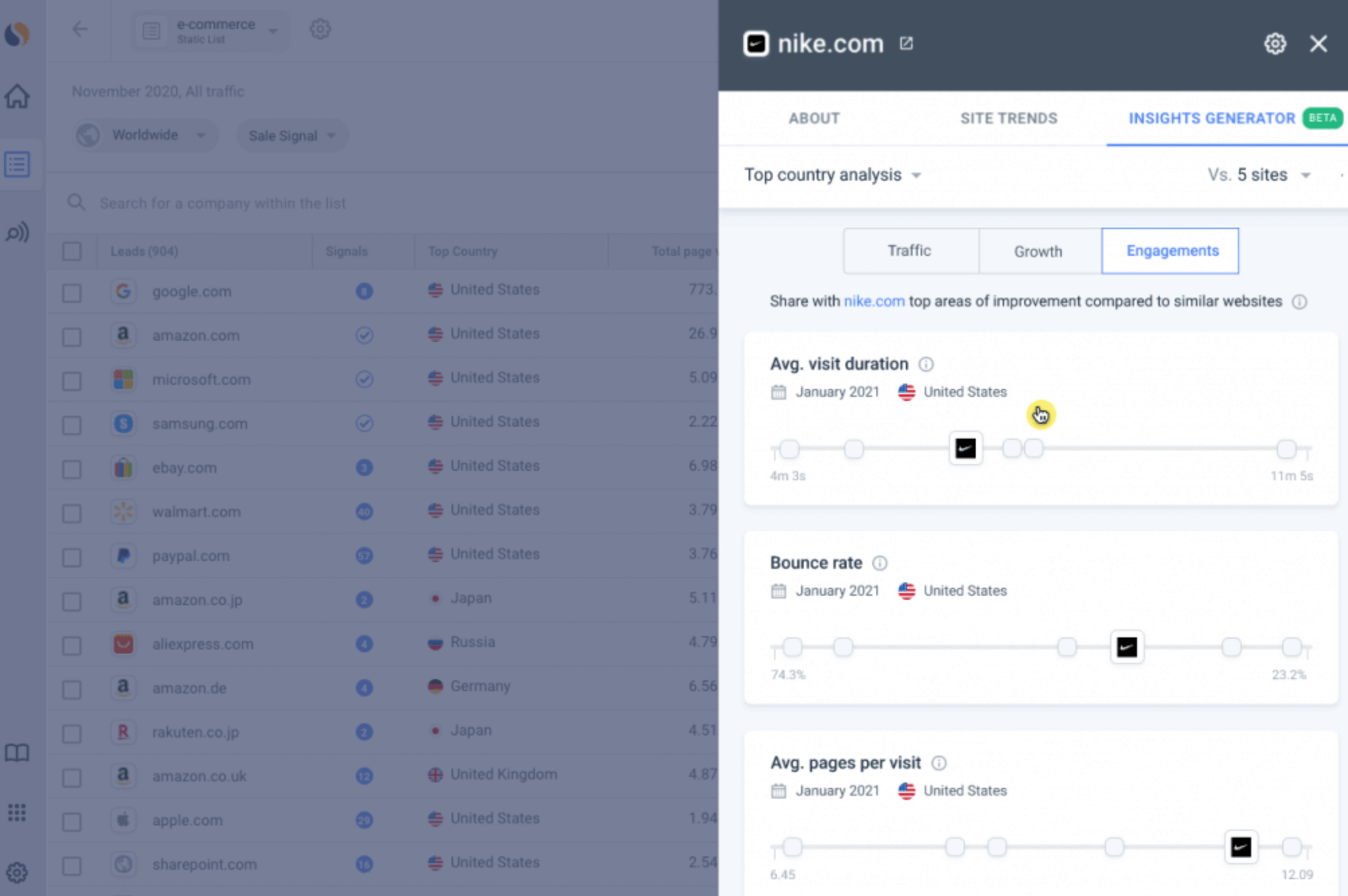
With these insightful nuggets of information, you can dramatically enhance your email outreach and sales calls to foster more trusting relationships with leads, and ultimately, close deals faster.
Monitoring the effectiveness of your efforts against a set of predefined KPIs and optimizing your efforts accordingly are crucial strategies to increase B2B sales.
Unless you define quantitative goals and KPIs, you can’t know how successful your marketing and sales efforts are. In turn, it’s impossible to know, with any degree of certainty, what to change or improve.
For example, if you don’t set a goal for the number of leads you wish to generate from a certain campaign, you have no way of knowing if the campaign is “working.” After all, success is relative to your desired outcome. In turn, you won’t know where to increase budget and where to decrease it.
Measuring performance is such an important sales strategy for increasing B2B sales because it provides answers and gives you a direction when initiating optimization efforts.
Sales teams face many challenges today. An ever-expanding market of sales tools, a dizzying array of communication channels, and a saturated digital space all make the prospect of reaching the right leads – and getting them to listen to you – a major challenge.
Fortunately, there are also many ways to increase B2B sales.
Sales intelligence technology that allows you to effortlessly identify hyper-relevant leads and generate helpful insights about them are a game-changer for both lead generation and sales success.
That, combined with the eight best practices listed above, provide a solid foundation of sustainable sales success.
What is an ICP and why is it important to define it in B2B sales?
ICP stands for Ideal Customer Profile, and it refers to the characteristics of the customers who are most likely to benefit from your product or service. Defining your ICP is important in B2B sales because it helps you focus your efforts on the customers who are most likely to buy from you, and tailor your messaging and sales approach to their specific needs and pain points.
How can I enhance my prospecting efforts in B2B sales?
To enhance your prospecting efforts in B2B sales, you should start by creating a list of target accounts and using a variety of tactics to engage with them, such as email outreach, social media engagement, and targeted advertising. You should also leverage your network and use referrals to generate new leads, and use tools like LinkedIn Sales Navigator to find and connect with decision-makers in your target accounts.
Why is it important to align sales and marketing in B2B sales?
Aligning sales and marketing in B2B sales is important because it helps ensure that both teams are working towards the same goals and messaging, and that there is a seamless transition between marketing-generated leads and the sales pipeline. By working together, sales and marketing can also share insights and data that can help improve the effectiveness of both functions.
How can I use marketing automation to increase B2B sales?
Marketing automation can help you increase B2B sales by automating repetitive tasks and nurturing leads through the sales funnel. You can use marketing automation to send personalized emails, trigger targeted campaigns based on customer behavior, and score leads based on their level of engagement. This can help you save time, improve lead quality, and ultimately increase conversions.

Sr. Marketing Intelligence Specialist
Sarah creates engaging content with over 5 years of experience. She enjoys traveling, family time, baking, and Netflix. Sarah holds a psychology degree from Clark University and lives in Israel.
Top Ecommerce Companies in the USA: The 100 Brands Winning the Traffic Race in 2026

3 of the Sharpest Minds Weigh in on the State of Gen AI in 2026

Try Similarweb Sales Intelligence today — free of charge
