
3 of the Sharpest Minds Weigh in on the State of Gen AI in 2026
by Darrell Mordecai3 Min.
Aug 26, 2026
 Insights
The boom in generative AI text generators that can write essays and resumes has spurred a counterbalancing boom in whether AI wrote an essay, a job application cover letter, or a sales pitch email. While there are legitimate roles for tools like ChatGPT to play in education and business, everyone wants to know whether what they’re reading is the work of a bot as opposed to the student, potential employee, or salesperson.
Here are the leading sites offering free (or free trial) AI content detection tools as part of their services, not including Turnitin, an established academic tool that among other things helps verify the originality of homework assignments.
The leading pure-play AI content detector, GPTZero, was created on a shoestring budget by 22-year-old Edward Tian to help professors detect the use of AI in student work. GPTZero has since hired AI PhDs to help scale the business, which recently attracted $3.5 million in funding.
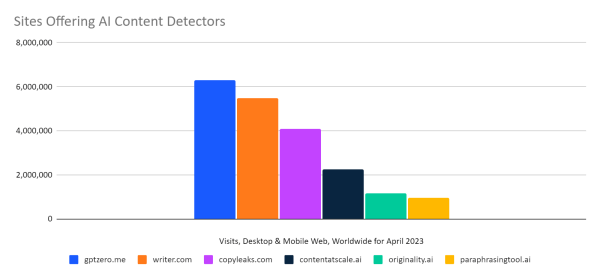
Several companies shown in this comparison are not new but have seen strong growth since adding AI content generation features and tapping into the groundswell of interest in the positive and negative implications of AI text generators. The boom started at the end of November 2022, with the launch of ChatGPT.
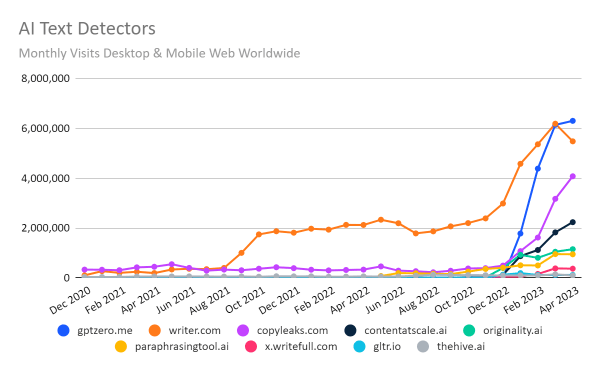
Most of the domains ranked by traffic above are for companies that provide other services, in addition to AI content detection, with GPTZero the big exception. To rank their AI content detection tools more accurately, we can look at the traffic segments within those sites related to AI content detection and compare them with GPTZero and originality.ai, another new service born to capitalize on the concern about AI text (although it also offers plagiarism detection).
This shows that Writer (writer.com) is the second most popular tool behind GPTZero among this crop of upstarts. Based on desktop web traffic, the comparison is about 5 million visits for NetZero to about 3 million for Writer in April.
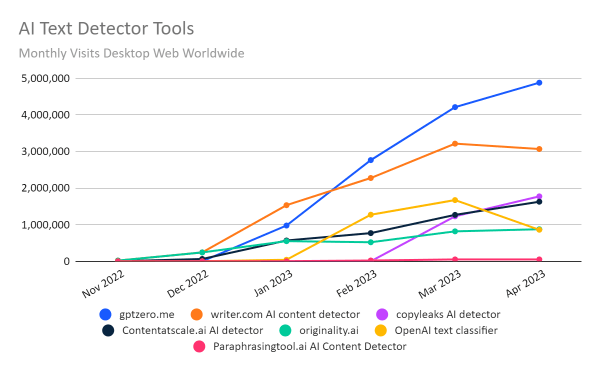
The much more established academic tool Turnitin still attracts about three times as much traffic as GPTZero.
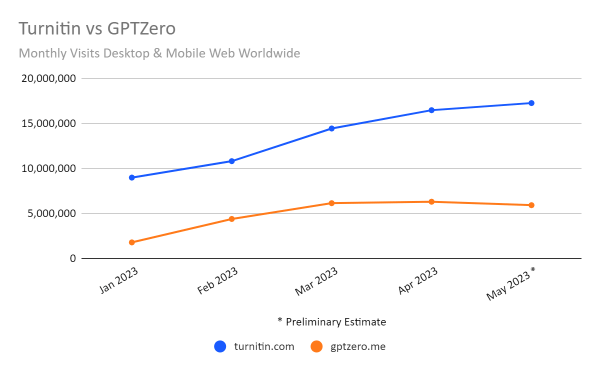
The academic business worlds are still adapting to the advent of ChatGPT and other generative AI tools and figuring out rules for when using them is right or wrong. This is particularly a big issue in education, but law firms might want to give their attorney’s work similar scrutiny following the case of the lawyer who used ChatGPT to write a legal brief that turned out to be full of made-up citations.
In a recent essay in The Atlantic, The First Year of AI College Ends in Ruin, Ian Bogost uses the example of the student who used ChatGPT not to write his paper but to “debate” him on the points he was making so that he could strengthen his thesis. In some cases, the use of these tools could be perfectly appropriate, while in other cases an AI detection tool might wrongly flag a student’s work as AI generated when it wasn’t – which some studies have found to particularly be a problem when English is not the student’s first language.
Yet there’s no doubt that text generators make evaluating the originality of any written work harder for academics, editors, and hiring managers – all of whom are looking for help.
The Similarweb Insights & Communications team is available to pull additional or updated data on request for the news media (journalists are invited to write to press@similarweb.com). When citing our data, please reference Similarweb as the source and link back to the most relevant blog post or similarweb.com/blog/insights/.
Contact: For more information, please write to press@similarweb.com.
Report By: David F. Carr, Senior Insights Manager
Disclaimer: All names, brands, trademarks, and registered trademarks are the property of their respective owners. The data, reports, and other materials provided or made available by Similarweb consist of or include estimated metrics and digital insights generated by Similarweb using its proprietary algorithms, based on information collected by Similarweb from multiple sources using its advanced data methodologies. Similarweb shall not be responsible for the accuracy of such data, reports, and materials and shall have no liability for any decision by any third party based in whole or in part on such data, reports, and materials.

David covers social media, digital advertising, and generative AI. With a background in web trends since the 1990s, he’s also the author of "Social Collaboration for Dummies".
Give it a try or talk to our insights team — don’t worry, it’s free!