by Darrell Mordecai4 Min.
Oct 21, 2026
 Insights
People don’t just Google things anymore. A lot of them ask ChatGPT or use Google’s new AI mode. And now, some of those AI answers come with ads in them, like an ad popping up in the middle of a conversation.
That creates two questions every marketing team should be asking right now:
Most tools only answer one of those questions. This guide shows you why you need both answers and how one Similarweb customer uses both together.
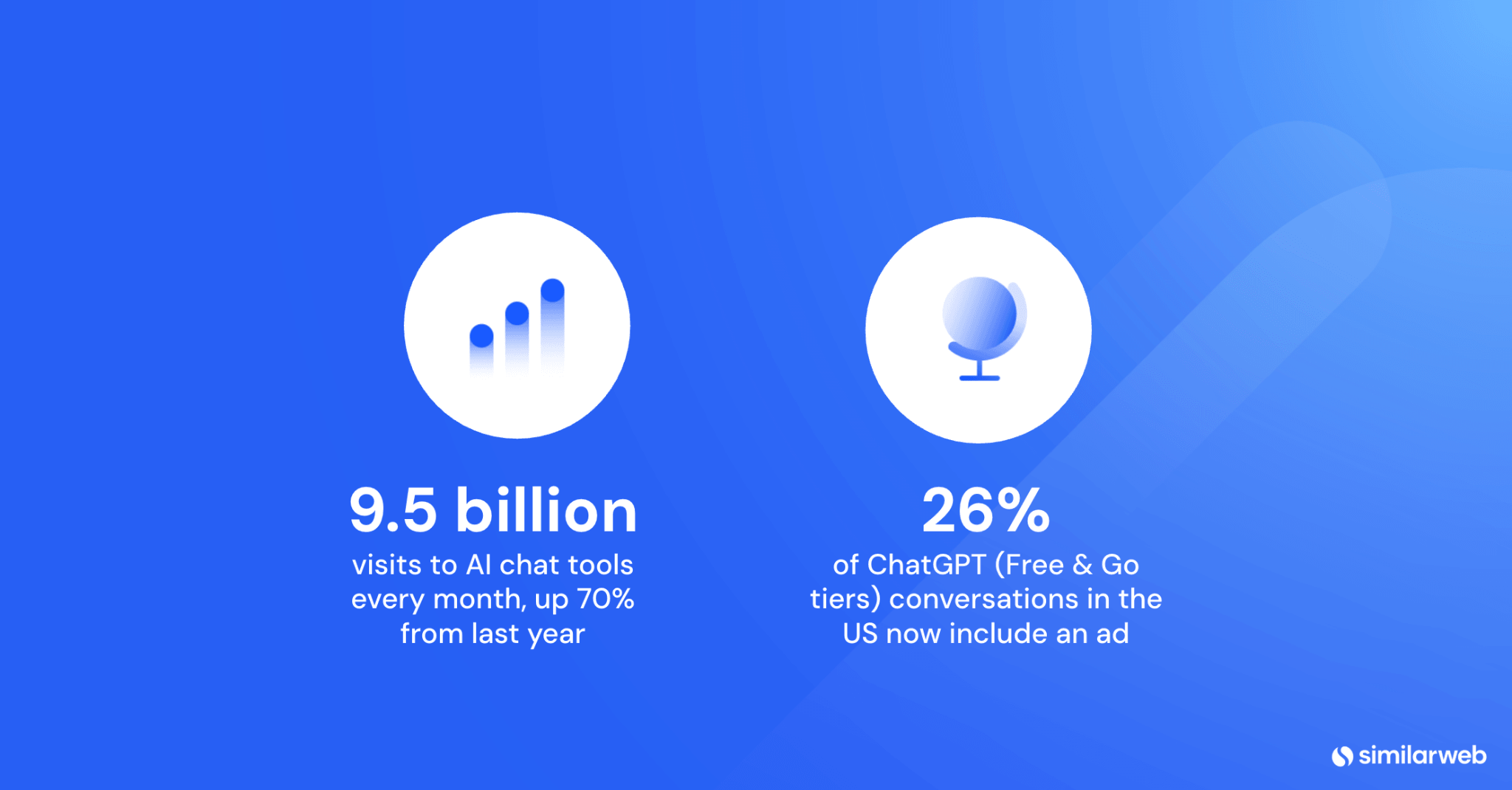
AI chat is no longer small. And ads inside AI chat are growing fast. If you’re not watching both, you’re missing half the picture.
Right now, most companies pick one of two paths:
Neither one shows you real user prompt data. And a lot of the time, the organic mention and the paid ad are happening on the exact same question.
And it’s not just ChatGPT. Google’s AI Max takes a brief you write (what to say, what to avoid) plus your landing page, and builds and runs ads automatically for people typing full, prompt-style searches instead of keywords. Same shift in how people search, just showing up on a different platform.
Natural Intelligence runs comparison websites that help people pick things like insurance, moving companies, dating apps, and credit cards, across more than 80 categories. When someone picks a business through one of their sites, that business pays Natural Intelligence a referral fee. That’s the affiliate model. They get paid for sending customers to the businesses that do. Here’s how their Head of Strategy, Jonathan Bar-Vardi, put it:
“We’ve been using Similarweb across two different channels. On the organic front, it helps us look at which actual prompts the users are talking about and what they see.”
Jonathan Bar-Vardi, Head of Strategy, Natural Intelligence
They use Similarweb to watch both sides at once, the free mentions and the paid ads, in the same place:
“On the paid front, using Similarweb’s prompt data has been extremely significant, because there is so little data being provided by OpenAI right now. It’s the only way to understand the user’s actual behavior, the overall market, or the competitors active in it.”
Jonathan Bar-Vardi, Head of Strategy, Natural Intelligence
And it’s not just the marketing team using it anymore:
“For the first time, it’s not only the strategy team or marketing teams that are using it, but product teams can use it, business teams can look at the advertisers they work with, and the content team and the SEO team have all been using it too.”
Jonathan Bar-Vardi, Head of Strategy, Natural Intelligence
Here’s the simple version. Pick a handful of real questions your customers ask AI about your category, then check two things for each one:
| If this is true… | …do this for organic visibility | …do this for ads |
| AI never mentions you | Make sure that your brand shows up in AI with the right AEO strategies | Consider bidding on it while your content catches up |
| AI mentions you but not consistently | Keep track of your visibility performance and optimize regularly for strong recommendations | Use ads to maintain consistency where your organic visibility is instable |
| Competitors are already buying ads on it | Build your brand visibility in AI search | Use tools like Similarweb’s AI Advertising to examine if you are able to compete. |
Check this consistently, AI answers change faster than Google rankings ever did.
AI Max takes your brief and your landing page and builds the ad itself, which means your prompt data is really just brief-writing material. Here are ways to use Similarweb’s prompt tracker data:
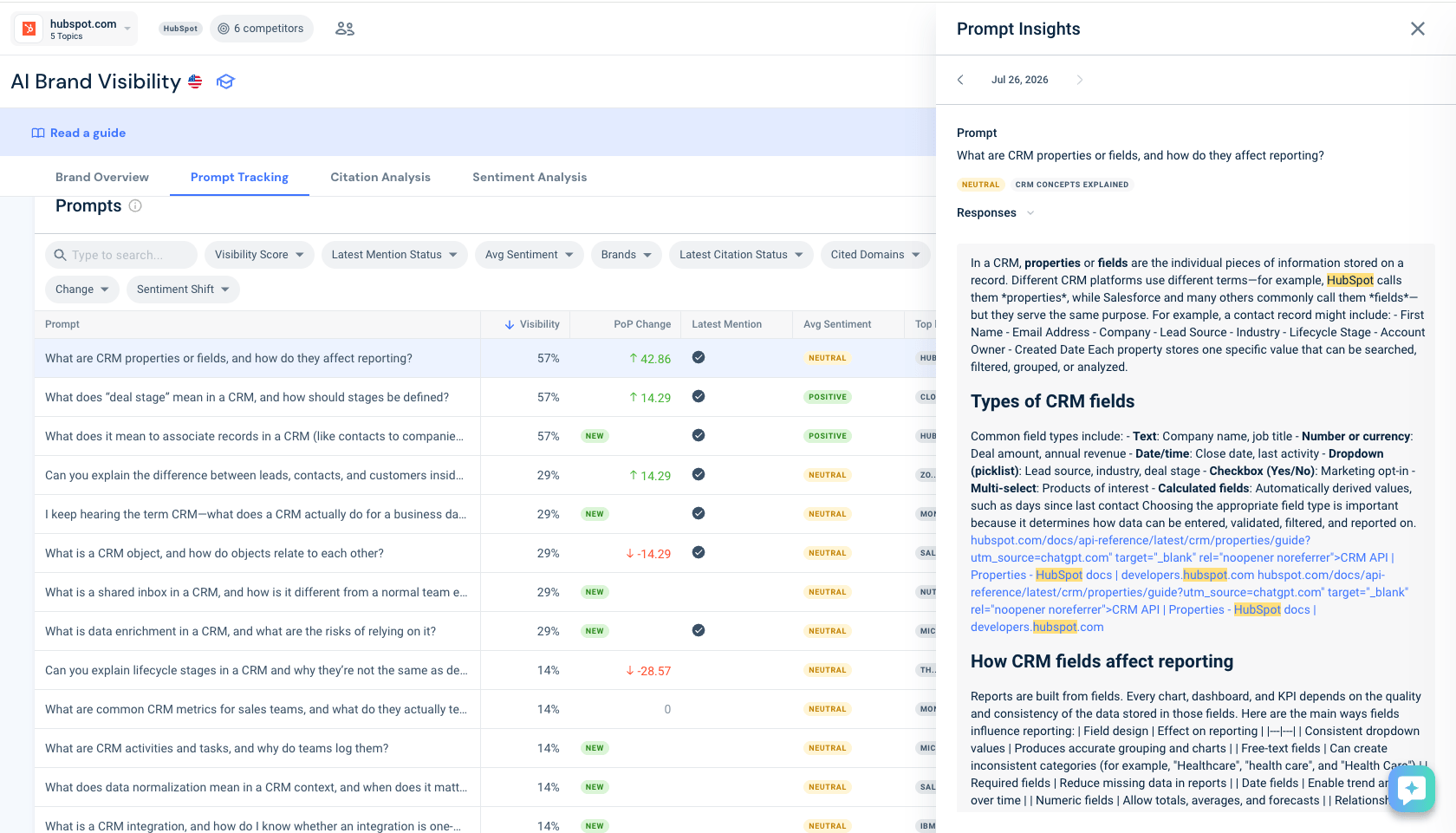
Right now, most prompt searches cluster around three topics: web traffic, competitor analysis, and ad intel. Keep an eye on that mix. If one of those starts trending harder, or a competitor starts gaining ground on a specific topic, that’s your cue to spin up a dedicated campaign, with its own ads and landing page, fast, instead of waiting for the next quarterly review.
Organic visibility in AI and paid ads in AI are two sides of the same coin, whether that’s a ChatGPT answer, a Google AI Overview, or an AI Max campaign. Most tools only show you one side. Similarweb shows you both, on the same questions, in one place, which is why Natural Intelligence’s whole company ended up using it, not just marketing.
What does “AI search visibility” mean for a brand?
AI search visibility is how often and how favorably a brand shows up in answers from ChatGPT, Google AI Overviews, Perplexity, and similar tools, rather than how it ranks on a results page. It’s tracked through metrics like citation frequency, share of voice, and average position within AI-generated responses.
How is answer engine optimization (AEO) different from traditional SEO?
SEO optimizes pages to rank and earn clicks on a results page. AEO structures content so AI platforms can extract and cite it as a direct answer. A page can rank first on Google and still never appear in an AI-generated response, and the reverse happens too.
How do ads inside ChatGPT work?
ChatGPT generates its answer first, then a separate ad system checks whether a sponsored placement fits the conversation, so ads run on systems kept physically separate from the model itself. Advertisers only see aggregated performance data, like views, clicks, and conversions, never individual chats.
What is Google AI Max, and how is it different from ChatGPT ads?
AI Max is an optimization layer inside existing Google Search campaigns, not a standalone ad product. It uses broad match and “keywordless” technology, plus your landing page, to automatically expand targeting and generate ad creative. Unlike ChatGPT’s conversational placements, it plugs into keyword-based Search campaigns you already run.
How can an affiliate or comparison-site business use AI search tracking?
Comparison sites earn a referral fee when a visitor picks a business through their site, so revenue depends on being the source AI recommends across many category-specific prompts.

by Liat Sagiv
Senior Product Marketing Manager - Ad Intel
Liat is a product marketer with 7+ years of experience shaping go-to-market and marketing strategies across B2B technology companies. At Similarweb, she leads product marketing for Ad Intelligence.
Give it a try or talk to our insights team — don’t worry, it’s free!