
How Nothing.tech is Outsmarting the Giants (On a Budget)
by Darrell Mordecai7 Min.
Feb 26, 2026
 Insights
The 2026 FIFA World Cup is the biggest sporting event on the planet. And over the last few months, millions of fans have been doing what they always do before a major event.
Searching for tickets.
But here’s what’s changed. They’re not all starting on Google.
Increasingly, the first question goes to AI. “How do I buy FIFA World Cup tickets?” lands in ChatGPT, Gemini, and Perplexity, and those models answer. They recommend official channels, flag verified resellers, explain the resale process, and warn about scams. The consumer gets an answer before they ever touch a search bar. Then they move to search for a way to act on it.
That two-stage journey, AI first, search second, is now the default for high-intent consumer decisions. And FIFA’s World Cup ticket market is the biggest case study currently available for understanding what brands win and lose at each stage.
The data is staggering.
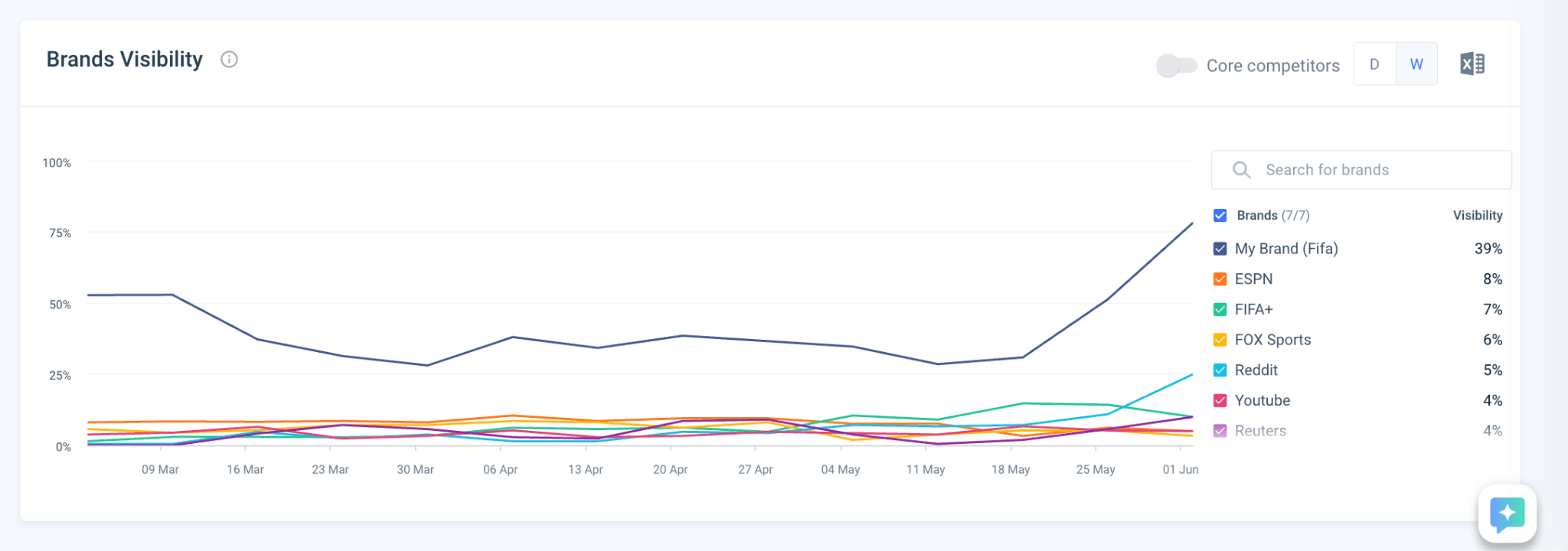
FIFA has built extraordinary organic authority in AI search. A 39% brand mention share for World Cup ticket queries, well ahead of ESPN (8%), FIFA+ (7%), and FOX Sports (6%), according to Similarweb AI Search Intelligence. When fans ask AI about World Cup tickets, FIFA’s properties dominate the answer.
Then those fans move to search. And that’s where the ambush happens.
This article maps both stages. What FIFA gets right in AI and organic search, what it loses in paid, and what the gap reveals about the new consumer journey for any brand navigating a high-intent moment.
FIFA’s organic authority in AI search is not an accident. It’s the result of controlling the narrative for the product being searched. According to Similarweb AI visibility tracking, FIFA holds a 39% brand mention share for World Cup ticket queries. Approximately five times the nearest competitor.
The organic keyword data confirms the same structural advantage. Similarweb’s May 2026 keyword intelligence shows FIFA holding position 1 in Google US for every major World Cup ticket term:
| Keyword | Google rank | Organic clicks (May ’26) | Zero-click rate |
| fifa world cup tickets | #1 | 182,290 | 19% |
| fifa tickets | #1 | 182,993 | 14% |
| world cup 2026 | #1 | 100,015 | 79% |
| world cup tickets | #2 | 96,297 | 22% |
| fifa world cup 2026 tickets | #1 | 57,167 | 28% |
| world cup 2026 tickets | #1 | 17,270 | 36% |
That’s more than 630,000 organic clicks on ticket and tournament terms in a single month from one domain, before counting any paid activity. The SERP features amplify this further. Every high-volume ticket keyword triggers expanded organic sitelinks for FIFA.
Here is where the data gets uncomfortable. Despite owning the AI narrative and holding position 1 on every major organic ticket term, FIFA captures just 8% of paid clicks on its own branded keywords. The remaining 92% flows to resellers.
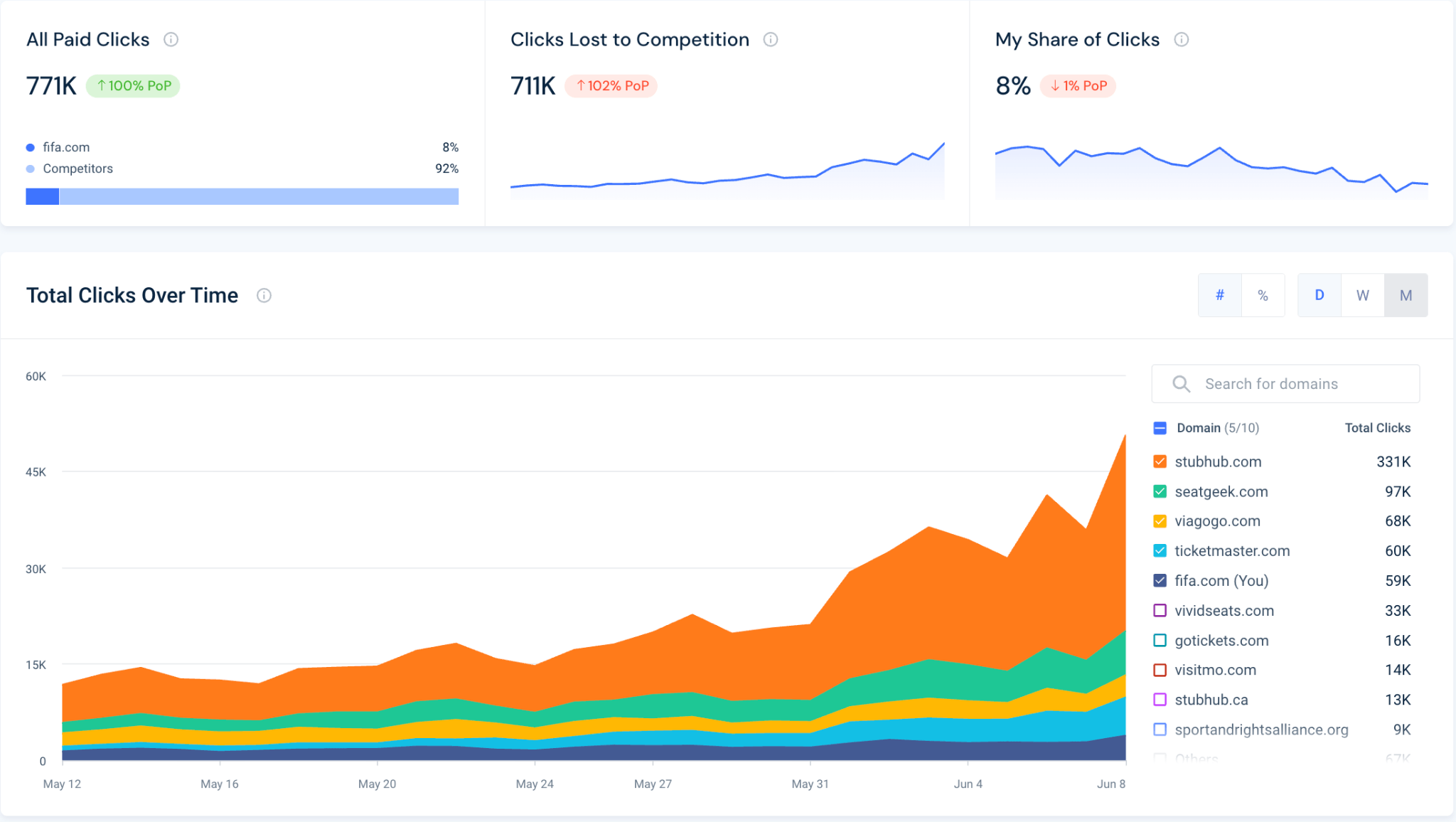
Similarweb Monitor & Protect, Ad Intelligence data (May 12 to June 9, in the USA, Canada, and Mexico) shows that StubHub alone captures 331K paid clicks. SeatGeek takes 97K. Viagogo with 68K and all combined lead to 711K clicks lost. Three platforms with no official FIFA relationship are collectively intercepting demand generated almost entirely by FIFA’s own brand authority and organic presence.
According to Similarweb’s Paid Landing Pages data covering May 12 to June 8, 2026, worldwide, the paid World Cup click distribution looks like this:
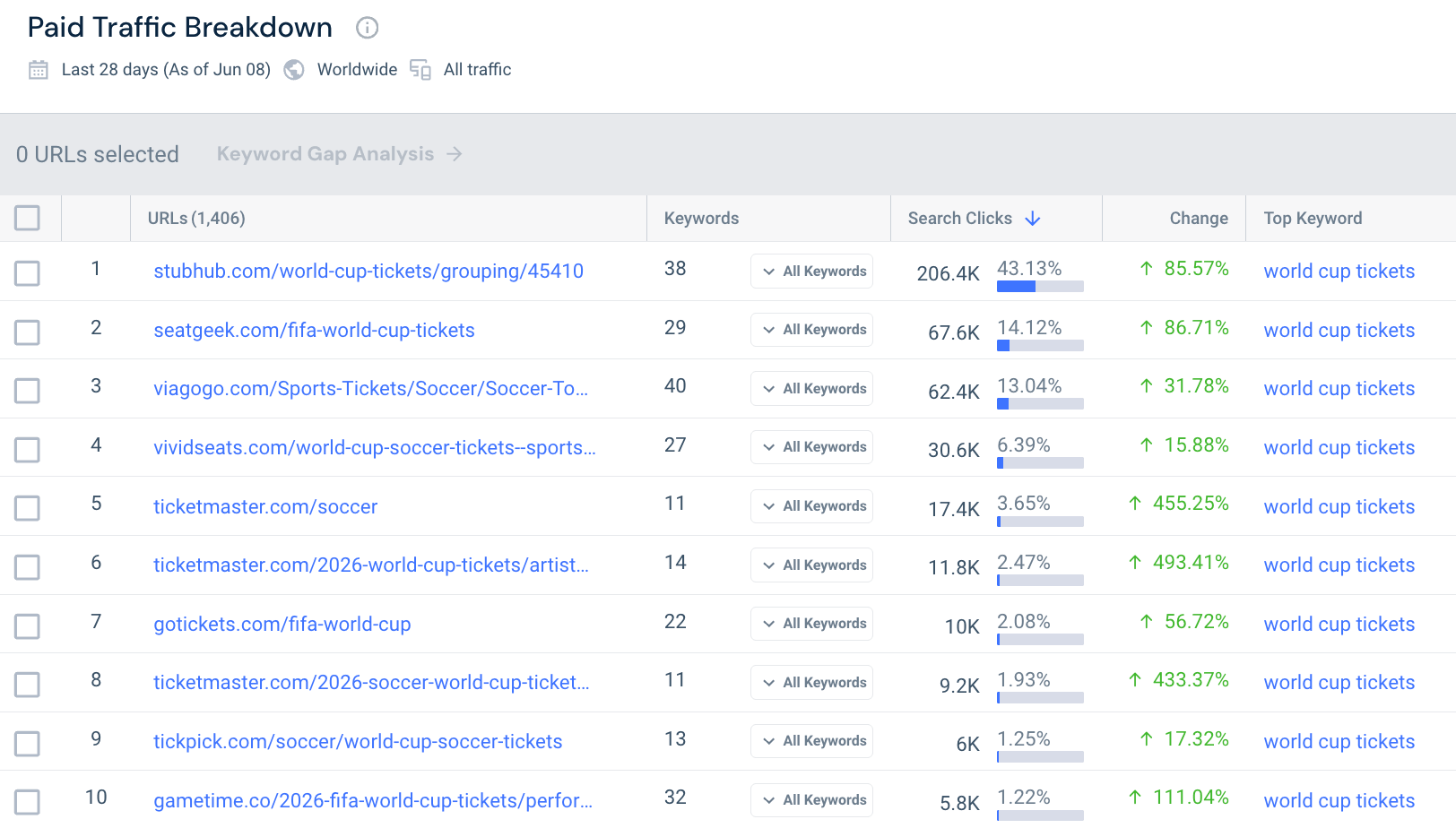
And once again, FIFA is nowhere to be found.
The World Cup ticket market reveals a broader shift in how consumers make decisions.
Today’s journey unfolds across two distinct stages of intent.
Consumers begin by asking questions. They want information, guidance, recommendations, and reassurance. Increasingly, those questions are directed to AI platforms.
For World Cup tickets, FIFA dominates this stage. AI systems consistently cite FIFA as the authoritative source, while FIFA also owns the most valuable organic search positions. The result is overwhelming visibility at the moment consumers are researching their options.
Once consumers understand their options, they move into action mode. They compare sellers, evaluate availability, and look for a place to complete the purchase. This is where paid search, marketplaces, and reseller platforms become critical.
For FIFA, this is where the landscape changes. Despite owning the discovery stage, resellers capture the majority of paid search clicks on World Cup ticket queries, intercepting consumers at the moment of transaction.
| Stage | Channel | FIFA performance | Gap |
| Discovery intent | AI visibility (GEO) | 39% brand mention share — category leader | None: wins convincingly |
| Discovery intent | Organic search | Position 1 on all 6 major ticket terms, 650K+ monthly clicks | None: wins convincingly |
| Treansactional intent | Branded paid search | 9% of paid clicks on own branded terms | Critical: 91% flows to resellers |
| Transactional intent | Ticket CPC market | $500K+ spend, 100% hospitality only | Structural: not competing in ticket paid market |
The Two-Stage Visibility Model. Where intent forms (AI + organic) vs. where intent converts (paid search).
The implication for marketers is clear: visibility must be measured across both stages. Winning discovery creates demand. Winning the transactional stage captures it. Brands that succeed in the AI era are those that can do both.
The World Cup is a concentrated, time-bounded version of what now happens across every high-intent category. Consumers ask AI first, then act in search. The gap between those two stages is where brand equity leaks and where competitors intercept the demand that the brand’s own authority generated.
Three questions that reveal whether a brand has the visibility infrastructure to win both stages:
FIFA’s story is clean. It owns the category in AI, as well as holding every organic keyword. It earns the intent at near-zero cost. And it loses the majority of paid clicks on its own brand to competitors, spending $2.5 million in a four-week window.
That gap between earning intent and capturing conversion is the central digital marketing challenge of the current era. It does not matter how much organic authority a brand accumulates if competitors intercept the buyer at the moment of transaction.
To see how Similarweb tracks AI visibility and paid search exposure across both stages, explore Similarweb’s AI Search Intelligence and Ad Intelligence before your next high-intent moment arrives.
What is FIFA’s AI search visibility for World Cup 2026 tickets?
According to Similarweb AI visibility tracking, FIFA holds a 39% brand mention share for World Cup ticket queries, the highest in the category. ESPN follows at 8%, FIFA+ at 7%, and FOX Sports at 6%. FIFA’s properties appear in AI-generated answers roughly five times more frequently than the nearest competitor when consumers ask about buying World Cup tickets.
Why do resellers outspend FIFA in paid search despite FIFA’s organic dominance?
FIFA holds position 1 organically for every major World Cup ticket keyword, earning those clicks at near-zero acquisition cost. Resellers have no equivalent organic presence and must buy into the same query space through paid search. According to Similarweb Paid Landing Pages data (May 9-June 5, 2026), StubHub spent an estimated $1.6 million and SeatGeek $684,000, collectively intercepting the majority of paid clicks driven by FIFA’s own brand authority.
How does Google AI Mode affect World Cup ticket search behavior?
Google confirmed in June 2026 that AI Mode now handles agentic ticket booking for the tournament, surfacing real-time availability from StubHub, SeatGeek, and Vivid Seats as transactional purchase options. The entry point to this flow is still a search query where FIFA’s organic pages appear first, and AI Overviews draw from FIFA’s content. The secondary platforms appear as the purchase mechanism, not the authoritative answer.
What is the two-stage visibility model?
The two-stage visibility model identifies the two points in the modern high-intent consumer journey where brand visibility can be won or lost. Stage 1 (AI conversation) is where intent forms. AI engines like ChatGPT, Gemini, and Perplexity answer questions and shape consumer shortlists before a search bar is touched. Stage 2 (search click) is where intent converts. Paid and organic search determine who captures the transaction. Brands winning both stages in tandem outperform brands that optimize only one.
How should marketing teams monitor both stages of the consumer journey?
Three metrics matter: AI brand mention share (how frequently your brand appears in AI-generated answers for category queries, tracked by Similarweb AI Tracker), branded paid click share (what percentage of paid clicks on your own brand terms you actually capture vs. competitors, visible in Similarweb Paid Landing Pages data), and citation source mapping (which URLs are driving your AI placements, so you can protect high-value pages and identify content gaps before they affect visibility).

by Rice Tong
Product Marketing Manager
Rice is a Product Marketing Manager at Similarweb, focused on the evolution of search and AI. She loves shaping stories that make complex ideas feel human and relatable.
Give it a try or talk to our marketing team — don’t worry, it’s free!