
FIFA Owns the Conversation. Resellers Own the Clicks.
by Rice Tong6 Min.
Jun 11, 2026
 Insights
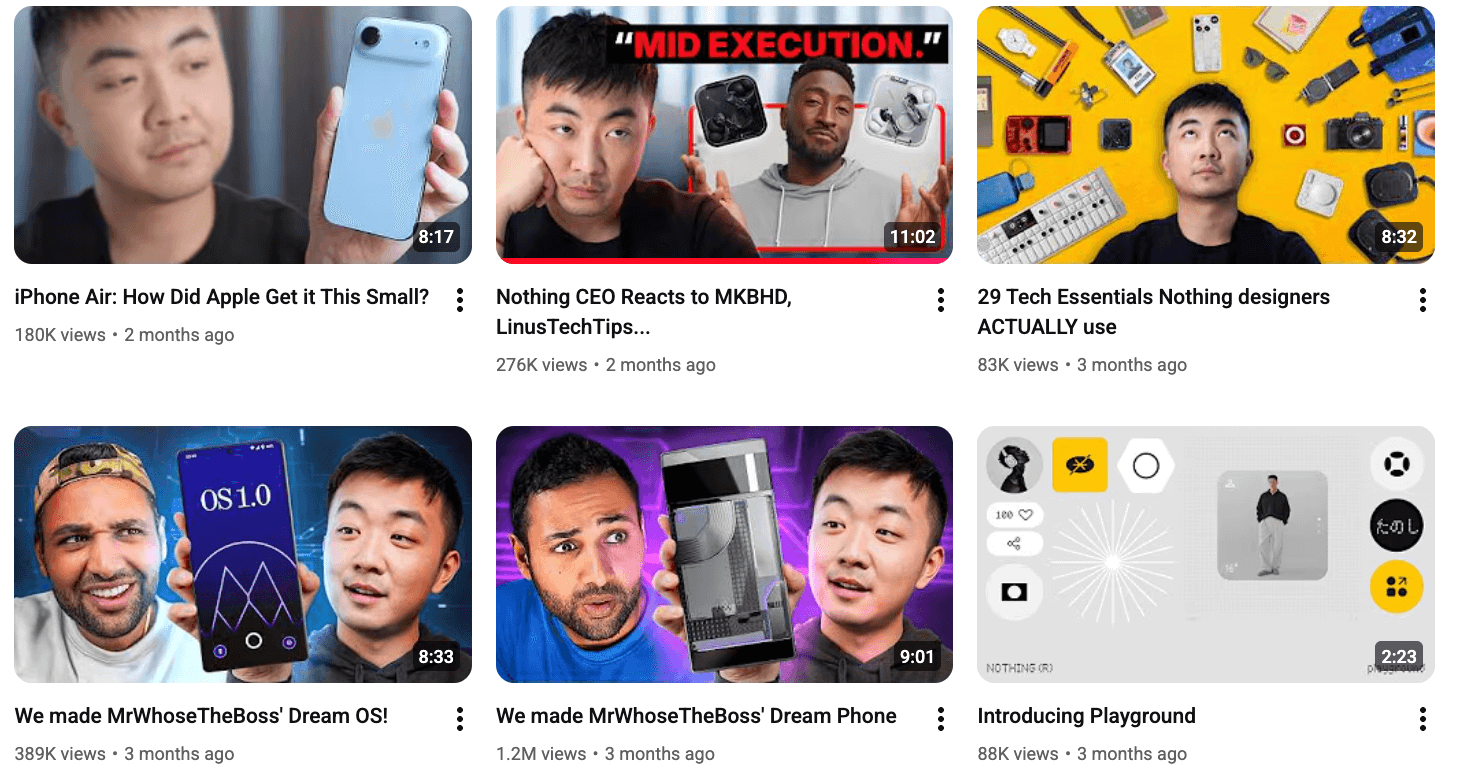
If you’ve spent any time on tech YouTube lately, you’ve seen him. Carl Pei, the CEO of Nothing, sitting in a chair reacting to reviews of his own products. It feels casual, maybe even a bit risky. But when you look at the Similarweb data, you realize those videos are a masterclass in building radical transparency that turns casual viewers into brand disciples.
Today, I’ll tear down the digital DNA of nothing.tech, one of the standout winners in the Similarweb D100. By securing the position #6 for year-over-year (YoY) web visit growth in the Consumer Electronics category, this London startup has officially moved beyond hype, proving they have the digital momentum to grab a seat at the table with giants like Apple and Samsung.
Instead of competing head-to-head with Apple or Samsung, nothing.tech is winning by manufacturing demand. Similarweb data shows that its 2025 growth came from three clear forces:
The result is a challenger brand converting culture, community, and design into measurable digital momentum and a playbook other brands can apply to their own competitive analysis.
To understand how they did it, we start with the data.
Looking at Nothing’s YoY traffic performance in 2025 in the Similarweb Website Performance report, three major spikes tell the story of a precisely timed product roadmap, each one expanding the brand’s reach in a different way.
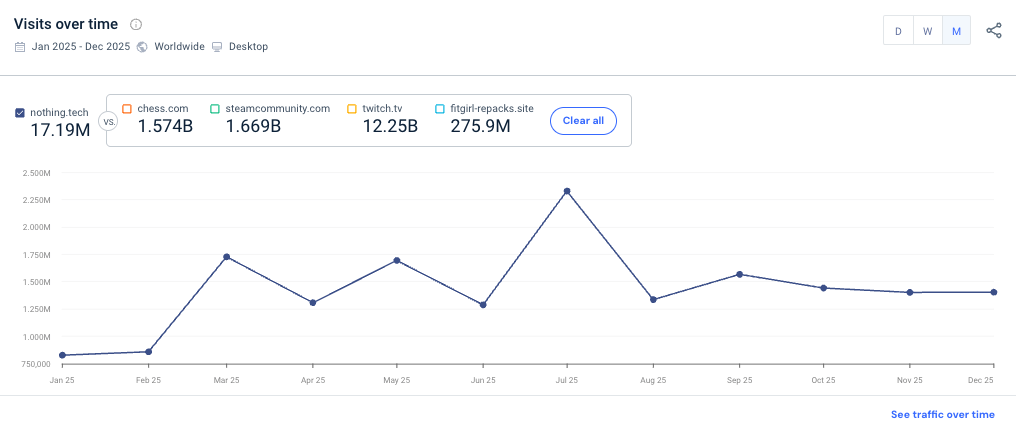
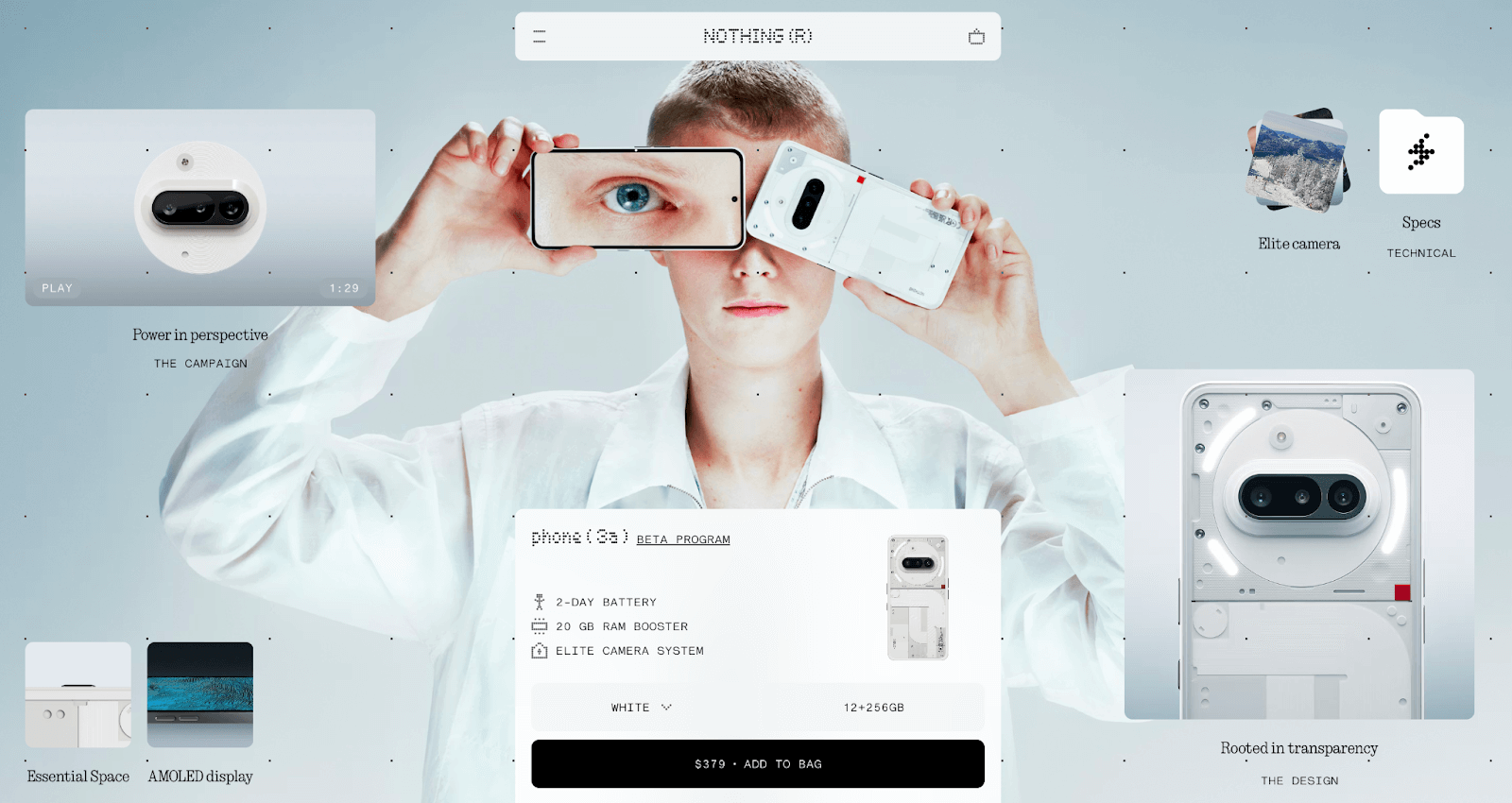
Traffic nearly doubled from 3.3M to 6.8M visits following the global launch of Phone (3a) and Phone (3a) Pro on March 4th.
Why it mattered from a marketing perspective:
This launch was about removing the price barrier that limited Nothing’s addressable market.
By debuting the 3a series at MWC Barcelona, the mobile industry’s largest global trade show, Nothing reframed the narrative away from ‘another Android phone’ and toward value leadership. Reviews from outlets like Tom’s Guide and Tech Advisor consistently positioned the devices as redefining what mid-range buyers should expect, which drove a surge in high-intent searches rather than passive browsing.
The key outcome:
What looked like a routine product release functioned as a top-of-funnel expansion play, pulling a much larger, and more price-sensitive, audience into the brand for the first time.

Traffic climbed steadily from 4.7M to 5.7M visits following the launch of CMF Phone 2 Pro and CMF Buds 2 (announced April 28th, on sale May 5th).
Why it mattered from a marketing perspective:
This was a classic momentum management move.
Rather than allowing interest from the March launch to decay, Nothing introduced CMF as a budget-focused sub-brand that kept the domain relevant to a broader audience between flagship moments. The messaging centered on ‘pro specs for budget prices,’ reinforced through region-specific influencer activity, particularly in India, where Nothing saw 156% YoY growth in Q1 2025.CMF acted as a demand buffer, ensuring the brand avoided the typical post-launch traffic crash that many hardware companies experience.
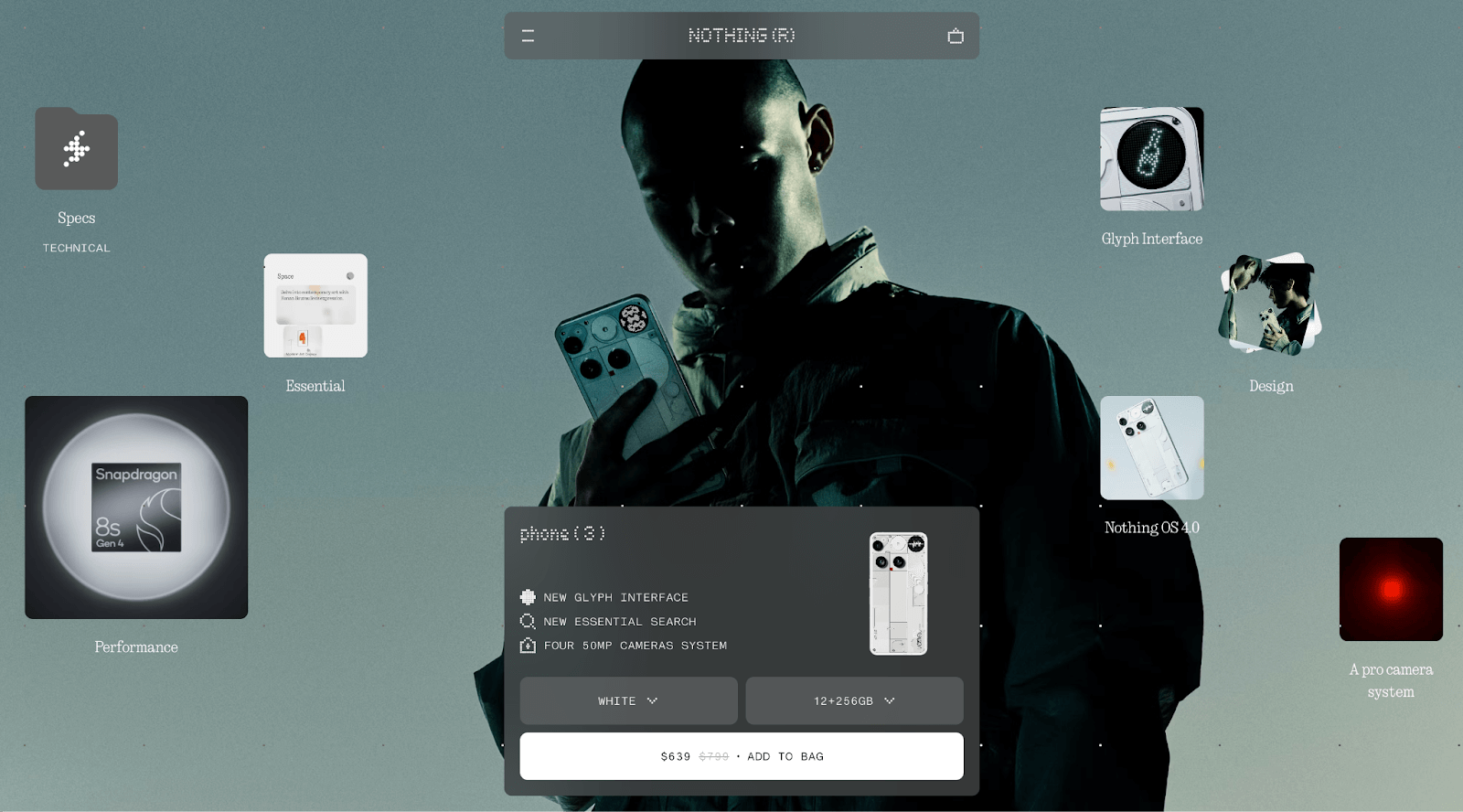
The year’s largest traffic spike occurred in July, surging from 4.6M to 7.4M visits following the reveal of Nothing Phone (3) on July 1st, positioned explicitly as the company’s first true flagship.
Why it worked (the strategy):
This wasn’t a spec dump or a traditional launch. Carl Pei reframed the moment as a philosophical milestone for the brand. Instead of leading with benchmarks, Nothing:
By controlling the narrative early and consistently, Nothing turned the announcement into a conversation. The timing reinforced the impact. The traffic spike aligns precisely with the pre-order window opening on July 4th, converting curiosity into immediate intent.
The strategic takeaway
Nothing didn’t treat their launches as isolated events. Every launch answered a different growth question:
More than launching a flagship phone, Nothing validated its right to compete in the premium tier, and it did so by selling vision before product.
Looking at the Similarweb Channels report, the most interesting insight isn’t paid growth or social spikes. It’s the synchronized movement between Direct and Organic Search.
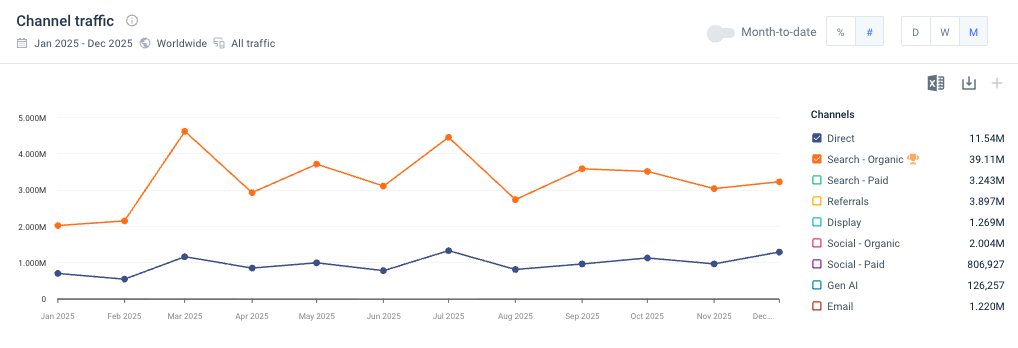
As traffic peaks around each launch, both direct visits and organic search climb together. Both are downstream signals of the same upstream force.
Brand momentum.
Product launches, media coverage, influencer content, and CEO visibility created attention. That attention expressed itself in two measurable ways:
In other words, Nothing wasn’t competing primarily for generic queries like ‘best phone under $500.’ It was generating branded demand strong enough that users searched for Nothing Phone 3a Pro or CMF Phone 2 Pro by name.
That’s the halo effect: when brand activity lifts multiple high-intent channels at once.
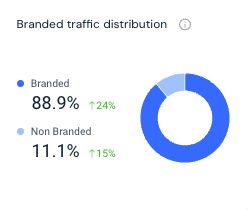
The Similarweb SEO Overview tells the same story. An overwhelming 88.9% of search traffic is branded, meaning users aren’t discovering Nothing accidentally, they’re actively seeking it out.
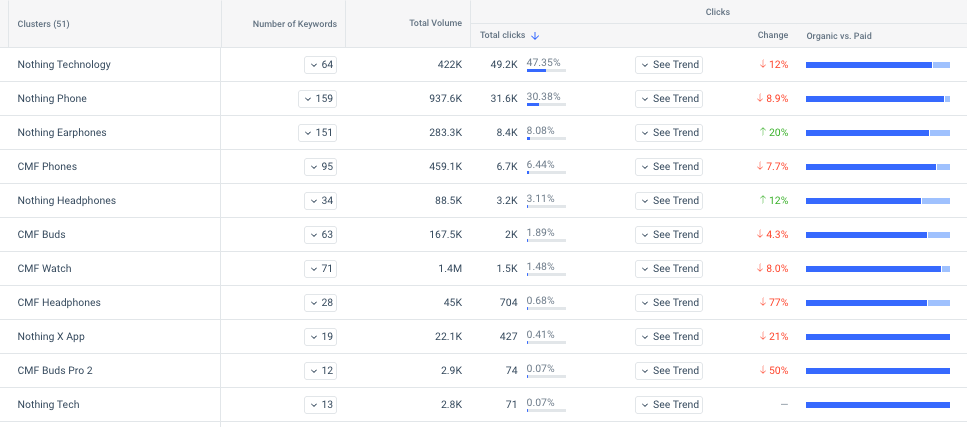
Looking deeper into the Keyword Clusters view, the pattern becomes even clearer. Rather than broad category items, the dominant clusters are branded and product-specific searches. The growth isn’t being driven by ‘cheap smartphones’ or ‘Android deals.’ It’s being driven by intent-rich queries tied directly to the brand and its launches.
| Channel | % Growth (YoY) | Share of Total Growth | The ‘So what?’ |
| Organic Search | +52.7% | 76.3% | The heavy lifter. The brand is dominating product intent queries |
| Direct | +38.2% | 17.9% | Proof of brand power results in users seeking Nothing out |
| Paid Search | +88.0% | 3.1% | Used sparingly. They only pay for what they can’t win organically |
| Social | +16.1% | 1.6% | The Top of Funnel spark that ignites the Direct/Organic loop. |
Notice that organic search accounted for over 76% of their total growth. Where most brands are losing organic reach to AI and paid ads, Nothing is expanding theirs.
Why does it work? Because PR awareness fuels search behavior and direct traffic. When users see a Nothing product on YouTube or in the wild, they don’t just type in a URL. They search for Nothing Phone 3a Pro or CMF Buds 2 Plus. That branded demand is the holy grail of digital marketing.
In the smartphone world, the Apple effect is real. Most companies wait for Apple to move, then follow suit. But Carl Pei realized early on that for a challenger brand, following the leader is a death sentence.
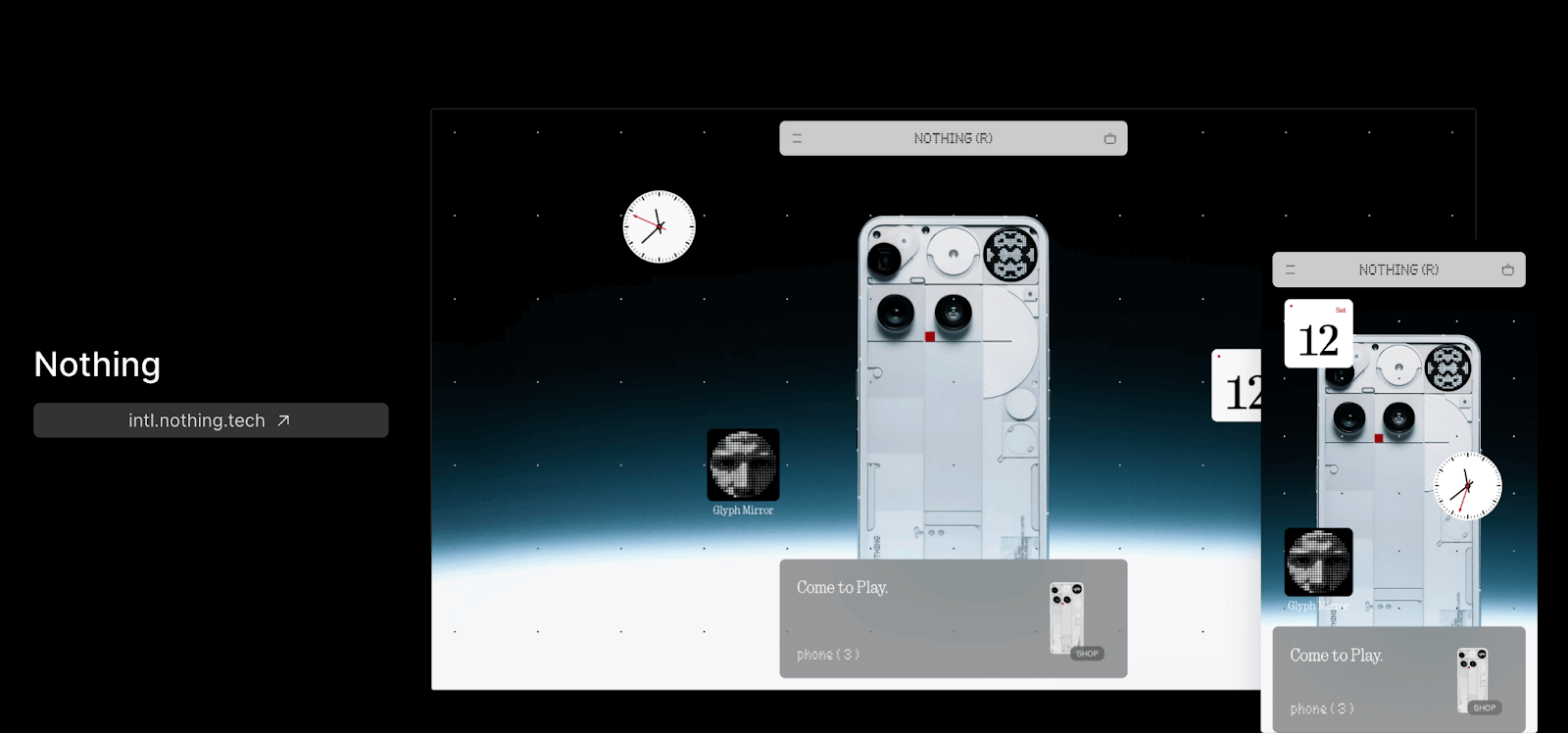
As Pei has noted in several 2024 and 2025 interviews, if a startup can’t offer a reason to exist beyond ‘we also make a phone’, they will be crushed by the giants who already cover every basic user need.
The reality of the industry is stark:
When raw components are commoditized, differentiation has to come from intentional design and user experience.
Nothing’s solution is a deliberate pattern interrupt. In a sea of opaque glass slabs, a transparent phone with glowing Glyph lights is a signal, not just aesthetics. It tells users immediately that this is something else.
This identity-first strategy leaves a measurable footprint.
Nothing.tech proves that in a crowded market, neutrality is your enemy. If your product looks and sounds like everyone else’s, you are forced to compete on price and ad spend (where the giants will always win).
By creating a pattern interrupt, whether through design, a CEO’s voice, or a radical mission, you create branded demand.
Actionable insight:
Look at where your audience goes besides your direct competitors. If they only visit rival brands, you’re stuck in a red ocean. Nothing’s audience also explores art, design, and culture platforms, spaces where no other phone brand competes.
That’s how you outsmart the giants. Not by shouting louder, but by being unmistakably different.
Attention compounds when identity is clear.
Neutral brands rent traffic. Distinct brands generate it.

Darrell creates SEO content for Similarweb, drawing on his deep understanding of SEO and Google patents.
Give it a try or talk to our marketing team — don’t worry, it’s free!