Most Searched Things on Google in 2026
by Maayan Zohar Basteker15 Min.
Oct 15, 2026
 Marketing Intelligence
ChatGPT’s advertising ecosystem is moving fast. Similarweb’s ChatGPT Ads tool has been tracking ads in every country where OpenAI is serving.
Here is what our data shows right now.
| 5,171
unique advertisers, all-time | +46%
active advertiser growth, last 7 days | ~15
average ad-firing turn, top brands (when the ad appears) |
Active advertisers on ChatGPT jumped from 2,585 to 3,770 in the seven days ending June 8, 2026, a 46% week-over-week increase. The primary driver was OpenAI’s decision to lower the minimum spend threshold for participation, opening the platform to a substantially larger pool of advertisers almost overnight.
That one-week surge is part of a much broader growth trajectory. Since measurable ad volume first appeared, the cumulative number of brands tracked in Similarweb’s panel has climbed rapidly:
Total active brands tracked on ChatGPT by Date:
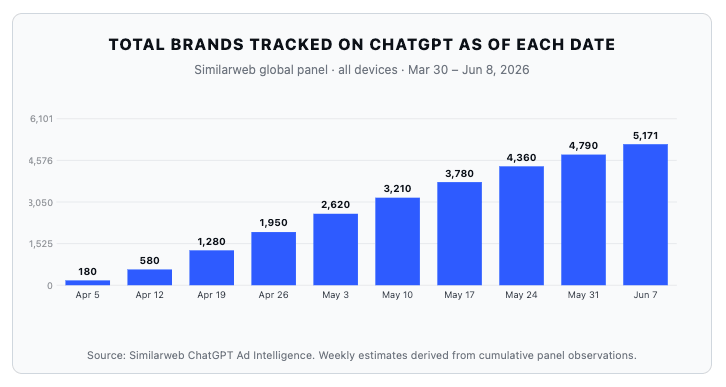
Source: Similarweb Ad Intelligence. Mar 30 – Jun 8, 2026.
Brand participation has roughly doubled every four weeks since tracking began. A notable inflection point emerged in late May, when the cumulative brand count jumped from 3,780 to 4,360 in a single week. That surge coincided with OpenAI’s May 5 launch of its self-serve Ads Manager and CPC bidding model, suggesting that lower barriers to entry helped accelerate advertiser adoption.
The result is a platform whose advertiser base is growing not only in size, but also in velocity.
Despite a 46% increase in active advertisers, impression share remains highly concentrated among a small group of brands. Monday.com alone accounts for 5.05% of global impressions, while the top five advertisers collectively capture nearly 17%.
This pattern is familiar to performance marketers. In the early stages of emerging ad platforms, a handful of advertisers often establish an outsized presence before broader competition arrives. Similar dynamics were evident in the early days of Google Shopping and Meta’s News Feed, when first movers were able to secure disproportionate visibility before the market matured.
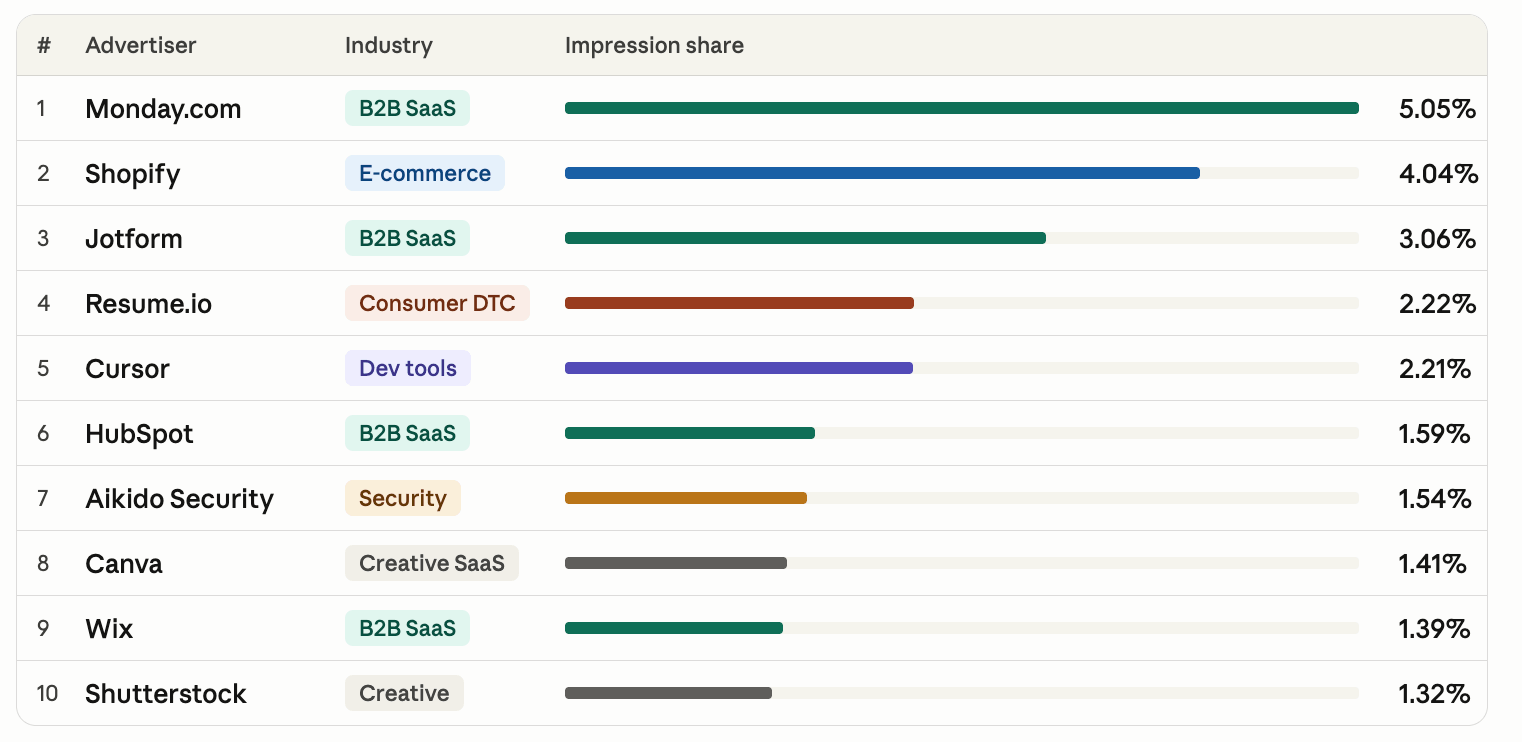
Source: Similarweb Ad Intelligence, April 20 – June 8
The category mix reinforces the same conclusion. Eight of the top 10 advertisers are B2B SaaS or productivity brands. This is not because other verticals are absent, but because the companies that entered early and invested consistently have established a strong foothold.
On emerging ad platforms, first-mover advantage tends to compound over time. Early advertisers accumulate performance and relevance signals, improve auction efficiency, and make it increasingly difficult and expensive for later entrants to win share.
The concentration will ease. It always does on maturing platforms. But the window where early spend buys outsized share is still open.
OpenAI has announced advertising expansion into the UK, Japan, South Korea, Brazil, and Mexico. Yet advertiser activity in these markets is already visible in Similarweb’s panel data, even as the formal rollouts are still underway.
The pattern suggests demand is not waiting for official launch milestones. As new markets open, advertisers are moving quickly to establish an early foothold, extending the same first-mover dynamics already visible on the platform globally.
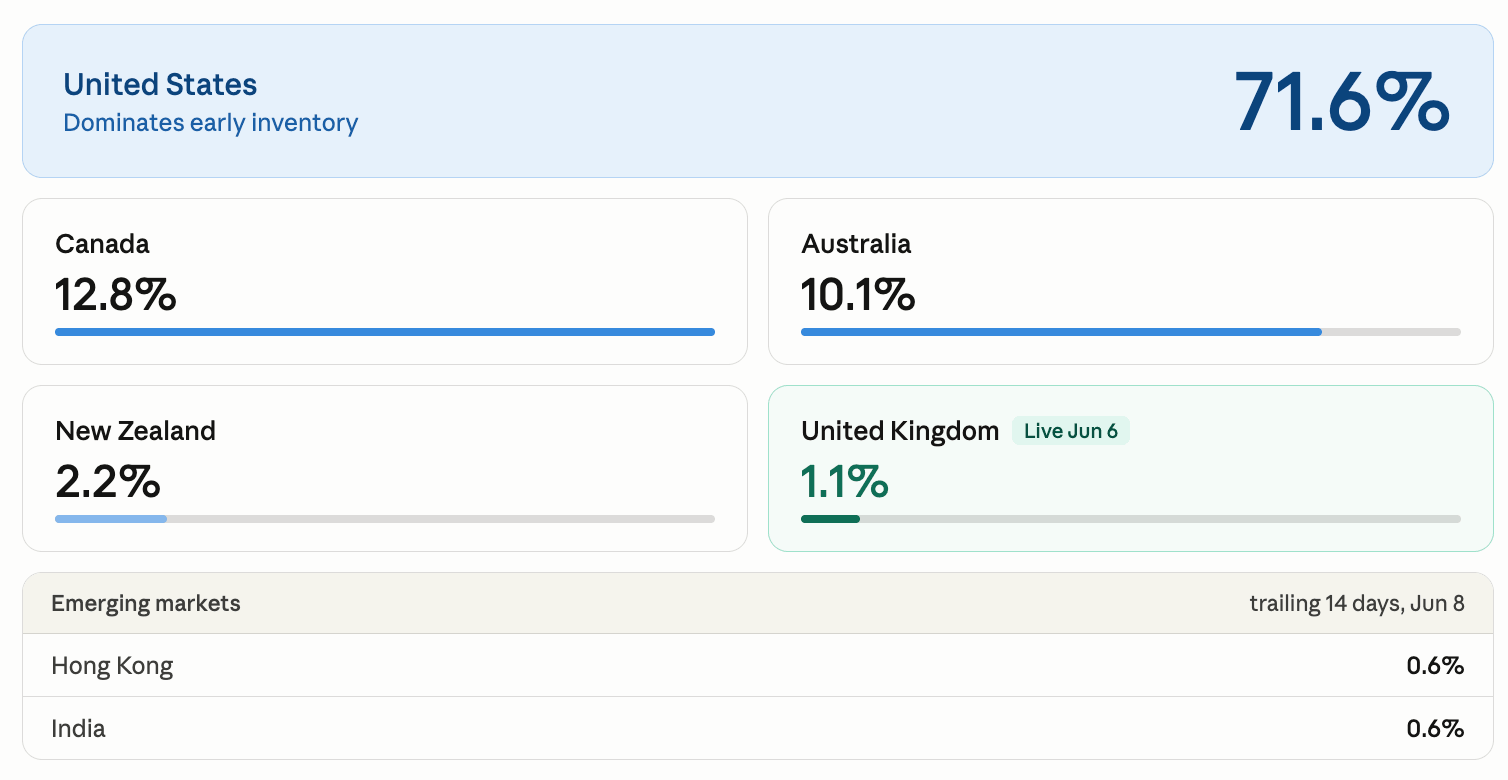
The UK surpassed 1% of total impressions in the week ending June 8 after being virtually absent just two weeks earlier, following its June 6 launch. Japan, South Korea, and Mexico appear poised to follow a similar trajectory.
Our data suggests that the first brands to enter a new ChatGPT market can benefit from roughly 30 days of category-level dominance before competition intensifies and auction dynamics normalize. For advertisers looking to establish an early presence, that window remains open.
This may be the most important signal in the data, yet it receives the least attention.
Three weeks ago, the median ad-firing turn for leading advertisers was between turns 7 and 8. Today, it ranges from turns 14 to 22. In other words, fewer ads are appearing while users are still defining their problem. They generally appear much later in the conversation, after substantial research has taken place, after options have been compared, and often when the user is narrowing a shortlist or approaching a decision.
The implication is significant. ChatGPT Ads appear to be increasingly reaching users at the consideration and decision stages of the journey, rather than at the point of initial discovery.
| Brand | Avg ad-firing turn (last 7 days) | Change vs Apr 20-27 |
| Vanta | 15.8 | +11 |
| Aikido Security | 15.0 | new |
| Wix | 14.6 | new |
| Monday.com | 13.6 | +5 |
| Home Depot | 12.8 | new |
| Shopify / Cursor | 10.4 | +2 / +4 |
Source: Similarweb Ad Intelligence. Conversation depth = user-turn index at the moment of ad serve. Comparison vs Apr 20-27, 2026 cohort.
Turn 3 and turn 15 do not represent the same audience. At turn 3, a user is often exploring a category or defining a problem. By turn 15, that same user may be comparing specific vendors, evaluating tradeoffs, and moving toward a purchase decision. Each stage of the conversation reflects a different level of intent and a different likelihood of conversion.
The rollout of Conversion Pixel tracking in early June is likely to reinforce this dynamic. As advertisers gain the ability to optimize against actual conversion outcomes, bidding behavior will naturally shift toward the conversation stages where conversions occur most frequently.
Although advertisers cannot directly control where their ads appear, they can invest in better understanding user intent across the conversation journey. The advertisers that develop the strongest visibility into those intent signals will be best positioned to show up in the right context, at the right moment, and with the highest probability of driving action.
The launch of the self-serve Ads Manager, CPC bidding, and the removal of the minimum spend requirement have dramatically reduced the cost of running an initial test. At the same time, the accelerating growth in advertiser participation suggests competition will continue to intensify.
In other words, the longer brands wait to enter the auction, the more expensive that entry is likely to become. In emerging ad ecosystems, early participation is often the lowest-cost opportunity to learn, optimize, and establish a foothold before competition increases.
Advertisers cannot directly target specific conversation turns. However, they can analyze where user intent evolves from exploratory to transactional and optimize their campaigns accordingly. The better a brand understands the moments when purchase intent emerges, the more likely it is to appear in those high-value contexts.
A useful exercise is to segment performance by conversation depth and measure conversion rates across turn cohorts. Early evidence suggests that the increase in conversion probability between turn 3 and turn 15 may be far greater than the corresponding increase in media costs. Understanding that relationship could become a meaningful competitive advantage as the auction matures.
If you’re a B2B SaaS advertiser, your advantage is real but it won’t last forever
Eight of the top 10 advertisers by global impression share are B2B SaaS or productivity brands. That is not a coincidence. ChatGPT’s audience skews toward research-intensive users, particularly on desktop and iOS, making it a natural environment for software evaluation and business decision-making.
At the same time, impression share remains highly concentrated. The brands already establishing visibility at turns 13–16 are building performance history, relevance signals, and auction advantages that can compound over time. The opportunity remains significant, but the lead enjoyed by early entrants will become harder to close as competition increases.
The UK is now live, Brazil has begun rolling out, and Japan, South Korea, and Mexico appear to be next. Similarweb’s data suggests that the first brands to establish a presence in a newly opened market can benefit from roughly 30 days of category-level advantage before competition increases and auction dynamics normalize.
For advertisers targeting these regions, the key insight is timing. The greatest opportunity often exists before a market’s expansion is widely recognized, not after the formal launch announcement.
ChatGPT Ads is past the experimentation phase. The numbers tell a consistent story: 46% weekly growth, 5,171 brands tracked, and conversation depth doubling in three weeks. These are not the signals of a platform merely adding advertisers. They are the signals of a platform accelerating structurally.
The strategic questions have shifted as a result. Not whether to test, but where in the conversation to bid. Not whether the market has scale, but which markets to enter first. Not whether early movers have an advantage, but how long that advantage stays affordable.
The window is open. The data shows it won’t stay that way for long.
How fast are ChatGPT advertisers growing?
Active advertisers on ChatGPT grew 46% in a single week in early June 2026, rising from 2,585 to 3,770 following OpenAI’s reduction of the spend threshold. Cumulatively, Similarweb has tracked 5,171 unique advertisers since March 30, 2026, roughly doubling every four weeks since the panel opened.
Which brands are advertising on ChatGPT?
As of June 2026, Similarweb’s ChatGPT Ad Intelligence panel has tracked 5,171 unique advertisers globally, spanning B2B SaaS, ecommerce, consumer, and creative categories. The advertiser base has roughly doubled every four weeks since tracking began in March 2026, with 3,770 brands active in the last seven days alone. Similarweb tracks which brands are live, how much impression share they hold, and at what point in the conversation their ads are appearing.
Why is impression share concentrated among so few brands?
Impression concentration is typical of new ad platforms in early months, where brands with larger budgets and earlier entry dominate before auction competition spreads share more evenly. On ChatGPT, Monday.com holds 5.05% of global impressions alone. Scale and sustained investment still provide meaningful visibility advantages on the platform as of June 2026.
What is conversation depth in ChatGPT Ads?
Conversation depth is the user-turn index at which an ad fires inside a ChatGPT session. An ad at turn 2-3 reaches a user who is still framing their question. An ad at turn 15 reaches a user who has completed substantial research and is near a decision. Similarweb data shows top advertisers shifted from a median firing turn of 7-8 to 14-22 over three weeks in May-June 2026, a structural move from discovery to consideration targeting.
Which countries can advertisers currently reach on ChatGPT?
Similarweb observes ad impressions in 30+ countries as of early June 2026. The US holds 71.6% of total impressions, followed by Canada (12.8%), Australia (10.1%), and New Zealand (2.2%). The UK launched formally on June 6 and crossed 1% of impressions within its first week. Brazil’s first paid ad was observed May 28. Japan, South Korea, and Mexico are announced as the next markets.
How do you measure ChatGPT ad performance?
Similarweb’s ChatGPT Ad Intelligence tracks ad impressions in every country where ChatGPT serves ads. Each impression is classified by conversation turn, capturing the moment at which the ad fired. This means you can see not just who is advertising and how much share they hold, but at what depth in the conversation their ads are appearing and how that correlates with downstream behavior. Standard metrics include impression share, CTR, conversation depth, and share of voice by category and geography.
How is ChatGPT advertising different from search or social ads?
Traditional search ads target declared intent through keywords. Social ads interrupt passive browsing using demographic and behavioral signals. ChatGPT ads reach users who are already mid-research, inside an active conversation. Similarweb data shows top advertisers are now firing ads at turns 14 to 22, meaning the user has already compared options and is approaching a decision before the ad appears. That is a fundamentally different audience moment than a keyword match or a scroll-stop, and it requires a different measurement approach to capture accurately.

by Liat Sagiv
Senior Product Marketing Manager - Ad Intel
Liat is a product marketer with 7+ years of experience shaping go-to-market and marketing strategies across B2B technology companies. At Similarweb, she leads product marketing for Ad Intelligence.
Give it a try or talk to our marketing team — don’t worry, it’s free!