

How to Run a Black Friday Competitor Analysis in One Conversation
by Alina Miron5 Min.
Nov 02, 2026
In August, 1,426 searches for “black friday tv deals” were made in the US. In September, there were 5,684. Over the same period, searches for “black friday mattress sale” went from 310 to 300. Black Friday shoppers are already out there, and they are hunting for TVs first.
Black Friday 2026 lands on November 27. This article covers what US search and traffic data show ahead of it: the demand ramp, the categories moving first, how much early retailer traffic comes from AI chatbots, and what the data can’t tell you. Search and traffic figures come from Similarweb. Spending forecasts come from Adobe and are labeled as such.
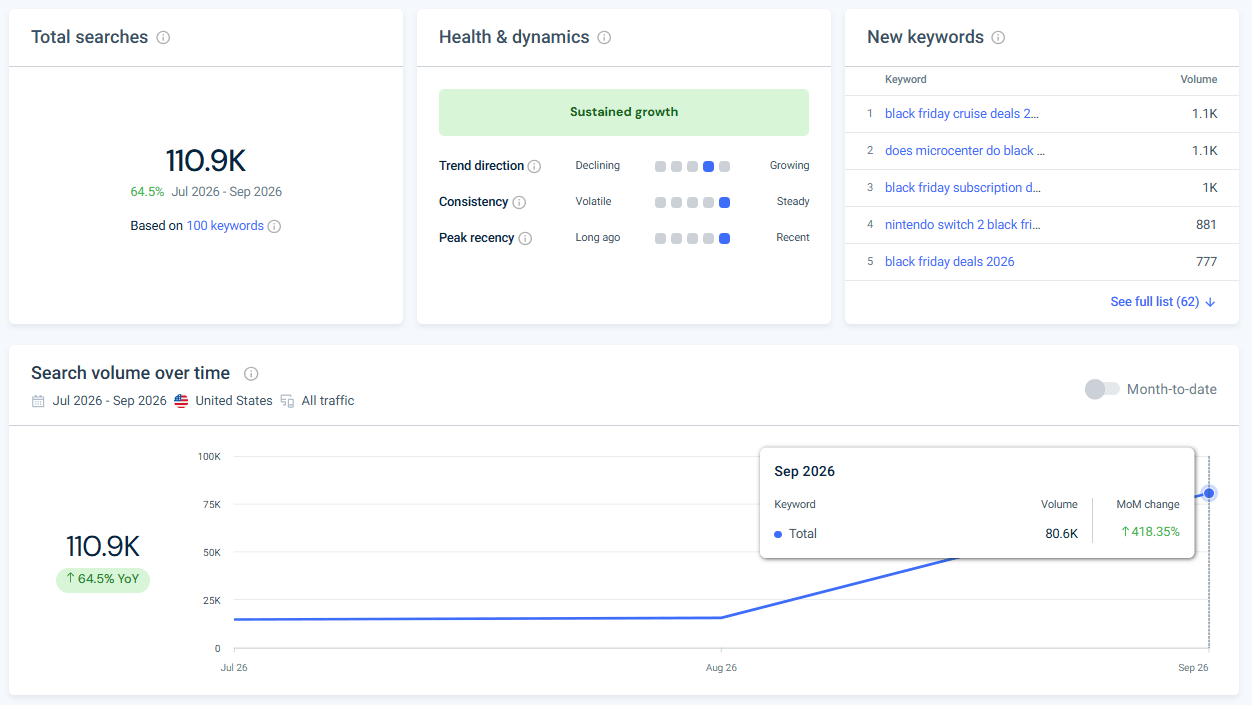
Yes. In Similarweb’s Demand Analysis tool, US search volume for keywords tied to “black friday deals” hit 80.6K in September 2026, up 418% from August. July and August sat flat at about 15K each before September jumped. Across July to September, the set totaled 110.9K searches, up 64.5% year over year.
Last year’s curve shows what follows. Monthly totals were 21.9K in August, 33.6K in September, 157.1K in October and 7M in November. October volume was nearly 5X September’s, and November was about 45X October’s.
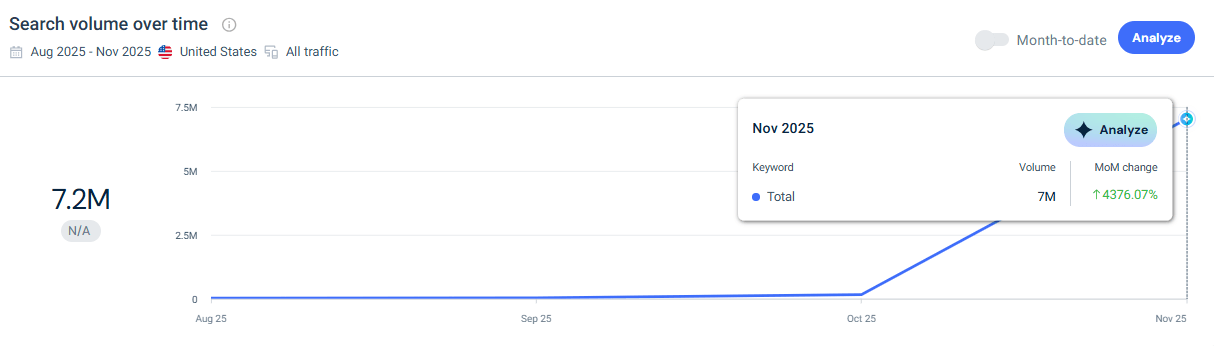
November is when Black Friday gets measured. October is when it gets decided.
TVs and consoles. US searches for “black friday tv deals” rose 299% from August to September 2026, and “switch 2 black friday” rose 210%. Laptops grew 53%. Mattresses, outside electronics, stayed flat. Demand isn’t lifting evenly, so a site-wide trend line hides the categories that matter.
| US search keyword | August 2026 | September 2026 | Change |
| black friday tv deals | 1,426 | 5,684 | +299% |
| switch 2 black friday | 857 | 2,658 | +210% |
| black friday laptop deals | 862 | 1,322 | +53% |
| black friday mattress sale | 310 | 300 | -3% |
Retailer pages show the same skew. Looking at Best Buy’s most popular pages, one product page, the Switch 2 Zelda 40th Anniversary Edition, took about 2.7% of the site’s September 2026 traffic.
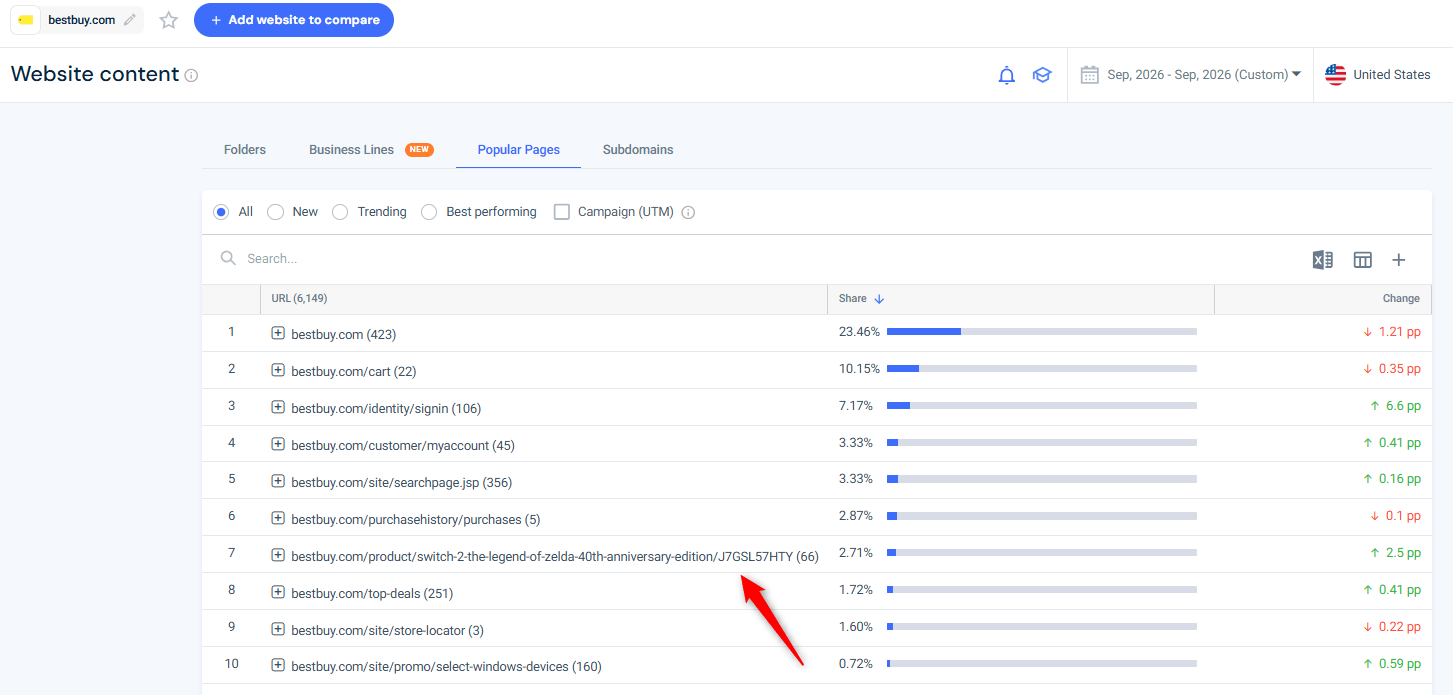
That pairing points to a pattern: shoppers research big-ticket electronics early and buy late. The data shows timing, not motive, so treat that as a hypothesis. What you can act on is the timing. Track category keywords weekly, not the head term.
AI chatbots. Using Similarweb’s AI Chatbot Traffic Tracker, we see that US AI chatbot referral visits to Best Buy rose from 624.4K in October 2025 to about 1.2 million in November, nearly double, according to Similarweb. Adobe forecasts AI traffic to US retail sites will rise 130% year over year this season.
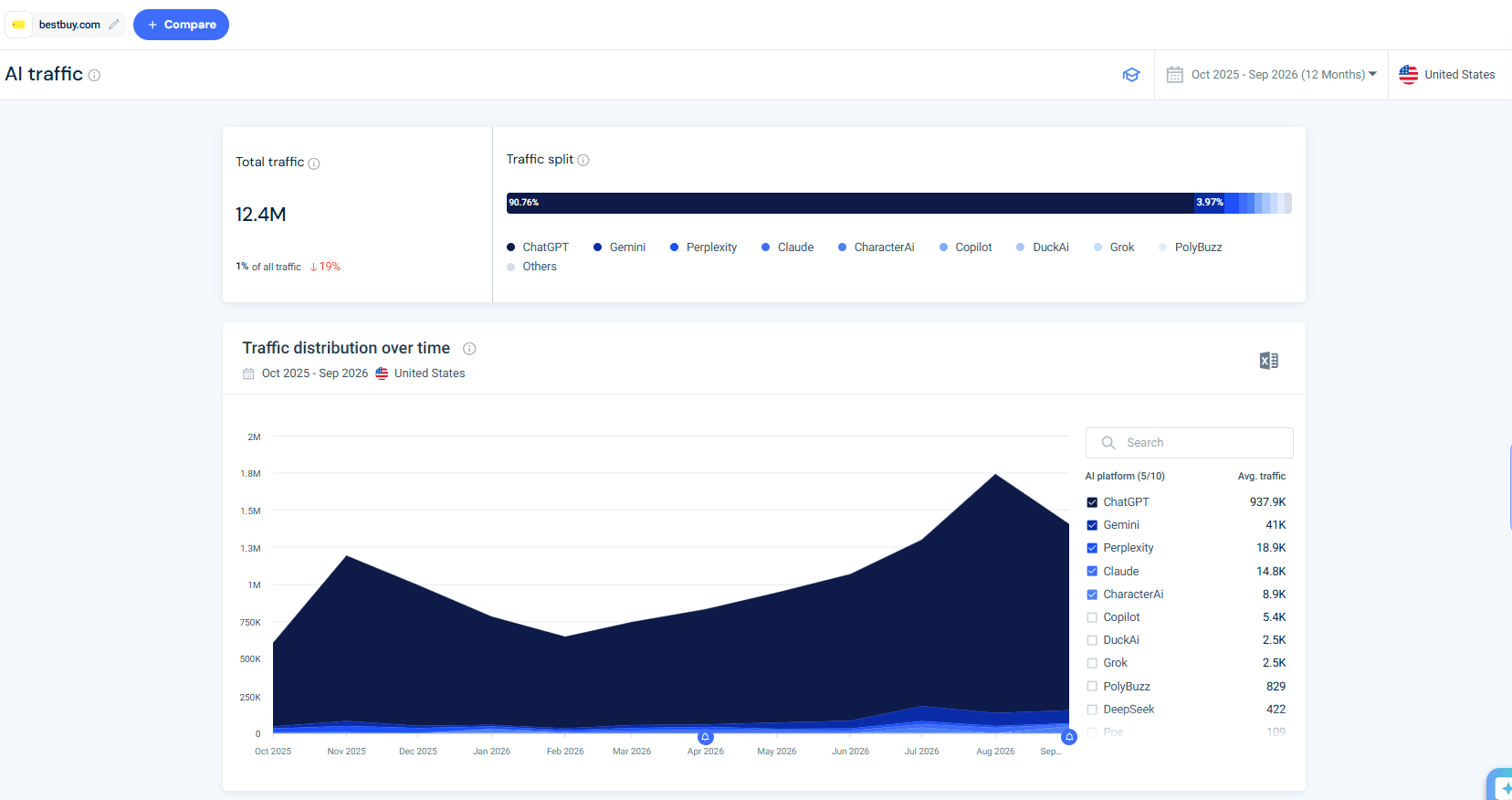
It can’t tell you what shoppers will buy, or how 2026 compares with 2025 by category. Monthly keyword data covers only the last three months, apparel and furniture returned no usable signal, and the AI referral figures cover three retailers (Best Buy, Walmart and Target), not the sector.
Search interest and purchases are different things. A keyword that quadruples from 1,426 to 5,684 is a strong signal, but it is still a small base. And Adobe’s numbers are a forecast, not a result.
Ask three questions, in this order: which keywords in my category are moving, where is my traffic coming from, and which competitors are scaling. We pulled every number above via our Claude connector in one conversation using Similarweb data. You can run the same questions yourself: Get the full prompt playbook
Black Friday isn’t one date. It’s a calendar of categories, and the early ones are already moving.

by Alina Miron
Senior Product Marketing Manager - Data and AI
lina is a Senior Product Marketing Manager for Data and AI at Similarweb, leading go-to-market for the company’s API, datafeeds and MCP. She brings more than a decade in adtech and marketing, six years of it in product marketing, across gaming, mobile advertising and B2B data. Most recently she led product marketing at Lusha, where she took the company’s data to developers and AI builders through API and MCP, and shipped partner launches with Clay, Make and monday.com. She helps data and AI products get bought, not just understood.
Harness the power of data with Similarweb’s APIs to drive smarter business decisions