


 Marketing Intelligence
AI-Generated Content and SEO: Can Speed Compensate for Quality?
As someone who’s spent over a decade in SEO, I’ve watched search evolve through countless algorithm updates, but nothing compares to the disruption caused by AI-generated content. In 2025, the internet feels like it’s been rewritten overnight. A report from Graphite even shows that more online articles are now created by AI than by human writers. It’s efficient, scalable, and, for many, irresistible.
AI tools make it faster and cheaper than ever to produce SEO-optimized content at scale. For SEO teams and content marketers, that efficiency sounds like a dream, until you see what happens to rankings when quality takes a back seat. The opportunity is real, but so are the risks: inconsistent accuracy, loss of voice, and Google’s growing scrutiny of what qualifies as truly “helpful” content.
And yes, before you all accuse me of being a hypocrite, I used AI in the creation of this very article. From researching recent debates and exploring angles to summarizing studies and refining structure, AI helped accelerate the process. But every section was reviewed, fact-checked, and rewritten with a human touch. That combination of efficiency and oversight is exactly what this piece argues for. Using AI for SEO is fine; you just need to be smart about it.
What is AI-generated content?
AI-generated content refers to any text, image, video, or other media created by artificial intelligence rather than a human. In written content, this usually involves tools such as ChatGPT, Gemini, or Jasper generating text based on prompts, data, and learned patterns. These systems are trained on massive datasets, allowing them to produce fluent, structured copy that resembles human writing, sometimes convincingly so.
However, AI content often lacks the nuance, personal experience, and unpredictability of human writing. It tends to follow formulaic patterns, prioritizing clarity and structure over originality. While it can speed up content creation and support idea generation, it also introduces risks: factual inaccuracies, repetitive phrasing, and tone inconsistencies.
For SEO professionals, understanding how AI-generated content behaves is critical. It can improve production efficiency, but without human guidance and editorial review, it can easily miss the mark on authenticity and depth.
The promise: AI as a productivity engine for SEO
AI is undeniably changing how we approach SEO. According to DemandSage, 56% of organizations are now actively integrating AI into their SEO workflows, using it to speed up keyword research, topic clustering, meta tag generation, and draft writing.
From my experience, AI can absolutely boost efficiency. It’s great for surfacing opportunities faster, handling repetitive tasks, and supporting keyword strategies. My team often uses it to build outlines or explore content angles, freeing up time for analysis and creative work. A typical workflow looks like this: research keywords manually, feed them into AI with competitor pages for a draft, then refine and edit heavily with human expertise. The process saves time, but it still needs editorial oversight.
The biggest misconception I see (Usually on LinkedIn…) is that speed alone will help you rank. It won’t. In fact, AI can cause problems if the content lacks depth, originality, or real expertise.
The problem: Quality, originality, and EEAT
Google’s stance on AI-generated content is pragmatic: it’s fine, as long as it’s helpful and high quality. The Search Central documentation clarifies that what matters is how content is created, not who creates it. So, yes, AI content can rank, but only if it demonstrates genuine value.
Google’s EEAT framework (Experience, Expertise, Authoritativeness, Trustworthiness) is a decisive framework that determines whether your content ranks or fades from visibility. AI tends to miss those human signals, the details, insights, and firsthand experiences that readers (and algorithms) recognize as authentic. WebFX has shown how low-depth, generic AI text can undermine credibility, and I’ve seen tons of so-called SEO experts writing on LinkedIn on how they generated thousands of AI-generated pages that ranked at first and tanked later, and are now prompting you to comment to see what they learned.
Research from Media Search Group reinforces this: purely AI-generated pages reach the top 10 search results only 28% of the time, and the top 3 just 6%. Hybrid content, by contrast, where humans refine and add value, consistently performs better. The pattern is obvious: AI boosts volume, humans bring value.
Characteristics of AI-generated content
AI writing often follows predictable patterns. After reviewing dozens of AI-driven articles, these traits stand out:
- A formal, robotic tone: Repetitive structures and mechanical phrasing that lack emotion or nuance.
- Repetitive phrasing: Overuse of certain sentence templates or stock phrases (Who here has seen the words “enhance” and “unlock” show up more in online content and even in everyday speech?)
- A lack of personal touch: Quick synthesis of facts, but little in the way of personality or lived experience.
- Predictable formatting: Perfectly structured lists, consistent headings, and symmetrical paragraphs. It looks polished but can feel sterile.
Some publishers lean into that polish and even thrive on it. Those em dash-heavy, cleanly structured articles may look great at first glance, but over time, they can blend into the noise. SEO is about distinctiveness and structure working together. That’s where humans still win.
The flood: When quantity becomes an SEO liability
The web is drowning in content. AI has made it possible to publish at an unprecedented scale, but this content inflation is making visibility harder, not easier. I’ve seen brands pump out thousands of AI-written pages, only to watch engagement tank and rankings slide.
Google’s algorithms now favor useful originality over sheer volume. When every article sounds the same, engagement metrics like time on page, clicks, and shares drop. High bounce rates send a clear message: users can tell when content lacks substance. Media Search Group’s research aligns with what I see in practice: unedited AI content rarely holds attention or ranks well for long.
If you’re scaling content, do it carefully. Quantity can build reach, but only if quality keeps up.
The evolution: Search engines and AI-powered discovery
AI is changing both how content is written and how it’s discovered. Google’s AI Overviews, Bing’s Copilot, and obviously ChatGPT are redefining what visibility looks like. Instead of a list of links, users now get synthesized answers. As a result, the competition now includes the AI interface itself alongside other sites.
The irony is hard to ignore. People have even accused Google’s AI Overviews of violating its own spam policies.
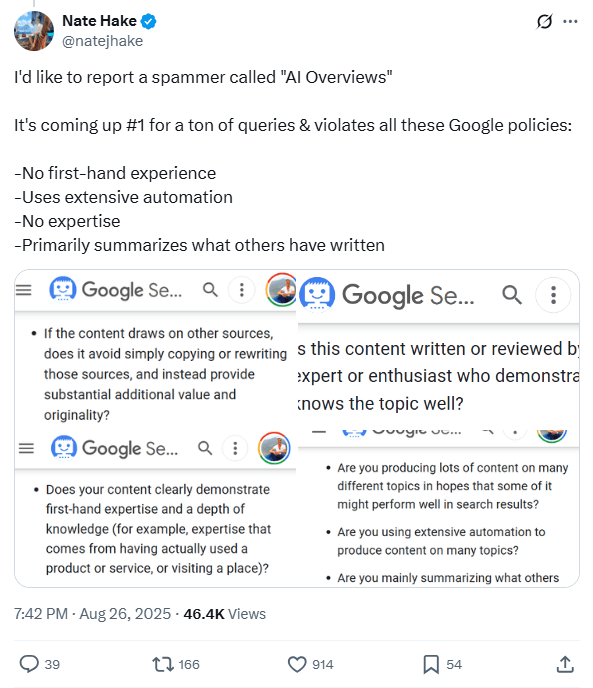
If Google struggles with its own automation, it underscores how tricky this landscape has become for creators.
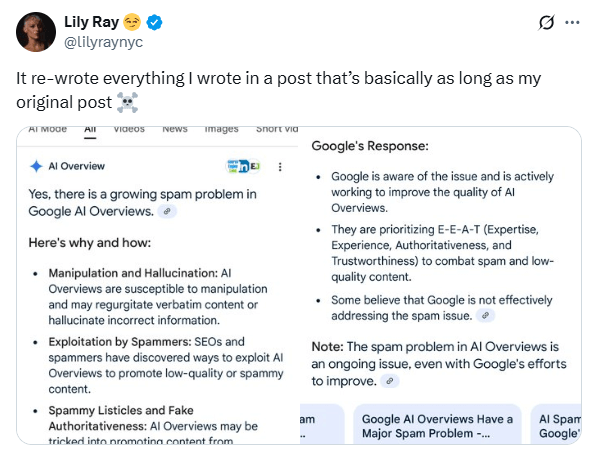
Accuracy and credible sourcing matter more than ever. AI-generated summaries tend to pull from authoritative domains or leading personas in an industry, so building topical authority, through trustworthy, well-edited content, is now the smartest long-term SEO strategy.
The middle ground: The hybrid SEO model
In my work, the best-performing content almost always follows a hybrid model, combining AI’s efficiency with human oversight.
Here’s how I typically recommend approaching it:
- Start with prompt intent-driven research and understand the searcher’s goal before prompting AI.
- Use AI for structure, outlines, headlines, and first drafts.
- Add human insight, your experience, examples, and commentary.
- Refine manually, check accuracy, tone, and flow.
- Optimize, use SEO fundamentals: integrating keywords, internal linking, and more.
This approach keeps production fast without losing depth. AI handles the scale, while human insight keeps the message meaningful.
Best practices: Making AI work for SEO
I treat AI as a teammate, useful for brainstorming, organization, and draft support, but not ready to publish on its own.
Do:
- Use AI to develop ideas and identify content opportunities.
- Edit rigorously for clarity, personality, and EEAT.
- Attribute expertise: add quotes and evidence.
- Track how AI-generated content performs in search, monitor impressions, clicks, and engagement for both human-edited and AI-assisted pages.
- Use AI tools selectively for SEO tasks that relate directly to AI content creation, such as optimizing metadata for AI visibility or analyzing which AI-generated pages gain traction.
Don’t:
- Publish AI text without review.
- Expect AI to replace original insights or opinions.
- Neglect verification, fact-check everything.
Editing is the stage where expertise shines and content becomes refined. AI’s tone often feels overly formal or predictable, so I vary rhythm, use shorter sentences, and add a bit of personality. That balance keeps the writing sharp and authentic while preserving AI’s efficiency.
The future of SEO and content in the age of AI
Today, everyone wants to rank for what’s being called GEO (Generative Engine Optimization), AEO (Answer Engine Optimization), AIO (Artificial Intelligence Optimization), LLMO (Large Language Model Optimization), and whatever new acronym the industry invents next. Companies are putting immense pressure on SEO teams, whether in-house or at agencies, to make their brands visible in AI-driven discovery tools like ChatGPT, Perplexity, or Google’s AI Overviews. The competition for presence in these interfaces has created a new arms race, and dozens of new analytics platforms have emerged to measure AI visibility.
This is also where Similarweb’s AI Search Intelligence comes in. It’s one of the few solutions providing measurable insights into brand visibility and traffic from generative AI systems. With tools like GenAI Intelligence, SEOs can go beyond visibility and actually measure performance in AI-driven discovery. The suite offers:
AI Brand Visibility: Track where your brand appears across GenAI answers, uncover the prompts and topics driving mentions, and analyze sentiment around those mentions.
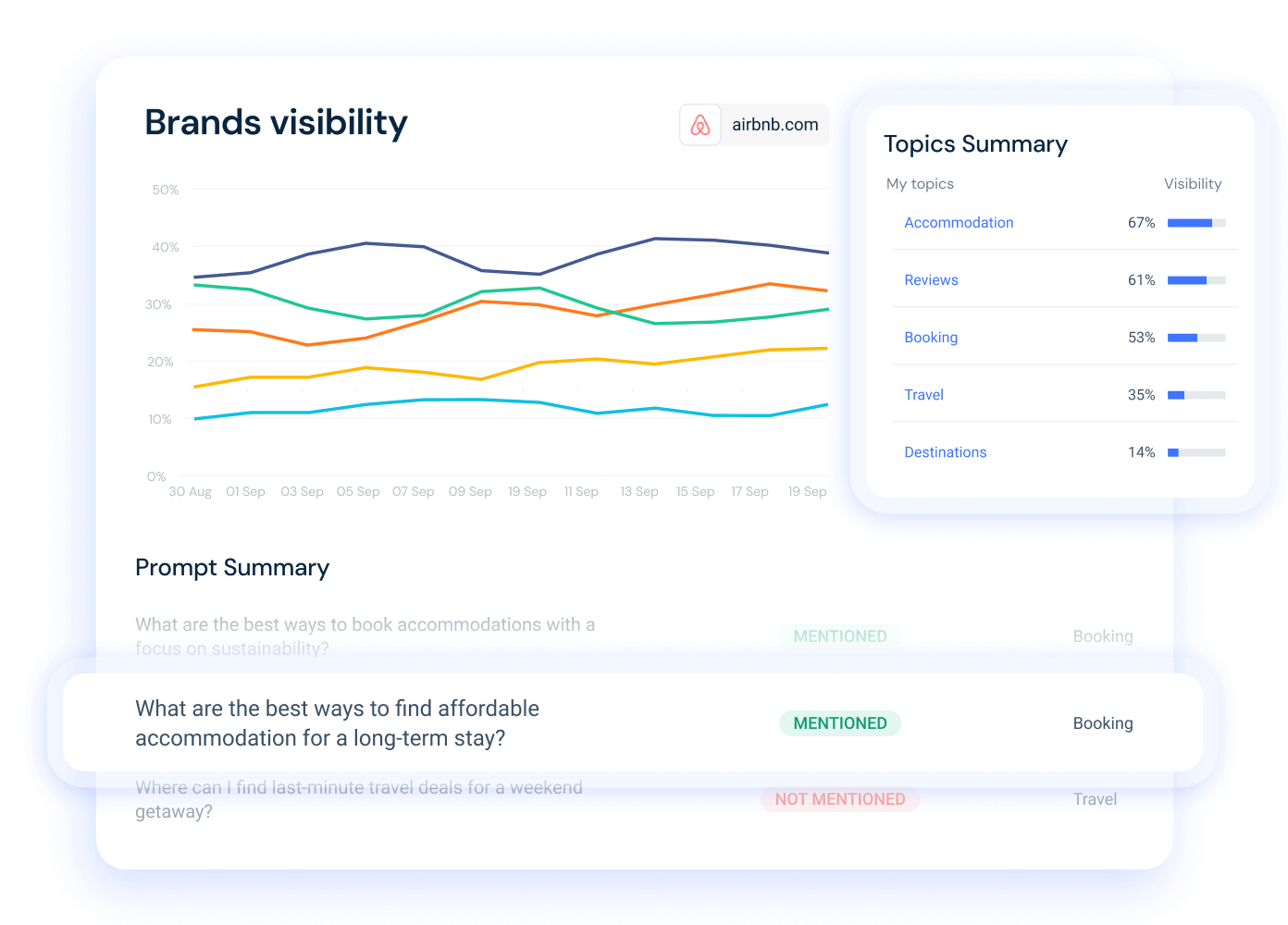
You can even compare your visibility share to competitors and see whether your brand is cited as a trusted source. The feature also lets you analyze the exact URLs that influence mentions, giving you a complete view from prompt to source.
AI Traffic Tracker: Understand how much traffic your site and competitor sites receive from GenAI chatbots like ChatGPT and Perplexity.
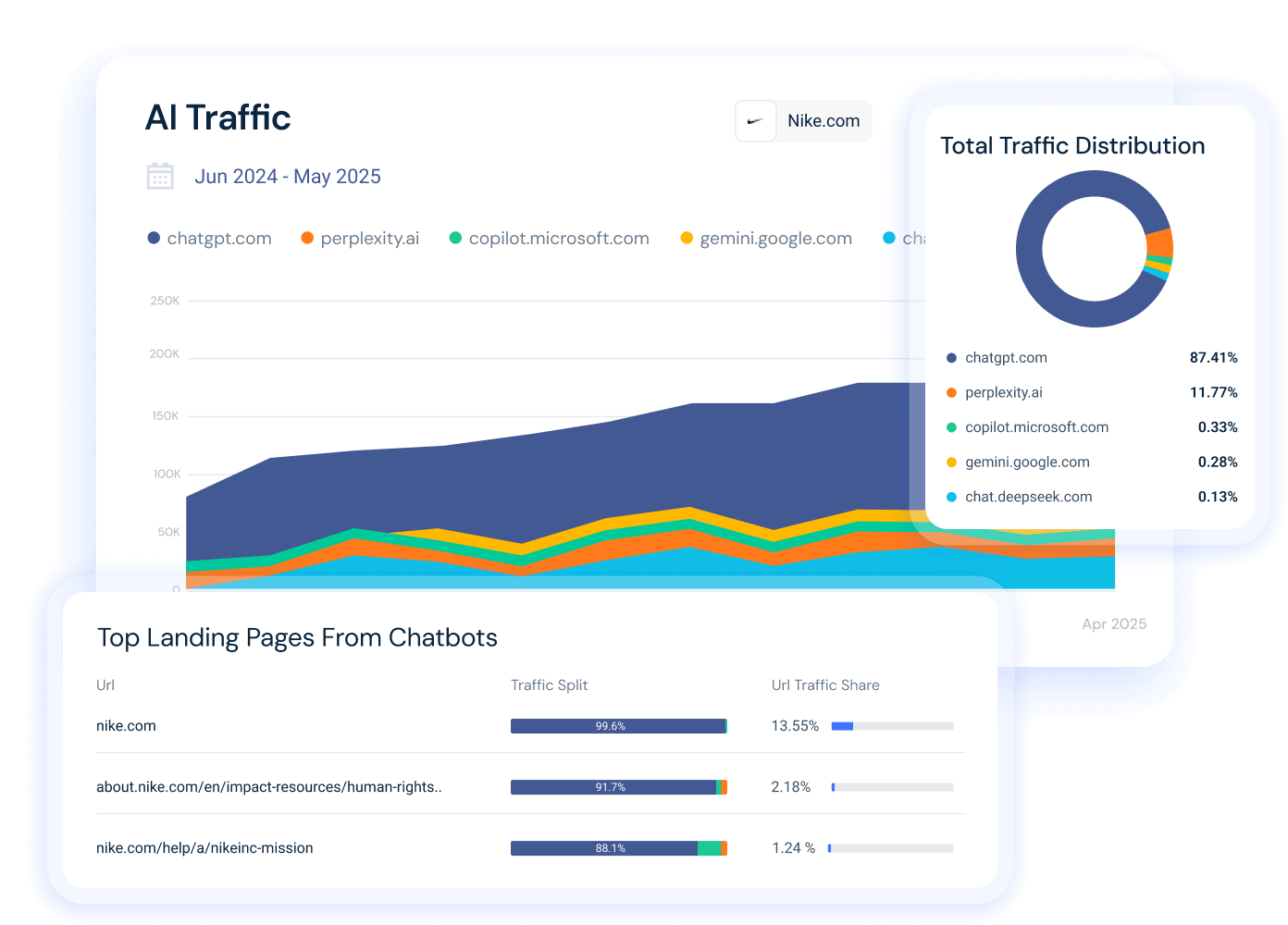
It reveals which pages get surfaced in AI chats, the prompts behind those visits, and how AI-driven clicks change over time. You can track shifts in AI traffic share, identify rising opportunities, and see how different chatbots contribute to total visits.
Together, these tools offer a new level of intelligence for modern SEOs, showing where your brand ranks in search results as well as how it performs in AI conversations. Similarweb’s real-user data and prompt-level insights make it possible to benchmark your brand’s presence in GenAI answers, adjust for citations, and uncover new opportunities in this rapidly changing search ecosystem. For any SEO professional navigating this new landscape, these insights are becoming just as important as traditional search rankings.
A personal take on the future of SEO
For me, the real question isn’t whether AI can produce content, it’s whether it can produce credible content. The future of SEO will belong to teams who know how to combine technology with human context. Those who rely too heavily on automation risk losing not only rankings but trust.
In the end, I believe SEO success will depend on one thing: human judgment. AI can handle the data, but humans understand meaning, emotion, and intent.
AI can help you write more, but only humans can make content worth finding.
FAQs
Does Google penalize AI-generated content?
No, Google doesn’t penalize content just because it’s AI-generated. What matters is whether the content provides real value, demonstrates experience and expertise (EEAT), and satisfies user intent. Low-quality or spammy AI content, however, can still hurt rankings.
How can I tell if AI content is helping or hurting my SEO?
Track engagement metrics like bounce rate, time on page, and organic click-through rate. If AI-generated pages perform worse than human-written ones, it’s a sign they’re not connecting with your audience or meeting intent.
Should I disclose when content is AI-assisted?
Transparency builds trust. Many publishers now add small disclaimers when AI tools contribute to research or drafting. It’s not required, but disclosure can reinforce credibility, especially for expert-driven topics.
Can AI tools improve technical SEO?
Yes. AI can optimize metadata, generate schema markup, suggest internal linking structures, and identify keyword gaps. However, technical recommendations should always be reviewed by an SEO specialist to ensure accuracy and strategy alignment.
What’s the best balance between AI and human input for SEO content?
Use AI for research, outlines, and draft generation, then let humans refine tone, add insights, and ensure compliance with brand and SEO standards. The most successful teams treat AI as a collaborator, not a replacement.
How is SEO changing with AI-powered search (like ChatGPT or Perplexity)?
SEO is expanding beyond traditional rankings. Visibility in AI-generated answers (sometimes called GEO or LLMO) is becoming just as critical. Credible sourcing and topical authority will determine whether your content gets cited in AI responses.

Related Posts

How to Do A Competitive Analysis: Complete Guide & Free Templates

How to Build an AI Search Intelligence Dashboard for Client Presentations Using Claude and Similarweb MCP

AI Visibility Momentum: The VAMP Framework For Tracking What Visibility Scores Miss

The Dark Funnel Paradox: Why Your Best B2B Leads Are Invisible (And How to Find Them Anyway)
![GEO Framework For Growth Leaders [+Free Template]](https://www.similarweb.com/blog/wp-content/uploads/2026/02/attachment-growth-leader-geo-decision-framework-768x429.png)
Wondering what Similarweb can do for your business?
Give it a try or talk to our insights team — don’t worry, it’s free!