


 Marketing Intelligence
How to Find and Close AI Visibility Gaps?

An AI visibility gap is any topic, prompt, or context where competing brands appear in AI-generated answers and yours does not. There are four main types: topic gaps, prompt-level gaps, sentiment gaps, and citation gaps. Each type has a different cause and a different fix, and all of them are findable using our AI brand visibility data.
AI search has quietly taken over the top of the purchase funnel. According to Similarweb’s 2026 AI Brand Visibility Report, 35% of US consumers now use AI tools at the product discovery stage, compared to just 13.6% who use traditional search. At the evaluation stage, AI holds a 32.9% to 15% advantage over search.
That means by the time a potential customer reaches a search engine, their shortlist is already formed. AI has taken over the purchase funnel, and if your brand wasn’t mentioned in the AI answer that started their journey, you weren’t on that shortlist.
The problem is that most brands don’t know which conversations they’re missing. They know their search rankings. But AI visibility gaps, where competitors are mentioned and your brand is absent, are almost completely invisible without the right tools.
I decided to look at this problem hands-on. Using Similarweb’s AI Search Intelligence, I ran a full gap analysis for a beauty brand to see exactly where they were missing from AI-generated answers, and what the data was pointing to as the priority areas to fix.
Why finding AI visibility gaps matters
An AI visibility gap is not the same as a search visibility gap. In traditional search, a gap means you’re ranking on page two instead of page one. In AI search, a gap means you’re not mentioned at all, and the user never knows you exist.
What makes this especially high-stakes is the permanence of AI answers. When a user asks ChatGPT “what’s the best product for grey hair coverage?” they get a synthesized answer with 3-4 brand recommendations. There’s no page two. There’s no “also check out.” If your brand isn’t in that answer, the conversation is over before it began. Research from Pew Research Center found that when an AI summary appears in search results, click rates drop from 15% to just 8%, meaning users are resolving their queries inside the AI answer, not by clicking through to brand websites.
The other reason gaps matter: they compound. The AI landscape is volatile, and the brands that establish topical authority early are harder to displace. Every month, a competitor holds the mention share on a topic where they’re reinforcing their presence, and you’re not. Waiting to act means ceding ground that becomes progressively more expensive to reclaim.
The good news is that AI visibility gaps are findable and fixable. They follow patterns: topic gaps, prompt-level gaps, sentiment gaps, citation source gaps, and each type has a specific action attached to it. The process I’ll walk through below covers all of them.
How to find AI visibility gaps
Step 1: Find where your visibility is weakest by topic
The first thing I do when analyzing a brand is open the Topics view inside Similarweb’s AI Brand Visibility tool. This shows me, at a category level, what percentage of AI answers for each topic mention the brand, and how that compares to the total mention share available in that topic. Mention share is the percentage of all brand mentions across AI answers in a given topic that belong to your brand. It tells you not just whether you’re present, but how dominant your presence is relative to the whole conversation.
When I looked at the beauty brand’s data, the picture was immediately clear.
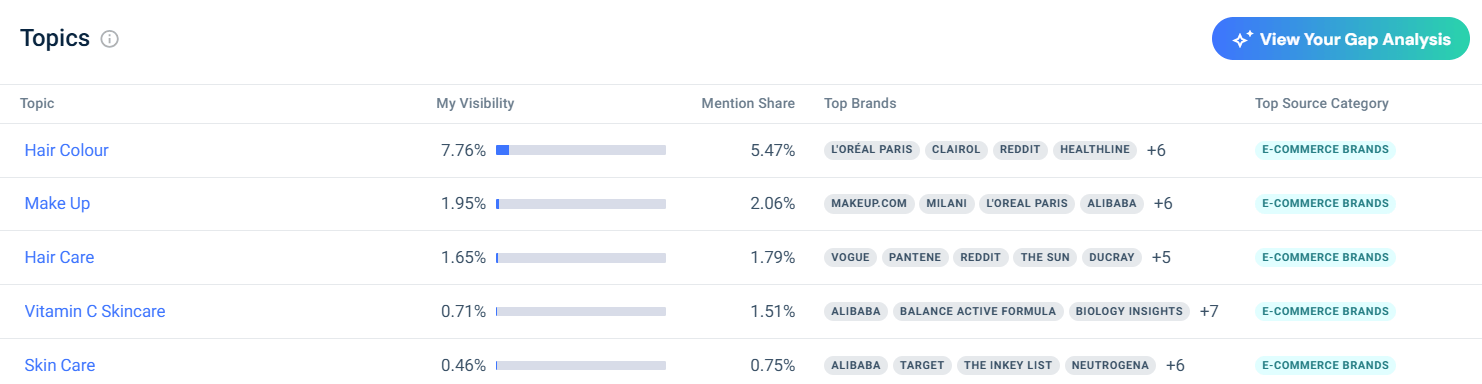
This view gave me a prioritized list of where to focus. I’m not trying to fight every gap at once. I’m looking for two things: topics where the brand has some presence (worth defending and growing) and topics where the brand has near-zero presence, but the category matters commercially (the biggest opportunities). For this brand, Make Up is one of the topics that jumped out immediately: barely any visibility, commercially important, and competitors already established.
Step 2: Check sentiment scores by topic and competitor
Before diving into individual prompts, I checked the Sentiment Score Comparison view in the AI Sentiment Analysis tool, and cross-referenced two things: where the brand has visibility and where it has sentiment. Since they don’t always move together, the gap between them tells you different things.
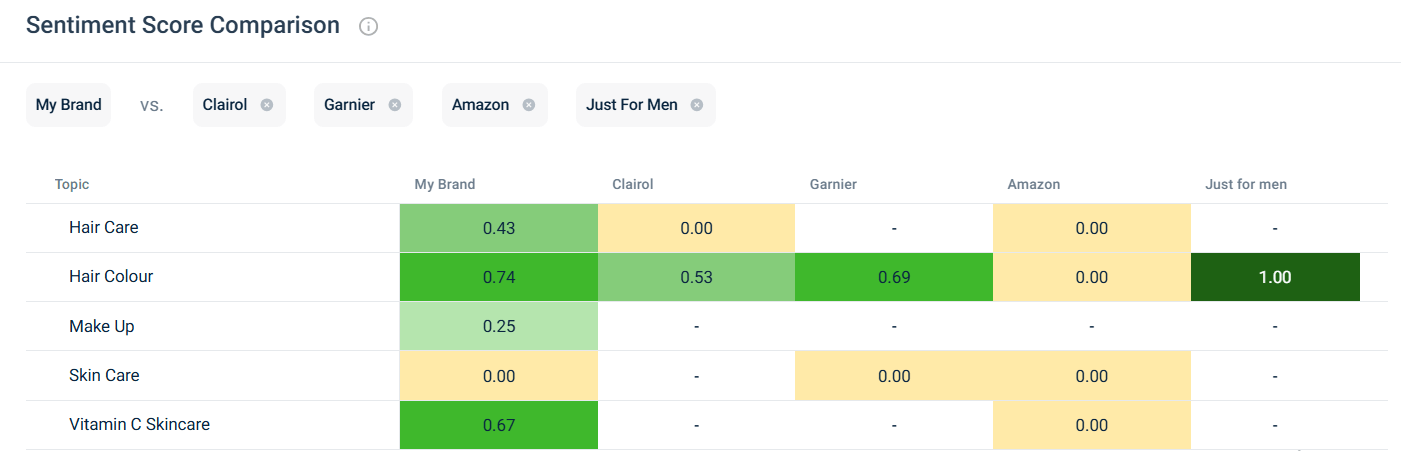
Looking at the data, I can spot three distinct patterns:
High visibility, strong sentiment: Hair Colour is where the brand is performing best: 7.76% visibility from Step 1, and a sentiment score of 0.74 here. That’s a topic worth protecting.
Present but scoring zero: Skin Care shows a 0.00 sentiment score for the brand, the same as Amazon and Garnier where they appear. Zero sentiment doesn’t necessarily mean negative, it means AI is not generating enough confident, positive associations to score above neutral.
This is a different type of gap: content may exist, but it’s not structured clearly enough for AI to extract a recommendation from it.
Low visibility, low or zero sentiment: Make Up sits at just 1.95% visibility and a sentiment score of 0.25. More importantly, none of the four competitors has any sentiment data on Make Up at all, the column is blank across the board. That tells me AI doesn’t have a strong content base to draw from for any brand in the Make Up topic.
That’s actually an opportunity: the space is open, and the first brand to build real content authority here has a clear path to owning it in AI answers.
Step 3: Filter prompts by “not mentioned” to find the real gaps
Now I go granular. I opened the AI Prompt Analysis tool and filtered by “Not Mentioned” under the Sentiment Status filter. This showed me every prompt where AI answered without naming the brand at all.
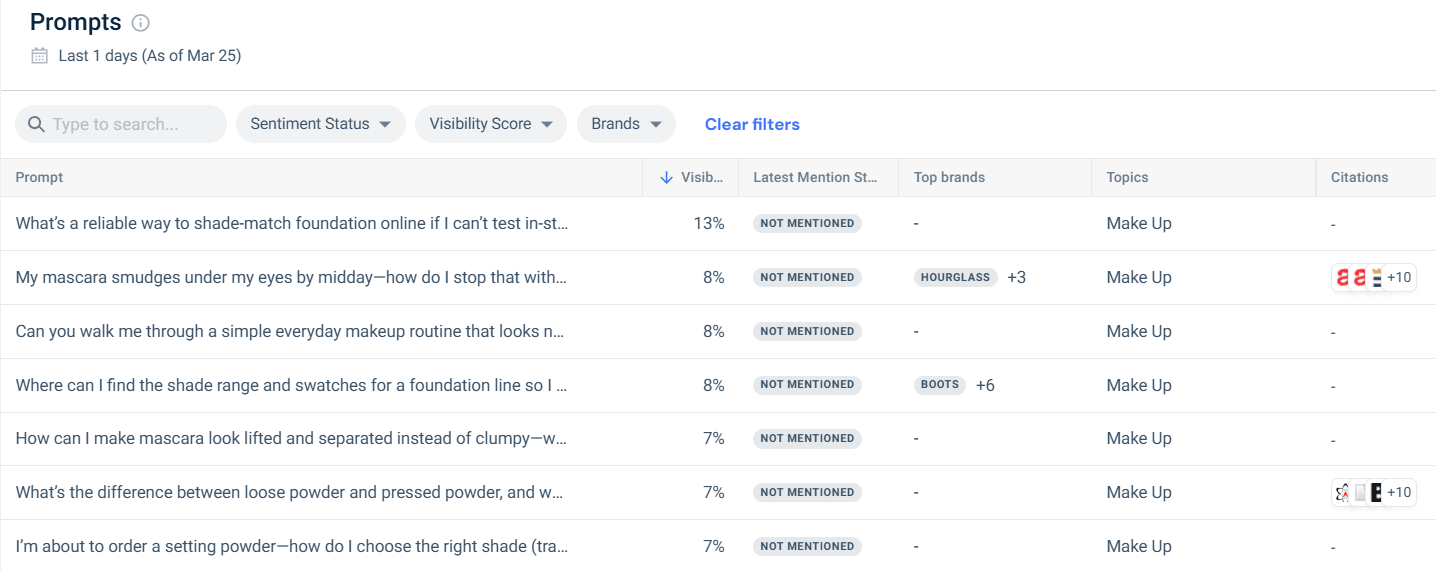
Looking at the Make Up topic prompts, I found that these are not niche queries. Shade matching, mascara longevity, foundation swatches, and everyday routines – these are the exact questions a beauty brand’s target customer is asking AI before making a purchase. And the brand isn’t showing up for any of them.
What this tells me is that it’s not a positioning or a sentiment issue, it’s a content existence problem. AI has no material to pull from. There’s no owned content answering these questions, no third-party editorial coverage naming the brand in this context, nothing for the AI to cite. The Make Up topic is essentially a blank slate for this brand, which is both the biggest gap and the clearest content opportunity in the entire analysis.
Step 4: Check “neutral” sentiment and find where competitors are positive and you’re not
When I filtered by Neutral, I found that across Hair Colour, Hair Care, and Skin Care, competing brands are getting named while the brand is present but not positively framed.
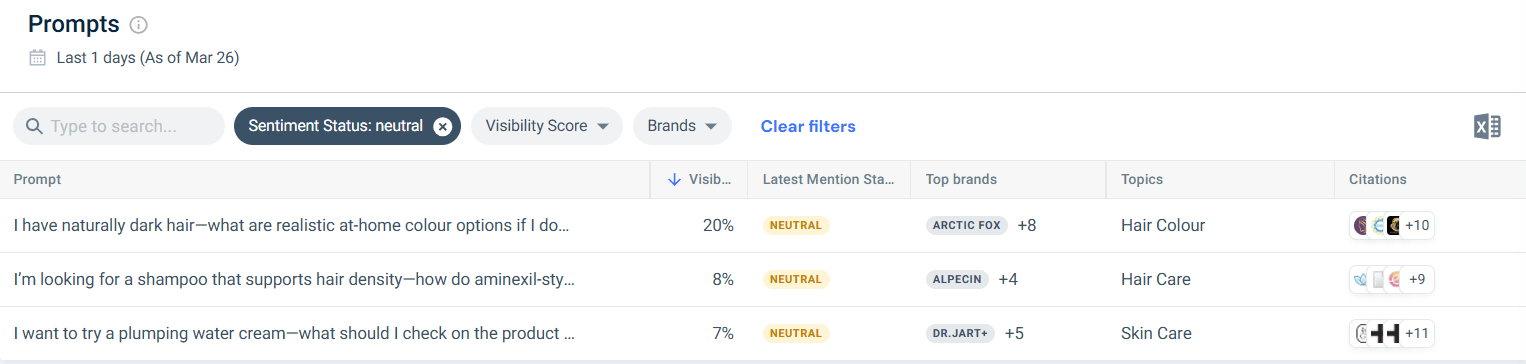
The fix here isn’t creating new content. It’s going back to the existing content covering these topics and making it more explicit: clearer use cases, more specific benefits, more direct answers to the exact questions being asked. AI needs clean, confident signals to generate a positive mention, vague or generic content won’t get there.
Take the prompt “I have naturally dark hair – what are realistic at-home colour options if I don’t want to use bleach?” as an example. The brand blog post on How to Dye Your Hair a Natural Colour at Home is the closest match on the site, but it’s structured as a general how-to guide covering preparation, application steps, and aftercare.
What the post is missing is a clear, upfront statement that directly addresses dark-haired users who want colour without bleach: which formula types work, what results they can realistically expect, and which specific shades are designed for their starting point. Adding a dedicated section, or even a short paragraph near the top, that says “If you have dark hair and want to avoid bleach, here are your realistic options and what each one delivers” would give AI a clean, extractable answer. That’s what moves the needle from Neutral to Positive: not a rewrite, just a direct answer placed where AI can find it.
Step 5: Find citation source gaps to see which domains are influencing your competitors’ mentions
The last layer I checked is citations. I looked at the Citations column in the Prompt Analysis view and identified which domains are being cited in the AI answers that do mention competitors.
The logic here is simple: AI doesn’t invent brand recommendations. It cites sources. If a competitor’s brand is being mentioned on a high-visibility prompt, something is being cited, a review article, a comparison roundup, a product guide, or a Reddit thread. If that same citation source has covered the competitor but not my brand, that’s a citation gap I can close.
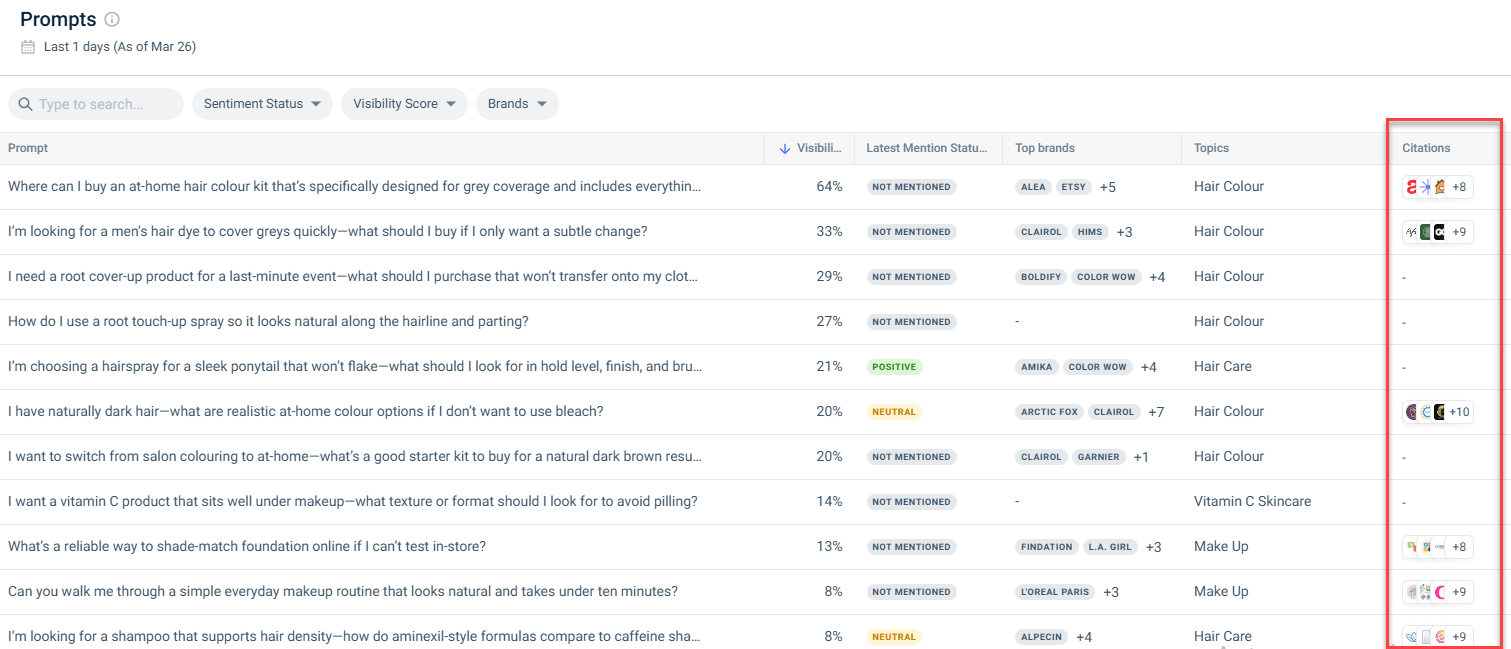
What stood out is the prompts with no citations at all, like the root cover-up and root touch-up spray queries, are also the ones with no top brands surfaced. That suggests AI lacks strong source material on those topics, which presents an open opportunity.
For prompts where citations exist and competitors are named, those citation sources are the outreach list. I clicked on the prompt to see the exact pages AI is pulling from, and found 12 citation sources.
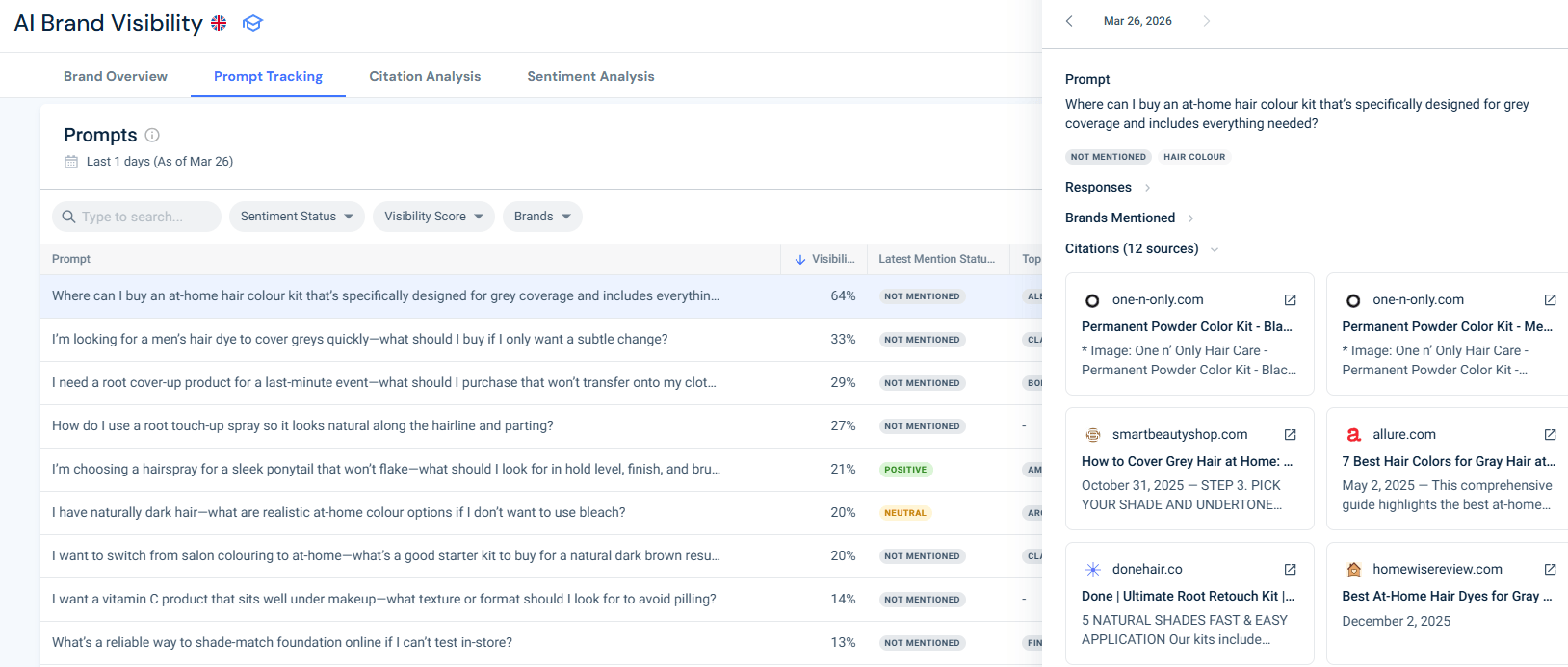
Looking at that mix, product pages, how-to guides, and best-of roundups, it’s clear that showing up in one place isn’t going to be enough.
To close this gap, the brand needs coverage across all three content types. Getting featured in the Allure roundup matters, but so does being mentioned in a practical how-to guide and having a strong product page that AI can reference. All three are working together here, and the brand is missing from all of them.
Closing the gaps: What to do with the data
After running through all five steps, I compile everything into a visibility gap list, a prioritized action plan based on what the data actually showed.
| Gap type | Topic | What I found | Action |
| Content existence gap | Make Up | Brand absent from every prompt, no owned content, no third-party coverage | Create content targeting the specific prompts identified: shade matching, everyday routines, mascara longevity, foundation swatches |
| Sentiment gap | Hair Colour, Hair Care, Skin Care | Brand present but not positively framed, while competitors score positive on the same prompts | Rewrite existing content to be more specific, clearer use cases, more direct answers, more explicit benefits |
| Zero sentiment gap | Skin Care | Brand scoring 0.00 sentiment, content exists but too vague for AI to extract a recommendation | Restructure existing pages to lead with explicit claims and outcomes |
| Citation gap | Hair Colour | 12 citation sources driving competitor mentions on the grey coverage prompt, brand missing from all of them | Pitch for inclusion in Allure roundup, smartbeautyshop.com guide, and homewisereview.com review article |
| Open opportunity | Hair Colour | Root cover-up and root touch-up prompts have no citations and no top brands surfaced for anyone | First to publish authoritative content here owns the space |
This list becomes the brief for the content and PR teams. Each row includes a gap type, a finding grounded in the tool’s data, and a specific action. Nothing on this list is a guess. Everything comes directly from what our AI Brand Visibility tool surfaced.
I also built a free template you can use to run this process for your own brand. Download and copy the AI Visibility Gap Tracker. It includes the full gap log, an action checklist by gap type, and a priority matrix so your team knows what to fix first.
Final thoughts
Most brands know where they rank in search. Very few know where they stand in AI. Those are two different questions, and in 2026, the second one matters more at the top of the funnel.
The process I walked through here, starting with topics, layering in sentiment, going prompt-level to find where you’re absent, and tracing the citation sources behind competitor brand mentions, gives you a clear picture of exactly where those gaps are and what’s causing each one. Every step produces a specific action, not just a diagnosis.
The brands doing this now are building AI authority that compounds. The ones that aren’t are letting competitors claim it by default.
FAQs
What is an AI visibility gap?
An AI visibility gap is any topic, prompt, or context where competing brands appear in AI-generated answers but yours does not. Unlike a search visibility gap, where you rank lower than a competitor, an AI visibility gap means you’re completely absent. The user never sees your brand, and there’s no trace of it in your analytics.
How is an AI visibility gap different from a search visibility gap?
A search visibility gap means you’re ranking lower than a competitor on a search results page. An AI visibility gap means you’re not mentioned at all when AI synthesizes an answer. There’s no position two in an AI answer, being absent is total absence, not just lower visibility.
What are the different types of AI visibility gaps?
There are four main types: topic gaps (your brand has near-zero presence in a whole category), prompt-level gaps (you’re absent from specific high-value questions), sentiment gaps (you’re mentioned but not positively, while competitors are), and citation gaps (the third-party sources AI relies on don’t include your brand).
How do I know which AI visibility gaps to fix first?
Start with the Visibility Score in Similarweb’s AI Prompt Analysis tool, higher scores mean the prompt is asked frequently and answered confidently by AI. Then layer in commercial intent. Topic presence gaps in categories that matter to your business, like a beauty brand with zero Make Up visibility, usually take priority over sentiment refinements.
What causes a brand to score zero on AI sentiment?
A zero sentiment score usually means AI is either not mentioning the brand at all, or mentioning it without generating a confident positive association. The most common cause is content that’s too vague or generic, AI can’t extract a clear recommendation from it. The fix is restructuring existing content to lead with explicit claims, specific use cases, and direct outcomes.
What is a citation gap and how do I close it?
A citation gap is when the sources AI relies on to answer a prompt mention competitors but not your brand. To close it, click into the prompt in Similarweb’s AI Brand Visibility tool to see exactly which pages are being cited. Those pages, editorial roundups, how-to guides, product comparison articles, become your outreach list. Getting included on those specific pages is what moves the needle, not more content on your own site.
Does improving AI visibility also help my SEO performance?
Often yes. The content improvements that earn AI citations, structured, specific, use-case-led content on third-party authority sites, also tend to strengthen traditional organic rankings. The overlap is especially strong for informational and comparison queries where AI Overviews and generative AI engines pull from the same sources.
How often should I run an AI visibility gap analysis?
I run a prompt-level gap review monthly and a full topic-level audit quarterly. The AI landscape shifts quickly, citation sources change, new competitors build authority, and AI platforms update how they surface brands. A monthly check keeps you close enough to the data to act before gaps widen.

Related Posts



Why AI Engines Cite UGC Over Brand Content And How To Leverage It For AEO

AI Mentions vs. AI Citations: What’s the Difference and Why It Matters for GEO


Wondering what Similarweb can do for your business?
Give it a try or talk to our insights team — don’t worry, it’s free!