





Top Ecommerce Companies in the USA: The 100 Brands Winning the Traffic Race in 2026
by Inbar Eytan6 Min.
Aug 30, 2026
 Marketing Intelligence
A backlink is a link from another website to yours. That’s the whole definition. What makes backlinks worth an entire industry’s attention is what they signal: when a site links to you, it’s casting a small vote of confidence, and search engines (and increasingly, AI systems) read those votes as evidence that your content is worth trusting.
Here’s a real backlink in the wild: Entrepreneur linking out to Mashable within an article. Google sees that link, follows it, and factors it into how it evaluates Mashable’s page.
Backlinks have been at the heart of ranking in Google since PageRank first shipped in the late 1990s, and nearly three decades later, the core mechanic hasn’t changed: sites that earn links from trustworthy, relevant sources tend to outrank sites that don’t. What has changed is the landscape around them, rising costs, a harder line on quality over quantity, and a second audience (AI search engines) now reading link signals in their own way.
This guide covers what backlinks are, why they still matter, what separates a good one from a wasted one, and how to build them in 2026.
Google and other search engines treat links from trustworthy sites as recommendations. The more high-quality backlinks a site earns, the more search engines tend to view it as trustworthy and relevant, and the more likely it is to rank for the queries that content answers.
Backlinks aren’t just a ranking lever. If the site linking to you is topically relevant, its readers are already primed to be interested in your content, which means backlinks can drive some of the highest-intent referral traffic you’ll get.
Not all links are created equal in the SEO world, some pass link equity, and some don’t:
Both link types have their place. Dofollow links build authority; nofollow links, common on social platforms, forums, and press releases, still make your content more discoverable and send real traffic. A healthy backlink profile typically includes a mix of both rather than an artificially clean 100% dofollow ratio, which can actually look unnatural to search engines.
No one outside Google’s core ranking team knows the exact weight assigned to any given link. But the industry agrees on the factors that consistently separate a valuable backlink from a wasted one.
A link earned from a page that’s topically relevant to yours passes far more value than one from an unrelated page. Here’s a clear example: if a marketing agency in London writes an article on buyer personas and links out to a fast-food restaurant in Singapore, it’s obvious to any algorithm that the link is irrelevant and will pass on very little, if any, equity.
Links from authoritative pages carry more weight than links from weak or low-traffic ones. This matters because traffic and trust don’t always move together, a page can be popular without being the kind of source other sites should cite. Authority is also one of the clearest ways backlinks feed into E-E-A-T, Google’s framework for judging content quality. A page that earns links from established, topically relevant sources is effectively getting third-party validation of its expertise and trustworthiness, which is exactly what E-E-A-T is designed to measure.
Anchor text is the clickable text of a link, and it’s one of the strongest relevance signals available to a crawler. When Google finds a link, it uses the anchor text to judge whether the destination is relevant to the topic at hand. “Click here” tells a search engine nothing. Anchor text that reflects the linked page’s actual topic, without being stuffed or exact-matched on every single link, tells it a lot. Overusing identical, keyword-rich anchor text across many links is itself a red flag Google’s spam systems are built to catch.
This is the question that’s reshaped link building more than anything else in the past two years, and the honest answer is: yes, but they’re no longer the whole story.
AI Overviews, along with tools like ChatGPT, Perplexity, and Gemini, don’t rank pages as traditional search does. Instead, they look for signals of credibility and consistent citation across the web. A strong link profile helps, but it isn’t the main driver of whether a brand gets mentioned in AI-generated answers.
That doesn’t mean backlinks are irrelevant to AI visibility, it means their role has shifted. Instead of functioning purely as ranking currency, backlinks now double as one input into a broader trust and reputation signal, one that AI systems weigh alongside how often a source gets referenced across the wider web.
The takeaway for anyone building a link strategy in 2026: keep earning backlinks for their proven ranking value, but pair every piece of linkable content with the kind of citable, data-backed substance that gets you mentioned, linked or not, across the web your future customers (and their AI assistants) are reading.
Auditing your backlinks regularly surfaces SEO opportunities you might not know existed, and catches problems before they cost you rankings. Here’s how to do it, using Similarweb’s Backlink Analysis Tool part of the SEO toolset as the example tool (we’ll use netflix.com to show what the data actually looks like).
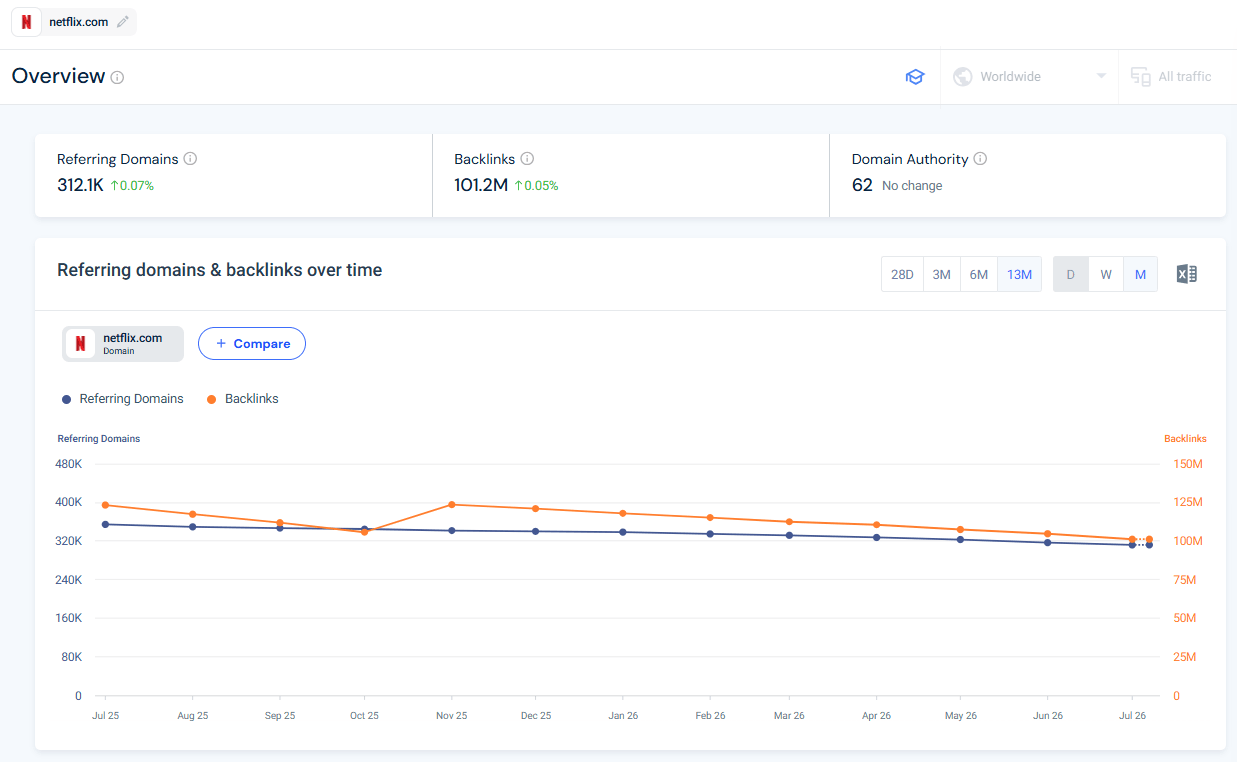
On the surface, the topline numbers look strong: 312.1K referring domains, 101.2M backlinks, and a Domain Authority of 62. But the 13-month trend tells a different story than the snapshot, both referring domains and backlinks have been declining steadily since mid-2025. That’s a slow, quiet erosion happening underneath an otherwise-solid Domain Authority score, and it’s the kind of thing a one-time check would miss entirely. Even a dominant global brand can’t assume its link profile is growing by default.
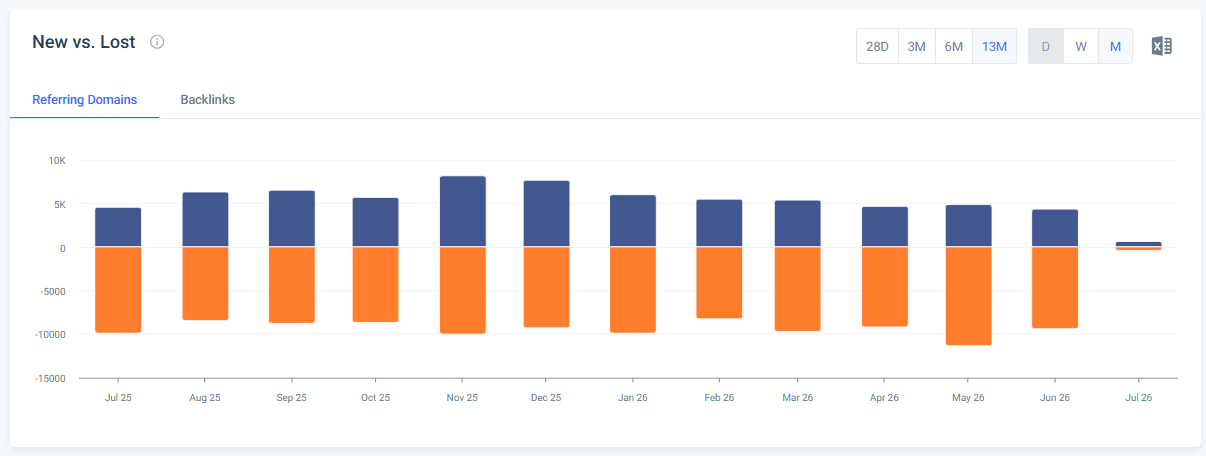
The month-over-month view confirms what the trend line suggests: referring domains lost have consistently outpaced referring domains gained, every single month in the period analyzed. A declining topline number isn’t a plateau, it’s a sustained net loss, and it would be easy to miss if you only ever checked the Overview snapshot instead of the gained-vs-lost breakdown underneath it.
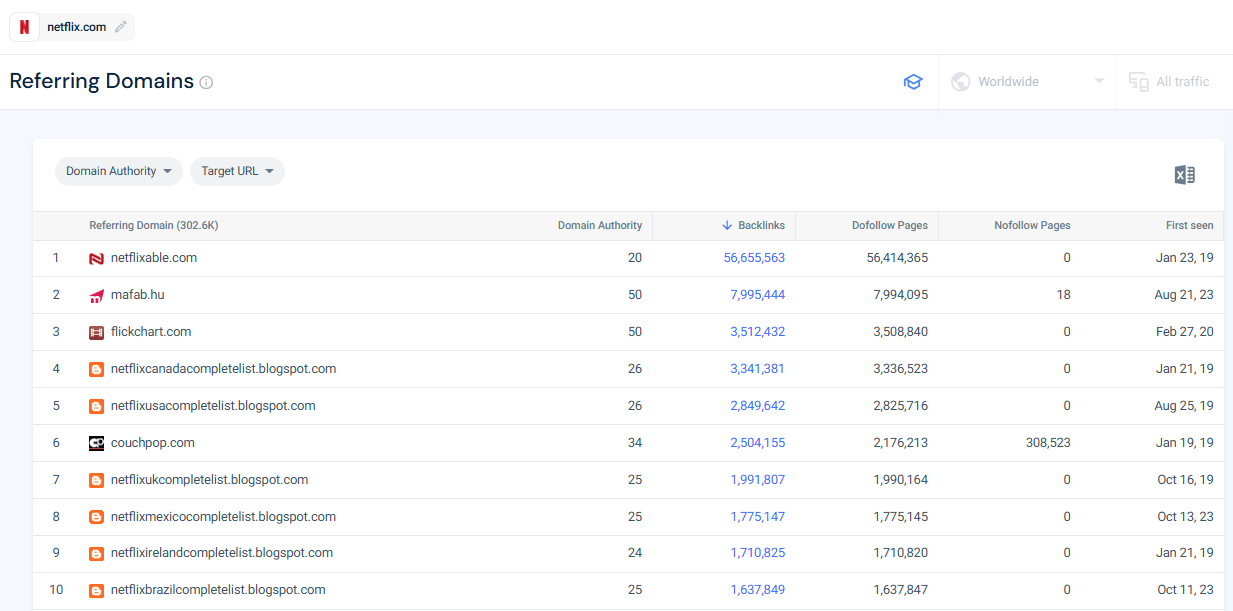
Digging into which domains make up that backlink count explains a lot of the volume. A meaningful share of Netflix’s top referring domains by raw backlink count aren’t editorial mentions at all, they’re piracy-adjacent “complete list” blogspot sites and scraper domains, one of which alone accounts for over 56 million backlinks from a domain with an authority score of just 20. That’s volume without value: links that inflate the total count without doing any real authority-building work. The domains actually worth paying attention to, moderate-authority, topically relevant sites, sit much further down the list by volume, buried under the noise.
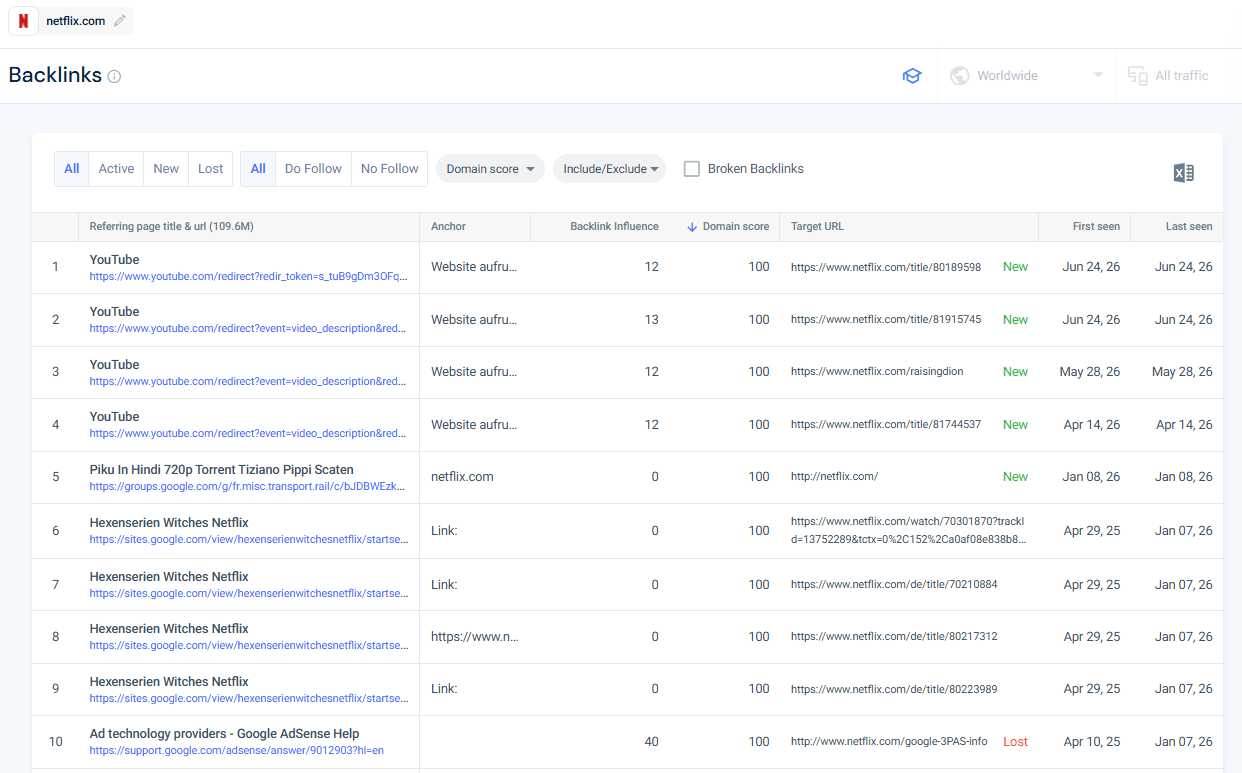
The individual-link data makes the same point even more sharply. Several links pointing to netflix.com carry a maximum domain score but essentially zero backlink influence, a mismatch that shows up when the linking page (a torrent listing, an unrelated fan site) has nothing to do with the content it’s linking to. Meanwhile, one lost link, from Google’s own AdSense help documentation, and a genuinely influential one, disappeared entirely during the period analyzed. That’s exactly the kind of loss worth catching and, where possible, replacing, and it’s invisible if you’re only looking at aggregate counts.
The lesson generalizes well past Netflix: a large raw backlink count and a solid Domain Authority score can both mask a profile that’s quietly shrinking or padded with low-value links. Checking the trend rather than the snapshot, separating high-influence links from high-volume noise, and tracking what’s been lost, not just what’s been gained, is what turns a backlink report into an actual audit.
The tactics that work in 2026 look different from a decade ago. Here are the top 5 tips for your new backlink strategy.
Original research, proprietary data, and well-designed studies remain the most reliable way to earn links passively. If you have first-party data, customer behavior, industry benchmarks, survey results, packaging it as a standalone report gives journalists and bloggers a reason to link to you without any outreach at all.
Digital PR means proactively pitching your original data, expert commentary, or newsworthy angle to journalists and publications, rather than offering to write content for their blog. It converts at a lower volume than guest posting but earns higher-authority, more durable links per placement.
Find dead or redirected links on relevant sites, tools like Check My Links (a free Chrome extension) will flag them instantly, and reach out to suggest your content as the replacement. It’s a genuine favor to the site owner, which is exactly why it still works.
If your brand, product, or research is mentioned online without a link back to you, that’s the easiest “backlink” you’ll ever earn. A short, polite note asking the author to add a link usually gets a yes, since they’ve already decided you’re worth mentioning.
Guest blogging still works, but standards have risen. Pitch sites your actual audience reads, insist on a contextual link within the body (not just an author-bio link), and treat it as one tactic in a broader mix rather than your entire strategy.
Whatever mix you choose, prioritize quality and relevance over volume. A single link from a page that’s genuinely relevant to your topic and trusted in your niche will do more for your rankings, and now, your AI visibility, than a dozen links from unrelated, low-authority pages.
Backlinks haven’t stopped mattering, the data on rankings is as clear in 2026 as it’s ever been. What’s changed is that they’re no longer the only signal worth optimizing for. Google still rewards relevant, authoritative links the way it has for decades, while AI search engines are increasingly rewarding something adjacent: being mentioned, cited, and named across the web, with or without a link attached.
The practical move is to stop treating these as separate projects. Audit your existing backlink profile regularly, keep building the kind of relevant, authoritative links that move rankings, and pair that work with the citable, data-backed content that earns you mentions whether or not anyone links to it. Do both, and you’re covered no matter which search engine, human-run or AI-run, your next customer happens to be using.
How many backlinks do I need to rank in Google?
There’s no fixed number. What matters more than raw count is the number of unique referring domains and how relevant and authoritative they are. A page with a handful of highly relevant, authoritative links can outrank a page with hundreds of weak ones.
Are nofollow backlinks worth pursuing?
Yes. Since Google treats nofollow as a hint rather than a directive, nofollow links can still carry some ranking value, and research shows they perform nearly as well as dofollow links for AI search visibility. They also drive real referral traffic on their own.
Do backlinks still matter for AI search results like Google AI Overviews and ChatGPT?
They still play a role, but branded mentions, being named and cited across the web, linked or not, are now a stronger predictor of AI visibility than backlinks alone. The strongest 2026 strategy builds both at once: earn links for rankings, and earn citable, data-backed mentions for AI visibility.
What’s the fastest way to get backlinks for a new site with no authority yet?
Reclaiming unlinked brand mentions and broken-link outreach tend to convert fastest, since you’re offering the site owner something they already need. Digital PR and original research take longer to produce but earn higher-authority links once they land.
How can I check who’s linking to my competitors?
A backlink analysis tool will show you a competitor’s full referring domain list. Cross-reference it against your own to find sites that link to them but not to you, each one is a qualified outreach target since it’s already proven willing to link to businesses like yours.
How often should I audit my backlink profile?
Quarterly is a reasonable baseline for most sites, though sites in competitive or fast-moving niches benefit from monthly checks. The goal is catching link decay and toxic links early, before they quietly cost you rankings.

Senior SEO Specialist at Similarweb
Maayan is a senior SEO specialist with 7+ years of experience in SEO. She loves complex research projects, creating SEO strategies and performing technical audits.
Top Ecommerce Companies in the USA: The 100 Brands Winning the Traffic Race in 2026

3 of the Sharpest Minds Weigh in on the State of Gen AI in 2026

Give it a try or talk to our marketing team - it’s free!
