





Top Ecommerce Companies in the USA: The 100 Brands Winning the Traffic Race in 2026
by Inbar Eytan6 Min.
Aug 30, 2026

Wanna know something wild? Whether you said yes or no, you’re about to anyway.
The average person sees up to 10,000 ads every single day. And that’s a lot of competition for your sales email, ad campaign, or content.
In the age of information overload, account-based marketing (ABM) is one of the most effective strategies for reaching and converting high-value accounts and boosting marketing ROI.
You want to know more, right? That’s why we thought, “Why not have a whole guide on account-based marketing?” for you to enjoy, so you can develop and implement your own ABM strategy.
Account-based marketing (ABM) is a B2B sales and marketing strategy using the power of personalization to win high-value clients within a target set of accounts.
With an ABM strategy, your sales and marketing team will work together to form a list of key accounts, get their attention, nurture each lead, and convert them into loyal customers using research and relationship-building.
There are two main types of account-based marketing, and those are:
If you’re in marketing (or know about it), you might have heard of “one to many”. This type of marketing is more of a one-size-fits-all approach, taking away the personalization that ABM is so well-known for.
By approaching prospects with a one-to-one or one-to-few method, you allow for more time to research, understand pain points, and adapt your outreach campaigns to:
And that, my friends, is the beauty of account-based marketing. Time and effort put towards custom campaigns to really boost your engagement and customer relationships.
Account-based marketing or ABM comes in all shapes and sizes, with lots of different types of content and approaches for outreach.
But any successful ABM strategy has to be made up of these three components:
The primary trait of account-based marketing is that it’s extremely targeted. You only go after accounts that you or your marketing team have determined will generate high ROI and lend specific strategic value to your book of business.
The ‘omnichannel’ imperative isn’t exactly anything new, but it’s very important to ABM. We’ll look into some of the different channels and platforms in the next section. Your ultimate goal? To run coordinated, highly-tailored campaigns across these channels to maximize user engagement.
Along with everything in marketing, monitoring KPIs is integral to ABM. By keeping tabs on metrics, like spend, campaign runtime, conversion rate, and deal value, you gain important insights on how to optimize your campaigns and their performance so you can improve results every time.
Now, what content do you need for ABM? (We told you we’d come back to it).
ABM content can vary from campaign to campaign and prospect to prospect. You’ve got to give the people what they want, after all.
Here are just a few examples:
And you know what? It doesn’t have to be just one of these methods. You can pick and choose a selection, or even all of them, to create the best-fitting campaign for your prospect.
So, why is account-based marketing so popular with growing businesses? With at least 67% of brands using ABM, it has to be doing something right, doesn’t it?
Well, we’ve got 6 reasons right here:
First up, with an ABM strategy, you’re utilizing your resources in the most efficient way possible. That includes your staff, your time, and your budget.
Let’s look into this a bit more.
With a more targeted approach from beginning to end, you’ll find fewer resources and hours are wasted. You know who you’re targeting, you know they’re right for you, and you know your product or solution is right for them. So, any time put into researching and developing a marketing campaign specifically for them should be considered productive. Why? Because it gets you closer to closing that deal.
Another benefit of account-based marketing is the necessary alignment between marketing and sales. With more alignment, improved communication between the two branches, and slicker processes as a result.
Can’t complain about that, can you?
This synchronization of marketing and sales creates quite the dynamic duo, making sure both departments’ messaging, targets, and goals are in keeping with each other. That’s great news internally as a company, but also externally, creating a flawless customer experience.
When there’s a lack of continuity in your messaging or how your company communicates, that can be pretty jarring, whereas consistency will strengthen your brand and authority in the eyes of the prospect.
Good news for the sales reps out there. When using account-based marketing, it means less time cold calling or writing cold sales emails, and more time spent with prospects that will definitely have an interest in your product or solution.
With outreach that is customized for a lead, you’re one step ahead in terms of engagement. Now you’ve just got to go in for your killer sales pitch, loaded with relevant data and insights to help them overcome any pain points – and get them to sign.
Okay, so we already kind of said this one, but we mean it: ABM boosts your engagement rates. It’s guaranteed.
In fact, 30% of marketers who use an account-based marketing strategy reported engaging twice as frequently with their C-level targets.
Get your prospecting right, and you’ll see a much improved customer acquisition thanks to your personalization and nurturing of key customers and prospects that you know work for you, and higher revenue per deal.
Let’s be honest, we know who would win a hypothetical fight between a personal approach versus a blanket approach.
The personal approach, of course, because everyone loves to feel special.
Taking the time to tailor your ABM campaign to a specific prospect will not only make them feel special but also resonate with them, whether it’s one specific contact or multiple within an account. It shows the prospect that you care (and that you know they’d be a good fit for your product), giving a better and more trustworthy representation of you as a salesperson, and of your company.
A blanket approach, on the other hand, will just make your outreach like any other generic sales email: deletable. ❌
Account-based marketing provides the highest level of ROI among B2B sales and marketing tactics, because it decreases any waste and risk that can be involved in other strategies.
We already mentioned in the three main components that tracking is key to any campaign, to optimize the campaign and maximize revenue. To help make sure you’re covering all ground, we’ve put together the main ABM metrics you need to be tracking. Check it out.
With ABM boasting pretty amazing success rates, it’s easy to see why it’s so popular with marketers. In fact, more than three-quarters of markets (87%) say that account-based marketing outperforms other marketing activities, 86% say it boosts win rates, and 80% say it increases lifetime customer value (LTCV).
With the main aim of ABM being to target (and win) big strategic deals, it can be a real winner for those moving upmarket or adopting a hybrid GTM strategy. It can also work well for smaller businesses willing to spend their time and money on a longer and probably more expensive sales cycle, for the potential of a higher ROI.
With benefits like those, you could say ABM is a good idea for most companies. But really, businesses that do adopt this strategy require a potentially larger, dedicated marketing and sales team to move forward with it successfully, as well as the relevant data to maintain such a strategy.
When it comes to adopting ABM, take these 6 key steps to create a strong foundation for your business’s go-to-market strategy:
Marketing and sales teams, assemble.
We’ve said it once, and we’ll say it again: the alignment of these two teams is crucial.
Some companies will have the headcount to establish teams that work exclusively on their ABM activities, some will employ a blended approach where certain sales reps and marketers split their time between ABM and regular marketing and sales efforts, and some will outsource it.
Whatever approach you go for, you need a blend of experienced sales reps, well-versed on your prospects’ needs and business objectives, along with a marketing team working on different channels and platforms, as well as marketing ops.
Since ABM is a highly strategic method, it aims to involve individuals who are strategic thinkers, creative, and performance-driven.
Right then. You’ve got your team, now it’s time to determine who your prospects are. In the case of account-based marketing, this will be identifying the highest-value accounts that fit with your ideal customer profile. Think about factors like product fit, sales funnel length, strategic value, competitors, and territory.
Not sure where to start with that? Head to our guide to ideal customer profiles (including an ICP template).
With the right tools, it’s possible to pinpoint your ideal prospects with unmatched precision. Similarweb Sales Intelligence is just one example of that, and with it, you can sell smarter in a number of ways, including:
What makes ABM so unique is that it gives you the opportunity to specifically nurture the primary decision maker in your target account.
Oh, and that’s just another thing Similarweb Sales Intelligence can help you with.
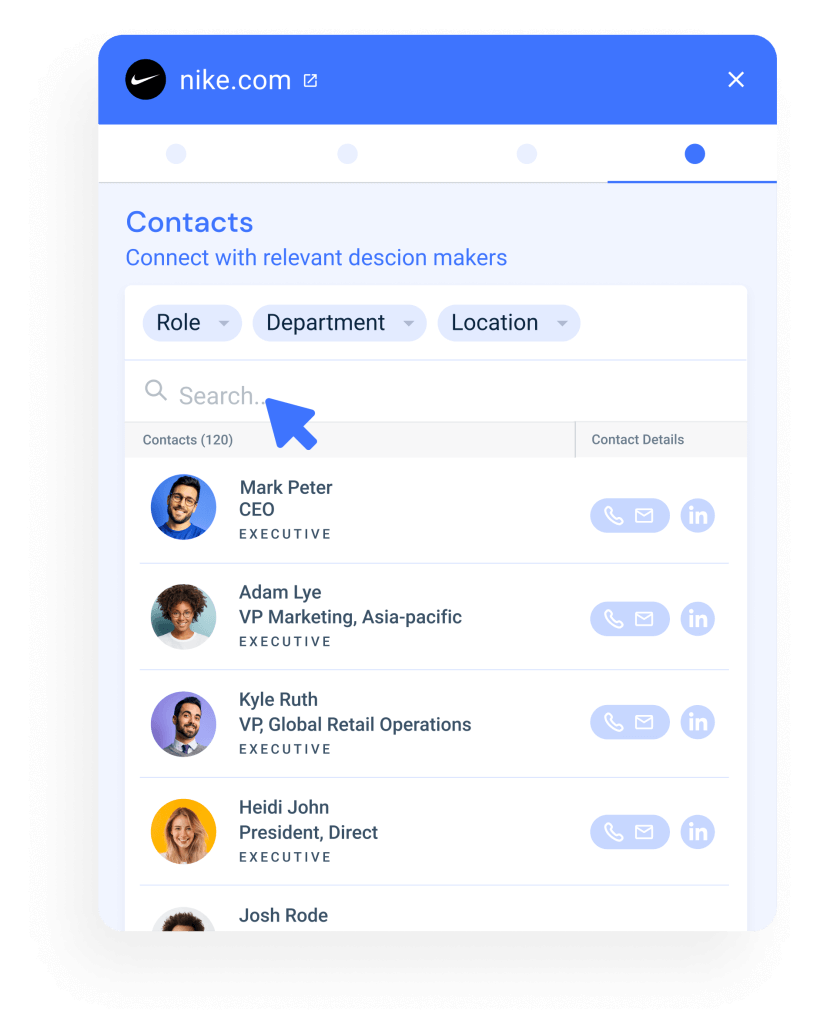
After creating a list of companies that meet your specifications with our extensive filters, you can click on the Contacts tab for direct access to your prospect’s contact information – whether you’re after a singular contact or multiple contacts within an account. And you can download it straight to your Salesforce or Hubspot, or get them all on an Excel spreadsheet.
Yep, all that in a couple of clicks.
When approaching a specific account, it’s important to put time and effort into creating relevant content that provides value to your prospect.
Now that you understand exactly who you’re targeting, including their goals, pain points, challenges, and needs, you should have a better idea of what your content should focus on.
We’ve already established that a cross-channel approach is fundamental to ABM, but through your research, you’ll find that decision-makers in different positions will favor some channels over others.
For example, high-level executives might be more inclined to engage with email newsletters, which deliver concise and valuable content straight to their inbox. They might also be more likely to interact with LinkedIn ads, compared to ads on any other social media platform. On the other hand, a mid-level manager might have more time to attend webinars or events, where they can get insightful tips to put into practice among their teams.
Whatever channels you choose, you’ve got to keep it relevant.
When you’re ready to launch your campaigns, make sure marketing and sales stakeholders are totally aligned on elements like key messaging in your campaigns, the channels being used, and when sales will begin reaching out to prospects.
Marketing and sales activities supplement one another in an ABM strategy, which means making sure your campaigns are highly coordinated from beginning to end is essential.
Marketing + sales. Name a more iconic duo.
Hot tip: always be monitoring key metrics throughout each of your ABM campaigns. This will help you assess progress and performance, informing both marketing and sales where they can optimize their efforts.
Some of the most important ABM metrics and KPIs for you to focus on include:
Track, adapt, and optimize as you go to improve the relevance of your product or solution in the eyes of your prospect… and for maximum impact.
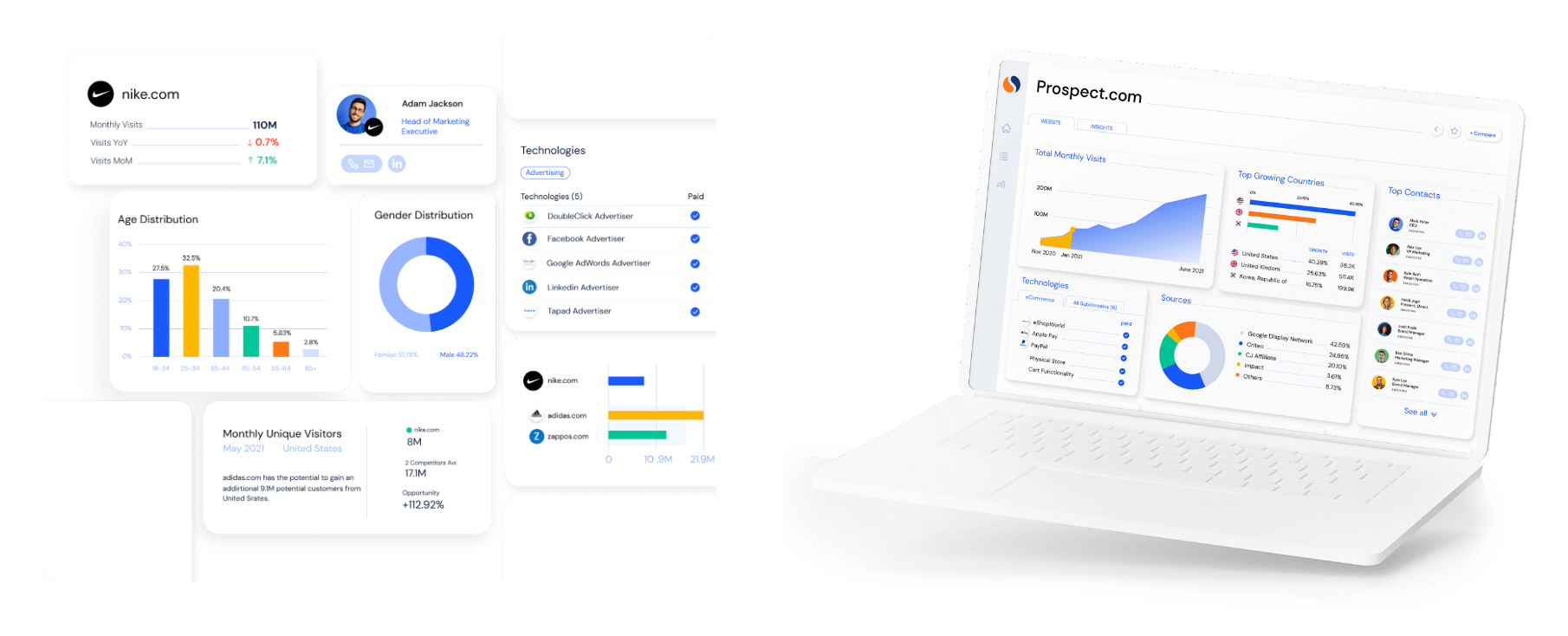
You can also use the Insights Generator and Account Review features to identify key insights about your prospects, which will give your ABM campaigns and sales outreach a major leg up. With detailed and specific insights that provide your prospects value, it’s much easier to capture their attention and keep them engaged throughout the sales funnel.
There are a bunch of B2B account-based marketing tactics to use in your strategy. Here are a few common ones:
How about a couple of account-based marketing examples for some inspo and insight into what ABM in action looks like? You got it.
You’ve just generated a strong list of high-value accounts with Similarweb Sales Intelligence, identified several key pain points that many of them have in common via the Insights Generator. With this information, you can develop a new campaign that includes:
After creating your list of strategic accounts and uncovering insights about their needs, identify individual contacts within each target company. From there, you:
By employing account-based marketing, you’ll reap the benefits that we’ve already mentioned, including the big one that will make you and your team’s eyes light up: a higher ROI.
A carefully planned sales strategy, the right ABM tools, and buy-in from all of the relevant stakeholders are what will get you there.
So, here’s another shameless plug for the unmissable features of Similarweb Sales Intelligence. Well, unmissable if you want to sell smarter, anyway…
Find out more about how Sales Intelligence can work for your ABM efforts and your business as a whole by booking a demo today.
If you’re keen to find out more about account-based marketing, here’s a little reading list for you to peruse in your own time. Hint: they might just help you boost that ABM strategy of yours.
What is account-based marketing?
ABM is a type of B2B marketing that aligns marketing and sales to target, engage, groom, and convert specific high-value accounts.
How does ABM work?
It starts with determining prospects with the biggest revenue potential, identifying specific decision makers to target, locating their contact information, and then launching marketing campaigns that are tailored to them.
What are the three key components of ABM?
The three main components of account-based marketing are targeting strategic accounts, executing campaigns across various channels that are relevant to each and every one of your prospects, and monitoring each campaign’s performance as you go so you can optimize where needed.

Senior Content Marketing Manager
Leah is a Senior Content Marketing Manager with a passion for turning complex topics into engaging, educational content.
Top Ecommerce Companies in the USA: The 100 Brands Winning the Traffic Race in 2026

3 of the Sharpest Minds Weigh in on the State of Gen AI in 2026

Try Similarweb Sales Intelligence today — free of charge
