







The Top 100 Most Visited Websites in the USA (August 2026)
by Shai Belinsky10 Min.
Sep 29, 2026

If you’ve been in the sales world for more than one (1) day, then you know all too well that there’s no such thing as a sales silver bullet.
But there are ways to close more deals and secure more revenue with just a little less tearing out of one’s hair. ♀️
What are these ways, you might be wondering, and why has this blog post started out with such visceral hair-related imagery?
Well, way #1 is to tie your hands to your chair between prospect calls so you’re not tempted to tug at those glossy locks. Simple yet effective.
Way #2, on the other hand, is a more proactive approach. And that’s using buying signals.
In the world of sales, buying signals are little hints or actions from a prospect that suggest they’re ready to make a purchase. Think of them like sales green lights — or at least blinking yellows.
Spotting buying signals helps salespeople know when, how, and with whom to make their move, so they don’t waste time on dead-end leads.
Buying signals fall into four main categories: fit data, opportunity data, intent data, and behavior signals.
Let’s dive into these categories, and then we’ll explore some examples of buying signals in action.
Fit data includes technographic, firmographic, demographic, and web traffic & engagement data. Altogether, these signals help you see if a prospect matches your ideal customer profile (ICP).
For example, if you’re an SDR for a company that offers ecommerce shipping in France, you’re probably on the lookout for prospects that use ecommerce technologies on their website (technographic data), are headquartered in your territory (firmographic data), and have significant web traffic from France (traffic data).
Opportunity data is information that indicates favorable sales conditions, usually on a company-wide level. This includes things like:
On the less happy side of things, opportunity data also includes company challenges, such as:
Not only do these more negative signals help spot churn risks in existing accounts, but they can also signify openings for certain kinds of B2B companies. Cybersecurity companies, for example, or budget-friendly companies looking to steal business from their more expensive competitors.
Intent data is intel about what a company’s employees are searching for online. This data signals what your target (and client) companies might do next — like purchase a new software in your category, or leave your product for a competitor.
Let’s say you work in sales at an ecommerce software company that offers a cart abandonment solution. It’d be pretty darn helpful to know which of your target companies have employees actively searching for cart abandonment solutions, wouldn’t it?
Plus, you could see which of your clients is searching for your competitors and spot churn risks from a mile away. Two birds, one .
Behavior signals are verbal and nonverbal cues potential customers provide during an interaction — be that via video call, email, or any other mode of direct communication.
Verbal buying signals include things like:
Nonverbal buying signals, on the other hand, may include:
Okay, enough theory — let’s get down to brass tacks. How do all these signals work in the wild?
Here are five examples of how salespeople can use buying signals in real time to get real results.
Imagine you’re leading a sales team at a buy-now-pay-later (BNPL) payment provider.
Of the bajillion (that’s an exact number) leads assigned to them in Salesforce, your SDRs need to know which ones to prioritize to take them one step closer to hitting quota.
Buying signals tiiiiime. Using a tool like our very own Sales Signals feature, they can filter leads to show only ecommerce companies that are showing the following signals:
Et voila: your SDRs have a refined list of the companies they should reach out to first. A 100% win rate it may not be (we can dream), but it’s definitely a step in the right direction.
Now let’s say you’re heading up a sales team at a shipping & logistics company that services ecommerce companies in the US.
You want to catch — and sign — the next ASOS or Shein before the competition, so you’re always on the hunt for up-and-coming ecomm brands.
With a tool like Similarweb Sales Intelligence, you set up a weekly Sales Signals email digest that alerts you of all ecommerce companies showing the following buying signals:
Bonus points if you then get your team to use those insights in their outreach.
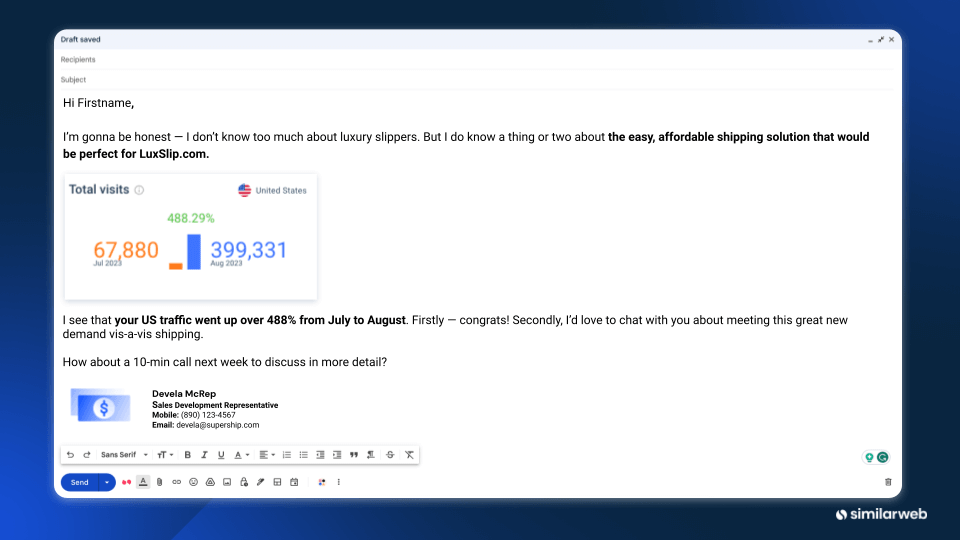
Plot twist: now you’re a sales leader at a big AdTech company. Your CRO’s placed a big emphasis on retention this quarter, and you’re all hands on deck to prevent churn.
You set up a daily Sales Signals email alert so that you get notified right away if a client company does either of the following things:
Whenever a client starts working with a new ad network — or even thinks seriously about doing so — you get the chance to react strategically before it’s too late.
Once you’re in the know, you start a conversation with the client to check in on their goals and make sure your ad network’s continuing value is crystal clear.
Next up, you manage a sales team at an email marketing SaaS company that specializes in marketing localization.
You set up Sales Signals alerts so you get notified when any of your target accounts:
Then, you pray that the aforementioned new location is somewhere tropical and insist you must go on an extremely important business trip to seal the deal have your reps reach out to the most relevant prospects with the insights you found on their new geo, and show why your email platform is the best for streamlining localization.
For your final act, you’re the Director of Business Development at a chatbot software company that offers an app for Shopify-based ecommerce stores.
To move the sales needle, you want your team to target ecommerce sites that are both in need of a customer service boost and have the budget to pay for that boost.
You filter your total available market (TAM) list to show only the companies that have recently received new funding (venture capital, grants, IPO, etc.).
With this refined list in hand, your reps can work the most relevant accounts first. Time = saved, meetings = booked, reps = en route to President’s Club.
Finding fied (koala-fied) prospects — and closing deals with them — is never going to be the easiest thing on earth, but it no longer has to be the hardest, either.
With buying signals, you can direct your sales team’s efforts to where they’ll make the most impact. (Plus, if you’re using Similarweb Sales Intelligence, you get user-friendly email alerts so you don’t even have to go digging to get all those deal-driving signals.)
In short, buying signals = easier and better lead gen, more impactful conversations with prospects, and improved retention.
Want to test it out for yourself? Click on that little orange button below and give it a shot.
What are buying signals?
Buying signals in sales are signs that a potential customer is more likely to purchase your product or service.
What’s an example of a buying signal?
Buying signals include fit data, opportunity data, intent data, and behavior signals. An intent buying signal, for example, might be a prospect searching for your product or products in your competitive landscape online.
How can I identify buying signals?
The best way to identify buying signals is by using a platform like Similarweb Sales Intelligence, which offers a tool called Sales Signals specifically for tracking buying signals.

Content Marketing Manager
Madeleine is a content marketing enthusiast with a passion for languages and a career focused on sales and marketing.
The Top 100 Most Visited Websites in the USA (August 2026)

Similarweb Named in Forrester's Answer Engine Optimization Technologies Landscape, Q3 2026

Anthropic IPO: What Claude's Web and App Data Show
Try Similarweb Sales Intelligence today — free of charge
