
3 of the Sharpest Minds Weigh in on the State of Gen AI in 2026
by Darrell Mordecai3 Min.
Aug 26, 2026

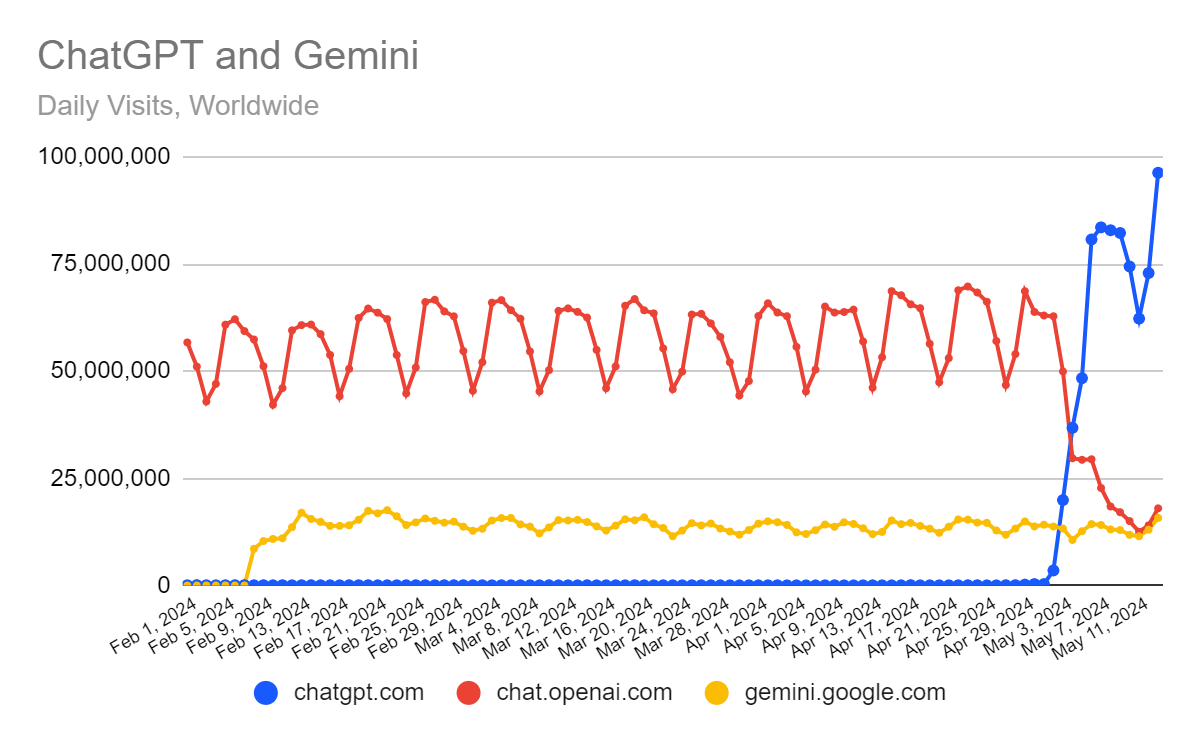
Following Monday’s ChatGPT feature and free access announcements from OpenAI, ChatGPT set another new daily traffic record with 96.2 million visits, up 16% from the previous daily peak set a few days before. (Update: the next day, traffic increased again to 103.6 million visits.)
On Monday, May 13, OpenAI announced ChatGPT 4o – that’s the letter “o” as in Omni – which responds to voice, image, and video prompts as well as text input. More importantly, in terms of traffic volume, OpenAI said it was making its GPT 4 generative AI algorithms, including many new features, available on the free version of its platform. This also means that developers building Custom GPTs for OpenAI’s nascent “app store” will get access to a bigger audience.
While paid ChatGPT subscribers will get access to some features first, along with higher capacity, OpenAI seems to have determined it needs a mass audience for ChatGPT. So far, that doesn’t mean targeting that audience with ads – rumors that OpenAI would launch a search engine this week proved incorrect.
OpenAI’s announcement was timed to upstage the AI product and feature announcements made at the Google I/O conference. For Google, the news was less about its ChatGPT-like product Gemini as a stand-alone product (gemini.google.com, but rather on expansive plans to build Gemini-powered AI summaries into search engine results pages. AI-enhanced search will be available to billions of people by the end of the year, according to Google.
The chart below shows recent daily traffic to the old chat.openai.com subdomain (until recently, ChatGPT’s home page) to the new chatgpt.com domain. There is some lingering traffic to chat.openai.com where visitors are redirected to the new website.
Google’s Gemini underwent its own transition from bard.google.com (not shown).
One reason OpenAI is opening more features to the public is to create a larger audience for Custom GPTs, the specialized applications and integrations it promotes through its own “app store” of custom experiences. We will be watching to see whether usage of those apps increases significantly now that they are coming out from behind a paywall.
The Similarweb Insights & Communications team is available to pull additional or updated data on request for the news media (journalists are invited to write to press@similarweb.com). When citing our data, please reference Similarweb as the source and link back to the most relevant blog post or similarweb.com.
Disclaimer: All names, brands, trademarks, and registered trademarks are the property of their respective owners. The data, reports, and other materials provided or made available by Similarweb consist of or include estimated metrics and digital insights generated by Similarweb using its proprietary algorithms, based on information collected by Similarweb from multiple sources using its advanced data methodologies. Similarweb shall not be responsible for the accuracy of such data, reports, and materials and shall have no liability for any decision by any third party based in whole or in part on such data, reports, and materials.

David covers social media, digital advertising, and generative AI. With a background in web trends since the 1990s, he’s also the author of "Social Collaboration for Dummies".
Give it a try or talk to our insights team — don’t worry, it’s free!