






The Top 100 Most Visited Websites in the USA (August 2026)
by Shai Belinsky10 Min.
Sep 29, 2026
 Marketing Intelligence
Imagine a house with no shelves. No closets. No way to organize your things. Sounds pretty scary, right? In this type of house, it’s hard to find what you need or get anything done quickly. It’s my type-A, Virgo nightmare.
Trying to create a content strategy without a content calendar is basically like that. Without a structure or way to organize your strategy, it’s difficult (if not impossible) to meet deadlines, coordinate and prioritize tasks, and analyze your progress with marketing intelligence.
The content calendar enables you and your whole team to reach your content goals.

A content calendar is a shared document that sets the timeline for your content creation and publishing. It’s a helpful tool that organizes your efforts to plan and distribute content over time and coordinate tasks across teams.
It should be accessible to anyone involved with the content strategy and frequently updated to reflect the current status.
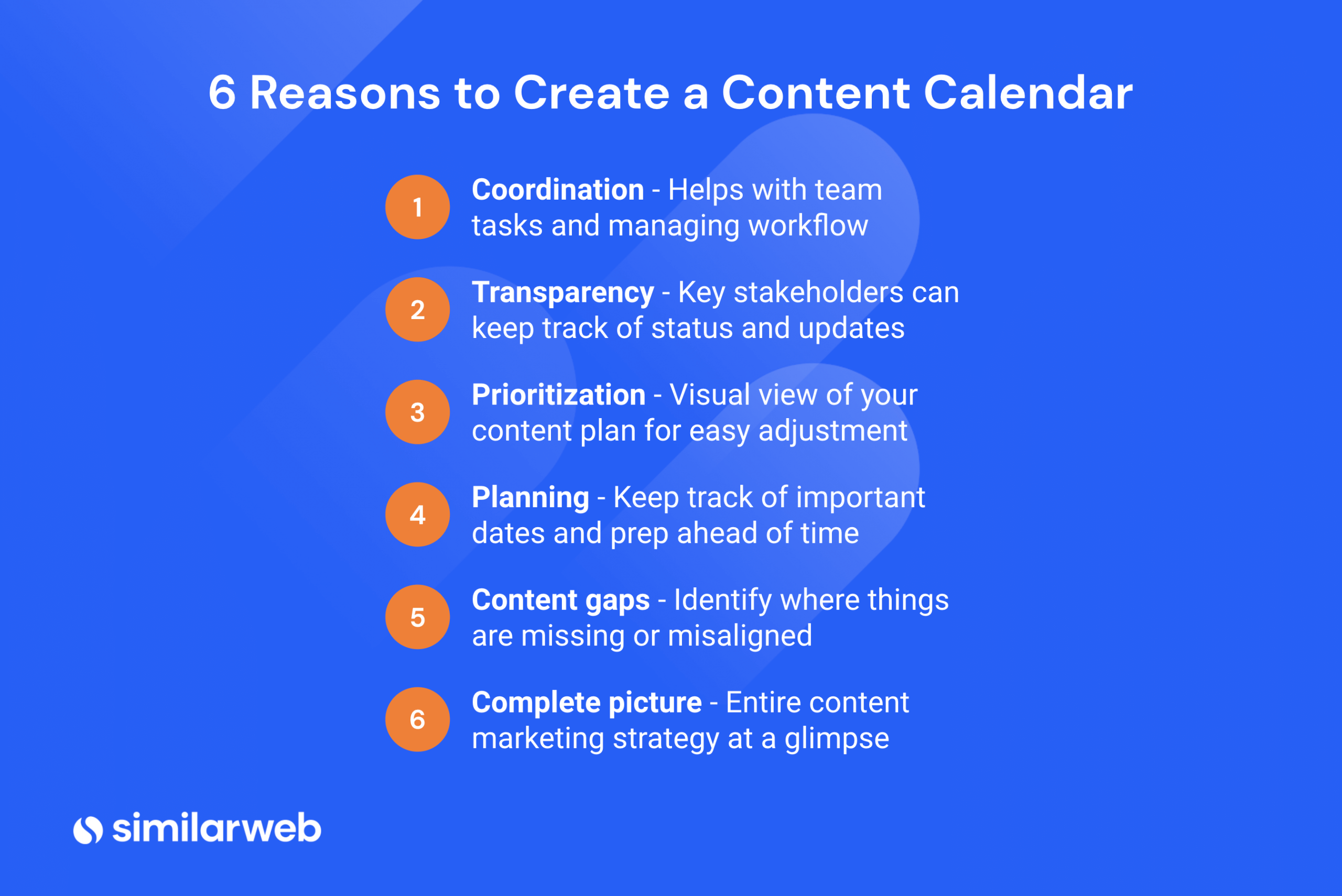
A content calendar enables your team to stay organized and provide your audience with a consistent flow of content. It’s no coincidence that this sounds strikingly familiar to the definition of content marketing. The calendar is the tool that facilitates your content marketing strategy.
Here are six ways it helps:
To get the most out of your content calendar, you should have a publishing schedule for the next three months at least. Ideally, you’d set it up yearly, but ya know, we plan, and God laughs, right? You might be thinking: Who has time to think up the future when we’re so busy creating content now? In the long term, the content calendar will save you time and loads of it.
Here’s how to create your own calendar in just three steps:
To get started, review and map out your existing content. Look at everything on your website and blog, including gated assets and outdated content. You’ll achieve two goals: one, identify gaps in your published content, and two, identify pieces for repurposing. A report could be turned into a video, a webinar into a blog post, etc. These require less time and effort, plus they can help you through the first few weeks until you get into a routine of creating significant ahead of time.
Meanwhile, start collecting ideas for new content. Here is where you can do some basic SEO keyword research. Using a tool like Similarweb, you can check what keywords your competitors are ranking for and look for opportunities to outrank them.
Once you find some keywords and creative ideas, keep these on a separate worksheet that functions as a content idea bank. This will help you quickly come up with topics and concepts when needed and fill your calendar.
There are a few decisions you need to reach to streamline expectations and workflow. Determine how often you want to publish different types of content and set due dates. For example, you might decide to publish a blog post once a week and case studies twice a quarter. Whatever the volume, mark definite dates on the calendar. Are there any significant events coming up in your company, like a podcast series? How about in the world, like a big holiday or special occasion? Note the dates because you’ll want to plan related content ahead of time to support the campaign.
Using a calendar tool like Trello, CoSchedule, or even Google Calendar can help keep everyone aligned. Try out a few options and figure out what works best for you. It doesn’t need to be complex, but it needs to be housed somewhere. This will help you assign different stakeholders tasks and deadlines to make sure you publish on time.
You also need to include status updates in the content calendar so everyone can see the progress. For this, you’ll need a common language across your team so everyone is on the same page. “Complete,” for example, might mean published to one person and ready to be published for another person, so be sure you are clear about what each status means. In my early years, I definitely made that mistake more than once.
Your calendar isn’t just for the here and now, you’ll want to ensure it’s set up and filled in with loads of essential details that will allow you to track and repurpose your current items in the future.
Start scheduling content pieces that require more of your time and energy followed by less energy-consuming tasks. Make note of any hard deadlines to keep your priorities in check. Then, add the heavy one-hit-wonder pieces that require more time, cooperation across teams, and resources. Identify dates for long-form content, such as white papers, eBooks, and video production as well as any big design lifts.
By now, you’ll be able to identify gaps. Fill up the calendar with your regularly scheduled content, such as your weekly blog posts, and then strategically fill in the holes.
You’ll likely want to manage your social media marketing in a separate calendar linked to your main editorial calendar. Social media content has a pace of its own, and the distribution needs vary significantly by channel and goal. It requires different resources and, therefore, a different creation workflow and separate social media content calendar.
You need a comprehensive content calendar to keep your content assets and timeline in order for all your stakeholders, and to keep your sanity in check.
Download our free content calendar template and start filling in the essential fields. You’ll get an easy start, and in time you’ll see which information is helpful to add to your specific internal workflows.
You may not need all the fields at the beginning, especially if you have a small team, so edit as you see fit and grow it over time.
Let’s remember what the purpose is: Stay on track with the content schedule and publish consistently. The calendar needs to include the essential information to make that possible:
Depending on the amount of content, its complexity, and your team’s size, you can add whatever is useful to improve your workflow.
Let’s look at some key considerations for setting up your content calendar:
To sum it up, a simple file can turn your entire content planning and management into a smoothly flowing stream. A content calendar is a working tool, and if you update and optimize it frequently, everyone will benefit from it.
Check out our marketing calendar events guide for 2023.
What is a content calendar?
A content calendar sets the timeline for content creation to help you organize and distribute content over time.
What should be included in a content calendar?
A content calendar should include the essential information needed to stay on track with your content schedule. This includes the type of content, publishing date, topic, status, and stakeholders.
What is the purpose of a content calendar?
The purpose of a content calendar is to help your team stay organized and to provide a consistent flow of content. A content calendar helps with coordination, transparency, prioritization, planning, filling content gaps, and providing a complete picture of your strategy.

by Yael Klass
VP of Corporate Marketing
Yael, with 10+ years in SaaS and a background in art education, excels in storytelling and international campaigns. She contributes to Forbes and teaches at Reichman University.
The Top 100 Most Visited Websites in the USA (August 2026)
Similarweb Named in Forrester's Answer Engine Optimization Technologies Landscape, Q3 2026

Anthropic IPO: What Claude's Web and App Data Show
Give it a try or talk to our marketing team — don’t worry, it’s free!
