


 Marketing Intelligence
8 AI Search Optimization Best Practices And Techniques To Use In 2026

By May 2025, nearly 69% of all searches ended without a single click to any website, according to Similarweb’s zero-click research, up from 65% in 2020 per SparkToro’s analysis of Similarweb data. That was almost a year ago.
When AI Overviews are involved, that figure climbs to nearly 80%, according to Similarweb zero-click data. The user got the answer. They just never arrived. If your content is not the source of that answer, you have not lost a click. You have lost the conversation before it started.
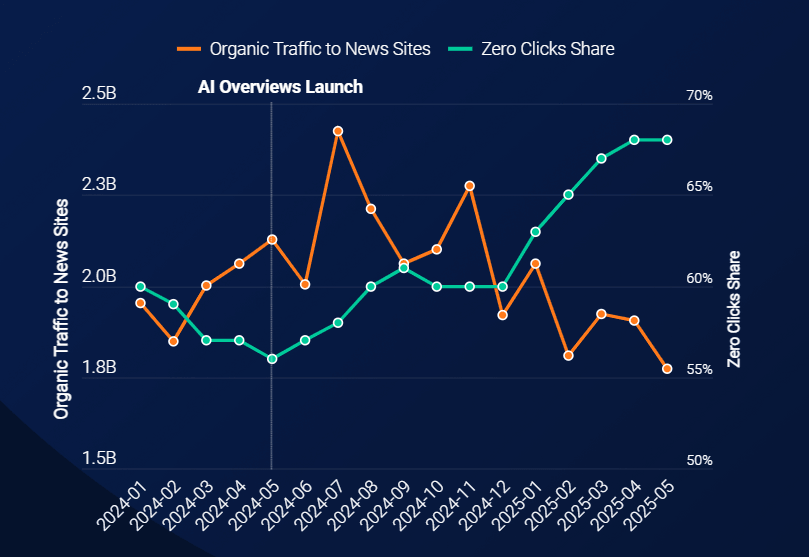
But before you torch your entire SEO strategy in pursuit of AI citations, here is the other number that matters: approximately 52% of all search queries still produce no AI Overview at all. For every search that ends in a synthesized AI response, there is another search where ten blue links are the entire experience, and position still determines whether you get clicked.
AI search optimization is not a replacement for what already works. It is an additional optimization layer that requires different signals, a different structure, and different measurements, layered on top of a functioning SEO foundation.
Interest in AI search optimization has grown faster than almost any other marketing discipline in the past 12 months. That tells you practitioners are paying attention. What it does not tell you is how to do it without breaking what you already have. That is what this guide covers.
AI search optimization, also called AISEO, is the practice of making your content retrievable, extractable, and citation-worthy in AI-powered answer systems. It spans content structure, technical access, topical authority, and measurement.
However, it starts from the same foundation as traditional SEO: crawlable pages, clear signals, and genuine expertise. The SEOs who are winning in AI search are not the ones who rewrote everything from scratch. They are the ones who applied the right optimizations to content that already had organic search authority.
In this article, I’ll cover the eight best practices for AI search optimization (with data behind each), how the major AI platforms differ, and how to measure whether any of it is working.
What is AI search optimization (AISEO)?
AI search optimization is the practice of structuring content and building brand authority so that AI-powered platforms select, cite, and mention your brand when generating answers.
Unlike traditional SEO, which positions pages in a ranked list, AISEO targets inclusion in the synthesized answer itself, where a handful of sources get cited per response, and everyone else is invisible
The mechanism is called Retrieval-Augmented Generation (RAG). When a user submits a query, the AI system searches an index, retrieves candidate documents, and a language model synthesizes them into a single coherent response.
Being indexed is necessary but not sufficient: the content still needs to be structured in a way that the language model can extract, verify, and cite with confidence.
This is why AISEO adds to your SEO obligations rather than replacing them. Google’s search liaison publicly confirmed the core premise: appearing in AI Overviews requires the same technical and content work that earns traditional SERP visibility. Every signal that earns a traditional ranking, authority, relevance, freshness, and clarity, also matters for AI citation eligibility.
Strip those signals in pursuit of “more conversational” content, and you lose both games simultaneously.
You cannot be cited in an AI Overview from a page that does not rank. Brightedge research tracking citation overlap found that organic rankings remained a strong predictor of citation eligibility, particularly in trust-sensitive verticals like healthcare and finance, where the overlap between AI-cited content and top-10 organic rankings ranges from 68 to 75%.
How AISEO and traditional SEO differ: a working comparison
| Dimension | Traditional SEO | AI search optimization (AISEO) |
|---|---|---|
| Primary goal | Rank pages in a list of links | Be cited inside a synthesized answer |
| Success metric | Organic clicks and CTR | AI citation frequency, brand mention rate |
| Content target | Match keyword intent at the page level | Cover the full topic cluster and sub-queries |
| Key technical requirements | All SEO signals (crawlability, indexing, performance) | All SEO signals, plus BLUF structure, structured data, llms.txt |
| Measurement | Rank tracker, Google Search Console, Google Analytics | AI visibility tracker, rank tracker, AI referral traffic |
| Failure mode | Dropped rankings | Absent from AI answers for tracked queries |
The terminology: AISEO, GEO, and what this article covers
AISEO is the SEO industry shorthand for AI search engine optimization, merging both disciplines. You will also see this work referred to as Generative Engine Optimization (GEO), which specifically refers to optimizing citations in AI-synthesized responses.
These terms describe closely related practices that overlap significantly. This article focuses on AI search optimization as the umbrella discipline: what you need to do to earn visibility across AI-powered answer surfaces, regardless of which acronym the industry eventually settles on.
What are the best practices for AI search optimization?
The eight AI search optimization best practices all share one characteristic: they make your content easier for AI systems to retrieve, verify, and cite with confidence. None of them requires dismantling what already works in traditional SEO. They are an optimization layer, not a replacement, and several overlap with practices good SEOs are already running.
Let’s dive in:
1. Structure every section for independent LLM extraction
LLM extraction requires that each section of your content be independently citable: complete enough to answer the heading’s implicit question without requiring the reader, or the AI, to have read any prior section. This is called atomic section architecture: each H2 and H3 block must stand alone.
LLM systems do not read articles top to bottom the way humans do. They parse content into segments (AKA content chunks), evaluate each segment for relevance and authority, and select the best-fitting segment across multiple candidate documents. A section that opens with “as mentioned above” or “building on what we covered earlier” is partially or wholly invisible to AI retrieval systems, because those sections depend on prior context that the retrieval mechanism does not carry.
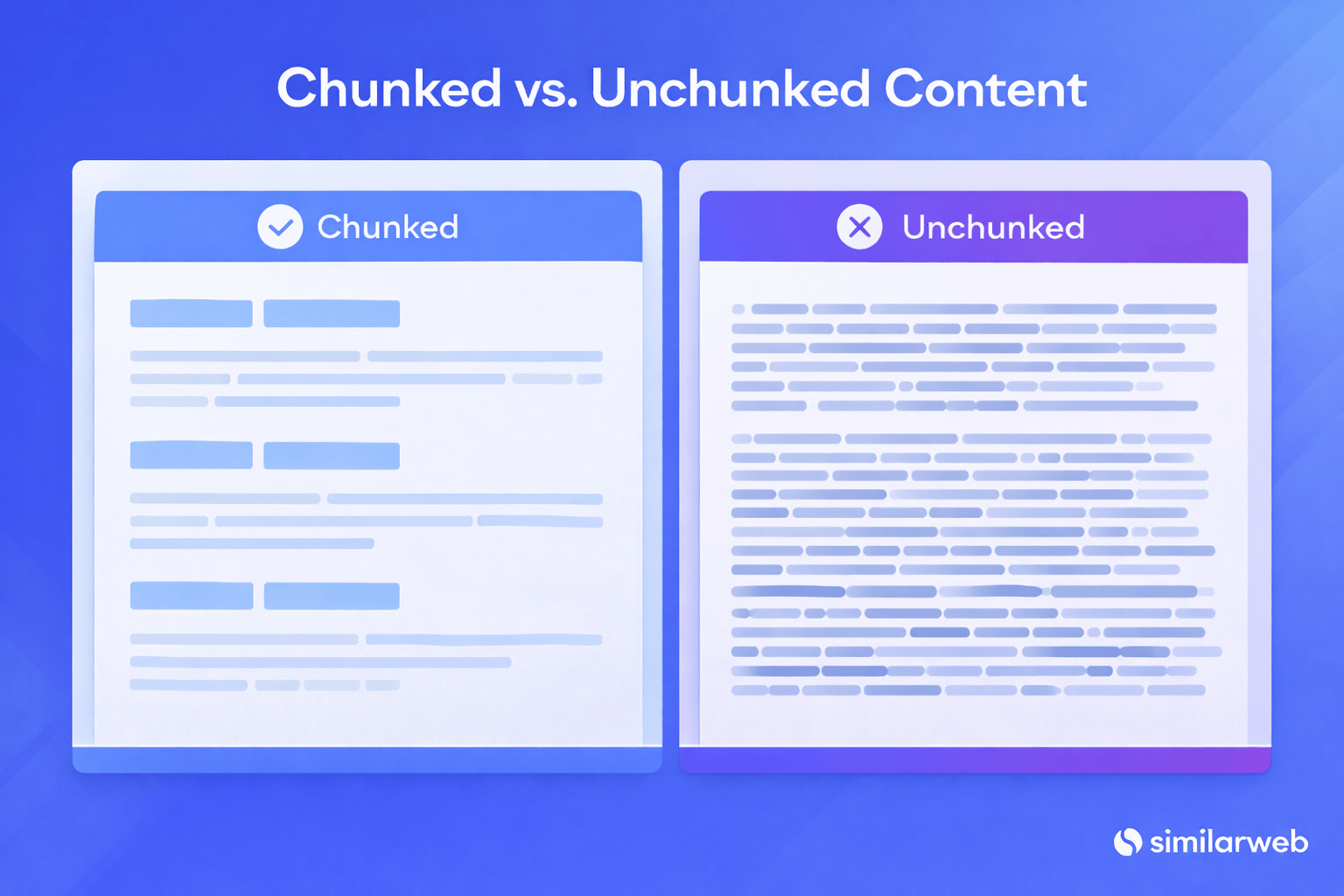
How to apply it: Before publishing, read each H2 section in isolation. If it makes sense as a standalone 200-word answer, it is ready for extraction. If it requires context from previous sections, rewrite the opening to be self-contained.
2. Lead every section with a direct answer (BLUF)
The Bottom Line Up Front (BLUF) principle requires that each section begin with a 30 to 60-word direct answer to the question implied by the heading. That opening block is what AI systems extract first. Kevin Indig’s research from February 2026, analyzing over 100 million LLM citation instances, found that 44.2% of all citations are drawn from the first 30% of text in a document.

Practically, this means your opening sentences carry disproportionate citation weight.
A BLUF opener has a specific structure: a direct statement of what the section covers, in plain language, without preamble. Anything you would write after “in this section, we’ll explore…” is not a BLUF. It is a detour.
How to apply it: Rewrite the first sentence of every H2 and H3 so it answers the heading directly. Delete all throat-clearing openers: “In this section,” “As you might expect,” “Before we dive in,” and similar constructions.
3. Implement FAQ and Article schema markup
Schema markup is the nutrition label for your content: it tells AI systems exactly what they are looking at, who produced it, and how to categorize it.
FAQPage and Article schema are the highest-impact schema types for AI search optimization. Implementing the FAQ schema on a page with existing FAQ content has increased citations by 350% in controlled product experiments, reflecting how structured data reduces the parsing work AI systems must do before selecting a source.
Article schema adds author attribution, publication date, organization name, and content type, all of which serve as E-E-A-T signals that AI systems use to evaluate trustworthiness before citing.
Author schema, specifically: websites implementing author schema are substantially more likely to appear in AI-generated answers because authorship provides the named-expertise signal that AI systems treat as a credibility proxy.
The HowTo schema is worth adding for any instructional or process-based content. It explicitly marks up a numbered sequence of steps with titles, descriptions, and optional images, giving AI systems a pre-parsed, extractable structure for procedural answers. When a user asks how to do something and your page has HowTo markup, the steps are already labeled and sequenced, with no inference required. Apply it to any page where the primary content is a process: setup guides, audit workflows, optimization checklists.
How to apply it:
- Add the FAQPage schema to any page with a dedicated FAQ section.
- Add Article schema to all blog posts and guides, including author name, author credentials, and publication/update date.
- Add HowTo schema to any page where the primary content is a process: setup guides, audit workflows, optimization checklists.
- Validate all three with Google’s Rich Results Test before publishing. Crawl monthly with Similarweb Site Audit to identify issues.

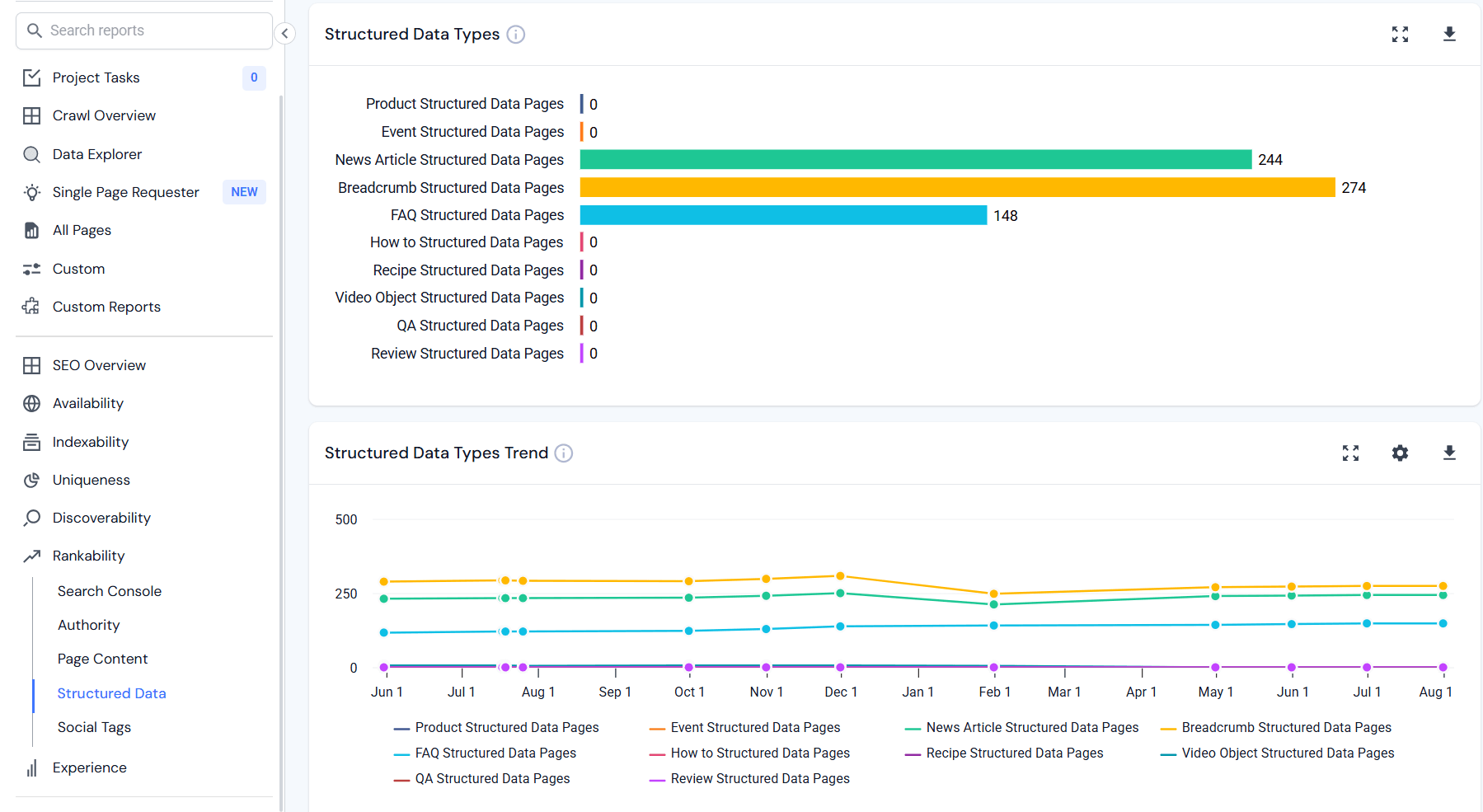
Many of these are available via the website’s CMS, eliminating the need for manual updates for most schemas and reducing the likelihood of issues.
4. Include statistics with primary source attribution
Statistics improve AI citation rates not because they make content look authoritative, but because they give AI systems verifiable claims to extract. A Princeton Research study applying GEO strategies to content found that including specific statistics improved AI citation rates by up to 40% compared to unoptimized content, with attribution to primary sources showing the strongest performance gains.
By contrast, SEO practices like keyword stuffing performed below baseline in the same research: adding repetitive keyword phrases actively reduced citation probability.
Every statistic in AI-optimized content needs: a number, a timeframe, and a source (at minimum). “Research shows that AI adoption is increasing” is not a citable claim. “AI referral traffic now accounts for 1.08% of all web traffic and is growing roughly 1% month over month, according to Superlines’ March 2026 AI search analysis” is citable, verifiable, and extractable.
How to apply it: Audit your key articles for unsourced statistics. For each one, either find the primary source and add full attribution (Yes, that means you should add external links), or remove the claim. Replace vague language like “up 40% year over year” with the actual number and source.
5. Allow AI crawlers and publish an llms.txt file
AI-powered answer engines depend on web crawlers to index your content. If your robots.txt blocks those crawlers, you are excluded from the citation pool before any content quality signal is ever evaluated.
The major AI crawlers you should explicitly allow:
- GPTBot (OpenAI)
- Google-Extended (Google)
- OAI-SearchBot (OpenAI’s search agent)
- CCBot (Common Crawl).
Blocking any of these is, in effect, an opt-out from the AI answer layer.
An llms.txt file is an emerging standard that complements robots.txt by giving AI systems a curated, human-readable summary of your site’s key content, organization, and most important pages. Microsoft’s AI content optimization guidance explains how Copilot uses page-structure signals to parse and select content for answers.
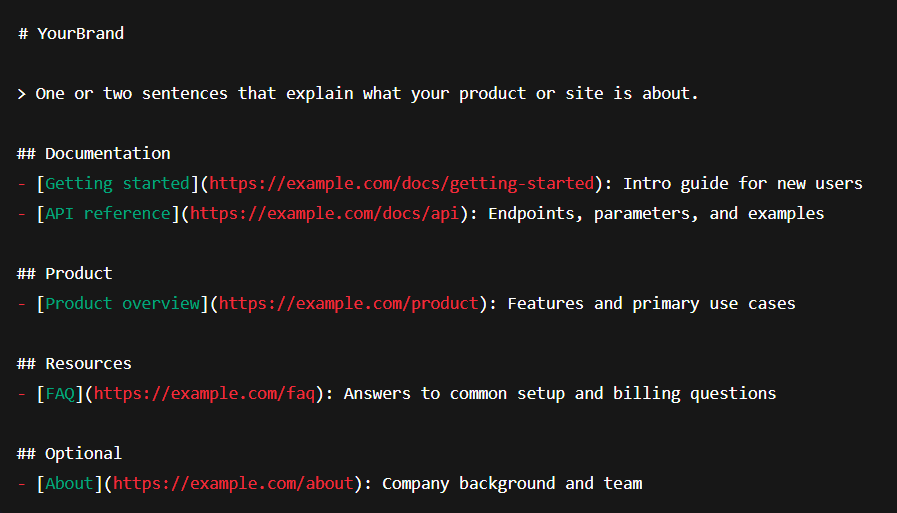
How to apply it:
- Check your robots.txt.
- Confirm no blanket “Disallow: /” applies to AI crawlers.
- Publish an llms.txt file at yoursite.com/llms.txt pointing to your highest-authority pages.
See our guide on technical GEO for the complete implementation checklist. You can also check out our version of the LLMs.txt file at https://www.similarweb.com/llms.txt
6. Build topical authority through a content cluster
AI systems evaluate authority at the topic level, not just the page level. A brand that has published five well-structured articles on a topic cluster earns a higher baseline citation probability for all five than a brand that has published one article, even if the single article is longer and better structured.
Research on AI citation patterns found that brands in the top 25% for web mentions on a topic receive more than 10 times the AI visibility of those in the next quartile.
For AI search optimization, this means the hub-and-spoke internal linking model that serves SEO also serves AISEO: a pillar article covering the topic broadly, supported by satellite articles on specific sub-queries, all internally linked.
At Similarweb, we use exactly this structure: a cluster of articles across GEO, AEO, technical optimization, and measurement, each internally linked and each covering a distinct sub-query type.
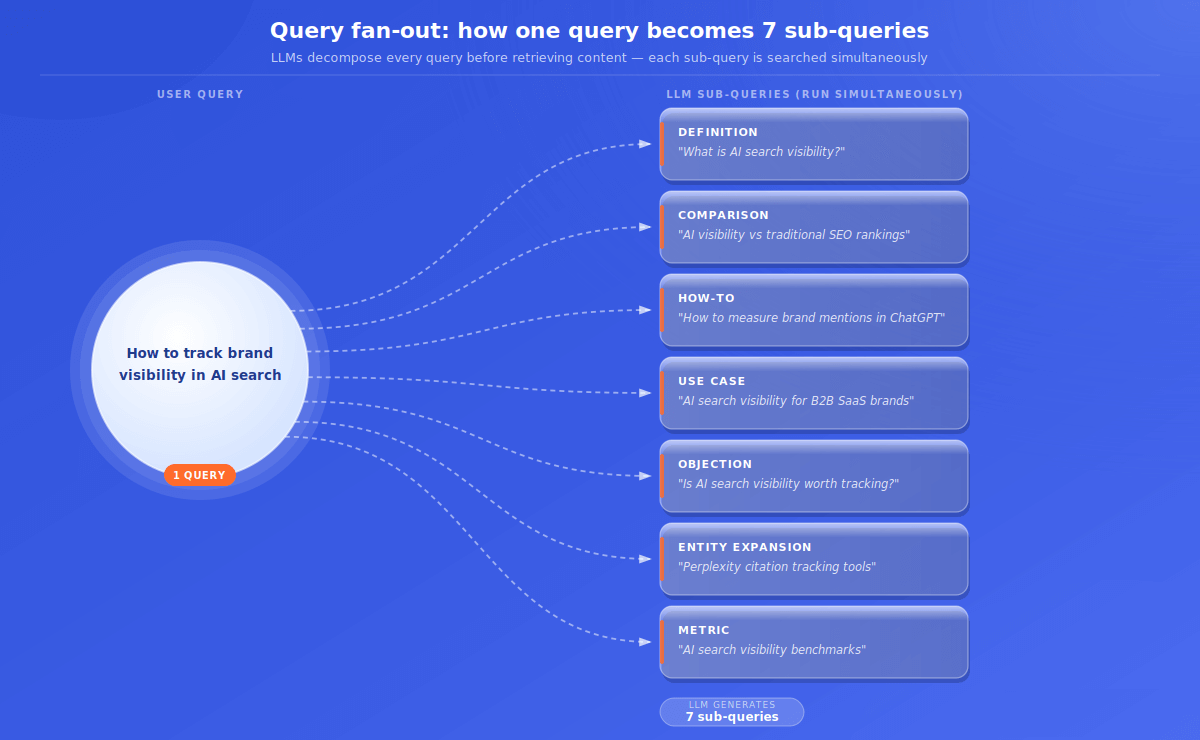
When an AI system fan-out searches a query across multiple sub-questions, a brand with content covering all of them wins multiple citation slots. A brand with one article wins at most one.
How to apply it: Map your existing content against the sub-query types your primary topics generate. Identify which sub-queries have no dedicated content. Those gaps are your highest-priority AISEO content investments.
7. Earn third-party citations on authoritative external publications
AI systems do not rely solely on your own website to evaluate your authority on a topic. They cross-reference your brand across the broader web: mentions in industry publications, inclusion in “best of” lists, expert quotes in third-party articles.
A brand with excellent owned content but minimal external presence is, from an AI system’s perspective, a brand that has not yet earned credibility at scale.
This is where SEO and PR converge in AISEO. Guest articles in authoritative publications, expert commentary in industry media, and inclusion in curated resource lists all generate third-party citation signals that AI systems use as proxies for credibility.
This is not about link building in the traditional SEO sense. It is about building the cross-web presence that makes your brand a credible answer candidate across a range of queries.
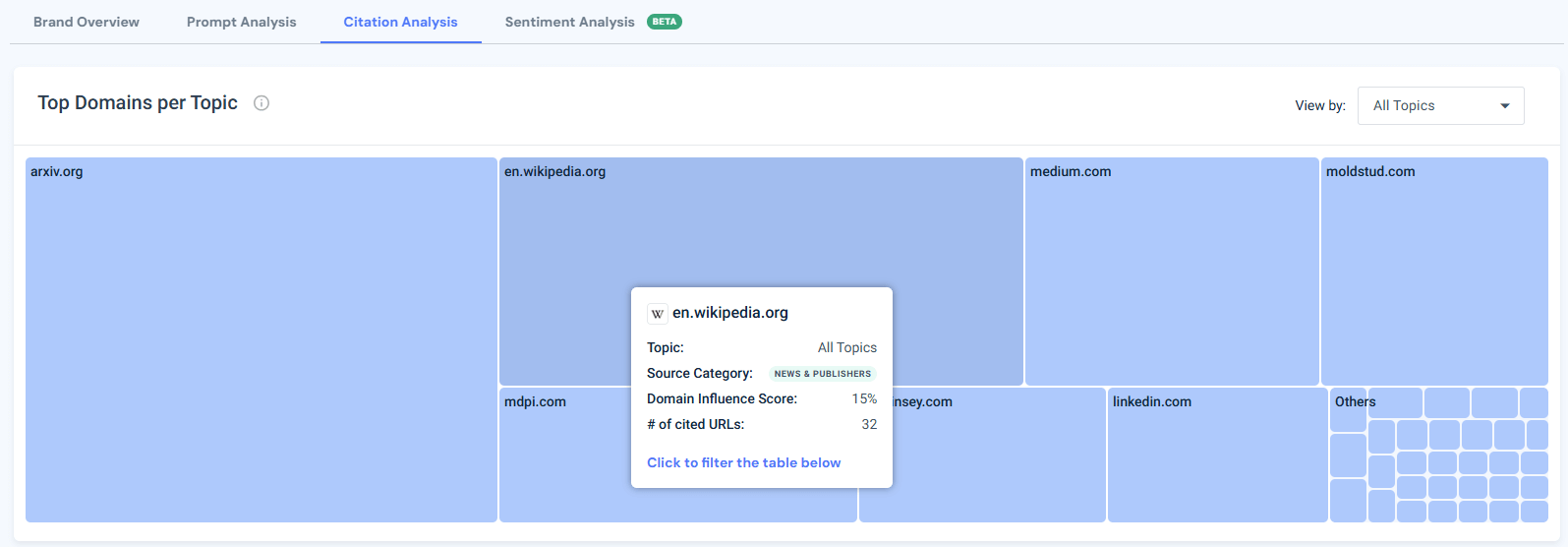
How to apply it: Identify the 10 to 15 publications that appear consistently in AI-generated answers for your key topics. Run those queries manually in ChatGPT and Perplexity. Pitch those publications with genuinely useful data points, original frameworks, or expert perspectives that their editorial teams will want to reference. With Similarweb’s Citation Analysis Tool, you can quickly identify top-cited domains for your brand’s topic, as well as individual cited URLs:
8. Maintain content freshness
AI systems show a clear bias toward recent content, particularly in fast-changing topic areas such as AI search itself.
The mechanism is direct: AI engines retrieve content from the live web at query time, meaning stale content competes against fresher alternatives on every retrieval. A well-structured article from 2024 that has not been updated will lose citation share to a less thorough but more current article, even if the older piece is technically superior.
Freshness is also the one AISEO signal that directly and positively reinforces traditional SEO. Google’s freshness signals reward pages that are updated when the topic warrants it. Updating your highest-performing SEO articles with new data, revised statistics, and current examples serves both channels simultaneously.
How to apply it: Build a content calendar that schedules quarterly reviews for your highest-traffic and most-cited articles. At a minimum, update the publication date, replace any statistics older than 18 months, and add one new relevant data point.
Platform differences: ChatGPT, Perplexity, and Google AI Mode
ChatGPT, Perplexity, and Google AI Mode each retrieve and cite content through different mechanisms, which means the same content can earn citations on one platform and be absent from another.
Treating “AI search” as a single channel is one of the most common strategy errors marketers make.
Superlines‘ analysis of 34,234 AI responses across 10 platforms found that the same brand’s citation volume can differ by a factor of 615 between the platform with the lowest and the platform with the highest citation rates (January–February 2026). That is not a minor statistical variance. That is a platform behavior difference that demands platform-specific awareness.
| Platform | Primary index | Primary citation signal | Freshness weight | Schema sensitivity | Key implication |
|---|---|---|---|---|---|
| Google AI Overviews | Google’s own web index | Topic completeness + existing organic ranking | High (favors recent updates) | High | Strong SEO foundation = higher citation baseline |
| Google AI Mode | Google’s own web index (deeper, multi-step fan-out) | Semantic completeness + passage-level authority | High | High | Goes deeper than AI Overviews. Covers sub-queries that rank trackers don’t monitor |
| Perplexity | Real-time web crawl (primarily Bing index + direct crawl) | Directness of answer + source authority | Very high (real-time) | Medium | Rewards highly structured, directly answerable content |
| ChatGPT Search | Primarily Bing’s search index | Named authority (domain and author) + topical coverage | High | Medium | Bing Webmaster Tools coverage matters more than most SEO teams realize |
| Copilot | Bing index | Same as ChatGPT Search | High | Medium | Optimizing for Bing organic visibility gives multi-platform AI coverage |
Where to focus first:
- If your audience primarily finds you through Google, prioritize Google AI Mode and AI Overviews optimization by strengthening your organic rankings and adding structured data.
- If you have not yet registered with Bing Webmaster Tools and submitted a sitemap, do that this week. This will also give you access to the Bing AI performance overview, where you can get more data on how you appear in AI search results.
- Perplexity coverage flows largely from Bing rankings. ChatGPT Search follows the same path. One action, three platforms.
The most underexploited insight from the platform table: Google AI Mode uses a multi-step fan-out process that evaluates content against sub-queries your rank tracker does not monitor. Similarweb’s AI Mode guide covers the specific optimization adjustments for this platform in detail.
AI search optimization checklist
The AI search optimization checklist converts each of the eight best practices into a concrete, verifiable action item. Use it as a pre-publication audit for new content, or as a prioritized update list for your highest-traffic existing pages. Each item maps directly to its corresponding best practice and includes a pass/fail verification criterion.
Copy the checklist here
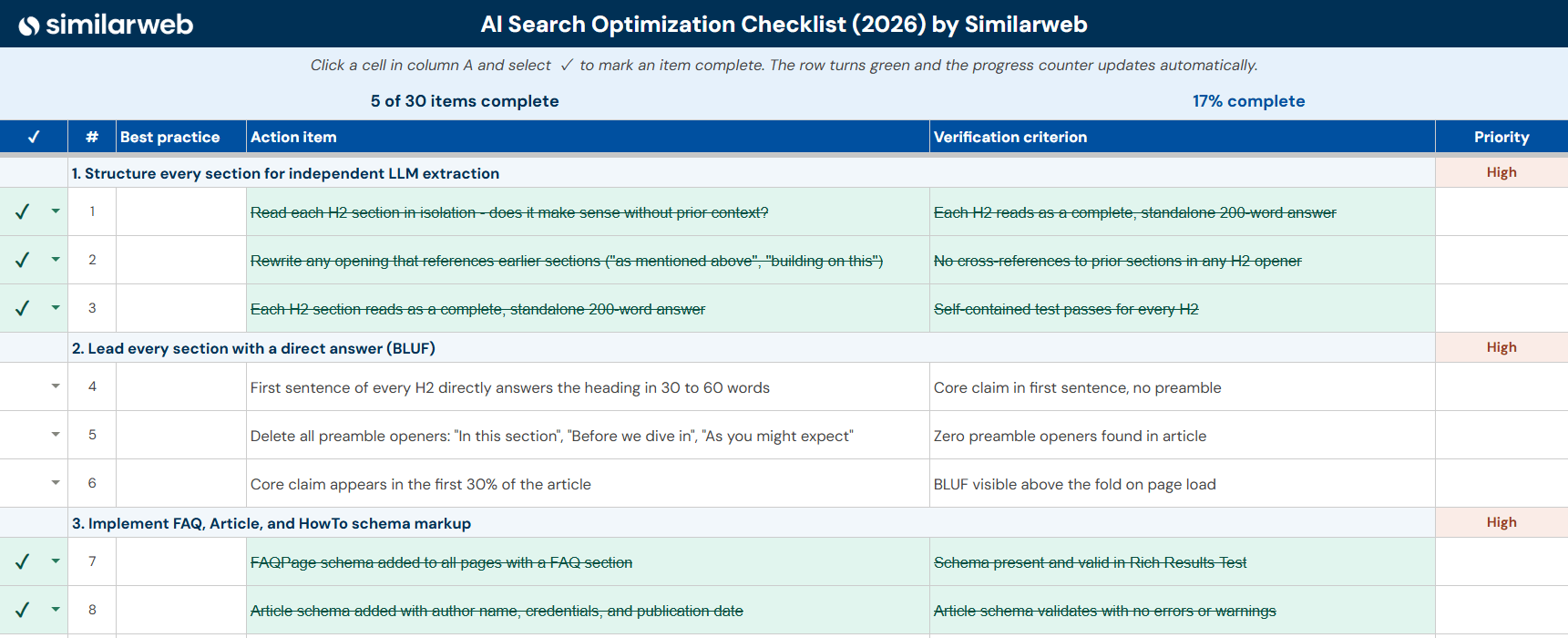
The meta-check: Before applying any item on this checklist to an existing high-ranking page, confirm that the change does not remove or weaken any existing SEO signal. BLUF rewrites should replace weak openers, not keyword-optimized ones. Schema additions should not alter visible page content.
If a proposed change improves AI visibility at the cost of organic ranking signals, it is the wrong change.
For a deeper audit covering all nine technical dimensions of AI-era content optimization, the Similarweb GEO audit guide systematically walks through each factor.
How to measure AI search optimization performance
AI search optimization performance is measured through six GEO KPIs: Brand Visibility Score, Brand Mention Share or AI share of voice (your share of total mentions vs. competitors), Prompt Coverage, Domain Influence Score (similar to DA in SEO), Sentiment Distribution (the tone of your brand mentions), and AI Referral Traffic quality (volume and conversion rate of sessions from AI platforms).
Standard SEO metrics, organic position, clicks, and impressions, remain useful as prerequisite indicators but are no longer sufficient success measures on their own. For that, you need a dedicated set of GEO KPIs, tracked through a tool that monitors what AI engines actually say.
The core metrics are:
| KPI | What it measures | Measurement tool | Measurement cadence |
| Brand Visibility Score | The percentage of AI responses for your tracked prompts that include your brand | Similarweb AI Search Intelligence | Monthly |
| Brand Mention Share (AI share of voice) | Your brand’s share of total mentions across tracked prompts compared to competitors | Similarweb AI Search Intelligence | Monthly |
| Prompt Coverage | The proportion of your tracked prompt set where your brand appears at least once | Similarweb AI Search Intelligence | Monthly |
| Domain Influence Score | How authoritative your domain is as a citation source within your tracked topic space | Similarweb AI Search Intelligence | Quarterly |
| Sentiment Distribution | The breakdown of positive, neutral, and negative brand mentions in AI responses | Similarweb AI Search Intelligence | Monthly |
| AI Referral Traffic | Volume and conversion rate of sessions arriving from AI platforms | GA4 + Similarweb AI Chatbot Traffic | Monthly |
The logic for prioritizing these over traditional metrics is straightforward: if the majority of searches on your primary keywords produce no clicks at all, impressions and rank tell you very little about whether your AI search optimization is working. Brand Visibility Score and Prompt Coverage directly fill that measurement gap.
Two metrics to retire as primary KPIs: average position and organic CTR. These remain useful diagnostic signals, but for any topic cluster with meaningful AI Overview presence, they increasingly reflect factors outside your control. A page ranked first for a query where most users get their answer from the AI Overview before ever seeing the ranking list will show declining CTR regardless of content quality.
The correct interpretation is not “this page is underperforming.” It is “this query has shifted from a traffic opportunity to a citation opportunity.”
Use Similarweb AI Search Intelligence to establish benchmarks across all KPIs before you begin any AISEO optimization activities. Without a baseline, you cannot distinguish genuine improvement from natural variation in AI model behavior.
You can use the same playbook as the Similarweb SEO team
These eight practices are not theoretical. They are the same ones the Similarweb SEO team applies to our own content, including this article. Every section opens with a BLUF. Every statistic links to a primary source. Every piece sits within a content cluster, with internal links mapped out before a word is written.
We run the checklist before publishing and again as part of a quarterly review cycle. The measurement section uses KPIs we report internally.
I have been in SEO for over 20 years. I have watched the industry survive keyword-stuffing penalties, PageRank manipulation, the content farm collapse, mobile-first indexing, and the featured-snippet land grab.
Every single one of those shifts followed the same pattern:
- The SEOs who protected their fundamentals and added the right layer on top won.
- The ones who abandoned what was working in pursuit of the new thing lost both.
This is no different. AISEO is not a replacement discipline. It is the next layer. The brands earning consistent AI citations right now are the ones that already had clean technical foundations, authoritative content, and genuine topical depth.
The eight practices in this guide gave them the additional signals AI systems needed to select them. That is a much shorter path than starting from scratch.
Start with the checklist. Apply it to your highest-traffic pages first. Establish your GEO KPI baselines before you optimize, so you can measure what is actually moving.
The best practices have not changed. The scoring has.
The question marketers keep asking is whether AI search will eventually replace traditional search. It won’t, at least not in any timeframe that requires you to abandon your SEO foundations today. What it is doing is splitting the success metric. Ranking first is no longer the whole game. Being cited is the other half.
The brands that will own both are the ones treating AISEO as an addition rather than a pivot. The eight practices in this guide are not a detour from good SEO. They are what good SEO looks like in 2026.
The window is still open. Most brands have not started. The ones optimizing for AI citation now are establishing authority before the field consolidates, and that pattern has compounded the same way every time search has shifted.
Early movers built structural advantages that took years to close. If you want the full picture of where AI search is heading across platforms and sectors, start by going over the latest AI stats.
Track where your brand appears across AI platforms, which prompts trigger answers that mention you, and where competitors are earning citation share you are not, with Similarweb AI Search Intelligence.
FAQ
What is AI search optimization?
AI search optimization is the practice of structuring content and building brand authority so that AI-powered platforms select, cite, and surface your brand when generating answers. It is also called AISEO. The goal is inclusion in the synthesized answer itself, not position in a ranked list of links. The discipline adds specific structural, technical, and authority requirements on top of traditional SEO foundations, making content retrievable and citable by AI retrieval systems.
What is AISEO, and how does it differ from traditional SEO?
AISEO is the practitioner abbreviation for AI search optimization. Traditional SEO optimizes for position in a ranked list of links, measured by organic clicks and click-through rate. AISEO optimizes for citations within AI-generated answers, measured by citation frequency and brand-mention rate.
The two disciplines share the same technical foundations: crawlability, indexing, content authority, and E-E-A-T. AISEO adds structural requirements on top: BLUF section openers, atomic content architecture, schema markup, and freshness signals. AISEO does not replace SEO. Removing SEO foundations to make room for AI-specific tactics will cost you both channels simultaneously.
How do I get my content cited by ChatGPT and Perplexity?
To get cited by ChatGPT and Perplexity, take five actions: confirm AI crawlers (GPTBot, CCBot) are not blocked in your robots.txt, open each content section with a direct 30 to 60 word BLUF answer, include statistics with full primary source attribution, implement FAQPage and Article schema markup, and build Bing organic visibility, since both platforms index primarily from Bing. Bing Webmaster Tools registration and sitemap submission are frequently missed, high-impact actions with a fast turnaround.
How long does AI search optimization take to show results?
Initial AI search optimization results typically appear within 4 to 6 weeks for Google AI Overviews and Perplexity, and 5 to 6 weeks for ChatGPT. Full citation stability across platforms generally takes 3 to 6 months. The timeline shortens significantly for pages with established SEO authority, since AI systems use existing organic credibility as a trust signal. For new or low-authority sites, building the underlying SEO foundation in parallel with AISEO optimization is more effective than pursuing citations before the authority baseline exists.
How do I measure the success of AI search optimization?
Measure AI search optimization success with six GEO KPIs: Brand Visibility Score, Brand Mention Share (AI share of voice), Prompt Coverage, Domain Influence Score, Sentiment Distribution, and AI Referral Traffic. These replace average position and organic CTR as primary success metrics for any topic cluster where AI Overviews appear. Track them monthly using Similarweb AI Search Intelligence, and establish baselines before you begin optimizing so you can distinguish real improvement from natural model variation.
Does AI search optimization work if my site does not rank on Google?
Partially. AI systems use organic rankings as one credibility signal among several, not as a strict gate. Pages outside the top 10 can still earn citations with strong topical authority, structured content, and cross-web brand presence. However, for Google AI Overviews specifically, ranking authority correlates strongly with citation eligibility, particularly in trust-sensitive verticals, where top-10 citation overlap ranges from 68 to 75% (Superlines, March 2026).
Build organic ranking authority and AISEO in parallel. They reinforce each other, and trying to win AI citations from a weak SEO foundation is the long way around.

Related Posts



Why AI Engines Cite UGC Over Brand Content And How To Leverage It For AEO

AI Mentions vs. AI Citations: What’s the Difference and Why It Matters for GEO


Wondering what Similarweb can do for your business?
Give it a try or talk to our insights team — don’t worry, it’s free!