


 Marketing Intelligence
Should You Invest in AI Visibility? A Data-Led Perspective

If you’ve spent more than five minutes on LinkedIn recently, you’ve probably seen it.
SEO is dead. No, wait, SEO is alive, but now it’s GEO. Or AEO. Or LLMO. Or maybe everything is just AI search now.
Every new interface seems to trigger a new acronym, a new hot take, and a new sense of urgency. Almost daily, my LinkedIn feed fills up with posts (most likely, written by ChatGPT) claiming someone has cracked the formula for optimizing content for ChatGPT or other LLMs. The pattern is familiar: a confident claim, a vague promise of results, and a call to leave a comment so the “framework” or “playbook” can be sent privately.
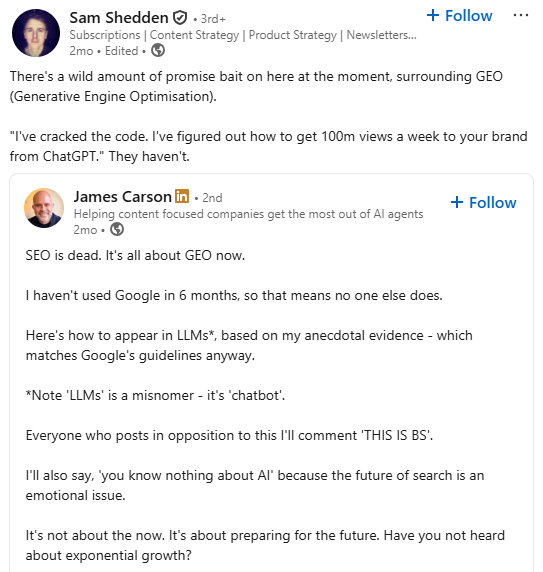
And once again, marketers are left wondering whether they’re already behind.
But beneath the noise, the question isn’t whether SEO is over, but whether user behavior has changed to the point where visibility inside AI-generated answers is now worth real investment.
To answer that, we need to move past opinions and look at what people are actually doing. The insights in this article are based on data from Similarweb’s 2025 Generative AI Landscape report, which analyzes how people are actually using generative AI platforms across web and app environments.
AI visibility isn’t a new discipline, it’s a new surface
The difference between search and generative AI becomes obvious when you look at how a typical session unfolds.
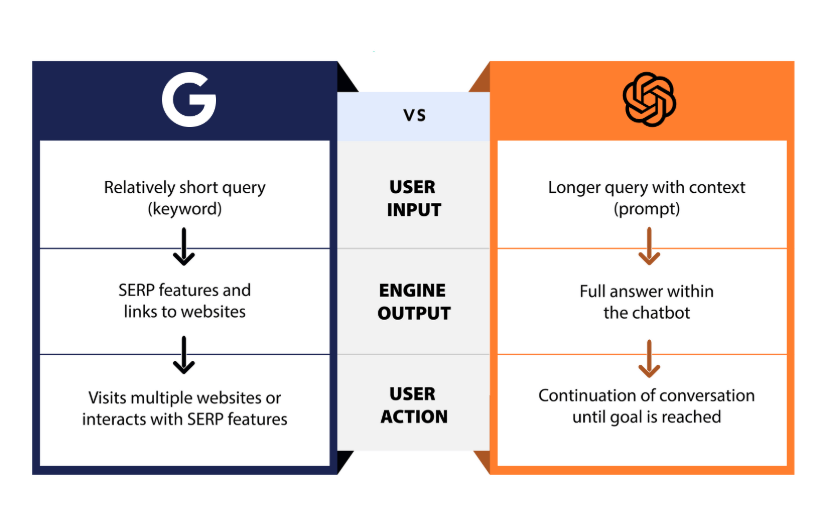
In Google, users start with a relatively short keyword. They’re shown a SERP filled with links, SERP features, and ads, and they piece together an answer by visiting multiple websites. Discovery is fragmented, and the user does much of the synthesis themselves.
In ChatGPT and similar tools, the flow is inverted. Users start with a longer, more contextual prompt. The system produces a synthesized response immediately, often citing a handful of sources. From there, the user continues the conversation until they feel confident enough to act.
This shift in flow is exactly why AI visibility matters. If your brand isn’t part of the synthesized answer, there is no second page to compete on.
AI is already at scale
The scale of generative AI usage has reached a point where it can no longer be treated as experimental or niche.
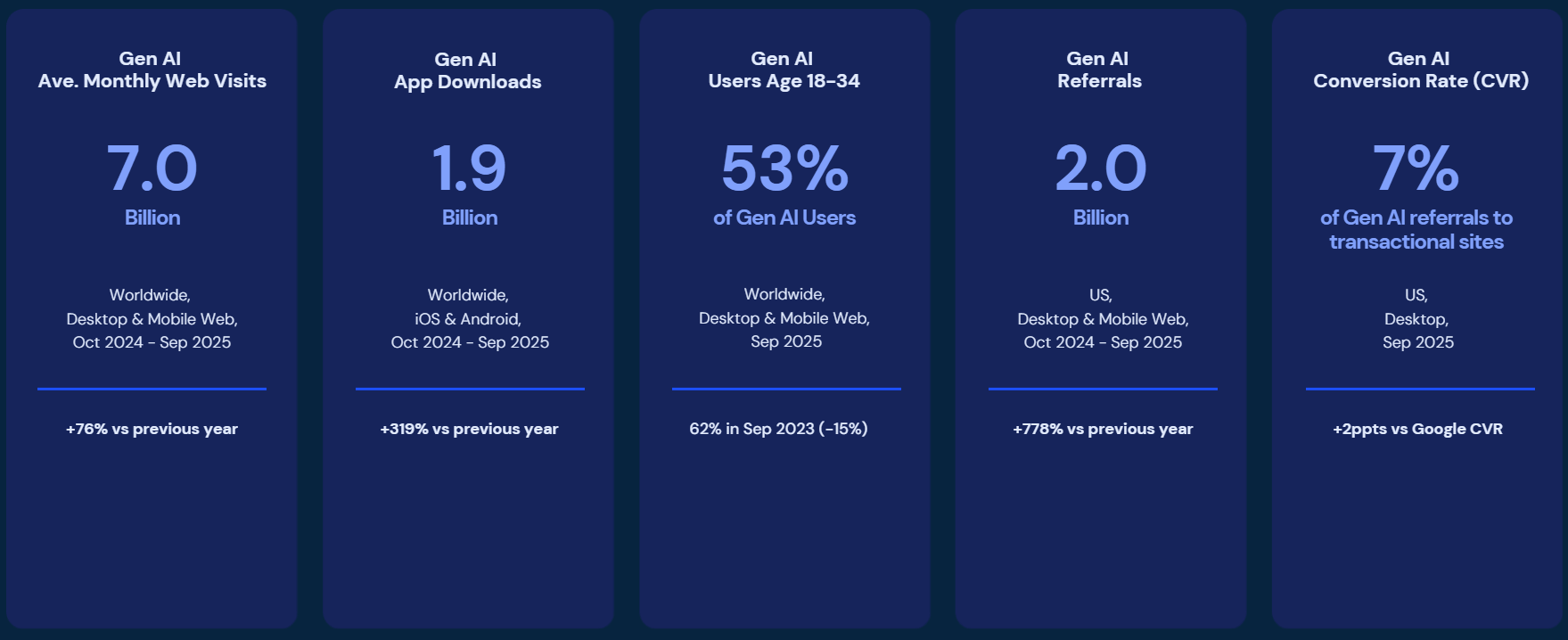
According to Similarweb’s 2025 Generative AI Landscape report, generative AI platforms now attract around 7 billion average monthly web visits, representing 76% year-over-year growth. Mobile adoption is accelerating even faster, with 1.9 billion app downloads over the past year, more than triple the previous period.
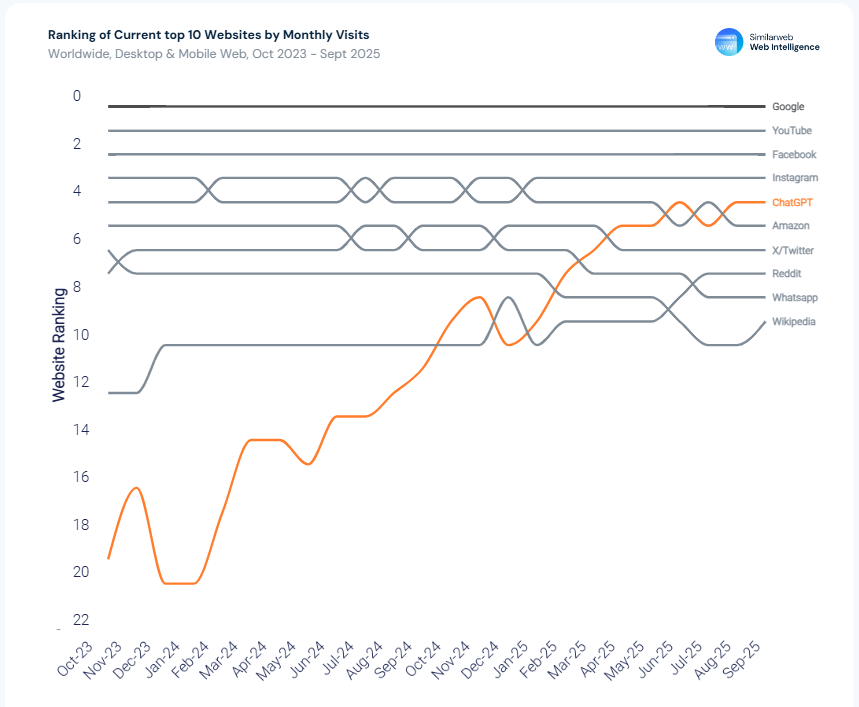
That growth has propelled ChatGPT into the global top five websites by monthly visits, placing it alongside long-established internet giants. Very few platforms in digital history have reached this level of scale this quickly.
But volume alone doesn’t explain why AI visibility matters.
The real shift is how people use these platforms.
How AI changes the way people ask, and decide
When you compare intent between Google searches and ChatGPT prompts, the difference is striking.

Traditional search is still dominated by informational and navigational queries. Users are often exploring a topic, looking for definitions, or trying to reach a specific destination.
ChatGPT prompts, on the other hand, skew heavily toward practical guidance, creative ideation, and problem-solving. Users aren’t just asking what something is, they’re asking how to do it, which option to choose, or what they should do next.
Behaviorally, this shows up in longer prompts and deeper sessions:
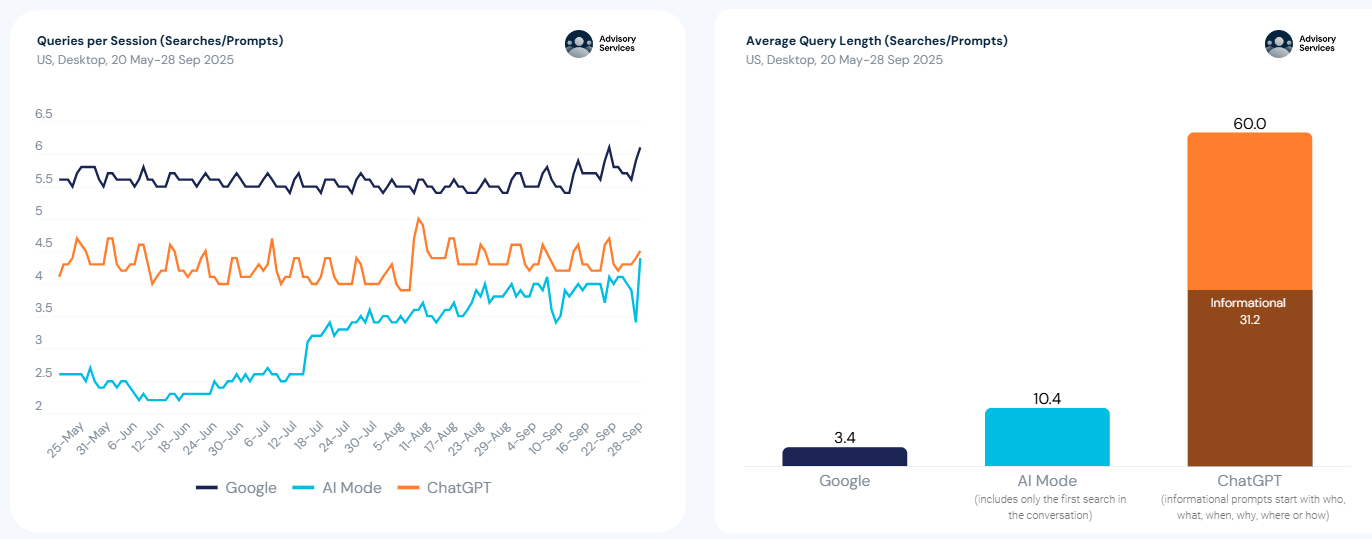
ChatGPT queries are significantly longer than Google searches, and users issue multiple prompts per session as they refine and narrow their prompt intent. Instead of bouncing between sites, the refinement happens inside the conversation.
This compression of research, comparison, and validation into a single interface is what makes AI visibility fundamentally different from ranking for keywords.
AI isn’t replacing search, it’s sitting beside it (for now)
Despite the rapid rise of generative AI, user behavior doesn’t support its replacing traditional search.
An analysis published by Search Engine Land found that AI tool adoption among U.S. internet users grew from roughly 8% in 2023 to around 38% in 2025, while about 95% of users continued to rely on traditional search engines. AI usage is growing quickly, but it is being added to existing search behavior, not replacing it.
Similarweb audience overlap data supports this and shows that the vast majority of ChatGPT users also use Google. People aren’t abandoning search, they’re adding AI as another tool in their decision-making process.
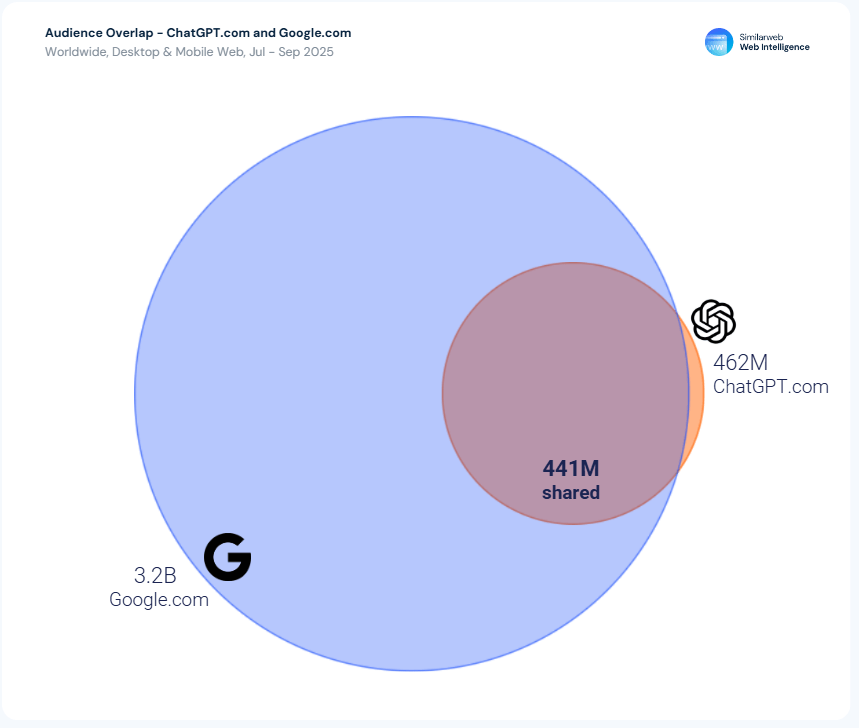
Search remains the place where exploration often begins. AI increasingly plays the role of validation, synthesis, and confidence-building. Users move fluidly between the two depending on what they’re trying to accomplish.
This coexistence is why AI visibility should be treated as an extension of search strategy, not a competing one.
Why AI traffic punches above its weight
While AI-driven referrals still represent a smaller share of total traffic compared to search, their quality tells a different story.
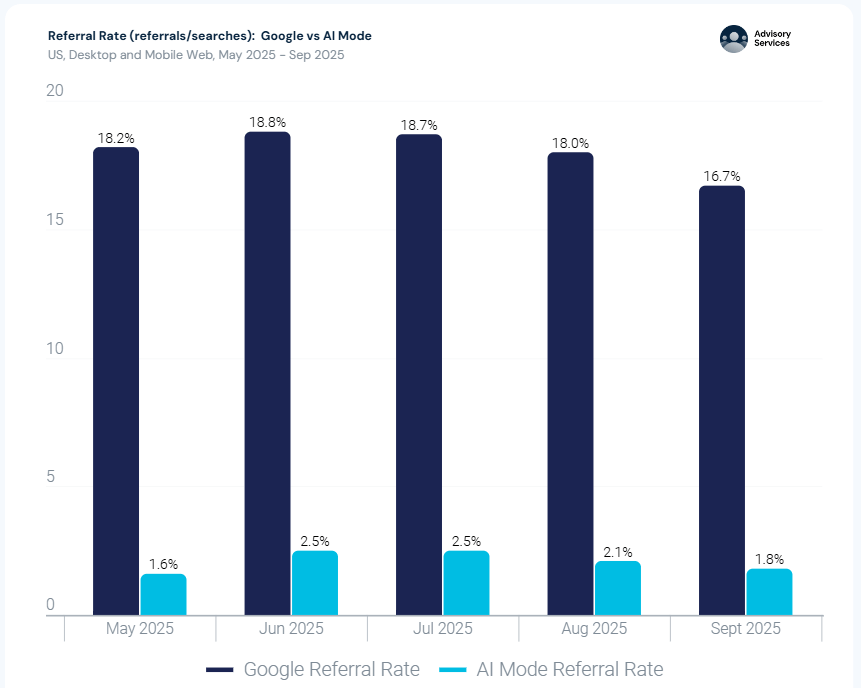
When our team compared downstream behavior from AI mode and Google referrals, AI traffic consistently showed stronger engagement. Visitors referred from AI platforms spend more time on the site, view more pages, and are more likely to convert.
In the US, referrals from generative AI to transactional sites convert at around 7%, compared with roughly 5% from Google, and they also spend more time on websites and browse more pages.
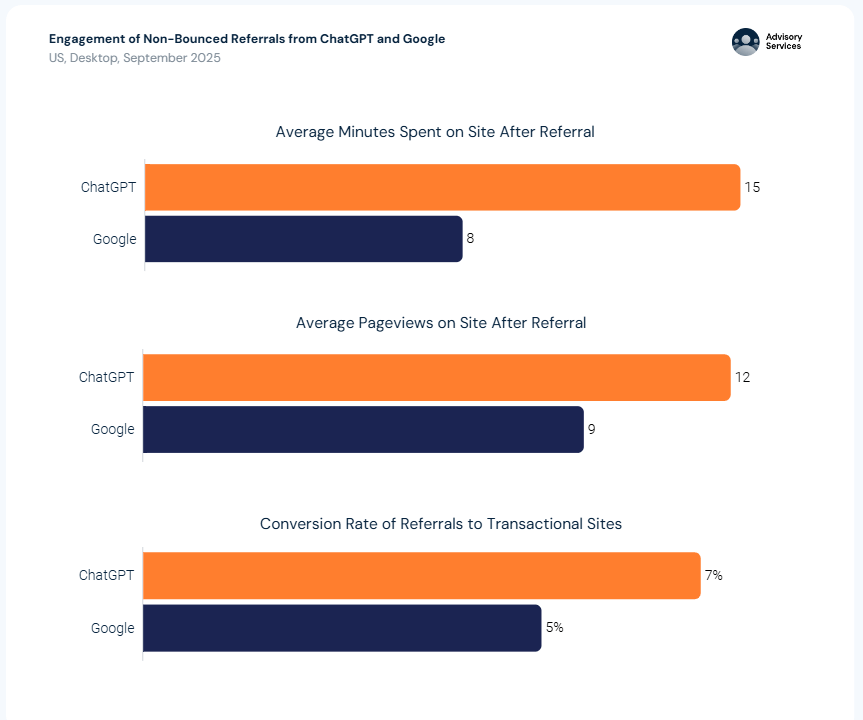
What’s more important is the trend. AI referrals and referrals per visit have both increased steadily over time, suggesting that AI platforms are not only sending more traffic, but increasingly sending better-qualified traffic.
AI visibility isn’t a volume play. It’s a decision-stage play.
So, when does investing in AI visibility actually make sense?
Looking at brand visibility across industries, one pattern stands out immediately: AI visibility is already concentrated. In retail, for example, a small group of brands dominates mentions and citations in generative AI answers.
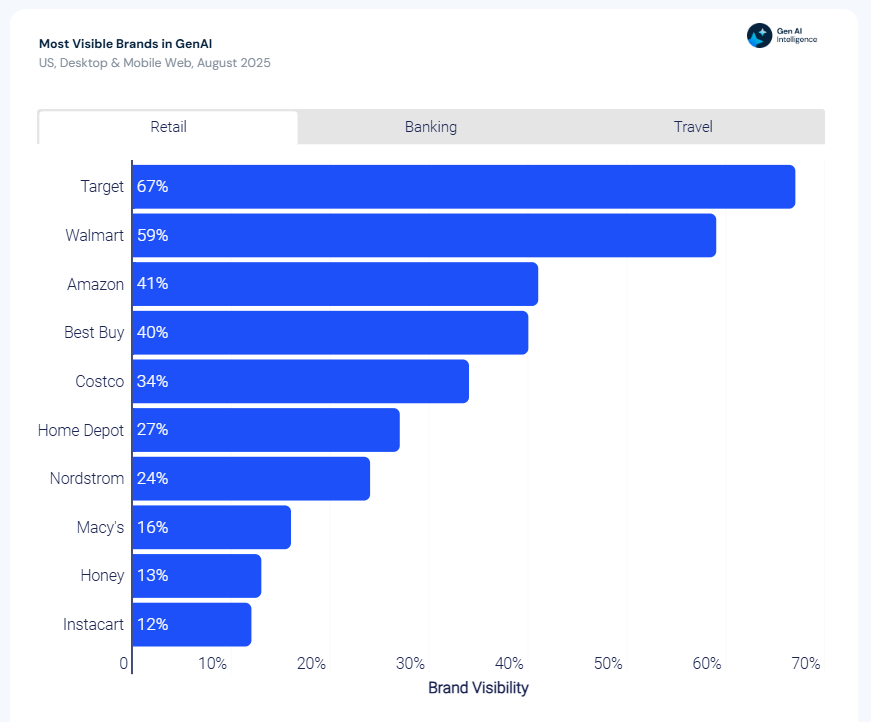
That concentration signals early competitive advantage, and a growing gap between brands that are present in AI conversations and those that are not.
Your category depends on trust, comparison, or explanation
If users need help choosing, understanding trade-offs, or validating options, AI systems are increasingly mediating that process.
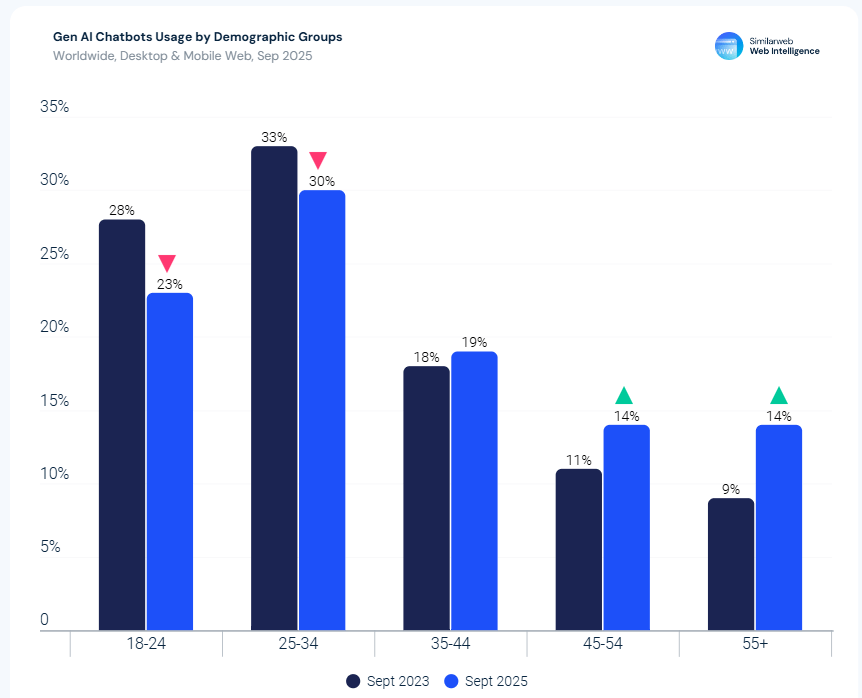
Your audience is already there
More than half of generative AI users fall into the 18–34 age group, but adoption among older demographics is rising steadily, especially for productivity and problem-solving use cases.
You already invest in high-quality SEO
AI systems tend to surface brands with strong authority, structured content, and credible coverage, the same fundamentals SEOs have focused on for years.
Your competitors are showing up, and you’re not
Citation depth data shows that AI systems overwhelmingly reference content that sits close to the root of a site’s structure. Pages buried deep in folder hierarchies are far less likely to be cited.
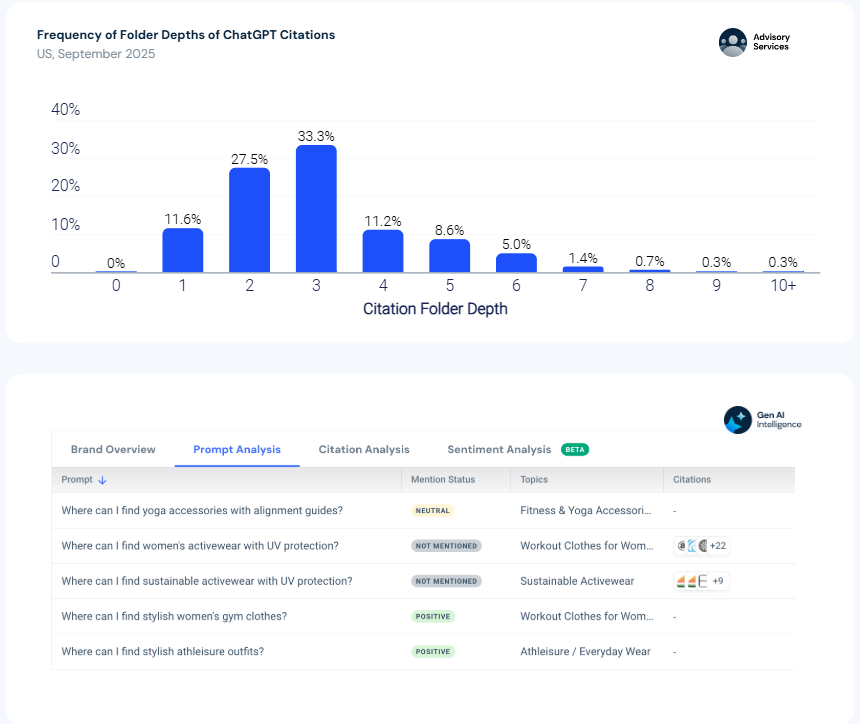
That means AI visibility compounds around brands with clear site structure and accessible, well-organized content.
Similarweb turns AI visibility into something you can measure
One of the biggest challenges with AI visibility is that it is largely invisible by default. Brands know AI platforms are influencing research and decisions, but they often have no clear way to see what that influence looks like in practice.
This is where Similarweb’s GenAI Intelligence comes in. It is designed to make AI-driven discovery measurable by breaking it into two distinct but connected views.
AI Traffic
AI Traffic focuses on what happens after an AI platform sends users to your site, and on understanding which generative AI chatbots are driving that traffic in the first place.
Using Similarweb’s AI Chatbot Traffic reports, teams can clearly identify traffic coming from platforms like ChatGPT, Perplexity, and other generative AI chatbots. This makes it possible to see which AI platforms are actually influencing referral behavior, rather than treating AI as a single, generic source.
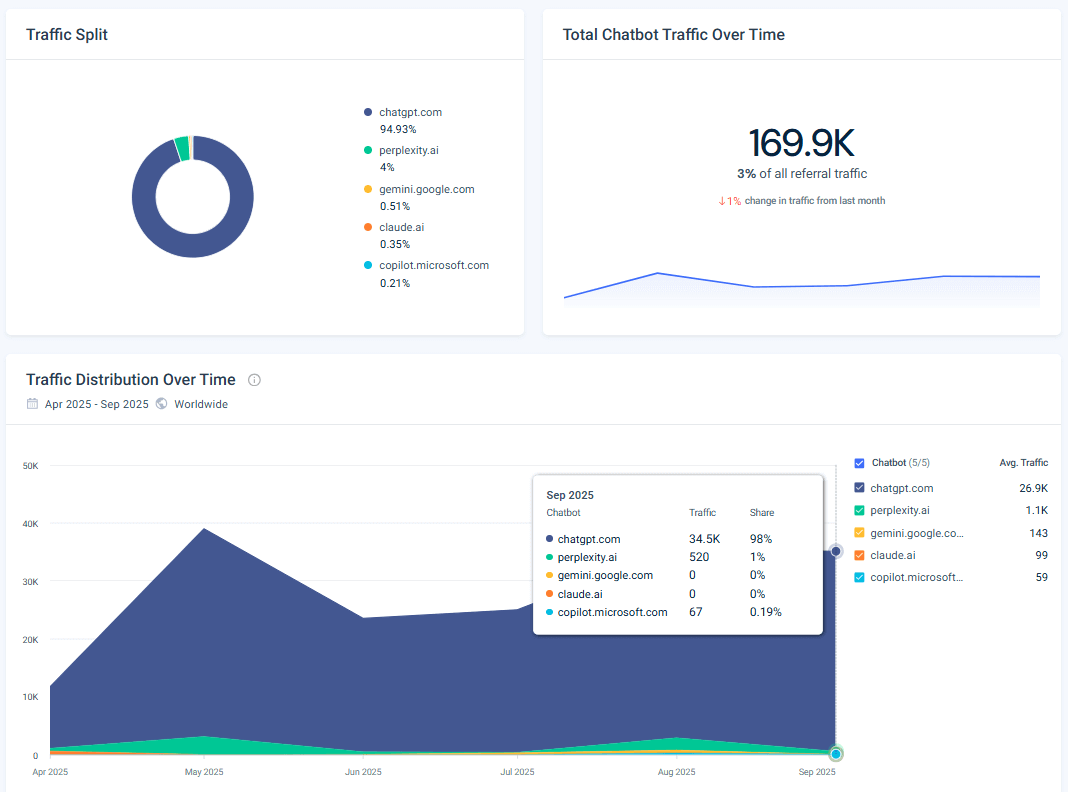
AI Traffic analysis helps answer practical questions, such as which chatbots are sending the most visits, how that traffic is split across competitors, and how AI-driven visits trend over time. By looking at traffic share, growth patterns, and distribution by chatbot, teams can spot where AI influence is accelerating and where competitors may be benefiting more than they are.
The report also surfaces prompt-level referral insights, showing which types of questions and prompts are leading users from AI chatbots to specific pages. This helps teams understand not just that AI traffic exists, but why it is being sent and what kind of intent sits behind it.
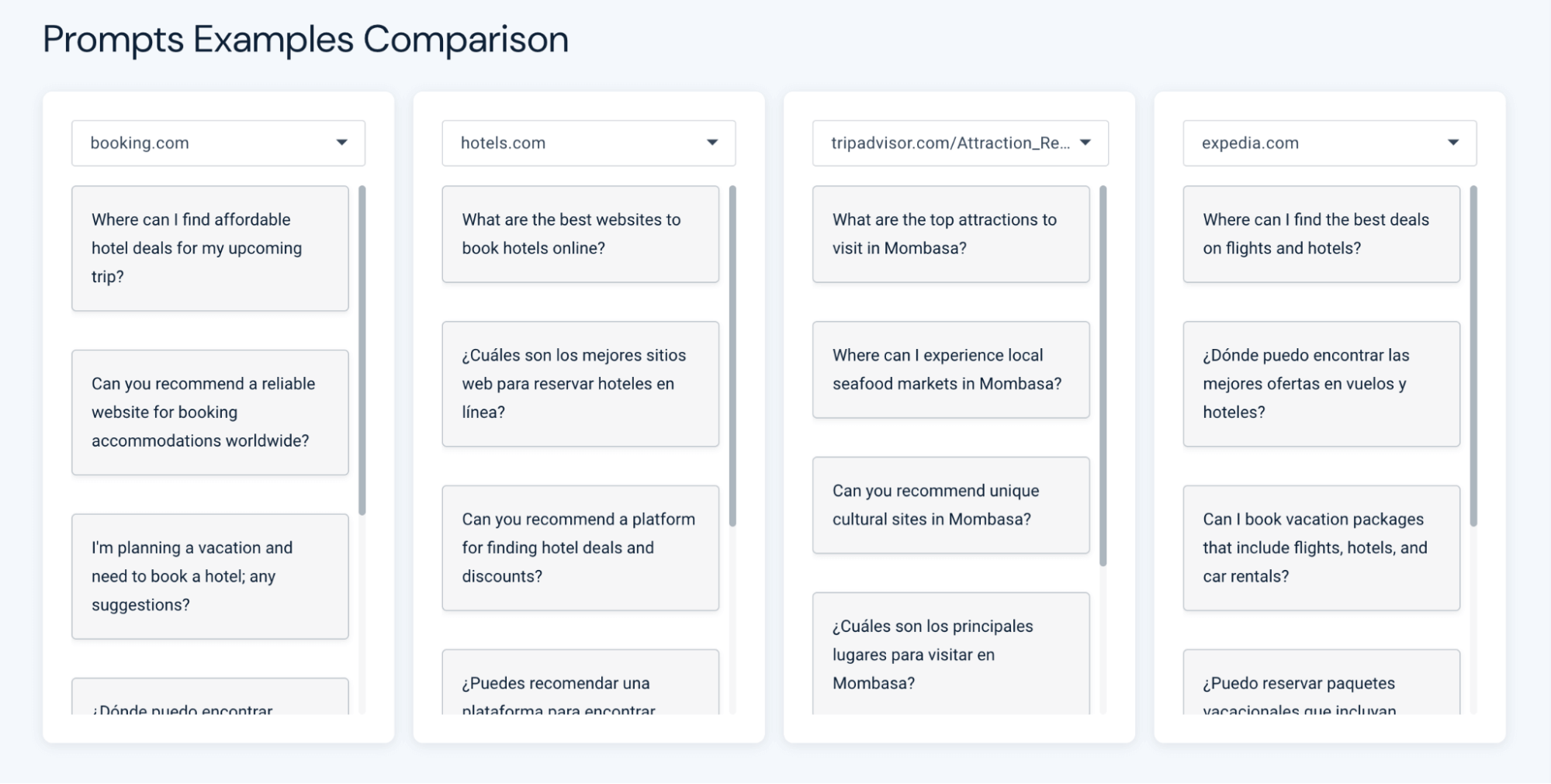
Instead of guessing whether AI matters, AI Traffic makes the impact of generative AI measurable. It shows how different chatbots contribute to visibility, engagement, and conversions, and where content and optimization efforts are most likely to pay off.
AI Brand Visibility
The AI Brand Visibility tool focuses on what happens before the click. It shows how and where your brand appears inside AI-generated answers, which prompts surface your brand, and which sources shape those answers in the first place.
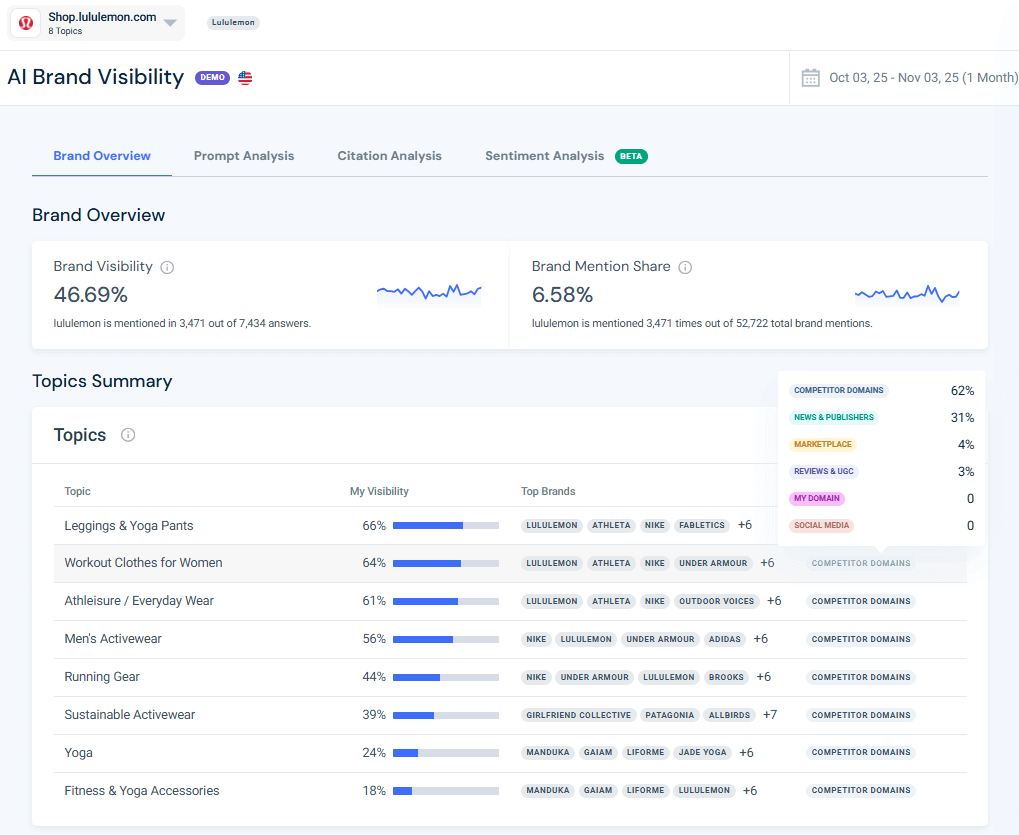
AI Brand Visibility is built around three complementary views that explain not just whether you appear in AI answers, but why.
Citation Analysis
The AI Citation Analysis tool shows the sources that generative AI models rely on when answering questions related to your topics. At a high level, it highlights which domains are most frequently cited and how influential they are across AI answers.
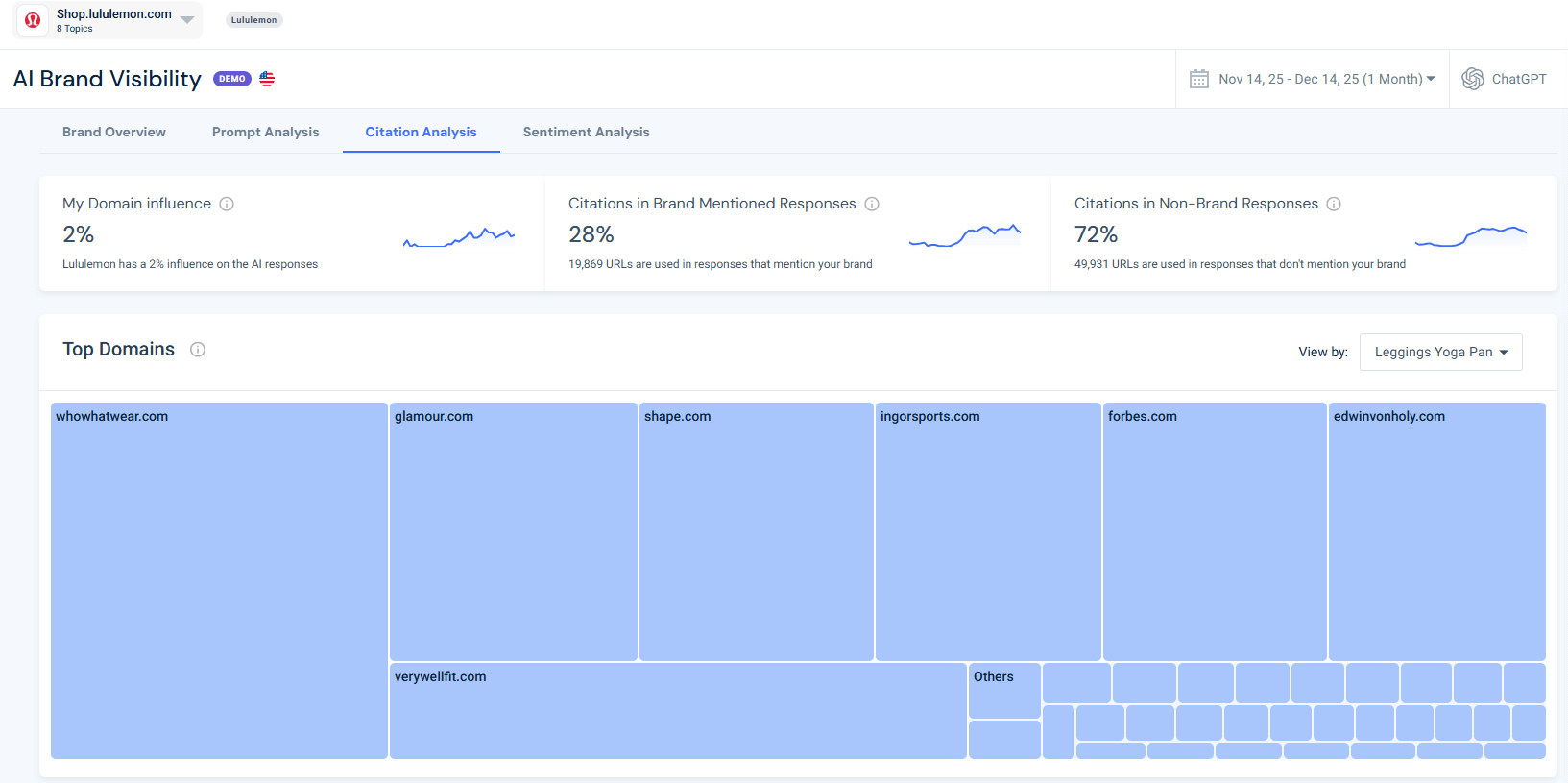
Drilling down reveals the exact URLs being used as sources, the topics and prompts they influence, and the type of source they represent, such as publishers, reviews, UGC, marketplaces, competitor sites, or your own domain.
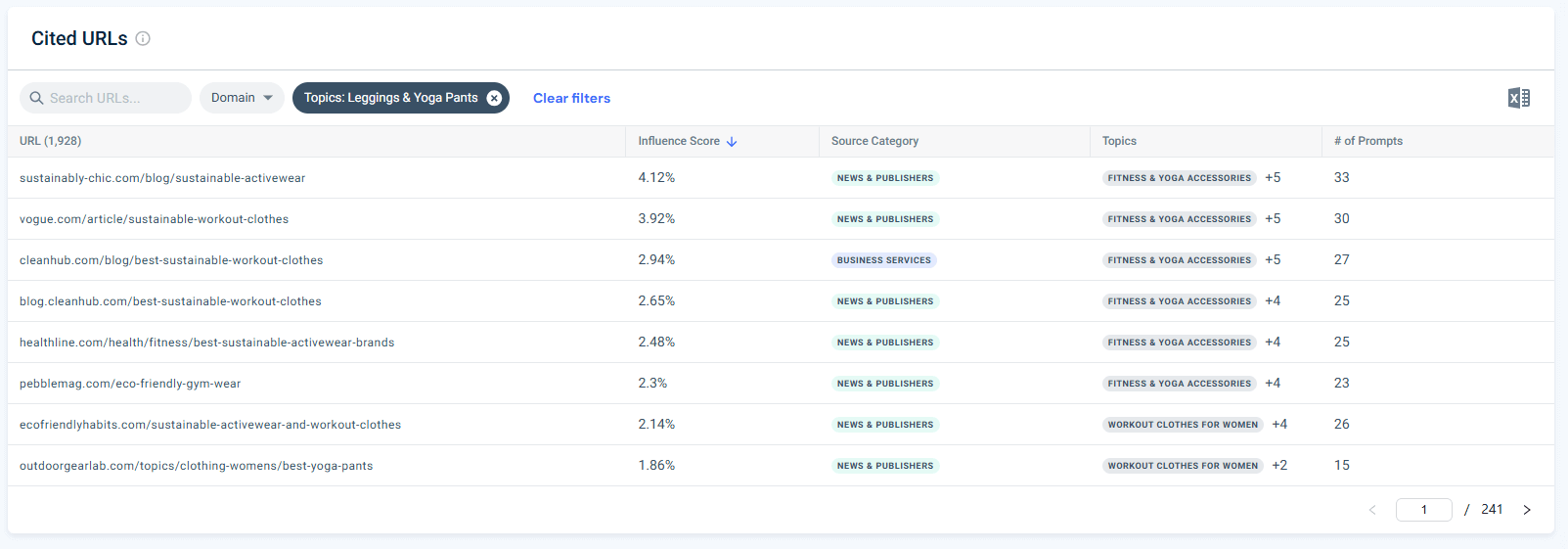
This makes it possible to see which sites AI systems trust most, where your competitors are gaining visibility, and where opportunities exist to either strengthen your own content or partner with high-influence sources through PR, reviews, or brand-building efforts.
Prompt Analysis
The AI Prompt Analysis tool shifts the focus to what users are actually asking AI platforms.
It shows the specific prompts users enter for the topics you track, whether your brand is mentioned in the answer, and which other brands appear alongside you. For each prompt, you can also see the full AI-generated response and the sources used to construct it.
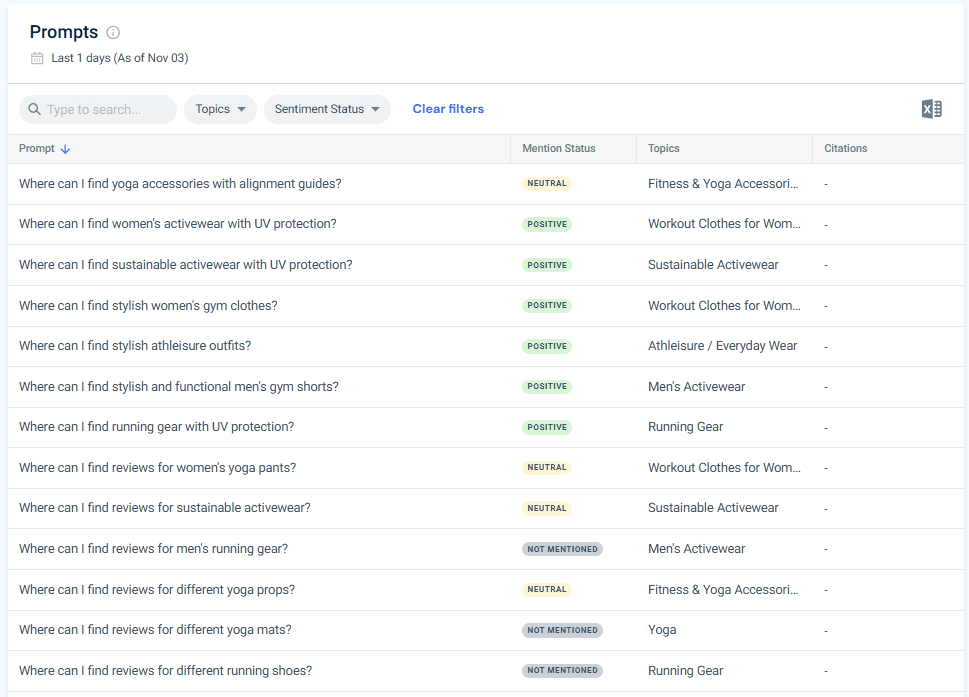
This view helps teams identify AI visibility gaps quickly. Prompts where your brand is missing become clear priorities for on-page content improvements, while citation patterns point to off-page opportunities such as partnerships or coverage on trusted domains.
Sentiment Analysis
The AI Sentiment Analysis tool adds important context to visibility by showing how AI models talk about your brand. It tracks whether mentions are positive, neutral, or negative across topics, prompts, and competitors.
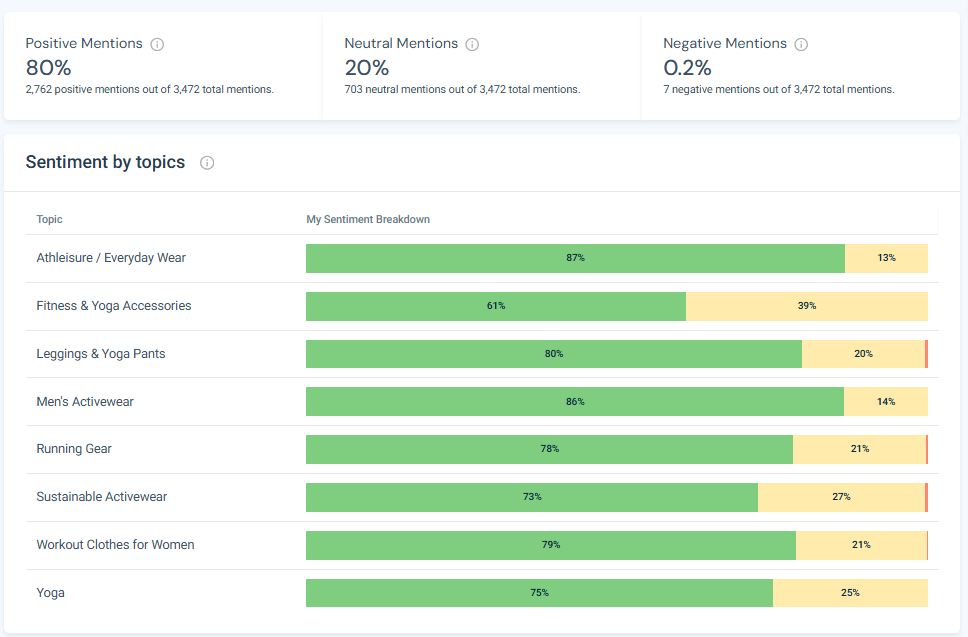
This helps teams understand not just presence, but perception. Visibility without trust can work against you, and sentiment analysis highlights where messaging, positioning, or brand signals may need attention.
Together, these views turn Similarweb’s AI Brand Visibility tool practical and actionable. They connect prompts, sources, mentions, and sentiment into a single picture that explains how AI systems represent your brand, and where action will have the greatest impact.
So, is this SEO, GEO, or something else?
The acronym debate misses the point.
AI visibility isn’t a replacement for SEO, it’s the next chapter of it.
The core question has simply evolved:
- Then: How do I rank for this keyword?
- Now: How do I become the source AI systems trust enough to reference?
That shift rewards depth, clarity, structure, and credibility, not hacks.
Don’t panic. But don’t ignore it either.
AI isn’t killing search.
But it is reshaping how people research, compare, and decide.
For marketers and SEOs, the smartest move isn’t to chase acronyms or abandon proven strategies. It’s to recognize that generative AI has become a new marketing channel, and to make sure your brand is present where those decisions increasingly happen.
AI visibility isn’t about chasing the future.
It’s about responding to behavior that’s already here.

Related Posts


LLMs Comparison: How Different LLMs Contribute to Category Visibility
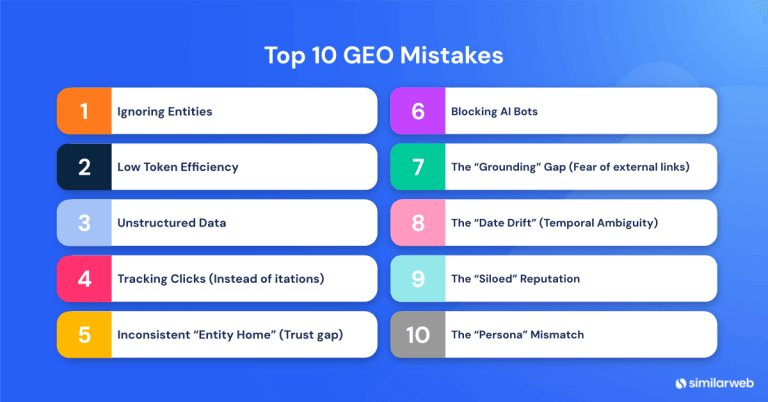
The 10 Biggest GEO Mistakes That Keep You Invisible to AI (+ One You May Be Doing Without Knowing)


The UCP Era: Why Visibility Matters More Than Ever In Agentic Commerce


Wondering what Similarweb can do for your business?
Give it a try or talk to our insights team — don’t worry, it’s free!