


 Marketing Intelligence
How to Optimize for Google’s AI Mode Searches
AI Mode is here, and, as SEOs, we’re all figuring out what it means.
I’ve spent the past few months watching the rollout, reading everything Google has published about it, and testing how it actually behaves. Some people like to see it as the death of SEO (Again). Others position it as a new way for people to find the information they need. Personally? I think it’s both a reset and an opportunity.
In this article, I’ll break down what Google AI Mode really is, how it differs from chatbots like ChatGPT and Perplexity, what’s actually changing for SEO, and what we can do right now to prepare. I’ll also share how I’m measuring visibility and traffic in this new search world, because yes, it’s still measurable.
What Google’s AI Mode Actually is (and Isn’t)
AI Mode is Google’s new, Gemini-powered search experience that delivers full, conversational answers directly in the interface. It’s a generative layer on top of Google Search, a place where users can ask complex, multi-step questions and get reasoning-driven summaries instead of 10 blue links.
As Google explained in its own announcement, AI Mode is now expanding to more languages and regions after months of testing. It’s not a single answer box like Featured Snippets or AI Overviews. It’s a full-screen conversational experience where Google can interpret intent, anticipate follow-ups, and cite relevant sources.
A few key things make AI Mode different from the traditional SERP:
- Fan-Out Queries: For every user prompt, Google fires off multiple related queries at once to gather context.
- Reasoning Chains: Gemini retrieves information and connects the dots between sources to form conclusions.
- Personalization: Google tailors responses using what it knows about you, from search history to Gmail and Maps data. (As BleepingComputer reported, this personalization layer goes deep.)
- Multimodality: AI Mode handles text, visuals, and voice, so optimization now extends far beyond copywriting.
Google’s September update post on Search AI experiences gives a glimpse of what’s next: a tighter integration of AI Mode with core search, and even new formats for shopping, local, and travel queries.
This is an early signal of how search is being fundamentally rebuilt around AI reasoning.
AI Mode vs ChatGPT and other chatbots
| Feature | Google AI Mode | ChatGPT / Perplexity / Claude |
| Core Function | Integrated into Google Search; powered by Gemini | Standalone conversational tools (Perplexity also functions as an AI search engine) |
| Data Source | Live Google web index + Knowledge Graph + Shopping Graph | Perplexity: live web index; ChatGPT/Claude: pre‑trained LLMs with optional live web browsing/tools |
| Citations | Consistently surfaces supporting links with answers (format varies) | Perplexity typically cites sources; ChatGPT/Claude show citations only when web browsing/tools are used |
| Personalization | Uses Google account signals and device/context data for deeper personalization | Limited to session/memory or account-level settings; not tied to Google’s cross-product signals |
| Retrieval Logic | Issues multiple background queries (“query fan‑out”) to assemble responses | Perplexity performs multi-source web retrieval; ChatGPT/Claude may issue ad‑hoc queries when browsing is enabled |
| Traffic Potential | Can drive clicks via cited links; ads are rolling out in AI Mode | Some referral traffic (strongest from Perplexity); ChatGPT/Claude generally limited |
| SEO Impact | Part of Google Search – classic SEO + GEO (answer/AI optimization) both apply | No traditional rankings; focus on being cited/mentioned (GEO/LLMO) rather than classic SEO |
In short, AI Mode remains part of Google Search, which means SEO still matters, now alongside GEO (generative engine optimization). ChatGPT and Claude are great for learning and assistance, but AI Mode more directly shapes discovery because it’s tied to Google’s live index and links back to the web.
How AI Mode changes SEO
The fundamentals of SEO still apply, but their weight in the algorithm is shifting. In the past, SEO revolved around ranking pages for keywords and earning clicks from SERPs. With AI Mode, success is about being cited within Google’s generative answers and earning visibility through mentions and trusted context. Metrics that once defined performance, click-through rate, and keyword position, now give way to newer ones like visibility share, sentiment, and engagement quality.
Ranking has evolved from optimizing entire pages for keywords to optimizing individual passages that support AI reasoning. Visibility is no longer confined to snippets or top positions; it’s about appearing in the right answer at the right time. Optimization is less about stuffing terms and more about structuring entities, context, and trust signals that AI can interpret, especially as AI-generated content floods the web and forces Google to prioritize credible, human-reviewed information.
Today, for some people, earning a place in Google’s reasoning process matters more than being #1 on the SERP for a specific keyword.
Here’s what I’m seeing so far:
- Visibility without clicks. You might get cited in AI answers without driving traffic, but those impressions still build authority and brand awareness.
- Entity and topical depth matter more. Google is using semantic understanding to decide which content supports its reasoning.
- User experience is now content quality. Fast, readable, factually supported pages are favored because they’re easier for AI to process.
- Zero-click search expands. With AI summaries and soon-to-come ads, organic clicks could keep shrinking, but intent-driven visits will be higher quality.
The new mindset: Optimize for discovery, not just rankings
I’ve started thinking about SEO as a balance between ranking well in Google’s traditional results and earning inclusion in AI-generated answers, making sure I maximize visibility in both ecosystems.
Here’s how I break it down:
1. Context: Be the source AI trusts
Google’s reasoning models rely on credible, consistent information. That means reinforcing EEAT at every level: real authors, expert credentials, consistent data, and verifiable sources. Use structured data to link your brand to entities Google already understands.
2. Coverage: Own the topic, not the term
AI Mode doesn’t see isolated keywords. It maps related questions and subtopics through fan-out. Build pages that cover the full conversation, from “what” to “how” to “why”. Include FAQ blocks, use natural language, and link internally to related pages.
3. Credibility: Win the citation game
The new currency is citations. Write answer-first, fact-based paragraphs. Use numbers, comparisons, and clear statements that can stand on their own. The easier you make it for AI to quote you, the more likely you’ll appear in its reasoning chain.
How to optimize for Google’s AI Mode: 10 Actionable GEO tips
You don’t need to reinvent your strategy, just refocus it around clarity, credibility, and coverage.
Audit your top pages for AI readiness
Start by identifying your most valuable content, the ones already ranking or earning backlinks. Review whether each section provides a complete answer to a user’s question. AI Mode extracts information at the passage level, so each paragraph should stand alone, delivering value without requiring users (or AI) to read the entire article. Include data points, concise definitions, and examples that help clarify complex concepts.
Structure for passages, not pages
AI Mode thrives on clarity and hierarchy. Use descriptive H2 and H3 headings that match user intent, and add summary boxes or pull quotes that encapsulate the key takeaway of each section. Break long paragraphs into digestible content chunks, and incorporate tables, bullet points, and comparisons. This structure improves readability for humans and helps AI models interpret your page’s hierarchy.
Anticipate follow-up questions
Think like a user having a conversation with Google. If someone asks “What is AI Mode?”, their next question might be “How does AI Mode impact SEO?” or “Can I optimize for it?”. Include these natural progressions in your content by adding FAQ sections and internal links that guide both users and AI through related queries. This mimics conversational logic and improves your chances of appearing in multi-turn AI responses.
Show your expertise
EEAT is the foundation of AI visibility. Highlight your real-world experience and credentials throughout your site. Use author bios that showcase subject-matter expertise, and cite reputable sources in your content. If you’ve conducted proprietary research, mention it. Demonstrate hands-on understanding instead of summarizing what’s already out there. AI systems favor first-hand, expert insights over generic commentary.
Add visuals and transcripts
AI Mode can analyze text, images, and even video transcripts, so every format counts. Include original graphics, annotated screenshots, and embedded videos that explain processes visually. Use descriptive file names, alt text, and captions that add semantic value. If you publish webinars or podcasts, add full transcripts, as they provide additional keyword context and make your media accessible to both users and AI crawlers.
Implement Schema Markup
Structured data is how you talk directly to AI. Mark up your pages with FAQ, HowTo, Product, Organization, and Article schemas to give Google context. Validate the schema regularly to ensure there are no syntax errors or mismatches between markup and visible content. Schema helps your content appear in AI Mode responses as well as in enhanced search results, supporting both discovery and click potential.
Optimize site experience
AI Mode still values fast, accessible, and secure pages. Compress images, improve Core Web Vitals. A simple, well-structured layout helps both users navigate easily and crawlers interpret your content accurately. Additionally, pay attention to mobile-first design since AI Mode experiences are deeply integrated with mobile devices and the Google app.
Cluster by topic
Build interconnected topic clusters that reflect how users explore subjects. Instead of one-off blog posts, develop pillar pages supported by detailed subpages that dive into narrower questions. Link them internally with descriptive anchor text. This structure signals to Google that you have deep authority on a topic, improving your odds of being included across multiple AI Mode queries.
Keep content fresh
AI Mode relies on recency signals to provide up-to-date answers. Revisit your high-performing pages quarterly, updating them with new data, screenshots, or examples. Use publication dates and “last updated” labels transparently, as it reinforces trust. Outdated information risks being skipped by AI, so treat freshness as a ranking factor in itself.
Reframe KPIs
Traditional SEO metrics like raw traffic and keyword rank are no longer enough. Measure visibility share, how often your brand appears in AI answers, and sentiment to gauge perception. Track engagement metrics such as scroll depth and dwell time to assess how visitors interact after finding you. Combine this with AI traffic and prompt intent analysis to see which types of content drive both citations and conversions. The goal is to shift your reporting from volume to influence, showing leadership and visibility rather than just numbers.
How to measure success in the AI Mode era
This is where most SEOs are struggling. We can’t rely solely on GSC impressions or organic sessions anymore. It’s the essence of GEO, optimizing not just for traditional SERPs, but for how generative engines surface and summarize your content. Visibility is fragmented across AI answers, chatbots, and assistant interfaces.
To stay ahead, I use two key data points from Similarweb’s AI Search Intelligence tools:
1. AI Brand Visibility
With Similarweb’s AI Brand Visibility tool, you can measure and understand how and where your brand shows up across LLM-generated content, giving you the insights needed to take action. The tool lets you discover your visibility for specific topics within generative AI platforms and benchmark against competitors. It shows the most visible websites for each topic, pinpoints which sources AI tools rely on most, and helps you analyze the relevant prompts to see if your brand appears in the answers.
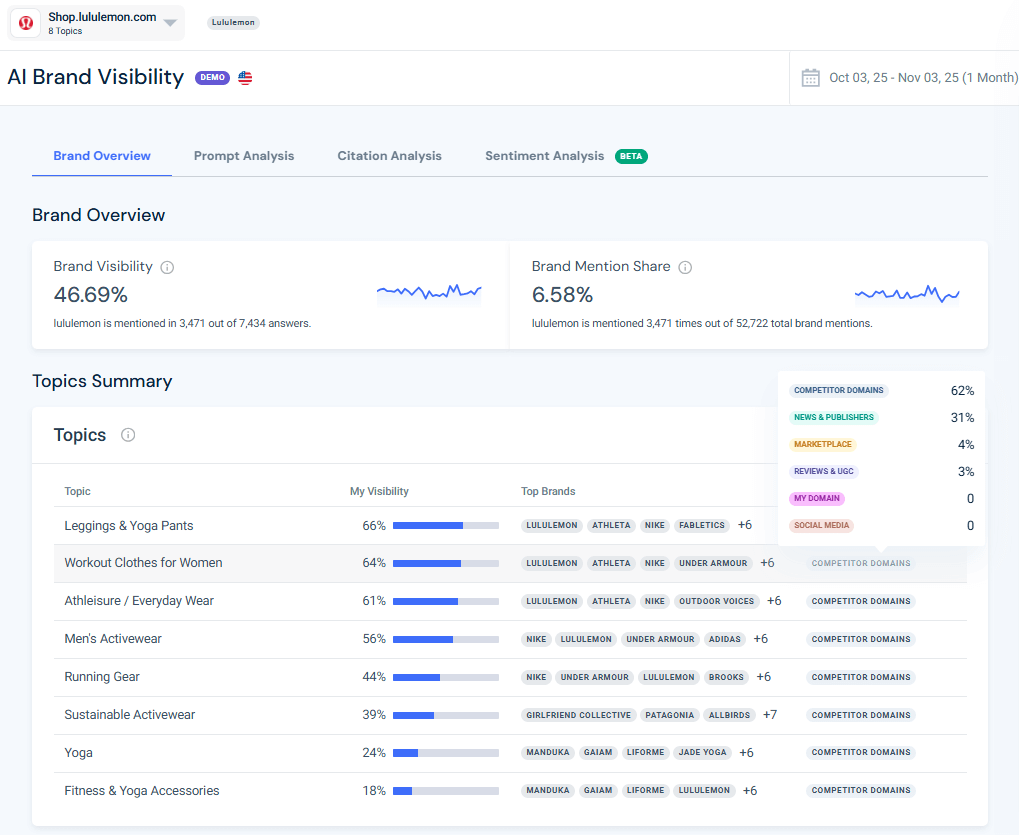
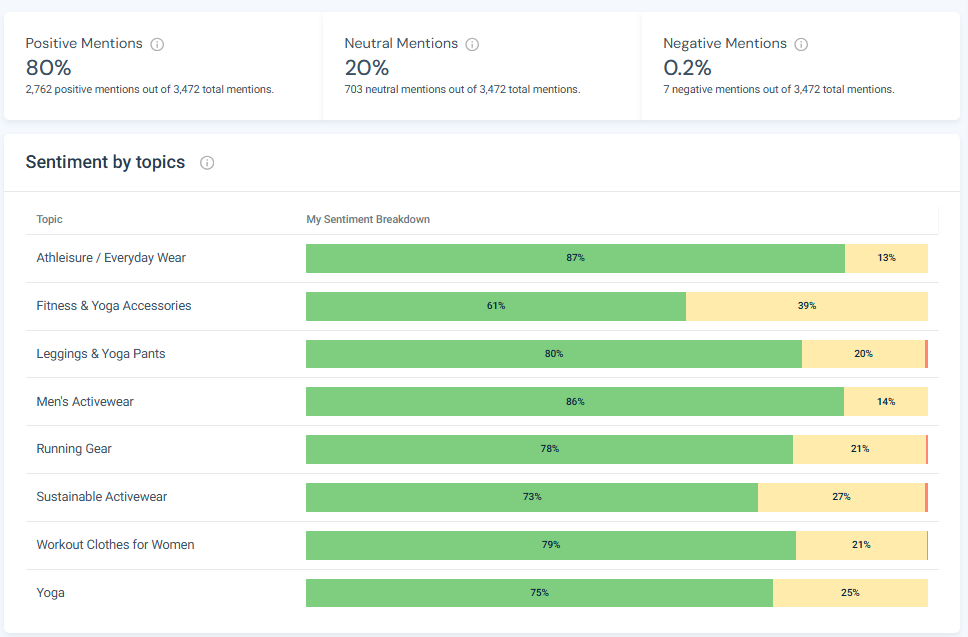
Beyond raw visibility, the Sentiment Analysis feature helps you measure reputation. You can see how your brand is being spoken about, positive, negative, or neutral, across prompts and topics. A sentiment score (from -1 to 1) benchmarks how your brand compares to competitors, while prompt-level transparency shows exactly which questions generated different tones. This allows you to detect risks early, reinforce positive narratives, and refine your messaging to improve perception.
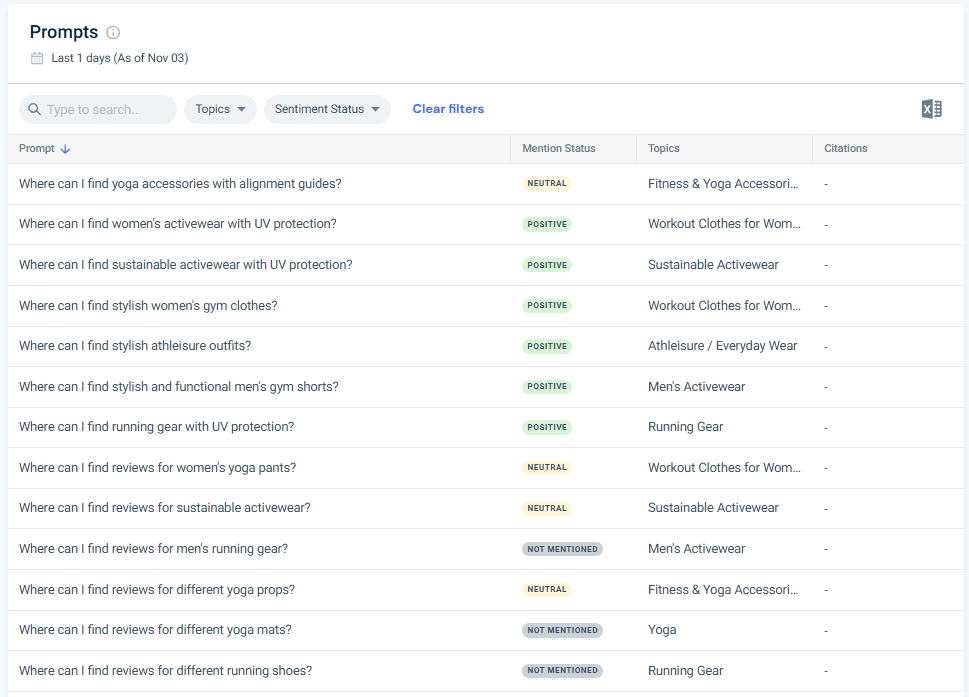
Citation and Prompt Analysis modules offer even more context. The Citation Analysis tool shows the specific sources shaping AI answers, helping you identify which domains are driving your mentions, while the Prompt Analysis tool reveals the prompts that led to those responses. Together, these insights show both the “why” and “how” behind your brand’s AI presence, empowering you to take concrete action to improve it.
2. Track AI traffic
Visibility is great, but I also want to know what’s driving visits. Similarweb’s AI Traffic Tracker shows which domains, including mine and my competitors’, are receiving traffic from chatbots like ChatGPT, Perplexity, Copilot, and DeepSeek. It lets me see:
- How much traffic comes from AI sources vs. search?
- The exact prompts that lead to clicks.
- Top pages getting AI-originated visits.
- Shifts in AI traffic over time.

Together, these tools close the gap between visibility and measurable performance. I can track AI visibility share, AI traffic share, and even prompt-to-click conversion, translating previously hidden AI interactions into measurable performance data.
Final thoughts: SEO isn’t dying, it’s getting smarter
Seasoned SEOs have navigated major changes before, and this is another one. We’ve adapted through every algorithm update and interface change so far, and we’ll adapt again.
AI Mode doesn’t eliminate SEO, it redefines what effective optimization looks like. We’re not just optimizing for rankings anymore, we’re optimizing for visibility, credibility, and being a part of AI-driven discovery.
Rather than chasing clicks, concentrate on visibility and authority within AI-generated results. Track your mentions, understand your prompts, and make your brand part of the conversation.
Because in the AI Mode era, visibility within AI answers has become as valuable as top placement once was.
FAQs
How does AI Mode affect local SEO efforts?
AI Mode’s generative answers often pull from trusted local sources such as Google Business Profiles, review sites, and verified regional pages. To stay visible, ensure your local listings are accurate, use structured data like LocalBusiness schema, and include location-specific details that make it easier for AI systems to connect your business to local intent queries.
What’s the best type of content to earn citations in AI Mode?
Fact-rich, clearly structured, and expert-led content performs best. AI Mode looks for trustworthy, well-sourced material to support reasoning, so it prioritizes depth, accuracy, and EEAT.
Can AI Mode surface content from smaller sites, or is it biased toward big brands?
While larger domains may have stronger authority, smaller sites can still rank and be cited when they offer unique expertise or highly specific information relevant to a topic.
Should I optimize differently for AI Mode versus classic search?
Core SEO principles remain, but AI Mode optimization focuses more on topic authority, structured data, and clarity at the passage level.
How often should I update content to stay visible in AI Mode?
Review high-performing pages quarterly. AI Mode favors fresh, accurate information, so regular updates signal reliability and increase the chances of being included in AI-generated summaries.

Related Posts

Why AI Engines Cite UGC Over Brand Content And How To Leverage It For AEO

AI Mentions vs. AI Citations: What’s the Difference and Why It Matters for GEO


How to Do A Competitive Analysis: Complete Guide & Free Templates


Wondering what Similarweb can do for your business?
Give it a try or talk to our insights team — don’t worry, it’s free!