


 Marketing Intelligence
How to Optimize Ecommerce Websites for ChatGPT

For the past twenty years, optimizing an ecommerce website has meant one thing. Ranking higher in Google.
But Gen AI platforms don’t rank websites.
They recommend brands and products.
When a shopper asks ChatGPT for ‘the best noise-canceling headphones for travel,’ the AI doesn’t provide a list of websites to browse. It acts as a digital personal shopper, curating a shortlist of brands it trusts.
This shift represents a new era of ChatGPT ecommerce that changes the optimization problem entirely.
It’s no longer just about getting the click. It’s about winning the recommendation. If the AI doesn’t feel certain about your product, you effectively don’t exist to the shopper.
This guide shows you how to build that certainty.
1. How the AI personal shopper vets your brand
ChatGPT doesn’t search the web in the way traditional search engines do. It doesn’t crawl pages to rank them for keywords or return a list of blue links.
To recommend your product to the user, AI needs to build a coherent, high-confidence picture of what you sell.
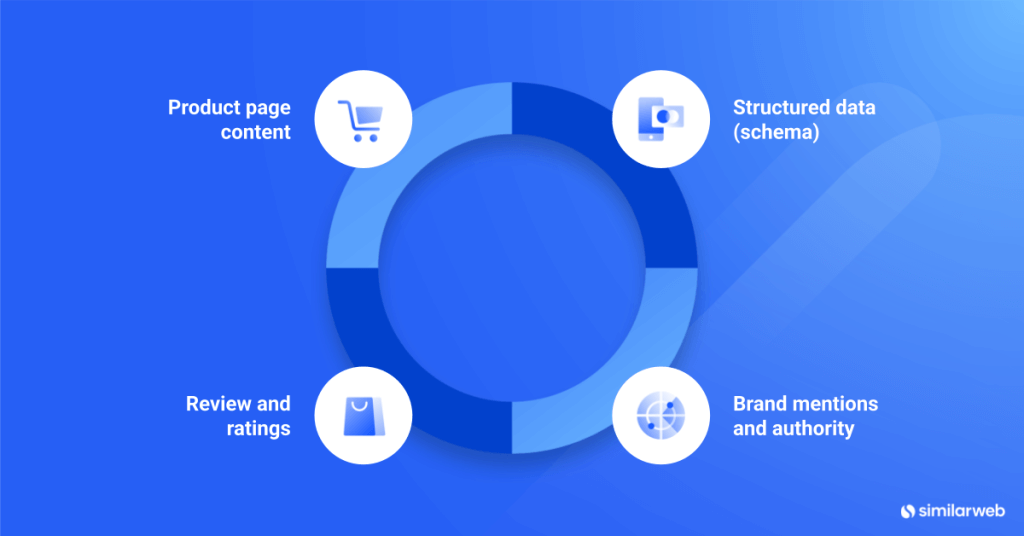
It does this by vetting four specific signals:
a) Product page content
At the foundation is the product page content. Clear descriptions, use cases, specifications, and benefits make it easier for AI systems to accurately interpret what you sell and when it’s relevant to a shopper’s question.
b) Structured data (schema)
AI systems hate ambiguity. Structured data acts as a machine-readable fact sheet. By using JSON-LD schema, you provide the AI with grounded facts price, availability, and dimensions that it can verify instantly without having to guess by reading your marketing copy.
c) Review and ratings
An AI shopper won’t recommend a product it doesn’t trust. It scans reviews and ratings to understand real-world quality and sentiment. It looks for consensus. If thousands of users call a pair of boots durable, the AI gains the statistical confidence to repeat that claim.
d) Brand mentions and authority
The AI looks beyond your website to see what the rest of the web says. If your brand is consistently cited in best of lists on Wired, discussed on Reddit, or reviewed by experts, the AI views you as a vetted authority in your category.
Taken together, these signals point to a simple reality. Clear, well-structured ecommerce sites are easier for ChatGPT to understand and more likely to be recommended. More than mere gaming an algorithm optimization is about removing friction between how your products are presented and how conversational AI interprets them. Here is a practical guide to mastering GEO for your ecommerce store to get more visibility, more traffic, and more conversions.
2. How to optimize ecommerce websites for ChatGPT
Now that you know how and where ChatGPT recommends brands like yours, here is a practical guide to getting more visibility, more traffic, and more conversions.
a) Measure your current AI visibility and traffic
This is where the rubber meets the road. You can’t know whether your ChatGPT optimization efforts are working if you’re not measuring visibility in AI-driven discovery channels.
Before making changes to your site or content, you need a clear baseline. How visible is your brand today, and where is that visibility coming from?
With Similarweb AI Search tools, you can track a brand’s AI visibility by topic, which makes topic selection a critical first step. Choosing the right topics ensures you’re measuring the conversations that actually reflect how shoppers discover and compare products.

Above, we see that Ray-Ban is tracking:
- Black Friday sunglasses deals
- Wayfarer Sunglasses
- Clubmaster sunglasses
- Sunglasses for men
- Meta Smart Glasses
- Camera glasses
- Prescription sunglasses
- Polarized sunglasses
For every topic, we provide a Visibility Score based on how often your brand name appears in AI-generated responses to relevant user prompts.
Tracking at the topic level allows you to see how your brand performs across different product categories and intents, not just branded queries.
From there, you can compare your visibility directly against competitors.
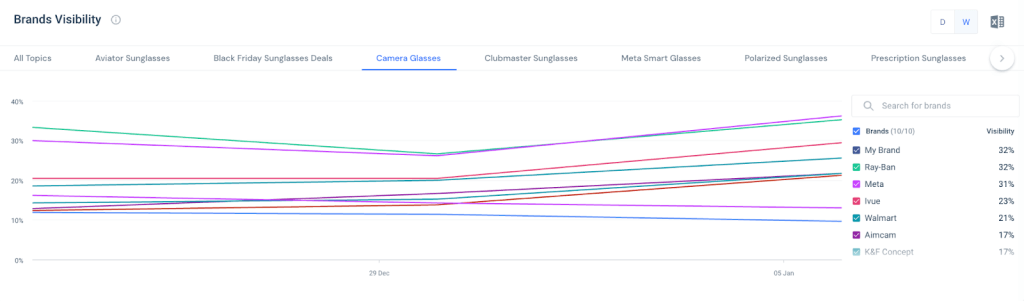
For instance, in camera glasses–related prompts, Ray-Ban’s brand appears in 32% of AI responses, followed closely by Meta at 31%. This type of insight highlights where your brand is leading and where competitive pressure is highest.
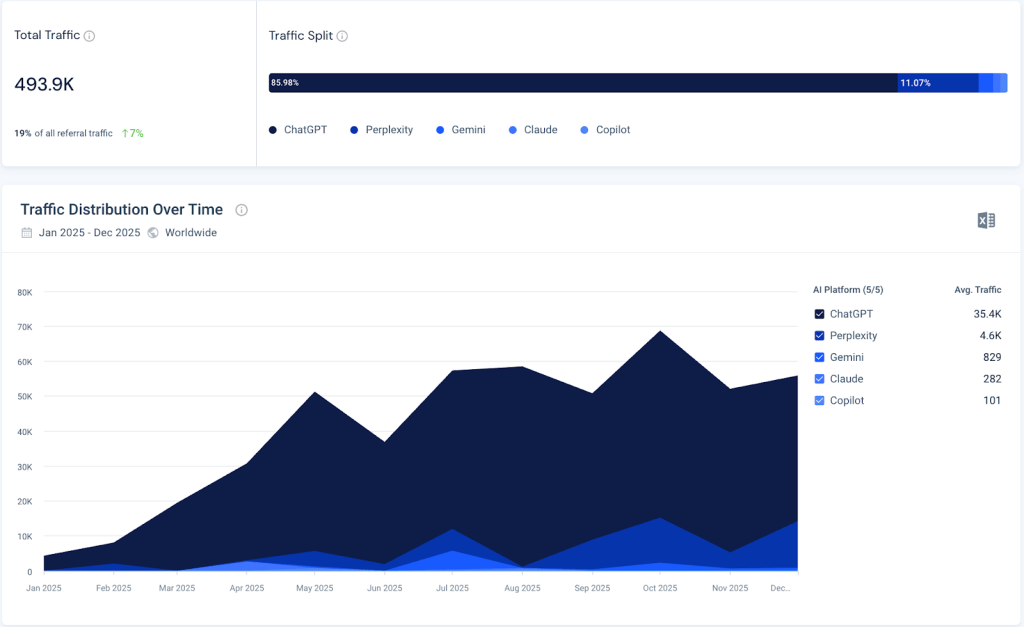
Visibility is only part of the story. Traffic matters too. Measuring how much referral traffic your brand receives from generative AI platforms helps quantify real impact. You can do that with Similarweb’s AI traffic tracker. In Ray-Ban’s case, ChatGPT drives 86% of its AI-referred traffic, with Perplexity accounting for another 11%.
What makes this feature especially valuable is that it shows which pages are capturing the most AI-driven traffic, along with the exact prompts users are using to reach them.
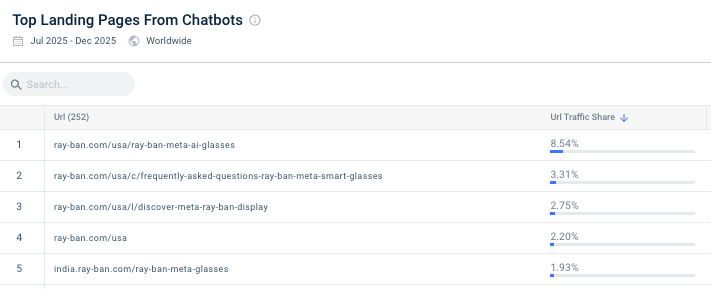
For example, Ray-Ban’s Meta Glasses product page accounts for 8.5% of all AI-referred traffic, outperforming even the homepage, which captures just 2.2%. This highlights how conversational AI often sends users directly to highly relevant product or category pages, not generic entry points.
Use this data to see where you are already winning and where you can make the most impact.
Together, visibility share and traffic share provide a clear picture of how AI is influencing discovery and where optimization efforts will deliver the greatest return.
b) Identify what drives AI exposure today
Once tracking is in place, patterns start to emerge quickly. You can see not only where your brand is visible in AI-generated responses, but why.
Now, identify the drivers behind that visibility. To illustrate, let’s look at opportunities for Ray-Ban.
One of the most powerful levers for increasing AI exposure is third-party brand citations. Gen AI platforms verify products statistically, relying on repeated validation from trusted external sources. As a result, brand mentions on authoritative third-party sites play a critical role in whether and how often a brand appears in AI-generated answers. To see how your own brand is being discussed across these sources, you can track AI brand mentions to uncover the drivers behind your current visibility.
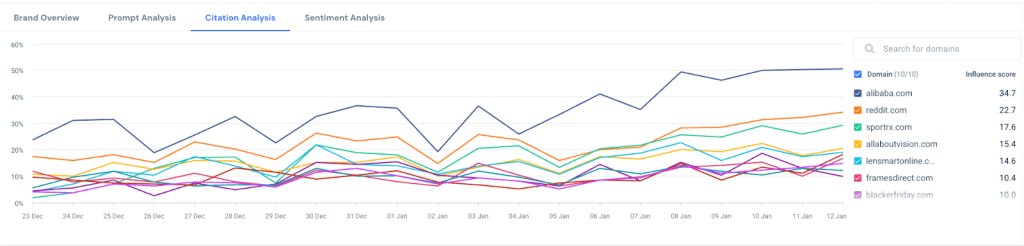
To uncover these drivers, head to the AI Citation Analysis tool. This report shows the exact sources and content AI platforms reference when generating responses for each topic you’re tracking. To get the most out of this data, you should perform AI citation analysis to identify which high-impact sites are shaping your category’s AI responses.
For example, within the camera glasses topic, Alibaba holds a 34.7% influence score, while Reddit accounts for 22.7%. These sources are shaping how AI systems understand the category and which brands they surface.
From there, you can dig deeper by downloading a targeted list of influencing URLs. This gives you a practical roadmap of high-impact sites and publications to prioritize for partnerships, PR, reviews, or content placements. Securing brand mentions on these URLs directly increases your likelihood of appearing in AI-generated recommendations.
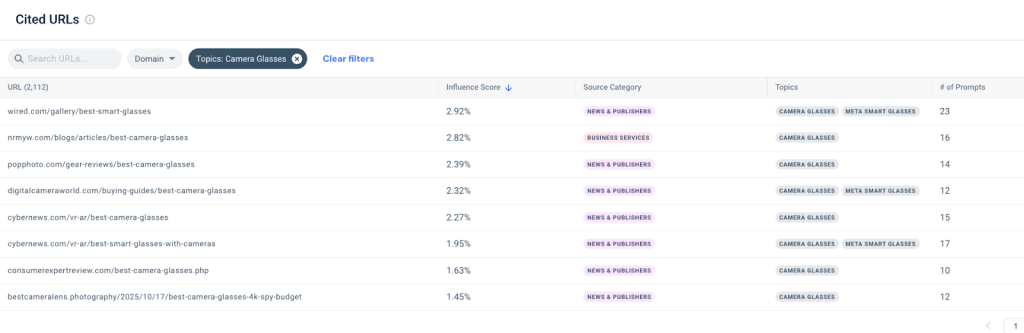
In this case, an article from Wired titled The Best Smart Glasses to Augment Your Reality carries an influence score of 2.9%. That makes it a high-value opportunity for brand inclusion, one that can materially improve AI visibility within the category.

By understanding which sources shape AI responses today, ecommerce teams can move from passive observation to intentional influence, focusing efforts where they matter most.
You’ve worked on your off-page strategy. It’s now time to work on your on-page.
c) Ensure complete and accurate product information
For ChatGPT to confidently reference and recommend products, it needs a clear, unambiguous understanding of what you sell. Incomplete, inconsistent, or outdated product information creates friction and reduces the likelihood that your products appear in AI-generated answers.
1. Product page
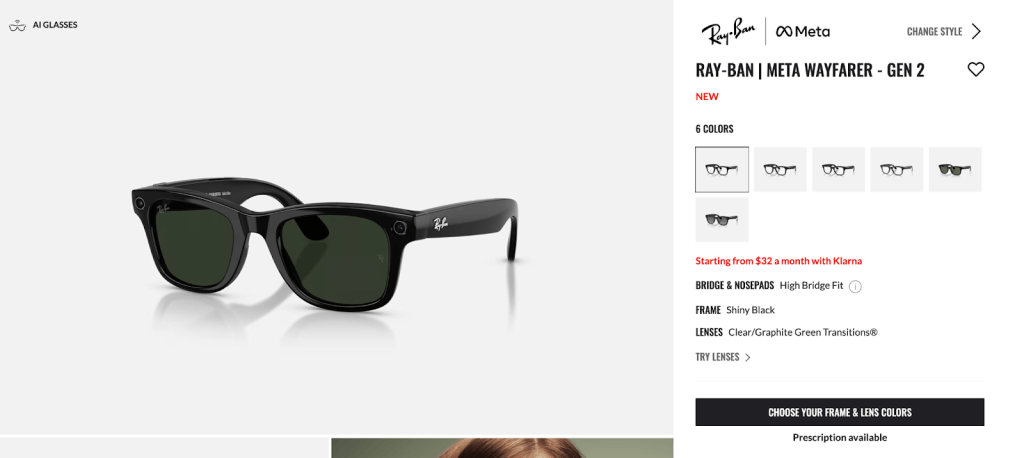
Start with complete product pages. Descriptions should clearly explain what the product is, who it’s for, how it’s used, and what differentiates it. Specifications, materials, dimensions, compatibility, and use cases all help conversational AI accurately match products to user intent.
2. Structured data
For ChatGPT to recommend you, it needs verifiable data that removes statistical uncertainty. If your technical details are vague, the AI will skip your brand to avoid hallucinating.
Use clear, machine-readable details: Don’t just tag price and name. Use JSON-LD structured data to provide a source of truth that AI crawlers like OAI-SearchBot can parse instantly.
- Go beyond the basics: Include specific attributes, including Brand, GTIN, MPN, PriceValidityUntil, and AggregateRating, material, color, dimensions, and fuel_type.
- Show stock status: Use the Offer schema to provide real-time stock status.
- Connect the dots: Use the brand property to link products to your main brand entity, helping the AI connect your site to external citations.
Organize specs for easy comparison: Users often ask specific questions: Show me noise-canceling headphones with USB-C and 20+ hours of battery. If those details are buried in a long paragraph, the AI might miss them.
- Use comparison tables: Put your technical specs in a clean table. AI systems can grab data from tables much more reliably than from a story-style description.
- Keep data consistent: Ensure the price and specs on your website match what’s on Amazon or your Google shopping feed. AI builds trust by triangulating information; if your data varies across the web, the AI’s confidence in your brand drops.
3. Keep everything up to date
Keep everything up to date. Pricing, stock availability, product variants, and regional differences change frequently, and AI platforms are more likely to reference brands that present consistent, current information across their site. Outdated details hurt user experience and weaken AI confidence in your brand.
In a discovery environment driven by conversational AI, accuracy isn’t a nice-to-have. It’s foundational to earning and maintaining visibility.
d) Write product pages for conversational search
ChatGPT is trained on how people ask questions, not how they type keywords. That means ecommerce product pages need to reflect natural language and real-world phrasing, not just optimized specs and bullet lists.
Use human, conversational language. Product descriptions should read the way a knowledgeable salesperson or expert would explain the product in person. Clear, plain-language explanations help AI systems better understand context, intent, and relevance.
Next, emphasize benefits and use cases, not just technical specifications. Shoppers using ChatGPT are often looking for guidance:
- What problem does this solve?
- Who is it for?
- When should I choose it over alternatives?
Addressing these questions directly makes your content more aligned with conversational discovery.
It also helps to think in questions rather than keywords. Many AI-driven prompts begin with:
- What
- Which
- Best
- How
Structuring product content to naturally answer these types of questions increases the chances that your product is referenced when ChatGPT responds.
Use prompt analysis
With Similarweb’s Prompt Analysis tool, you can perform AI prompt analysis to see exactly what users are asking to reach your site through AI platforms. This report provides a downloadable list of prompts, which you can filter by topic to focus on the most relevant discovery conversations.
By analyzing these prompts and grouping them by prompt intent, you gain a clear understanding of what users are actually looking for whether they’re researching options, comparing products, or getting ready to buy. These insights can then directly inform content, product pages, and optimization priorities.
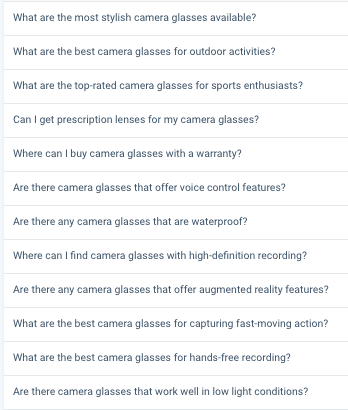
You can use your prompt data to find natural phrasing you might not have thought of. By adding synonyms and natural phrasing, you increase your brand’s surface area in the AI’s semantic map.
AI models don’t look for exact word matches. They look for contextual neighbors. Even if two words mean the same thing, the AI associates them with different vibes:
- “Sunnies” lives near words like beach, vacation, and style
- “Sunglasses” lives near UV protection, polarized, and glare
When you include a cloud of these related terms, you tell the AI that your product fits both the lifestyle and the technical context. This makes the AI significantly more confident that your product is the right answer, regardless of which specific word the user chooses to type.
e) Build snackable content for AI harvesting
ChatGPT doesn’t just link to your website; it harvests, summarizes, and synthesizes your content to build its own answer. Because the AI breaks apart your pages to find facts, the way you organize your information determines how accurately your brand is represented.
By structuring your content into snackable pieces, you essentially pre-digest the information for the AI, making it easy for the system to extract your key selling points without losing context.
1. Add FAQs (question-answer pairs)
Add FAQs to product and category pages. FAQs are the ultimate reusable content because they mirror the exact format of a conversational prompt. When you provide a clear Question and a direct Answer, you are giving the AI a ready-made building block to use in its response.
2. Buying guides and product comparisons
Invest in content that explains how to choose a product. When a user asks, “What’s the difference between X and Y?”, the AI looks for comparison tables or “Best for…” lists. These structured formats provide high-quality context that the AI can easily summarize to help a user make a decision.
3. Descriptive customer reviews
Encourage reviews that go beyond “Great product!” Detailed reviews provide real-world sentiment that AI models use to add flavor to their recommendations. A review that says, “This lens is perfect for low-light weddings but a bit heavy for hiking,” gives the AI two distinct use cases to harvest.
4. Identify themes (pros and cons)
Make it easy for the AI to see the bottom line by summarizing common feedback into Pros and Cons lists. This reduces noise for the AI. If the AI can quickly see a consensus on your product’s strengths, it is much more likely to echo those strengths when a shopper asks for a recommendation.
F) Make sure AI systems can access your website
Before optimizing content or messaging, it’s essential to ensure that OpenAI’s crawlers and AI-powered discovery systems can access your site. Even the strongest product pages can’t influence AI-driven discovery if they’re blocked, restricted, or difficult to retrieve.
1. Review your robots.txt settings
Review your robots.txt settings. OpenAI operates dedicated crawlers such as GPTBot (used for training data collection) and OAI-SearchBot (used to surface websites in AI-powered search experiences). If these crawlers are blocked, your content may be excluded from the systems that retrieve and reference web pages in generative AI responses.
2. Ensure product and category pages are not blocked
Avoid unintentionally blocking important product and category pages. Noindex tags, overly restrictive URL parameters, or aggressive filtering rules can prevent AI retrieval systems from accessing revenue-driving pages. If a page is critical for users, it should be equally accessible to AI systems.
3. Maintain up-to-date sitemaps
Maintaining clean, up-to-date sitemaps is a best practice that supports discovery and coverage. While not a guaranteed ranking lever for AI visibility, accurate sitemaps help crawlers understand site structure, identify priority pages, and discover new or updated content more efficiently.
4. Implement an llms.txt file
Beyond traditional crawler instructions, you can now provide a dedicated roadmap specifically for Large Language Models. An llms.txt file is a markdown-based file that lives in your site’s root directory. It provides a concise, LLM-friendly summary of your most important pages and data, helping AI tools process your site’s context more efficiently without getting lost in unnecessary code or secondary content.
5. Prepare for the Agentic Commerce Protocol (ACP)
Google recently announced a new protocol designed to standardize how AI agents interact with ecommerce checkouts. While traditional SEO helps your page rank, this protocol acts as a handshake between an AI agent (like Gemini or a ChatGPT-powered assistant) and your store’s backend.
- Why it matters: As discovery shifts to agentic shopping, where the AI finds, compares, and buys the product for the user, your site needs to support these standardized protocols to ensure a seamless handoff.
- The goal: By adopting these emerging standards, you ensure that when an AI agent decides your product is the best choice, it can actually complete the transaction without hitting technical roadblocks.
Ensure your site delivers a fast, mobile-friendly experience. While performance alone doesn’t determine whether a brand is referenced by an AI, it strongly impacts what happens next. Many AI-driven journeys send users directly to deep product pages, and poor performance can break the handoff from discovery to conversion. Mastering the technical side is essential for getting traffic from AI and ensuring those users actually reach your checkout page.
g) Build brand authority across the web
Even with great products, an AI won’t recommend you if it’s confused about who you are. To fix this, you must treat your brand as an Entity, a distinct, verifiable concept in the AI’s knowledge graph. Think of the AI as a child trying to learn about the world. It learns through repetition and consistency.
1. Establish your entity home
As expert Jason Barnard teaches, every brand needs a single source of truth usually your About Us page. This is where you tell the AI exactly who you are so it doesn’t have to guess.
- Claim it: Clearly state who you are and what you do in simple language at the top of the page.
- Frame it: Use consistent descriptions. If you call yourself “The World’s Best Sunglasses Brand” on your site but “A Luxury Eyewear Boutique” on LinkedIn, the AI may struggle with Identity Resolution (the process of realizing both profiles belong to the same company).
- Prove it: Link out to your social profiles, news articles about you, and your official store listings. This creates a loop of confirmation for the AI. You should also track AI brand mentions regularly to ensure your branding remains consistent across all third-party platforms the AI harvests.
2. Reiterate on 2nd party platforms
Once your home is set, you must echo that same information on platforms you control but don’t own such as LinkedIn, X (Twitter), Crunchbase, or your Google Business Profile.
- Mirror the identity: If your website says you are “The World’s Best Sunglasses Brand” but LinkedIn calls you “A Luxury Eyewear Boutique,” the AI struggles with Identity Resolution. It might think these are two different companies.
- Consistency builds confidence: Use identical branding, taglines, and About descriptions across all profiles. When the AI can resolve all these scattered mentions into one clear identity, its confidence score increases, and it feels safe recommending you.
3. Earn validation on 3rd party sites
Finally, you need independent sources to verify your claims. This is where the AI looks for social proof that isn’t written by your marketing team.
- The Reddit factor: AI models treat Reddit as a primary source for authentic, human sentiment. When ChatGPT looks for a consensus, it checks to see if real humans are backing you up.
- Secure the human seal: Encourage customers to share honest reviews in niche subreddits (like r/sunglasses). When the AI harvests these threads, it builds a more nuanced profile of your brand as a vetted, real-world favorite.
h) Monitor answer sentiment
Simply being mentioned by AI platforms isn’t enough. In conversational ecommerce, your brand is frequently cited within the context of reviews and comparisons. This means how you appear is just as critical as appearing at all.
Besides listing products, AI platforms also synthesize sentiment. If an AI personal shopper internalizes a few authoritative but negative reviews, it can effectively steer thousands of potential customers away from your brand before they ever reach your site.
1. How to audit your AI reputation
To protect your brand, you must monitor how AI platforms present your brand. Similarweb’s Sentiment Analysis tool allows you to move beyond simple positive/negative labels by segmenting sentiment into specific topics and intents.
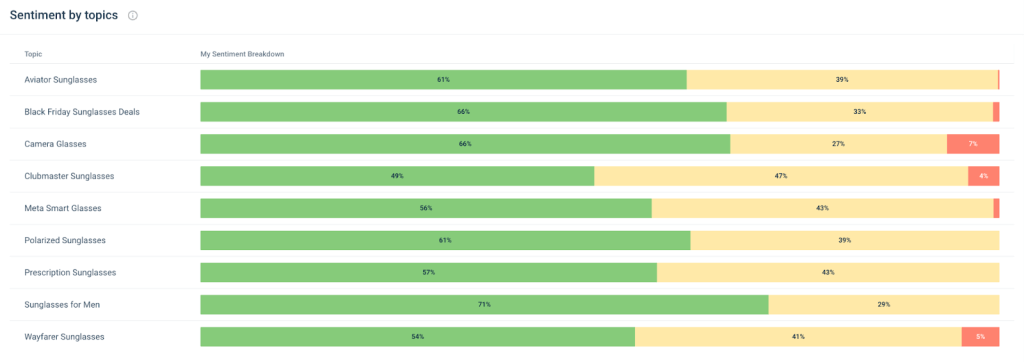
For example, in the Ray-Ban data above, we see that while the brand performs well overall, a 7% negative sentiment exists specifically within the camera glasses topic.
2. From insight to action
By clicking through the sentiment report, you can see the exact prompts users are typing and the synthesized answers the AI is providing.
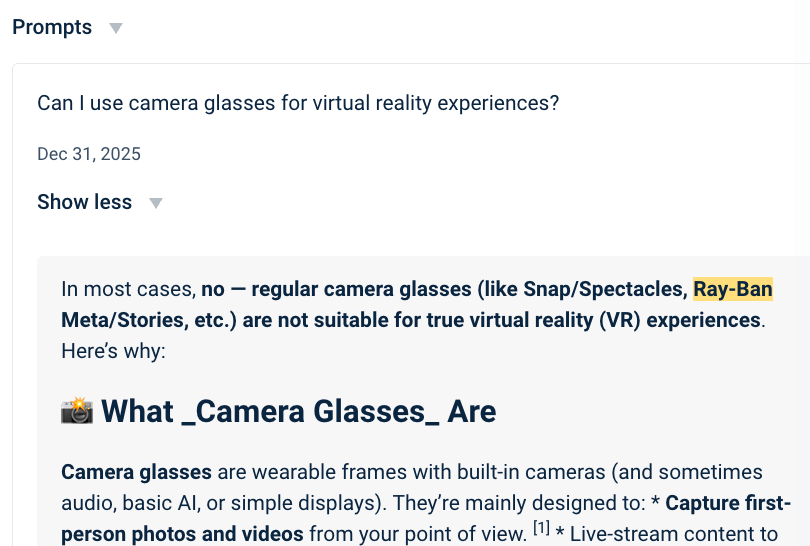
Once you’ve found a brand mention that you want to fix, just click on the Citation Source tab and you’ll see a list of pages that the AI is using as a source for the information in the answer.
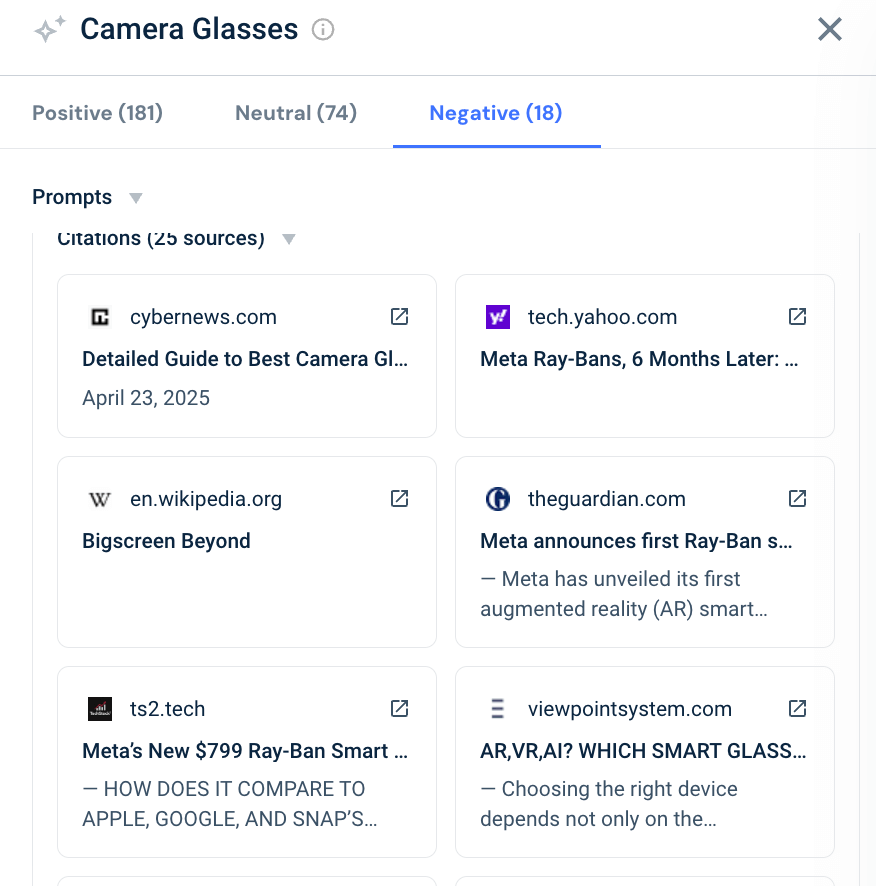
- The fix: Reach out to these site owners or managers to address inaccuracies or partner with them to update the content.
- The result: Since AI models rely on these citations for their confidence, changing the source material is the most direct way to flip the sentiment of the AI’s answer.
i) Continuously measure, learn, and refine
AI-driven discovery is not static. As models evolve, sources change, and user behavior shifts, the way products and brands surface in ChatGPT will continue to change. That means optimization can’t be a one-time effort, it has to be ongoing.
Track AI visibility trends over time. Monitoring how often your brand appears across topics and categories helps you understand whether your efforts are increasing relevance or if competitors are gaining ground.
Keep a close eye on changes in prompts, citations, and sentiment. Shifts in how users phrase questions, which sources AI platforms reference, or how your brand is described can reveal emerging opportunities and risks early.
Use these insights to iterate continuously. Update product pages to better match conversational intent, expand content where new questions are emerging, and strengthen off-site authority where influence is concentrated.
In an AI-driven ecosystem, the brands that win aren’t the ones that optimize once they’re the ones that learn fastest and adapt continuously.
Be the brand AI can confidently recommend
Optimizing for ChatGPT isn’t about chasing rankings or reverse-engineering a black box. At its core, it’s about clarity and trust.
Clarity means making it easy for AI systems to understand what you sell, who it’s for, and why it matters through well-structured sites, clear product information, and content written the way people actually ask questions. Trust comes from consistency: accurate data, strong third-party validation, credible reviews, and authoritative mentions across the web.
As ChatGPT becomes a starting point for ecommerce discovery, brands don’t win by being louder. They win by being easier to understand and easier to believe. The more confidently AI systems can interpret and validate your brand, the more likely they are to surface it in moments that shape purchasing decisions.
FAQs
How does ChatGPT decide which ecommerce products to recommend?
ChatGPT acts as a digital personal shopper, vetting brands based on grounded facts. It evaluates your product descriptions, technical specs (Schema), customer sentiment, and third-party mentions. It recommends products when it has high statistical confidence that they match the user’s specific intent.
Can ecommerce brands directly optimize for ChatGPT the same way they do for SEO? Yes, but the tactics shift from ranking to clarity. Instead of just targeting keywords, you optimize for AI by providing high-density structured data, using natural conversational language, and ensuring your brand information is consistent across the entire web.
What role does structured data play in ChatGPT product discovery?
Structured data (JSON-LD) is your brand’s digital fact sheet. It provides machine-readable proof of your price, availability, and specs. This removes ambiguity for AI crawlers, giving them the verifiable data they need to recommend your product without the risk of hallucinating.
How important are product reviews for visibility in ChatGPT recommendations?
Crucial. Reviews serve as the AI’s reference check. It scans them to understand real-world quality and specific use cases. Detailed, descriptive reviews help the AI gain the consensus it needs to confidently label your product as the best or top-rated option in its category.
How can brands track how often they appear in ChatGPT and other AI tools?
You can track visibility by monitoring your Visibility Score across specific product topics. Tools like Similarweb allow you to see your share of voice in AI-generated responses, identify which competitors are winning recommendations, and see the exact prompts driving traffic to your store.
What Similarweb tools help measure AI-driven brand visibility?
Similarweb offers a suite of Gen AI tools, including AI Visibility Share, AI Citation Analysis, and Prompt Analysis. Together, these tools track how often your brand is recommended, which sources the AI trusts, and how AI platforms are presenting your store.
How can AI Prompt Analysis help ecommerce teams optimize product and content strategy?
AI Prompt Analysis reveals the exact natural language questions shoppers use to discover your products. By grouping these by intent (e.g., researching vs. buying), teams can identify content gaps and update product descriptions with the specific phrasing and use cases that AI models are already looking for.
How do brands benchmark their ChatGPT visibility against competitors?
Using the Visibility Score within Similarweb, brands can compare their share of mentions against direct competitors for specific topics (like “polarized sunglasses”). This allows you to see where a competitor is winning the AI’s statistical confidence and which third-party citations are driving their lead.
How can AI Citation Analysis show which pages and products ChatGPT relies on?
AI Citation Analysis identifies the specific URLs and domains that LLMs use as their ground truth when generating answers. It shows you which of your product pages are being harvested and which third-party sites (like Reddit or Wired) are influencing the AI’s perception of your brand.
How often should ecommerce brands monitor and update their ChatGPT optimization strategy?
Because AI models are updated frequently and user prompt behavior shifts rapidly, brands should treat ChatGPT optimization as an ongoing process. We recommend a monthly audit of visibility trends and a quarterly deep dive into citation shifts and sentiment changes to stay ahead of the curve.

Related Posts

Why AI Engines Cite UGC Over Brand Content And How To Leverage It For AEO

AI Mentions vs. AI Citations: What’s the Difference and Why It Matters for GEO


How to Do A Competitive Analysis: Complete Guide & Free Templates


Wondering what Similarweb can do for your business?
Give it a try or talk to our insights team — don’t worry, it’s free!